India’s health insurers paid out in claims more than 80,000 crores in 2023-24; however, claims that insurance companies paid were far less than the number of claims they received. Therefore the claim settlement ratio is a very important statistic for anyone considering an insurance company. The settlement ratio tells you how likely it is that the company will pay its claim, and it is calculated by dividing the amount of claims paid out by the total amount of claims that the insurance company has received.
Whether you are purchasing health insurance for the first time or reevaluating your current health insurance policy in 2026, understanding a company’s claim settlement ratio will help you avoid being surprised when you go to make a claim. We will explain what the claim settlement ratio is; we will also give you instructions on how to calculate it, and how to use this information in order to select an insurance company that will have the highest likelihood of paying your claim.
What Is Claim Settlement Ratio (CSR) in Health Insurance?
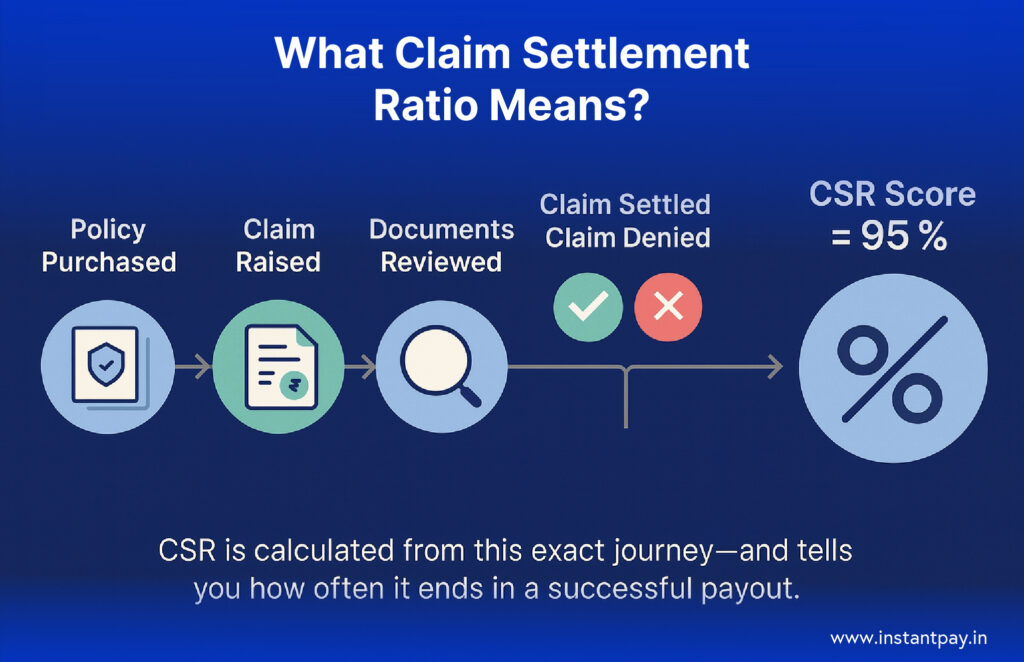
An insurer’s guarantee to provide service is demonstrated through its claim clearance ratio (also known as its payout performance ratio). An insurer’s CSR is calculated using a simple formula:

Suppose you have 10,000 claims received by an insurer over a one-year period and it has resolved 9,800 of those claims; your insurer’s CSR would be 98%. This number can serve as a measure of trust, particularly when you are comparing like-to-like health care plans.

To put the significance of this into perspective, in FY 2023–24, Indian health care insurers processed more than 2.69 crore claims; therefore, the claim clearance ratio (CSR) becomes even more important as it relates to the claim clearance rate of a provider. A high CSR indicates that an insurer has collected premium dollars and has successfully delivered those dollars to its clients.
Why Does Claim Settlement Ratio Matter?
When individuals evaluate medical insurance, they typically consider many different factors such as: how much they will pay for premiums, which hospital systems they can go to and any other types of additional coverage available to them. But there is a statistic that often goes unconsidered by many insurers and policybuyers, which is the claim approval ratio.
A high claim approval ratio doesn’t just consist of numbers; it is an indicator of how well and fairly the insurer processes claims for its customers in times of emergency – the most critical point in time is during an emergency where timing, clarity and confidence are all present.
In fact, for the IRDAI (Insurance Regulatory and Developmental Authority) Annual Report for 2023-24, almost 58% of all health insurance claims were settled on a cashless basis, an improvement over prior years. Thus, when reviewing insurers with high claim approval ratios, many times you will find that they also provide for timely and efficient claims payment without their clients needing to fight for what they are owed.

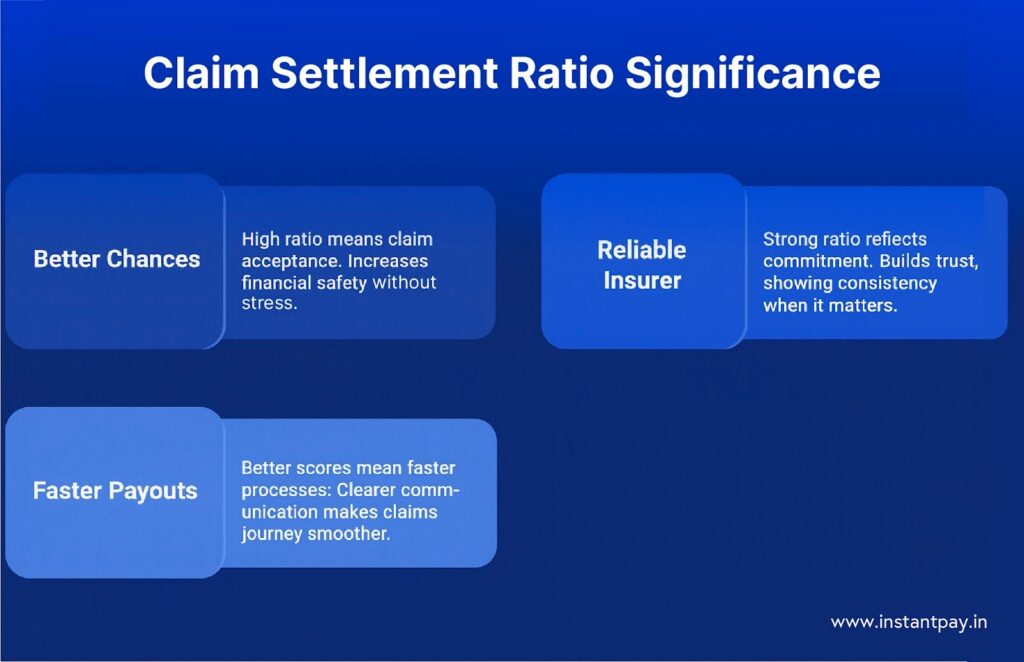
Some of the advantages to having a high Medical Policy Settlement Benchmark (the ratio between total claim payments to total claim activity) include:
- Better Chances of Getting Paid
A high medical policy settlement benchmark regarding health insurance can increase the likelihood of your claims being paid. An increase in the percentage of claims that will be paid translates to an increased financial safety net for policyholders when every hour counts, relieving stress associated with potential financial difficulties. - Signals a Reliable Insurer
A high medical policy settlement benchmark in regard to health insurance is a statement that indicates that a company is committed to servicing its policyholders. It also helps to build trust and increases the likelihood that the company will pay claims when they are submitted. - Faster Payouts, Fewer Delays
Companies that have high medical settlement benchmarks for their policyholders often process claims more quickly, have more transparent communication with their policyholders, and utilize better-trained employees when processing claims, therefore improving the efficiency and effectiveness of the claims process.

How to Calculate Claim Settlement Ratio (CSR)?
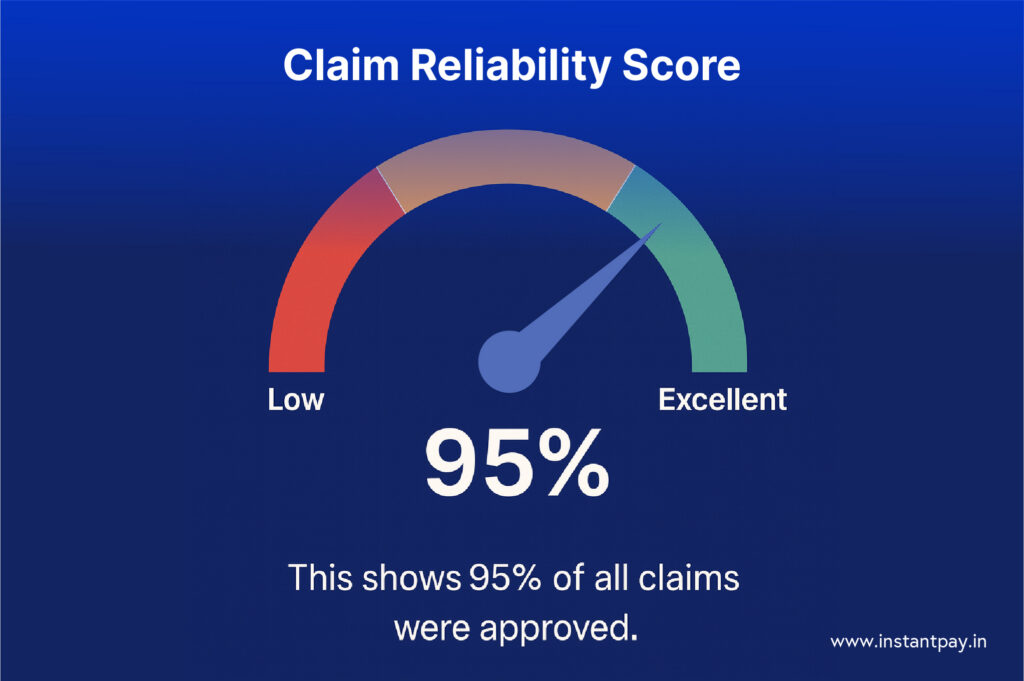
The Claim Settlement Ratio (CSR) is a good indicator of insurer reliability based on actual behavior instead of marketing rhetoric. You calculate an insurer’s CSR like so:
CSR = (Settled claims)/(Claims submitted) x 100
To illustrate, an insurer receives 10,000 claims during a given financial year. If the insurer settles 9,850, then its CSR will be:
(9,850/10,000) x 100 = 98.5%.
Thus, the insurer has settled 98.5% of all submitted claims and shows solid historical performance concerning claims settlement.
Insurers’ CSR reports are published annually by the IRDAI and are one way to compare different insurers’ performance with respect to claims settlements and assess potential payout patterns for your medical policy selection before purchase.
Mini checklist for calculating CSR:
1. Total number of claims submitted
2. Total number of claims settled
3. Compute (settlements/claims submitted) x 100
4. Check accuracy using published IRDAI annual reports
The Claim Settlement Process in India
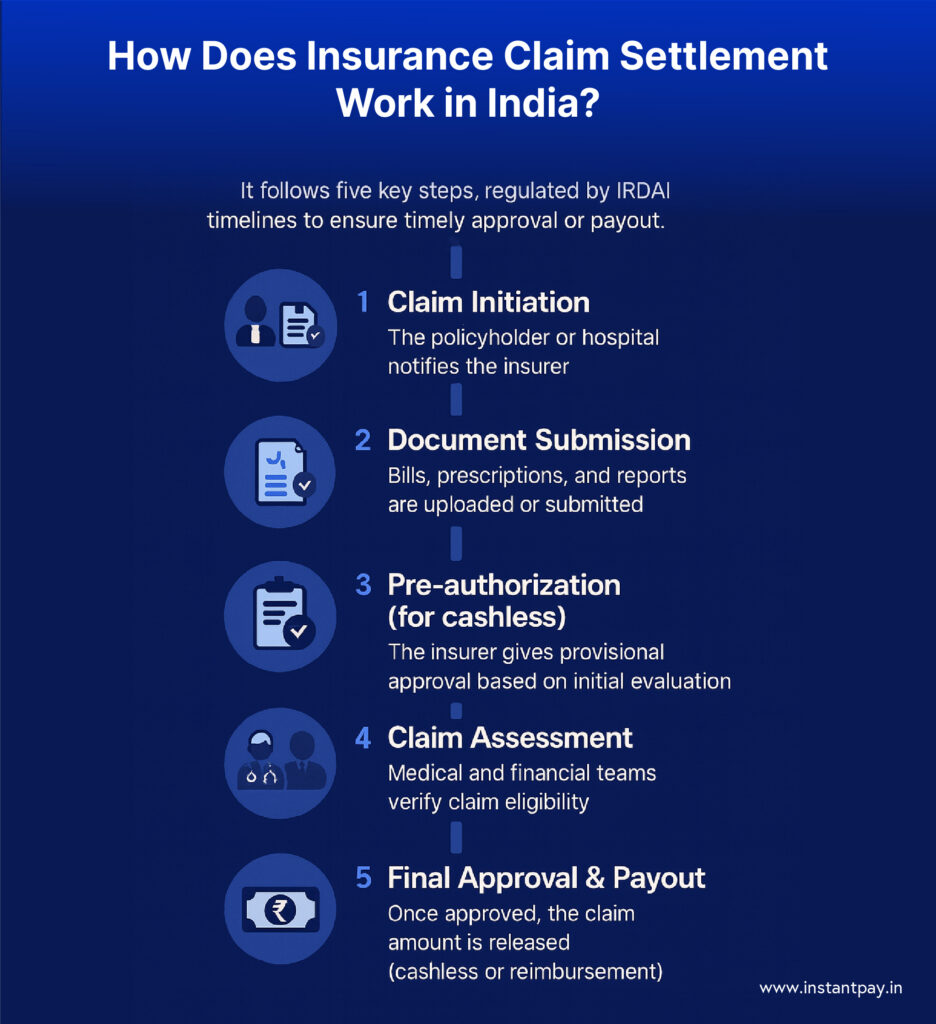
When a medical incident happens and a claim is made, your policy payout journey follows a particular timeline. Although each insurance company may have minor differences in how they execute their plans, the core steps remain widely consistent in most health insurance plans:
1. Claim Initiation
The first step in this process happens once the insured (e.g., policyholders, hospitals or representatives) notifies the insurance company of the hospitalization or medical procedure(s). Notification may be made via:
(a) telephone
(b) email
(c) online portal
(d) directly at the hospital’s TPA desk if requesting a cashless claim.

2. Document Submission
Once you have submitted a claim to the health insurance company, the insurance carrier (a.k.a., insurer) will require certain documentation to process the claim. In general, you will be required to provide:
(i) Discharge summary
(ii) Hospital bills
(iii) Diagnostic reports
(iv) Prescriptions for medications given to the patient while in the hospital
(v) Details about your insurance policy.
For reimbursement claims, the original bills are typically required. For cashless claims, scanned copies of the bills or pre-authorized formats will suffice.

3. Pre-authorization (Cashless Claims Only)
If you are filing a cashless claim, the insurer typically begins the pre-authorization process within a few hours after you are admitted to the hospital. The hospital sends the insurance company a treatment plan for you along with an expected cost. Once the insurance company processes the information, it will determine if you meet the eligibility requirements necessary for pre-authorization approval to be granted. The pre-authorization approval will usually be conditioned on final billing.

4. Claim Assessment
Once you are discharged from the hospital, the claims team of the insurance company (or the TPA as the case may be) will review all documentation provided to the insurance company in support of your claim.
The review process will include determining if you are eligible under the terms of the policy, whether the waiting periods have been satisfied, whether any items billed to the insured were not included in coverage under the insured’s policy, among other things. If no document deficiencies or other ambiguities exist and/or if no questions exist about the claim, the claim will be approved.

5. Final Approval & Payout
After the claim is fully reviewed, the insurance company will either approve or deny the claim (and provide the reason for the denial). If the claim is approved, and you are making a cashless claim, the amount approved will be paid directly by the insurer to the hospital. If you are making a reimbursement claim, the amount approved will normally be deposited into the policyholder’s bank account.

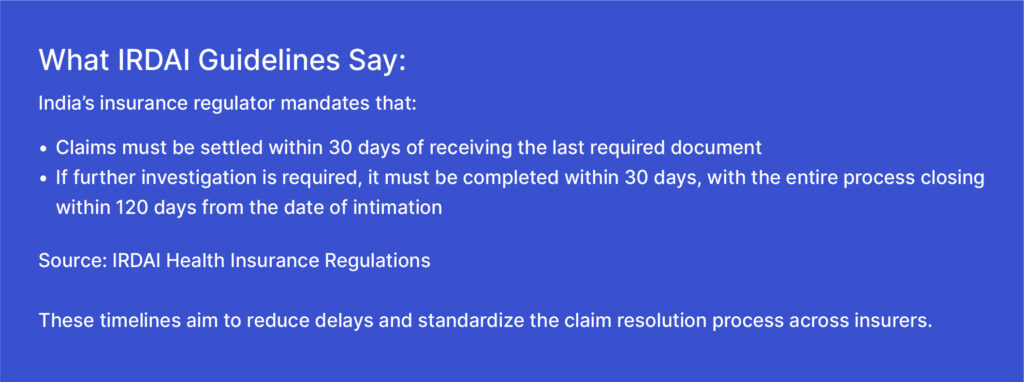
For more nuanced timelines in critical care scenarios, this is also explored in our blog on Understanding Critical Illness Insurance, where cashless authorizations often happen in real-time.
What Are The Limitations of CSR?
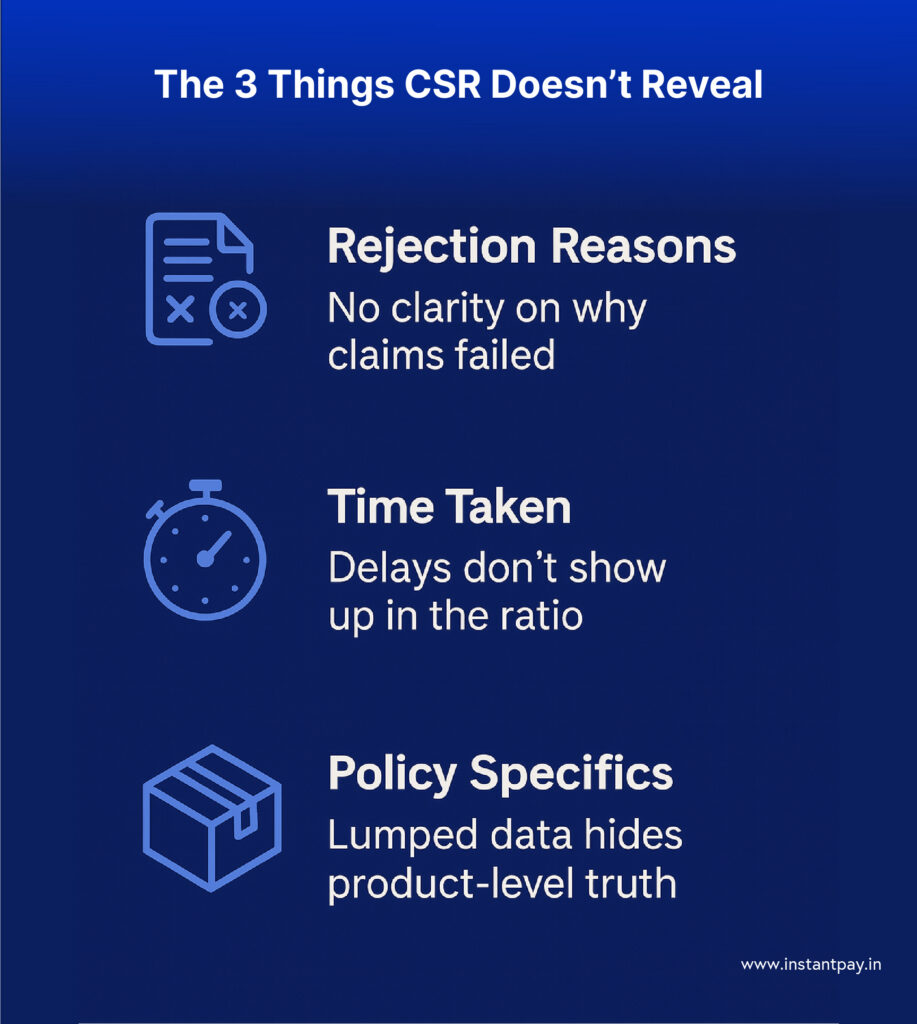
1. It Blends All Policy Types
All companies are required to report a single settlement percentage for all policy types. This means that when a company reports a CSR (claim settlement ratio) for health claims or term life, the number can only be used as a proxy for the policies you are interested in. However, this can be misleading if you are trying to use your CSR to compare two different health issues.

2. No Turnaround Time Transparency
While insurers publish their CSR and tell you how many claims have been settled, they do not provide details on turnaround times. For two insurers who have a claim settlement ratio of 98%, one may settle a claim within 7 days while the other settles in 45 days. For urgent care situations such as a hospitalization, the difference from a time perspective can be significant. More insight into the speed of claims and the responsiveness of the insurers can be found within the sections on critical illness, where timing will have an impact on the outcome of the patient.
3. It Hides Claim Rejections
97% sounds great, but what about the 3% that did not settle CSR does not provide:
- Why the company rejected claims
- If the rejection was due to documentation issues, exclusions or delays
- Whether the rejections are concentrated in specific policy types (e.g., daycare and hospitalization)
According to IRDAI, in FY 2023-24, approximately Rs.15,100 crore were disallowed by insurance companies, or 12.9% of total claims. An additional Rs.10,937 crore (9.3%) of the claims were repudiated upon review, and Rs.7,585 crore (6.5%) were outstanding as the claim remains unpaid.
How to Avoid Claim Rejection: A Quick Checklist

Here is a simple guideline before starting to collect payments from your health insurer to minimize the possibility of having your claim refused or delayed.
Pre-existing conditions need to be revealed in full
If your condition is a chronic disease such as diabetes, hypertension, or some other issue, do not conceal your previous medical history when applying for health cover. One of the primary reasons for claim rejection is failing to disclose these issues to your insurance provider.
Maintain Bills & Records
You should have paper and electronic copies of all your medical prescriptions, lab results, discharge summaries, and proof of payments, as you will need to provide these either for a cashless claim or a reimbursement claim.
Understand Waiting Periods
Most health insurance policies have waiting periods for many treatments (especially in relation to chronic diseases and maternity), so the sooner you make an application for payment, the more chance your insurance provider will automatically reject your claim.
Opt for Network Hospitals (Cashless)
If the hospital you use for treatment falls under the cashless network of your insurance provider, it will require less paperwork from you to be processed. Also, you won’t have to put down any money up front for your treatment, and you won’t have to wait long for reimbursement on your claim.
Review Non-payable Items
There are many costs that are not covered by your health insurance e.g. gloves, meals, registration fees, etc. Understanding this prior to your treatment will allow you to manage your expectations and avoid receiving a partial payment for your treatment.
Top 10 Health Insurance Companies by CSR in India

Choosing a medical policy provider isn’t just about coverage features; it’s also about how often they settle claims without delay. The claim approval ratio helps identify insurers with strong, consistent performance.
The following list ranks India’s top 10 health insurers by their approval rate of health policies, based on official IRDAI data for FY 2023–24. These companies have shown high payout credibility and minimal disallowances, making them more dependable in real-world situations.
Top Health Insurance Providers by CSR – FY 2023–24
Health Insurance Company | CSR (%) | Overview | Key Strengths |
| 99.96% | Known for quick digital claim approvals | Fast processing, strong cashless network |
| 99.70% | Covers a wide hospital network across India | Reliable tech support, fewer delays |

| 97.00% | Strong urban coverage and wellness benefits | Speed + digital ease |

| 98.00% | Focused on specialized and senior health coverage | Dedicated plans for critical illness |
| 96.00% | Known for high customer retention and OPD features | Strong service response |

| 95.22% | Offers cashless at over 21,000 hospitals | Robust network and mobile app |

| 95.00% | Trusted brand across corporate and individual segments | Efficient corporate claim servicing |

| 94.90% | Offers flexible plans with low co-payment options | Affordability with moderate speed |

| 94.60% | Competitive premium + wide plan range | Balanced value & digital interface |

| 94.40% | Government-backed PSU with strong rural presence | Deep penetration, trusted heritage |
Source: IRDAI Annual Report FY 2023–24 – Health Insurers Annexure IV
Factors to Consider Before Choosing a Health Insurer
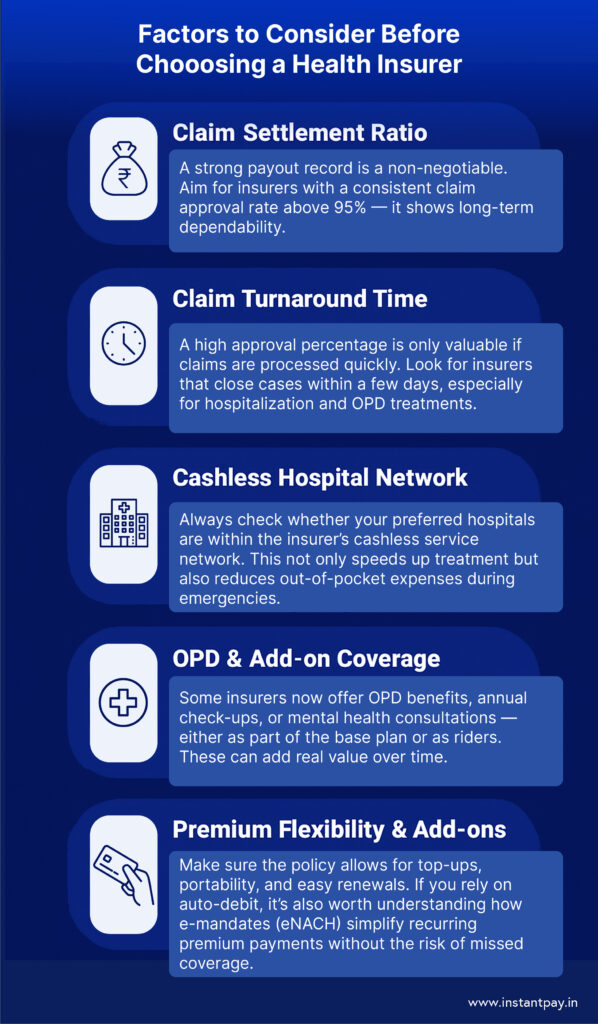
When selecting a provider for your healthcare coverage, it is important to first consider not just the cost (low premium) of the insurance, but the quality of the insurance company and the services it provides during your time of greatest need after purchasing the insurance policy. Use this checklist to help you evaluate your options with care:

Key Evaluation Factors
1. Claim Settlement Ratio
A good claims settlement ratio indicates a reliable company to do business with. Ideally, you should find an insurer who has a history of settling claims in excess of 95%, indicating that it can be counted on for many years.
2. Claim Turnaround Time
The claims approval ratio by an insurer will have no value unless you also know how long it typically takes them to process claims. Look for insurance companies that process claims in a few days, especially for hospitals and other outpatient department (OPD) medical procedures.
3. Cashless Hospital Network
Always check whether your hospitals are part of the insurance company’s “cashless” payment network. This will lower your out-of-pocket costs for emergency care and speed up treatment if the hospital accepts your insurance.
4. OPD & Add-on Coverage
Some insurance companies now have OPD benefits, regularly scheduled 1-year checkups, and mental health consultation services as part of the base policy or as additional riders. Over the long term, these benefits can add substantial value to your insurance coverage.
5. Premium Flexibility & Add-ons
You should ensure that your insurers’ policy provides for premium top up options, portability of coverage, and a simple process for renewal of the policy. Also, if you are using auto-debit from your bank, you should know how e-mandates (eNACH) simplify recurring premium payments safe and easy to manage so that your coverage never lapses.

Claim Settlement Ratio in Term Insurance Plans
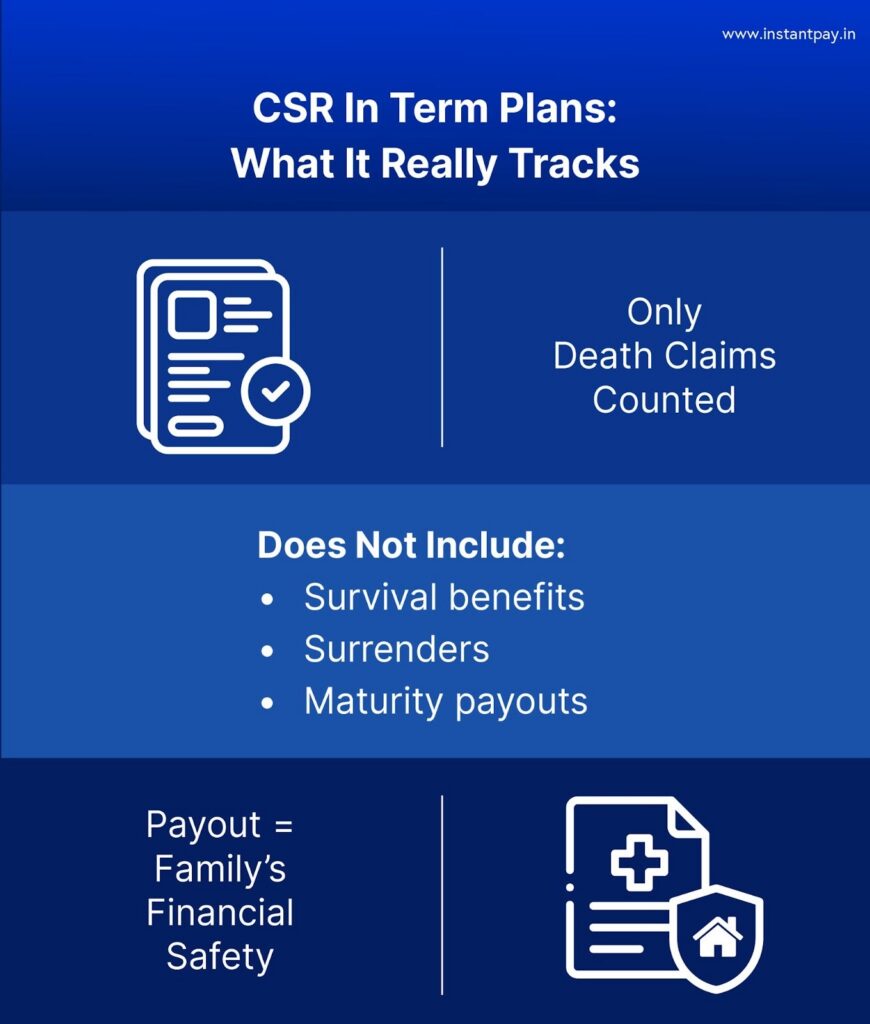
In regards to health insurance, the claim performance ratio is used as one metric among many others for evaluating the performance of a given insurer; however, it carries more significance in terms insurance (as the entire benefit of the policy depends upon a single event — the death of the policyholder).
In contrast to health insurance, the claim performance ratio in relation to a life insurance policy will only reflect an insurer’s payment of death claims; therefore, this measure does not include any other type of claim (survival benefits, policy surrenders, etc.) and can be considered one the most definitive measures of an insurer’s reliability.

For example, Tata AIA Life Insurance reported a CSR of 99.13% in FY 2023–24, meaning almost every legitimate death claim was successfully honored. This level of consistency becomes especially important when you’re comparing long-term protection options for your family.
Final Thoughts: What CSR Means for You in 2026 and Beyond
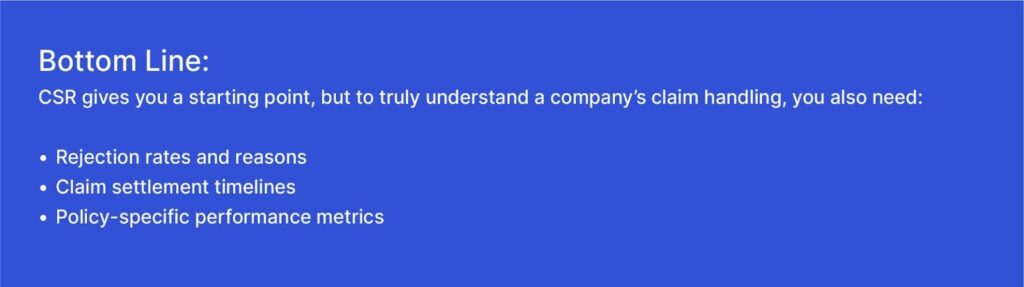
While the Claim Settlement Ratio (CSR) is an important measure of an insurer’s reliability, since it tells us how frequently claims are paid out, there are other criteria that also contribute to understanding that level of reliability. The CSR does not provide the complete picture when considered in conjunction with an analysis of rejection rates, the average amount of time it takes to receive a claim payment, and how well a particular policyholder has performed with all their insurer’s policies.
As we continue our journey of increased data-driven transparency, we have seen the development of the National Health Claim Exchange (NHCX) and the anticipated regulatory enhancements of [Name of Insurance Regulatory Authority], well known as [IRDAI], which will likely lead to the following:
- Quarterly CSR statements for tracking purposes in real-time
- Increased standardisation of cashless claims
- The creation of a digitally tracked ‘claim experience’ that policyholders will have access to
What this means for policyholders is improved tools to use in evaluating an insurer for reasons other than simply what they are offering on paper, but also how they perform when it is vitally important to perform well.
When did you last review your policy? Experts recommend looking at your insurance coverage and policies at least every 18-24 months. If you have maintained a favourable claim history in the past, this does not mean it will remain the same going forward, especially since the [IRDAI] is working on developing dynamic scoring matrices for insurers’ claims history and as insurers disclose more about their claims histories.
FAQs
1. What is a good claim settlement ratio?
A claim settlement ratio above 95% is considered excellent. It indicates that the insurer settles most claims filed and reflects high claim reliability.
2. Which health insurance has a 100% claim settlement ratio?
As of FY 2023–24, ManipalCigna reported a CSR of 99.96%, the highest in India. A full 100% ratio is rare and may not be sustainable across all years.
3. Which life insurance has the highest claim settlement ratio?
Tata AIA Life Insurance had the highest CSR among private life insurers at 99.13% in FY 2023–24, based on IRDAI data.
4. How to calculate settlement ratio?
CSR = (Total Claims Settled ÷ Total Claims Received) × 100
This formula shows the percentage of claims an insurer has approved in a year.
5. How to check claim settlement ratio?
Visit the IRDAI official website and access the latest annual report. Insurer-wise CSR data is published for each financial year.
6. What is the claim rejection rate?
It’s the percentage of claims an insurer denies out of total claims received. High rejection rates may indicate stricter claim approval processes or poor transparency.
7. Which insurance company denies most claims in India?
Insurers with lower CSR and high repudiation data from IRDAI reports generally deny more claims. This varies yearly and by product type — always compare updated figures.
8. What is the formula for rejection rate?
Rejection Rate = (Claims Rejected ÷ Total Claims Received) × 100
This shows how many claims were refused by the insurer.
9. What is the fault rejection rate?
This refers to claims rejected due to customer-side errors like incomplete documentation, non-disclosure, or filing outside policy terms.
10. What does a high rejection rate mean?
A high rejection rate suggests stricter underwriting or poor policyholder communication. It could signal red flags about claim friendliness.
11. What are CSR indicators?
CSR indicators reflect how many claims are paid versus received. They include:
- Settlement percentage
- Year-on-year consistency
- Product-specific performance
- Rejection and turnaround time (indirectly)