The implementation of a Vehicle RC Verification API entails more than just incorporating an endpoint into an application. The quality of verification depends on the way in which the API is employed, the manner in which exceptions have been managed, and how verification conforms to the entire onboarding or operation workflow. Even a dependable API may provide inconsistent results if frequent implementation errors are ignored.
This article points out the five most common mistakes in Vehicle RC Verification that businesses make, and the best practices to create reliable, scalable, and accurate verification processes.
Why Vehicle RC Verification Implementations Fail?
Vehicle RC Verification API is introduced to make vehicle checking easier. Still, implementing the API successfully involves more than simply connecting this API with your application. The issues related to verification occur primarily due to not obvious choices of implementation processes, such as relying on the documents that have been uploaded, skipping the process of exception handling, and treating verification as a single action.
With the increase in the volume of digital verification, small gaps that appear in the process may lead to inconsistency in verification processes, delays in operations, and unnecessary manual verifications.
Did You Know?
According to the information obtained from the VAHAN platform, there were 44.5+ crore registered vehicles in India. This demonstrates the necessity of automating and creating the applicable standards for the verification processes.
Instead of assuming that every verification instance will yield a perfect outcome, the stakeholders should create a workflow that would account for failures, discrepancies in the data, and operational exceptions from the start.
5 Common Vehicle RC Verification Mistakes Businesses Must Avoid
The vehicle REST Verification APIs may enhance the accuracy of data verification processes, but improper implementation may still lead to mistakes that cause inactivity and inefficiency. Let’s look at the five most common mistakes made by businesses during API implementation, and on how to tackle them correctly.
Mistake 1: Treating the Submitted RC Document as the Main Source
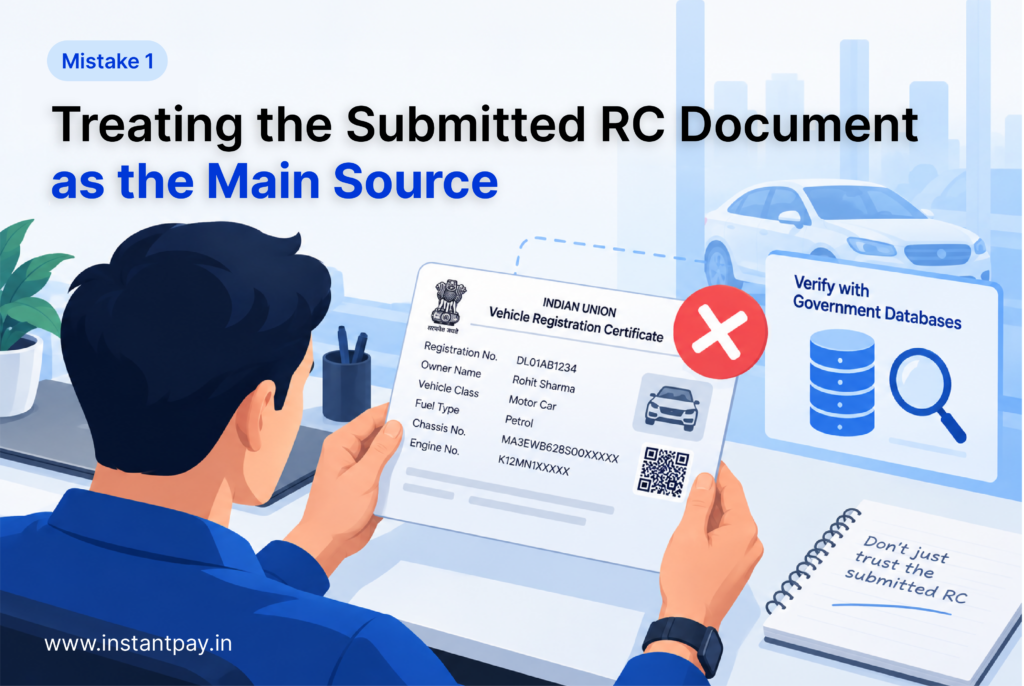
The mistake made most frequently by companies is relying on the uploaded RC document as the main source of information regarding the vehicle. Although the RC document does provide valuable information about the vehicle in question, the truth is that it only contains what is stated in the document on the date of its release. There are times when RC documents have vague, unclear, or outdated information and thus cannot be trusted.
Did You Know?
According to the Indian Motor Vehicles Act of 1988, each vehicle is to be registered with the registering authority before being allowed on public roads.
Best Practice
The more effective approach could be to check the official record of vehicle registration instead of the RC document itself. In this case, the verification of data will have to rely on up-to-date information stored with regulators.
Mistake 2: Viewing Vehicle RC Verification as a One-Time Event
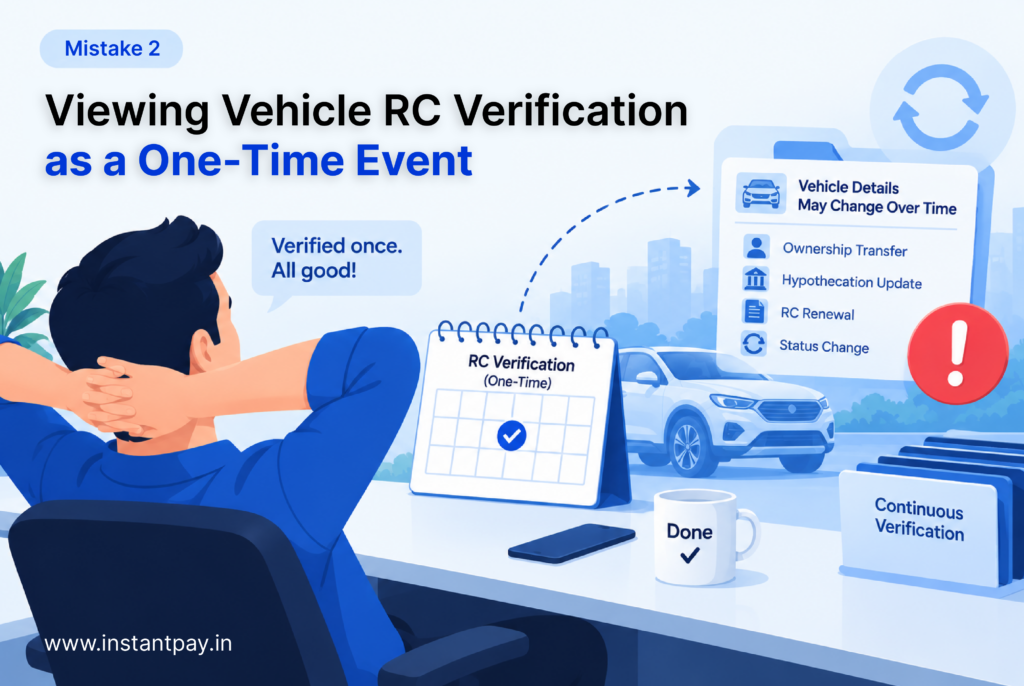
Vehicle data can change over time. This could mean a change of ownership, an update of hypothecation status, expiry of permits, or alterations in registration data in the records. If RC is checked once during the onboarding process, there is a risk of not updating it or relying on it.
This issue is most relevant for companies that maintain long-term relationships with customers, provide vehicle financing services, deal with fleet operations, and perform recurring services. A check performed a while ago could become ineffective.
Did You Know?
The VAHAN system gets constantly updated by the transport authorities as vehicle registration data are being created or altered, meaning that it is the most trustworthy source of updated vehicle registration information.
Best Practice
Consider Vehicle RC Verification as a process done according to events and not a one-off activity. Re-verify the vehicle information whenever an important business event occurs, such as ownership transfer, loan renewal, policy changed, fleet onboarding, etc.
Mistake 3: Discarding Error Detection and Exception Management

Vehicle RC verification requests don’t always return successful results. Registration numbers may be filed incorrectly, or it’s possible that the database is down or the database does not contain the information about the vehicle being searched for. Using every failed response as a verification failure will result in rejected applications and bad experience for the user.
Best Practice
A good implementation should differentiate between failures and other types of responses. For instance, invalid registration number, temporary database malfunction and searched data absence need to be treated in the different way. Lack of error management will lead to the emergence of manual delays or refusals to accept reasonable requests that only need to be repeated/verified.
Implementation Tip
Build different workflows for different outcomes. For example:
- Invalid input: Ask the user to review the registration number.
- Temporary service issue: Retry the verification after a short interval.
- Record not found: Route the request for manual verification or supporting documentation.
Quick Takeaway
Configure your verification system so that it can handle errors properly, allowing to define retries, unsuccessful applications and informing the user about the issue.
Mistake 4: Collecting Excess Data
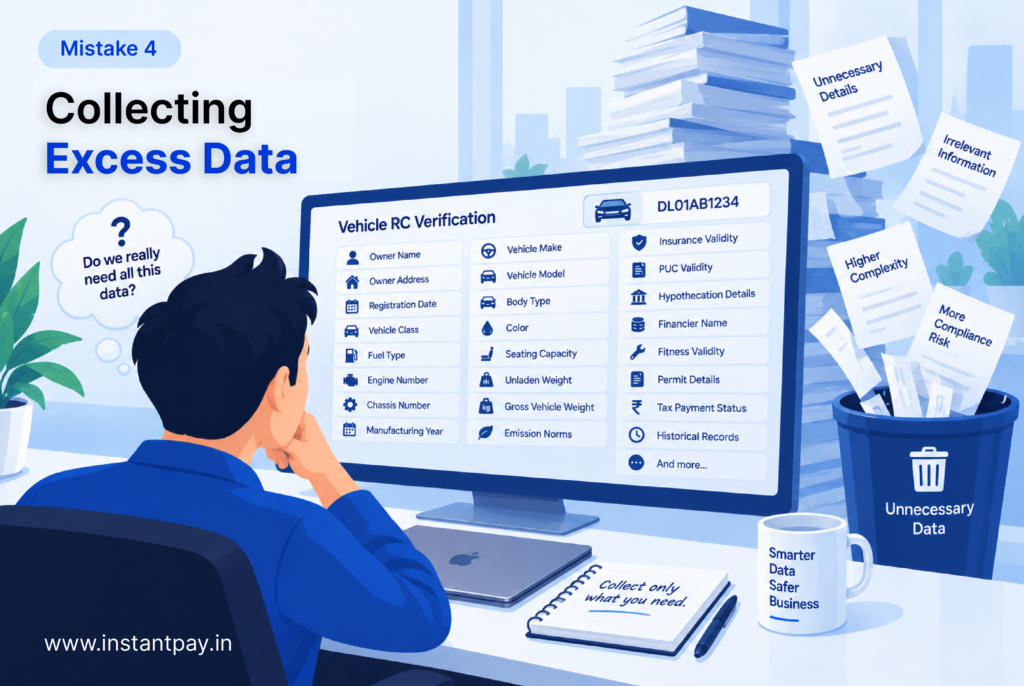
A mistake that is often made during implementation is collecting too much information regarding vehicles. It is correct that a Vehicle RC Verification API can give several kinds of data. However, not every app has the need to remember every bit of information.
Too much data opens a larger door of complexities, and it leads to having more responsibility regarding audits. Thus, having plenty of unnecessary information seems like a waste of time. The better approach is to collect data that is essential for business purposes.
Did You Know?
According to the Digital Personal Data Protection (DPDP) Act, 2023, companies are obliged to collect information only in a legal way and with full consent of the owner, as it was said in the act.
Best Practice
Decide what data is really required and set it up before implementing the API. Make sure that the processes of storage and access to information are up-to-date.
Implementation Tip
Create a field-level mapping between your business workflow and the API response. If a field isn’t required for decision-making or compliance, avoid storing it by default.
Quick Takeaway
More data doesn’t mean better verification. Collect only the information your workflow genuinely requires.
Mistake 5: Using an API Without Considering Scalability & Reliability
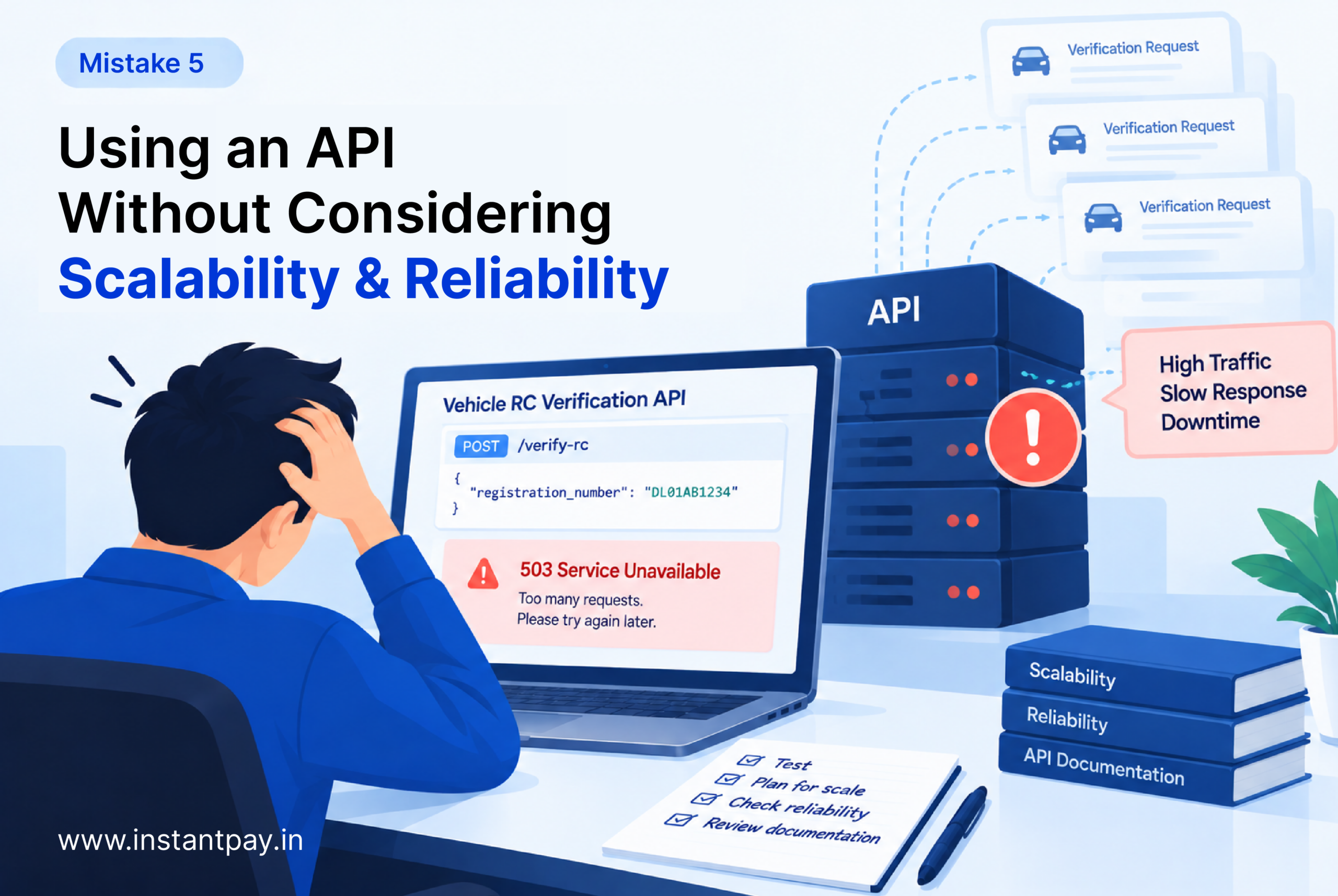
While selecting a Vehicle RC verification API, businesses may look at APIs for ones that provide specific vehicle details. This is focused on only one aspect of API implementation, which is the response. It is imperative to consider many other components for a productive verification experience, for example: response time, service availability, how the API handles errors, the quality of the documentation, and particularly, the API’s scalability.
An API may work great in a test environment but will fail in an operational environment if the API does not work at the scale that verification requests are being made. Lack of documentation and/or an API that does not communicate errors clearly will make maintenance and development of the API more difficult.
Best Practice
Do not only look at the verification capabilities of an API. Before you implement the API, look at the verification load that it is able to handle and the reliability and performance that it is able to provide in the environment you need the API to work.
Consider the following:
- Response time and uptime
- Coverage of the official data source
- Clear error and status codes
- Comprehensive API documentation
- Scalability for increasing verification loads
- Technical support
Implementation Tip
Simulate traffic to the API and intentionally send invalid requests to verify how the API performs under load and how it responds to service disruptions before you implement the API.
Quick Takeaway
When implementing vehicle RC verification, consider both the verification functionality of the API and the API’s reliability and performance in real-world scenarios.
Vehicle RC Verification Checklist
Integrating vehicle RC verification is more than just an API connection, as successful integrations need thoughtful workflows and exception management. It also needs governance of the data for efficient operations in the long run.
| Best Practice | Why It Matters |
| Verify against official transport records instead of relying solely on uploaded RC documents. | Improves verification accuracy and reduces dependence on document quality. |
| Standardize vehicle registration numbers before sending verification requests. | Minimizes input errors and improves verification success rates. |
| Build workflows to handle verification failures and exceptions. | Reduces unnecessary rejections and supports smoother user journeys. |
| Reverify vehicle details for important business events when current information is required. | Helps ensure decisions are based on the latest available registration data. |
| Collect and retain only the data required for your business purpose. | Supports efficient data management and aligns with privacy-by-design principles. |
| Evaluate APIs for performance, scalability, and documentation before deployment. | Enables reliable verification as transaction volumes grow. |
| Maintain logs and audit trails for verification requests and responses. | Improves operational monitoring, troubleshooting, and audit readiness. |
Implementation Tip
Consider this checklist in your deployment review. If Vehicle RC Verification integration has been deployed correctly, it will produce accurate results on day one and will keep scaling with your business.
Final Thoughts
Integrating a Vehicle RC Verification API goes beyond merely adding a verification service to your app. Successful integration requires creating workflows that verify against official records, process exceptions in a thoughtful way, design data collection with intent and purpose and most importantly, implement a design that can scale with the needs of the business.
Common mistakes of service integrations can be avoided by applying these tried and tested practices. This also will greatly improve the verification service reliability and accuracy, meeting the demands of flexible digital operations.
FAQs
1. What causes failure in Vehicle RC Verification?
Vehicle RC Verification may fail for a number of reasons. These include erroneous vehicle registration numbers, absent or old transport records, temporary availability issues, or partial input data. One of the ways to handle unsuccessful verification requests is to build a retry mechanism and a proper exception handling mechanism. It is bad practice to consider those requests as failed verifications.
2. How to enhance verification accuracy regarding Vehicle RC?
For enhanced verification accuracy concerning Vehicle RC, rely on official transport records, use a standardized way for registration numbers, and handle exceptions in a way that uses less manual control, and more automated, structured workflows.
3. In what situations is it necessary to reconfirm vehicle details?
Vehicle details should be reconfirmed when there is a business necessity to have the latest vehicle registration information. This includes, but is not limited to, transfer of vehicle ownership, vehicle loans and insurance renewals, onboarding vehicles to a fleet, and any other business activities requiring updated vehicle information.
4. What factors should be evaluated before selecting a Vehicle RC Verification API?
Apart from verification results, API reliability, response times, coverage of official data sources, scalability, quality of documentation, error management, and integration support should be evaluated when choosing a Vehicle RC verification API. These factors will ensure good and consistent performance as the number of verifications increase.
5. Is it a requirement for businesses to retain all data provided by a Vehicle RC Verification API?
This is not a requirement. Businesses should retain data necessary for their operations and/or compliance requirements. Retaining only the necessary data, and establishing a data retention policy, helps create a more manageable data estate, and is aligned with a privacy-first approach.
6. Is it possible to embed Vehicle RC Verification in existing workflows?
Vehicle RC Verification APIs can be embedded in any digital workflows, including onboarding, lending, insurance, fleet management, and other business operations.