With the growth of the digital economy in India, the need for companies to verify the identity of their consumers in a fast, secure, and regulatory-compliant way has grown many-fold. From banks opening a new account, fintechs disbursing quick loans, and insurance companies helping their clients enroll in policies to e-commerce platforms making sure that their vendors are genuine, identity verification has become a vital element of any digital customer journey.
The scale of Aadhaar’s success is a testament to this transformation. Today, Aadhaar is termed as one of the largest ecosystems for digital identity in the world, with more than 14.4 billion Aadhaar numbers issued. Since its foundation, the Aadhaar system has been used to process over 173 billion authentication transactions and more than 23.7 billion e-KYC transactions, making it one of the most secure systems for digital identity.
The need for digital verification is increasing extensively. Just for the 2024-2025 period, Aadhaar verification completed 150 billion transactions and saw tremendous year-on-year growth in e-KYC transactions. As a result, companies are using real-time systems for customer onboarding, enabling their platforms to improve user experience and efficiency in operations.
However, some organizations are still facing difficulties with slow onboarding processes, verifying prospects manually, higher compliance demands, or increased identity fraud. Old methods of verification make it hard to acquire clients quickly, increase operational costs, and create obstacles in application processing.
This is where the Aadhaar Demographic Verification API does a wonderful job. By ensuring a quick verification through an automated system and matching main demographic data, like name, date of birth, gender, and address, with records pre-approved by UIDAI, companies can make KYC processes simpler and faster while making sure they comply with rules and regulations.
In this article, we will give a brief overview of the Aadhaar Demographic Verification API and its usefulness for various businesses.
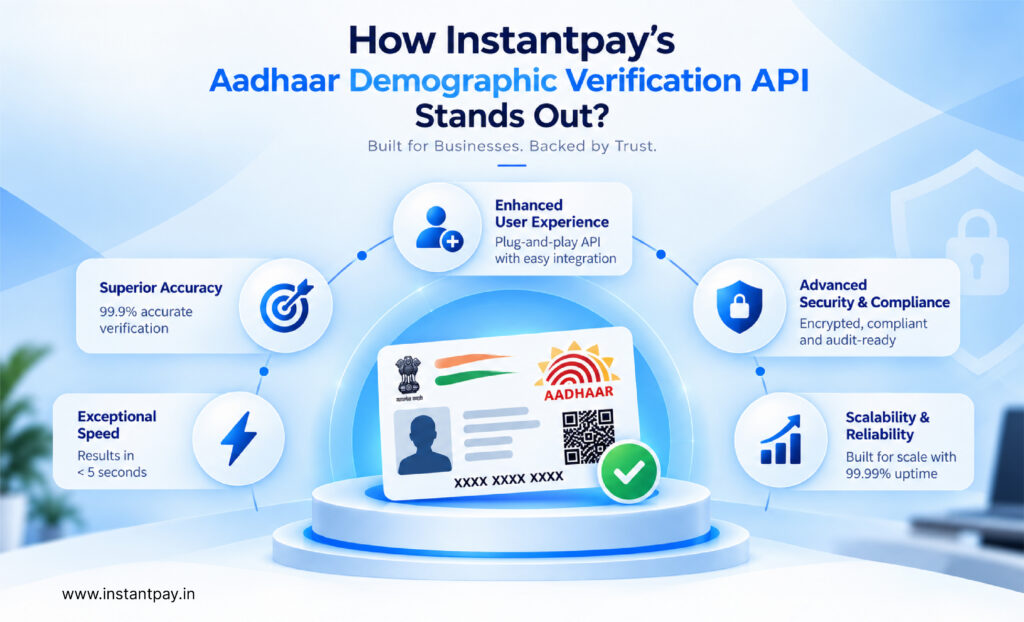
How Instantpay’s Aadhaar Demographic Verification API Stands Out?
1. Superior Accuracy
Instantpay’s Solution:
- The organization employs innovative techniques and utilizes UIDAI’s reliable database to attain a 99.9% legitimate demographic verification.
- Through the implementation of unique error detection techniques, it eliminates any mistake in Aadhaar information such as name, birth date, and residence.
Competitive Edge:
Since many organizations fail because of errors in data parsing, Instantpay uses its API to attain correct results, minimizing the need for human involvement.
2. Exceptional Speed
Instantpay’s Solution:
- Provides quick results verification in less than 5 seconds which allows onboarding in real-time for applications with large volumes.
- Designed to work with large scale businesses, processing requests for verification thousands of times concurrently.
Competitive Edge:
Where many APIs face delays during peak times, Instantpay’s infrastructure is made to provide quick speed and reliability, which guarantees uninterrupted service in peak times.
3. Enhanced User Experience
Instantpay’s Solution:
- Facilitates smooth access through plug-and-play API structure, thereby minimizing development efforts and complexities.
- Offers straightforward response formats (e.g., JSON, XML) for easy decoding and application on various platforms.
- Comes with thorough documentation and assurance on technical support round the clock for smooth onboarding.
Competitive Edge:
In contrast to other offerings that often require complicated alterations and lack sufficient customer support options.
4. Advanced Security and Compliance
Instantpay’s Solution:
- Includes complete encryption and tokenization to secure crucial Aadhaar data.
- All adhere to UIDAI regulations, the Aadhaar Act, and international data privacy laws, including GDPR.
Competitive Edge:
Whereas other companies might neglect detailed compliance specifications, Instantpay aids enterprises in remaining prepared for audits without facing compliance penalties.
5. Scalability and Reliability
Instantpay’s Solution:
- Built to scale effortlessly, supporting businesses from startups to enterprises.
- Maintains uptime of 99.99%, ensuring consistent availability for mission-critical applications.
Competitive Edge:
Instantpay’s scalable architecture outperforms competitors that often falter under heavy loads, making it a dependable choice for businesses experiencing rapid growth.
Real-World Impact
- Fintech Implementation: An innovative lending platform implemented Instantpay’s Aadhaar demographic verification API and decreased its onboarding intervals from 48 hours to 5 minutes while increasing customer satisfaction level as well as improving retention rates by 30%.
- E-Commerce Development: A marketplace deployed Instantpay’s Aadhaar API authentication features to assess sellers’ identities and help decrease fraud in their platform by 40%.

Case-Study: Transforming KYC Processes with Aadhaar Verification API
Client Overview
This is a premier online lending company located in India that provides personal loan solutions to its clientele. The company boasts over ten million customers, but they are struggling to carry out identity verification processes quickly and accurately. The company was particularly challenged because of compliance with certain legislation such as Know Your Customer (KYC) rules prescribed by the Reserve Bank of India (RBI).
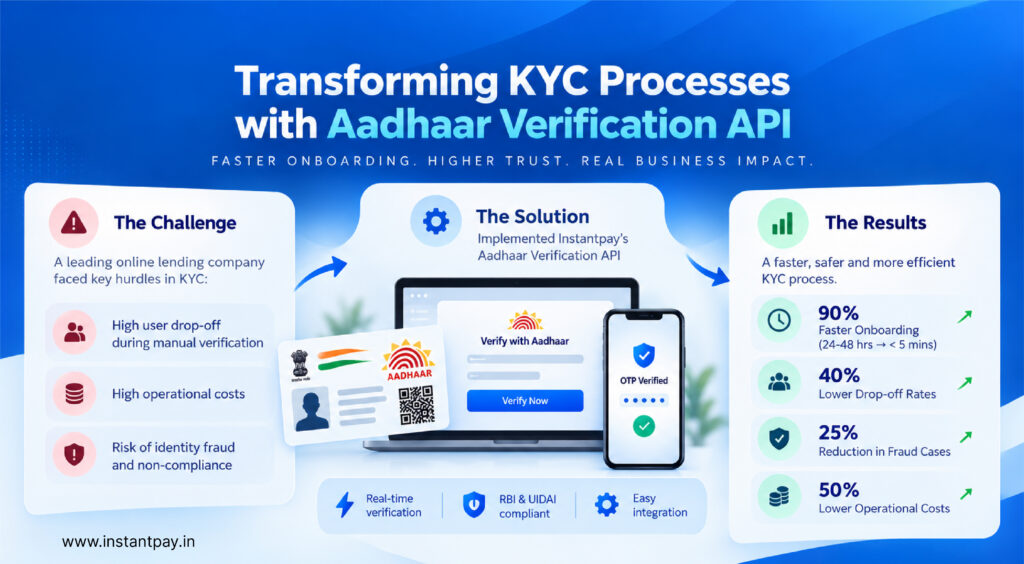
Some challenges that emerged from the situation were the following:
- A great number of users abandoning the application during the process of manual verification.
- Higher-than-anticipated costs incurred while performing manual document verification.
- Increased likelihood of identity theft or non-compliance with regulations.
Solution Implemented
To address these issues, the client utilized the Aadhaar Verification API. The following are among the reasons why the client decided to use the Aadhaar Verification API:
- The capability of verifying any user information such as identity, locality, and DOB “in real-time” right when the information is entered by the user.
- Implementation of KYC can be done within 60 seconds owing to OTP-based authentication of the user.
- Adherence to the rules and regulations of the RBI and UIDAI
Implementation Steps:
- Collaboration with the customers’ technology staff made the implementation possible with minor alterations to their current systems.
- Thorough testing from start to finish was performed to confirm that the validation data remained uniformly accurate and that the solution was effective when dealing with “high” loads.
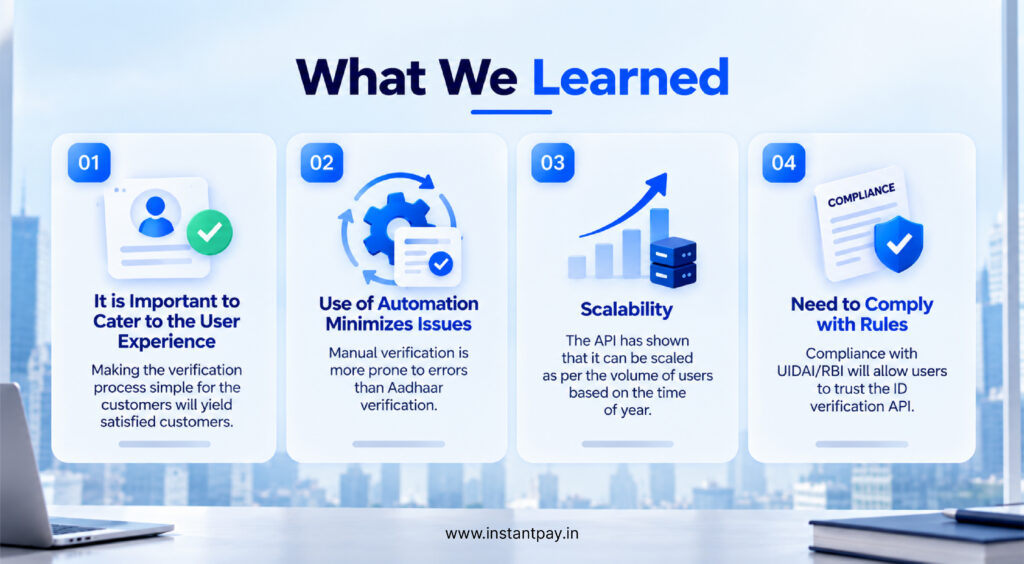
- All users who registered and began using this system had a better KYC onboarding experience after four weeks of the rollout.
Outcomes Achieved
1. Reduced Onboarding Time:
- Pre-API: 24-48 hours for manual verification.
- Post-API: Less than 5 minutes for automated Aadhaar verification.
2. Increased User Retention:
- Drop-off rates during the KYC process reduced by 40%.
- User satisfaction scores improved by 30%, reflecting a smoother onboarding journey.
3. Enhanced Fraud Prevention:
- Identity fraud cases dropped by 25% due to real-time validation.
- Tokenization ensured sensitive Aadhaar data was secure and not misused.
4. Cost Savings:
- Operational expenses reduced by 50% with the elimination of manual verification processes.
Use Case
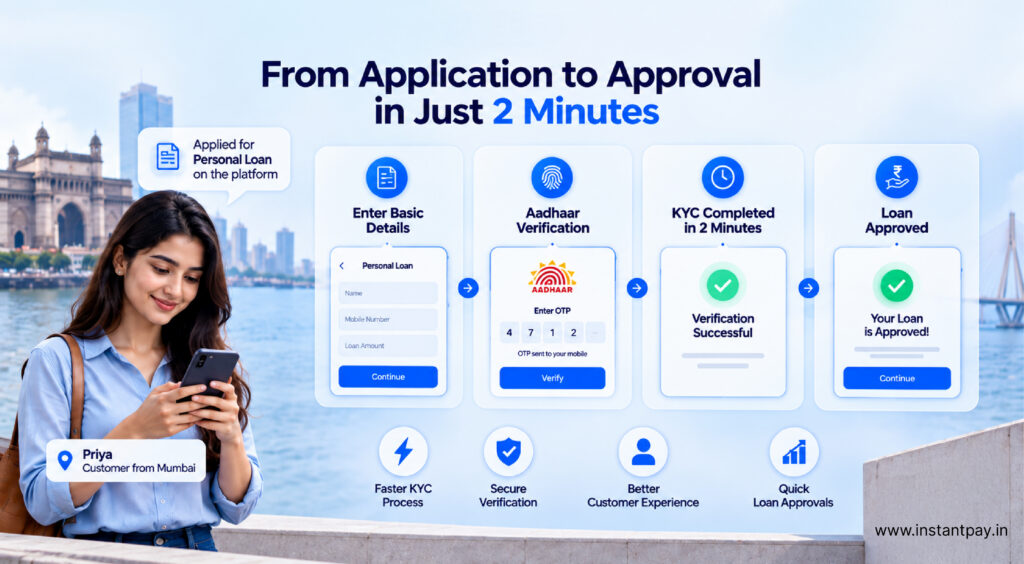
Priya, a customer from the city of Mumbai, applied for a personal loan on the platform. In the past, customers had to go through lengthy procedures to upload scanned copies of the PAN card, Aadhaar card, etc., which did not let the customers use the platform successfully. In this case, the Aadhaar verification API/OTP-based authentication was introduced to Priya, which helps ensure KYC process within two minutes of time so that immediate loan approval takes place.
Debunking Common Myths About Aadhaar Verification API
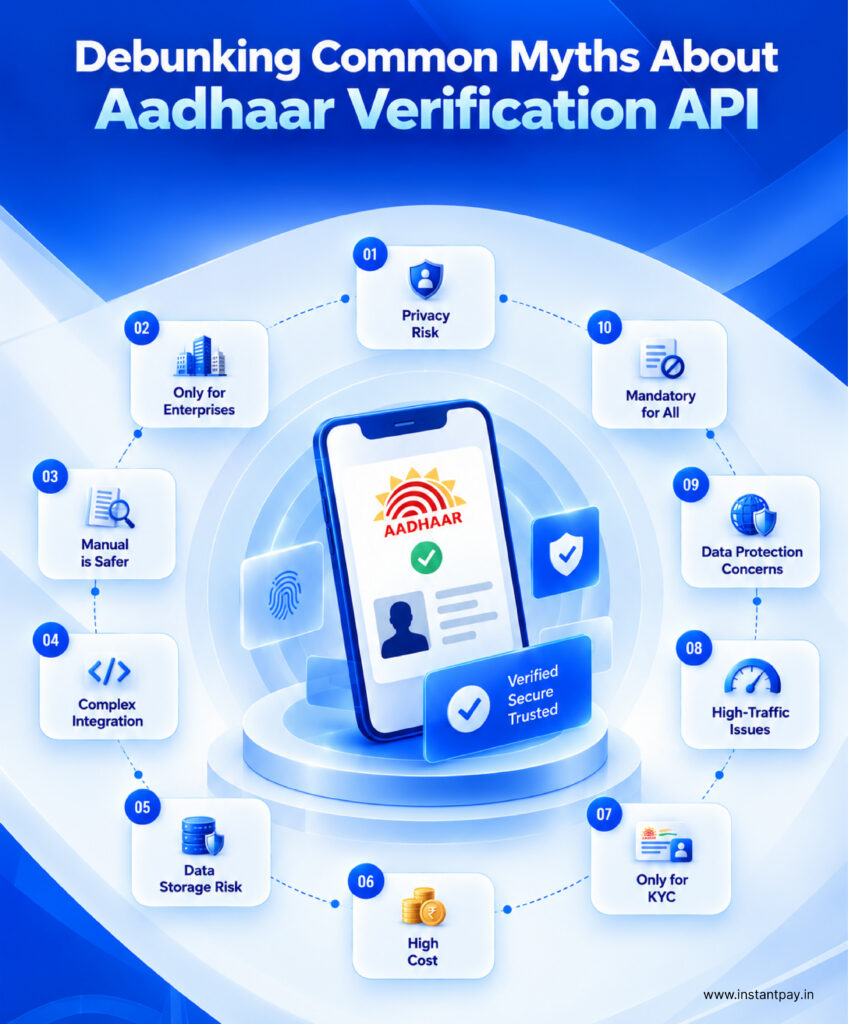
Myth 1: Aadhaar Verification API Compromises Privacy
Fact: Privacy is central to the design of the Aadhaar Verification API.
API adheres to stringent guidelines established by the UIDAI in order to uphold data validity and protect the privacy of the persons involved, whereby end-to-end encryption by way of tokenization, along with compliance with the Aadhaar Act, ensures that no sensitive assets are disclosed or kept without permission. Instead of allowing access to a full database containing Aadhaar details, the system allows only verification of information belonging to a specific person.
Myth 2: Aadhaar Verification API is Only for Large Enterprises
Fact: The Aadhaar Verification API can be used by any size of company.
The Aadhaar Verification API can be employed by both startups and small and medium enterprises, as there are options for retail businesses utilizing the API, thanks to plug-and-play technology creation that allows businesses to access a scalable service created for conducting numerous transactions.
Myth 3: Manual Verification is Safer Than API-Based Verification
Fact: There are many errors and delays associated with manual verification.
The Aadhaar Verification API is technologically innovative, as it is characterized by high competency and effectiveness, thereby minimizing the possibility of human mistake (as in the case of data entry) and shortening the duration of verification. This is connected to the fact that while checking the data manually, it may be more likely to commit fraud as compared to the Aadhaar Verification API, which utilizes the UIDAI’s secure database to validate data in real time.
Myth 4: Aadhaar Verification API is Too Complex to Integrate
Fact: The API has been designed for easy integration.
The Aadhaar verification API is a self-sufficient technology and provides clients with all necessary documentation, support from developers, and a user-friendly architecture needed for successful integration into their operations through third-party solutions.
Myth 5: The API Stores Aadhaar Data, Increasing the Risk of Misuse
Fact: No?Aadhaar data is held during the verification process.
The Aadhaar verification API functions on the principle of “no storage”, meaning that all personal data about individuals is permanently discarded after verification. Therefore, there is no need for companies to store Aadhaar information and thus mitigate the risks associated with its potential misuse.
Myth 6: Aadhaar Verification API is Expensive
Moreover, the API is economically viable, which is due to the technology behind the verification process. Because of this, the API has the potential to benefit businesses by helping them save expenses and reinvest their earnings.
Myth 7: Aadhaar Verification API is Limited to KYC Use Cases
The API can be used for various purposes. The most common usage case is KYC. However, there exist additional ways to use the Aadhaar verification API, such as:
- Allowing eSignations
- Verifying applicants for government subsidies and schemes;
- Verifying the background of a prospective employee;
- Validating seller data ahead of e-commerce transactions.
Myth 8: Aadhaar Verification API is Unreliable During High Traffic
The API is made for processing a large amount of transactions on the regular basis. UIDAI created the Aadhaar system that can manage billions of transactions and is dependable even during the times of peak usage. Businesses can expect the same quality of service from the API regardless of level of demand due to its strong design.
Myth 9: It Violates International Data Protection Standards
The Aadhaar Verification API complies with the rules of Aadhaar Act, Digital Personal Data Protection Bill (DPDP), and other rules regulating data protection. Therefore, companies can be sure that the API meets global requirements concerning data protection and privacy.
Myth 10: Aadhaar Verification is Mandatory for All Services
Companies may use Aadhaar to verify a user’s identity; however, it is compulsory to verify one’s identity using Aadhaar for certain governmental programs. In addition, people should give their consent to have their Aadhaar number verified when it comes to businesses.
By debunking these myths, we hope to clarify any doubts and encourage businesses to explore the potential of Aadhaar Verification API.
Building Trust, One Verification at a Time
Today’s digital environment has trust as an important currency in business-customer relationships. While the Aadhaar Verification API is a technical tool, it is also a means to build trust for customers as it enables identity verification that is both safe and real-time.
Take into account all those who rely on your services, from families getting loans and business owners opening a business account to young professionals sharing their personal information with you. Every verification means the empowerment of people’s lives.
Integrating the Aadhaar Verification API does not only allow you to improve the processes. It shows customers that they can trust you, and you will do everything possible to safeguard that trust.
What are you waiting for? Use the Aadhaar Verification API to build a trustworthy and transparent business today!
Take the first step today—because trust isn’t given; it’s earned.
Frequently Asked Questions (FAQs)
- What is an Aadhaar Demographic Verification API?
An Aadhaar demographic verification API is a trusted electronic service that checks if specific demographic particulars provided by a user, like an individual’s name, date of birth, gender, and address, match with the details kept in the Aadhaar records of that individual. Companies adopt the use of this API to make the customer application processing fast, minimize problems associated with manual verification and adhere to legal requirements concerning individual verification. The process of verification is carried out based on the regulations and procedures sanctioned by UIDAI.
- How does an Aadhaar demographic verification API work?
The API processes the individual demographic data supplied by the user comparing it against corresponding Aadhaar records. When the verification request is completed, the verification results are immediately reported to the user which makes it possible for the company to approve the individual’s application faster. The method used for authentication will depend upon the UIDAI system being used on the particular case being processed.
- Is Aadhaar demographic verification secure?
Yes, there are many security controls in place for verifying Aadhaar identification information, including encrypted transmissions, secure authentication infrastructure devices, and tough compliance requirements. Organizations using Aadhaar verification have to follow UIDAI’s key principles and privacy laws to ensure secure processing of information. Aadhaar verification APIs are widely utilized across various sectors which need immediate and accurate identity verification, including:
- Banking and financial services
- Fintech and digital lending
- Insurance.
- Non-banking financial institutions (NBFCs)
- E-commerce marketplaces
- Telecom operators,
- Health care
- EdTech
- HR and employee management
- Government services
These sectors depend on Aadhaar verification in order to hasten the process of onboarding, curb fraud, and comply with all regulatory requirements.
4. Are Aadhaar verification APIs only for big firms?
No, Aadhaar verification APIs are not limited to big corporations. Start-ups, small and medium enterprises (SMEs), and expanding companies integrate them using the simple API technology and user-friendly technology documentation.
5. How long does Aadhaar demographic verification take?
Modern Aadhaar verification APIs generally fulfill verification in a couple of seconds, which makes them suitable for real-time onboarding. Faster verification is crucial for improving the customers’ onboarding experience.
6. Does Aadhaar verification API save Aadhaar information?
No, Aadhaar verification is regulated by stringent privacy and information protection laws. Perhaps it is possible to process Aadhaar information and comply with UIDAI rules regarding storing, using, and handling of identity information.
7. What is the difference between Aadhaar authentication and Aadhaar e-KYC?
Aadhaar authentication verifies whether the data provided by the user matches the information on the UIDAI servers and usually provides confirmation without actual disclosure. Aadhaar e-KYC enables the organizations with the right to share information needed for KYC checking to share information, which includes personal data and various checks related to KYC.
8. Why is it better for companies to use the Aadhaar verification API instead of human verification?
Manual verification takes more time and money and is vulnerable to human mistakes, while Aadhaar verification API enables the companies to:-
- On-board customers faster
- Make verification process more precise and accurate
- Lower the costs of operation
- Reduce risks of fraud
- Provide clients with better quality
9. What are the advantages of using the Instantpay Aadhaar demographic verification API?
Instantpay Aadhaar demographic verification API was designed for companies requiring fast, safe, and scalable ways to verify clients’ identity and offers businesses the ability to streamline customer onboarding while maintaining a smooth verification experience.