Do you regularly pay EMIs, utility bills, or insurance premiums? These payments are often deducted automatically from your bank account, offering a seamless experience. But managing these payments was once a manual, error-prone task. Enter eNACH and e-Mandates—innovations that revolutionized recurring digital payments in India.
While the terms are often used interchangeably, there are key differences:
- e-NACH is regulated by the National Payments Corporation of India (NPCI).
- e-Mandates are typically managed by individual banks through various digital channels.
Let’s explore how these systems work and the advantages they offer.
What is an Electronic Mandate (e-Mandate)?
An (e-)mandate allows a bank or service provider to automatically deduct funds from a customer’s account on a recurring basis instead of having to create a traditional, paper mandate.
(e-) Mandates can be used to authorize banks to automatically make payments for:
- Loan EMIs
- Utility bills
- Ongoing subscriptions
- Insurance premiums
In FY 2024-25, e-NACHs had processed about 696.7 crore transactions.
What is e-Mandate?
An e-Mandate is a digital consent that authorizes recurring auto-debits from a bank account for fixed or variable bills like EMIs, SIPs, and premiums.
1. API-Based e-Mandate (Bank API Integration)
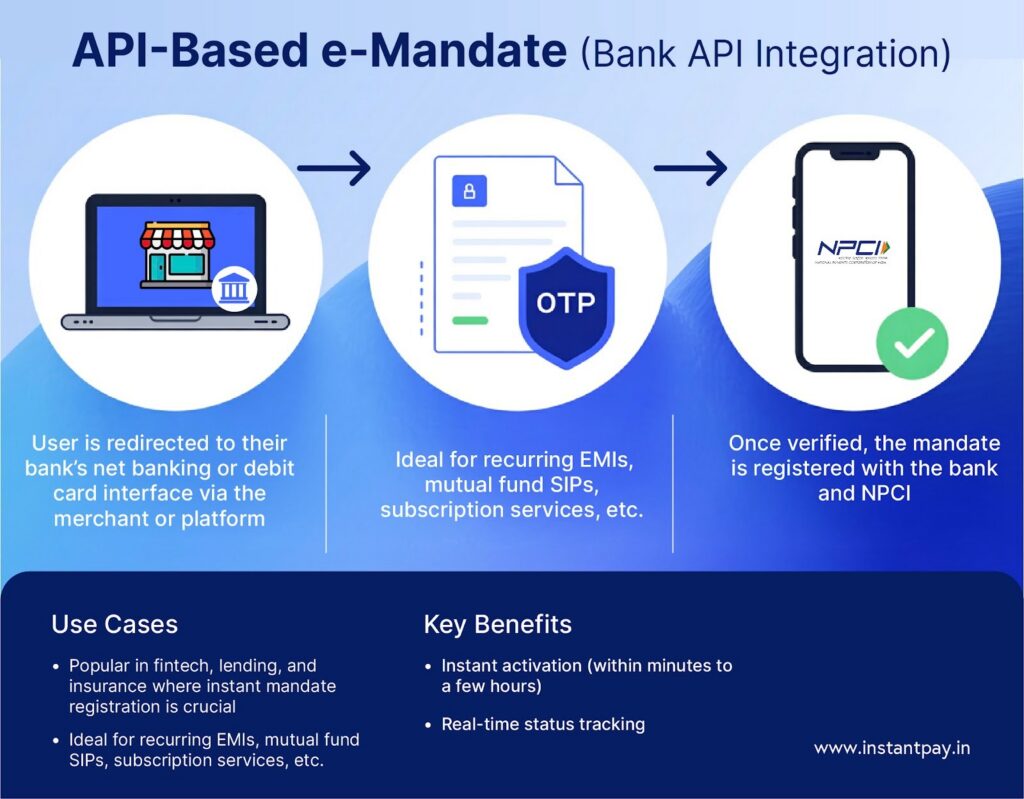
The API-based method is the easiest way to set up e-Mandates quickly and easily by having the e-Mandate request processed by a bank’s API at the same time you submit your order to the merchant or platform.
How It Works:
1. The consumer will complete their order with the merchant or platform and be redirected to their bank’s net banking or debit card interface.
2. The consumer authenticates using either their net banking credentials or their debit card and inputting their OTP.
3. Once authenticated, the bank will register the e-mandate with NPCI as well as with the consumer’s bank.
There is no need for an individual to provide their Aadhaar information because the e-mandate is created by the bank/API combination.
Use Cases:
- This type of e-mandate is commonly used in the fintech, lending, and insurance industries, where the ability to have an e-NACH set up instantly is extremely important.
Some examples of use cases include the following:
- Recurring EMIs
- Mutual fund SIPs
- Subscription services, etc.
Key Benefits of Using API-Based e-Mandates:
- Instant activation, (within minutes to hours)
- No dependency on Aadhaar
- Low failure rate
- Real-time status tracking
How long does e-Mandate activation take?
API-based mandates can activate quickly (often same day), while eSign mandates may take longer depending on bank processing and validation.
2. eSign-Based e-Mandate (Aadhaar-linked Digital Signature)
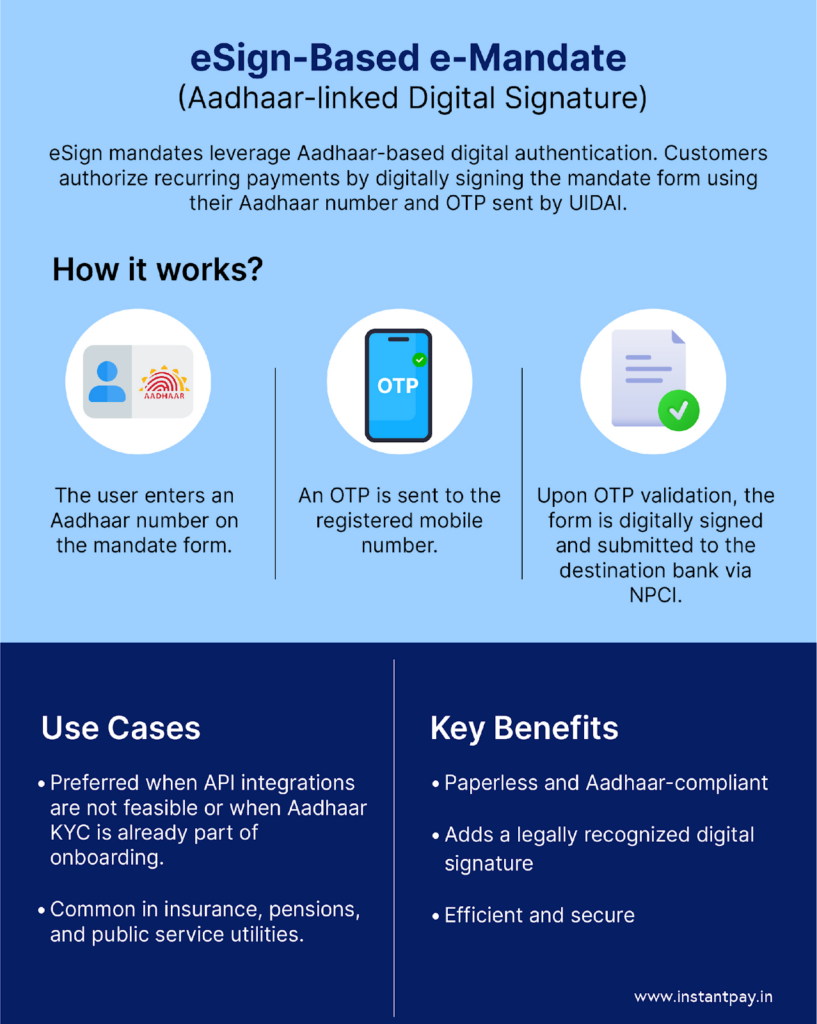
eSign mandates utilize Aadhaar-based digital authentication. Customers approve recurring payment by signing the mandate form digitally with their Aadhaar and an OTP provided by UIDAI.
How it works:
1. The user inputs their Aadhaar number on the mandate form. An OTP is dispatched to the registered mobile number.
2. After validating the OTP, the form is signed digitally and sent to the destination bank through NPCI.
Use Cases:
- This method is particularly useful in situations where API integration is not feasible or when onsite onboarding requires Aadhaar KYC.
- Insurance, pension, and public utility services.
Key Benefits:
- The services are digital and compliant with Aadhaar.
- Incorporates a digital signature that is recognized by law.
- Fast and safe.
Fact: NPCI in 2021 recognized eSign eMandates for the first time as a valid form of authentication. It is the first step towards bridging the gap between fully automated APIs and manual mandates.
Security Note: The digital signature is legally binding as per the IT Act of 2000.
Are e-Mandates secure?They use bank-grade controls like OTP-based authentication and standardized routing through regulated payment rails.
3. Physical Mandate (Paper-Based Manual Submission)
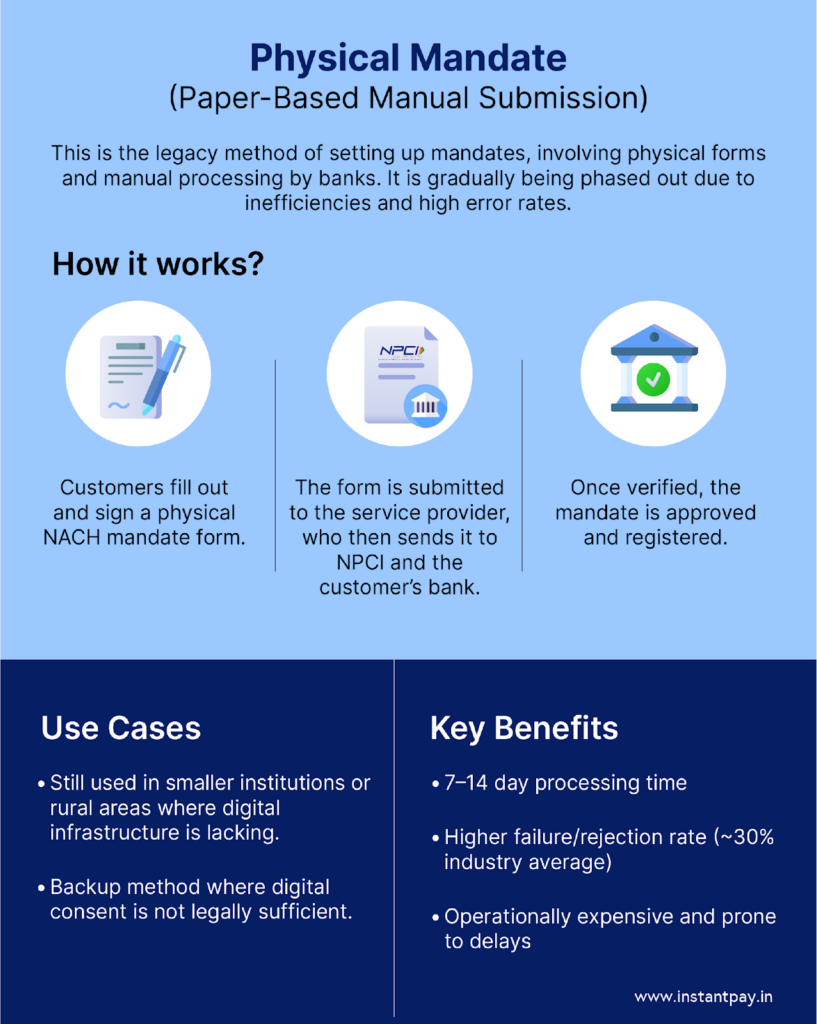
The traditional approach to establishing mandates is accomplished by filling physical forms by customers, followed by manual processing by banks. In the last 5-10 years, low efficiency & high levels of error have caused this method of establishing mandates to be phased out over time.
How It Works:
1. Customers fill out and sign a NACH Mandate form
2. Once they have completed it, customers submit the original paper to their service provider;
3. The service provider sends the completed and signed papers to the NPCI (National Payments Corporation of India) (the governing body for NACH) and the customer’s bank;
4. Once both the NPCI and customer’s bank receive the original (paper) mandate, they verify it;
5. After verifying the original mandate, the NPCI registers the mandate and sends confirmation to the customer, service provider, and customer’s bank.
Use Cases:
- Many small financial institutions in India are still using the legacy process because of the lack of digital infrastructure in rural areas.
- As a backup form of creating mandates when digital consent is not considered legally valid.
Key Drawbacks:
- 7-14 day processing time
- Higher failure/rejection rate (~30% avg. rate of rejection/failure for specific mandates)
- Operationally costly and prone to delays
Summary Comparison
| Feature | API-Based eMandate | eSign Mandate | Physical Mandate |
| Authentication | Bank credentials + OTP | Aadhaar + OTP | Wet signature |
| Speed of Activation | Instant – Few hours | 1–2 days | 7–14 days |
| Aadhaar Required | No | Yes | No |
| Use Cases | Fintech, Insurance, EMI | Govt schemes, KYC-heavy apps | Low-tech rural applications |
| Failure Rate | Very low (<5%) | Low | High (~30%) |
| Operational Effort | Fully digital | Semi-digital | Manual, paper-heavy |
Evolution from Manual Mandates
Before the rise of digital solutions, people relied on manual processes to handle recurring payments such as EMIs, insurance premiums, and utility bills (NACH). The manual process of managing these types of payment requests was complex, cumbersome, and very error-prone.
Can e-Mandates be used for EMIs?
Yes. Loans, credit products, and NBFC collections commonly use e-Mandates for scheduled EMI debits.
Traditional Manual Mandate Process: What It Looked Like?
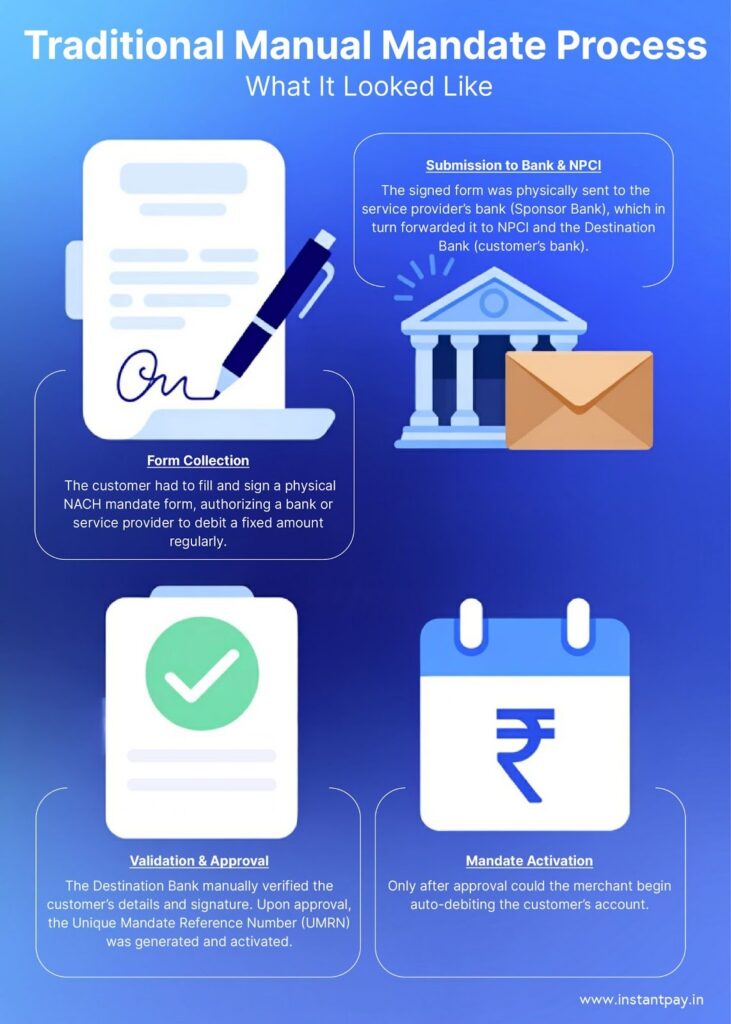
Step-by-Step Breakdown:
- Form Collection:
The customer is required to fill and sign a physical NACH mandate form, authorizing a bank or service provider to debit a fixed amount regularly. - Submission to Bank & NPCI:
The signed form is physically sent to the service provider’s bank (Sponsor Bank), which in turn forwards it to NPCI and the Destination Bank (customer’s bank). - Validation & Approval:
The Destination Bank manually verified the customer’s details and signature. If the above procedure was successfully completed, a unique mandate reference number (UMRN) was created and activated. - Mandate Activation:
The merchant could only start auto-debiting the customer’s account after the mandate was activated.
Challenges of Manual Mandates
| Challenge | Description |
| Lengthy Processing Time | Activation took 7–14 business days, delaying service delivery or loan disbursement. |
| High Failure Rate (~30%) | Errors in form filling, signature mismatch, courier delays, or missing fields led to rejections. |
| Customer Drop-offs | The friction of paperwork discouraged many from completing the process. |
| Operational Overhead | Businesses had to manually handle forms, follow-ups, and resubmissions, leading to increased costs. |
The Shift to Digital: API & eSign e-Mandates
To respond to the issues surrounding eNACH, NPCI and banks introduced digital options, via the following eMandate offerings;
1. API eMandates:
- Uses Net Banking or OTP from your debit card
- Authenticate and activate in real-time within 24 hours, and remove paper-based and personnel involvement.
2. eSign eMandates:
- Use Aadhaar + OTP for legally compliant digital signatures
- Activate within 1-2 days; only for Aadhaar-seeded accounts and government-supported services.
Key Benefits of Digital Evolution
| Area | Manual Mandate | e-Mandate (API/eSign) |
| Processing Time | 7–14 business days | 1–3 days |
| Success Rate | ~70% | 95%+ |
| Customer Experience | Paperwork & branch visit | Digital & mobile-friendly |
| Operational Cost | High (manual verification, courier, rework) | Low (automated workflows) |
| Compliance & Security | Basic | High (OTP, encryption, Aadhaar eSign) |
How Does e-NACH Work?
The Electronic National Automated Clearing House (e-NACH) is a centrally regulated platform by NPCI to provide businesses with an efficient process for collecting recurring payments, via electronic instructions, directly from their customers’ bank accounts. This is a digital process that is rapid, secure, and highly scalable.
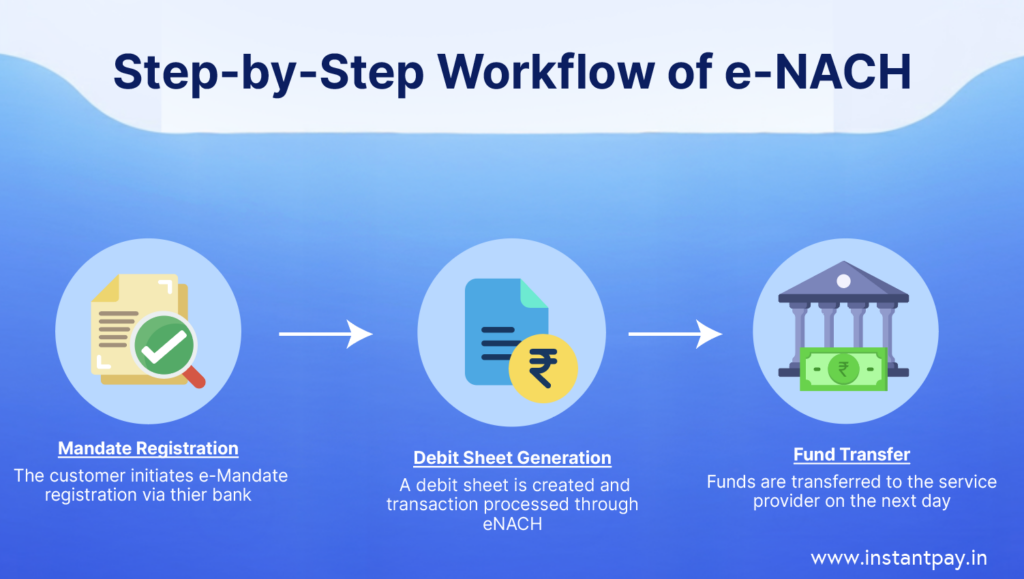
1. Mandate Registration
What Happens:
- The customer (payer) starts the recurring payment registration with the service provider (merchant).
- The customer’s destination bank is contacted for approval of the mandate.
- The Sponsor Bank (Merchant partner) forwards the mandate request to NPCI.
- NPCI forwards the mandate request to the Destination Bank for approval.
Objective: To electronically document customer’s agreement to make future periodic debit payments
Timeline: Timing difference: Immediate (API-based) versus 24-48 hours (eSign-based).
2. Debit Sheet Generation
What Happens:
- Once the mandate is approved, the UMRN (Unique Mandate Reference Number) will be created, listing all the required information, such as the amount of the debit, frequency, schedule, and details of the customer account.
- The debit instruction is sent from the sponsor bank to the destination bank via NPCI
Objective: To start and verify the actual debit instruction transaction based on the registered mandate.
What is UMRN in eNACH?
UMRN (Unique Mandate Reference Number) is the unique ID assigned to a mandate after approval, used for tracking and managing the mandate.
3. Fund Transfer
What Happens:
- On the specified date, the destination bank debits the customer’s account.
- The amount will then be sent through NPCI (National Payments Corporation of India) for transfer to the sponsor bank as the intermediary.
- Funds will be credited to the merchant/corporate account one day after the debit from the customer’s account.
Objective: To successfully and accurately complete the quarterly debit transaction automatically with no manual input.
Key Stakeholders in the e-NACH Ecosystem
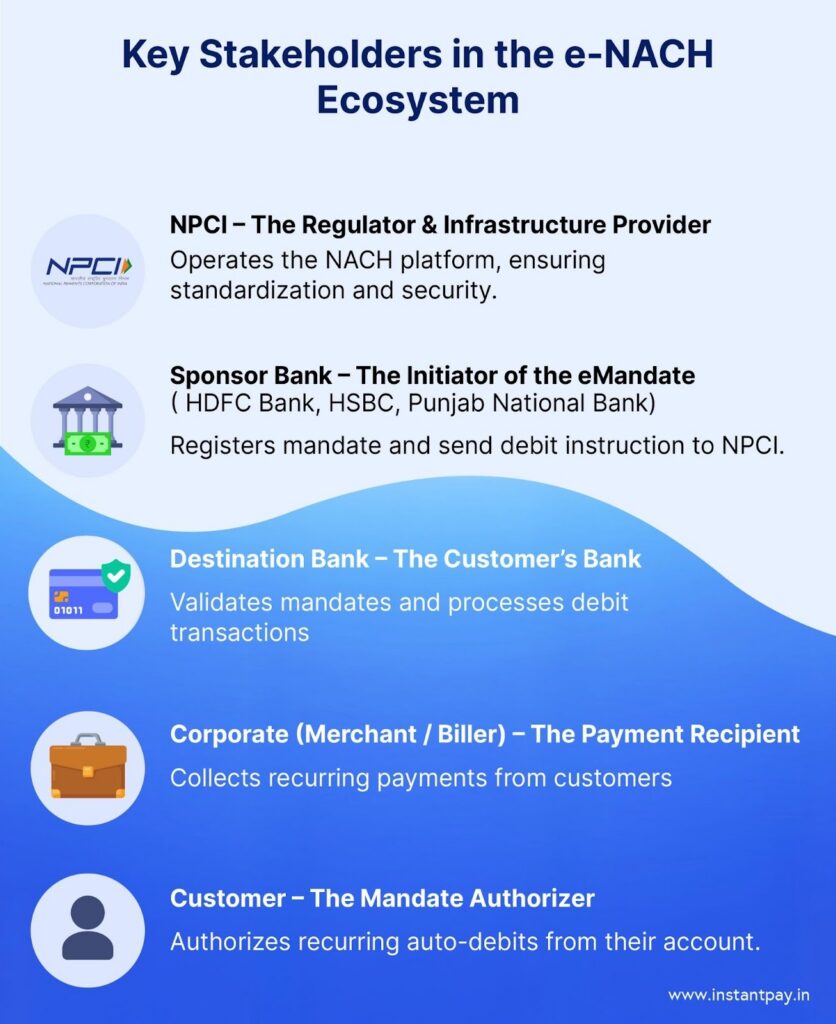
1. NPCI – The Regulator & Infrastructure Provider
- Role: NPCI (National Payments Corporation of India) is the central body responsible for running the NACH platform, including both paper-based and electronic mandates.
- Responsibilities:
- Ensures standardization across all banks
- Handles routing requests, debit sheets, and transaction reports
- Monitors performance, compliance, and fraud prevention
- Significance: NPCI acts as the clearinghouse between parties involved in the transaction and provides reliability and security.
2. Sponsor Bank – The Initial Point of Contact for E-Mandates
- Examples: HDFC Bank, HSBC, Punjab National Bank
- Role: The Sponsor Bank facilitates the e-NACH from a corporate or retail merchant to the customer by being the Initiating Bank.
- Responsibilities:
- Interfaces with the NPCI to register mandates
- Sends debit instructions once the mandate is activated
- Significance: It acts as the link between the merchant and the NPCI, and without the sponsor bank, no e-NACH can be initiated.
3. Destination Bank – The Customer’s Bank
- Role: The Destination Bank is the financial institution where the customer maintains their account that will be debited.
- Responsibilities:
- The Destination Bank verifies the customer’s credentials and eMandate approval.
- The Destination Bank executes the debit transaction.
- Significance: The completion of the transaction in regard to security, accuracy, and timeliness is based upon the Destination Bank’s technology and compliance with NPCI standards.
4. Corporate (Merchant / Biller) – The Payment Recipient
- Role: The corporate entity (insurance, loan, subscription, utility, etc.) collects recurring payments for services or goods provided to the customer.
- Responsibilities:
- Obtain the customer’s consent to use an eMandate.
- Submit the eMandate to the Sponsor Bank and initiate the collection process.
- Significance: Corporates use eMandate to introduce automation into their collection process, reduce manual reconciliations, improve their cash cycle, as well as improve customer satisfaction.
5. Customer – The Mandate Authorizer
- Role: The Customer is the Payor/End User that grants Consent to Auto-Debit and Recurring Payments from Their Bank Account
- Responsibilities:
- Initiate the Mandate Digital Consent via an API or e-Signature
- Ensure Sufficient Funds Are Made Available in Time for Each Due Date
- Significance: The Customer’s Authorisation Is the Foundation for All Mandates; The Simplicity and Transparency of the e-NACH Process Will Build Trust and Increase Adoption Among Customers to Authorize Recurring Payments
Features of e-Mandates
e-NACH are designed to provide a cost-effective way to make and receive payments. The following makes eMandates a wonderful addition to India’s digital payments ecosystem:
1. Automated and Paperless
No more lengthy approval processes for submitting a paper NACH form and waiting for someone to approve it—eMandates Are Digital:
- Users Authenticate Themselves and Authorize The Agreement Using NetBanking Credentials, A Debit Card + OTP, Or an Aadhaar eSignature
- Once The Mandate Has Been Authorized, Future Auto-Debits Will Automatically Be Scheduled for Execution, requiring no subsequent approvals or reminders.
- Elimination of the use of Courier, Printing & Other Paper-Related Activities Will Reduce The Cost of the Transaction and Result in a smaller carbon footprint for the environment.
Benefit: Time Savings, Reduction in Error Rates And An Improved Customer Experience.
2. Real-Time Authorization
Using real-time banking APIs and authorization flows, e-Mandates use the user to help them complete the entire process in a few minutes:
- The requested authorization will be authenticated as soon as it has been completed, using secure OTP-based or Aadhaar-based digital verification methods.
- Most authorizations are granted approval and go live within 24–48 hours versus the typical 7–14 days for manual processes.
Benefits: Speeding up customer onboarding so that companies can process payments more quickly for their customers.
What authentication methods are used?Common methods include netbanking credentials, debit card + OTP, or Aadhaar eSign + OTP.
3. Multi-Platform Access (Web/Mobile/Branch)
E-mandates have multi-channel capabilities because users can initiate and manage e-mandates via various e-channels:
- Website of the service provider (i.e., mutual fund houses, insurers).
- Mobile applications when users are on-the-go.
- Bank locations when users prefer banking services for assistance.
- This flexibility ensures that all customers, whether they are tech-savvy youth, or offline-first rural customers, can access and manage their subscriptions through e-mandates.
Benefits: Giving users more options to access and manage their e-mandates.
4. Integrated with NACH (NPCI)
All eNACH utilize the National Automated Clearing House (NACH) infrastructure by the National Payments Corporation of India as their operations platform.
- NACH also provides standardized statement formats and processes across all banks and service providers.
- NACH also allows for uniformity of transaction acknowledgement and tracking all over India.
- Finally, NACH also has standard procedures for cancelling, changing or pausing current authorizations of active e-NACH.
Benefits: All Major banks in India and most NBFCs utilize the NACH System providing a trusted, secure, and scalable system for all e-mandates.
5. Secure with Encryption & OTP-Based Verification
E-mandates are secured by bank-level security measures, such as:
- End-to-end encryption so that when you send out sensitive data, it passes securely through total encryption.
- Multi-Factor Authentication (using a one-time code sent to users via mobile phone/email) or an authentication process using an Aadhaar OTP—ensuring authenticity of users and their consent for each transaction.
- The National Payments Corporation of India (NPCI) looks for fraudulent patterns in transactions and any anomalies.
Benefits: The customer experiences peace of mind when transacting through e-mandate because of the reduced chance of fraud or failure.
Benefits of e-Mandate
| Benefit | Description |
| Convenience | No need to remember due dates. Fully automated. |
| Timely Payments | Reduces missed payments and protects credit scores. |
| Cost Savings | Avoid penalties; some providers offer discounts. |
| Security | Strong authentication and encryption. |
| Transparency | Get alerts and transaction records instantly. |
| Eco-Friendly | Reduces paper use and supports digital India. |
Final Thoughts
Recurring payments are a key element of the current financial landscape. From loan repayments (EMIs) and insurance premiums to subscriptions and utility bills, regularly scheduled payments have become almost universal.
Earlier, processing recurring payments has involved the manual preparation of paper-based authorization forms (mandates), which have had to be signed and submitted to the bank or service provider. The processes involved in approving or rejecting authorizations can lead to delays, errors, and missed payments.
The introduction of e-Mandates and the eNACH framework is changing the situation to an automated, entirely digital, and highly secure method of processing recurring payments.
Since automated payment authorisation is built on the NPCI’s NACH infrastructure, e-Mandate users benefit from process flows, expedited activation, enhanced security through stronger authentication, and a significantly lower rejection rate than traditional paper-based mandates. This change ultimately reduces the complexity of continued business operations for organizations while promoting a better experience and greater financial discipline for end-users/customers.
As India transitions to a digital financial system, e-NACH will become an important foundation on which to create reliable, secure, and scalable recurring payment solutions across multiple sectors.