When a major illness strikes, the emotional stress is instant, and the financial stress can last for ages. Term insurance is becoming common in India, but insurance isn’t the most important part in a person’s working life. Health insurance is more important.
This is the current need for add-on protections.
The latest MRFR report expects India’s critical illness insurance market to grow at a CAGR of ~7.0%, from USD 15.44 billion in 2024 to USD 32.5 billion by 2035.
The increasing costs of long term care, particularly for illnesses covered by critical illness insurance and not by a standard term insurance plan, is the most important factor driving the growth of the industry.
When you add a Critical Illness Rider, you receive a lump sum payment when you are diagnosed with any of the specified illnesses. This gives you enough financial support for treatments, household bills, or recovery without the stress of losing your income or going into debt.
With the cost of health care on the rise, and the risks we face being unknown, it is important to know how term insurance and a Critical Illness Rider work together.
What is a Critical Illness Rider?
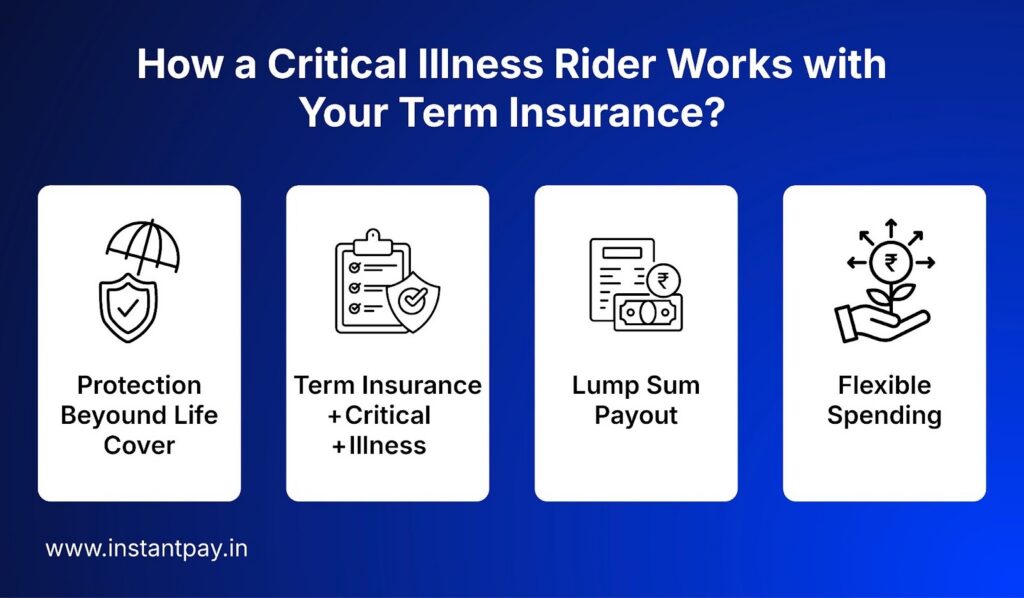
A critical illness rider is an optional feature on a term insurance policy that pays a lump sum to an insured person when they are diagnosed with a critical illness, for example, cancer, stroke, or kidney failure, among others.
To fully comprehend how a critical illness rider adds value to your life insurance, it is important to understand the basics of term insurance and how it secures the future of your family over a long period of time with the right strategy.
This rider does not merely increase the value of your policy, it helps in building your policy into a more robust value instrument that helps mitigate uncertainties in both life and health.
Critical Illness vs Terminal Illness Rider: What’s the Difference?
While a critical illness rider pays a lump sum when one is diagnosed with a serious illness, for example, cancer or a stroke, which is considered to be a treatable illness, a terminal illness rider only robs a person of life and pays no claim if one is diagnosed with an illness that is likely to result in death in a period of 6 to 12 months.
Difference Between Critical Illness and Terminal Illness Riders
| Feature | Critical Illness Rider | Terminal Illness Rider |
| Trigger | Diagnosis of a covered serious illness | Doctor-certified terminal condition with under 12 months life expectancy |
| Payout Timing | Early, right after diagnosis | Late, when illness is declared terminal |
| Coverage Scope | Treatable conditions (e.g. cancer, stroke) | End-of-life situations only |
| Premium Impact | Slight increase to base plan | Usually included at no extra cost |
| Purpose | Cover treatment, income loss, lifestyle costs | Ease final-stage expenses, support dependents |
Why This Comparison Matters
This is applicable in refining choices when adding illness covers to a term plan. While both are valuable, only the critical illness rider aids in recovering financially while still battling the illness, not just at the end of life.
How Does It Work?
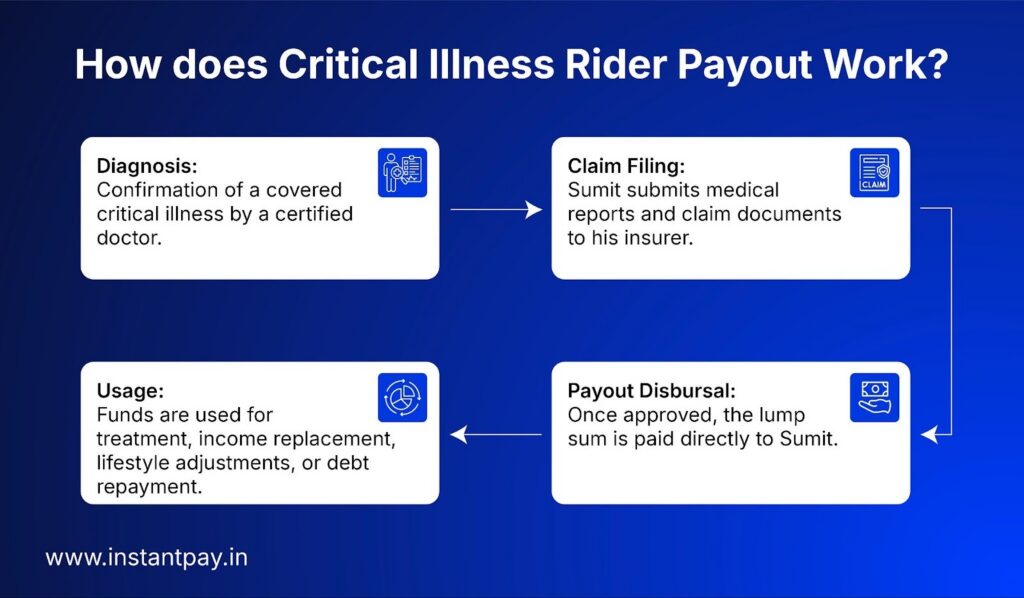
Sumit is a 45-year-old professional who has a term insurance policy with Critical Illness Rider. While the policy is active, he is diagnosed with cancer. Because of the rider, he obtains a lump sum payment shortly after claim filing. He utilizes this money to pay for his treatment, to cover his basic living expenses, and to provide financial support to his family during his recovery.
This process usually consists of the following:
- Diagnosis: A doctor specialized to confirm a critical illness gives the diagnosis.
- Claim Filing: Sumit submits medical reports along with claim paperwork to the insurance company.
- Payout Disbursement: The insurance company is always liable to pay this sum immediately to Sumit, after they have approved his claim.
- Usage: The money is utilized to pay for treatment, replace income, adjust to the new lifestyle, or pay off debts.
This payout is offered to provide the insured person with additional financial support, and it works completely separately from the base term insurance cover.
Key Features of a Critical Illness Rider
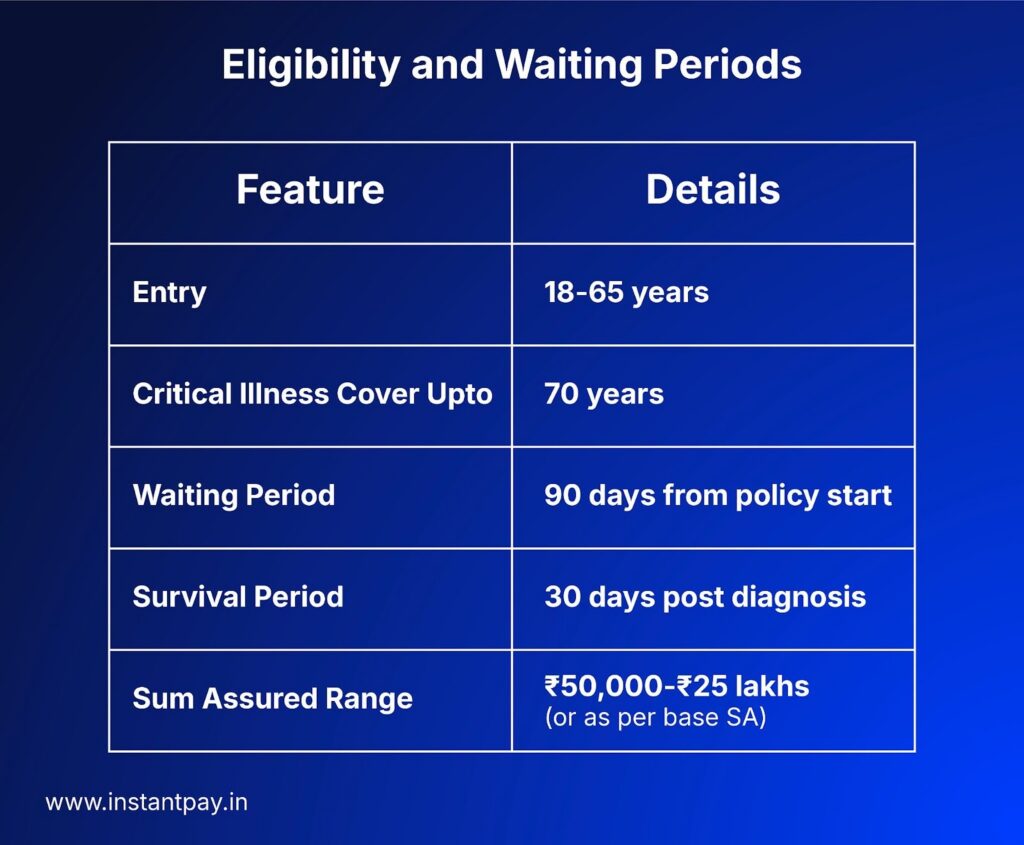
Every covered illness has its own criteria to pay out, so knowing the particulars of your Critical Illness Rider is essential. Here are the important details.
1. Eligibility
You can generally only add this rider on your first purchase of your term plan, and must meet the following eligibility criteria:
- Age of Entry: 18-65 years
- Age for Coverage Ceasing: Up to 70 years
2. Sum Assured
Your total payout (or Sum Assured) has a range of 50,000 to 25 lakhs. Some insurers even offer the option to match the base policy’s sum assured.
3. Waiting and Survival Period:
Critical illness riders, like health insurance, have a number of stipulations. Conditions are as follows:
4. Waiting Period: Coverage starts 90 days after the policy start date.
5. Survival Period: After diagnosis, the policyholder must survive for 30 days to qualify for a payout.Covered Illnesses
Depending on the specific plan purchased, different insurers will typically cover between 10-40 critical conditions. Some of the most common critical conditions covered include the following:
- Cancer
- Stroke
- Heart Attack
- Major Organ Failure
- Kidney Failure
- Paralysis
Always read the policy documents to see the list of covered illnesses.
Why You Should Add a Critical Illness Rider to Your Term Plan?
A term plan provides coverage to your family in case something unfortunate happens to you. But what happens if something unfortunate happens to your health while you are still alive?
This is where a Critical Illness Rider truly adds value. Your term plan becomes a tool for protection and safety for the life you are living. Here is what makes this rider a good choice in addition to your base term insurance.
Key Benefits of Adding a Critical Illness Rider
| Benefit | How It Helps |
| Covers High Medical Expenses | Treatment for critical illnesses like cancer or heart disease can run into lakhs. This rider gives you a lump sum for your ease. |
| Lump Sum Payout Regardless of Bills | The payout is fixed, and no bills or proof of expenses required. You can use it your way. |
| Income Replacement During Recovery | If you’re unable to work for months, this rider can help cover your living costs. |
| Supports Lifestyle Adjustments | Funding for rehab, special care, or mobility aids is possible without dipping into savings. |
| Debt Repayment Aid | Helps prevent EMI defaults or draining assets during your treatment phase. |
| Goes Beyond Hospitalization | Provides coverage that is not related to hospitalization like most health insurances, which is great for outpatient or continuance of care. |
| Comprehensive Financial Coverage | When combined with base term insurance, it offers protection for both death and disease. |
| Tax Benefits | Premiums paid for this rider may be eligible under Section 80D, and payouts may qualify for exemptions under Section 10(10D). |
| Fights Rising Treatment Costs | With rising inflation in healthcare, the rider cushions you against unexpected shocks. |
| Waiver of Premium on Diagnosis | Some policies offer a premium waiver once a claim is made, so coverage continues without further payments. |
Selecting appropriate riders involves an understanding of your well-being, your available funds, and the type of coverage you may need in the future.
What risks do I face if I develop a critical illness before securing coverage?
Without a critical illness rider, you may face huge out-of-pocket expenses, income loss, or debt accumulation. Securing this add-on early locks in future protection while you’re still insurable.
Why Critical Illness Coverage is Vital After 40?
Increasing Numbers in the Age Group of 35-54: Recent data reveals a 20% increase in the purchase of critical illness cover in the 35-54 age bracket. This captures the awareness of the dangers of serious illnesses and the need for financial cover.
This is especially true for those over 40 and requires serious consideration of this rider. This is how it explains the difference:
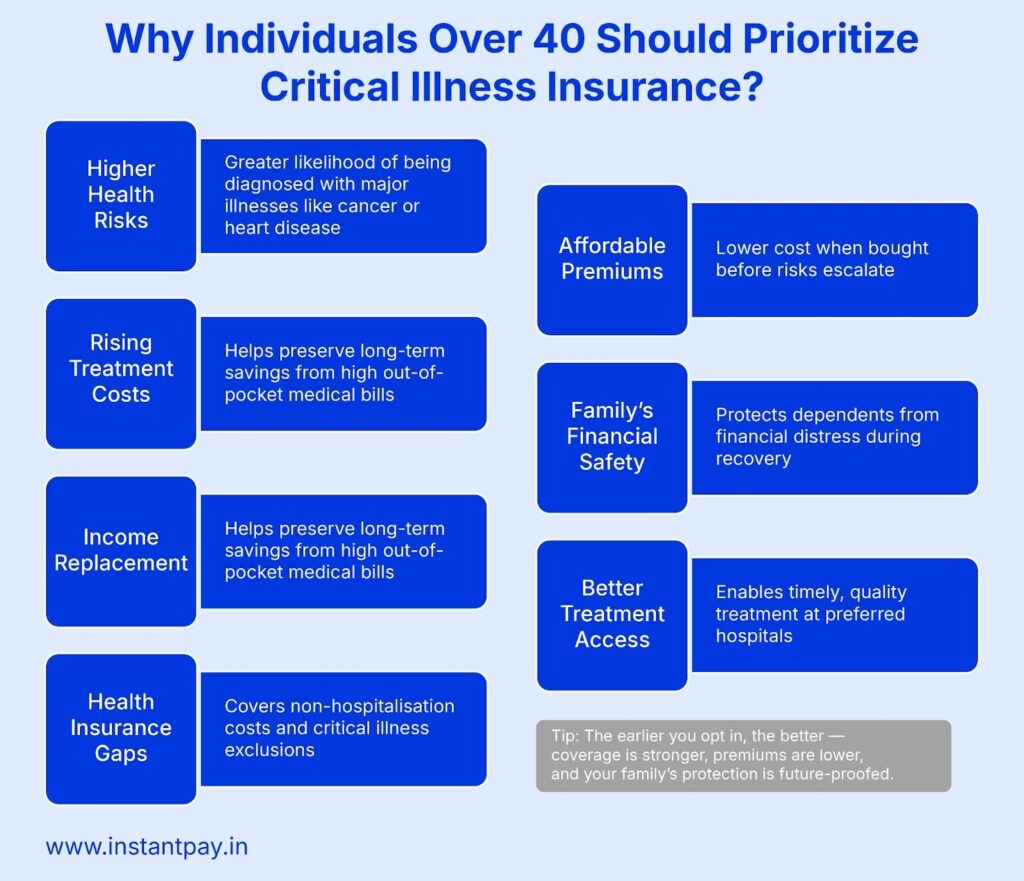
Why Individuals Over 40 Should Prioritize Critical Illness Insurance?
| Reason | Impact for Over 40s |
| Higher Health Risks | Greater likelihood of being diagnosed with major illnesses like cancer or heart disease |
| Rising Treatment Costs | Helps preserve long-term savings from high out-of-pocket medical bills |
| Income Replacement | Ensures your family’s lifestyle isn’t disrupted if you’re unable to work |
| Health Insurance Gaps | Covers non-hospitalisation costs and critical illness exclusions |
| Affordable Premiums | Lower cost when bought before risks escalate |
| Family’s Financial Safety | Protects dependents from financial distress during recovery |
| Better Treatment Access | Enables timely, quality treatment at preferred hospitals |
Tip: The earlier you opt in, the better — coverage is stronger, premiums are lower, and your family’s protection is future-proofed.
“Can I get critical illness cover after 50?”
Rajesh, 57, chose to enhance his term cover with an illness-linked rider after learning about his family’s history of strokes. When he experienced a mild stroke two years later, the rider ensured a swift lump sum payout. This allowed him to begin rehabilitation immediately, reduce hospital stay, and avoid debt during recovery.
For those over 50, the risk of serious illness is real — but financial recovery can still be planned ahead.
Critical Illness Rider vs Health Insurance
Difference between Health Insurance and Critical Illness Rider
| Feature | Critical Illness Rider | Health Insurance |
| Payout | Lump sum on diagnosis | Reimbursement of hospital bills |
| Claim Trigger | Diagnosis of a listed critical illness | Hospitalization and medical expenses |
| Flexibility | Use payout freely for any need (treatment, income, debts) | Usage restricted to medical expenses |
| Premium | Lower (as it’s an add-on) | Typically higher for comprehensive coverage |
| Best Use Case | Long-term financial security + income support | Short-term medical cost management |
| Tax Benefits | Yes, under Section 80D/10(10D) | Yes, under Section 80D |
Who Should Consider a Critical Illness Rider?
An illness-based add-on is ideal for someone who could experience a financial loss upon being diagnosed with a serious illness. It provides a form of protection during the recovery process and is important if you are the primary wage earner or there is no financial support back up.
You should consider this rider if you are:
Are the main earner with dependents – Flexible Cover ensures income continuity while you undergo treatment.
Are self-employed – You don’t have employer sponsorship or paid medical leave.
Are aged 40 or over – You face greater health risks. It is more affordable if the cover is purchased earlier.
Have a family history of illnesses – You have a greater likelihood of suffering from significant illnesses.
Work in a high-stress/ hazardous occupation – You are more susceptible to experiencing health issues suddenly.
How Critical Illness Payouts Work with Term Insurance?
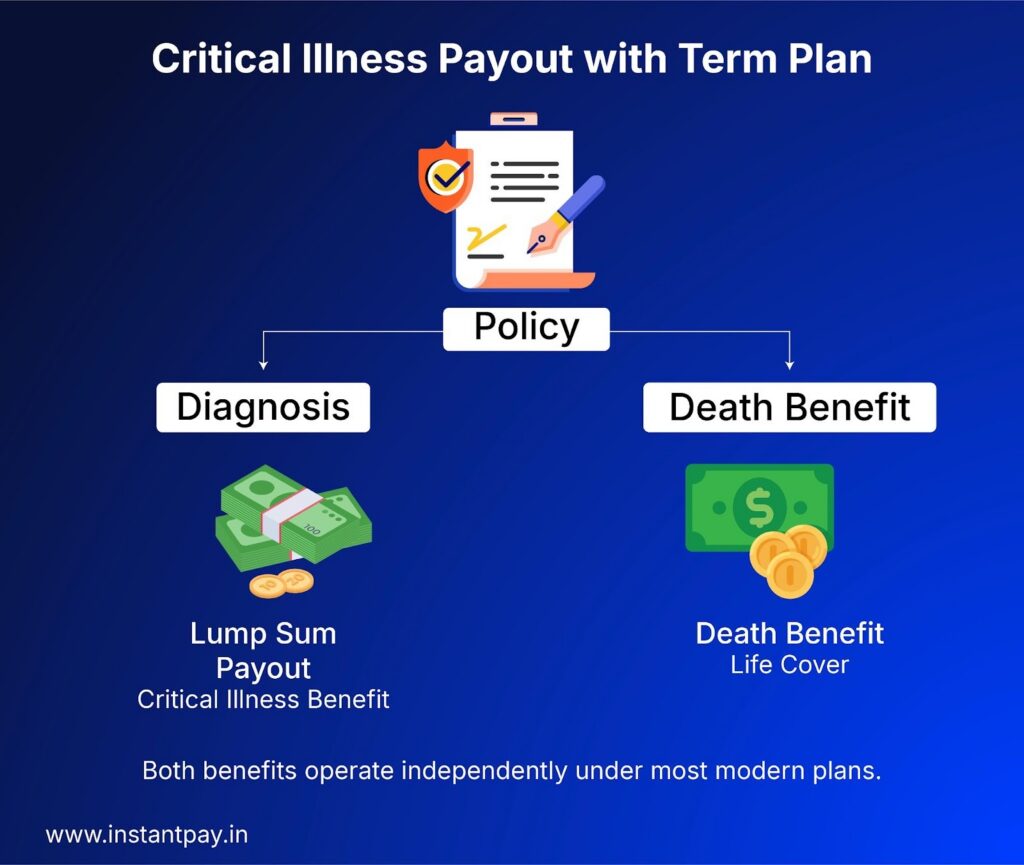
When a policy holder dies, the policy holder’s family gets a portion of the policy, while a Critical Illness Claim pays the policy holder a lump sum while they are still alive, and that is the primary difference that sets life insurance and a critical illness benefit apart.
Term Insurance with a Health Rider is a two-pronged financial safety net. This is how it is set up:
- If you are diagnosed with one of the critical illnesses described in the contract during the contract term, you will receive one critical illness payout.
- If you die, the life insurance policy will still be in force, and the nominated person will receive the death benefit, or the life cover.
One of the benefits of these two coverages is that they are non-overlapping. This means that one benefit will not cancel the other (except as noted in the policy wording).
This is the essence of the value of CI riders. It combines the elements of a short-term and a long-term protection in a single plan.
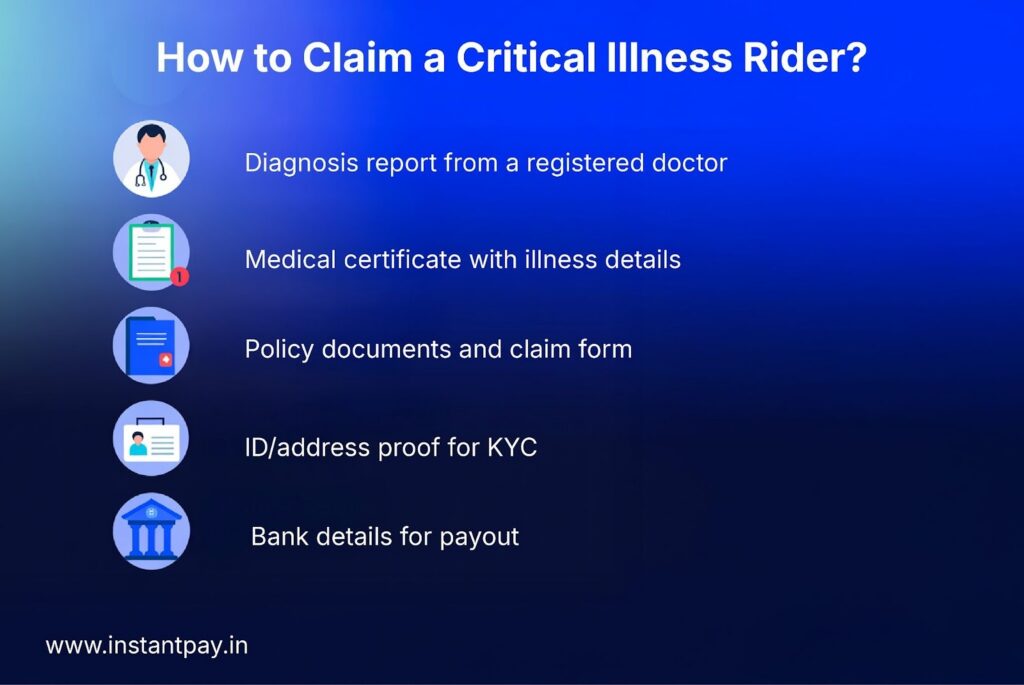
If approved, the insurer pays the entire claim amount with no need for any hospital bill submissions.
Pro tip: To avoid delays, always inform the insurer about the diagnosis
How Many Critical Illnesses Are Covered by Major Insurers in 2026?
The number of illnesses covered under these riders varies widely. Some plans offer basic protection (10–25 illnesses), while others extend to 60+ diseases—including cancer, organ failure, and neurological disorders.
Coverage Details from Major Indian Insurers
Insurance Company | Plan Name | Number of Critical Illnesses Covered | Maximum Policy Duration (years) |

| Click 2 Protect Super | 60 | 15 |

| iProtect Smart | 34 | 30 |

| Smart Term Plan Plus | 22 / 64 | 20 |

| E-Touch II | 10 / 25 / 60 | 20 |

| Sampoorna Raksha Promise | 40 | 5 (renewable up to 75 years) |

| Smart Term Plan | 64 | Not specified |

| Mera Term Plan Plus | 50 | Not specified |

| Poorna Suraksha | 36 | Not specified |
Note: Some insurers offer multiple variants (basic, mid, comprehensive), hence the range.
Cost of Treatment and Financial Impact
How does early coverage of common diseases like kidney failure or paralysis benefit me?
Early protection ensures you receive the lump sum immediately upon diagnosis, allowing you to access high-quality care without exhausting your savings or disrupting your income.
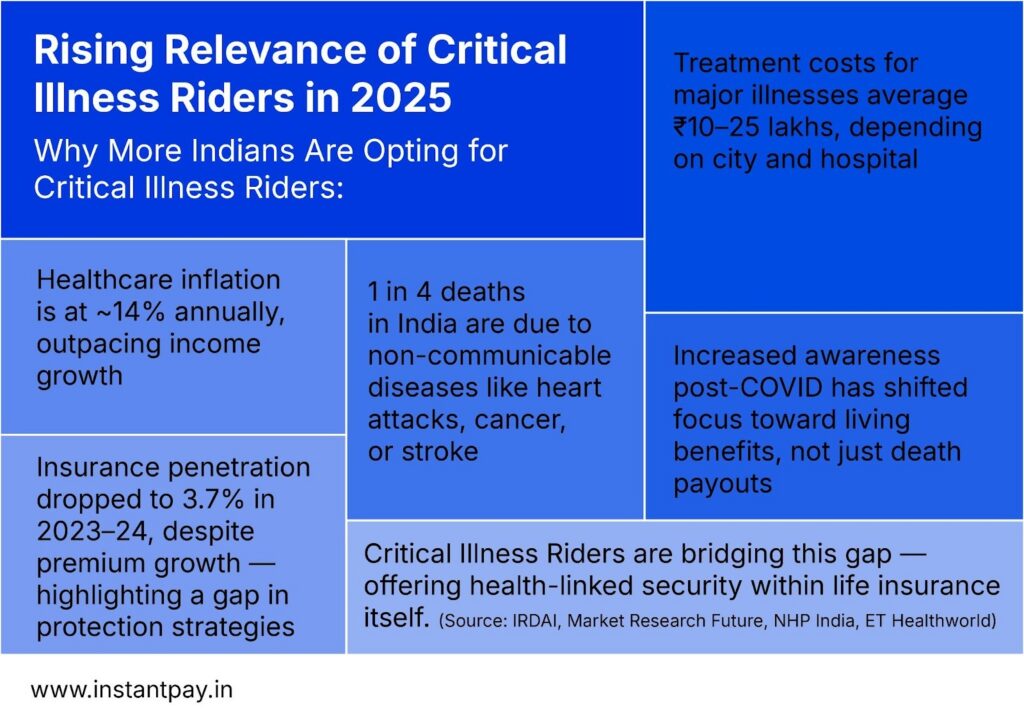
Even as premium collections rise, India’s overall insurance penetration dropped to just 3.7% in FY 2023–24 — down from 4% the previous year. This declining coverage comes at a time when lifestyle diseases are increasing sharply, pushing treatment costs to new highs. That’s why early protection with a serious illness benefit like this becomes a financial necessity, not a luxury.
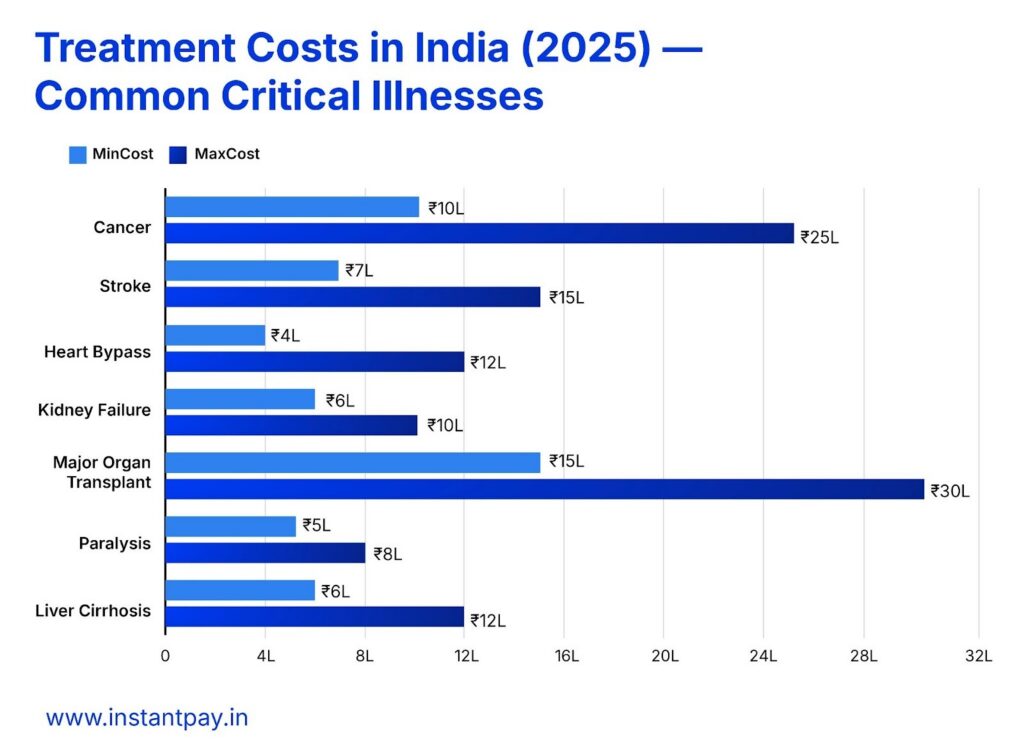
Cancer-related treatments in Tier-1 cities now average Rs.15–18L, often requiring out-of-pocket funds or long-term loans. Riders like this help you sidestep financial trauma during recovery.
Key Considerations Before Adding a Serious Illness Cover to Your Term Plan
While health-related add-ons may appear comprehensive, they can be quite different from one another. Before you sign, you must consider important elements that will ultimately affect the coverage, claims, and finances.
What to check before buying a critical illness rider?
Always review exclusions, claims process, benefit reduction clauses, age-based premiums, and tax benefits to ensure your serious illness coverage delivers true value when needed.
1. Know Your Policy Exclusions
Not every serious illness is covered. Certain policies do not include coverage for illnesses diagnosed at early stages, or illnesses that are a result of pre-existing conditions, substance abuse, or conditions that are hereditary. Always do a thorough review of the exclusions list.
2. Understand the Claims Process
What is the process for filing a claim? Is it a digital process, assisted process, or is it an offline process? What specific documents may be requested? How quickly do I need to inform my insurer? Understanding the claims process will help you understand what to expect when you need it the most.
3. Look for Co-Pays or Benefit Reduction Clauses
Your plan may contain a clause that reduces the payout percentage if you are diagnosed with a certain illness after a certain age, or it may carry co-payment clauses for specific diseases. Therefore, it may contain less financial assistance than you expected, so carefully read your policy
4. Age-Related Changes to Premium
If you try to add a Critical Illness benefit after age 45, your premiums will be higher, or you may have limited reduced sum assured options. It is more economical to add the benefit earlier.
5. Make most of Your Tax Benefits
The premiums you pay for these riders may be deductible under Section 80D, but tax efficiency is a function of how the benefit is designed — either as a stand-alone benefit or bundled with other benefits.
Trends to Watch in 2026: Critical Illness Riders
What are the trends in critical illness riders for 2026?
In 2026, there will likely be widespread implementation of serious illness riders, digital health evaluations, and the IRDAI will likely improve the transparency of riders, making their benefits more clear.
Digital-First Underwriting:
The new trend in InsurTech is to use AI for health evaluations and approvals for the aforementioned illnesses. Customers can expect to be able to onboard faster and not have to wait as long for policy approvals.
Final Thoughts
A term plan is a promise to protect your family’s future; however, a critical illness can affect your future as well. That is when a well-structured rider comes into play.
The Critical Illness Rider, for example, is not a typical rider. Rather, it is a form of financial protection that responds to claims during the most stressful times of your life — during a serious illness. Because it is provided as a lump sum, it financially facilitates treatment, supplements the income loss during a health crisis, and relieves financial stress to enable the insured to concentrate on recovery without affecting the long term objectives.
The rising cost of medical care and the unpredictability of health problems in the future makes this rider an important addition to your term plan to enhance its effectiveness. It is most important to the working professionals, caregivers, and individuals who are in their 40’s.
Be selective with the rider that you choose, as the right rider can enhance your policy and individually provide a comprehensive buffer.
FAQs
1. What is the critical illness cancer rider?
It’s an add-on to a term plan that pays a lump sum if you’re diagnosed with cancer, helping cover treatment and income loss.
2.Is critical illness rider worth it in term insurance?
Yes, it adds vital financial protection for serious illnesses, covering costs that standard life or health insurance may not.
3.What qualifies as critical illness?
Diseases like cancer, heart attack, stroke, kidney failure, and major organ transplants typically qualify, depending on the insurer’s policy.
4.What is the maximum age for critical illness cover?
Usually 65–70 years, though it varies by insurer. Some allow renewable coverage until 75.
5.What are the disadvantages of critical illness insurance?
Limited disease list, waiting and survival periods, and non-renewability at older ages are common drawbacks.
6.What is the maximum age for critical illness insurance?
Most insurers offer coverage up to age 70; some allow renewals till 75 depending on policy terms.
7.What diseases are covered by critical illness?
Coverage varies, but often includes cancer, stroke, heart disease, kidney failure, paralysis, and major surgeries.
8.When to claim critical illness?
You can file a claim after diagnosis, once the waiting and survival periods are met.
9.Is arthritis a critical illness?
Typically, no. Unless it causes severe disability, arthritis isn’t listed under most critical illness policies.