A single medical emergency can destroy years of savings and a cyberattack can shut your business down overnight. In present-day evolving India, where healthcare costs are rising, climate hazards are increasing, and digital businesses are booming: Insurance is no longer an option, it is a crucial safety net for people and businesses alike.
However, millions of citizens do not have any type of insurance. According to NITI Aayog’s “Health Insurance for the Missing Middle” report, approximately 30% of Indians (40 crores) are part of the “missing middle”. They are too wealthy to qualify for existing Government programmes, such as PM-JAY, but they do not have any insurance, nor are they willing to purchase private insurance. This guide will provide an overview of the various types of insurance in India, such as life and health insurance to modern solutions like cyber and business insurance, so you can better protect yourself, your family, your finances, and your future.
What is Insurance and How Does It Work?

What is Insurance?
Insurance is essentially a financial safety net for you in circumstances when an unexpected incident occurs, like an emergency medical bill, an auto accident or damage to your building as a result of a weather event; therefore, the goal of having insurance is to avoid a single event from ruining your financial situation.
In simple terms, when you purchase insurance, you are transferring your risk to the insurer by paying them a small amount, typically called your premium on a periodic basis, in exchange for the insurer’s promise to cover you for certain damages as specified in your policy.
As a result of the uncertainty that the world has become due to increased healthcare costs, increased climate related events like floods and wildfires, and increased cyber-attack risks, insurance is a crucial component of your financial stability.
Key Terms for Insurance to Know:
- Premium – the amount you pay on a regular basis to maintain an active policy.
- Policy – the official endorsement that details what will be covered by the insurance policy and what will not be covered.
- Deductible – the portion of the loss that you must pay before the insurer will cover the remainder of your loss.
- Beneficiary – the person who receives the benefit of the insurance policy’s professed value.
Types of Insurance in India: A Detailed Breakdown
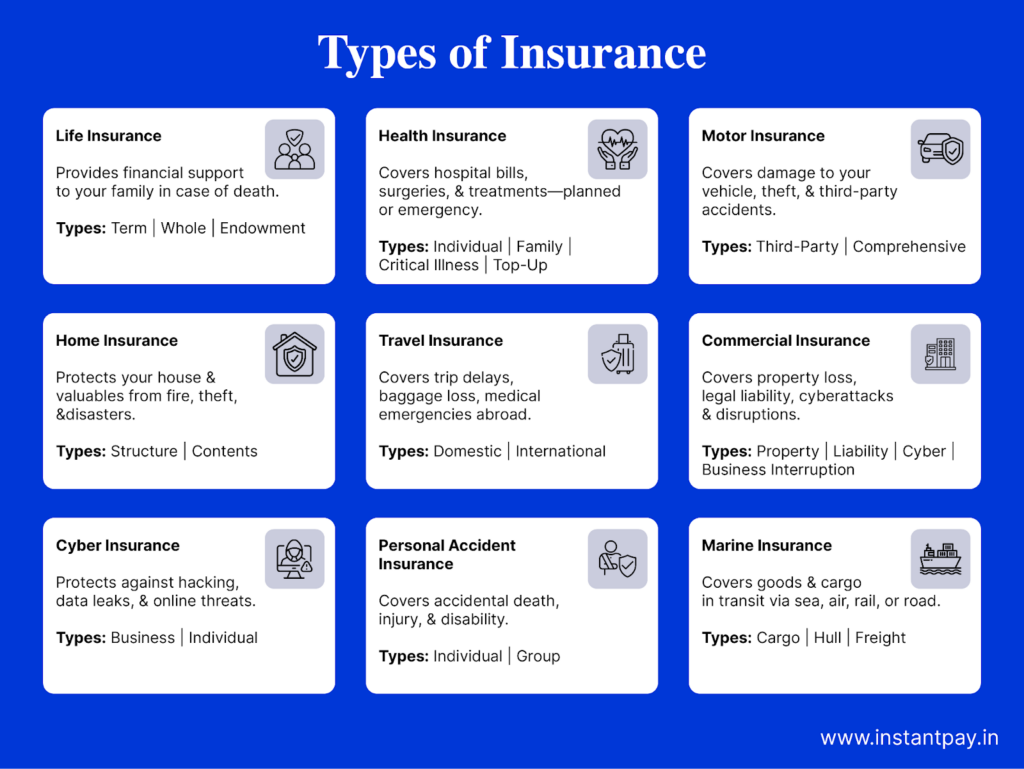
The type of insurance required in India will vary based on stage of life, responsibility and level of assets owned. Different types of insurance provide protection for different participants; therefore, accurately identifying the need for insurance will give you clarity when it comes to filing a claim or choosing to purchase that coverage.
1. Life Insurance
Provides the beneficiary with a financial benefit when the policyholder dies. The financial payout could be used to maintain an individual’s living expenses, pay down existing debts and help meet the beneficiary’s long-term goals (i.e., fund a child’s education). Life insurance serves as a cushion for the financial loss at the time of death of the dependent.
Ideal for: People with Dependants e.g., spouse, children, aged parents, etc.
Common types in India:
- Term Life Insurance: Provides coverage for a specified term and is the most affordable type.
- Whole Life Insurance: Offers lifelong coverage, along with a savings or investment component.
- Endowment Plans: A hybrid policy that combines insurance with a savings plan, paying out after a set period or upon the policyholder’s death.
2. Health Insurance
Generally referred to as ‘basic health coverage, health insurance protects against basic costs associated with medical treatment, to include bills associated with hospitalisation; surgery; required diagnostic testing; and the cost of other forms of required medical treatment. Medical costs are on the rise in India, so a single hospital bill could deplete a considerable amount of assets if no insurance is in place. Health insurance will allow insured individuals to receive medical treatment without paying large sums of money out-of-pocket.
Ideal for single policyholders, family-type (i.e., mother, father and child) policyholders, and those requiring family-related assistance.
Popular variants:
- Individual Health Plans: Coverage for just one person.
- Family Floater Plans: A single policy that covers all members of the family.
- Critical Illness Plans: Covers specific life-threatening conditions like cancer, heart disease, etc.
- Top-Up & Super Top-Up Plans: Additional coverage on top of existing policies to cover higher medical expenses.
3. Motor Insurance
Motor insurance provides coverage for your vehicle and its liability for damage to others in the event of an accident, theft, natural disasters and other types of loss. It can provide money to cover the cost of repairs for your own vehicle, and can also provide money for liability if your vehicle causes bodily injury or property damage to another person. All owners of motor vehicles In India are required by law to purchase and maintain third-party motor insurance.
Ideal for: All owners and operators of automobiles, motorcycles, and commercial motor vehicles.
Types:
- Third-Party Liability Insurance: Legally required and covers only third-party damage.
- Comprehensive Insurance: Covers both your vehicle and third-party damages, including theft, natural disasters, and accidental damage.
4. Home Insurance
Home insurance is designed to provide protection to you and/or your property from a variety of risks, including fire, theft, natural disasters, or an accident leading to the physical destruction of your home or personal possessions. Home insurance can provide coverage for both the primary structure (i.e., house) and personal property (i.e., electronics, furniture, appliances), which allows you to avoid significant financial hardship from having to rebuild or replace any damaged property.
Ideal for: Homeowners, tenants, and landlords.
Types:
- Structure Insurance: Covers damage to the physical structure of the house.
- Contents Insurance: Covers the belongings inside the home, such as furniture, electronics, and personal items.
5. Travel Insurance
Travel insurance will provide financial guarantees to the insured in the event of unexpected events occurring while travelling, including, but not limited to, medical emergencies in foreign countries, lost baggage, cancelled trips, delayed flights, or any other unforeseen circumstances. Travel insurance helps ensure that people who are travelling domestically or internationally do not incur significant financial losses as a result of unforeseen events. Travel insurance is particularly valuable in countries where medical care is significantly more expensive than in the client’s home country.
Ideal for: Frequent travelers, especially those going abroad or on expensive trips.
Types:
- Domestic Travel Insurance: Coverage for travel within India.
- International Travel Insurance: Protection while traveling abroad, covering medical emergencies, cancellations, lost baggage, etc.
6. Commercial/Business Insurance
Insurance for businesses will help to manage the risks of things like employee injuries and illnesses, property damage or loss, liability claims, or business interruption. This type of insurance may help businesses to recover financially from an unforeseen event and to keep operating. Today, many commercial insurance policies also cover cyber risks and provide coverage for business interruption.
Ideal for: Startups, small and medium enterprises (SMEs), and large corporations.
Subtypes include:
- Property Insurance: Protects business property from fire, theft, and other perils.
- Liability Insurance: Covers legal expenses arising from third-party claims.
- Cyber Liability Insurance: Protects against cyberattacks and data breaches.
- Business Interruption Insurance: Covers lost revenue due to events like natural disasters or equipment failure.
7. Cyber Insurance
Cyber insurance provides financial protection to individuals or businesses for losses due to a cyber event (like a cyberattack, hacking, ransomware, or data theft). It can also be used to pay for recovery costs, legal costs, and costs to notify customers after a cyber event. In India, the growth of digital payments and online businesses is making cyber risks more prevalent.
Ideal for: Businesses dealing with sensitive customer data, e-commerce companies, or anyone with substantial online activity.
8. Personal Accident Insurance
Personal accident insurance can provide benefits to the insured person for injuries or death sustained by the insured person as the result of an accident. This insurance may cover medical expenses incurred due to an accident and lost wages as a result of a disability. Having personal accident insurance will provide an additional layer of protection on top of your regular medical insurance.
Ideal for: Working professionals, especially those in high-risk jobs or frequently on the move.
9. Marine Insurance
Marine Insurance protects your goods while they are being shipped to you or your customers through the ocean, roads, railways or air. During transit, marine insurance provides protection against damage, loss, theft or accident. Today’s international trading environment has made marine insurance a key factor in the success of companies who ship and manage logistical operations.
Ideal for: Importers and exporters, manufacturers, wholesalers, and logistics companies.
Why Insurance Is Crucial for Financial Security?
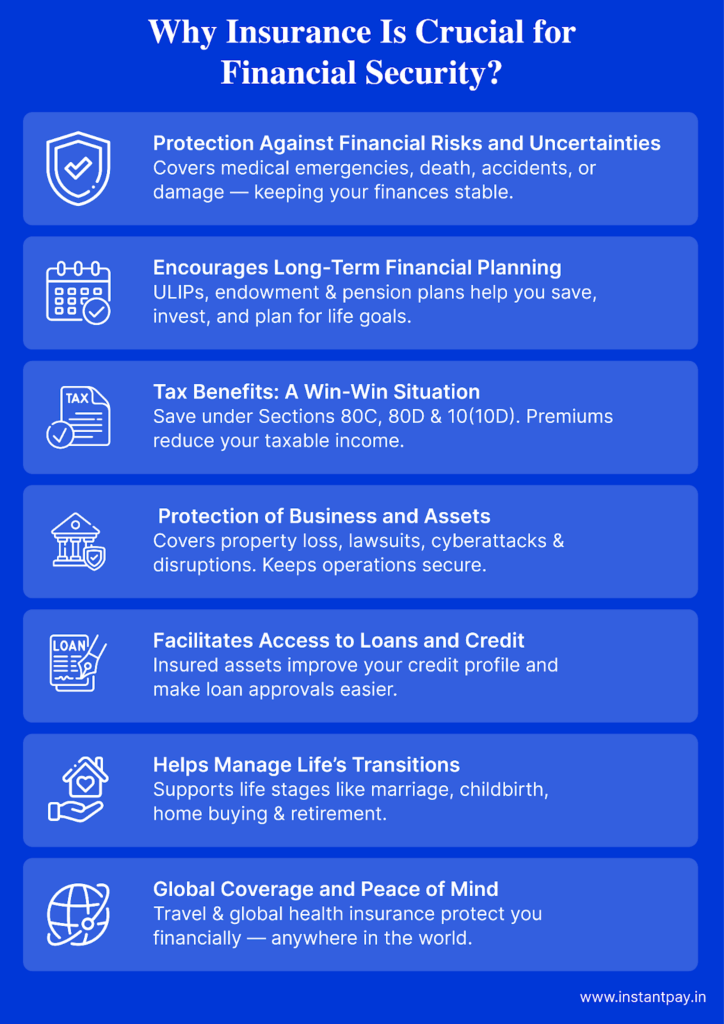
Unexpected events such as medical emergencies, accidents, or business losses can quickly disrupt even strong finances. Insurance provides individuals and businesses with a safety net that allows them to manage their risks without depleting their savings.
1. Helps You Manage Unexpected Financial Shocks
Insurance helps you manage sudden expenses that could result in significant financial distress. This allows you to avoid relying solely on savings during an emergency.
- Health insurance will cover your high-cost medical expenses.
- Motor insurance covers damage to vehicles and/or third-party liability.
2. Provides Incentives for Long-Term Financial Planning
Some insurance products offer protection as well as saving or investing benefits. This allows you to plan for big-life goals while remaining financially protected.
Endowment and pension plans are examples of how you can use insurance to help you plan for your retirement. Some life insurance products help you fund your children’s education.
3. Offers Major Tax Benefits That Reduce Your Financial Burden
Insurance policies can offer a large number of tax-saving opportunities under Indian tax laws. This means insurance can be a great way to protect yourself, while at the same time being a great long-term financial planning vehicle.
- Premiums for life insurance qualify for tax deductions under Section 80C.
- Premiums for health insurance qualify for tax deductions under Section 80D.
4. Business & Asset Protection
Businesses are always at risk of property damage, liability claims, and cyber attacks; thus, they need to protect themselves financially with insurance in order to resume operations after any type of disruption.
- Property insurance protects business property.
- Cyber insurance helps businesses recover losses resulting from data breaches.
5. Management of Major Life Change Events
As life events increase your financial litigation obligations, so will your financial stability when you can count on insurance during your major life changes.
- Life insurance provides income to dependents upon your death due to the birth of children or marriage.
- Health insurance provides support with the increased cost of health care due to growing older.
6. Strengthens Access to Loans/Credit
When applying for a loan, insurance provides a source of financial assurance to lenders by establishing the financial legitimacy of the borrower in obtaining a loan. Consequently, lenders often require loan applicants to have appropriate levels of insurance for all loans that are secured against their assets.
- As proof of coverage, lender requirements for mortgages often require that the borrower have property or homeowners insurance.
- As required by lenders, all loans for vehicles also require evidence of vehicle insurance coverage.
7. Peace of Mind/Global Coverage
As travel and international business continue to increase, the need for global insurance to provide support and financial protection continues to increase. The use of insurance-based travel insurance helps cover the cost of emergency medical treatment and trip cancellations while traveling outside of India, while international health insurance can help offset the cost of expensive health care while outside India.
How to Choose the Right Insurance for Your Needs?

The sheer number of insurance products available can make it difficult to choose. However, if you focus on your actual risks, your financial goals and your budget, you’ll make a solid decision about your protection without paying for coverage you don’t need.
1. Identify Your Risks
To choose the right insurance for you, it’s best to identify what risks you have in everyday life or if you have a business. Insurance should only cover the things that you value the most.
- Individuals have health risks, dependents and owning homes and vehicles.
- Businesses may have the risk of property loss, business liability claims, cyber threats, and employee risks.
2. Make Sure Your Coverage is Balanced with Your Budget
Choose the type of your coverage that provides adequate protection and does not cause you financial hardship. The cheapest policies are not always the best if they create serious gaps in your coverage.
- Compare premiums, deductible amounts and limits of coverage for each policy you’re interested in.
- If you don’t need the optional “riders” on your policy then don’t purchase them.
3. Research and Compare
The quality of service and the reliability of different companies vary greatly. Find insurance companies that have strong claims histories as well as providing good support to their customers.
4. Give Yourself Time to Compare
Prior to making a final choice regarding the insurance policy, be sure to compare several different insurance policies with different insurance companies.
- Be aware of coverage limits and exclusions as you’re comparing coverage limits.
- Be sure to check for optional riders you would like to add to your policy such as critical illness or accident coverage.
5. Pay Attention to Exclusions
The policy you purchase will explain to you the exclusions you have within your policy as well as what the claim process is as well as what the renewal process is. By understanding this information, you can eliminate being surprised when you file a claim.
Final Thoughts
Although many families across India continue to be uninsured or under insured resulting in risk against unexpected financial hardship, there are options available today. One of the most important factors to consider when creating a secure financial future is the use of insurance.
Each type of insurance can protect you in different ways:
- Health Insurance: Covers your medical expenses after an accident or illness.
- Life Insurance: Provides financial support to family members after you pass.
- Motor Insurance: Insures your car against theft & injury.
- Home Insurance: Protects your home & contents against theft & damage.
- Travel Insurance: Protects your belongings when traveling outside of your country.
Closely reviewing each type of coverage, determining your needs, and selecting coverage that meets these needs will provide you with the basis for creating a solid financial safety net.
Insurance coverage can now often be purchased via digital platforms with fast processing times and easy-to-understand policy documents. The resources are out there to protect you both now and in the future; it just takes a single, wise choice to create your own safety.
FAQs
1. What is a claim in insurance?
A claim is a formal request to your insurer asking for payment based on your policy terms, typically made after an insured event like hospitalization, theft, or damage.
2. Is insurance only useful during emergencies?
No. While insurance is crucial during crises, it also offers long-term financial planning, tax benefits, and peace of mind.
3. Do young and healthy people really need insurance?
Yes. Getting insured early often means lower premiums, fewer exclusions, and uninterrupted coverage when you actually need it.
4. Does insurance cover every possible loss?
Not always. Every policy comes with exclusions. It’s important to read the terms to understand what is and isn’t covered.
5. Can I trust digital insurance platforms?
Yes, if the platform is IRDAI-compliant.They often offer faster processing, transparent pricing, and better comparison tools.
6. Is life insurance the same as health insurance?
No. Life insurance provides a payout to beneficiaries in case of death, while health insurance covers medical expenses.
7. What are some common insurance myths?
- “I don’t need insurance because I’m young and healthy”
- “Insurance claims never get approved”
- “All policies cover everything”
- “Group insurance is enough”
All of these are misconceptions. The truth lies in knowing your policy well and choosing the right coverage.