Although you have a solid employment background with an income that is able to consistently meet your debts, pay your bills on time, and have a good credit score (the last time you checked it was on your CIBIL report), when you applied for a loan, it was denied for “no reason.” You were not given any indications that your loan would not be approved, nor were you made aware of any issues that might arise from your application, and you received no notice that you were declined, just a simple “no.”
In many instances, your income and your intention to pay back the loan are not the reason you are not being approved. However, there is a far more significant issue preventing you from getting your loan, which is likely related to your PAN Card number.
People typically do not consider how their same-day PAN numbers report against their same-day CIBIL credit scores. A PAN number is your day-to-day tax identification number and serves to give the RBI authority over the credit reporting for the reporting of your credit usage. Accordingly, by leveraging unique identifiers such as your PAN number, there is a singular credit file being created for each of the over 600 MM individual and 32 MM corporate credit accounts maintained by the major credit bureaus such as TransUnion CIBIL.
To create these singular re-identification of individuals and corporations so that all the loans, credit cards, and EMI payments are part of the same credit file for that borrower in terms of banks or lenders using any of those credit bureaus as their credit reporting agent.
Further to make it worse, there are currently two credit bureaus and therefore it is highly likely that a credit report that is sent from either credit bureau to both credit bureaus may not be a complete or accurate representation of that individual and or corporation. Therefore, a loan application might only contain partial loan information which will result in either the application being denied or not being processed and/or approved as applied for.
Likewise, the current retail loan and personal loan growth in India continues to grow at an annual compounded rate of over 20%. The sectoral statistics from the Reserve Bank of India continue to indicate strong growth in the area of personal credit, illustrating the depth with which credit has established itself within the day-to-day financial lives of consumers.
The expansion of personal credit is being accelerated by the rise of fintech and new digital lending channels. In FY24, fintech lender NBFCs approved nearly 9 crore loans totalling Rs.98,000+ crore, making up about 65% of total loan volume and indicating how quickly digital channels are expanding access to credit for previously unbanked or first-time borrowers.
Overall, NBFCs were part of broad-based expansion in credit. By March 2026, total amounts of credit issued by NBFCs are expected to reach approximately Rs.48.4 lakh crore, evidencing their significant role in the credit distribution system in the country.
Buy Now, Pay Later (BNPL) is one of the fastest-growing components of this system and is projected to grow from roughly $37 billion in 2026 to nearly $92 billion in 2031 at a CAGR of close to 20%.
Additional estimates suggest that BNPL could reach $46 billion by 2034 or even $78.5 billion by 2030 with aggressive growth and high rates of e-commerce adoption, along with heightened demand for short-term, flexible credit.
Both BNPL and embedded finance increasingly provide first-time borrowers, particularly millennials and Gen Z, an opportunity to enter the credit ecosystem without an existing credit history. Products and services that offer BNPL are often integrated into the checkout experience, facilitating near-frictionless access to credit.
As such, it is imperative to accurately map your identity through your PAN, as these early behaviours—generally of a small dollar value and short duration- will dictate your long-term credit score. A minor contradiction today may ultimately have a relatively large influence on your entire credit history tomorrow.
In this blog post, we explore the connection between your PAN card and your CIBIL report, how even something as simple as a discrepancy in your PAN details can potentially lead to a lower credit score or rejection of loans, and what you can do to verify and correct your credit report so that you remain ready to access credit.
What Is the PAN Card & Credit Score Connection?
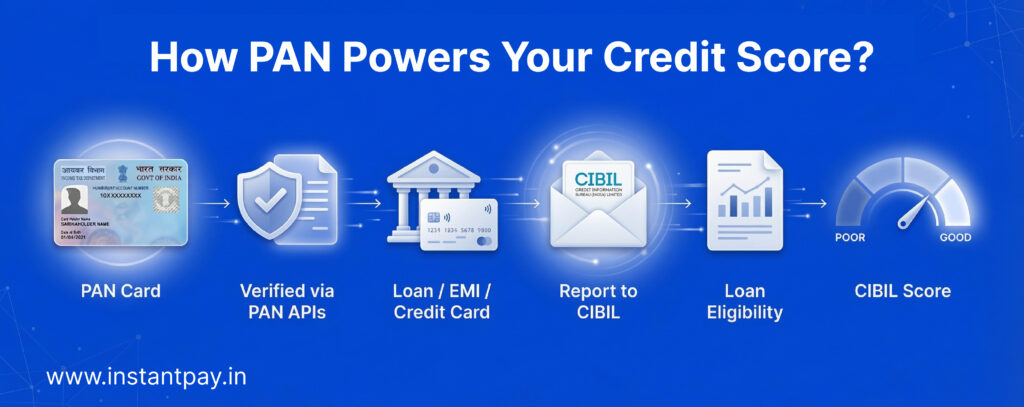
Your credit score is not a stand-alone item, it is uniquely identified by your Permanent Account Number (PAN). Whenever you apply for a loan, use your credit card, or make an EMI payment, the lender enters that activity into the credit bureau such as CIBIL and connects it back to your PAN.
Having a PAN as your unique identifier prevents duplicate accounts from being created in the credit bureau database and ensures that the information about your credit history is accurately mapped back to your PAN, providing lenders with a reliable means of evaluating your overall pattern of financial behaviour.
Can I get a CIBIL score using my PAN card only?
Yes. Your PAN is the primary ID used by credit bureaus like CIBIL to track your loan and repayment history.
Any errors such as a name mismatch or duplicate PAN can negatively impact your entire credit history by disrupting your credit trail and resulting in an inaccurate credit score or a flagged report. Because of this, companies frequently implement PAN verification APIs to verify the accuracy of the individual’s PAN information prior to reviewing loan eligibility and pulling credit reports.
Does PAN change affect credit history?
Yes—especially if the new PAN isn’t updated across all linked financial institutions, which can break your credit record and reset your score visibility.
Steps to Check PAN Card & Credit Score Using CIBIL
As a quick access point for monitoring and maintaining credit scores, your PAN can facilitate getting an overview of your entire credit history through access to your complete credit summary in one place prior to applying for loans and/or credit cards. In addition to having access to multiple free credit reports, should you choose not to purchase a detailed report, or to use free credit reporting services, your PAN will serve as an anchor for retrieving your credit report from any given source.
Which site gives the most accurate CIBIL score by PAN?
TransUnion CIBIL offers the most detailed credit report via its official site. However, platforms like Paisabazaar and BankBazaar also provide reliable summaries.
Keep in mind the following when retrieving your credit report via different platforms: you will need your PAN, date of birth, and mobile number with OTP authentication; it is imperative that the information you enter on the website matches your PAN records accurately in order for them to verify your identity; you will likely have the option of accessing either a completely free platform or purchasing the credit report as a premium service, therefore you will want to plan for what service best fits your needs based on your research and preferences through this comparison guide..
Checklist: What You Need Before Checking Your Credit Report
- PAN number
- Mobile number linked to PAN for OTP
- Correct name and date of birth as per PAN record
- Decide between a free monthly check or a detailed CIR
Compare Platforms to Check Credit Score Using PAN
| Platform | Cost | Report Type | Frequency |
| Paisabazaar | Rs. 0 | Monthly summary | 1x/month |
| CIBIL official | Rs. 550 | Full CIR + history | Anytime |
| BankBazaar | Rs. 470 | Summary + trends | 1x/month |
How to Check Your CIBIL Score with PAN: Step-by-Step Guide?
Here’s how to check your credit score using your PAN card on official and free sites, whether it’s your first time or you’re tracking it regularly.
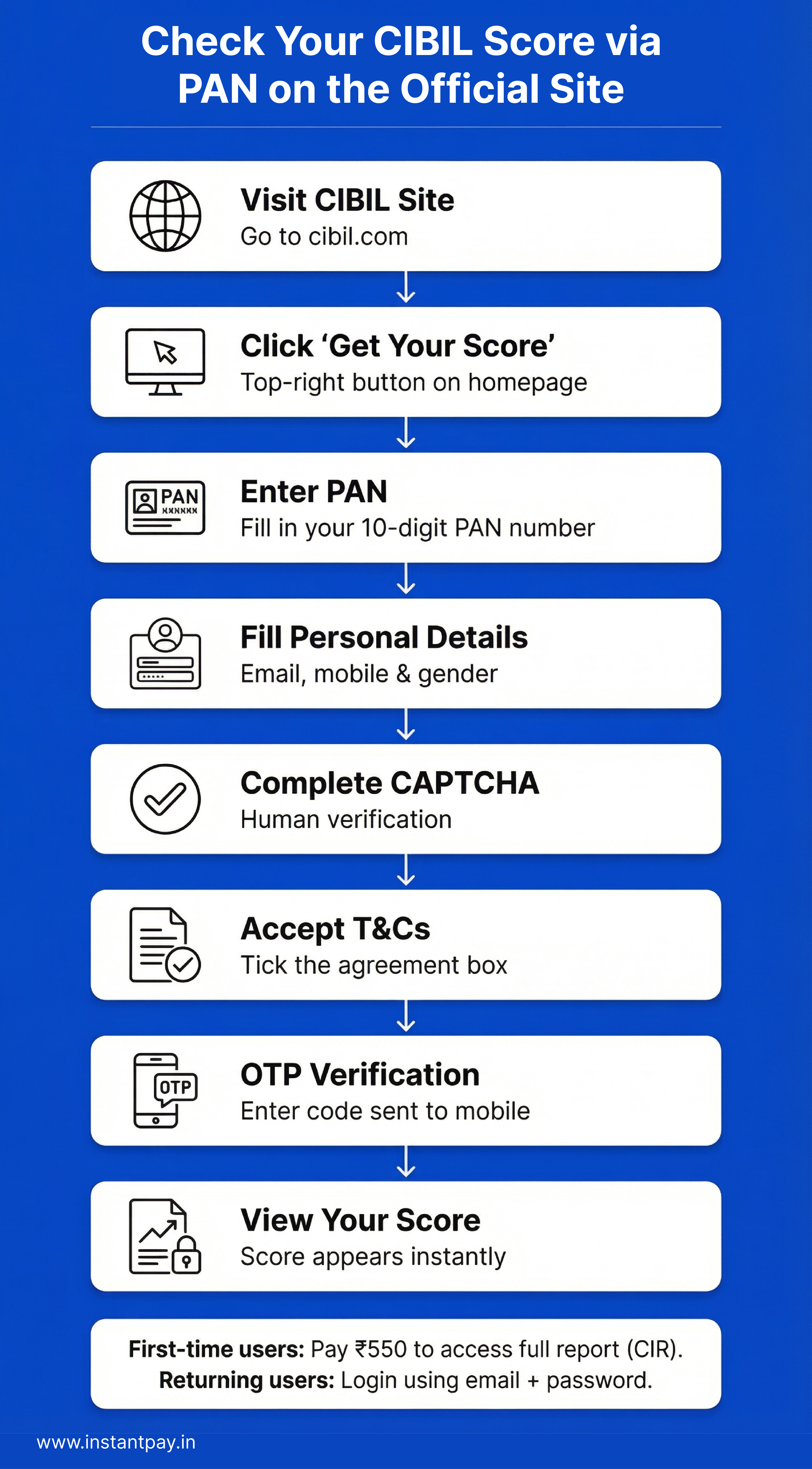
Follow these steps to check your detailed credit report via the official CIBIL portal:
Step 1: Visit the official CIBIL website
Step 2: Click on “Get Your CIBIL Score” (usually top-right)
Step 3: Enter your valid PAN card number
Step 4: Provide details like date of birth, gender, mobile number, and email
Step 5: Complete the CAPTCHA
Step 6: Accept the terms and conditions
Step 7: Authenticate using the OTP sent to your mobile
Step 8: Your CIBIL score will be displayed on-screen
The first time you try to use this service it will take you to a payment gateway where you can pay for the credit information report (CIR), which costs Rs.550; You have the option of receiving this report either by email or by post. If you have previously purchased a CIR then you may use your email ID and password to log into your account.
Don’t Have a PAN Yet?
While PAN is the standard for credit tracking, some platforms allow access using alternative details, such as name, date of birth, identity proof (like Voter ID or Aadhaar), address, and mobile number. However, without a PAN, your credit footprint may be limited or unavailable.
How to Check Active Loans Linked to Your PAN Card?
Your Permanent Account Number (PAN) is associated with any loans you’ve ever taken out or credit cards you may have used, so if you’ve ever borrowed money then you will have a loan history associated with that PAN. By simply providing the PAN along with some other information about yourself, you can retrieve the complete history of your loan obligations, including current loans, loan payments made in the past, outstanding balances on credit cards, and settled loans.
Can I track pending EMIs using my tax ID?
Yes. A credit report generated via PAN includes active EMIs, their due dates, loan tenure, and repayment history, allowing you to monitor obligations in real time.
When you query your credit report using your PAN, information will be collected from various financial institutions, who report to credit bureaus to create a summary of all your outstanding debts. This report helps you see what you owe now and if there are old debts or wrong closures to fix.
Some fintechs and service providers also make use of alternative data channels and new technologies to cross-reference potential liabilities that may be associated with an individual’s PAN for the purpose of adhering to regulatory obligations (e.g., the Income Tax Act’s 206AB and 206CCA). These services allow lenders to identify individuals who face elevated risk due to defaulted or high-risk liabilities before making lending decisions. When evaluating potential borrowers for business or compliance purposes, PAN 206AB/206CCA Lookup APIs provide an additional layer of validation.
CIBIL Score Range in 2026: What’s Good Enough Now?
Using someone’s credit file when checking their credit score via their PAN (Personal Account Number) provides a number between 300 & 900 that can determine your financial credibility to a lender. By 2026, as more consumers adopt fintech to pay bills, lenders will have higher expectations of consumers as a result of tighter underwriting requirements. As of now, the CIBIL credit score scale remains unchanged but lender’s cut-off score to process loans faster has changed to a score of 700 or greater. Therefore, if you want to be considered for an Unsecured Loan, obtaining a minimum of 700 as your CIBIL credit score will be your first step towards success with your application.
What score is considered good for loans?
A credit score of 720 or above is generally considered excellent for most lenders in 2025. It increases your chances of approval and lowers your interest rate.
CIBIL Score Band Table
| Score Range | Rating | Loan Impact |
| 300–500 | Poor | High rejection probability |
| 550–650 | Fair | Likely approval with higher interest |
| 650–750 | Good | Most banks and NBFCs approve |
| 750–900 | Excellent | Pre-approved offers, low interest rates |
Your PAN-based credit score reflects your entire repayment behavior. Even if you’re not planning a loan immediately, maintaining a strong score helps build long-term financial credibility.
The Impact of Changing Your PAN on Your CIBIL Score
It can appear to be just another administrative task when making changes to your PAN. However, within credit scoring, it has a huge impact – positively or negatively – as it will either enable you to continue using the same history of credit (with the same name) or cut that past link with the same credit history.
Did You Know?
Getting a new PAN card (with a new number) and not informing your banks or CIBIL can break the link to your existing credit data. Your score could reset, and lenders might not find your loan history.
If You’ve Reissued the Same PAN (Same Number)
Reissuing the same PAN (i.e., using the same PAN number) only occurs when a valid PAN has been issued, but has either been lost or damaged, and you are requesting a duplicate copy.
- There is no effect on your credit score.
- All of your current credit information will still be linked to that same ten-digit number.
- You do not need to take any steps, since the only information that has changed is the actual plastic card/number.
If You’ve Gotten a New PAN (Different Number)
If you have a new PAN issued because you had a name change, an address change, or you need to update your identity, problems can arise because the new PAN is a new number and will not connect to any of your previous loans or repayments because it is seen as nothing more than a new loan.
The credit bureau (CIBIL) may see you as a new borrower; therefore, lenders may not see your repayment history or score (in many cases).
The only way to avoid these issues is to:
- Notify all of your banks and non-bank financial companies of your new PAN
- Request the credit bureaus to update your record
Check your new PAN linkage through a verification API before applying for credit.
Does PAN change affect credit history?
Yes. If your PAN number changes and isn’t updated with CIBIL and lenders, your past credit history may not reflect in your score.
When PAN Errors Drag Your Creditworthiness Down
The PAN is more than just a tax identification number; it is also used for identification and credit purposes. Even though your PAN information represents a single entity (i.e., you) to the taxation department, any inconsistency between that number and other forms of identification, such as those issued by financial institutions, can create serious problems with your credit profile.
What if my PAN has errors on my credit report?
Incorrect PAN details—like wrong spelling, mismatched date of birth, or duplicate records—can lead to fragmented or inaccurate credit reports. Fix them before applying for any loan.
They will include:
(a) Delay in approval of a loan application because your number cannot be verified.
(b) Be denied credit because your credit information is not linked to your number.
(c) Your credit report could show incorrect activity if the other parties do not have a correct record.
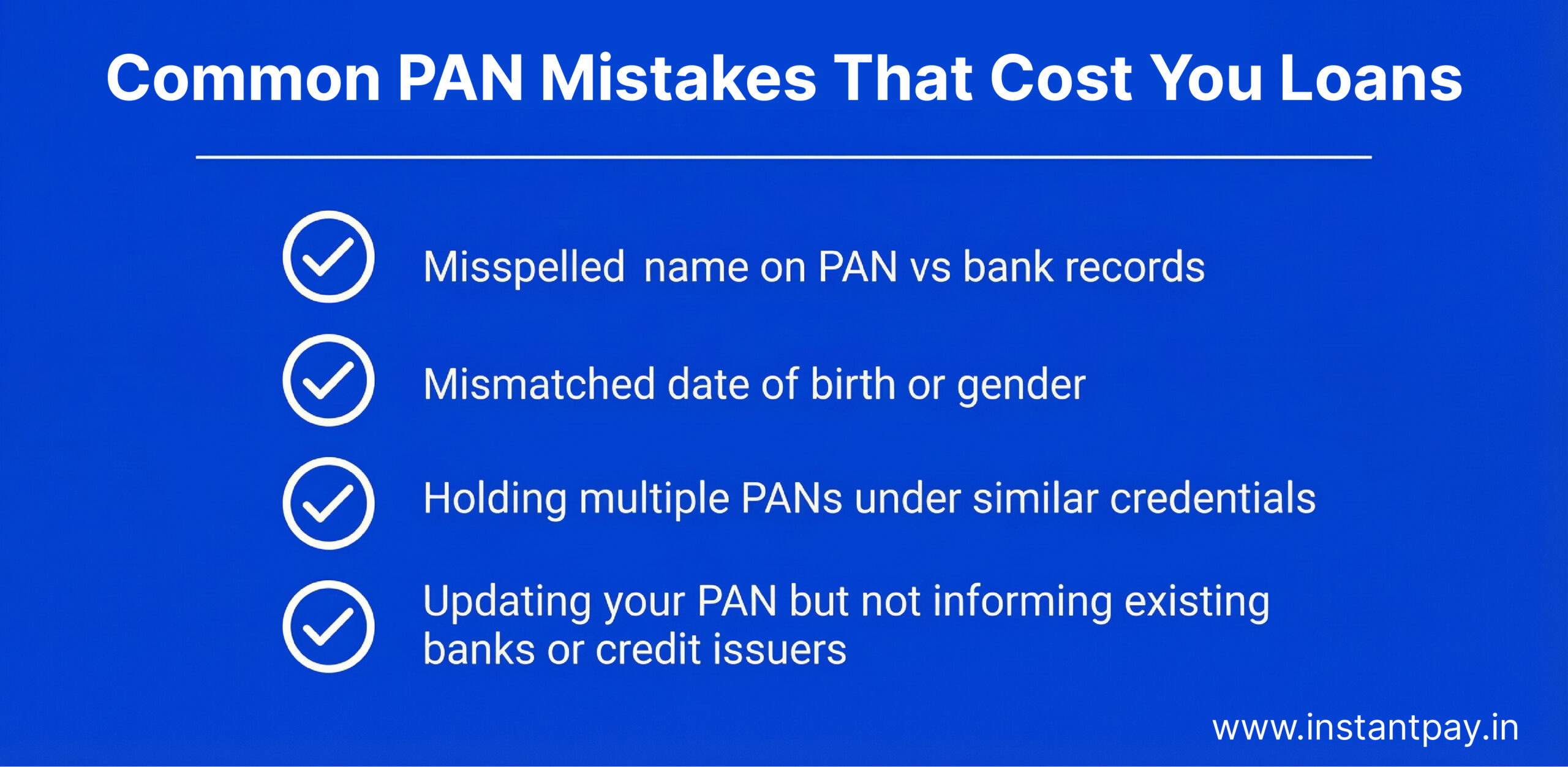
- Misspelled name on PAN vs bank records
- Mismatched date of birth or gender
- Holding multiple PANs under similar credentials
- Updating your PAN but not informing existing banks or credit issuers
These mistakes often show up during PAN–CIBIL validation, especially when lenders use automated verification tools before processing applications. To prevent last-minute surprises, it’s worth checking your PAN linkage health in advance.
How to Raise a PAN–CIBIL Dispute & How to Fix It?
Don’t Panic If There Is Incorrect Information on Your Credit Report!
Sometimes your credit report may have inaccurate loan accounts, it may show unknown defaults, or the details of your personal information don’t match your PAN. The good news is that CIBIL has a structured dispute resolution process through which you can reclaim the accuracy of your true credit status.
What to do if PAN-linked loan details are incorrect?
To process this, you need to submit a dispute via CIBIL’s online dispute resolution service. Submit along with your valid PAN/KYC proof. Wait for the credit bureau to conduct and complete their investigation, which usually takes up to 30 days to do so.
Here’s how to go about it:
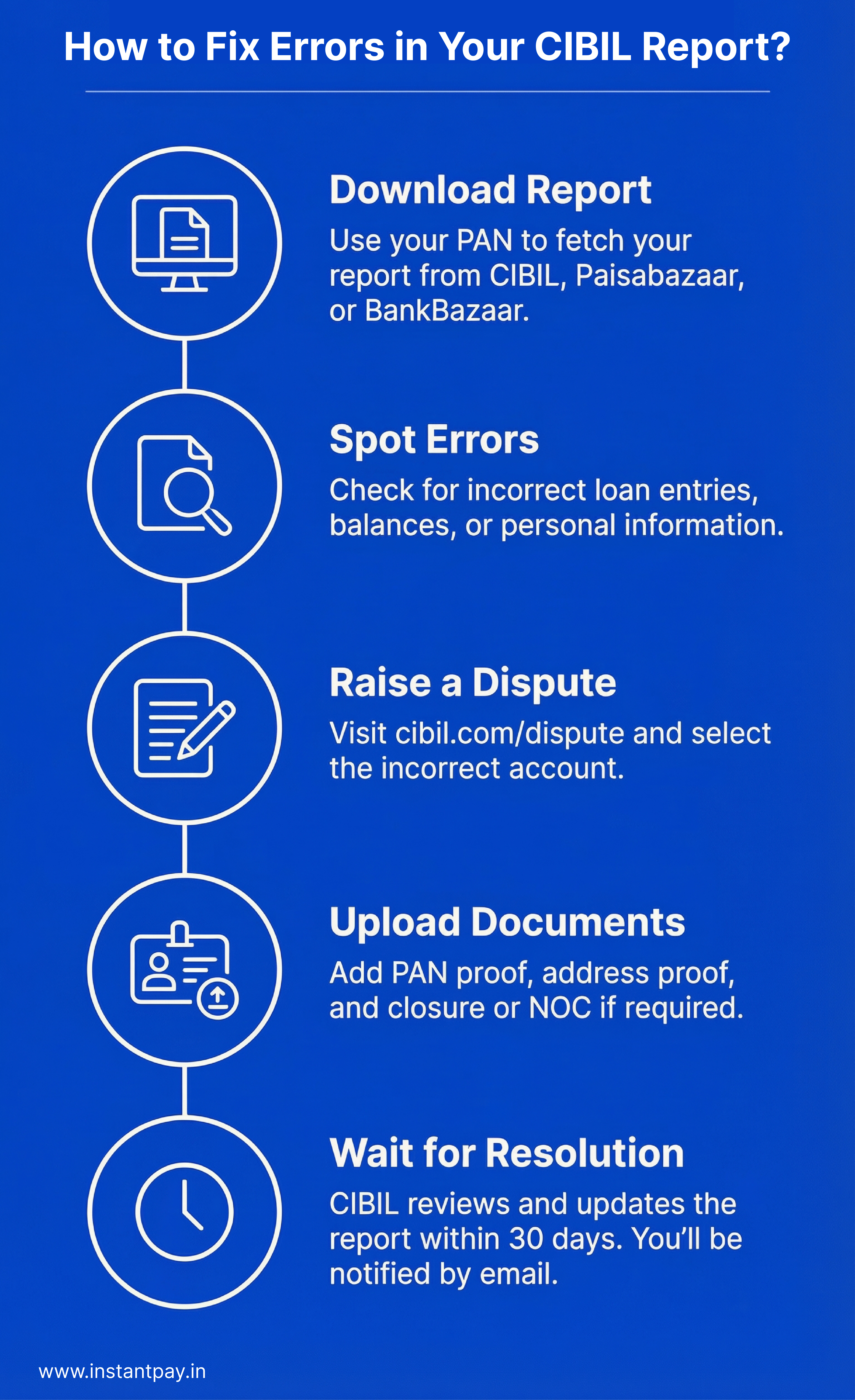
Step-by-Step: CIBIL Dispute Resolution
1. Using Your PAN Number to Obtain Your Credit Report
You can access your credit report from 3 sources: CIBIL, Paisabazaar, and BankBazaar.
2. Find Mistakes in Your Credit Report
Look for any loans that you don’t recognize, incorrect balance information, inaccurate personal identification, or any overdue accounts that are not yours.
3. Elevate a Dispute Online
To dispute a credit report error, use the CIBIL Dispute Center located at cibil.com/dispute.
From there, select “Dispute Type” and enter required information regarding the affected account.
4. Submit Required Documents
Upload your identity verification (PAN Card), proof of address, and loan closure/no due certificate documentation (if applicable).
5. Wait for Resolution
CIBIL will typically take no longer than 30 days to complete verification. You’ll receive a notification through email or on the dashboard regarding the status of your dispute.
Credit reporting errors that are linked to your tax identification number can remain unresolved indefinitely. Any erroneous accounts, whether they result from mistaken defaults or otherwise, should be corrected as soon as possible so that they do not negatively affect your ability to obtain credit, and ultimately, they are the first step to removing the defaulter flag from your PAN number once these errors are corrected.
How to Clear Your Name from the Defaulter List?
A loan default may be wrongly recorded in a person’s record but can restrict access to credit, create issues when being reviewed for employment, and diminish credit reputation. Under certain circumstances, if cibil indicators indicate a loan is in default and the borrower’s PAN is linked to that default status, actions can be taken that will allow for removal of the default markers quickly and easily.
Steps That Must Be Taken:
1. Settle the delinquent amounts with your financial institution (if applicable)
2. Dispute the default status based on an inaccuracy or out-of-date information provided to cibil.
3. Request a formal letter confirming prior loan status (for the charge-offs in question) from the lender, bank (or financial institution), as cibil relies on lenders to report the status of delinquent accounts.
4. File the letter w/ the dispute center of cibil along w/ identification.
5. Check your file every month w/ the use of your printed Id and your permanent account number (PAN) to verify whether or not the information has been updated to reflect true status only without providing false marking.
Pro Tip:
Don’t just stop after settling dues—ask for written confirmation from the lender and follow up with CIBIL. This is the most reliable way to remove the defaulter tag from your credit profile.
How to Apply for a Loan After Checking Your CIBIL Score?
After checking your credit score through your tax ID, next comes the process of applying for credit. This includes a personal loan, home loan, or business credit line. As long as you know what your score is and what score range it falls under, applying will be more successful and have lower interest rates than without this knowledge.
Tips to Follow Prior to Applying
1. Before you apply, always check that your latest PAN (Permanent Array Number) is still current. In the event that it was recently reissued or updated, it is important to use that number.
2. Make sure you are applying to a lender whose score criteria fall within your score range. If your score is higher than the brackets of a lender, you probably will be denied.
3. Do not apply to multiple lenders at one time because each of those types of application will trigger a hard pull inquiry of your report. Each inquiry made can potentially hurt your credit.
4. Include recent income verification, bank statements, and make sure that your address matches the address in your PAN.
5. When selecting to use full credit reports for application purposes be discerning: free reports will provide you with monthly updates, but paid reports (approximately Rs470.00 to Rs.550.00) will provide you with more comprehensive information and detail prior to applying.
If you’re unsure which report to get but require a historical report with full bureau reporting (i.e. CIBIL), select the official CIBIL report for Rs.550.00 instead of a summarized report. The nominal fee could save you thousands in denied loans.
Looking Ahead
In India, as digital credit grows, the relationship between your credit score and your PAN Card will get stronger. Over the next 2 years you can expect many changes to be made in relation to the following:
What’s Changing:
– PAN-Aadhaar linkage will likely become mandatory for all digital lending platforms to ensure seamless KYC verification and credit profiling when you apply for a loan.
– PAN 2.0 will likely launch with biometric-enhanced features for better fraud detection & real-time CIBIL score synchronization with all banks & lenders.
– Small and Medium Enterprises (MSME) will have their credit history and credit score evaluated based on tax ID-based credit maps, giving them a bureau-visible borrowing history.
– More extensive usage of PAN-based APIs for checking credit scores, compliance checking (206AB, 206CCA), and obtaining real-time credit health reports should enhance the embeddability of finance across all sectors.
As Regulatory Alignment occurs and Credit Products become more Customized, your PAN will no longer only be a tax ID; it will become your credit identity.
Keep Your PAN Score-Ready
Your PAN number is not only a unique identifier for your tax payments but also acts as a unique identifier for all of your financial transactions.
By linking your PAN to all of your credit-related activities, including credit card applications and requests for credit (for example, loans, mortgages, etc.), your PAN is essentially an electronic trail that leaves a record of each financial transaction.
As a result, when you have accurate, up-to-date, and monitored data associated with your PAN, it will be the most powerful tool you have for gaining credit.
However, when your PAN does not match the records of the lender, even a small discrepancy or outdated information can lead to delays in obtaining your credit, higher interest rates, and/or being denied credit.
Keep these points in mind:
- Monitor your credit score regularly using your PAN, either by using Paisabazaar for free or for a fee of Rs.550 through the CIBIL administration.
- Make sure you’re reporting any errors to the lender as soon as you find the error by informing them when there are errors in the records associated with your PAN.
- Always use your most recent PAN on any new applications for credit and notify the lender if your PAN is being reissued or corrected.
- Avoid making multiple hard inquiries into your credit account because they will have an immediate effect on your ability to obtain credit.
- Always take the time to build your credit profile so you will be prepared when it is time to apply for credit.
Frequently Asked Questions on PAN Card and Credit Score
1. Can my PAN card affect loan approval?
Yes. Lenders use your PAN card to access your credit history. Errors or missing data linked to your PAN can lead to rejections.
2. Can I have a credit score without a PAN card?
No. In India, credit bureaus require PAN to generate and maintain a complete credit profile.
3. Does changing my PAN card reset my credit score?
If the PAN number changes, your credit history may not automatically carry forward unless updated with lenders and credit bureaus.
4. Can having multiple PAN cards affect my credit score?
Yes. Holding multiple PAN cards is illegal and can cause fragmented credit reports and compliance issues.
5. How often should I check my credit score using my PAN card?
At least once a month to catch errors early and track changes.