India is a predominantly cash-based economy, which has seen considerable improvements in the form of bank branches and ATMs that have been digitized. These upgrades and new technologies have successfully improved user experience while simultaneously allowing banks to optimize their resources without impacting their efficiency.
The Reserve Bank of India has asked all banks, ATM networks and white label ATM operators to provide interoperable card less cash withdrawal (ICCW) at their ATMs, with NPCI facilitating UPI integration for these transactions. To further promote the accessibility of banking services, Prime Minister Mr. Narendra Modi inaugurated 75 Digital Banking Units.
The digital revolution has now revolutionized how we do business and interact with the world. Technology has enabled us to do more in less time, from online shopping to digital banking. In India, digital banking is set to transform the banking landscape, offering customers more convenience, faster transactions, and enhanced security.
With the Reserve Bank of India (RBI) introducing new regulations, banks can now offer customers a wide range of digital banking services. Customers can now easily manage their finances from online bill payments to mobile wallets.
By leveraging technology, banks can also reduce costs and improve customer service. As a result, digital banking units are becoming an integral part of banking operations in India. This article will discuss how digital banking units transform India’s banking sector and the benefits customers can enjoy.
Similar Insightful Articles:
What is digital banking?
Digital banking uses technology-enabled services by banks that facilitate customers to perform banking transactions remotely, anytime and anywhere. Digital banking includes internet banking, mobile banking, electronic money transfer, and other technology-enabled services.
Customers can perform various banking activities using their computers or mobile devices, including fund transfers, bill payments, and asset management. Digital banking makes banking more convenient and accessible, enabling customers to meet their banking needs anytime and anywhere.
The Digital Revolution in India
For many years, financial institutions relied on a traditional, branch-based model to serve their customers. Customers would visit a branch to conduct their banking transactions. However, with the advent of technology, banks could reach out to customers through multiple channels, including mobile and the internet.
Today, Indians are increasingly using digital banking channels for their transactions. Traditional banking services such as savings, deposits, and loans have been completely revamped with the advent of technology. Customers can now apply for a loan online, get their account balance and transaction details, and even make payments through their mobile phones or computers.
Digital Banking Regulations in India
The RBI has issued guidelines and regulations for digital banking services in India. Banks can now offer a wide range of digital banking services and can tie up with third-party service providers for these.
Digital banking services can also be provided to unlisted entities, such as small and medium enterprises (SMEs), contractors, and farmers.
Customers can now digitally transfer funds for various purposes, including paying bills, buying shares, and completing forex transactions. They can also digitally store their cash, gold, and other valuables to earn interest.
Digital Banking Services
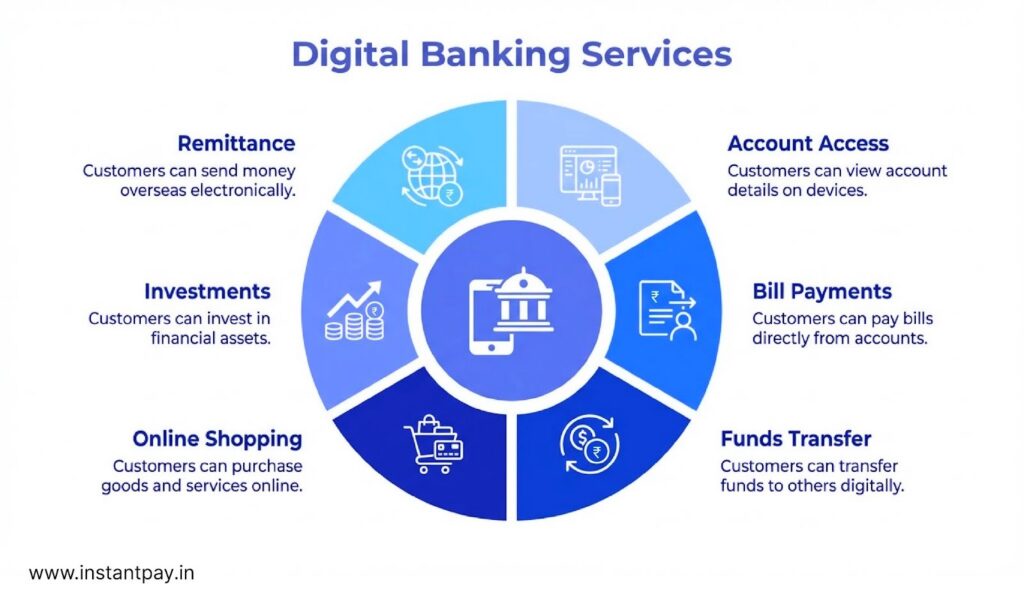
- Account and transaction details: Customers can access their account details on their computers or mobile devices, including account balance and transaction history.
- Bill payments: With digital banking services, customers can pay their various bills, such as electricity, water, and telecom bills, directly from their bank accounts.
- Funds transfer: Customers can transfer funds digitally to other bank accounts and make online money transfers. They can also send money to non-bank account holders.
- Shopping: Customers can purchase goods and services online using their digital accounts.
– Investments: Digital banking customers can invest in various financial assets, such as mutual funds, stocks, bonds, and gold.
– Remittance: Digital banking customers can electronically transfer funds to their overseas relatives and friends.
Digital Banking Units
A digital banking unit is a nodal centre that coordinates with the bank’s IT and business teams to offer digital banking services. Usually, a single digital banking unit caters to multiple branches and provides standard services, such as internet banking, mobile banking, electronic funds, account opening, and other services.
The digital banking unit is responsible for client maintenance, transaction services, and product development. It hosts the website, provides customer support, and manages the data, such as account details, transaction logs, etc.
Benefits of Digital Banking Units for Customers
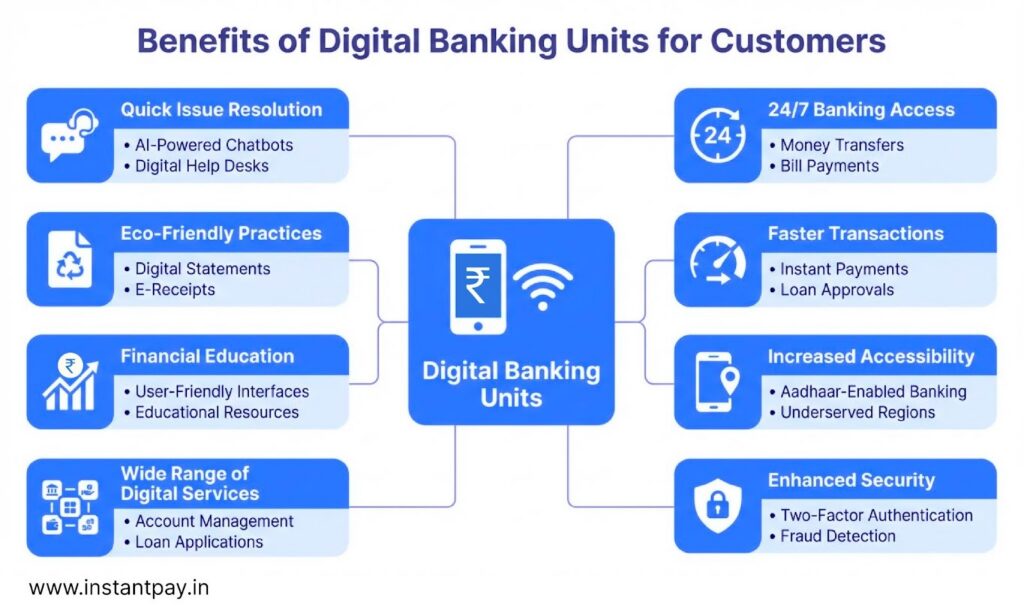
DBUs provide secure and connected digital banking facilities, allowing customers to access banking services cost-effectively, paperlessly, and conveniently. The self-service model will be available, but manual assistance will be available during certain times of the day to aid those from rural, semi-urban, tier III & below areas, senior citizens, or customers with little or no digital experience. This will increase digital payment awareness amongst a wider group of people.
For customers who are adept at digital banking, these DBUs will provide a more convenient and faster digital experience that is secure. This will be especially beneficial to those in remote areas with low banking penetration, as the cost of operating & maintaining bank branches will be significantly reduced.
New section
Here are the key benefits of DBU for customers.
1. 24/7 Banking Access
DBUs allow customers to access banking services anytime, providing flexibility through self-service platforms for tasks like money transfers, bill payments, and loan applications, even outside traditional banking hours.
2. Faster Transactions
With automated processes, DBUs ensure faster transactions, such as instant payments and loan approvals, without the need for paperwork. This reduces wait times and enhances customer convenience.
3. Increased Accessibility
DBUs play a crucial role in providing banking services to remote and rural areas. By offering Aadhaar-enabled banking, customers in underserved regions can easily access essential financial services.
4. Enhanced Security
DBUs provide robust security measures, including two-factor authentication and real-time fraud detection, ensuring that customers’ transactions and data remain secure.
5. Wide Range of Digital Services
Customers can manage accounts, apply for loans, and make payments digitally. With multiple payment options and seamless banking services, customers benefit from convenience and efficiency.
6. Financial Education
DBUs offer user-friendly interfaces and educational resources to help customers understand and use digital banking tools, promoting financial literacy, especially in rural areas.
7. Eco-Friendly Practices
By promoting paperless transactions, such as digital statements and e-receipts, DBUs contribute to environmentally sustainable banking.
8. Quick Issue Resolution
AI-powered chatbots and digital help desks ensure that customers can quickly resolve banking issues, reducing the need for long wait times and enhancing overall satisfaction.
Who can Open For Digital Banking Unit (DBU)?
The Reserve Bank of India (RBI) introduced Digital Banking Units (DBUs) to facilitate the growth of digital financial services throughout India. The goal of DBUs is to allow individuals to access financial services via digital platforms and ultimately lead to increased financial inclusion and the use of cashless transactions in the economy. In order to set up a DBU, however, entities must meet specific eligibility requirements.
1. Scheduled Commercial Banks (SCBs)
Only Scheduled Commercial Banks (SCBs) are allowed to establish a digital banking unit in India. SCBs are listed in the second schedule of the Reserve Bank of India Act, 1934, and are authorized to carry out banking functions such as receiving deposits and giving loans. SCBs include:
- Public Sector Banks (PSBs): State-owned banks such as SBI and PNB may open DBUs so they can provide more digital services to customers in remote locations or build on their existing digital services.
- Private Sector Banks: HDFC, ICICI, and Axis Banks are all private banks that currently operate digitally and can use DBUs to create a more efficient method of delivering digital banking services to customers who live in rural and semi-urban areas.
- Small Finance Banks: These are also SCBs that serve the goal of financial inclusion by providing digital banking services to underserved populations. Examples include Ujjivan and Equitas Small Finance Banks, both of which can use their DBUs to help meet their digital service goals.
2. Financially Stable Banks
In order for a digital banking unit to be sustainable and successful, only banks with a sound financial history and soundness can open digital banking units. This means that banks that are experiencing difficulty with non-performing loans (NPL) or otherwise have regulatory restrictions will be ineligible to open digital banking units. The RBA establishes criteria so that banks that possess the infrastructure and capability to provide secure and efficient digital services can be granted the authority to establish a digital banking unit.
3. Banks with Robust Digital Infrastructure
Banks that have already established strong digital banking infrastructure have a stronger capacity to establish and operate a digital banking unit. This includes banks that offer:
- Internet and Mobile Banking Services
- Instant Account Opening via Digital Means
- Digital Term Loans
- Secure Payment Mechanisms
The intention is that by allowing banks with established digital capabilities to expand their service offerings through a dedicated digital banking unit, they will be able to provide their services in areas where brick-and-mortar banking is limited.
4. Non-Cooperative Banks Excluded
The RBA does not permit any bank that has been designated as a non-cooperative bank or has any regulatory issues to establish a digital banking unit. The RBA has established specific criteria under which only banks that are in compliance with the regulatory framework and can demonstrate transparency in their operations will be eligible to effectively manage their digital banking units.
What DBUs Mean for Banks
Establishment of DBUs by qualifying banks creates a strategic advantage due to increased access (especially in regions currently lacking technology) and decreased operational expense compared to traditional brick-and-mortar bank branches; they are also part of the broader Digital India initiative to promote efficient use of technology to flat out financial inclusion within the banking industry.
How to Apply for a Digital Banking Unit (DBU)?
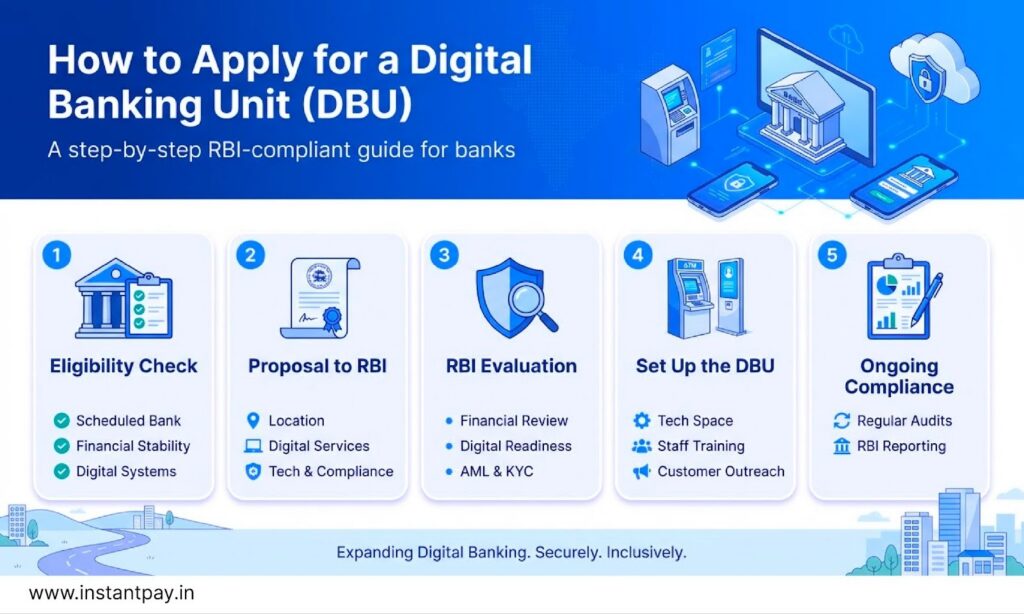
A Digital Banking Unit (DBU) provides banks an opportunity to ramp up their digital offering at locations where traditional banking would not work. The process that banks need to follow in order to set up a DBU is regulated by the Reserve Bank of India (RBI), which has issued a set of guidelines to banks with details about the application process and the necessary steps. The following is a step-by-step guide that outlines what a bank must do in order to obtain an application for a DBU:
1. Eligibility Check
Before proceeding with the application, banks must first ensure they meet the necessary eligibility criteria to establish a DBU:
- The bank applying for a DBU must be a Scheduled Commercial Bank (SCB), which is either a Public Sector Bank (PSB), Private Sector Bank, or Small Finance Bank (SFB).
- The bank applying must be financially secure, have followed compliance regulations, and have not had any major compliance violations or have a significant proportion of their loans being Non-Performing Assets (NPA).
- The bank must have a defined infrastructure for digital banking so that the bank can use its DBU to deliver its digital offerings and services. Assuming that a bank qualifies through these criteria for a DBU, banks may now continue with the formal application process.
Banks that meet these criteria can proceed with the formal application process.
2. Submitting a Proposal to the RBI
The Reserve Bank of India (RBI) requires banks to submit proposals to establish a Digital Banking Unit (DBU) to expand their banking services to customers through digital means.
The proposal must detail the following:
– Location – The bank must provide the location of the proposed DBUs. The RBI encourages banks to establish DBUs in Tier 2 – 6 cities; however, the establishment of DBUs in Tier 1 cities will also be permitted.
– Plans for Digital Services – The bank must specify the digital offerings from the proposed DBU. Examples would include the opening of accounts electronically, applying for loans online, transferring funds in real-time, providing mobile banking services, etc.
– Technology Infrastructure – The bank must provide details on the types of technology and security protocols it will use to provide services at the bank’s DBU. The intent is to demonstrate that the bank is capable of providing secure and efficient digital transaction services to its customers.
– Compliance and Security – The proposal must identify how the bank will comply with the data protection and cybersecurity laws applicable to the DBU. Compliance with PCI DSS regulations and the RBI Guidelines for Digital Banking will be required.
All banks will submit their proposals in accordance with the RBI’s proposal format and shall include all required documents and plans with them.
3. Approval Process
The Reserve Bank of India will evaluate all applications after receiving the proposal. This includes reviewing the overall financial soundness of the proposed new bank, as well as how digitally advanced it is and if it has been compliant in accordance with the guidelines set forth by the Reserve Bank of India.
In order to provide the banks with the required evidence necessary to advance through the approval process, the Reserve Bank of India will assess the following:
- The financial soundness of the applicant bank (i.e. capital adequacy, risk management practices, and level of non-performing assets (NPAs));
- Assess the digital readiness of the applicant bank (i.e. assess the current state of its existing digital banking framework and ability to provide secure and efficient digital banking services);
- Comply with all regulatory compliance standards required of applicant banks (i.e. anti-money laundering (AML) standards, Know Your Customer (KYC), and government or other required data privacy regulations).
This approval process ensures that only banks capable of securely managing digital transactions are permitted to establish DBUs.
4. Setting Up the DBU
When the RBI gives its stamp of approval, banks can begin to establish DBUs. Here are some things banks will need to do before they can get started:
- Set Up the Location: Though DBUs are digital in nature, banks will need to create an actual physical location for their DBUs, which is usually done within small technologic-enabled spaces where customer can access digital services and receive guidance and/or assistance.
- Deploy Technology: The digital transaction transaction can be processed through the use of hardware and software that banks must install in order to facilitate digital transactions, for instance point-of-sale (POS), kiosks for self-service banking, & provide the infrastructure that allows for secure real-time processing.
- Train Staff: Although generally self-service in nature, banks can hire a small number of staff for the purpose of assisting customers with their usage of digital tools. These employees should be adequately trained to be able to address customer questions regarding digital services.
- Promote Digitally: Banks should promote the services and benefits of their DBU to customers via multiple channels, including on line marketing and educational messages. The intent of these efforts will be to increase awareness of the offerings through, and to encourage greater use of, each bank’s DBU by its customers.
5. Ongoing Compliance and Reporting
The Bank is still accountable for the ongoing compliance of the DBU under RBI regulations, after the DBU has been launched. The Bank needs to do two main things to ensure that:
- Conduct Audits: The Bank must conduct periodic internal audits to confirm that the DBU continues to operate in accordance to its regulatory obligations regarding data privacy & data security.
- Provide Periodic Reports: The Bank may also be required to supply periodic reports to the RBI providing information on DBU activity such as customer adoption statistics, transaction volumes, any incidents related to the loss of data security, etc.
Key Benefits for Banks by leveraging DBUs
Digital banking units (DBUs) are an innovative concept designed to change the way banking services are delivered in India. Utilizing modern technology and digital platforms, DBUs provide customers with more access to banking services, increased operational efficiencies, and many other benefits. In addition to expanding their customer base, the establishment of DBUs provides banks with several strategic advantages, which include:
1. Reduced Operational Costs
Establishing a DBU has the potential to reduce operational costs significantly as compared to traditional brick-and-mortar branches. Traditional branches have high overhead costs related to rent, utilities, personnel/staffing, and maintenance, while DBUs operate with :
- Minimal physical footprint: The requirement for a DBU is significantly lower than that for a traditional branch; therefore, fewer employees and a smaller amount of physical assets are required to operate it. Many DBUs utilize self-service kiosks, online banking solutions, and other digital support tools to eliminate most of the operational costs.
- Automation: To the extent possible, banks have automated the majority of their traditional banking products; this includes services provided to the customer including account open, balance inquiry, loan application, and payment processing. As a result, banks will need to hire fewer employees to provide support to automated banking systems, thereby lowering their staffing costs.
- Economies of scale accomplished through digitization: Once a bank establishes its digital infrastructure, it can expand its DBUs quickly and efficiently with relatively low up-front costs compared to building new full-service branches in a geographic location or new market.
Using DBUs as an example, if a bank were to open several DBUs in rural areas, it could use the operational cost savings associated with real estate and staffing requirements to invest in technology to enhance its banking systems or to provide services to its customers, resulting in a more efficient and profitable banking operation.
2. Expanded Reach into Rural and Underserved Areas
DBUs are a key vehicle for achieving the goals of financial inclusion by providing services to areas that are typically without any formal banking services. For example, many constituents residing in rural or semi-urban parts of India are forced to do financial business through informal channels, such as cash, because there are no nearby banks where they can conduct their business. However, DBUs will help provide access to the services of a bank by :
- Locating Banks in Remote Areas: With DBUs located in all Tier 2 to Tier 6 urban areas and rural areas, banks can provide their customers with access to digital banking services when they have historically had no or very limited access to banking services. Some of the services that can be offered would include the ability to manage accounts, take out a digital loan, and send money through an online fund transfer service.
- Bridging the Digital Divide: DBUs can help to formally bank communities that have previously been “digital refugees.” The DBUs enable citizens to move away from a cash-based system of financial transactions to a more formal digital banking system, thus allowing for the accumulation of savings through modern financial systems.
- Everyone will be included: DBUs will enable banks to meet the mandates of the Government of India regarding financial inclusion by providing people with the ability to perform digital transactions using Aadhaar-enabled payment systems and Direct Benefit Transfers (DBT) within rural areas.
By entering these types of markets, banks will be able to communicate with a largely unbanked customer base as well as acquire customers and contribute to the goals of initiatives such as Financial Inclusion and Digital India.
3. Enhanced Customer Satisfaction
contributes to higher customer satisfaction. In today’s fast-paced world, customers prefer digital channels that provide them with instant access to banking services. DBUs can deliver this by offering:
- 24/7 Availability: Due to the traditional bank branches having fixed hours of operation, DBUs can provide banking services 24/7 to customers that need banking services throughout the day. Customers can complete transactions at their convenience, such as transferring funds, applying for a loan, or paying their bills without needing to go to the branch.
- Quicker Turnaround Time The automating of DBU transactions allows for faster processing of transactions. Customers can complete their transaction in minutes instead of hours, therefore reducing their wait time and providing a better banking experience.
- Self-Service Banking: Banks with automated banking services, such as self-service kiosks, allow many customers to have greater independence when managing their banking needs without having to call a customer service representative for assistance. By using the self-service kiosks at DBUs, customers can manage their financial situations by updating their account information, managing their investment accounts, and many more tasks.
The customer-centered focus of DBUs provides customers a better overall customer experience as well as develops long-term relationships with the bank, which leads to a more loyal and long-term customer base for banks.
4. Increased Digital Adoption and Innovation
Digital Banking Units (DBUs) help banks drive the adoption of digital technologies with customers. Through the use of new and innovative solutions, banks are encouraging customers to utilize the convenience and efficiency of digital banking. This has a variety of benefits to banks, including:
- Increased Digital Literacy: There are many customers, especially in rural/small towns, that are not familiar with digital banking; therefore, DBUs can assist banks to educate their customers about how to successfully use digital platforms, mobile applications, and online services, which will help to increase digital literacy amongst customers.
- New Digital Products: DBUs provide banks with the ability to showcase their latest digital products and offerings, including mobile application(s), digital wallets, AI-enabled/smart chat, personal finance management, etc., creating a more efficient banking experience for customers and positioning banks as leaders in digital transformation efforts.
- Fostering Innovation: As the digital banking marketplace continues to grow and evolve, banks can use DBUs as a testing ground for new [digital] service offerings and emerging technologies. Banks will use their customers’ feedback on their product offerings to improve those product offerings through different ways such as providing AI-based financial advisory services, personalized investment recommendations, or using digital methods to approve loans.
Overall, banks will expand revenue opportunities, reduce operational costs, provide greater efficiency, and continue to compete successfully with each other as the financial marketplace continues to evolve.
5. Regulatory Compliance and National Initiatives
Creating Digital Banking Units, or DBUs, has established banks as part of the RBI regulatory framework as well as within the government’s vision for a cashless, digital economy. There are many strategic benefits to banks when establishing DBUs:
- Support of Digital India Mission: DBUs support the Government of India’s Digital India goals as well as its Pradhan Mantri Jan Dhan Yojana goals by adding to the infrastructure needed to achieve a cashless society and providing every citizen with access to digital financial services.
- Simplified Compliance Reporting: Banks that utilize the DBU model will be required to follow strict data privacy and security regulations that govern how secure digital transactions are processed under the RBI guidelines. This will help banks streamline compliance reporting and continue to build trust with their customers.
- Environmental and Social Governance Benefits: DBUs also help banks reduce their environmental footprint through reducing paper consumption, reducing energy consumption and utilizing less physical resources. This supports the ESG goals of most banks and builds on banks’ commitment to sustainability.
How Digital Banking Units are Transforming Banking in India?
With the introduction of Digital Banking Units (DBUs), digital banking is having an impact on banks throughout India. As customers have access to convenient banking options and rapidly process transactions, they have access to improved security levels as well. They can complete their banking activities wherever and whenever they choose, along with being able to complete transactions while out and about.
DBUs provide a method for banks to offer branchless services to persons who have not had an opportunity to obtain a banking relationship. This is assisting to improve financial inclusion in India in reaching many individuals in the unbanked and underbanked segments of society. Digital banking is also continuing to drive the growth of various digital payment methods, including but not limited to credit/debit cards, UPI, and mobile wallets.
Challenges of Digital Banking Units
Digital banks have some difficulties, such as low trust, poor customer support & low customer awareness (of digital banking services). Customers who lack confidence in digital banking services will not complete their transactions via digital banking but will prefer to go into the branch.
To deal with this issue, some banks are offering additional digital banking services & skilling workshops for customers. Digital banks also lack sufficient human resources & infrastructure to provide adequate support to customers when needed. To add to this, banks are currently addressing these challenges by upgrading their existing systems and hiring and training more staff.
Conclusion
The banking industry in India is in a phase of digital transformation with consumers now having access to financial services via digital banking units (DBUs). This digital transformation has provided consumers greater and secure access to banking services by allowing them to conduct all of their banking transactions without any paper involvement or paper records.
DBUs are also designed to provide consumers with educational resources as well as tools to assist them with managing their bank accounts. Since there has been a significant increase in access to banking services, specifically for unbanked individuals and very low-income individuals in India, DBUs are a viable avenue for increasing financial inclusion in India.
Frequently Asked Questions (FAQ’s)
1. What is a Digital Banking Unit (DBU)?
A digital-only banking outlet, or Digital Banking Unit (DBU), allows individuals to conduct digital financial transactions without the need for a traditional brick-and-mortar bank. Examples of services provided by DBUs include the ability to create an account remotely, electronically transfer funds and apply for personal loans via electronic means.
2. How do digital banking units work in India?
A DBU is essentially a physical location where the latest technological innovations are utilized as part of a digital bank’s core function; customers use electronic means (mobile application, kiosk) to access and perform various digital banking services – such as making payments, managing their accounts or performing an electronic-based Know Your Customer (KYC) verification.
3. What services are available at a digital banking unit?
Customers are able to utilize a wide variety of electronic banking products and services including (but not limited to) opening accounts, checking account balances, transferring money between accounts, making bill payments, applying for loans or making investments, and performing an electronic-based KYC verification.
4. Who can open a digital banking unit in India?
Scheduled Commercial Banks (SCBs), such as public, private, and small finance banks, are allowed to operate DBUs as long as they comply with the regulatory requirements outlined by the Reserve Bank of India (RBI) in regard to overall financial stability and sufficient digital infrastructure to support DTUs.
5. What are the benefits of digital banking units for customers?
DBUs provide customers with the ability to access electronic banking services on a 24-hours-a-day, 7-days-a-week basis; bank customers using DBUs benefit from more timely transactions, less paper-based processes, enhanced physical security, and improved customer access to banking services, particularly for those living in rural or otherwise underserved geographic areas.
6. How do digital banking units promote financial inclusion in India?
Through the establishment of DBUs in geographically remote or underbanked locations, more consumers have access to digital payment and Aadhaar-enabled services, as well as government benefit programs; as a result, more individuals are able to have access to traditional banking services and enter the formalized economy.
7. Are digital banking units secure to use?
Yes. DBUs use robust security features such as two-factor user authentication, encryption, and real-time fraud detection/tracking as a means of ensuring secure and efficient transactions.
8. What is the difference between a bank branch and a digital banking unit?
While traditional bank branches rely on manual labor and employees to perform banking services, DBUs focus on increased efficiency by enabling bank customers to conduct electronic banking services from an electronic device themselves without the need for an employee assisting them.
9. What challenges do digital banking units face in India?
DBUs face multiple challenges, including limited consumer knowledge of digital banking and a general distrust of digital systems, limited banking infrastructure, and insufficient digital banking literacy and customer service support.
10. How are digital banking units transforming banking in India?
Through the establishment of DBUs, banks are transforming financial services by enabling customers with faster, more accessible, and more secure banking services while reducing banks’ operational expenses and moving society toward a cashless and digital-first economy.