With the rise of digital payments like UPI, tokenization, and AI-powered transactions, the annual volume of digital payments processed in India surpassed Rs.18,500 lakh crore in FY2024. The expansion of convenience that comes with digital payments, however, has led to an increase in threats, phishing attacks and card-not-present fraud, among others, which are all becoming increasingly sophisticated at an alarming rate.
Card Payment fraud losses around the globe has reached $34 billion in 2023, and India is one of the top 10 global target countries for payment fraud. Because of this reality, security for payment gateways is not only a technical necessity but also a strategic business requirement.
To understand the security of a payment gateway, let’s discuss the reasons why it is so important and how it provides protection to businesses and their customers.
Understanding Payment Gateway Security
When it comes to e-commerce, security for your payment gateway is one of the most important topics you can discuss; this is true both because of the negative repercussions poor security has on business and because of the negative repercussions it has on customers (e.g., financial loss, damage to company reputation, etc.). Therefore, it is important to analyze the key components of payment gateway security so that we can see how they protect everyone involved.
What is a Payment Gateway?
A payment gateway acts as a secure electronic bridge between a customer and the acquiring bank of that customer’s merchant. A payment gateway can also be thought of as a virtual cash register; it encrypts payment data for both the customer and the merchant as it securely transfers that data throughout multiple networks.
In the above example of a customer purchasing a smartwatch for Rs.5000 online, the payment gateway securely sends the customer’s credit card or UPI information to their bank for verification, waits for confirmation, and communicates that verification back to the customer in order to complete the sale.
India had more than 10 billion digital payments made in a month; the vast majority of which were made using UPI accounts for capturing 83%.
Why Secure Transactions Are the Backbone of E-Commerce?
In a time of costly data breaches, millions of dollars having payment gateway security has transitioned from a consideration to a necessity.
Here’s where its importance lies:
- Protection of Sensitive Data – Payment gateways utilize protocols such as TLS encryption, PCI-DSS compliance and tokenization to eliminate the ability of a hacker to intercept card details and CVV numbers.
- Establishing Customer Trust – 19% of online shoppers abandoned the checkout process in the last 3 months as they perceive the website being insecure.
- Increasing Conversion Rates – A secure-looking checkout process can increase conversion rates as much as 35%, according to some UI/UX A/B testing.
So why is payment gateway security so important?
Payment gateway security protects cardholder data against identity theft (fraud) and builds trust with consumers. Therefore payment gateway security is a key component of providing your consumers with a safe and secure online shopping experience.
The Role of Payment Gateways in Fraud Prevention
The rise in online fraud is expected to generate costs exceeding $343 Billion for global businesses in 2023-2027. India, as one of the fastest-growing countries in terms of Online Fraud, several modern payment gateways have incorporated technology to rapidly detect fraudulent activity.
To combat this, modern payment gateways are embedded with real-time fraud detection capabilities:
- Velocity Checks – Reviewing the number of transactions associated with the same IP address or card in a short amount of time.
- Geo-Fencing – Flagging any transactions from countries identified as being high risk will trigger alarms.
- AI & Machine Learning – Identifies patterns of fraudulent activity by comparison to prior history of behaviour.
- 3D Secure (2.0) – When checking out, an additional authentication method (text message/e-mail) is added to authentication at the time of purchase.
Fact: The Reserve Bank of India requires that all payment aggregators in India comply with the Payment Card Industry Data Security Standards (PCI DSS) as well as tokenization standards for storing card account information and misuse of card account information (Reserve Bank of India Guidelines, March 2024).
Key Components of Payment Gateway Security
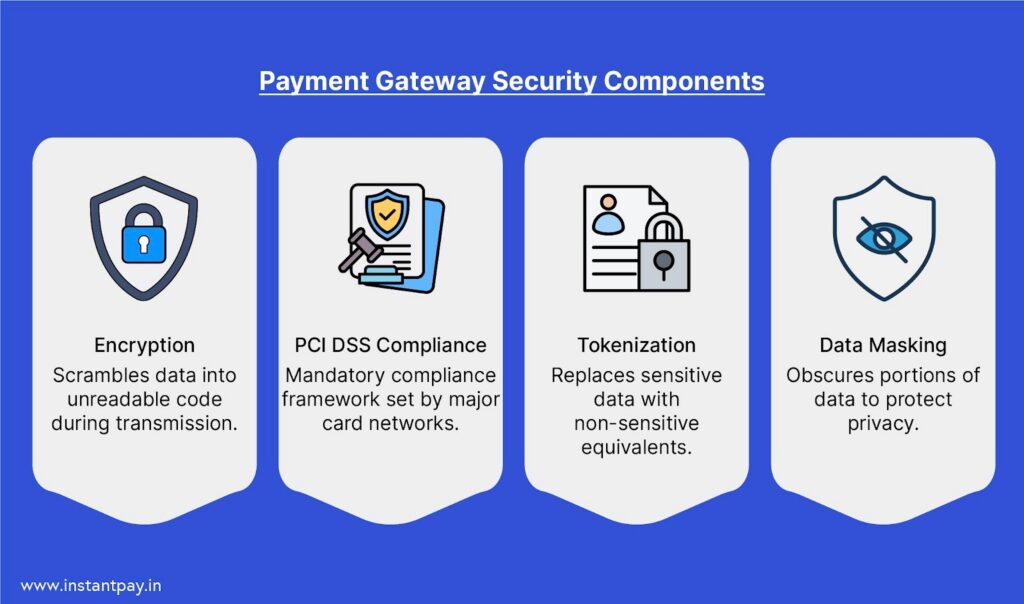
In the fiscal year 2023 – 2024, India had an average of more than Rs.14.75 lakh crore worth of UPIs each month while at the same time seeing an increase of over 20% in credit card fraud, according to both the RBI and NPCI. Numbers like these demonstrate just how important payment gateway security has grown to be within the digital commerce space.
With that as an overview of the need for payment gateway security and how it operates via methods such as encryption, PCI-DSS compliance, tokenization and data masking; let us now take a look at specifically how payment gateways implement their security.
Encryption: The First Line of Defense
During the process of sending information, this method scrambles the information that is being sent over an electronic network into an unreadable format so that the sender’s sensitive data (Credit Card Numbers / CVC Codes) cannot be intercepted or otherwise used in a way that would compromise the sender.
Types of Encryption Used by Payment Gateways:
- Symmetric Encryption: Only one key is used to encrypt and decrypt the information, which is a very fast and efficient way to encrypt data – however, the secure management of the key is extremely critical to avoid security breaches.
- Asymmetric Encryption: A public key is used for the encryption of the data and a private key is used for decrypting the data. If an attacker gets a hold of the public key, the data will remain secure unless the private key is also compromised.
What Encryption Method do Payment Gateways Use?
Payment Gateways utilize SSL 256 Bit Encryption and Asymmetric Cryptographic technology to secure sensitive transaction data.
PCI DSS Compliance: The Gold Standard in Industry
The PCI DSS (Payment Card Industry Security Standard) was created by all the major credit card networks such as Visa, Mastercard, and American Express as a required level of compliance for any business that stores, processes, or transmits cardholder data.
PCI DSS’s Main Requirements For Compliance Are:
- Create a secure environment for your data and network
- Securely store the cardholder data
- Encrypt the cardholder data being transmitted
- Has a strong access control system
- Conduct regular testing of the network
- Maintain an information security policy
Why PCI Compliance Matters:
- Establishes customer trust through evidence of data protection
- Avoids penalties up to Rs.5,00,000/month for non-compliance (for Indian Businesses per the Acquirer Guidelines)
- Reduces the risk of large data breach and lawsuit costs.
Data Breach Fact: Over 80% of all data breaches occurring in retail and Fintech are a direct result of failing to comply with basic PCI standards/protocols. (Source: Verizon DBIR 2023).
Zero-values Data Replacement Substitutes for Real Data Through Tokenization and Data Masking.
The world of payment security has advanced with the introduction of tokenization and data masking technologies; by using either of these techniques, even if a hacker gains access to your systems, they will not be able to obtain actual cardholder data.
Tokenization
Tokenization substitutes random token values for sensitive card data and is meaningless outside of a specific session/system whereby the actual card data is stored with the payment processor and not on your servers.For example, Apple Pay, Google Pay and most Indian apps that process payments through a bank using a credit card now use tokenization technology when storing a customer’s credit card credentials.
Data Masking
Data masking creates obscured values in systems – for example, displaying XXXX-XXXX-XXXX-1234 for the credit card’s 16-digit number, thereby allowing only authorized personnel to access the actual unmasked value if required and an attacker will only see the obfuscated value.
Data masking is also in-line with the Reserve Bank of India’s Tokenization Guidelines (from October 2022), as they have directed, that merchants are not allowed to store credit card data, thereby requiring the use of tokenization across India.
Fraud Detection Tools and Technologies
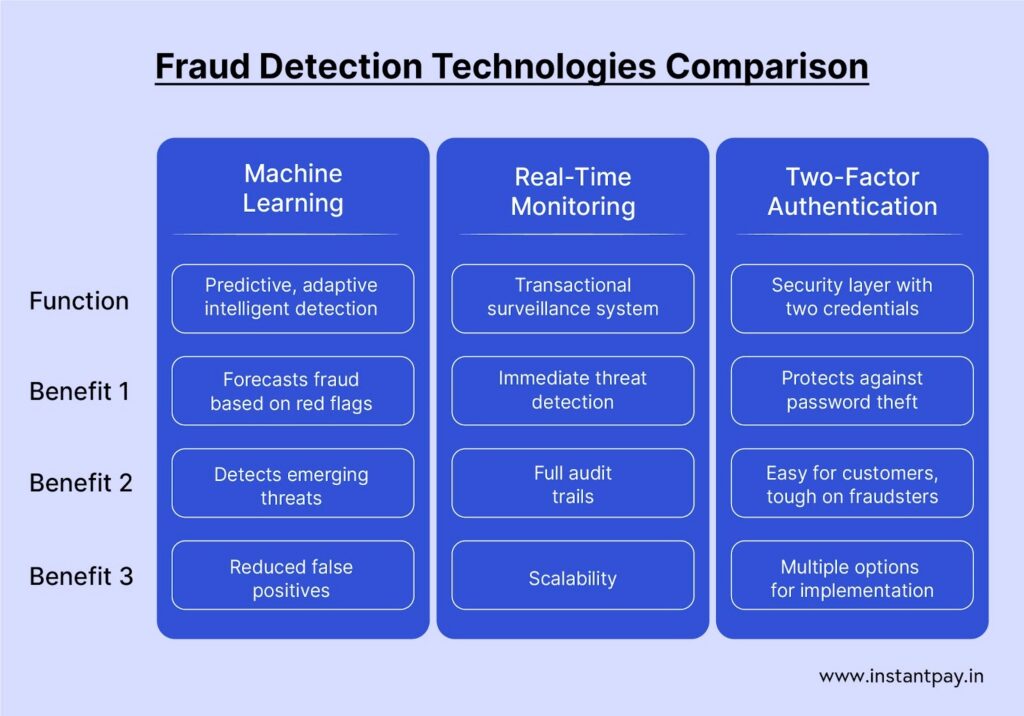
According to PwC India, India’s digital payments market could become a $300 trillion industry by 2030, and at the same time, instances of fraud on digital payment platforms are also increasing.
To reduce their risk, businesses are deploying advanced fraud detection technologies that incorporate machine learning (ML), real-time monitoring, 2-factor authentication (2FA), and other tools. These technologies detect fraudulent activity and help to build confidence among customers using the payment systems.
How Does Machine Learning Detect Fraudulent Transactions?
Machine Learning (ML) is transforming how businesses are protecting their payment gateways from fraudsters using predictive, adaptive, and intelligent fraud detection methods.
How ML Helps Secure Payment Gateways:
- Machine Learning Models Are Predictive: Using Historical Transaction Data to Build Predictive Models, Machine Learning Models Use red flags (unusual transaction location, multiple fast transactions, significant dollar increase in a transaction amount) to predict if a charge is probably fraudulent.
- Machine Learning Models Are Adaptive: Using continuous learning to identify new patterns, machine learning models can also adjust to new method(s) of fraudulent activity from which to predict when fraud will occur. Therefore, patterns can be identified without relying purely on fixed rules, making them well-suited for identifying new types of fraud, such as bot attacks and account takeovers.
- Machine Learning Models Have Lower False Positive Rates: The probability of inaccurately flagging a legitimate customer as a fraudster is greatly decreased through machine learning. In addition, many of these organizations mentioned above have identified having a high rate of false positives as being highly problematic for their business, and machine learning is designed to solve this problem through the ability to improve predictive accuracy over time.
Note: 10 million transactions per day are processed through digital payment systems by the largest payment processors in India (e.g., Razorpay & Cashfree) using machine learning-based fraud prevention systems.

Real-time Monitoring Systems: Catch Fraud as It Happens
Establishing a system for real-time monitoring of your transactions (the monitoring of an entire transaction process) allows your organization to monitor for anomalies (unexpected events) as they happen and take steps to prevent fraud or limit its impact.
Benefits of Real-Time Monitoring:
- Timely detection of threats – The alerts generated by your security system allow you to respond immediately to prevent the occurrence of a potential fraudulent activity by blocking or requesting that a transaction be confirmed.
- Complete audit trails – Each transaction is recorded in full so you can conduct a thorough investigation and produce a compliance report quite quickly when fraudulent activity is suspected.
- Scalability – Regardless of whether your organization has 500 or 50,000 transactions each day, a real-time monitoring solution will be able to scale appropriately and continue protecting your growing business.

Two-factor Authentication (2FA): A Simple Yet Powerful Barrier
Two-factor Authentication (2FA) is a commonly used, RBI-approved, security measure that requires users to provide two different pieces of identifying information before they can carry out sensitive activities such as logging on or completing a purchase.
Why Every Business Should Use 2FA:
- Stops Password Theft: If login information is available due to leakage through social engineering techniques like phishing or malware, two-factor authentication prevents access to the user without the second step. The second factor is typically either a one-time password or biometric authentication.
- Simple for Customers, Hard for Fraudsters: One-time passwords sent to the user’s mobile device using SMS or created by an app are easy to use; however, they also greatly increase the security of your organization.
- Numerous Options for Implementation: An organization can choose to implement two-factor authentication by either using one-time passwords sent through SMS, authenticator applications (such as Google Authenticator), or some type of biometric authentication depending upon their audience and what platform they are providing.
Best Practices for Enhancing Data Security
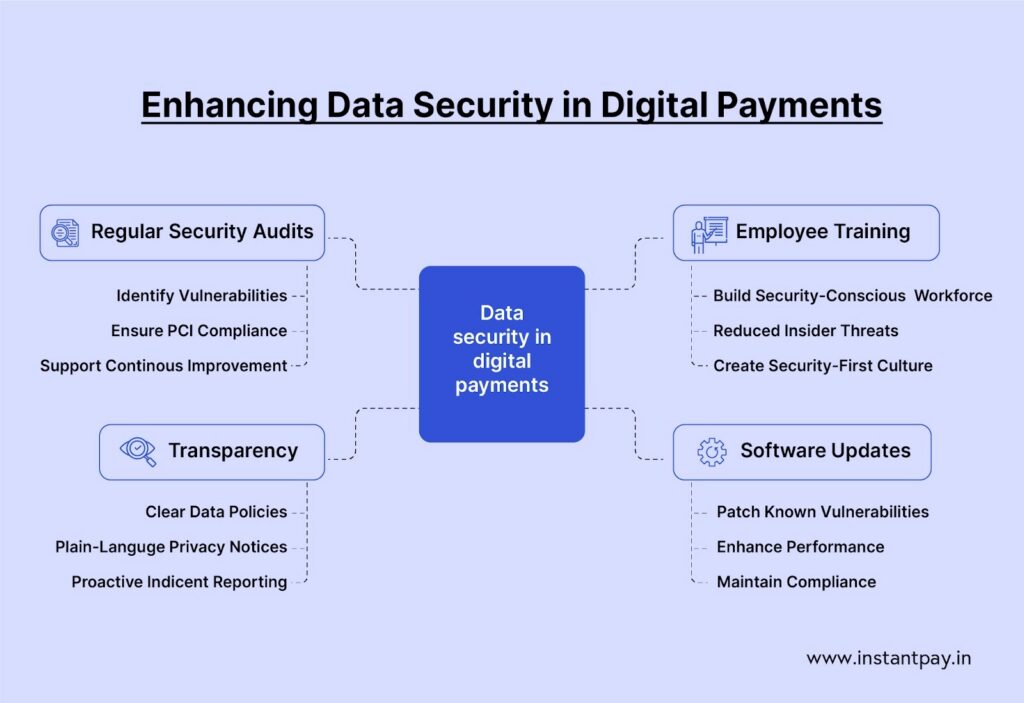
With India’s digital payments expected to surge to $10 trillion by 2026, the attack surface for cybercriminals is becoming larger and more complex. In addition to using fraud detection technologies such as AI and machine learning, proactive data security controls are critical additions to consider in order to secure your business against cybercrime.
The following provides suggestions on how to implement systematic controls using audits, employee education, and ongoing adherence to security protocols into your payment processing systems:
Regular Security Audits and Assessments
Performing security audits is like performing regular maintenance on your company’s digital infrastructure; it is an extremely important part of keeping your company secure, stable, and compliant.
Why Security Audits Are Non-Negotiable:
- Identify Vulnerabilities: Security audits help to identify previously undiscovered vulnerabilities, e.g., outdated plugins, incorrectly configured firewalls, and insecure APIs prior to them being compromised by a hacker.
- Demonstrate Compliance with PCI DSS: The PCI DSS requires merchants to perform regular security assessments and maintain compliance with PCI DSS, especially for merchants who accept, retain, or transmit cardholder information.
- Support Continuous Improvement: Security audits help organizations update their security policies, implement new security controls, and become more responsive to the changing nature of cyber threats.
Employee Training & Cybersecurity Awareness
According to the latest findings published in the 2024, Verizon Data Breach Investigations Report, 74 percent of all data breaches are caused by employees who make mistakes or use social engineering tactics to break into areas of a company’s network (e.g., desktops, servers, etc.). Therefore, it has become increasingly critical for companies to establish sound policies and governance frameworks to properly train their workforce.
How Training Strengthens Your Security Layer:
- Create a Security-Minded Work Environment – Train your workforce to recognize phishing attempts, social engineering tactics, and attempts to gain unauthorized access to the company’s information resources.
- Reduce the Chance of an Insider Threat – Most data breaches occur by mistake and without any ill intent. When employees are properly trained and educated on your company’s policies, they will have a level of trust in you; this will help them to adopt strong password policies, secure communications, etc.
- Foster a Culture of Security First – Continued training supports a culture where everyone in your organization is accountable for protecting the information belonging to your customers.

Updating Software and Security Protocols
Cybercriminals often use known software vulnerabilities as an exploitable point of entry into computer systems, so regularly updating systems and applications is a fundamental part of maintaining secure computer systems.
Why Regular Updates Are Critical:
- Patch Known Vulnerabilities: Vendors create and release patches for known security vulnerabilities, so if you don’t install them, your business is vulnerable to a zero-day attack.
- Increase Performance: Updates can include not just security patches but also performance improvement upgrades, which can make transactions faster and more reliable.
- Stay Compliant: Regulatory programs like GDPR and PCI DSS 4.0 require you to have secure, up-to-date systems to be in compliance. Otherwise, you risk being fined or banned from processing transactions.

Building Trust with Customers through Security
The rise of digital transactions such as UPI, means customers are more aware of how their data is secured online.
The currency of trust in this environment is fundamentally tied to secure payments.
Maintaining Transparency: Show Customers You Have Nothing to Hide
Transparency is one of the cornerstones of digital trust; customers truly appreciate, and more frequently expect, companies to be honest and frank concerning how their data is collected, stored, and secured.
Best Practices for Transparency:
1. Clear Data Policies – Provide a simple, clear and concise privacy statement (policy) that details;
– What type of data you will collect (e.g. Card info, IP address),
– How this data will be used (e.g. for processing transaction or for fraud detection),
– Any third parties to which this data may be shared (e.g. payment processors, law enforcement)
2. Clear Privacy Notices – Use plain language as opposed to technical language to enhance customer understanding. For instance, if you use a complex encryption algorithm (AES-256) to encrypt the customer’s data you can simply state “we lock your data with military-grade digital locks”.
3. Actively Reporting on Incidents – When a business experiences a data breach, the level of transparency shown in reporting the breach can greatly influence customer backlash. Under the CERT-In guidelines updated in 2022, businesses are required to report incidents of data breaches within 6 hours and customers should be included in the notification.

Communicating Security Measures: Make Safety Part of the Conversation
Many customers don’t understand the complexities of online security—but that’s exactly why you should explain it. Making security visible builds assurance and credibility.
How to Communicate Your Security Practices:
Many customers don’t understand the complexities of online security, but that’s exactly why you should explain it. Making security visible builds assurance and credibility.
How to Communicate Your Security Practices:
- Educational Content – Use blogs or newsletters to explain your PCI-DSS compliance, tokenization, or use of SSL encryption. For example:
“We use PCI-DSS Level 1 certified payment systems, the same standard trusted by top global banks. - Visible Security Badges – Use security seals like “Norton Secured”, “PCI DSS Compliant”, or SSL icons on checkout pages. According to Actual Insights, 61% of users didn’t complete a purchase due to missing trust logos.
- Interactive FAQs or Chatbots – Add real-time chat or a dedicated FAQ section answering:
- “Is your payment gateway secure?”
- “How is my card data protected?”

Leveraging Security as a Competitive Advantage
Security can be leveraged as more than just an underlying or backend capability. Security is a powerful competitive advantage for an organisation as it often drives customer loyalty.
Turn Your Security Posture into a Marketing Strategy:
1. Include Security In Your Marketing Copy – Use language in every piece of marketing collateral, such as “100% Secure UPI & Credit Card Payments” and/or “All Our Payment Options Are End To End Encrypted”.
2. Feature Customer Testimonials – Demonstrate social proof by selecting reviews and customer comments that showcase their satisfaction with secure and seamless payments.
3. Promote Your Security Partnerships – Partner with a trusted security vendor such as AWS Shield, CloudFlare, or Recurly and list these vendors as part of your security messaging.

Final Thoughts: Prioritizing Payment Gateway Security to Protect and Earn Trust
Digital payments are part of a growing and fast-growing economy in India, with the NPCI data estimating digital payments will surpass Rs.18 lakh crore in January and exceed Rs.17 lakh crore by December. As such, businesses must secure their payment gateways as a vital component of operating their businesses.
Why Robust Security Measures Are Essential:
1. Fraud Prevention – The number of reported online banking and card fraud incidents increased by 25% in the most recent RBI annual report, further illustrating the importance of implementing fraud detection solutions.
2. Data Protection – Securing sensitive customer data through encryption methods such as TLS 1.3, and through tokenization as prescribed in RBI’s payment processing rules and regulations should be necessary steps taken by businesses.3. Regulatory Compliance – Meeting the requirements outlined in the PCI Data Security Standard v4.0, RBI’s tokenization directive, and CERT-In’s 6-hour breach reporting requirements will enable businesses to maintain legal and operational continuity.
Actionable Best Practices:
1. End-to-End Encryption: For securing data in transit use AES-256- or 3DES-encrypted SSL/TLS protocols.
2. PCI Compliance: Conduct regular vulnerability scans and complete annual audits throughout the year to ensure compliance with PCI DSS.
3. Real-Time Fraud Detection: Use artificial intelligence and machine learning techniques to identify anomalies and stop fraud from occurring.
4. Frequent Updates to Security Protocols: Cyber threats are evolving rapidly; your security protocols must adapt quickly. Schedule quarterly reviews of your security protocols.
5. Create a Culture of Security Awareness: Provide training to employees, publish clear privacy policies, and notify customers about the steps being taken to protect their privacy and the security measures that are in place.
A report compiled by McKinsey indicates that companies with high levels of digital trust can achieve as much as a 30% higher customer retention rate than companies without digital trust; therefore, investing in secure payment gateways creates opportunities for growth rather than simply being expense related.
Frequently Asked Questions (FAQ’s)
1. What is a payment gateway and how does it work?
A payment gateway securely processes online payments by encrypting card data and connecting the customer, merchant, and bank.
2. Why is payment security important in e-commerce?
It protects customer data, prevents fraud, and builds trust in online transactions.
3. How do payment gateways prevent fraud?
They use tools like tokenization, encryption, fraud scoring, and AI to block suspicious transactions.
4. What are the best practices for secure online payments?
Use encryption, PCI compliance, 2FA, regular audits, and real-time fraud detection.
5. What is PCI DSS compliance in India?
It’s a mandatory security standard for handling card data, enforced by RBI and card networks.
6. Which payment gateways are most secure in India?
Razorpay, Cashfree, PayU, and CCAvenue are PCI DSS certified and offer fraud protection.
7. What is tokenization in payment gateways?
Tokenization replaces card details with random tokens, making intercepted data useless.
8. How does RBI regulate online payment security?
Through mandates like tokenization, 2FA, PCI DSS adherence, and CERT-In reporting norms.
9. What is 3D Secure and how does it work in India?
It’s an OTP-based layer of authentication required for online card transactions.
10. How can businesses protect themselves from online payment fraud?
By using secure gateways, enabling 2FA, training staff, and monitoring transactions in real-time.
11. What are examples of fraud detection tools?
Velocity checks, IP tracking, device fingerprinting, ML models, and risk scoring engines.
12.What is machine learning in fraud detection?
ML identifies fraud by analyzing patterns and adapting to new threats over time.
13. How does real-time monitoring work in payment gateways?
It tracks every transaction live and flags unusual behavior instantly.
14. Why is two-factor authentication essential in online payments?
It adds an extra layer of security even if passwords are compromised.