In India, your PAN or Permanent Account Number is more than just a tax ID. It’s a critical document used in everything from opening a bank account to buying property. Yet many people still struggle with questions like “What is a PAN card exactly?”, how it’s structured, or why linking it to Aadhaar matters.
This guide simplifies the essentials: how PAN works, where it’s required, how to apply or correct it, and what those 10 characters actually mean. Whether you’re applying for the first time, downloading your e-PAN, or verifying it for official use, this blog breaks it all down with checklists, examples, and the latest 2025–26 rules, so you stay compliant and avoid penalties.
What Is a PAN & Why Does It Matter?
If you’ve ever asked, “What is a PAN card?”—the answer goes beyond just a plastic document. Permanent Account Number is a 10-character alphanumeric identifier issued by India’s Income Tax Department. It plays a central role in tracking financial activity and ensuring tax compliance across individuals, businesses, and entities.
Every time you file taxes, open a bank account, invest in mutual funds, or make high-value purchases, your PAN helps the government accurately link and monitor your financial records. It’s not just for income tax returns, it’s embedded across India’s broader financial ecosystem, from GST registrations to digital KYC processes.
Did You Know?
Your PAN’s fourth character reveals your identity type—‘P’ means individual, ‘C’ means company, ‘H’ means Hindu Undivided Family (HUF).
What Is a PAN Card?
If you’ve ever filed taxes, made a high-value investment, or applied for a loan in India, chances are you’ve been asked for your PAN card. But what exactly is it?
The full form of PAN is Permanent Account Number. While “PAN” refers to the number issued by the Income Tax Department under Section 139A of the Income Tax Act, 1961, the PAN card is the official document that displays it alongside your name, photo, date of birth, and signature.
Think of it as your financial identity proof. Unlike an Aadhaar card, which verifies who you are, your PAN is used to trace financial activities across accounts, filings, and transactions. This document is especially important for regulatory compliance, whether you’re applying as an individual or as a registered business.
For digital onboarding and real-time identity checks, businesses now often rely on PAN Verification APIs to match and authenticate PAN details instantly, helping prevent fraud and operational delays.
How many digits are there in a PAN card?
A PAN card contains a 10-character alphanumeric code. It includes five letters, followed by four digits, and ends with a check letter. Each character holds specific meaning related to identity and sequence.
PAN Card Format & Number Structure Explained

Ever looked at your PAN card number and wondered what the mix of letters and numbers really means? The format isn’t random. Every character in your PAN follows a predefined structure, designed to capture specific identity and compliance data.
A typical PAN number format looks like this: ABCPE1234F
Here’s how it breaks down:
| Position | Type | Meaning |
| 1st–3rd | Letters | Alphabetic series (random) |
| 4th | Letter | Entity type: ‘P’ = Individual, ‘C’ = Company, ‘H’ = HUF, ‘F’ = Firm, etc. |
| 5th | Letter | First character of surname or entity name |
| 6th–9th | Numbers | Sequential digits from 0001 to 9999 |
| 10th | Letter | Alphabetic check digit, generated using a PAN algorithm |
For example, a PAN beginning with ABCP would indicate that the holder is an individual, with the ‘P’ as the fourth letter. Businesses and fintech platforms validating this data often use a verification API to decode and match these details instantly.
Understanding these 10 characters not only helps you read your PAN but also ensures the information matches exactly when submitting forms, paying taxes, or verifying identity online.
Who Needs a PAN Card in India? (Eligibility & Mandatory Use Cases)
Whether you’re salaried, self-employed, or running a business, if you earn, invest, or spend above certain limits in India, you’ll need a PAN card. It’s not just for taxpayers; it’s now a requirement across a range of financial and legal activities.
Who is eligible to apply for a PAN?
You should apply for a Permanent Account Number if you fall under any of these categories:
- Indian residents (individuals) with taxable income
- Minors earning income through interest, investments, or inheritance (PAN issued under the guardian’s name)
- NRIs who:
- Earn income in India
- Invest in Indian markets
- Operate NRO/NRE accounts
- Hindu Undivided Families (HUFs), trusts, partnership firms, and companies
- Foreign companies operating in India (via Form 49AA)
PAN Application Forms for NRIs vs. Indian Residents
| Applicant Type | Application Form Used |
| Indian Resident | Form 49A |
| NRI / Foreign Citizen | Form 49AA |
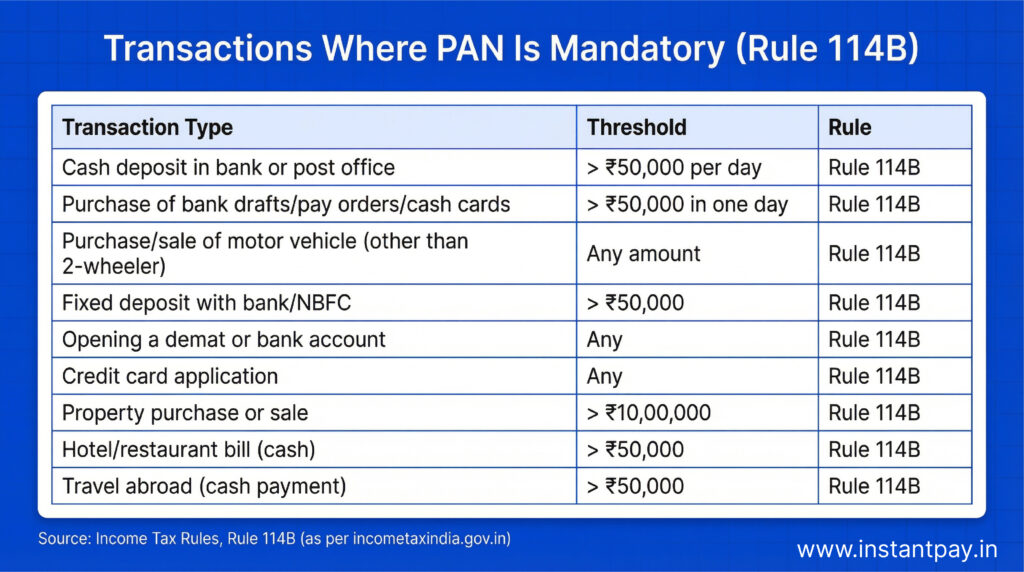
Where is PAN Mandatory? (Rule 114B, Income Tax Rules)
Certain financial transactions legally require quoting your PAN, even if you don’t pay income tax. Here’s a simplified breakdown:
Who is required to have a PAN card in India?
A PAN card is mandatory for individuals, businesses, NRIs, minors with income, and entities like trusts and firms who earn income in India or engage in high-value transactions above set limits under Rule 114B.
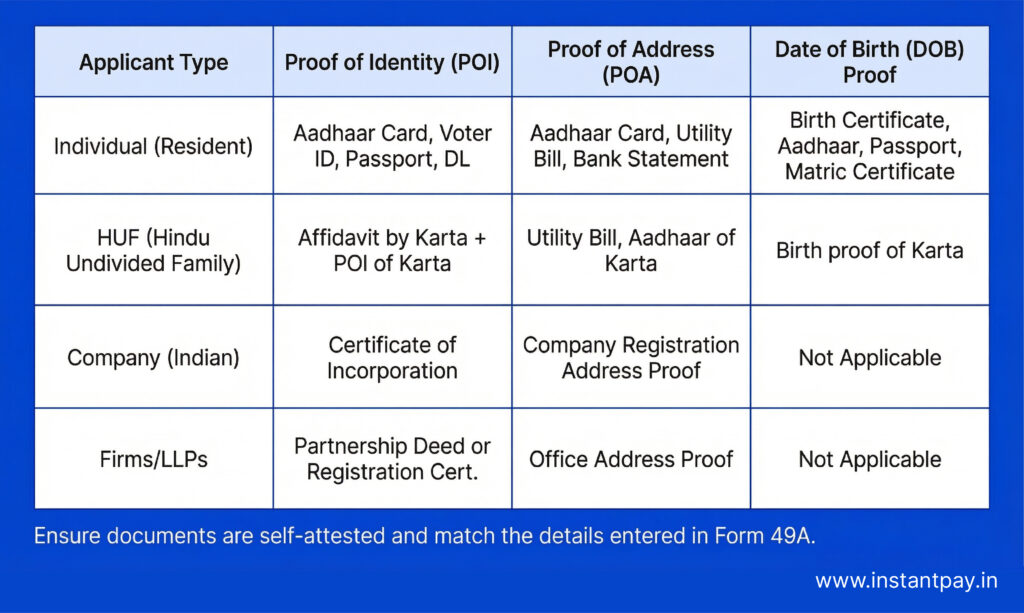
What are The Documents Needed for Indian Residents Applying for PAN?
Applying for a PAN as an Indian citizen? Whether you’re an individual, part of a Hindu Undivided Family (HUF), or representing a registered business, specific documents are required to verify your identity, address, and date of birth.
Here’s a quick reference guide based on your applicant type:
PAN for NRIs: Who Can Apply & How It Works?
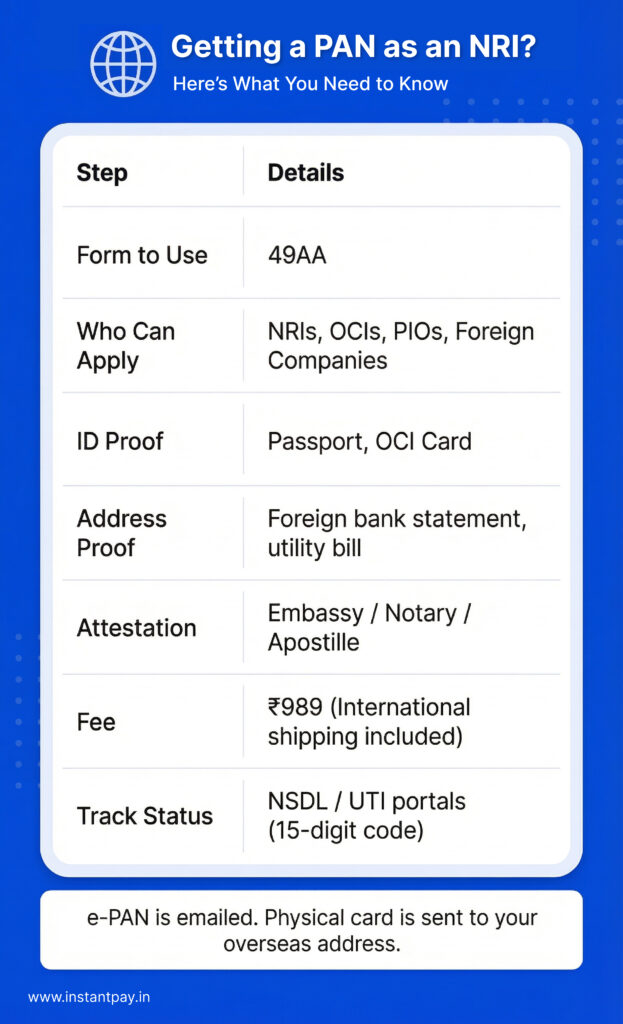
Even if you’re living abroad, a PAN card is mandatory for NRIs who earn income in India, invest in Indian markets, or operate NRO/NRE accounts. While the format of the card is identical to that of resident Indians, the process and documentation differ.
Form 49AA is specifically designed for:
- NRIs
- OCI (Overseas Citizens of India)
- PIO (Persons of Indian Origin)
- Foreign entities with taxable operations in India
Documents Required for NRI PAN Application
Identity Proof (Any one of the following):
- Copy of passport
- Overseas citizenship certificate (OCI card)
- Person of Indian origin card (PIO card)
Address Proof (Outside India accepted):
- Overseas bank statement
- Utility bill
- Copy of passport with overseas address
Documents must be attested by:
- Indian embassy/consulate OR
- Apostilled by a foreign authority OR
- Verified by a notary public (depending on jurisdiction)
How NRIs Can Apply for a PAN Card?
Online Application (Most Common):
- Visit Protean (NSDL) or UTIITSL
- Select Form 49AA
- Fill details, upload documents, and pay the fee
Fee for NRI PAN:
- Rs. 989 (includes overseas delivery)
Delivery:
- PAN card is couriered to the foreign address
- ePAN is also sent via email (PDF format)
How NRIs Can Track Their PAN Application Status
Once the form is submitted (with payment):
A 15-digit acknowledgment number is generated.
You can track the status:
This is valid for both residents and NRIs.
How to Apply for a PAN Card Online in India?
Applying for a PAN card today is easier than ever—no more long queues or physical visits. You can complete the process online through official portals like Protean (formerly NSDL) or UTIITSL. The application method varies slightly depending on whether you’re an Indian resident or an NRI.
Choose the Right Form:
- Form 49A – For Indian citizens (individuals, companies, firms, etc.)
- Form 49AA – For NRIs, OCIs, foreign entities
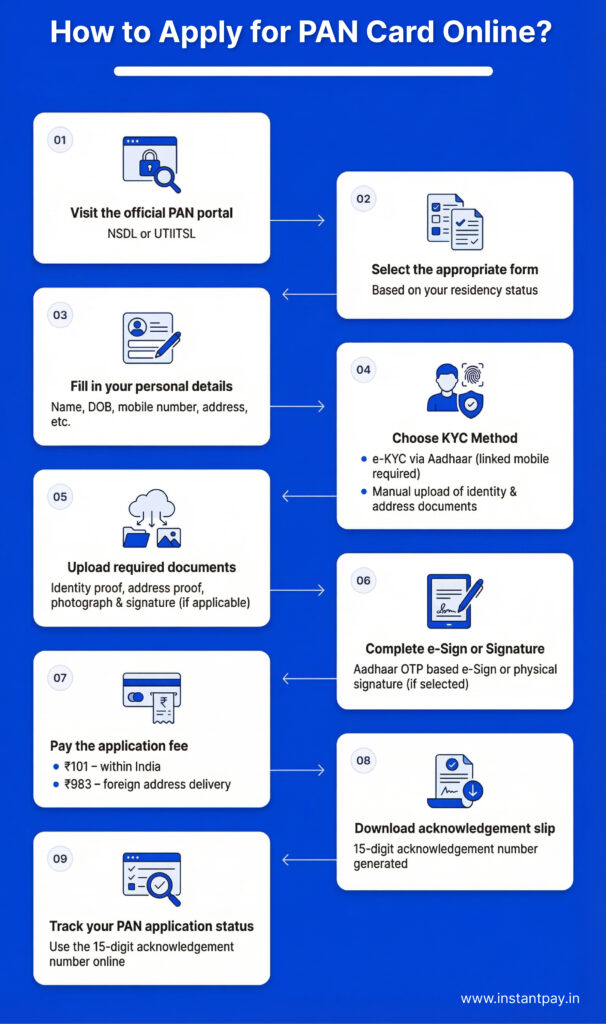
- Visit the official portal (NSDL or UTIITSL)
- Select the appropriate form based on your residency
- Fill in your details (name, DOB, mobile, address, etc.)
- Choose your KYC method:
- e-KYC via Aadhaar (linked mobile number required)
- Manual upload of identity/address documents
- Upload scanned documents and signature (if applicable)
- e-Sign via Aadhaar OTP or physical signature (if opted)
- Pay the application fee:
- Rs.101 (within India)
- Rs.989 (for foreign address delivery)
- Download your acknowledgement slip
- Track your PAN status online using the 15-digit number
Note: If you choose e-KYC via Aadhaar, ensure that your Aadhaar is already linked to your mobile number.
Prefer the Offline Method? Here’s How to Apply Without the Internet
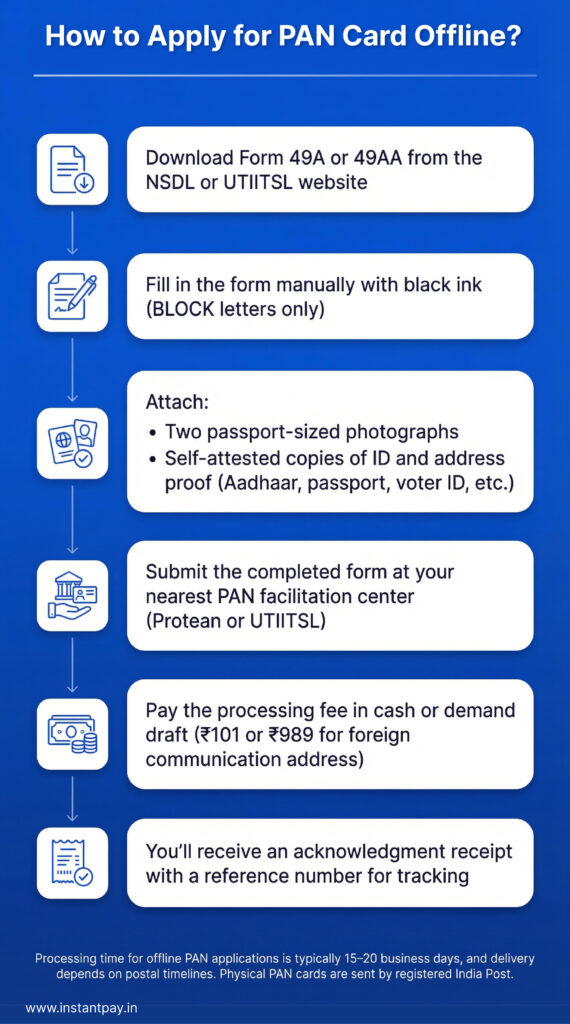
Not everyone prefers the online route—or has access to it. If you’re more comfortable with physical forms or don’t have Aadhaar-linked mobile access, you can apply for a PAN card offline through authorized service centers.
Here’s what you need to do:
- Download Form 49A or 49AA from the NSDL or UTIITSL website
- Fill in the form manually with black ink (BLOCK letters only)
- Attach:
- Two passport-sized photographs
- Self-attested copies of ID and address proof (Aadhaar, passport, voter ID, etc.)
- Submit the completed form at your nearest PAN facilitation center (Protean or UTIITSL)
- Pay the processing fee in cash or a demand draft (Rs.101 or Rs.989 for a foreign communication address)
- You’ll receive an acknowledgment receipt with a reference number for tracking.
Note: Processing time for offline PAN applications is typically 15–20 business days, and delivery depends on postal timelines. Physical PAN cards are sent by registered India Post.
This option is especially useful for senior citizens, rural applicants, or those applying without Aadhaar access.
How to Check PAN Status or Verify It Online?
Whether you’re an individual filing taxes or a business onboarding new customers, it’s important to know if a PAN is valid, active, and correctly linked to the person or entity it represents.
There are two main ways to verify your PAN:
- Through government portals:
The Income Tax Department and NSDL websites offer simple tools to check the validity of a PAN, view status updates, or confirm Aadhaar linkage. These are useful for individuals tracking their card delivery or checking corrections.
Using real-time verification APIs:
Businesses handling large volumes of customer or vendor data often use verification APIs to verify PAN numbers automatically. These tools fetch results instantly, matching the tax ID with official records to confirm name, entity type, and current status. They also flag errors like inactive or incorrect entries, helping streamline onboarding, tax compliance, and fraud prevention.
How can I check my PAN card status or verify it?
You can verify your PAN by visiting official portals like NSDL or using real-time APIs that match the number with government records. These tools confirm whether your PAN is valid, active, and correctly linked to your details.
How to Download Your PAN Card or ePAN?
Lost your tax identification card or just need a digital copy for KYC? The ePAN is a digitally signed PDF version of your Permanent Account Number, accepted across all official and financial platforms.
While the physical card is sent by post, the digital version can be downloaded anytime using your 10-character ID and Aadhaar-linked OTP, making it faster, paperless, and equally valid.
Here’s how to download your digital ID copy from government portals:
| Step | Action |
| 1 | Visit the NSDL or UTIITSL download page |
| 2 | Select whether you need a fresh copy or reprint |
| 3 | Enter your 10-character identifier and Aadhaar (linked mobile number needed) |
| 4 | Authenticate via OTP and download the PDF instantly |
How to download your digital tax ID online?
You can access your ePAN PDF from the NSDL or UTIITSL website by verifying your unique ID and Aadhaar-linked mobile number via OTP. It’s free for newly issued documents and available for reissue when needed.
How to Update or Correct Your Tax Identification Details Online?
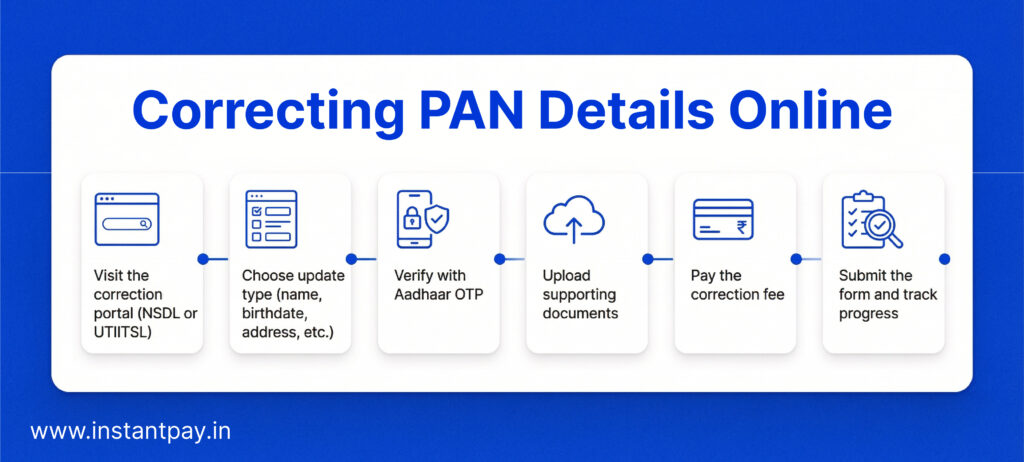
Made a mistake while applying? Whether it’s a misspelt name, wrong date of birth, or an outdated address, your Permanent Account Number record can be updated digitally using a simple form submission. This process also works for reissuing lost or damaged cards.
The update form (the same as Form 49A/49AA) lets you correct personal info, request a reprint, or change communication preferences. You can use either the NSDL portal or UTIITSL site to submit your request. Both allow OTP-based login, Aadhaar-linked e-signature, and online tracking.
Here’s What You Need to Do:
1. Visit the official correction page on NSDL or UTIITSL
2. Choose your update type: name, birthdate, gender, communication address, etc.
3. Enter your unique 10-character ID and verify with Aadhaar OTP
4. Upload supporting documents (as per field being corrected)
5. Pay the correction fee (Rs.101 for domestic, Rs.989 for foreign addresses)
6. Submit the form and note your 15-digit acknowledgement number to track progress
For those correcting Aadhaar-linked details, ensure both records match before submission.
How to correct your PAN details online?
To fix errors in your tax ID, visit the NSDL or UTIITSL correction portal, choose the update category, verify via Aadhaar OTP, upload documents, and submit the request. You can also request a reprint if the card is lost or damaged.
Tax ID’s Role in GST & Other Regulatory Use Cases
The 10-character tax identifier plays a pivotal role not just in direct taxation but also across indirect tax systems and compliance networks. When registering for the Goods and Services Tax, this ID becomes the foundational input for generating your GSTIN (Goods and Services Tax Identification Number).
In fact, the first two digits of your GSTIN represent the state code, while the next ten characters are the same as your Permanent Account Number, ensuring seamless integration of personal/business identity with the GST framework. This cross-linking helps the government prevent tax evasion, match transactions, and enforce regulatory norms.
Beyond GST, this unique code is also required for:
- Opening business current accounts
- Filing TDS/TCS returns
- Registering for Import Export Code (IEC)
- Digital KYC for mutual funds and brokerages
- Getting UDINs (for CA-verified filings)
- Applying for startup benefits, subsidies, and tenders
For businesses streamlining GST processes, APIs like GSTIN Verification help validate credentials using this identifier in real time, ensuring fraud prevention and clean records.
Is PAN required for GST?
Yes. Your GSTIN is generated using your 10-character tax ID. Without it, you cannot register for GST, file returns, or claim input tax credit.
Why Must You Link Your Tax ID with Aadhaar?
Under Section 139AA of the Income Tax Act, every resident who holds a Permanent Account Number and is eligible for Aadhaar must link the two. This integration helps curb duplicate identities, tax evasion, and enables unified KYC across financial platforms.
The current deadline for linking remains 30th June 2025 (subject to extension). Failing to do so results in the identifier being rendered inoperative, which means:
- You cannot file ITRs
- Refunds will be blocked
- TDS/TCS deductions may face higher rate penalties
- You may face difficulty in banking, investments, and loan processing
To avoid these disruptions, ensure your demographic details (name, DOB, gender) match in both documents before linking.
You can check the status or complete the linking on the Income Tax portal or explore this detailed guide on linking Aadhaar with your ID.
Is it mandatory to link Aadhaar with PAN?
Yes. If not linked, your tax ID becomes invalid for most financial and tax-related transactions. Penalties and restrictions apply under Section 139AA.
Understanding PAN, TAN & TIN: Key Differences Explained
India’s tax system relies on multiple identification numbers, each serving a unique regulatory function. While your taxpayer identification number is used for most personal and business transactions, two others—TAN and TIN serve distinct roles, especially in tax deductions and indirect tax systems.
Here’s how they differ:
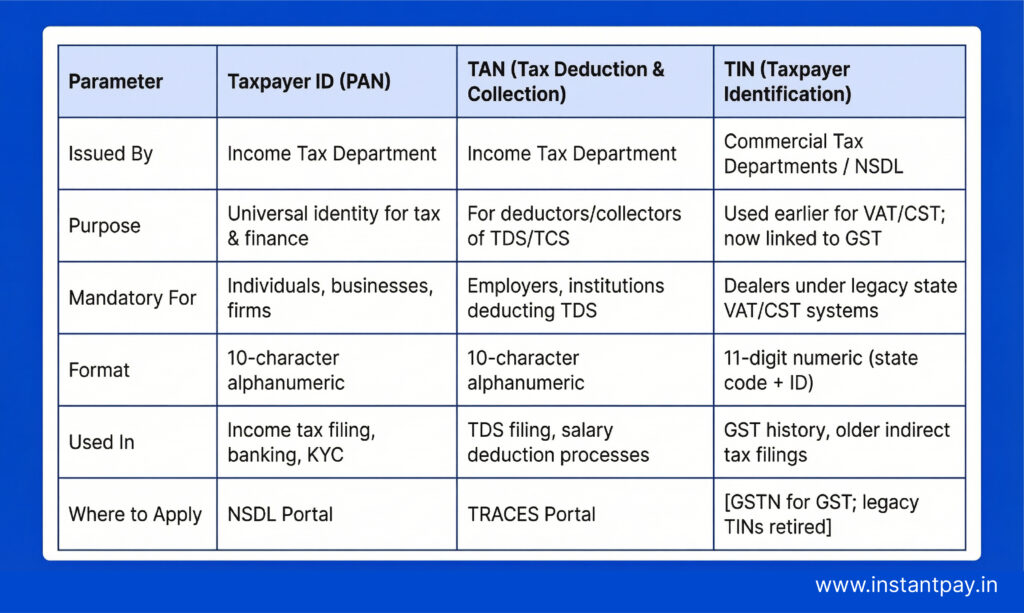
When is TAN needed?
If your organization deducts tax at source (TDS), like salaries or interest payments, you must apply for a TAN to remain compliant. Individuals usually don’t need one unless acting as employers or deductors.
Is TIN still in use?
TIN has been mostly phased out and replaced by GSTIN under India’s indirect tax system. However, legacy references may still exist in certain records or audits.
What is the difference between PAN, TAN, and TIN in India?
Your tax ID (PAN) is for all financial/tax transactions. TAN is needed for deducting TDS, and TIN was used for VAT/CST but is now replaced by GSTIN.
Advantages of Having a Permanent Account Number

Your tax-linked identity document does far more than help you file returns. Whether you’re salaried, self-employed, a business owner, or even an NRI, having this 10-character code opens the door to financial, legal, and compliance conveniences across India.
Here’s why it matters:
Key Benefits of This ID:
- Required for Income Tax Returns (ITR)
It’s impossible to file tax returns without quoting this number. - Mandatory for High-Value Transactions
Be it buying jewelry over Rs.2L, property above Rs.10L, or depositing cash above Rs.50K, this document is legally required as per Rule 114B. - Enables Account Opening
Most banks, mutual fund platforms, and brokerages won’t allow onboarding without verifying this code. - Serves as KYC for Financial Institutions
Acts as a primary proof in KYC processes for credit cards, demat accounts, and even insurance. - Simplifies Property & Asset Dealings
Crucial during the sale or purchase of immovable assets or even for applying for a home loan. - Required for Business Registrations
Firms need it for GST registration, loan approvals, vendor onboarding, and tax deduction tracking. - Helps Track Transactions Digitally
The government uses this number to monitor tax evasion and ensure accurate financial reporting. - Accepted Across Jurisdictions
Valid across India as a standardized identity for finance and taxation.
What are the benefits of having a PAN in India?
It’s essential for ITR filing, high-value transactions, opening bank accounts, getting loans, and completing KYC. It also ensures tax compliance and helps track financial records.
Compliance & Penalties: What Happens If You Misuse or Don’t Quote Your Tax ID?
Failing to quote your tax identification number (as issued under Section 139A of the Income Tax Act) in designated financial transactions can invite serious consequences. As per Section 272B of the Act, individuals or entities that fail to quote this ID when required or provide incorrect or duplicate versions can be penalized up to Rs.10,000 per instance.
Common Triggers for Penalty:
- Non-quoting the ID in banking, property, or mutual fund transactions
- Possession of multiple IDs in the name of a single person or entity
- Submission of false information during the application or KYC
- Mismatch between submitted ID and name, DOB, or financial data
Businesses or platforms that handle large volumes of customer data—like NBFCs, fintech apps, or tax filing services—should integrate automated validation tools to ensure real-time compliance. This not only prevents regulatory penalties but also improves onboarding accuracy.
How Businesses Use APIs to Verify Tax Identity?
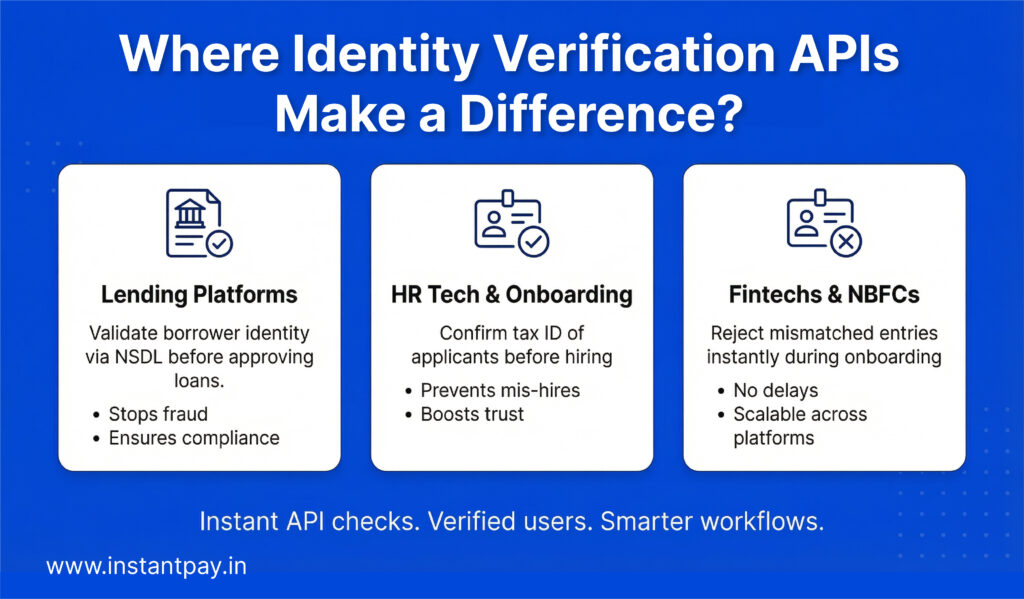
For businesses operating in lending, HR tech, insurance, or fintech, validating user identity in real time is crucial. That’s where API-based solutions come in—offering both speed and accuracy at scale.
The PAN Verification API by Instantpay enables digital platforms to:
- Fetch and verify the name from official sources instantly via NSDL
- Eliminate onboarding delays with plug-and-play REST APIs
- Reduce fraud risk by flagging fake or mismatched identity documents
- Automate checks for multiple entries via the dashboard or bulk file upload
Use Case Scenarios:
- Lenders can validate borrowers before disbursing credit.
- HR tech platforms can prevent mis-hires by confirming tax-linked identity.
- Fintechs & NBFCs can auto-reject mismatched entries in seconds.
The API is available with secure integration tools and real-time response formats to fit into any onboarding workflow, ensuring compliant, verified entries from the start.
Looking Ahead: What’s Next for Your Tax Identity in India?
India’s financial ecosystem is evolving, and so is its core identity infrastructure. As we move into a more digitally unified era, your tax-linked identifier is set to take on a much bigger role, thanks to PAN 2.0 and broader integrations across platforms like India Stack and UPI.
What Is PAN 2.0?
PAN 2.0 is not just a rebranded number; it’s a digitally upgraded version of the Permanent Account Number, designed to streamline financial compliance, verification, and reporting across platforms.
Key Highlights of PAN 2.0:
- Unified Business Identifier: Under Budget 2023, the document now acts as a primary business ID for registrations across regulatory bodies.
- Digital-First KYC: Supports real-time validation, API-ready onboarding, and seamless integration with India Stack.
- Faceless Processing: Enables instant, document-free verification across IT returns, GST, customs, and more.
- QR-Code Embedded e-PAN: Now issued instantly with a secure QR code, delivered straight to your registered email ID—free of charge.
- Multi-regulator Integration: Used by SEBI, RBI, GSTN, and other platforms to cross-validate user data.
- Enhanced Security: Implements stronger encryption and token-based institutional access.
- Unified Business Identifier: Under Budget 2023, the document now acts as a primary business ID for registrations across regulatory bodies.
Where Is This Headed?
By 2026, India is expected to fully embed this upgraded document into:
- UPI 3.0 and 4.0 onboarding and linking for merchant and business accounts
- Unified Document Code (UDC) initiatives
- Cross-utility onboarding across telecom, insurance, banking, and tax portals
- AI-led fraud prevention using identity scoring and dynamic verification APIs
If you’re a business handling user onboarding, KYC, or payouts, this is the right time to upgrade your workflows. With real-time PAN APIs, you can ensure compliance, speed, and fraud prevention without manual intervention.
Final Thoughts
This document may look small, but its role in India’s financial landscape is monumental.
What began as a tax identity has evolved into a critical anchor for digital finance, powering everything from investment access to subsidy claims, from eKYC to GST registration. Whether you’re salaried, self-employed, an NRI, or running a business, having a verified, updated identity number isn’t just helpful. It’s non-negotiable.
Today, your 10-character alphanumeric identifier is:
- Mandatory for high-value financial activity — opening bank accounts, filing ITRs, purchasing real estate, or investing in mutual funds
- A compliance filter — businesses use it to check mismatches, reduce fraud, and fast-track onboarding
- Your gateway to digital services — from UPI and Aadhaar seeding to e-signatures and GST filings
As India transitions into a digitally authenticated economy, identity and verification systems will only get tighter. With real-time validation, API-led workflows, and regulatory linkages like Section 139AA and 272B in place, staying updated is both a user responsibility and a business imperative.
So, what should you do now?
- Apply or download your document (e-format or physical)
- Link it to Aadhaar before the next deadline
- Update any incorrect information
- Quote it in all required transactions
- And if you’re a business, consider automating verification at scale
In an age where data hygiene equals trust, this identifier isn’t just about taxes; it’s about enabling secure participation in India’s financial future.
FAQs
1. What is the format of the Permanent Account Number in India?
It’s a 10-character alphanumeric code — 5 letters, 4 numbers, and 1 letter. Example: ABCDE1234F
2. What is the meaning of 10 digits in a PAN card?
Each part has a purpose: letters for sequence and entity type, numbers for identity, and the last letter is a checksum.
3. How can I know my PAN card’s Permanent Account Number?
You can find it on your document or retrieve it from the Income Tax e-Filing portal using your name, DOB, and mobile OTP.
4. What is the 11-digit PAN number in India?
There is no 11-digit version; the official format is always 10 characters. If you see 11, it’s likely an error.
5. What is the 15-digit numeric number in PAN card?
That refers to the acknowledgement number you receive after applying, not the ID itself.
6. What does the 4th alphabet in PAN mean?
It identifies the type of holder:
- P = Individual
- C = Company
- H = HUF
- F = Firm, etc.
7. How to decode PAN number?
Break it down:
- First 3 = random letters
- 4th = entity type
- 5th = surname initial
- Next 4 = digits (serial)
- Last = check letter
8. How can I check my PAN card number?
Use the “Know Your PAN” tool on the NSDL or Income Tax portal with your name and DOB.
9. Can we download a PAN card online?
Yes. If you applied recently or need a reprint, visit NSDL/UTI portals to download an ePAN PDF.
10. How to check PAN Aadhaar link?
Go to https://incometax.gov.in, open the ‘Link Aadhaar’ section, and check the status using your ID and Aadhaar number.
11. How can I check my PAN card status by PAN number?
Use your acknowledgment number or ID on the NSDL/UTIITSL website to track application or correction status.
12. How do I verify my PAN card?
You can verify your identity number through government portals or use business-grade APIs like this one for real-time validation.
13. Is PAN 2.0 available now?
Yes. It’s already being issued to new applicants as a secure, digitally enhanced version.
14. What does PAN card 2.0 mean?
It’s the upgraded version featuring QR codes, digital issue, and secure delivery — part of India’s digital KYC push.
15. Which company is giving PAN 2.0 project?
Protean (formerly NSDL e-Gov) and UTIITSL are authorised by the Income Tax Department to issue these updated documents.
16. How to update PAN card 2.0 online?
Use the correction form on NSDL or UTIITSL sites. You’ll get the upgraded version once reissued.
17. How to check PAN 2.0 status?
Track your updated document via the 15-digit acknowledgment number received during the correction or reissue process.
18. How to link PAN with Aadhaar?
Visit the Income Tax portal > Select “Link Aadhaar” > Enter your details and complete OTP verification.
19. Does PAN 2.0 have a chip?
No, it doesn’t include a chip. It uses a secure QR code for instant digital authentication.