Although the idea of securing a Permanent Account Number (PAN) card for your child may seem odd at first glance, there has been an increased need in recent years due to the tightening of KYC (Know Your Customer) compliance standards by banks, mutual funds, and other financial institutions on who qualifies to open new accounts, invest, or report income on gifts received. To conduct any of these transactions, a parent must obtain a PAN for their child as a result of the fact that many children are eligible for the benefits of Rule 114B of the Income Tax Act; this rule states that all financial transactions that occur before the age of 18 must be documented using a PAN.
Over the last few years, the expansion of the PAN system illustrates how the PAN has become a cornerstone for most Indian citizens’ financial identity. As of March 2025, 80 crore PANs have been issued (i.e., 800 million PANs), indicating that there is now a widespread ability to use financial services throughout India and that the PAN is now the central component for facilitating both financial inclusion and regulatory compliance.
While the PAN is generally used by adults, it now provides all families opportunities to begin planning for their financial futures from childhood through the use of minor accounts (e.g., minor savings accounts), investing in mutual funds, and reporting income from gifts or talents. There is no minimum age to obtain a PAN, so if an infant obtains any type of information that triggers the need for a PAN, he/she can receive a PAN.
However, many parents have little to no knowledge about the initial steps that are involved in obtaining a PAN card for minors. This guide outlines many of the common questions that parents may have and contains information on eligibility requirements, Form 49A, online versus offline application processes, fees, and information about how to update information in your child’s PAN file when your child turns 18 years of age..

What Is a PAN Card for Minors & Why Does It Matter?

Minor PAN cards are Permanent Account Numbers issued to children under the age of 18. Unlike adult PAN cards, the PAN card for minors does not have a photo or signature of the child and can be applied for by a parent/guardian.
Minor PAN cards are issued under Section 160 of the Income Tax Act, which allows for a representative assessee (the guardian) to be able to act on the minor’s behalf for income tax purposes.
As early as 2026, Indian banks and financial institutions will require PAN card for minors when they open their own accounts, initiate fixed deposits, or invest in mutual funds. PAN cards will also be required for a child who receives a payment for their work (i.e., talent contracts); receives income from property or bequeathed property, and to fulfil KYC (Know Your Customer) regulations.
In the absence of a PAN card, families may encounter difficulties in reporting income, managing gifts of more than Rs.50,000, and accessing financial services.

Who Can Apply for a PAN Card on Behalf of a Child?
When you are requesting a PAN card for minors, it should be only done by a parent or guardian. The Income Tax Department does not allow persons under the age of 18 years to legally enter into contracts or give consent; therefore an adult will act as a representative of the minor and can apply for them.
This representative is referred to as the “Representative Assessee” and must sign the application on behalf of the minor.
In addition to submitting the parent’s or guardian’s identity and address documentation, they must also submit a declaration of representation. Photos and signatures of the minor do not need to be included with the application for purposes of obtaining the PAN Card.
By establishing this method of representation, it creates a sense of responsibility while also making it easier for families to apply. This is why it is so important to verify your information prior to submitting, particularly when you will use this information for investment or business purposes

The guardian’s identity and address documents are submitted as part of the application, along with a declaration of representation. The child’s photo and signature are not required at this stage, as the card is issued without them. This structure ensures accountability while simplifying the process for families. It’s also why verifying the details before submission becomes critical, especially when the PAN will be used for financial or investment purposes.
Is There an Age Limit for PAN Card? Eligibility & When a Child Needs One

Many adults believe that they will need a permanent account number (PAN) because of their age and work status. In fact, anyone is free to apply for their PAN. There are no age limits for applying for a PAN in India; even babies can get one if they are able to show a legitimate reason to apply, such as a legal, financial, or tax auditing purpose.
Under the Income Tax Act, people of all ages may be issued a PAN if they have a legitimate use for that PAN, including opening a bank account, investing in fixed or mutual funds, or receiving income in the child’s name.
As new digital KYC regulations are appearing, many financial institutions/bankers now require that you provide a tax identification number (TIN) to open an account, whether you are a minor or student. You will want to obtain a PAN for your child now if you expect to invest for and later manage their financial inheritance or file income tax returns on behalf of your minor child.
Not having a PAN will create complications in obtaining scholarships for your child, opening minor investment accounts, and reporting gifts to the IRS that exceed the limits of taxable gifts.

What Documents Are Required for a Minor’s PAN Card in India?

In order to apply for a PAN card for minors, parents or guardians will need to provide identity and address proofs, both for the child (additional documents required) and for themselves. The applicant (child) is a minor, so the guardians’ information will be used as an official reference in their application processes.
A quick reference table showing accepted documents that can be used when applying via Form 49A follows:
| Document Type | Accepted Proofs | Purpose |
| Date of Birth | Birth Certificate, Aadhaar, Passport | Confirms the age of the applicant |
| Guardian’s ID Proof | Aadhaar, Voter ID, Passport | Verifies the guardian’s legal identity |
| Address Proof | Utility Bill(not older than 3 months), Aadhaar, Driving License | Confirms residential details |
Most PAN Seva Kendra centres and online portals will also ask for a passport-sized photo of the child, even though it won’t appear on the card. These documents ensure the applicant’s eligibility and help avoid rejections due to mismatched KYC.

How to Apply for a PAN Card for Minors (Form 49A Process)?

Parental legal guardians and the parent need to fill out form 49A which is the application form for a PAN card for minors and is the Official Application form for all Indian citizens. It can be filed online by NSDL (Protean) or UTIITSL or offline at a PAN centre. In both cases, the Parent or Legal Guardian, as the applicant (Representative Assesse), will have to provide their valid ID documents as well as proof of address.
Online Application (Step-by-Step)
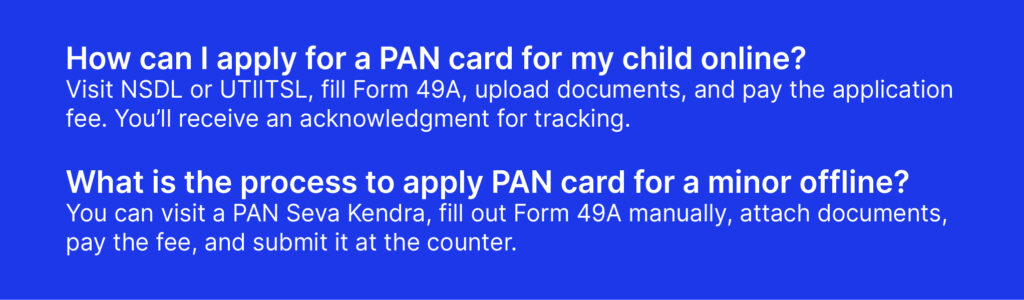
- To complete the process of applying for a PAN in the name of a minor, go to either the NSDL or UTIITSL portal.
- Under the individual category, select “Apply for New PAN (Form 49A).”
- Enter the minor’s name and date of birth.
- Enter the guardian’s name and address as the representative assessor.
- Upload copies of the minor’s date of birth, address proof, and identity proof.
- Pay the application fee using either UPI, credit card, or net banking.
- Submit your application and note the acknowledgment number so that you can track your application status.
You can also validate the PAN before using it to ensure it’s active and correctly issued.
Offline Application (Step-by-Step)
- Go to your local PAN Seva Kendra (or NSDL/UTIITSL).
- Complete a paper form 49A by requesting a copy from a PAN Seva Centre.
- Attach your child’s photo and photocopies of supporting documents.
- Sign as guardian, submit application with photo.
- Pay by demand draft or cash (if allowed).
- Get the receipt to track application status.
What are The Fees & Charges for Minor PAN Card?
If you want a PAN for your child, there are multiple options available to apply, like you can apply online or offline. You will have to pay a different fee depending on if you want a physical card or only e-PAN and if you want your PAN processed for dispatch in India or outside of India.
The following will give you a quick overview of the current government approved fees:
| Type of PAN | Fee (Rs.) |
| Physical PAN (within India) | Rs. 107 |
| e-PAN (Paperless PDF only) | Rs. 72 |
| Overseas PAN Dispatch | Rs. 1,017 |
These fees include processing and delivery fees, and they are charged at the same rate by all the authorized service providers, such as NSDL and UTIITSL.
Note : If you are using e-PAN, the use of the e-PAN card is best suited for digital users or for investments made online. All e-PANs will be emailed to you and are considered to be a valid form of ID for both financial and KYC purposes..

How to Track PAN Card Status for Minor?
After you send your child’s PAN application, you will receive a unique 15-digit acknowledgment number that allows you to see where your child’s application is in the process at that moment.
This 15-digit acknowledgment number will allow tracking through either the NSDL or UTIITSL tracking portals based upon which organization was used to submit.
To track the status, here are the steps to take:
1. Go to either the NSDL PAN status portal or UTIITSL tracking page.
2. Enter your acknowledgment number and hit the submit button.
3. Your status will be one of three conditions, i.e. under process, dispatched, or completed.
4. If you selected e-PAN there is a good chance you have already received an email with instructions on how to download your e-PAN.
If you’re not sure if their Aadhaar is already linked to their PAN, tracking the Aadhaar and PAN linkage may help you with your next steps.

Do Minors Need to Submit a Photo or Signature for PAN?
However, when parents apply for their children’s PAN, they often ask if their child needs to sign or submit a photograph. The answer is no!
Children under 18 years old are children (as defined by law) and will not have their signature or photograph printed on the PAN card, but the parent or guardian will sign the application and send in one passport-size photograph for backend records; however, that photo will not be printed on the PAN card for Minors. In addition, biometric data will not be taken as a part of this application process.
The exemption allows for a simpler process without adding unnecessary risk to the legal validity of the PAN. However, once the child turns 18, the child will have to get a new PAN card that includes a co-signature from the child and a photograph of themself and the existing PAN card for minors will be cancelled or surrendered.

How to Convert a Minor PAN to a Major After Age 18?
Once your child turns 18, he or she will need to update their PAN number based on their new adult status. Minor to major PAN conversion is a process that makes sure the individual has a PAN card with his/her photo, signature, and address instead of the guardians (or parents).
To update this information, you will need to go to the NSDL PAN Correction portal and complete a form. You will also need the following:
– A current passport-size photo of the applicant
– The new adult’s signature
– Proof of identity and/or address (with the new adult’s name)
This information is required for tax filings; for obtaining employment; for obtaining higher education; and to transact with financial institutions.
To make sure that your child’s information has been properly updated after conversion, you can view the PAN verification information.

What If You Don’t Update the PAN After Your Child Turns 18?

Many parents do not take this step, believing that a PAN continues to work forever. However, if a PAN Card for minors is not converted to an adult PAN once he or she reaches adulthood, a variety of implications (both legal and practical) may result.
If a child PAN is not changed to an adult PAN in a reasonable period of time (generally within a year after the child turns 18), the following may occur:
- The PAN could be deactivated or flagged as non-compliant by the Income Tax Department due to the lack of an updated photograph, signature, or adult identity proof.
- Banks, mutual fund companies, or insurers may reject a KYC verification on a PAN that reflects the identity of a minor, causing a person to potentially be denied access to accounts, investments, or digital onboarding.
- The PAN will no longer be valid for filing income tax returns, which could result in technical rejections of returns or delays in receiving refunds.
- Penalties may be warranted under Section 272B of the Income Tax Act when a person uses an invalid or un-updated PAN, especially for large dollar amounts. Penalties can reach Rs.10,000.
Pro Tip: Always initiate the PAN update process within 3–6 months after your child turns 18 to ensure uninterrupted use across financial and legal platforms.

Difference Between PAN Card for Minors and Major PAN
| Feature | Minor PAN | Major PAN |
| Photo | Not printed | Printed on card |
| Signature | Guardian’s signature | Applicant’s signature |
| Validity | Must be updated after turning 18 | Valid for lifetime (unless changed) |
Why Does a PAN Card Benefit Children Financially?
A PAN card isn’t just for adults. Children may also need it to participate in today’s growing digital and financial ecosystem. From opening a bank account to investing in their name, a valid Permanent Account Number helps establish early financial independence and credibility.
Here’s how a PAN card for Minors is useful in real scenarios:
- Open Bank Accounts: Many banks require a PAN for minor savings accounts, especially if linked to net banking or auto-debit.
- Invest in FDs & Mutual Funds: Platforms like mutual funds or junior SIPs ask for PAN as part of digital KYC.
- Claim Scholarships & Education Benefits: Some scholarship portals and education boards require a valid PAN for disbursal.
- Build Tax Identity Early: PAN helps track income, if any, in the child’s name and avoids future KYC delays.
Many financial institutions now verify the tax compliance status of PANs before allowing investments, especially under Section 206AB of the Income Tax Act. If you’re planning to invest in your child’s name, make sure their taxpayer ID is compliant by using this PAN 206AB lookup tool.
Final Thoughts: Why It Pays to Get a PAN Card Early?
A PAN card isn’t just for adults; it’s increasingly essential for children, too. From opening a student bank account to starting a SIP or fixed deposit in your child’s name, PAN helps lay the foundation for a sound financial future. It’s also becoming a must-have for education-related documentation, minor income reporting, and digital KYC verification.
As financial systems become more integrated and compliance-focused, early PAN issuance gives your child a head start in navigating banking, investments, and taxation. It reduces last-minute hassles when they turn 18, ensures smoother onboarding into formal financial systems, and helps avoid regulatory issues like KYC rejections or inactive accounts.
So, don’t wait until adulthood. Apply for a PAN card for minors today and secure your child’s access to tomorrow’s financial ecosystem with confidence, compliance, and peace of mind.
FAQs
1. Can I get a PAN card for minors?
Yes, a parent or guardian can apply for a PAN on behalf of a child using Form 49A. There’s no minimum age requirement.
2. What is the difference between minor PAN card and PAN card?
A PAN card for minors lacks a photo and signature and is signed by a guardian. Once the child turns 18, it must be updated with their own details.
3. How to convert minor PAN card?
Log in to the NSDL/UTI portal, fill the correction form, and upload the child’s new photo, signature, and contact details.
4. How do I check if my PAN card is minor?
Check the card details—if there’s no photo or signature, it’s likely a minor PAN. You can also verify using a PAN verification API.
5. What is the cost of a minor PAN card?
Rs. 107 for a physical PAN card and Rs. 72 for an e-PAN in India. Additional fees apply for international dispatch.
6. Can I open a bank account with a minor PAN card?
Yes, many banks require a PAN for opening a minor’s savings account or investment account for regulatory compliance.
7. How to register a PAN card for minors?
Apply through the NSDL or UTIITSL portal using Form 49A. Upload the required documents and submit the application on behalf of the child.
8. Do students need a PAN card?
Yes, especially if they are earning income, receiving scholarships, or investing. It helps with KYC and financial onboarding.