Recently a colleague disclosed she had maxed out her entire health insurance policy in one hospital visit and was left with nothing else to use on her other medical needs for the rest of the year. She thought she was covered adequately until she discovered she had many misconceptions about her policy (like so many others). A study showed over 75% of policyholders are not fully aware about the limits on room rent, whether there are sub-limits on specified types of medical expenses or a percentage of co-pay per visit, and these will all have a significant negative effect on people who don’t understand their health insurance policy in light of 12-14% annual rising Medical Inflation.
A Story: Where Coverage Wasn’t Enough
Take for instance Anjali (34), a professional living in Mumbai. She carries a Rs.3 lakh corporate health policy. Unfortunately, her mother was a recent hospitalisation due to pneumonia and heart-related issues, causing the family to pay out Rs.5.8 lakh for a 7-day stay in a private hospital, whereas Rs.1.2 lakh is the average cost of staying in the hospital as per the National Health Authority. However, because of a 20% co-payment component, a Rs.4,000 maximum room rent limit, and sub-limits on specified medical expenses (of which she had to pay Rs.2.9 lakh out of her own funds). Therefore, it makes no difference whether you have health insurance unless you fully understand how its functioning works! This comprehensive (A-Z) guide will help you learn about different types of health plans (HMO, PPO, EPO) and break down complex terminology and help you make better-informed choices regarding your health care
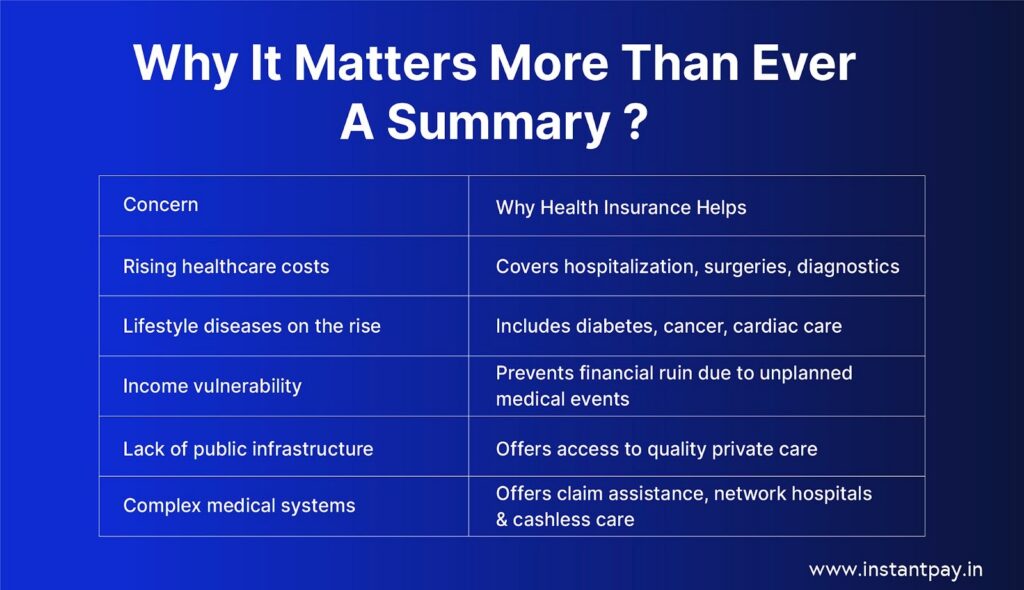
What Is Health Insurance, and Why Does It Matter?
A health insurance policy is an agreement between the insured person (the individual) and the insurance company. When you pay a premium on an ongoing basis to the insurance company, the company assumes liability for paying eligible medical expenses related to hospitalization, surgeries, diagnostic tests, and other qualified health expenses. Health insurance protects the individual against medical bills that are high and unexpected.
In India, the need for this protection is significant because many of India’s citizens are spending a considerable amount of their healthcare dollars out of their own pockets. According to the National Health Accounts (Ministry of Health and Family Welfare), an estimated 48.2% of the total health care spending in India was paid for by an individual directly (or from their funds).
The number of individuals currently covered by health insurance is still limited. The Insurance Regulatory and Development Authority of India (IRDAI) Annual Report states that an estimated 35–40% of the Indian population is covered by some form of health insurance coverage, leaving a significant number of individuals financially vulnerable during times of emergency due to health needs.
Healthcare costs can easily lead to families being placed in financial distress. The World Bank has documented that millions of Indian citizens are pushed into poverty annually as a result of their financial responsibilities for healthcare expenses.
For these reasons, health insurance is important; it helps secure your savings, relieves financial pressure during times of emergency, and allows you to receive high-quality health care when you need it most.
Key Terms Every Policyholder Should Know
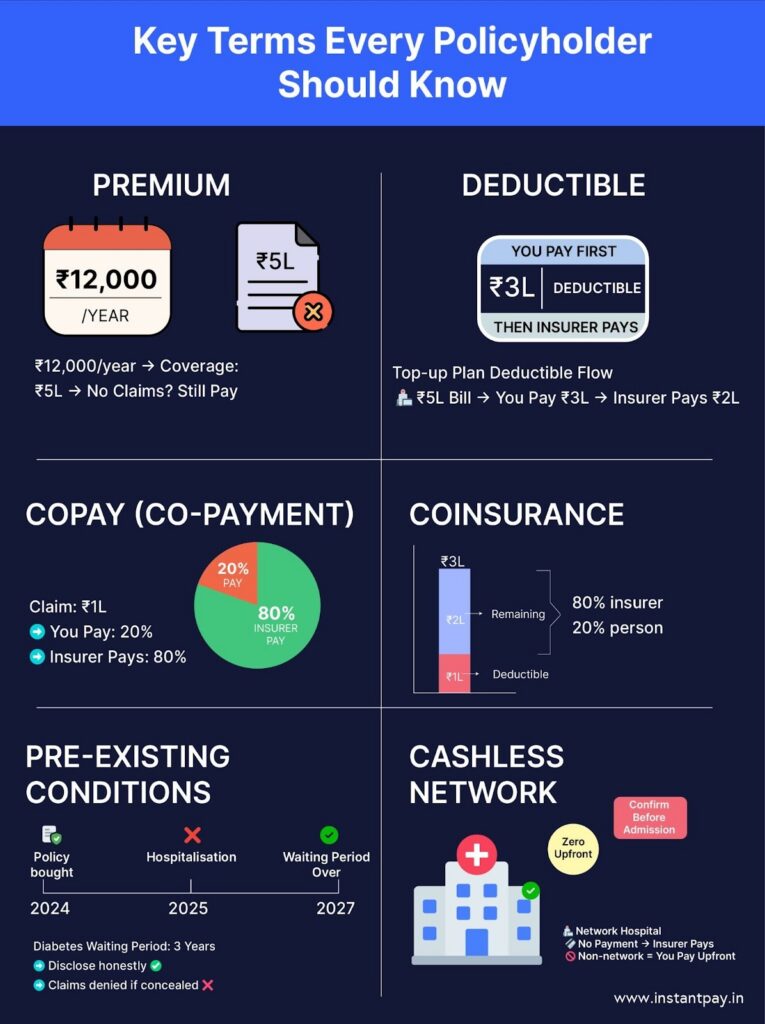
Premium
The premium is the cost you pay on a regular basis (monthly or annually) to keep your health insurance policy in effect.
For example, if you have a health insurance policy with Rs.5 lakhs worth of coverage and you pay an annual premium of Rs.12,000, you would pay Rs.12,000 every year to keep that coverage—even if you never make a claim.
The amount of premium you will pay generally depends on your age, health status, where you live, and your amount of coverage.
Deductible
A deductible is the cost that you must pay yourself (out of your pocket) before your insurance begins paying for anything.
As an example, if your health insurance policy has a Rs.3 lakh deductible and your total medical expenses amount to Rs.5 lakh, you would pay Rs.3 lakh and your insurer would pay the difference of Rs.2 lakh.
Deductibles are commonly found in top-up and super top-up policies.
Copay (Co-payment)
A copayment is a specific percentage (usually between 10% and 30%) of a medical bill that you are responsible for paying, with the other portion being the responsibility of the insurance provider.
For example, if you have a claim for Rs.1 lakh with a 20% copayment requirement, then you would owe Rs.20,000, and your provider would owe Rs.80,000.
Most senior citizen insurance policies have copayments between 10% and 30%.
Coinsurance
Coinsurance consists of the policyholder and the insurance company sharing costs based on a predetermined percentage, after the deductible has been met.
For example, if a corporate health policy had an 80%/20% coinsurance policy and the insured had a Rs.1 lakh deductible and received a medical bill for Rs.3 lakh:
- The insured paid their deductible of Rs.1 lakh.
- The balance of the bill of Rs.2 lakh will be shared: Rs.40,000 to the insured and Rs.1.6 lakh to the insurance company.
This form of coinsurance is uncommon in India but may appear in some corporate health policies.
Pre-Existing Conditions
Any condition that an insured has prior to purchasing an insurance policy is considered pre-existing.
Most insurance companies will typically have a waiting period of 2–4 years before they consider paying a claim related to a pre-existing condition.
Always disclose all pre-existing conditions when applying for a health insurance policy to ensure that your claim is not denied.
Cashless Network
Hospitals in a cashless network are facilities that have an agreement with an insurance company to accept payment for services rendered without requiring the insured to pay the bill in full when leaving the hospital. The insurance company pays the hospital directly for the services that they have approved.
For example, if an insured has surgery at a cashless networking hospital that has a total bill of Rs.2.5 lakh, the insurance company will pay the hospital’s covered portion directly, and the insured will be liable for any uncovered amounts.
Types of Health Insurance Plans

India’s private healthcare insurance market is changing quickly. Below are some of the key types of health insurance policies that are currently in use:
HMO Plans: Low Cost, Less Flexibility
This type of policy typically requires that you use hospitals that belong to the health insurer’s network. Usually, HMO contracts have a lower premium than other policy types but provide less flexibility to select your doctor.
Ideal For: Budget-Conscious Buyers
PPO Plans: Freedom to Choose Your Doctor
A PPO policy allows you to visit any doctor or hospital. However, using an in-network provider under a PPO health insurance policy is usually less expensive.
Ideal For: Individuals Who Want More Flexibility In Selecting Their Doctor
PPO-style health insurance policies are more common with international (expat) health insurance policies.
EPO Plans: A Hybrid Health Coverage Option
Exclusive Provider Organization (EPO) plans allow policyholders to visit preferred hospital networks for their insured members to help facilitate faster cashless treatment and expedited claims.
Ideal For: Urbans Who Prefer Specific Hospital Networks
Carriers that currently have provider-curated preferred networks include Niva Bupa and Navi.

How to Choose the Right Health Insurance Plan?

Explore the best health insurance plans in India that offer wide hospital coverage, low waiting periods, and transparent claim settlement processes with Instantpay.
Insight: IRDAI data (2023) shows 72% of urban policyholders opt for family floaters due to affordability and ease of management.
What are The Must-Have Features to Look For in a Health Cover Plan?
Restoration Benefit
What It Means: When you’ve used your total sum insured in any given policy year (and the policy covers it), the insurer provider will restore the sum insured to allow you to use the same sum insured for another claim within the same policy year.
Example: If you had an insurance policy with Rs.5 lakh coverage and you had used up the entire amount for surgery, the insurer will restore the entire Rs.5 lakh amount to allow you to make another claim later this year.
Important Note: Most policies will only allow one restoration; however, premium-type policies may provide for multiple restorations in a year.
Learn how restoration benefit works in family floater plans, and why it can be a financial lifesaver during multiple hospitalizations.
No Claim Bonus (NCB)
What It Means: If you don’t make any claims on your policy for any given year, the insurer will automatically increase your sum insured, but won’t increase your premium.
Example: If you had a policy with a sum insured of Rs.5 lakh and the policy provided for 20% NCB, if you didn’t make any claims in year one, in year two you would have a sum insured of Rs.7 lakh.
Important Note: The cap on NCB will vary from one policy to another; however, the majority of policies will not allow the NCB to exceed 100% of the basic sum insured. If a claim is made, NCB may be reduced.
Maternity & OPD Cover
What It Means: Some policies cover maternity and outpatient (OP) treatment, i.e., doctor visits, medications, and diagnostic testing.
Example: Maternity coverage typically covers normal deliveries, including prenatal care, whereas OPD coverage usually reimburses the insured for doctor visits even if the insured hasn’t required hospitalization.
Important Note: The waiting period for maternity benefits can range from 2 – 4 years, whereas the amount that can be reimbursed for OPD may be limited on an annual basis.
Advanced Tips for Smarter Coverage
How to Optimize Your Plan with Riders?
Riders are optional additional coverages that enhance your existing policy but do not require you to purchase a completely new one.
Some examples include critical illness coverage, accident coverage, and daily hospital cash benefits. If you want to purchase a high-value policy, consider combining both a base policy and a top-up or super top-up plan.
A combination of these policies typically yields the same overall amount of insurance at a much better value.
Government Health Schemes in India
- Ayushman Bharat offers families up to Rs.5 lakh in coverage for free each year if they meet the required income threshold.
- Individual states have also created their own programs, like BSKY in Odisha and CMCHIS in Tamil Nadu.
Each of these programs could be used in conjunction with private health insurance policies to provide additional coverage and benefits to eligible families.
Renewals, Portability & Claim Settlement
- Renewal grace periods: Typically 15–30 days after the expiration date of the policy.
- Eligibility for portability: You may move to a different insurance company and retain your waiting period benefit by following the rules outlined by the IRDAI.
- Claim settlement ratios: Most insurers settle more than 94–97% of the claims submitted, so reviewing the percentage settled gives you an idea of the insurer’s likelihood of settling your claim.
Case Study: How the Right Health Insurance Saved a Family from Financial Stress
Background: The Verma Family’s Preparedness Was Put to the Test
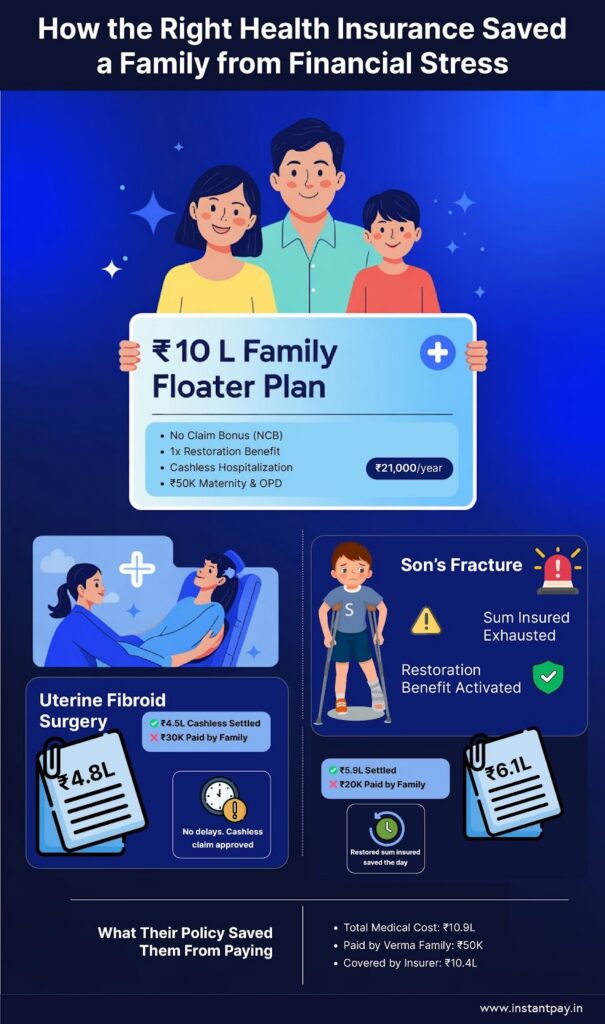
Rohit Verma (42 years old) works as an IT professional in Pune and purchased a family floater health insurance plan for his family that had a maximum benefit limit of Rs.10 lakh five years ago. He bought this policy to cover his wife Anjali and son with a variety of benefits included in the policy such as cashless hospitalization, no-claim bonus and restoration. This family paid approximately Rs.21,000 a year for the policy.
The Medical Emergency
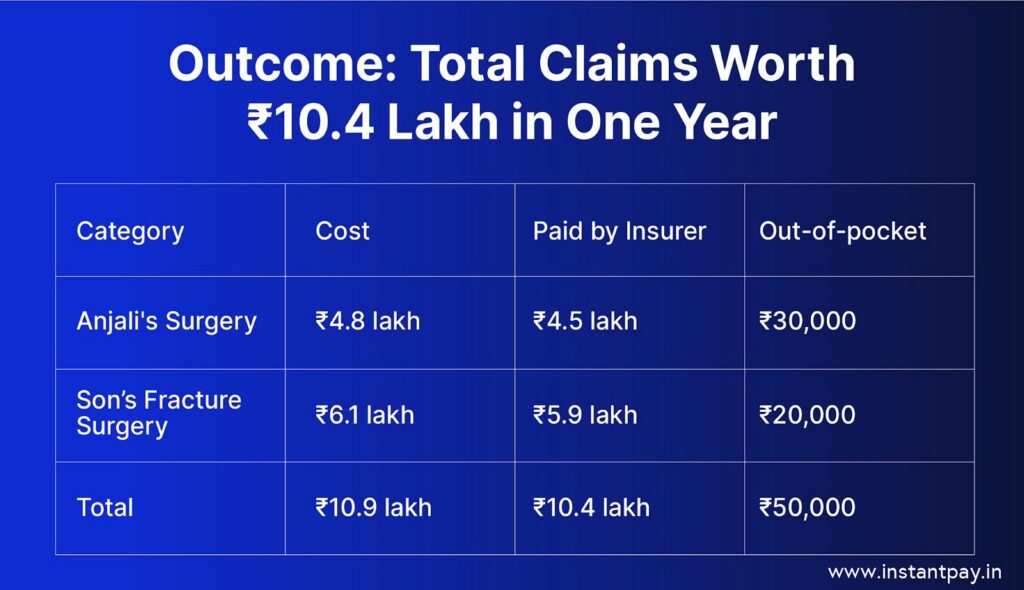
In early 2023, Anjali had to undergo surgery to remove a uterine fibroid. The total cost of the surgical procedure was Rs.4.8 lakh. The hospital was within the network of the insurance company; therefore, the insurance company paid Rs.4.5 lakh of the surgical procedure directly to the hospital, and Rohit paid the remaining Rs.30,000 from his own personal resources for non-covered items.
Two months later, their son had a femur fracture and required surgical intervention at an estimated cost of Rs.6.1 lakh. Rohit was concerned that he would have used all of his insurance coverage already; however, the restoration benefit of the policy restored the maximum benefit limit of Rs.10 lakh. The insurance paid Rs.5.9 lakh directly to the hospital and Rohit only had to pay Rs.20,000 out-of-pocket to the hospital.
Key Lessons Learned
The annual premium of Rs.21,000 contributed to the Verma family having been reimbursed more than Rs.10 lakh of medical expenses during the 2023 calendar year.
Therefore, families that select an appropriate amount of insurance coverage, restoration of benefits, and an extensive cashless provider network can avoid financial burdens due to an inability to pay for unexpected medical expenses.
Case Study: When “Just Having Insurance” Wasn’t Enough
Background: The Joshi Family’s Unexpected Wake-Up Call
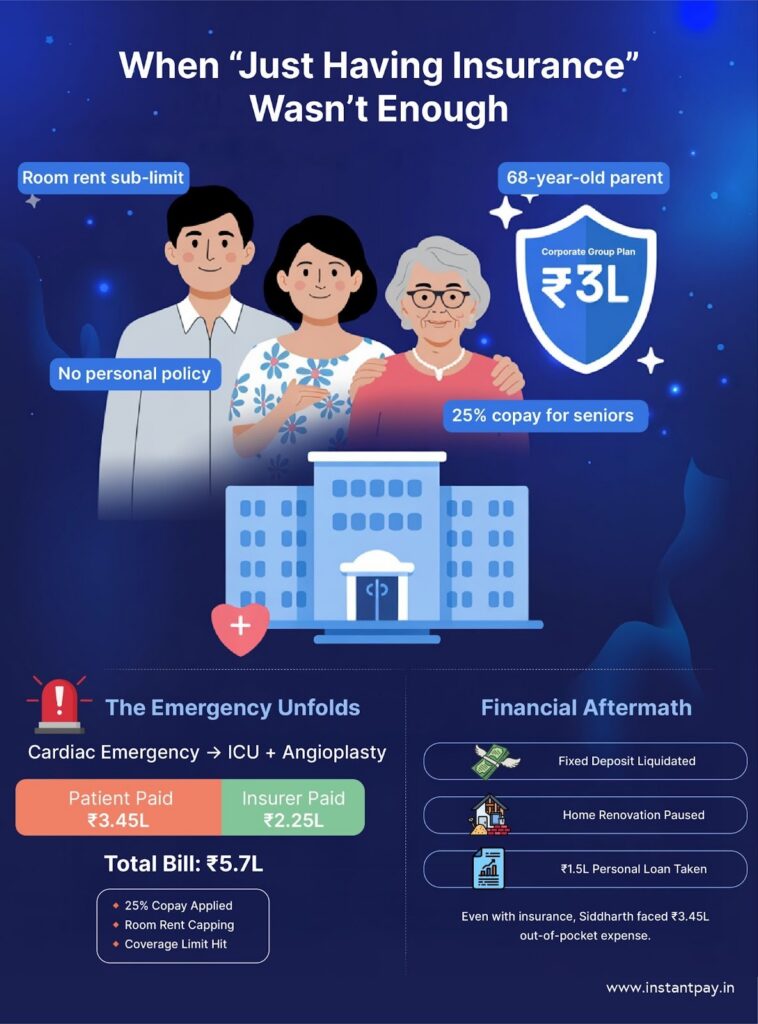
Siddharth Joshi, a 36 year old sales executive in Delhi, was completely dependent on his corporate health insurance, which provided him with Rs.3 lakh worth of health coverage that included his elderly father. Because all family members appeared to be healthy, he did not purchase a separate personal policy.
The Crisis: Cardiac Emergency Strikes
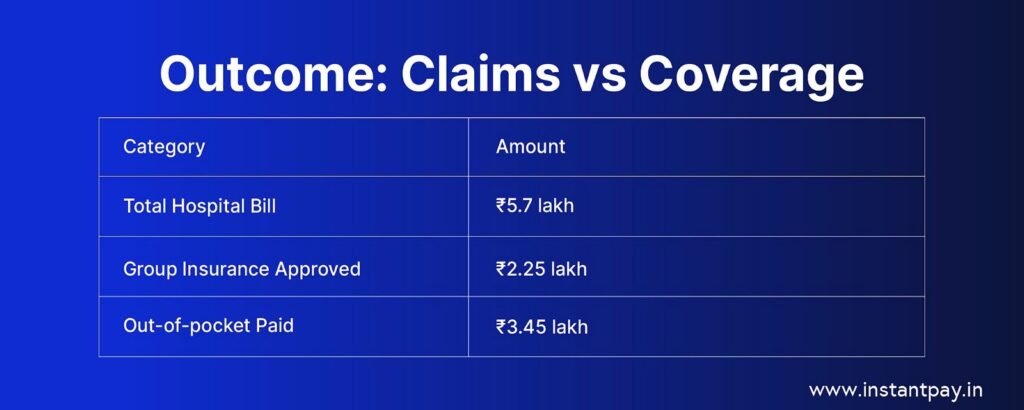
In 2023, Siddharth’s 68 year old father had a heart attack, which required him to undergo angioplasty. The bill was Rs.5.7 lakh.
However, the corporate policy had certain limitations:
- Maximum Coverage of Rs.3 lakh
- 25% Coinsurance Payment for Anyone over 65
Therefore, when all of the costs were finally adjusted, Siddharth’s insurance company only paid out Rs.2.25 lakh, leaving him responsible for paying out of pocket using all of his savings an additional Rs.3.45 lakh.
Key Lessons Learned
Siddharth was forced to empty all of his savings and take out a personal loan of Rs.1.5 lakh to cover the remaining cost. Siddharth learnt that corporate health insurance alone was not sufficient for him or his father, especially with his father’s age; a separate personal policy with increased coverage would have greatly offset his costs.
Debunking Common Myths About Health Insurance
Despite growing awareness of healthcare costs, health insurance in India is often misunderstood. Misinformation, mainly shared through word of mouth, can lead to costly mistakes during claims or when selecting coverage. Let’s clarify some common myths.
Myth 1: “I’m young and healthy, I don’t need health insurance right now.”
Reality: A medical emergency can happen to anyone at any age. Also, if you buy insurance when you are younger, your premiums will be lower than when you are older, and you won’t have to deal with the complication of waiting periods.
Myth 2: “Employer health insurance is enough.”
Reality: Most employers only offer Rs.2–3 lakh of coverage through their corporate policy; this amount may not provide enough coverage for major expenses. Also, if you leave your job; the corporate policy will no longer provide you with medical coverage.
Myth 3: “If I don’t make a claim, I’m wasting my money.”
Reality: Health Insurance protects you from the high cost of medical bills; many insurance companies will reward you with a No Claim Bonus (NCB), which will increase your coverage for each year you do not make a claim.
Myth 4: “All policies cover everything after 30 days.”
Reality: Most plans cover accidents from day one, but other illnesses have a 30-day initial waiting period. Also:
- Pre-existing diseases often have a 2–4 year waiting period.
- Maternity benefits may have a 2–6 year wait.
- Specific illnesses (like hernia, cataract) may have 1–2 year exclusion windows.
Know Before You Claim: Always check the policy brochure for waiting period clauses.
Myth 5: “I can only claim if I’m hospitalized.”
Reality: Many modern health insurance plans also cover daycare procedures, preventive physicals and some coverage for OPD medical treatment.
Myth 6: “Higher premium means better coverage.”
Reality: Higher premiums don’t always mean better benefits. Premiums can vary based on:
- Age and health condition
- Location (Tier 1 cities usually cost more)
- Features (like maternity, OPD, restoration)
What matters: Look at the sum insured, room rent limits, network hospitals, co-pay clauses, and exclusions—not just the price.
Myth 7: “The insurer can reject my claim anytime.”
Reality: A higher premium does not mean you have more coverage; it merely means you are paying more for your coverage. Make sure you look at the amount of coverage, network of hospitals, co-payments and exclusions in addition to simply the price.
Conclusion – Take Charge of Your Healthcare
Unexpected medical emergencies can happen at any time, and unfortunately, most people only find out about their health insurance limitations when they need it most. With rapidly increasing healthcare costs in India, just having health insurance isn’t sufficient; one must also have knowledge about what their policy actually covers.
Understanding key terms of medical insurance, types of medical insurance plans and common exclusions will assist you in making better decisions on your choice of health insurance and help to avoid unexpected surprises once you’ve made a claim. Ultimately speaking, health insurance is more than just an insurance policy; it provides a degree of financial protection, which could protect your savings or provide you with peace of mind during tough times.

Frequently Asked Questions (FAQ’s)
1. What is the waiting period in health insurance?
The term ‘waiting period’ in the context of health insurance refers to the period of time when certain claims cannot be paid out.
- The initial waiting period is typically 30 days long (but does not apply to accidents),
- The waiting period for pre-existing conditions varies based on the respective health insurance policy and often ranges from 2 to 4 years
- Some specific conditions, such as Hernia or Cataract, may require a one to two-year waiting period before they can be filed for reimbursement.
2. Does health insurance cover pre-existing diseases?
Yes, Pre-existing conditions are covered in most insurance policies, but generally, you must wait two to four years before filing a claim. Make sure to disclose pre-existing conditions when purchasing the policy; if you fail to do so, your claim will likely be denied.
3. Is a medical check-up mandatory before buying health insurance?
Generally, if you are under 40–45 years of age and have no prior history of medical issues, a medical test will not be required prior to purchasing health insurance. However, if you are older or have health problems, you may need to have medical tests conducted.
4. Can I have multiple health insurance policies?
Yes, you may own multiple health insurance policies; you may submit all health insurance claims associated with an inpatient hospital bill using your multiple policies, as long as the total of all policies combined exceeds the amount of the hospital bill.
5. What is the difference between individual and family floater health insurance plans?
Individual, or stand-alone health insurance plans, provide health insurance for each individual who buys one, whereas family floater health insurance plans cover the entire family under a single insured amount.
Family floater plans are frequently less expensive than individual plans for younger families.
6. Are outpatient department (OPD) expenses covered in health insurance?
The majority of traditional health insurance products cover hospital expenses only. Some insurance companies will cover OPD expenses, however it is usually an add-on to the core policy and there are limitations to the extent of coverage provided e.g doctor visit, lab/screening test and medications/etc.
7. Does health insurance cover maternity and newborn expenses?
Maternity/Childbirth related expenses are covered under several policies. Most insurance carriers include a waiting period for maternity related claims, with ranges from 9 months to 4 years depending upon the insurance carrier.
8. What is a cashless hospitalization facility?
Cashless hospitalization refers to being able to receive treatment at a networked provider without needing to pay for the total cost of the treatment upfront. The insurance carrier will directly pay the networked hospital provider for certain eligible costs.
9. Can I port my health insurance policy to another insurer?
Yes. Under the insurance portability regulations set forth by IRDAI, you can switch to another carrier at renewal and not lose any benefits from your previous carrier (for example, you will not have to count from zero on your standing waiting period).
10. Are there tax benefits on health insurance premiums?
Yes. You are entitled to claim an amount for a deduction against your income taxes under Section 80D of the Income Tax Act for health insurance premiums that you have paid. You will be able to claim an amount up to Rs.25,000 for yourself, your spouse, and any children you claim as dependents. You will also be able to claim an amount up to Rs.25,000 as an additional deduction for your parents (if your parents are over 60, you will be able to claim an additional deduction of up to Rs.50,000)
11. Is 10 lakh health insurance good?
A policy limit of Rs.10 lakh is generally seen as providing adequate coverage for anybody who lives in an urban area where cost of health-related services are more expensive.
12. How to select health insurance?
- Sum insured.
- Health insurance coverage.
- Waiting period.
- Co-payment clause.
- Pre-existing disease coverage.
- Plan flexibility.
- Sub-limit help.
- Tax benefits
13. What are the common health insurance plans?
The most common types of plans include:
- HMO (Health Maintenance Organization)
- PPO (Preferred Provider Organization)
- EPO (Exclusive Provider Organization)
The major difference among these different types of plans is the hospital network that you are allowed access to and the flexibility offered by the given plan.
14. What age is best for health insurance?
The ideal age to buy health insurance is in your late teens or early 20s or in your late 20s/early 30s. This is the time when you will pay the least amount of premiums and you will have time to complete any waiting periods before health problems occur.