A great product can still lose the sale at pay time. A refund that takes days can undo months of trust. And a vendor who isn’t paid on schedule will think twice before listing again. Payments aren’t a “backend detail”, they’re where revenue, loyalty, and operations meet.
This guide covers core e-commerce payments and it’s use cases: checkout completion, automated refunds, vendor/seller settlements, partner commissions, on-demand gig payouts, reconciliation, and risk-aware seller onboarding.
What Are E-commerce Payments?
E-commerce payments refer to the systems and workflows that enable online businesses to collect money from customers and distribute it to sellers, partners, and service providers. They go beyond checkout to include refunds, settlements, commissions, payouts, reconciliation, and compliance checks.
Well-designed e-commerce payments ensure money moves accurately, on time, and with visibility for customers, sellers, and internal teams, directly impacting revenue, trust, and operational efficiency.
Use Case 1: Customer Checkout & Payment Collection
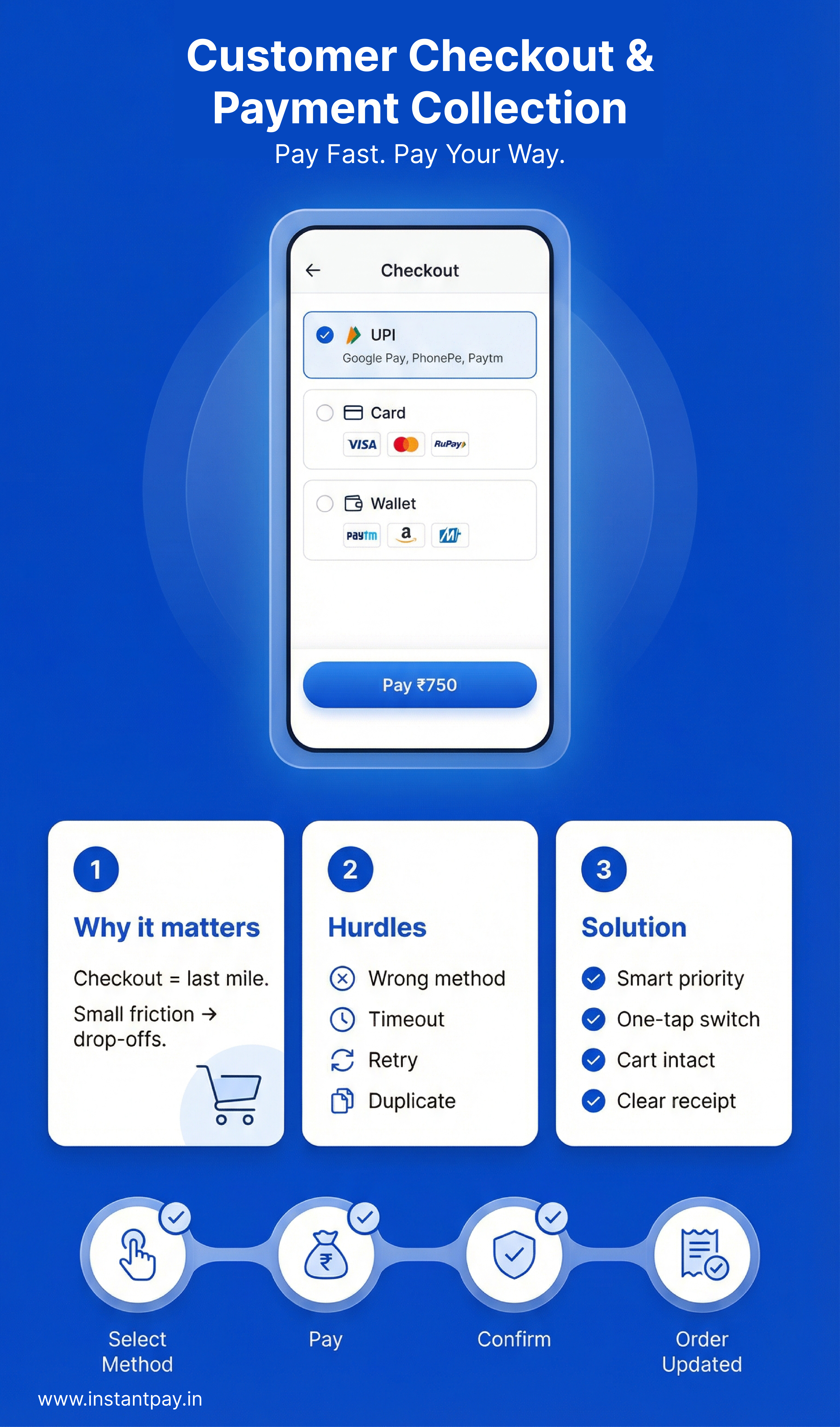
Allow customers to purchase and fulfill their orders using the payment options they want (UPI, card, or wallet).
Why it matters
The checkout process is the last step before a shopper receives their order. Small issues during this phase can lead to larger problems for a retailer. Examples are fewer purchases due to abandonment, increased support issues, and an overall decrease in conversion rates.
What are common issues during the checkout process?
– Incorrect payment options, such as showing UPI first on mobile devices.
– Time limits with OTPs or temporary redirects; ineffective error messages.
– Buyer loses all data if attempting payment fails.
– Duplicate charges create hesitation among the buyer and impact operations.
How does a retailer create the best experience during checkout?
First, the retailer must rank the payment methods by total amount and by device, which simplifies payment processes for all customers. Second, if payment fails, the retailer should maintain the cart while providing the customer an alternative to switch payment methods with the use of idempotency keys. Finally, all successful transactions are immediately confirmed to the customer with clear receipts that reflect the updated order status through webhooks, ensuring that both support staff and customers see the same outcome.
Example:
Suppose a weekend sale at a retailer has UPI listed as the primary payment method; however, many customers will switch to credit cards. The retailer could create a better experience for both customers by allowing customers to switch payment types using an easy-to-use method; thus, leading to a lift in conversion.
Use Case 2: Order Returns & Automated Refunds
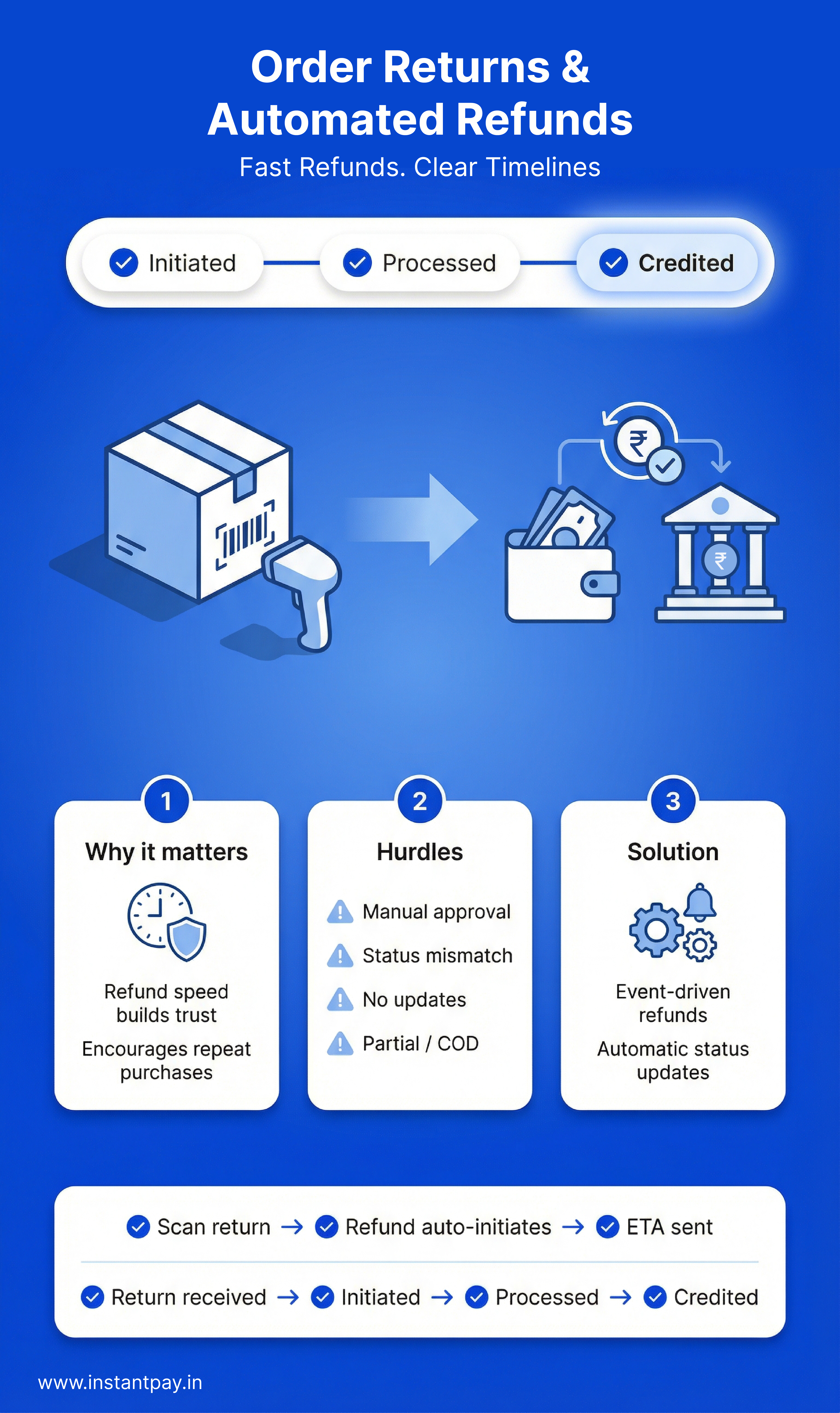
Refunds for completed purchases or orders that were canceled can be issued automatically, without needing manual intervention by support staff or the customers.
Why this is important
Quick refunds build consumer confidence in the brand, and will reduce ticket volumes (support issues). Slow refunds create the impression that “money is stuck” which can negatively impact future purchases.
Common challenges
– Payment approval requirements and manual tracking methods create a delay in credits being issued.
– Discrepancies between the order and the refund may cause unknown reasons for not getting a refund.
– Customers are not notified when the refund has been initiated, processing and/or received.
– Special cases such as partial refunds or cash on delivery (COD) orders create confusion for both the customer and the merchant.
Resolution
Automatically trigger a refund for a canceled or returned item based on a clear event (e.g., the warehouse scans an item at 11am), validate against the order records, and if possible, auto-initiate a refund back to the customer using the original payment method. For COD, get bank information once through a secure link and then reuse it in a safe manner. Notify the buyer of the status of a refund (initiated, processed, credited) through an SMS or email, and provide the consumer and the merchant access to the data via a dashboard.
Example
At 11 a.m., the warehouse scans the bar code or SKU of the returned item, matches the return to the original order, changes the status to “return received,” and initiates a refund back to the original payment method. The buyer receives an SMS/email with the expected time of arrival (ETA). The visible timeline will reduce the volume of support tickets.
Use Case 3: Vendor/Seller Settlements for Marketplaces

Paying sellers for orders delivered, as well as commissions, fees and splits is very important. Timely settlement of payments to sellers will help build loyalty, and ensures inventory is on the selling channels. Delays in payments will contribute to seller churn and could create issues with seller relationships, especially during peak sale times.
Some of the main challenges that occur with payment settlement are:
– Payment settlement files are all manual and have a high potential for error
– Payment settlement is delayed due to disputes based on payment fees or product returns
– High percentage of payment failures caused by outdated bank account numbers
– Payment settlement reconciliation (for example: order to refund to split) is a lengthy process
The solution is to automate the settlement process by creating and validating a payment file based on the seller’s orders, applying the appropriate split, and validating the seller’s bank account before creating the bulk settlement file and processing the bulk payment with clear and distinct statements. Exceptions (e.g. product returns that are under review) would be surfaced to a separate queue versus blocking the entire bulk payment process. Additionally, create and provide sellers with a ledger view for payments made that they can trust.
Example:
The system creates new settlement files on Tuesday, verifies that the seller’s bank accounts are valid, processes the bulk payment to the sellers and emails the sellers their statements. Sellers no longer have to contact support for payment status inquiries because settlement date and statements are predictable.
Use Case 4: Affiliate & Partner Commission Payouts
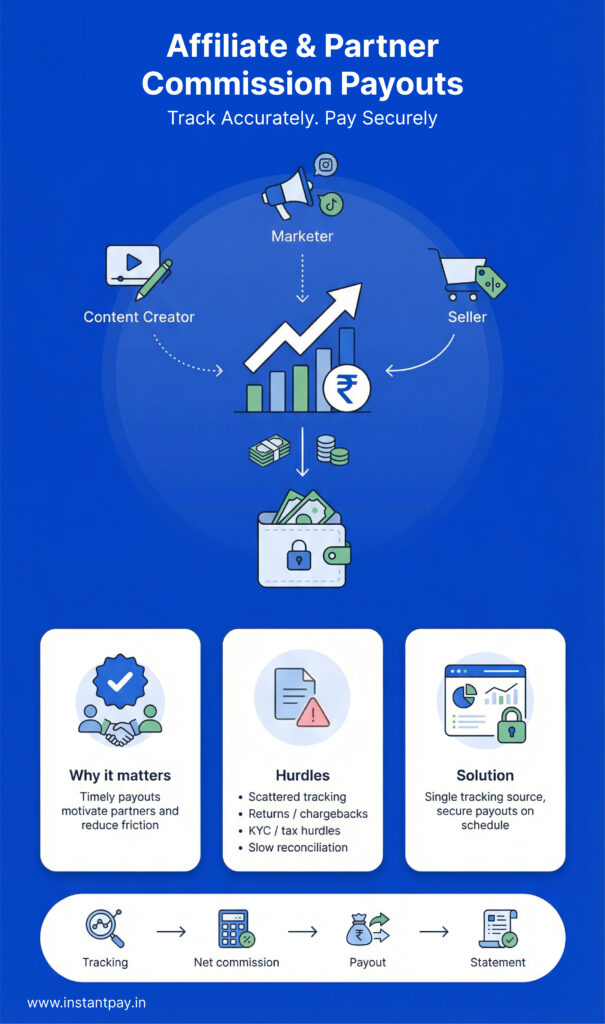
What it is:
Partners are compensated on a timing schedule based on sales from tracking.
Why it Matters:
Timeliness and accuracy to partners (and can avoid disputes) can also eliminate the time spent going back and forth with Finance and Support about reports.
Common Problems:
- Tracking can be fragmented across different systems, and can lead to the same numbers being mismatched from system to system.
- There isn’t a way to determine the correct net commission due to thresholds, returns, and charge backs.
- KYC/tax info isn’t currently available to be able to complete payment.
- Paying first time partners is challenging as they are hesitant to provide their banking information via email.
Solution:
A single source of truth for attribution and to create partner statements (net all returns/fees) and keep KYC/tax info on file after first payment. Create fixed cadence payment schedules and utilize secure payout links when paying first time partners to request bank/payout information. Create a simple portal for partners to see their statements and the current payment status.
Example:
At month-end, the system will create a net commission statement for each partner on the partner portal and give them an opportunity to flag issues that may be incorrect within the next 48 hours. Following the 48 hour period, the payment for partners will be processed and each partner will be provided with payment advice and a downloadable statement.
Use Case 5: On-Demand Payouts to Delivery/Gig Staff
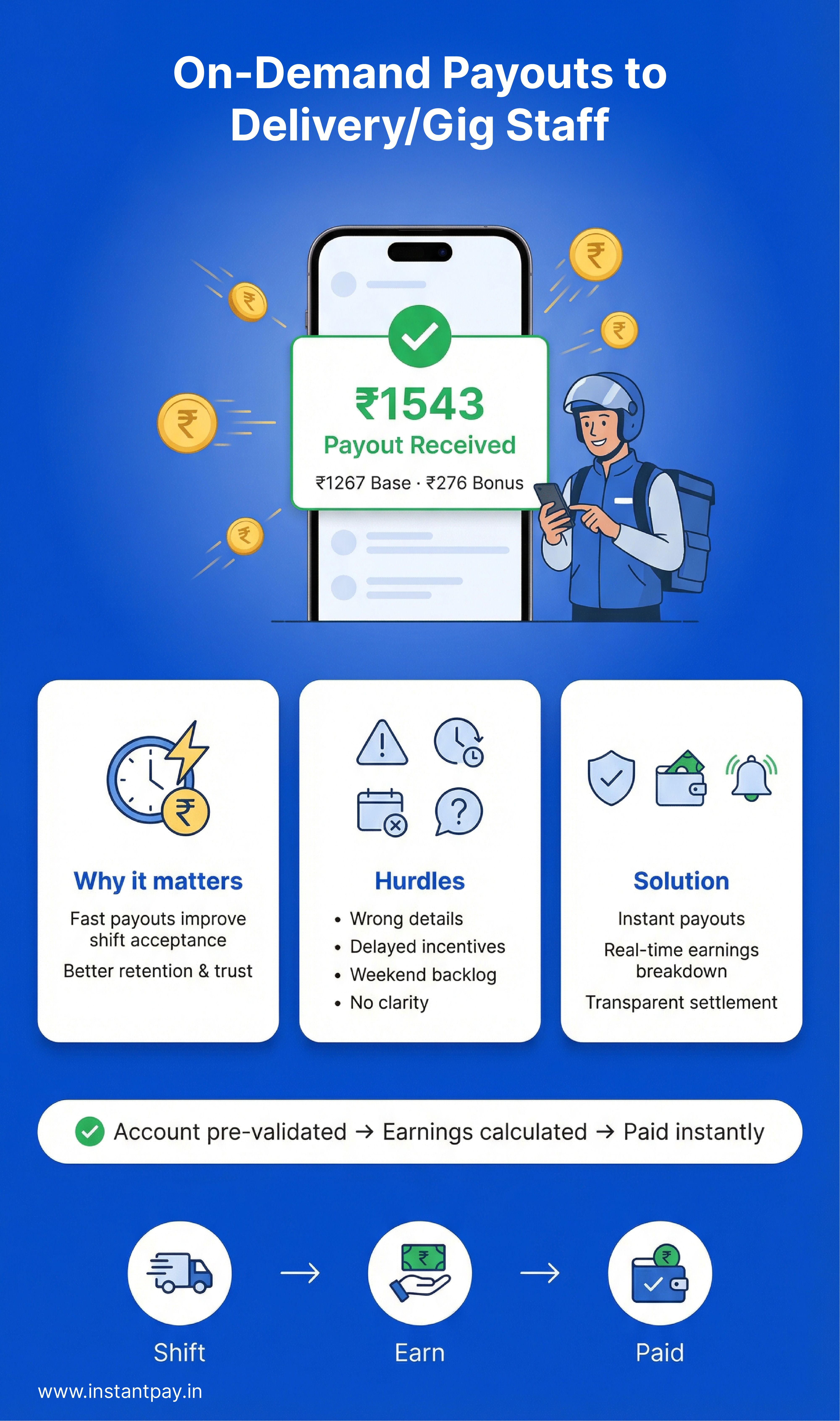
Paying riders, sorters, and seasonal staff for shifts, incentives, and reimbursements—often daily or intra-day.
Why it matters
Fast access to earnings improves shift acceptance and retention, especially during peaks and weekends.
Typical hurdles
- Bank details are wrong or missing; payouts fail late at night.
- Incentives are calculated in spreadsheets and posted days later.
- Weekend/holiday payouts pile up and flood Support on Monday.
- No clear visibility for workers on what was paid and why.
Solution
Pre-validate accounts before shifts, calculate earnings via API, and push instant payouts (including off-hours). Cap per-day limits for safety. Send SMS/app notifications with a breakdown and expose a simple ledger that workers can check anytime.
Example
During a festival sale, a 6 PM surge bonus is paid by 7 PM. Completion rates rise for the late slot because workers see money landing the same day.
Use Case 6: Reconciliation & Finance Ops (Orders > Payments > Refunds)
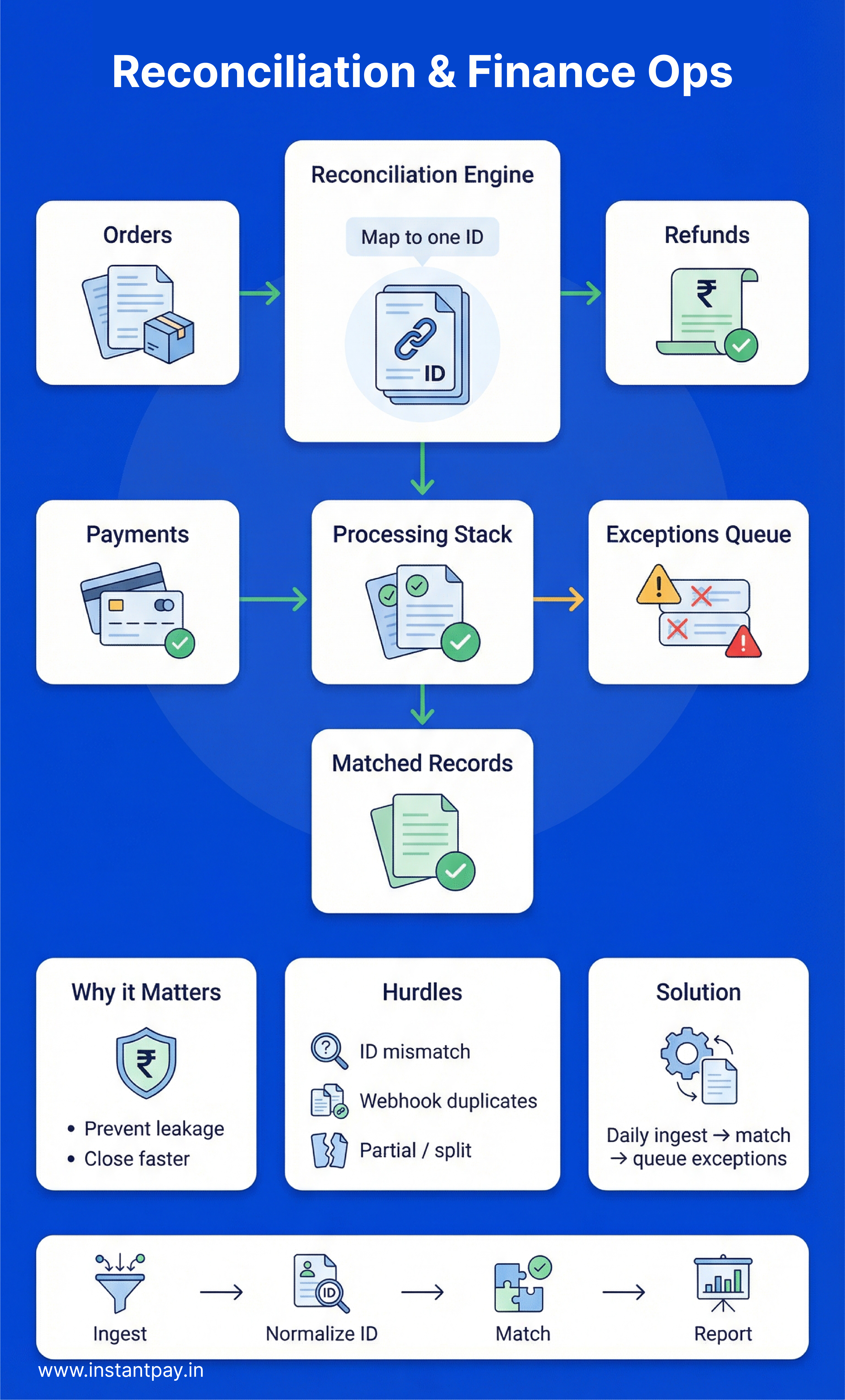
Matching orders with payment captures, refunds, chargebacks, and Remittances (COD) to ensure book accuracy
Why is this important?
Timely reconciliations will prevent loss, speed up monthly closures, and minimize write offs and audit issues.
What are the typical obstacles?
– Payment gateways, banks, and OMS systems don’t agree on identifiers or dates;
– Duplicate webhook calls generate phantom entries, and COD remittances can be delayed;
– Edge cases (e.g. split tenders, partial refunds) have to be addressed by hand;
– Traditional spreadsheets become very slow and harder to track.
How do we fix it?
By auto-ingesting data from each system on a daily basis, mapping the data to one common value, and sending any mismatches into an exception queue (one mismatched row doesn’t stop the entire process). Generate settlement/audit/aging reports for Finance, and send mismatch status updates to Support and Ops team.
Example:
Instead of Finance having to search for row mismatches, each day they will have a short list of exceptions. Month-end close will occur sooner and will have fewer escalations.
Use Case 7: Seller Onboarding & Risk Controls
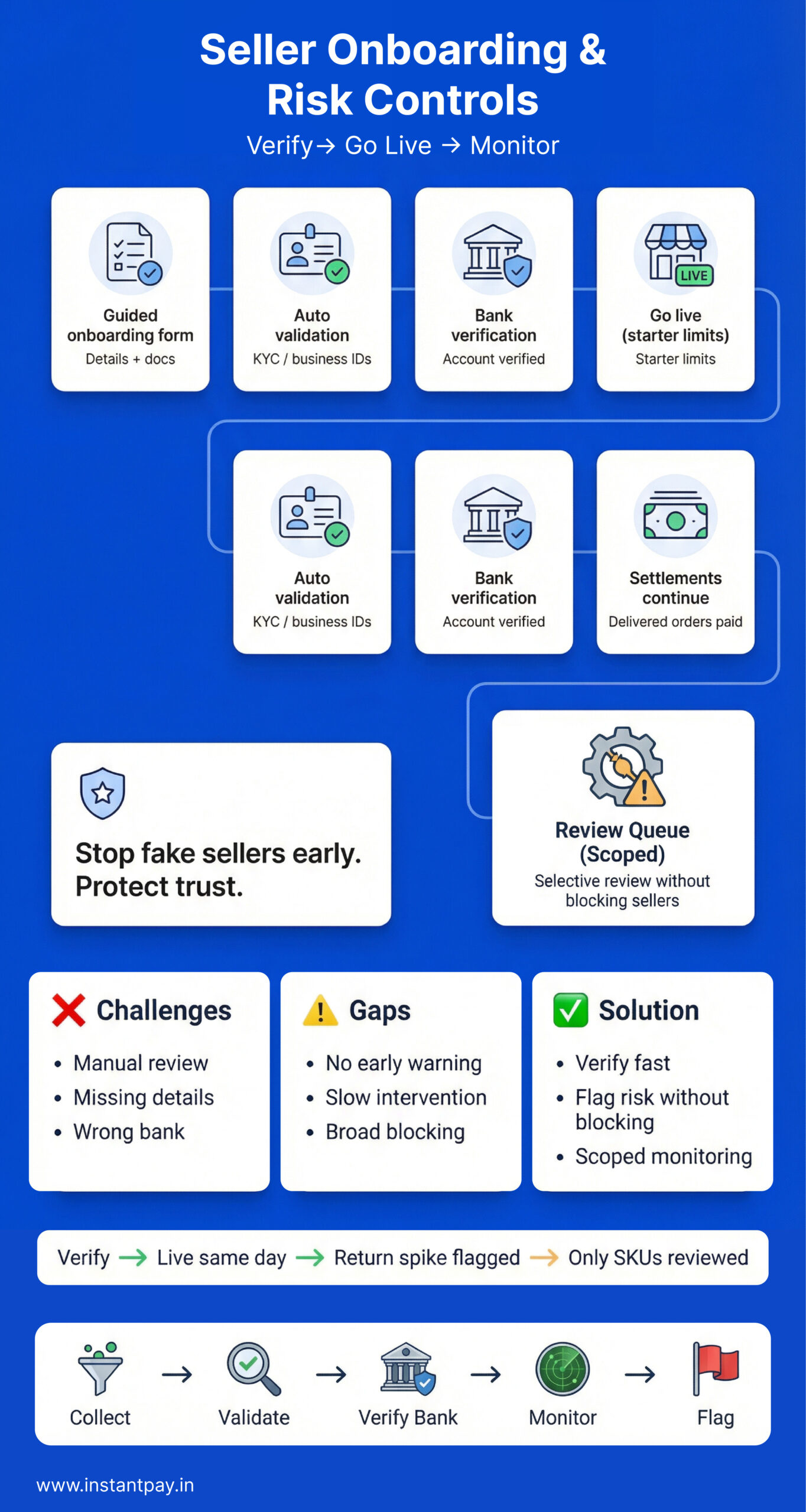
Sellers new to the marketplace must complete risk-assessment steps for their businesses and accounts before they can enter orders and/or list products for sale.
Why this matters: Early detection of counterfeit businesses or returns reduces chargebacks and keeps buyer trust level up.
Typical Roadblocks
– The manual review process is often decentralized, adding an additional 3-5 days to getting sellers live.
– Quality of the submitted documents or applications is often poor or inconsistent.
– Incorrect banking details contributed to declining or failed first payouts.
– Provides the organization with early notice of possible high-risk activities.
Solution
Implementing an easy-to-follow, step-by-step document collection process that automatically verifies that the documents are valid and that the bank account has been verified prior to the first payout. Using some simple rule-based checks (e.g., a seller’s inability to meet an established return rate) as a flag for review, while allowing good sellers to continue to accept orders.
Example
On Wednesday at 10:00 AM, a new seller completes the easy document collection process, has validated his business ID, has his bank account verified via penny drop, and, therefore, is allowed to begin taking orders THAT DAY – but at the starter account limits. After two weeks of sales activity, the seller has a potential spike in return rates that triggers a rule (automatically flagging new products and requesting return documentation) allowing only those flagged products to be removed from sale until return documentation has been reviewed, however the seller will still receive payout for any product sold.
Final Thoughts
Check-out is just a small part of what ecommerce payment processing has to offer. Payment processing plays a role in refunding customers, establishing relationships with sellers, providing motivation to partners, retaining gig workers, and allowing Finance to easily close the books. The more smoothly these payment processes run (i.e. payments are made and remain visible by buyers/sellers/internally), the more stable operations will be and the higher the trust levels will remain.
When you are creating or improving your payment solution, begin by identifying the current pain point with your payments. Identifying current problems might include: drop-offs during the checkout process, delayed refunds, settlement disputes, and reconciliations gaps. Once the pain points have been identified, create standardised processes using consistent triggers, consistent payout schedules, and dashboards that the entire team can rely on.
To reinforce your standardisation, establish key checkpoints with the various official payment rails and verifications. Check payment processing through the GST Portal (to validate seller data); reference UPI guidelines (from NPCI) to validate payments; and use these standardised processes to create a seamless onboarding and settlement experience.
Frequently Asked Questions on E-commerce Payments Use Cases
1. What are e-commerce payment use cases?
E-commerce payments use cases describe how online businesses collect, distribute, refund, and reconcile money across customers, sellers, partners, and internal teams.
2. Are e-commerce payments only about checkout?
No. Checkout is just one part. E-commerce payments also include refunds, seller settlements, partner commissions, staff payouts, reconciliation, and onboarding controls.
3. Why are payment workflows important for revenue?
Poor payment flows increase cart abandonment, delay refunds, frustrate sellers, and create reconciliation gaps—all of which directly impact revenue and trust.
4. Which e-commerce payments use case should be fixed first?
Most businesses start with checkout drop-offs or delayed refunds, as these have the fastest impact on conversion and repeat purchases.
5. Can one payment system handle all use cases?
Yes, if it supports collections, payouts, refunds, reconciliation, and verification through unified APIs and dashboards.