In India, since cash on delivery is the standard practice for almost every delivery, lags in cash flow are felt throughout the ecosystem of delivery providers, shippers, and consumers. Cash on hand accumulates 14% of GDP, which is run in courier bags. Excel files to provide cash payouts accumulate in your email inbox, and cash payouts occur at the end of the delivery process after incurring all of the expenses associated with the delivery.
Using finance workflows, logistics businesses can set up a logical cash path for each delivery. Collect at the door, collect proof of delivery, issue refunds without needing to document the customer’s bank account information, pay riders and shippers on time, and reconcile by either order number or delivery route. By utilising logistics financial solution workflow, companies can minimise the number of cash disputes, reduce the cycle for cash refunds, and increase the predictability of their working capital.
Use Case 1 — COD Collections & Settlements in Logistics Financial Solutions
Sales are driven by Cash On Delivery (COD). Many prefer to use cash, but it can lead to delays as it moves from rider to hub and goes through a bank. The records don’t always add up, which means finance teams cannot see money in real-time. As a consequence, incidents of disputes are on the rise.
This is where a logistics financial solution can help.
The Core Problem
Cash will pass through many hands before it gets to a bank. Receipts may not be readily available or they might not clearly reflect what happened. Bank entries also tend to come in at a later date than the delivery itself, and settlement files don’t always match with order records. Thus, finance teams have lost the ability to have visibility on same day; delays in paying the rider will become commonplace, there will be more variance cases, and month-end close will become a source of stress.
As a result, CODs that are not properly tracked can result in leakage of money.
How Does It Work?
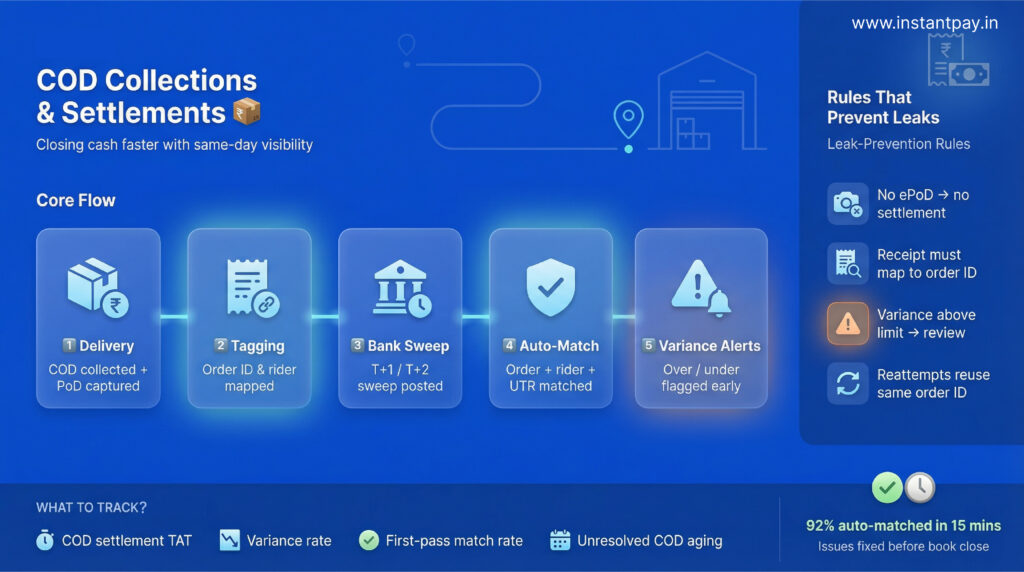
At the time of delivery:
- The COD amount is recorded
- Proof of delivery (a photo, signature, and/or an electronic proof of delivery) is acquired.
If the proof is missing, the settlement cannot be completed.
Then:
- Tag the cash or receipt to the correct order number
- Link the tagged amount to the rider’s run sheet.
At the end of the day, the following occurs:
- Close the cash daily sweep
- Make a deposit to the bank within TPT or TPTT
The system will automatically match against the following data:
- Order number
- Rider
- Date
- UTR (i.e., bank reference number)
If there is an overage, shortage or missing cash, an alert will be triggered and the problem will be resolved before making the cash deposit to the bank.
Simple Rules That Prevent Loss
Small rules make big impact:
- No ePoD = no settlement marked complete.
- Every cash packet must map to a valid order ID.
- Variance above limit needs manager review.
- Reattempts must use the same order ID.
Clear rules. Clear control.
What to Track:
To keep COD healthy, track:
- COD settlement TAT (delivery to bank days)
- Variance rate
- First-pass match rate
- Aging of unresolved COD cases
If these numbers improve, your cash process is strong.
Example
A Bengaluru hub closes Day-N cash at 8 PM. By 8:15 PM, 92% of orders auto-match with bank entries. Two packets show a shortfall. Alerts trigger. Ops fixes both before finance closes. No delay. No confusion. COD is not just delivery. It is a financial process.
Strong logistics financial solutions turn COD from a risk into a controlled workflow.
Use Case 2 — Doorstep Digital Collections (In-Transit) in Logistics Financial Solutions
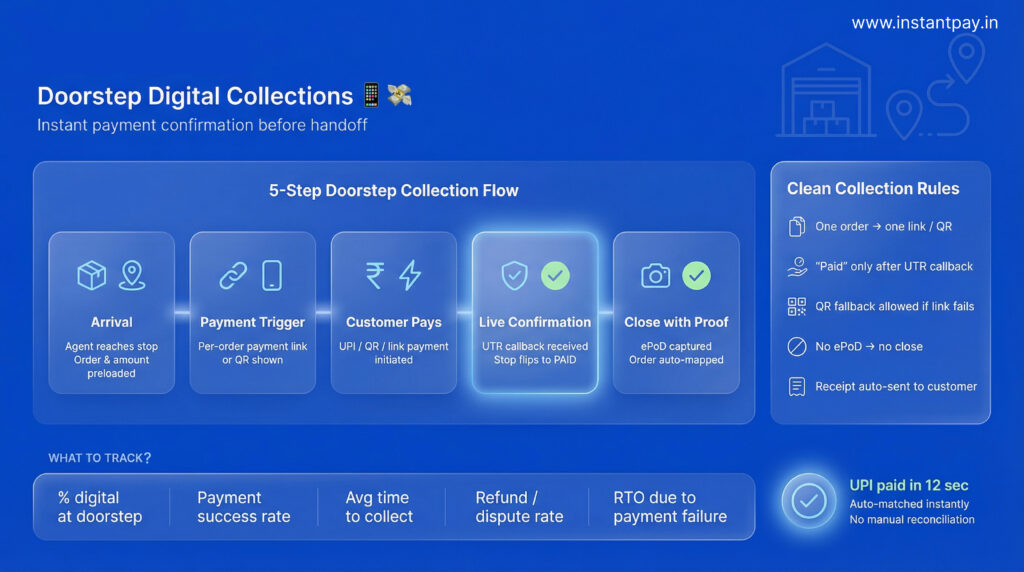
There are many customers who prefer to pay digitally and there are numerous points throughout the process where the Digital Payment Network could fail. This may be a link that the customer attempts to open can fail, a generic QR code does not map to the appropriate order, etc. Without immediate confirmation of payment, the agent and customer will have uncertainty about the transaction.
The Core Problem
Door-to-door collection is based on both network quality and timing of payments. If the link fails or there is a delay in payment confirmation from the bank, then payment for that stop cannot be closed out by the agent. If you use a generic QR code for multiple customers, the funds will not be allocated to the correct order for either customer. When there isn’t real time payment confirmation, there are greater opportunities for dispute resolution and additional attempts. Even digital payment sources may not have sufficient linkage to enable seamless reconciling.
How Does It Work?
Before delivery:
- The application will send the customer a text message with a link for payment of that order.
- The application will send a QR Code (with the amount of payment being pre-filled) that will link to the payment process.
At delivery:
- Payment will be made by the customer via UPI, QR code or link.
- The bank will return a confirmation of payment to the application in real-time.
- The stop will show as “Paid”.
- Then:
- The ePod will be captured.
- The hand-off will be completed.
The application will auto-map the payment against:
- Order ID
- Stop
- Agent
- Date/Time
- To ensure the payments are reconciled correctly.
- Modern logistics financial solutions make the process of making digital payments at the time of delivery to be clear and traceable.
Clean Payment Process Rules
- One order per link or QR code. Do not re-use a generic code.
- Show “Paid” only after receiving a confirmed callback from the bank or UTR (Unique Transaction Reference).
- If the payment link fails, allow the QR code to be used as the fallback for the same order.
- Without an ePOD, the payment stop cannot be closed, even if payment has been received.
- Send automatic emailed receipts to the customer following payment.
- Maintain clear rules to reduce the opportunity for disputes.
Example
On a Mumbai route, the app sends a payment link 5 minutes before arrival. The customer pays by UPI in 12 seconds. The stop changes to “Paid.” ePoD is captured. Receipts are sent automatically. Later, the order auto-matches during reconciliation. No manual work.
This is how logistics financial solutions simplify doorstep digital payments.
Doorstep digital collection should be fast and clear. With the right logistics financial solutions, every payment is confirmed, mapped, and easy to reconcile.
Use Case 3 — Calculating Refunds and RTOs in Logistics Financial Solutions
Return Orders are a common occurrence in the logistics industry. However, processing refunds can contribute to a company’s cash flow issues.
Team members collect bank account information over the phone. This information is then entered into a system. This information is then entered into a system, which is in place to prevent credits from being issued in error. Refunds against Cash on Delivery (COD) orders are even more complicated, causing an increase in support tickets. This causes an increase in support tickets. Finance has no clear solution to match refunds to the appropriate orders.
The absence of clear logistics and financial solutions makes handling refunds an uncomfortable and drawn-out process.
The Core Problem
If an order is returned to the shipper (RTO), the system begins to initiate the refund process. Team members collect bank account information over the phone and document it in a spreadsheet, which in turn is used to trigger a refund process. This leads to mistakes and frustrated customers. Refund requests can diminish trust in the brand.
The Finance team is hindered in their ability to cross-reference refund requests against the originating order.
The brand stands to lose potential business.
How Does It Work?
The refund logic is directly tied to the status of delivery or RTO.
In the event that a specific status is approved, the following occurs:
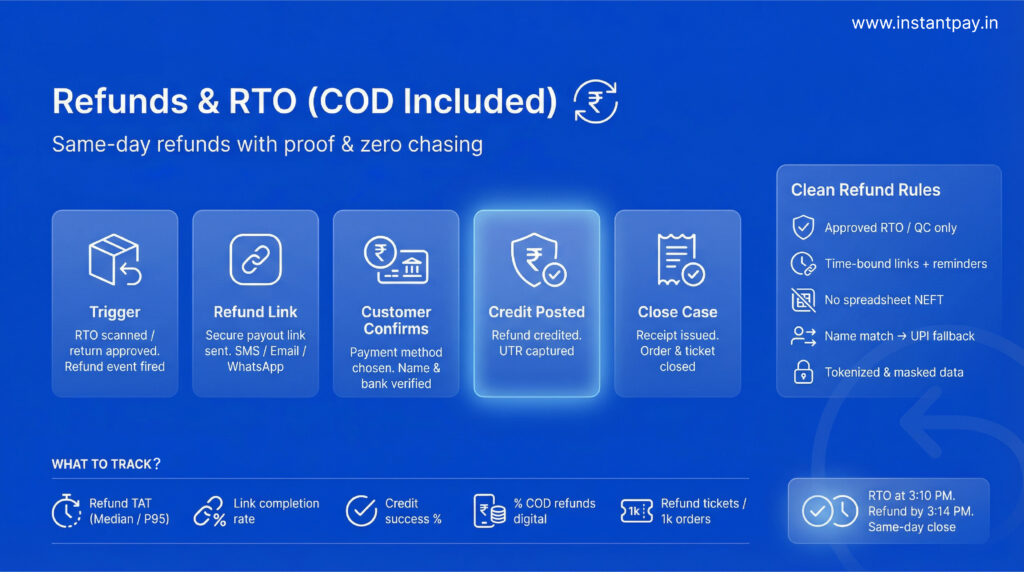
- An SMS, email, or WhatsApp message containing a secure payment link is sent to the customer.
- The customer is then presented with UPI or instant name/bank checks options.
- An instantaneous check is performed against the name and bank.
Following that, a credit refund is issued.
- The Unique Transactional Reference (UTR) is captured and documented against the order.
- An email receipt is sent to the customer.
- The support ticket is automatically closed.
- The system effectively initiates refunds in a traceable and event-driven manner.
Basic Guidelines Guaranteed To Keep It Clean
- Refund triggers only after events are approved (RTO received, QC Pass)
- Use time-constrained payment links that have automatic follow-up reminders.
- No manual NEFT will be performed from a spreadsheet.
- The name must correspond to the account for the funds to have validity. If not, UPI must be used.
- Never save raw data of banks. Always mask and tokenize it.
Clear controls decrease chances of fraud and non-completion of payments.
Performance Tracking
Track closely the refunds:
- Median/P95 refund TAT
- Link completion rate.
- First attempt credit completion rate.
- Bounce/non-complete credit rate.
- % COD refund completed digitally.
- Refund tickets per 1000 orders.
When operating TAT decreases and refund ticket numbers decrease, you are using a logistics financial solution.
Example
The return to origin (RTO) was scanned at 3:10 PM in Chennai. At the time of scanning, the system generates a payout link. At 3:14 PM, the client authorises it through UPI. Credit posts with a unique tracking reference (UTR) in real time. The customer service case is closed.
Refund average TAT reduced from 2 days to same day; structured refund control exists through strong logistics financials.
Use Case 4 — Driver & Field-Staff Payouts in Logistics Financial Solutions
Expectations for quick and accurate payouts are high among drivers and field staff. Many businesses still manually run payroll. Finance teams export files on Saturdays at week’s end; bank details are manually keyed in, which results in name mismatches causing returns, resulting in delayed payouts for riders and increased support cases due to “not receiving payment.”
Without a logistics financial services solution, payments are not timely or error-free.
The Core Problem
Manual payment processes are done on spreadsheets and processed in batches. Often, bank account validations are incomplete. Credits are rejected due to name mismatches. The time spent fixing invalid payments adds dramatically to the financial department’s workload. When payouts are delayed, riders lose faith in the system. In addition, small errors accumulate significant support calls.
Payouts that arrive too late lead to poor morale and wreak havoc on logistics operations.
The Process
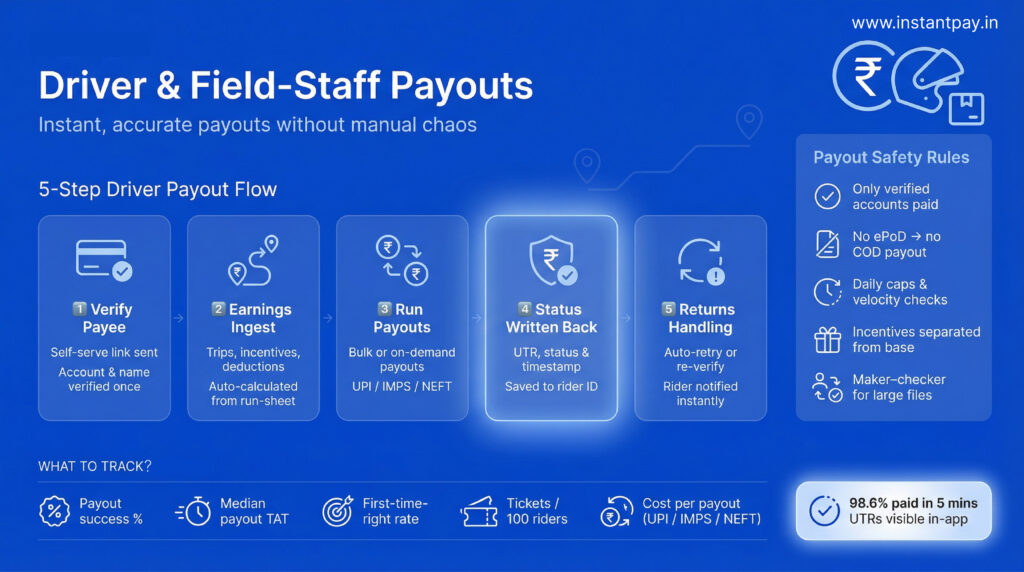
First steps: Source and authenticate rider information.
- Send out a self-serve link.
- Authenticate account and name matching one-time.
- Tokenize information and securely retain it.
Second step: Calculate earnings.
- Obtain trips and stops from route documentation.
- Apply rates, incentives, and withhold taxes/deductions.
Third step: Execute payment for driver/rider.
- Invoke either bulk or instant payment via UPI, IMPS, NEFT.
- Maintaining and preserving UTR, status of payment, and time-stamp against rider ID.
Upon payment not being completed:
- Automatic retry with UPI.
- Flagged for re-validation.
- Notify driver/rider via SMS or through app.
Current financial solutions for logistics make it fast to be paid, verified and tracked.
Simple Rules for Cleaning Up
1. Only Account Verifications May Receive Payments.
2. No ePOD = No Payment for COD Stops
3. New Riders Should Have Caps and Velocity Checks.
4. Base Pay & Incentive must be Separated.
5. Use Maker-Checker Control on Large Payment Batching.
Clear Rules Help Decrease Disputes and Decrease Fraud.
What to Track:
You Should Track Payment Health Monthly:
1. Payment Success Rate
2. Bounce/Return Rate
3. Median Payment TAT (Shift Close to Credit)
4. First Time Correct Percentage
5. Tickets/100 Riders
6. Average Cost/Payment Method
If Your Payment Success is High and Your Tickets Are Low, Your Financial Solutions for Logistics Are Solid.
Example
A Delhi-based hub finishes its morning scan at 2:00 PM. At 2:05 PM, the system calculates the earnings (using the amount earned) and pushes the UPI payout to the runner.
98.6% of payouts will be successful on the first attempt. Two payouts are automatically routed to be re-verified and will receive the payment within thirty minutes; the riders can view the UTR information in the app.
Timely payouts build trust.
Use Case 5 — Vendor, 3PL & Warehouse Disbursals in Logistics Financial Solutions
Partners play an important role in logistics. It is crucial that all line haul carriers, third party logistics providers, and distribution centers receive their payments timely.
Many partner payments are still managed manually. The invoices that come in have multiple formats, GST information is often not complete, and bank account verifications are frequently missing. The approval process for invoices takes too long, leading to situations where duplicate invoices are paid.
Consequently, without a structured solution to handle logistics financial management, the process of making partner payments can be overall disorganized and delayed.
The Core Problem:
There are numerous formats for partner invoices, often requiring significant manual effort to review by finance professionals. Finance departments are responsible for conducting GST, trip count and rate audits manually. Duplicate invoices may not be identified in a timely manner. Month end bundling of payments can lead to cash flow pressure. Partners can feel strained from the lengthy payment process. Non-verified invoices present a variability of risk associated with making incorrect partner payments.
Manual controls lead to the potential for financial leakage and create friction between all parties involved.
How does it work?
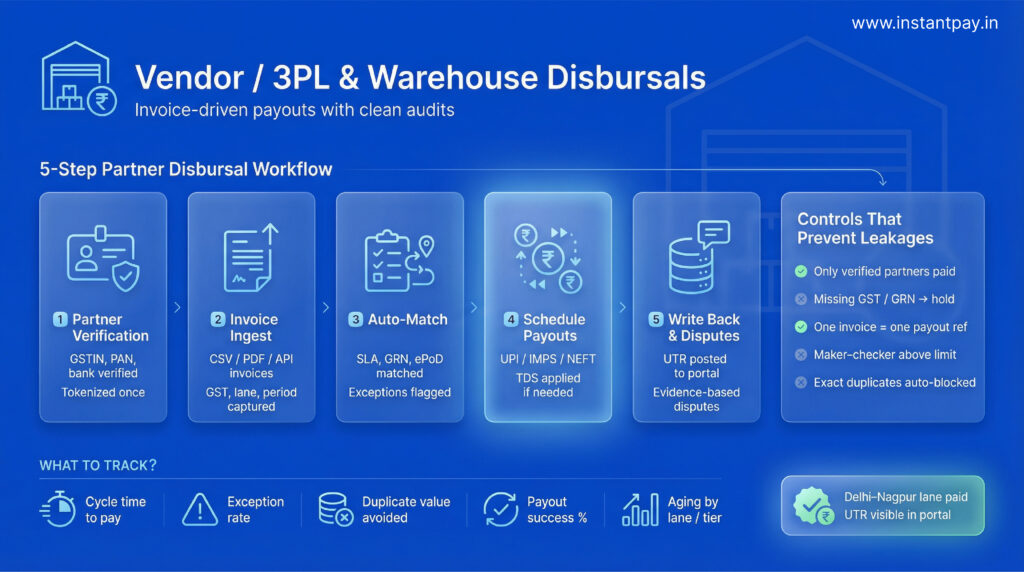
1st Step: One time collection of and verification of all partner information:
- GSTIN
- PAN
- Bank account
- Contact information
- SLA terms
- Tokenised/verification of the information.
2nd Step: Invoice ingestion:
- CSV, pdf or API will be accepted/filed as an invoice type.
- Capture key pieces of information: Amount, GST, date, lane and hub.
3rd Step: Automatch invoices:
- Verify against SLA rate.
- Compare mileage, stop counts, GRN or ePoD.
- Flagged exceptions automatically.
4th Step: Payment processing.
- Schedule payments either in bulk or staggered format (UPI, IMPS or NEFT).
- TDS will be applied, if applicable.
- UTR” will be posted to the partner portal.
By utilizing modern logistics financial solutions, the partners involved in making payment and receiving payment will benefit greatly.
Guidelines for Maintaining Payment Accuracy & Credibility
1) Only Authorized Partners Can Invoice / Receive Funds
2) Not Having A GRN, ePoD Or Not Being In Compliance With GST Will Result In Payment Being Held
3) Only One Bill Will Generate One Payment ID / Reference No
4) There Needs To Be A Maker-Checker Process For Any Payment Over $10,000
5) System Will Automatically Deny Duplicate Bills That Are An Exact Match
6) Effective Controls Will Prevent Overpayment And Fraudulent Payments
Metrics To Track
1) Invoice Payment Cycle Time For Each Partner
2) Rate Of Exceptions And Top 3 Reasons For Exception
3) Amount Saved By Catching Duplicate Invoices
4) Percent Of Total Payments That Are Successful By Partner Lane
5) Current Aging Based On Partner Tier
If Cycle Times Are Improving, And The Number Of Exceptions Is Diminishing, Then WOW Your Logistics Financial Services Are Working.
Example
The Line Haul Vendor Uploads Their Monthly Invoicing For The Delhi-Nagpur Lane.
The System Will Validate The GSTIN, Confirm Trip Length And Compare Stop Counts To The Routed Stops That Are Approved. In This Case, Two Of The Stops Did Not Meet The Criteria And Therefore Creates An Exception From The Payment Process. Once The Exception Has Been Resolved, The System Will Produce A Bulk NEFT To Pay The Validated Payment. The Vendor Will Be Able To See The UTR In Their Portal.
Timely Payments Build Strong Partnerships.
Final Takeaway: Map the Money, Not Just the Miles
For a logistics company, speed on the road is nothing without money moving in the back office. Each currency collection (paid-on-delivery), payment at your front door, refund, payout to drivers/riders, and payment to partners are fully integrated cash-flow events that start at your doorstep and end at the bank.
Logistics financial solutions can only work if they follow the same principles as logistics operations – unique ID Numbers, real time tracking of events/status, proof of at least 10 events/handoffs, and fast exception processing. When collections are associated with/shown to a specific order, payouts are triggered by confirmed events, and refund requests include a UTR, and reconciliation of all transactions happens daily instead of at the end of each month, cash is no longer lost through a delay or through dispute, but instead moves seamlessly from when you complete the sale until you have deposited cash in your bank account.
This creates tangible and measurable results – shorter settlements, fewer “Where is my money” tickets, happier riders/partners, and working capital availability that moves as consistently as your delivery routes. In a COD-centric logistic operation, the solution to cash-flow problems does not involve creating additional control processes, but instead involves creating finance processes/workflows that operate at logistics speeds.