Running a business often means walking a fine line between money that needs to be spent and money that is still coming in. In fact, an RBI Expert Committee has pegged the credit gap in India’s MSME sector at roughly Rs. 20–25 lakh crore, highlighting the numerous businesses that are forced to balance outgoing bills against incoming funds that have not yet arrived. Orders arrive, suppliers expect advances, staff and bills can’t wait, while customer payments may take weeks. Even the most stable businesses face these timing gaps, especially during peak seasons or when they plan to grow.
This is where lending solutions become important. By providing timely access to funds, they help businesses manage short-term needs without slowing their work. From stocking up inventory and paying vendors to covering daily costs or investing in new equipment, the right option ensures cash keeps moving. Instead of pausing for funds, businesses can stay steady, meet commitments, and take on new opportunities with confidence.
What Are Lending Solutions?
Lending solutions refer to structured financial options that help businesses access funds for specific needs such as inventory purchase, working capital, vendor payments, expansion, or equipment upgrades.
Unlike traditional long-term loans, lending solutions are designed to match a business’s cash flow cycle. They focus on timely access, purpose-driven funding, and flexible repayment, making them practical for day-to-day business challenges.
In India, lending solutions are commonly offered by:
- Banks
- NBFCs (Non-Banking Financial Companies)
- Digital lenders and fintech platforms
These solutions are widely used by MSMEs, traders, service providers, manufacturers, and growing enterprises that need funds without disrupting regular operations.
Common Types of Lending Solutions for Businesses
Different business needs require different lending solutions. Below are some commonly used options and how they are typically applied:
| Type of Lending Solution | What It Is Used For? |
|---|---|
| Working Capital Loans | Managing daily operational expenses like salaries, rent, and utilities |
| Short-Term Business Loans | Covering immediate funding gaps or seasonal demand |
| Inventory Financing | Purchasing stock in advance of high-demand periods |
| Invoice or Receivables Financing | Bridging the gap between invoicing and customer payments |
| Equipment or Machinery Loans | Buying or upgrading tools, vehicles, or machinery |
| Business Credit Lines | Accessing funds as needed, rather than borrowing a lump sum |
When Do Businesses Typically Use Lending Solutions?
Lending solutions are not meant to replace regular income or savings. They are usually used when timing or scale creates a short-term gap.
Businesses often consider lending solutions when:
- Customer payments are delayed but expenses are immediate
- Large supplier advances are required upfront
- Seasonal demand requires extra inventory
- Expansion or upgrades cannot wait for internal accruals
Lending Solutions vs Using Own Funds
| Scenario | Lending Solutions | Own Capital |
|---|---|---|
| Short-term cash gap | Suitable | May strain reserves |
| Large upfront expense | Helps spread cost | High immediate impact |
| Business expansion | Supports growth | Can slow existing operations |
| Emergency expenses | Quick access | Limited flexibility |
Use Case 1: Purchase Inventory
The Problem
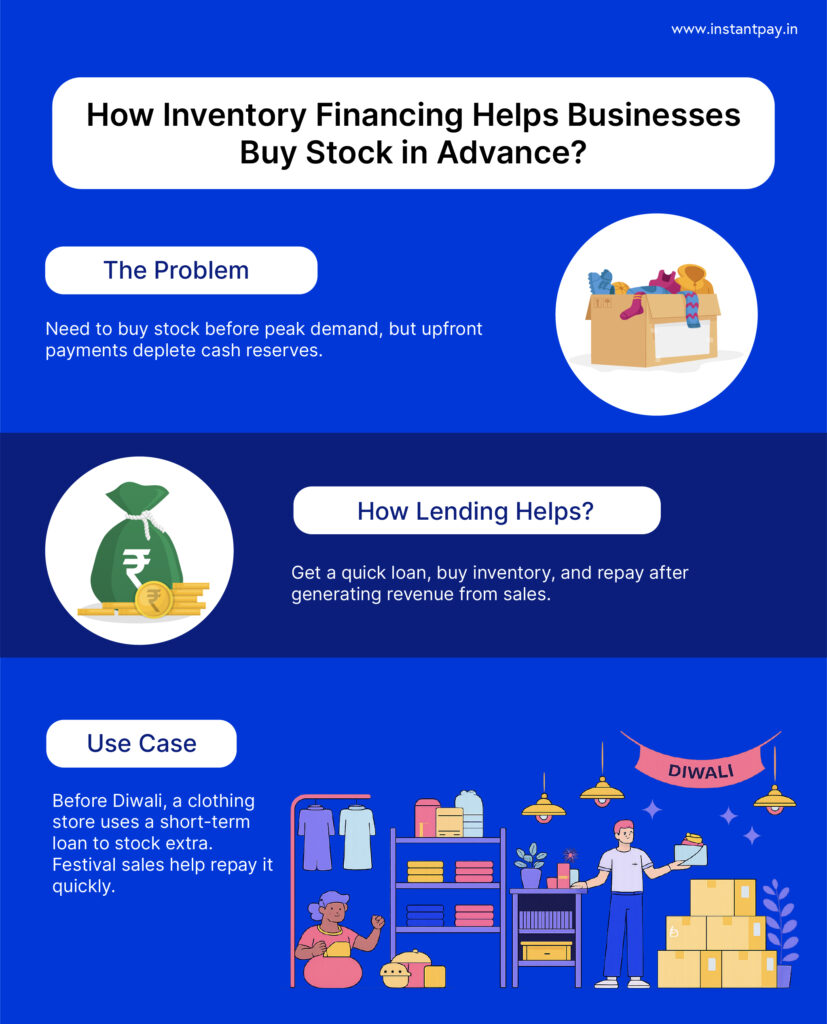
Businesses often need to buy stock before demand peaks. Retailers may prepare for festive sales, while wholesalers secure bulk orders. But suppliers usually ask for upfront payments, and waiting for receivables can leave businesses short on cash.
How Lending Helps?
Lending solutions provide quick access to funds so inventory can be purchased on time. Instead of missing opportunities or over-stretching reserves, businesses can borrow, buy stock, and repay once sales generate revenue.
Example
A clothing store orders extra stock ahead of Diwali. Using a short-term loan, it pays the supplier early, fills shelves in time, and clears the loan from festival sales.
Use Case 2: Vendor Advances
The Problem
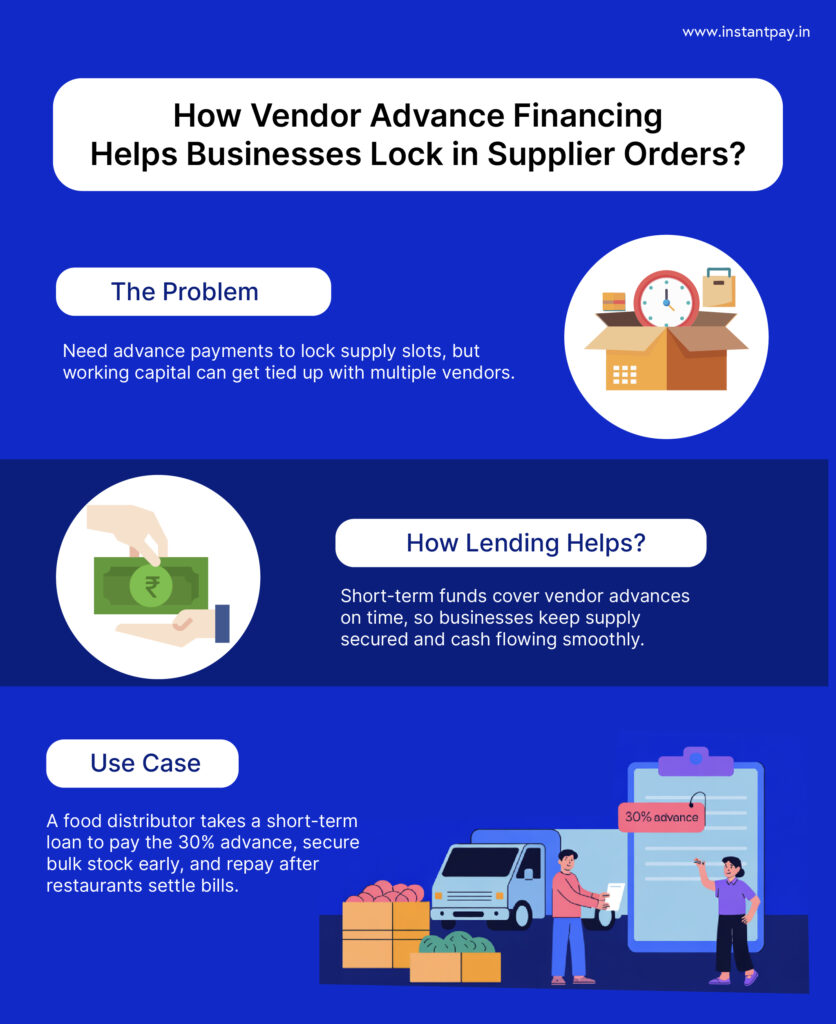
Suppliers often ask for advance payments before starting production or shipping goods. For small and medium businesses, this can lock up working capital, especially when multiple vendors expect upfront deposits at the same time. Delaying these payments risks late deliveries or even losing supply slots.
How Lending Helps?
With lending solutions, businesses can cover vendor advances without straining their cash flow. Short-term funds ensure suppliers are paid on time, orders are secured, and operations continue smoothly. Once customers settle their invoices, the borrowed amount can be cleared with less pressure.
Example
A food distributor needs to pay 30% in advance to a supplier for a large bulk order. Using a loan, the distributor secures the stock early, guarantees delivery timelines, and repays the loan when restaurants clear their bills.
Use Case 3: Working Capital Buffer
The Problem
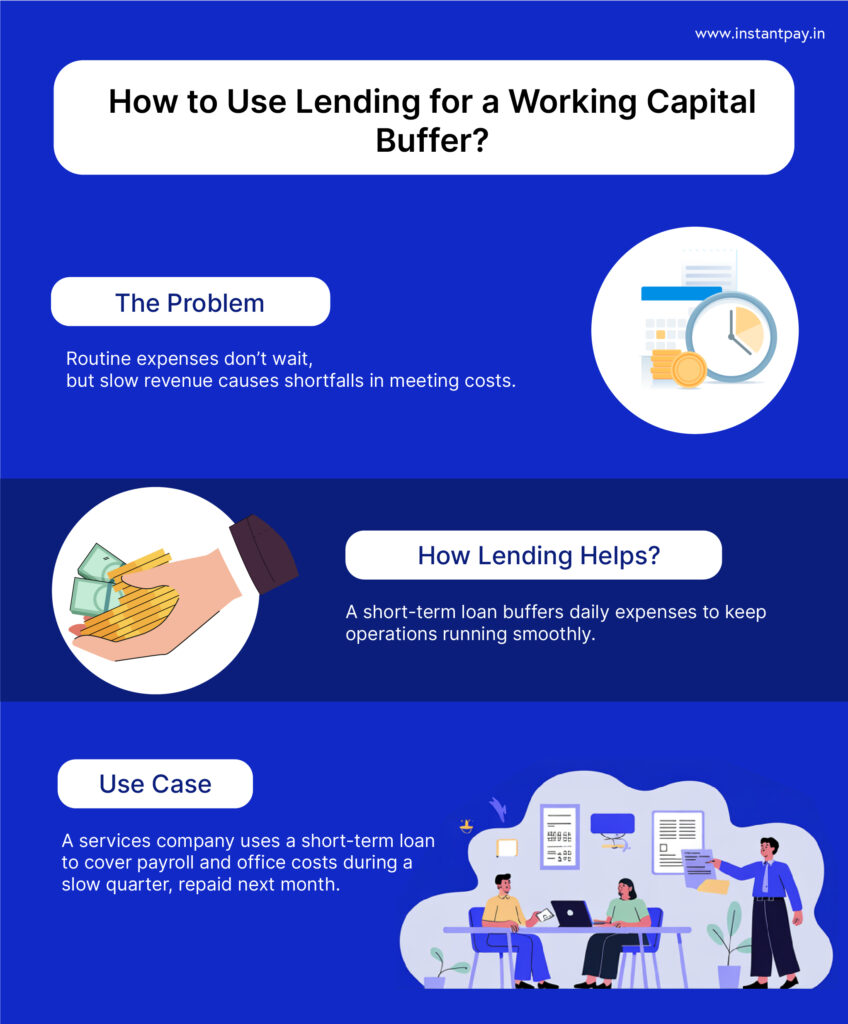
Every business has routine expenses that cannot wait—salaries, rent, utility bills, and logistics. But revenue does not always arrive in sync with these costs. Seasonal dips or delayed client payments can create short-term gaps that strain daily operations.
How Lending Helps?
Lending solutions provide a buffer to cover these recurring expenses. Instead of cutting back or delaying payments, businesses can keep operations steady and repay the loan when cash inflows return. This ensures that staff, suppliers, and partners remain confident in the business.
Example
A mid-sized services company faces a slow quarter with fewer projects closing. It uses a short-term loan to pay staff salaries and manage office expenses. Once client invoices are cleared the next month, the loan is repaid without disruption to the team or business.
Use Case 4: Support Cash Flow
The Problem
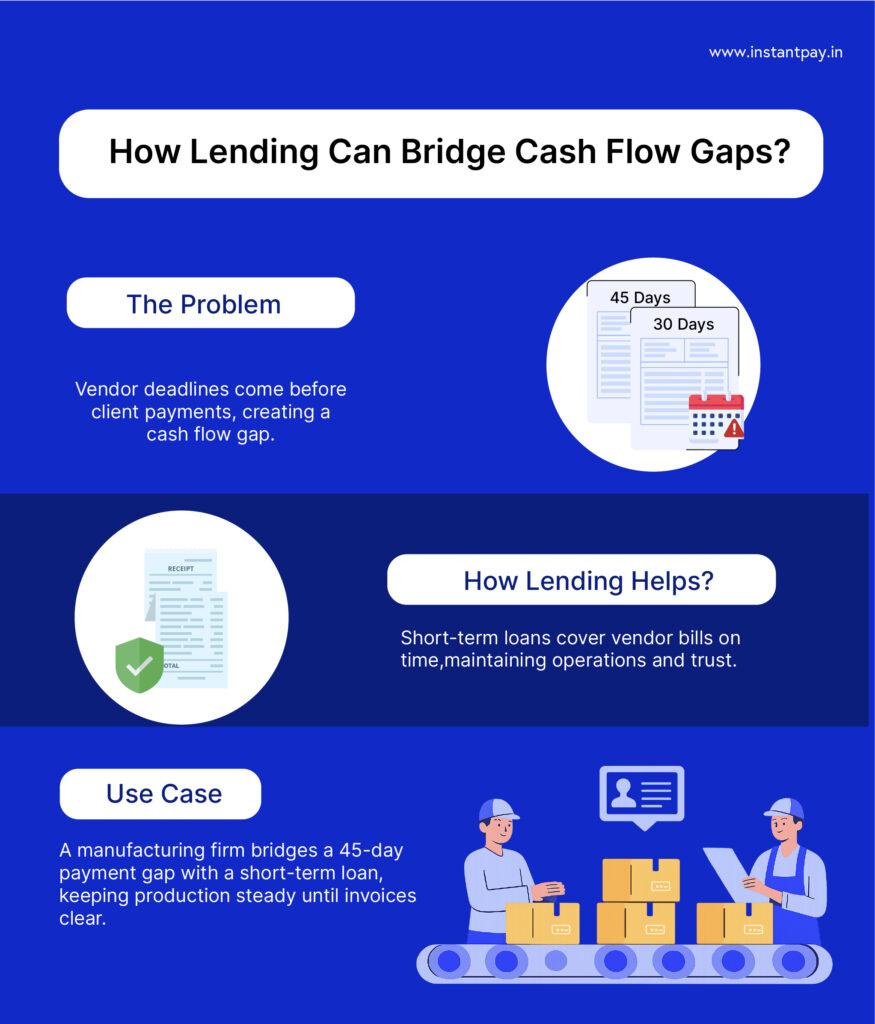
Many businesses face a mismatch between when they must pay vendors and when customers pay them back. Vendors often expect payment within 7–15 days, while client invoices may take 30–60 days to clear. This gap can lead to late fees, strained supplier relationships, or missed growth opportunities.
How Lending Helps?
Lending solutions bridge this receivables gap by providing funds at the right time. Businesses can pay vendors on schedule, maintain trust, and keep operations running while waiting for customer payments. Once receivables are collected, the borrowed amount can be repaid.
Example
A manufacturing firm supplies goods to a large retailer with a 45-day payment cycle. To pay its raw material vendors upfront, the firm takes a short-term loan. This ensures steady production, and once the retailer clears the invoice, the firm repays the loan without stress.
Use Case 5: Invest in New Equipment
The Problem
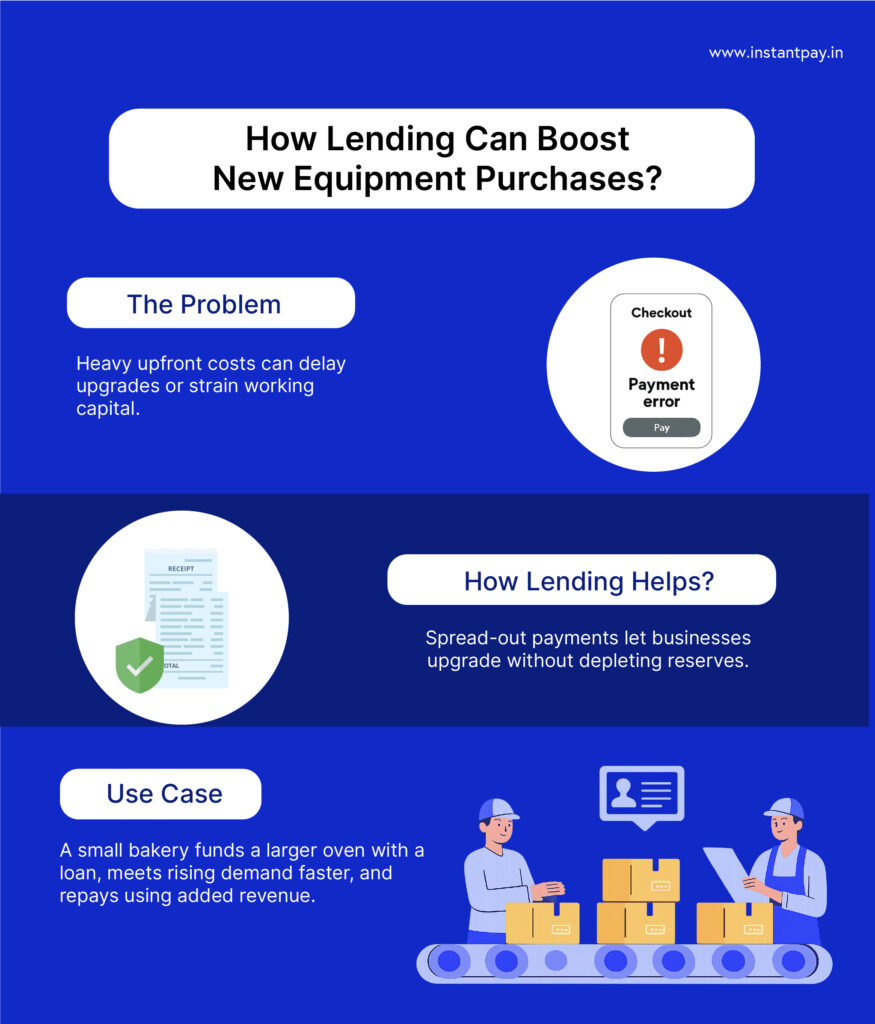
Upgrading equipment or adding new tools often requires a large upfront cost. For many businesses, this means dipping into reserves or delaying the purchase. Postponing upgrades can reduce efficiency, increase repair costs, and limit the ability to meet rising demand.
How Lending Helps?
Lending solutions allow businesses to invest in equipment without exhausting their working capital. The funds can be used to purchase machinery, vehicles, or technology upgrades, while repayments are spread out over time. This way, the new equipment starts generating value immediately, even before the loan is fully repaid.
Example
A small bakery wants to install a larger oven to meet growing customer demand. By using a loan it buys the oven right away, increases production, and pays back the loan through the extra revenue earned from higher sales.
Use Case 6: New Ancillary Company or Branch
The Problem
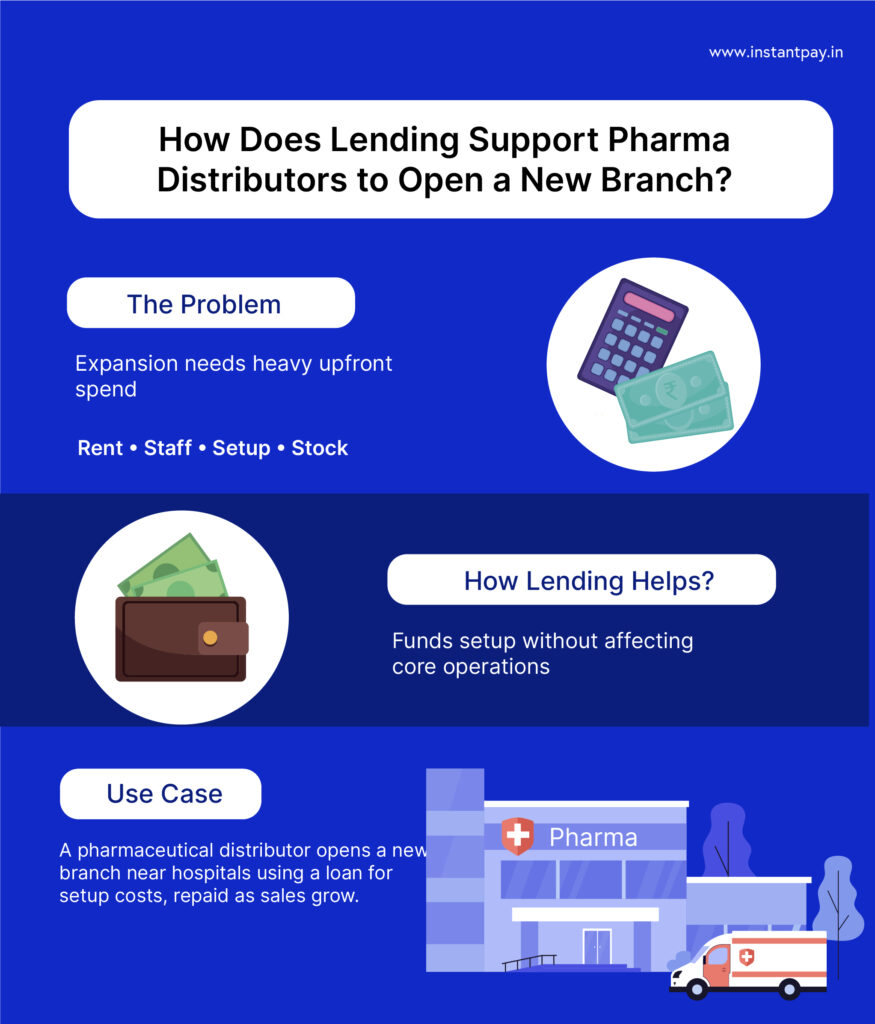
Expanding into a new market, opening a branch, or starting an allied business often requires significant upfront investment. Rent, initial stock, staff salaries, and setup costs add up quickly. For many businesses, tying up existing capital in these expenses can strain ongoing operations.
How Lending Helps?
Lending solutions provide the funds needed to cover these early-stage expenses without disrupting the parent business. By financing the setup, companies can focus on building customer reach and revenue in the new unit, while repaying the loan gradually as income starts to flow in.
Example
A pharmaceutical distributor decides to open a new branch near a cluster of hospitals. A loan covers the cost of rent, storage, and staff during the launch phase. As the branch begins generating sales, the distributor repays the loan and expands its overall footprint.
How Lending Solutions Work: Verify ? Disburse ? Repay
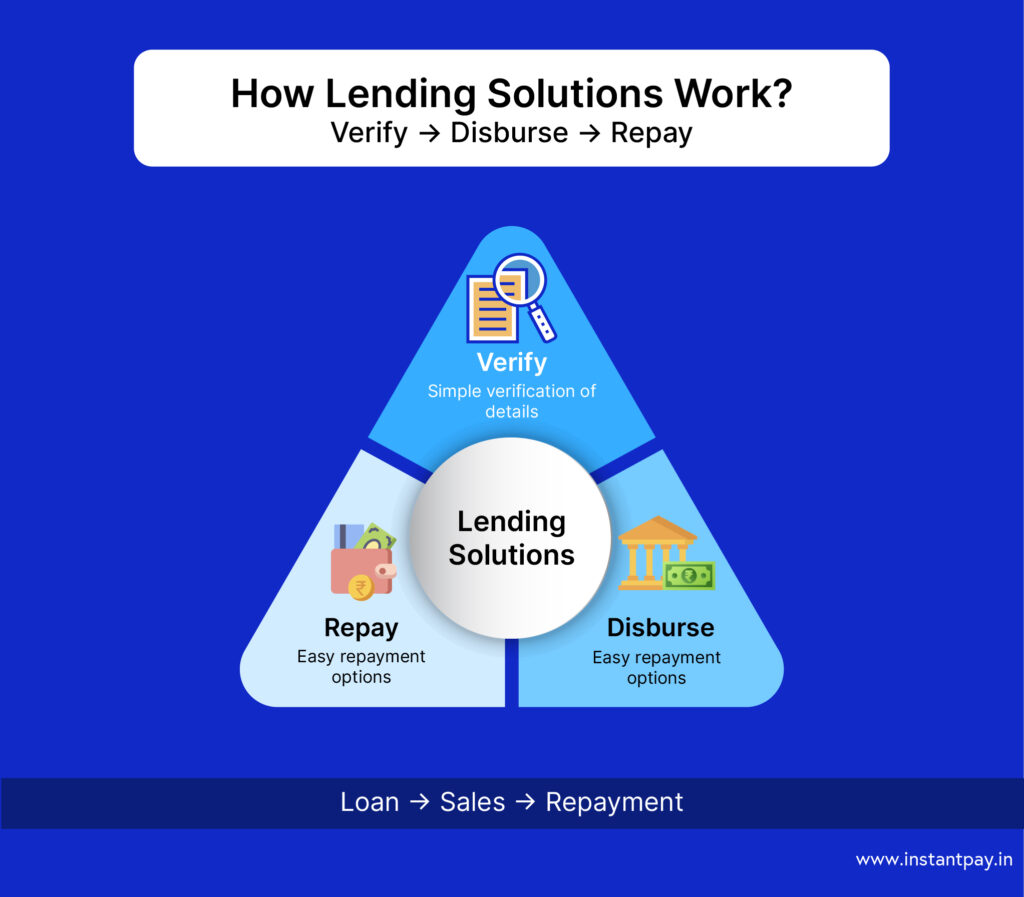
Behind every lending solution, the process stays straightforward. No matter the size of the loan or the use case, it usually follows three simple steps:
- Verify – The business shares basic details such as identity and bank account information. This quick check ensures that funds are going to the right place.
- Disburse – Once verified, the approved amount is sent directly to the business bank account or through a secure payout link. Funds are available quickly, so work does not slow down.
- Repay – The loan is repaid in simple steps, either as a one-time payment or through regular installments, depending on what fits the business best.
This cycle—verify, disburse, repay—keeps lending simple. It allows businesses to focus on running their operations, while the flow takes care of the money side.
Checklist Before Choosing a Lending Solution
Before applying, a little preparation makes the process smoother and faster. Here are a few essentials every business should keep ready:
- Basic identity details – PAN, GST (if applicable), and Udyam registration for MSMEs.
- Active bank account – Verify account details to avoid payout delays.
- Clear purpose – Know why you need the loan—inventory, vendor payment, cash flow, or expansion.
- Repayment plan – Match installments or due dates with expected inflows.
- Cost awareness – Track the total cost of borrowing, not just the interest rate.
- Past records – Keep your financial documents and credit score in order for faster approval.
Having these points sorted helps businesses get funds on time and repay without stress.
Final Takeaway
Lending solutions play a practical role in helping businesses manage timing gaps, meet commitments, and pursue growth without disruption. When used thoughtfully, they act as financial support systems rather than long-term burdens.
By aligning borrowing with real business needs and repayment with cash inflows, lending solutions help enterprises stay resilient, responsive, and prepared for new opportunities.
FAQs
1. Are lending solutions different from traditional business loans?
Yes. Lending solutions are often shorter-term, purpose-specific, and aligned with cash flow needs, unlike long-term loans meant for large capital investments.
2. Who can apply for lending solutions in India?
Most solutions are available to MSMEs, traders, manufacturers, service providers, and registered businesses with active bank accounts.
3. How quickly are lending solutions disbursed?
Disbursal timelines vary, but many modern lending solutions provide access to funds within a few working days after verification.
4. Are lending solutions secured or unsecured?
They can be both. Some require collateral, while others are based on business performance, transaction history, or credit profile.
5. What should businesses check before choosing a lending solution?
Businesses should assess the purpose, repayment schedule, total cost, and how well the solution fits their cash flow cycle.