Accounts payable isn’t just about clearing vendor invoices—it’s where cash flow, compliance, and control intersect. As businesses handle more vendors and real-time payouts, even a small delay or mismatch in the AP cycle can trigger penalties, disrupt supply chains, or erode trust. In India alone, delayed payments to MSME suppliers are estimated at around Rs. 7.34 lakh crore, a reminder that every broken AP cycle silently locks up working capital and strains vendor trust.
In this blog, we break down what payables management means in accounting, how it differs from bills payable and trade payables, and why it’s listed as a current liability on your books. Whether you’re managing daily operations or scaling vendor relationships, this guide helps you turn payables from a manual task into a strategic advantage.
What Is Accounts Payable?
In accounting, accounts payable refers to the amount a business owes to its vendors or service providers for goods and services received on credit. It reflects short-term obligations and appears as a current liability on the company’s balance sheet.
Here’s what it typically includes:
- Unpaid supplier invoices for materials, inventory, or services
- Recurring business expenses like utility bills or software subscriptions
- Credit-based purchases that haven’t been settled yet
- GST-inclusive invoices due within 30 to 90 days
Managing these payables effectively helps maintain healthy vendor relationships, improve cash flow visibility, and reduce the risk of missed payments or tax non-compliance.
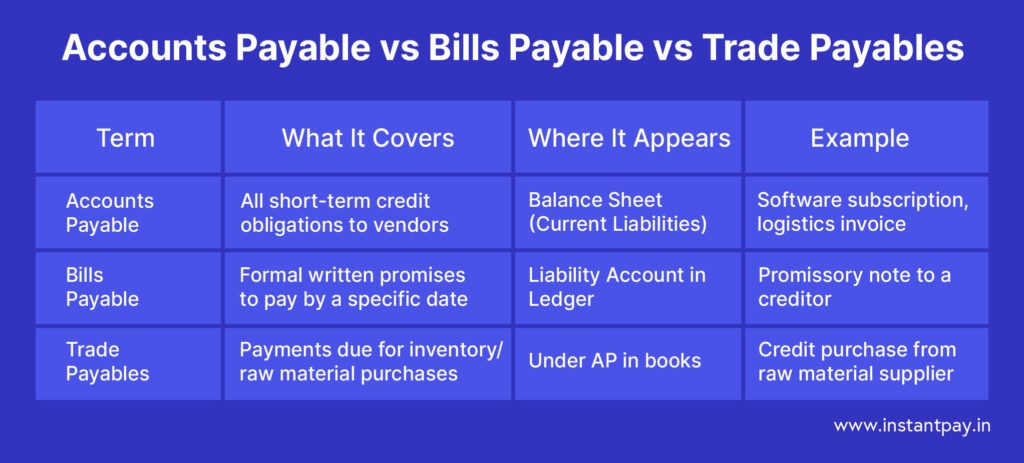
Real-World Payables in Indian Businesses
- Rs. 1.8 lakh due to a telecom vendor for enterprise internet services
Captured as a monthly utility under trade payables - Invoice from a packaging supplier including 18% GST, payable in 45 days
Reflected under accounts payable with tax breakdown - Electricity bills for factory operations, billed monthly under credit terms
Managed as recurring entries in the AP ledger - Pending payment to a freelance consultant for a marketing campaign
Categorized as a service payable, usually under ‘outstanding expenses’
These are all recorded under the payables account and managed as part of a company’s financial operations.
What Are the Core Functions of Vendor Payment Operations?
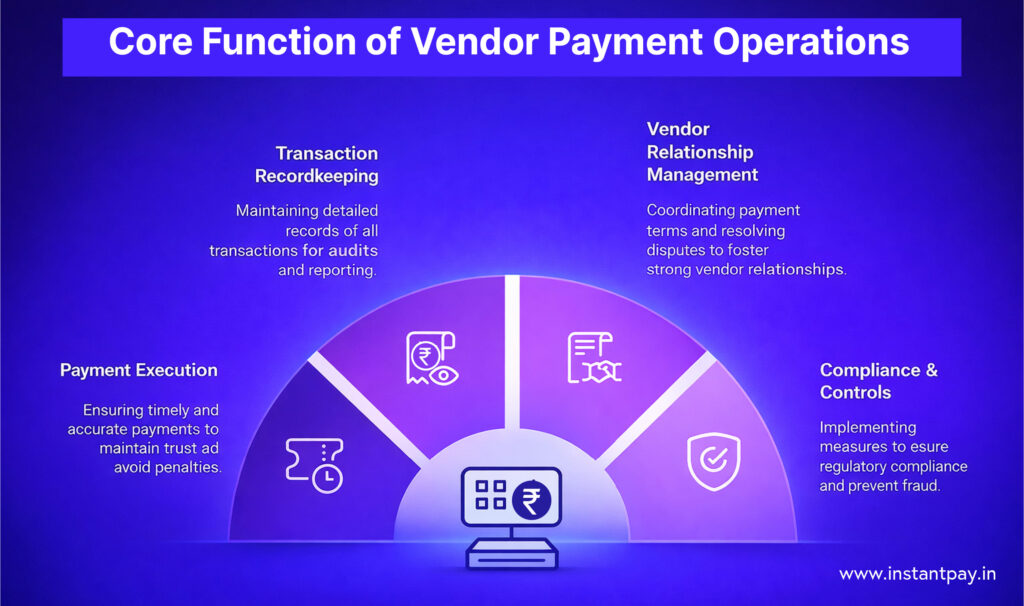
Managing vendor payments isn’t just about releasing funds it’s about safeguarding business continuity, compliance, and cash flow. A dedicated payables team (or finance ops unit) plays a strategic role across multiple touchpoints in the payment lifecycle.
Here are the core responsibilities that define this function:
- Payment Execution: Disbursing timely payments to vendors, partners, and service providers to maintain trust and avoid late penalties.
- Transaction Recordkeeping: Logging every invoice, approval, and disbursement with accurate timestamps for audits and internal reporting.
- Vendor Relationship Management: Coordinating payment terms, resolving disputes, and streamlining invoice clarifications across departments.
- Compliance & Controls: Implementing maker-checker logic, fraud detection workflows, and regulatory readiness—especially for GST, TDS, and reconciliation.
Businesses using automated payout solutions can streamline these functions while reducing manual bottlenecks and improving reporting accuracy.
The Accounts Payable Cycle in Indian Companies
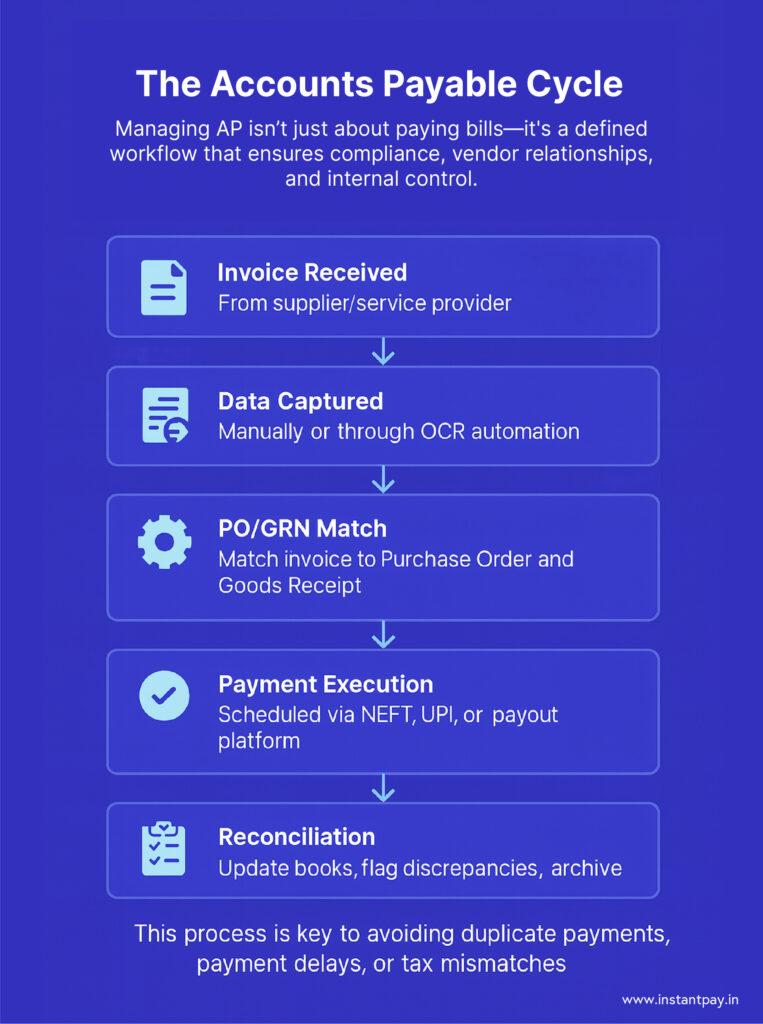
Managing AP isn’t just about paying bills; it’s a defined workflow that ensures compliance, vendor relationships, and internal control. Here’s what the payables cycle typically looks like in Indian businesses:
- Invoice Received
Your supplier shares a bill physically or digitally for goods delivered or services rendered. - Invoice Data Captured
Details like invoice number, GSTIN, due date, and amount are logged manually or through OCR/AP software. - PO / GRN Match (3-Way Match)
The invoice is matched with the original Purchase Order (PO) and Goods Receipt Note (GRN) to verify quantity, price, and delivery. - Approval Workflow
Designated personnel (e.g., accounts manager or department head) review and approve the invoice for payment. - Payment Execution
Upon approval, payment is released through banking channels (NEFT, RTGS, UPI) or automated payout systems (like InstantPay APIs). - Reconciliation & Reporting
After payment, entries are reconciled in the general ledger. Discrepancies (if any) are flagged, and the transaction is archived for audit trails.
This full cycle helps avoid late payments, tax mismatches, and duplicate entries, protecting both your cash flow and compliance posture.
Journal Entry & Accounting Treatment: How It Works
Every credit purchase a business makes becomes a liability that must be recorded properly. This ensures your trial balance reflects the true payable amount, GST input credit, and future obligations.
How Payables Are Treated in Accounting
- Accounts Payable = Current Liability on the balance sheet.
- It is a credit balance, as it reflects money owed to others.
- Purchases and Input GST are debits since they increase expense and assets respectively.
Example 1: Journal Entry with GST (India)
You buy raw materials worth Rs. 1,00,000 on credit, plus 18% GST.
Entry:
- Debit: Purchase A/c – Rs. 1,00,000
- Debit: Input GST A/c – Rs. 18,000
- Credit: Trade Payables A/c – Rs. 1,18,000
This helps claim input credit while recording the full liability owed to the supplier.
Example 2: Payment Against Outstanding Invoice
You pay off the above invoice using NEFT after 15 days.
Entry:
- Debit: Trade Payables A/c – Rs. 1,18,000
- Credit: Bank A/c – Rs. 1,18,000
Quick View: Is Payables Debit or Credit?
| Entry Type | Debit or Credit? | Account Type |
| Purchase (on credit) | Debit | Expense |
| Input GST | Debit | Asset/Input Credit |
| Accounts Payable | Credit | Current Liability |
| Payment to Vendor | Debit | Liability Settled |
Common Business Expenses Tracked as Vendor Liabilities
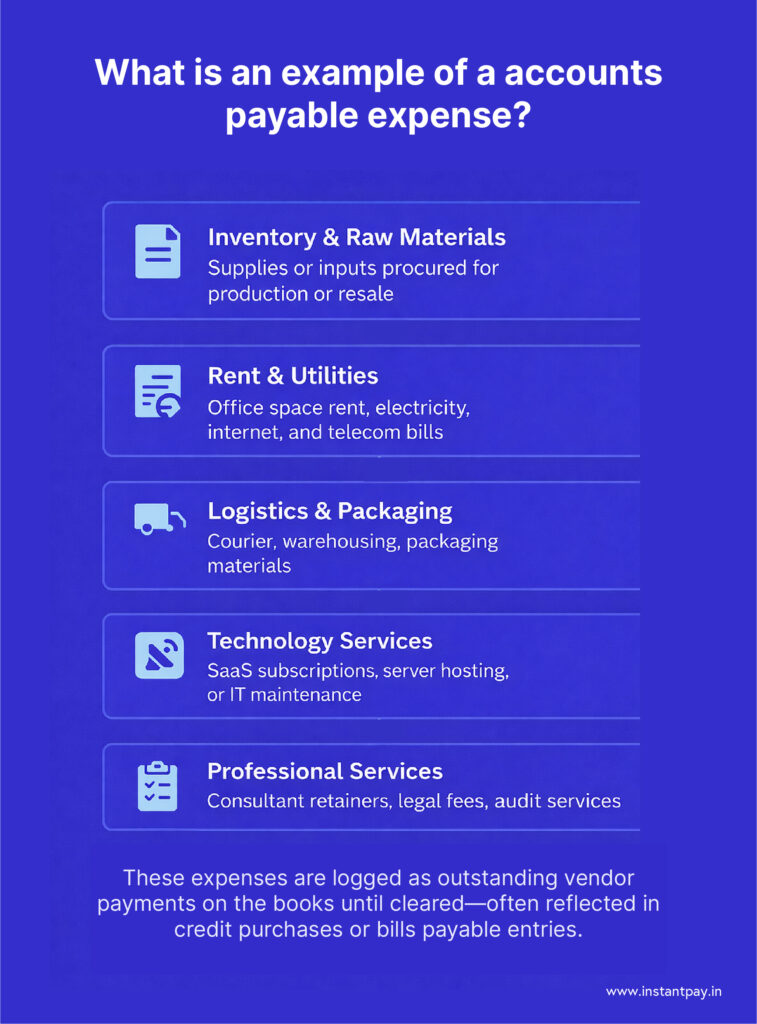
In most Indian businesses, these are typical expenses recorded as short-term payment obligations to vendors or service providers:
- Inventory & Raw Materials – Supplies or inputs procured for production or resale
- Rent & Utilities – Office space rent, electricity, internet, and telecom bills
- Logistics & Packaging – Courier, warehousing, packaging materials
- Technology Services – SaaS subscriptions, server hosting, or IT maintenance
- Professional Services – Consultant retainers, legal fees, audit services
These expenses are logged as outstanding vendor payments on the books until cleared—often reflected in credit purchases or bills payable entries.
Key KPIs Every Finance Team Should Track
Tracking the right metrics in your payables process isn’t just about compliance—it directly impacts cash flow, vendor confidence, and operational accuracy. Below are three core indicators every finance team should monitor.
Performance Metrics Table
| Metric | Formula | Why It Matters |
| DPO (Days Payable Outstanding) | (Avg. AP ÷ COGS) × 365 | Measures how long you take to clear supplier dues; impacts cash flow |
| AP Turnover Ratio | Net Credit Purchases ÷ Avg. Accounts Payable | Evaluates how efficiently you settle payables over time |
| Error Rate | % of incorrect or disputed entries | Indicates how accurate and compliant your AP system is |
GST & Compliance Readiness in Accounts Payable
Managing payables cycles in India comes with its own set of tax and regulatory responsibilities. Whether you’re dealing with vendor invoices, applying TDS, or reconciling GST returns, your payables team plays a crucial role in ensuring compliance and audit readiness.
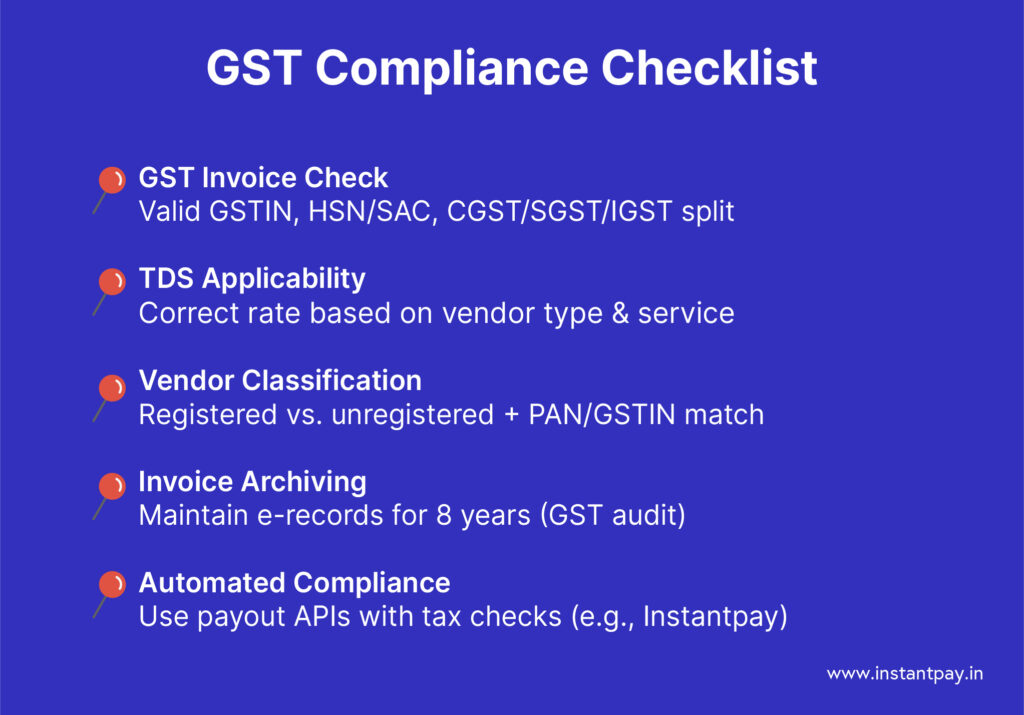
Compliance Checklist for AP Teams
Use this quick checklist to avoid common gaps in GST and TDS compliance:
GST-Compliant Invoices
Ensure vendor invoices carry a valid GSTIN, invoice number, HSN/SAC codes, and tax split (CGST/SGST/IGST)
TDS Applicability Check
Apply the correct TDS rate based on vendor type (individual, company, etc.) and nature of service
Vendor Classification
Separate registered/unregistered vendors and verify PAN/GSTIN match before payment
Invoice Validation & Archiving
Maintain e-invoice trail for at least 8 years for GST audit preparedness
Automated Payouts with Tax Mapping
Use platforms like InstantPay’s Payout API to integrate vendor compliance checks directly into the payment workflow
Real-World Example (GST + AP Integration)
Let’s say your business receives a Rs. 1,18,000 invoice from a registered packaging vendor.
Breakdown:
- Rs. 1,00,000 product value
- Rs, 18,000 GST (18%)
Before releasing the payment, your AP system should: - Validate GSTIN
- Verify PO alignment
- Apply TDS if applicable
- Record separate ledgers for purchase and input GST
Top Accounts Payable Challenges Faced by Indian Businesses (and How to Fix Them)
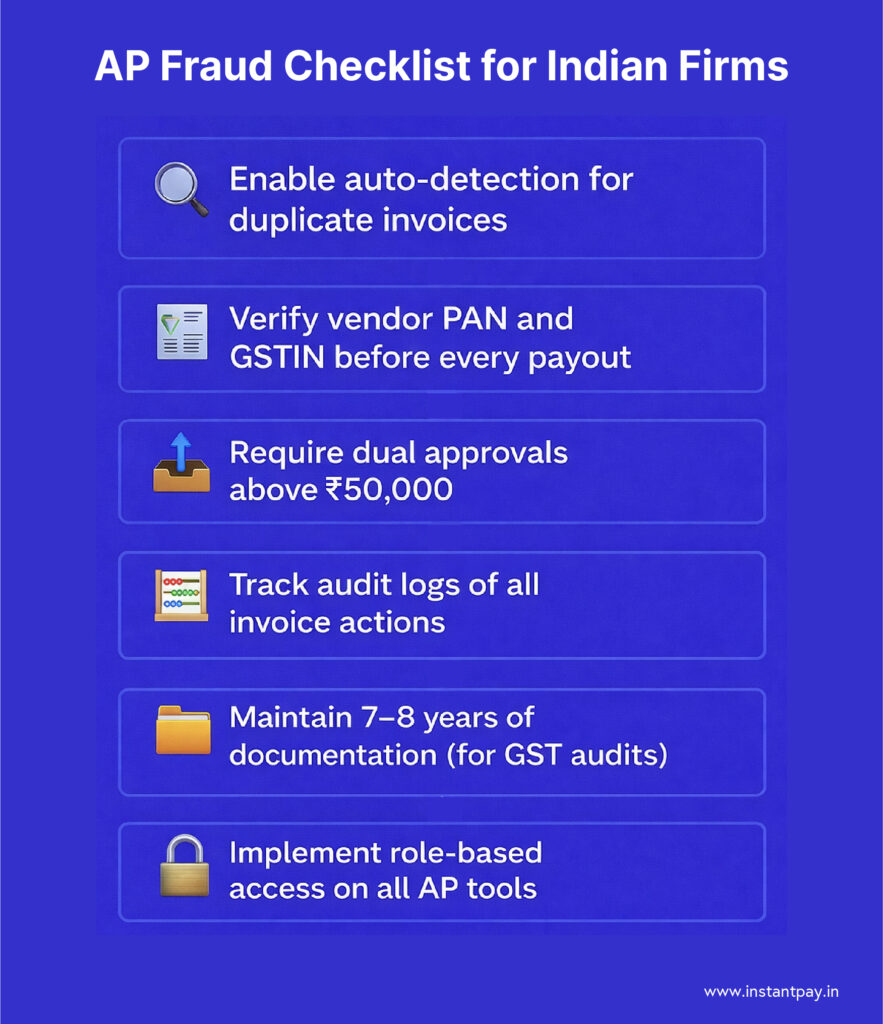
Even in tech-forward businesses, vendor payment fraud, manual errors, and delayed disbursements remain surprisingly common. Without proper automation and internal controls, these issues can snowball, disrupting vendor trust, compliance workflows, and your overall cash flow health.
Frequent AP Challenges
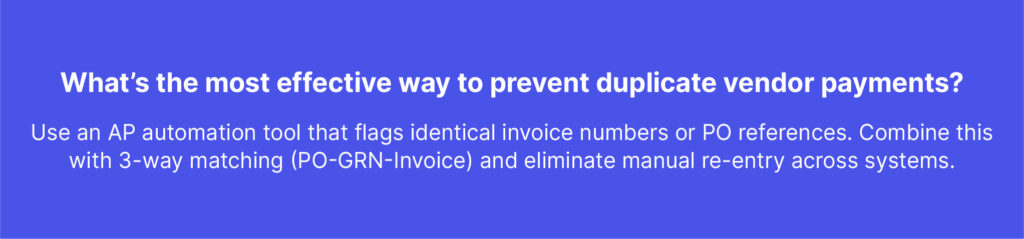
- Duplicate Invoices & Payments
When the same invoice is entered twice (or paid twice), it usually stems from poor version tracking or a lack of system alerts. This leads to overpayments and reconciliation issues. - Missing or Mismatched Invoices
Invoices without corresponding Purchase Orders (POs) or Goods Receipt Notes (GRNs) often slip through approval cracks. This not only delays processing but also complicates tax deductions and audits. - Manual Data Entry Errors
Typos in invoice amounts, incorrect vendor codes, or forgotten TDS deductions can result in misstatements in your books and expose you during audits. - Approval Bottlenecks
When AP processes depend on paper-based approvals or scattered email chains, payments get delayed. This can damage vendor trust and forfeit early-payment discounts. - Vendor Disputes & Trust Deficit
Poor communication around payment cycles or incomplete documentation often leads to disputes. This weakens vendor relationships and increases follow-up costs.
AP Automation in India: How OCR, RPA & APIs Are Transforming Vendor Payments?
Automating vendor payables isn’t just about speed—it’s about ensuring accuracy, transparency, and regulatory compliance. From OCR-driven invoice capture to API-led disbursements, automation is transforming how Indian businesses manage their outgoing payments.
Manual payables operations are often plagued by delays, data entry errors, and compliance gaps, especially when handling high volumes across multiple suppliers. That’s why over 56% of businesses globally have begun investing in automation, according to Stampli, with invoice volumes exceeding $51 billion.
In India, where GST compliance, TDS deductions, and supplier verification are integral, digitising your payment workflow is no longer optional; it’s essential for financial efficiency and audit readiness.
The AP Automation Stack: How It Works (Explained)
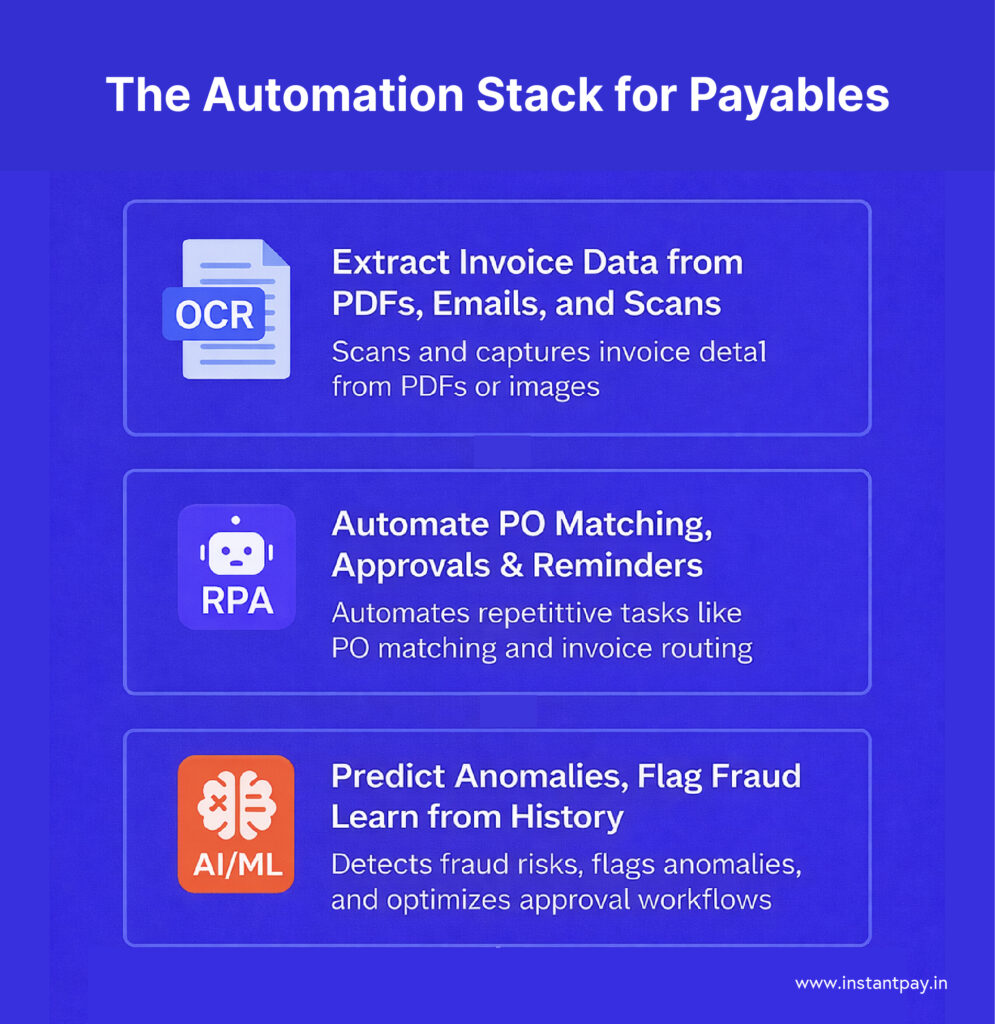
From traditional ledgers and spreadsheets to intelligent automation, here’s how modern Indian businesses are digitizing payables management step by step:
1. OCR – Optical Character Recognition
What it does:
OCR technology scans physical or digital invoices (PDFs, emails, scanned copies) and extracts critical fields, such as invoice number, vendor name, amount, date, and tax breakdown.
Why it matters:
No more manual entry. It reduces human error and speeds up data capture, especially useful when dealing with hundreds of invoices daily.
2. RPA – Robotic Process Automation
What it does:
RPA uses rule-based bots to automate routine tasks like:
- Matching invoices to POs and Goods Receipt Notes (3-way match)
- Routing invoices for approval based on vendor or amount thresholds
- Auto-scheduling payments based on due dates
Why it matters:
It eliminates delays caused by manual follow-ups and helps businesses maintain timely payments, even with a small accounts team.
3. AI & ML – Artificial Intelligence and Machine Learning
What it does:
These systems learn from historical invoice and payment data to:
- Flag duplicate or suspicious invoices
- Predict cash flow impacts
- Recommend optimal payment dates to improve DPO
Why it matters:
AI brings intelligence to the AP process, preventing fraud, improving cash planning, and reducing exception handling.
4. API Integrations
What it does:
APIs (like InstantPay’s Bulk Payouts API) connect your accounting software or ERP directly with payment systems and compliance checks. You can:
- Trigger vendor payouts automatically
- Run GSTIN and PAN validations before disbursement
- Update payment status in real-time and reconcile instantly
Why it matters:
This final layer makes your AP system truly real-time and scalable. It ensures compliance is baked into every transaction, without the need for manual checks.
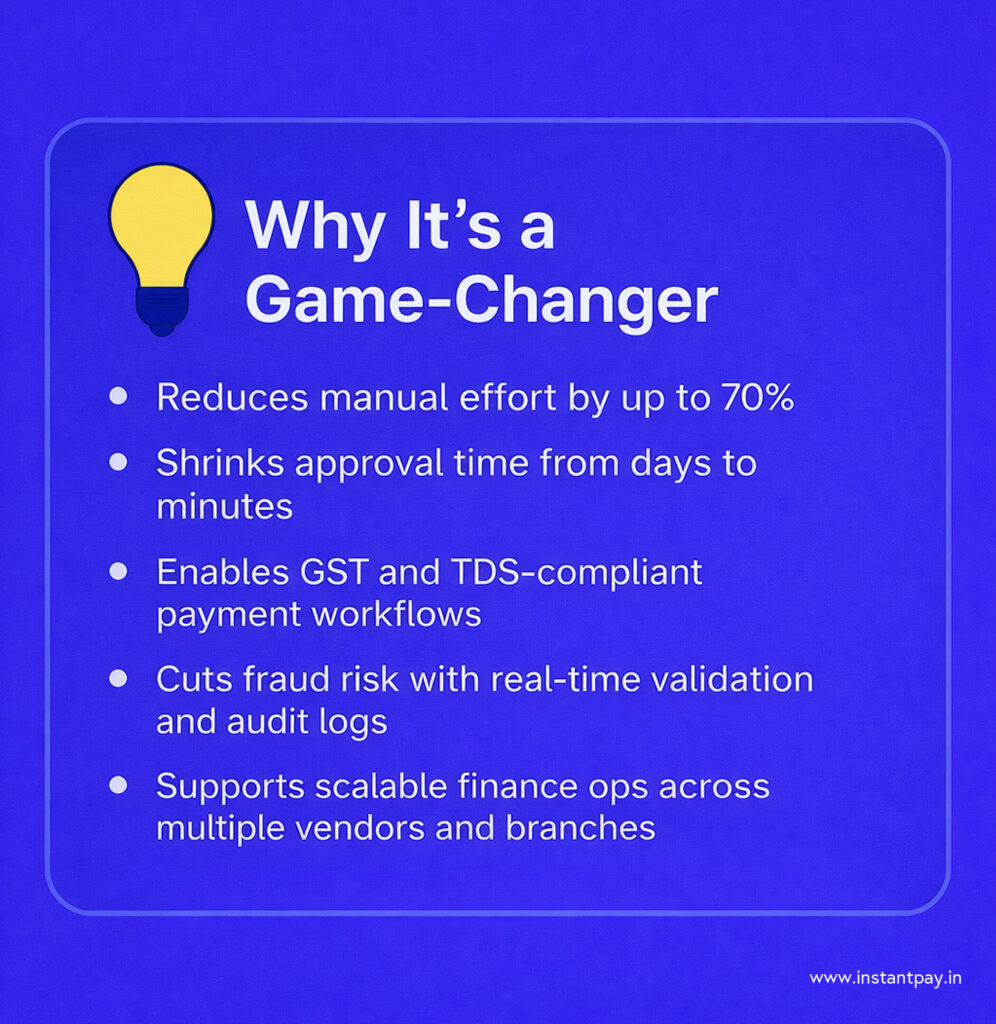
Where InstantPay Fits In: Automation Made Practical for Indian Businesses
For Indian SMBs and enterprises looking to move beyond spreadsheets, InstantPay’s Bulk Payouts API offers a ready-to-integrate solution that doesn’t require overhauling your existing systems.
With direct integration into ERP or finance tools, businesses can:
- Automate vendor payments across UPI, NEFT, RTGS, and IMPS on schedule and at scale
- Run real-time KYC validations, including PAN, GSTIN, and account checks before payout, removing compliance friction
- Implement custom approval flows using maker-checker logic tailored to payment amounts or vendor categories
- Track every transaction live with built-in audit logs, error alerts, and instant reconciliation, no manual follow-up required
Whether you process 50 or 5,000 invoices a month, InstantPay’s automation tools bridge the gap between payables management and compliance-first execution.

How to Choose the Right Accounts Payable Software for Your Business?
When choosing a vendor payment management system, most businesses focus on automation. But efficiency alone isn’t enough. Indian SMEs need to balance speed with compliance, flexibility with control.
Here’s what to evaluate, beyond just features:
Key Considerations Before You Buy AP Software
| What to Consider | Why It Matters for Indian Businesses |
| Compliance Mapping | Does the tool support GST invoice structuring, TDS slabs, and audit logs? |
| ERP/Bank Integration | Can it plug into your accounting tools (Tally, Zoho) and payout platforms like UPI/NEFT/RTGS? |
| User Roles & Access Control | Role-based approval layers reduce fraud—essential for maker-checker logic |
| Localization | Does it handle regional invoice formats, Indian vendor types, and GSTIN validation? |
| Scalability | Can it support multiple branches, vendor tiers, and growing invoice volumes? |
| Support & Implementation | Does it offer Indian timezone support and hand-holding through compliance onboarding? |
How Managing Vendor Obligations Strengthens Your Business?
For most Indian businesses, vendor payouts are often seen as a backend task. But when managed strategically, your payables process can become a financial engine optimizing working capital, improving supplier relationships, and unlocking hidden savings.
Why This Matters:
- Cash Flow Optimization: Timely management of dues allows better cash forecasting, reducing the need for short-term borrowing.
- Early-Payment Discounts: Terms like 2/10 Net 30 offer ~2% cost savings if bills are cleared within 10 days, improving margins with zero additional effort.
- Vendor Relationship Management: Businesses that consistently pay on time get better credit terms, faster fulfilment, and priority service.
- Better DPO Balancing: By controlling your Days Payable Outstanding, you extend your cash runway without damaging supplier trust.
- Finance Team Efficiency: Centralizing payouts with real-time automation tools helps streamline reconciliation, ensure compliance, and auto-generate documentation, without manual overhead.
AP vs. AR vs. Bills Payable – What’s the Strategic Difference?
| Category | Description | Impact Area | Real-World Example (India) |
| Vendor Payables | Dues owed to suppliers or service partners | Liabilities | Rs. 2L due to the logistics partner for Jan orders |
| Customer Receivables | Outstanding payments from clients | Assets | Rs. 5L pending from a wholesaler in Lucknow |
| Bills Payable (B/E) | Promissory notes accepted for payment | Formal Liability | Accepted the bill of Rs. 75K due next quarter |
Case Study: How a Mid-Sized Business Saved ? 9.2 L by Automating Payables
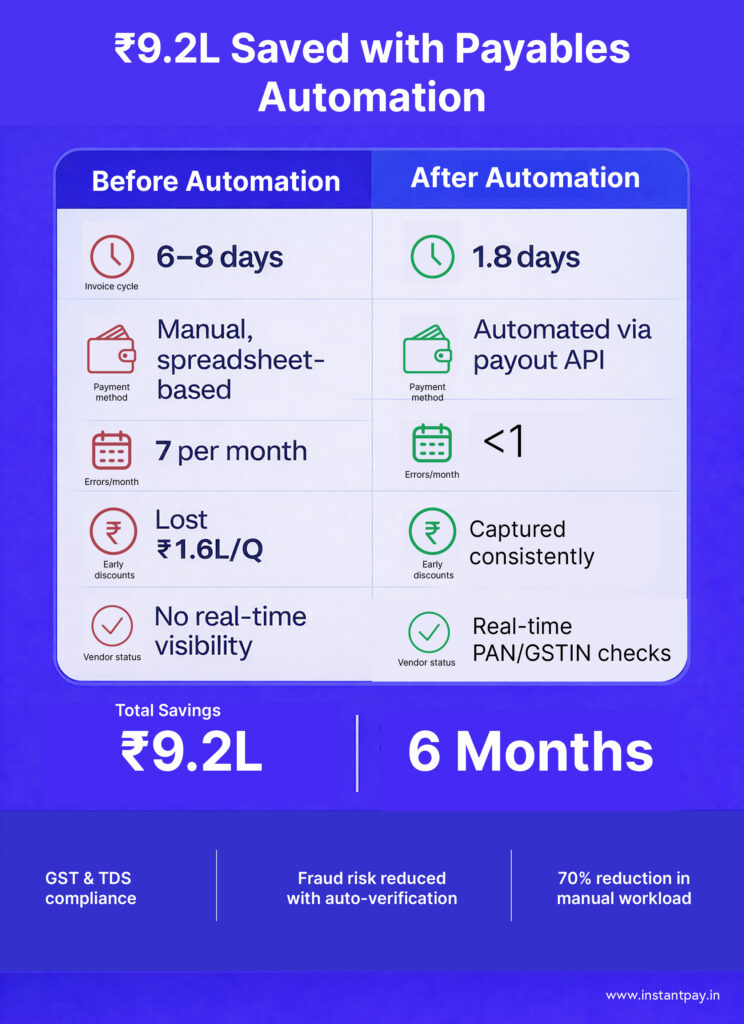
When a Delhi-based logistics SME began scaling operations across four cities, its manual invoice processing quickly became a bottleneck. With over 150 vendors, approvals were often delayed, duplicate invoices went undetected, and TDS/GST compliance checks were inconsistent.
Before Automation
- Invoice Processing Time: ~6–8 days per cycle
- Approval Routing: Manual, email-based
- Payment Errors: Avg. 7 per month
- Missed Early Discounts: ~Rs. 1.6L per quarter
After Implementing an Automated Payables Workflow
- Invoice-to-Payment Cycle: Reduced to 1.8 days
- Error Rate: Dropped by 90%
- Compliance: GSTIN/PAN auto-validation added
- Savings: Rs. 9.2 L over 6 months via reduced overhead, early-payment discounts, and fraud prevention
By integrating a payout solution that supported multi-vendor sync, real-time audit logs, and role-based approval flows, the business not only streamlined its vendor payment process but also improved cash flow visibility and audit readiness.
What’s Next for AP Automation in India?
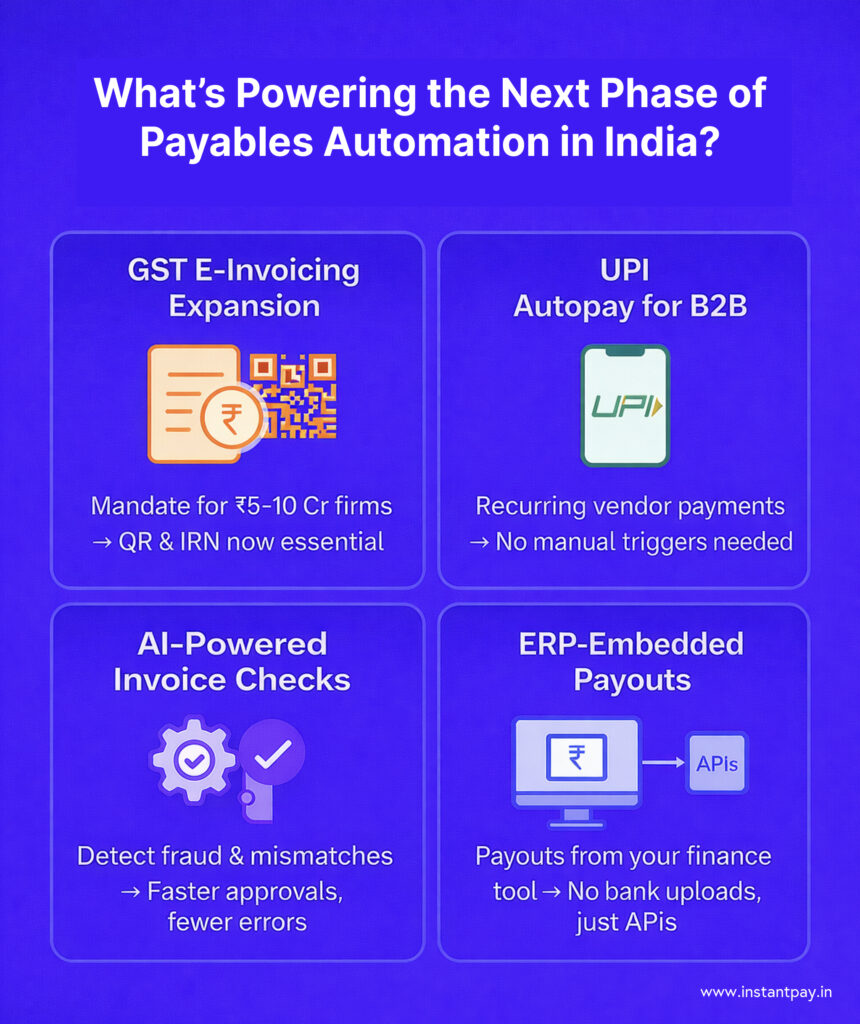
Accounts payable automation is entering a pivotal phase in India — driven by new policy mandates, fintech infrastructure upgrades, and increasing compliance requirements. Here’s what finance teams should watch out for in the next 12–18 months:
1. GSTN + Invoice Registration Portal (IRP) Expansion
What’s happening:
The GST Network is expanding mandatory e-Invoicing and real-time invoice validation for businesses below Rs. 5 Cr turnover in phased rollouts.
Why it matters for AP:
- AP systems will need to sync directly with IRPs
- Real-time validation will reduce fake invoice risks
- Automation tools must now handle QR-code embedded invoices + IRN matching
2. UPI for B2B Payments — AutoPay, Mandates, and Biller APIs
What’s coming:
NPCI is pushing for broader UPI adoption in B2B vendor payments, with support for:
- UPI Autopay for recurring payouts
- Biller integration APIs for invoice-linked disbursals
- UPI Plug-ins within ERP and finance platforms
Impact:
Expect faster vendor settlements and lower NEFT/RTGS dependency — especially for Tier 2/3 suppliers.
3. Embedded Compliance with MCA, GSTIN, PAN, and Legal Checks
Trend:
AP automation tools will increasingly bundle due diligence APIs to verify vendors during onboarding and before disbursements:
- MCA Director Checks
- GSTIN activity status
- PAN/Aadhaar match
- Litigation or court case red flags
Why it matters:
Reduces fraud risk before money leaves the account, not after reconciliation.
4. AI in AP: From OCR to Predictive Risk Models
Shift underway:
Basic OCR tools are being upgraded with AI that learns from past anomalies — detecting duplicate invoices, vendor behaviour changes, and incorrect GST inputs.
Future Use Case:
“Your vendor submitted an unusually large invoice — flagged based on past trend + GST mismatch risk.”
5. Integration-Ready Infrastructure for Indian ERPs
By mid-2026, we expect:
- APIs for NEFT/UPI payouts to become default in ERP workflows
- Most AP platforms to offer plug-ins for Zoho, Tally, and SAP India
- Government support for ‘Bharat Stack for Business’ — a unified framework combining DigiLocker, e-KYC, GST, and payment rails
Final Thoughts: Preparing for the Future of Vendor Payments
Vendor payments aren’t just about processing invoices anymore they’re a core part of your business’s financial health. With the right tools and strategies, your finance team can reduce risks, improve efficiency, and unlock working capital. This blog decoded everything from digital compliance and journal entries to GST handling and automation trends in India’s payable landscape.
Before you wrap up, use this checklist to evaluate your current setup and identify improvement areas.
Key Areas to Review in Your Vendor Payment Process
- Invoicing: Are your vendor invoices digitised and auto-matched with POs and receipts?
- Vendor Payouts: Does your ERP or payout setup support UPI, NEFT, and NACH workflows?
- Tax Compliance: Are GST input credits and TDS deductions being recorded correctly and automatically?
- Accounting Entries: Is your ledger reflecting the right purchase and GST journal entries?
- Approvals: Have you set up maker-checker approval flows for payment authorisation?
- Fraud Controls: Are PAN, GSTIN, and account details validated before processing payouts?
- Vendor Master Sync: Is your vendor database regularly verified and synced with compliance tools?
- Cycle Time: Is your invoice-to-payment time within 5 working days?
- Cash Flow Strategy: Are you leveraging early-payment discounts with key vendors?
- Reporting & KPIs: Do you track processing errors, vendor ageing, and Days Payable Outstanding?
The next phase of AP in India focuses on intelligent automation—where onboarding, validation, payments, and reporting work together in one secure, streamlined system.
FAQs
1. What is accounts payable vs. accounts receivable?
Accounts payable refer to money a business owes to its vendors. Accounts receivable are the money owed to the business by its customers.
2. What is the difference between trade payables and accounts payable?
Trade payables are amounts owed for goods bought for resale or production. Accounts payable is broader—it includes trade payables and other bills like rent or utilities.
3. What is the role of accounts payable?
It manages vendor payments, tracks outstanding invoices, ensures compliance, and maintains cash flow.
4. What is an accounts payable invoice?
It’s a bill sent by a supplier for goods or services purchased on credit, recorded as a short-term liability.
5. What does AP stand for in business?
AP stands for Accounts Payable—the team or process that handles paying vendors and managing short-term liabilities.
6. What is AP invoicing?
AP invoicing is the process of receiving, verifying, recording, and scheduling vendor invoices for payment.
7. What are some examples of payables?
Common examples include rent, utilities, raw materials, packaging costs, professional fees, and software subscriptions.
8. What are bills payable?
Bills payable are formal documents or credit purchases that a business must settle, recorded under current liabilities.