While small businesses are growing and generating revenue on the revenue side of their income statement, the Indian digital economy has created challenges for SMEs in creating sufficient cash flow to remain viable in India. In fact, according to research conducted by CBI Research, 71% Indian SMEs have indicated that in order to cover basic operational costs in 2025 they will need to find new sources of capital or more cash or greater amounts of capital.
All of these factors indicate that there is a major challenge with cash flow in the SME sector in India and with rising operational costs, a lack of sufficient revenue and insufficient access to cash to sustain their operations will create additional cash flow challenges and as SMEs prepare to migrate to the new digital economy they will need to shift from crisis oriented problem solving to using real-time predictive cash flow systems.
In this blog, we will focus on the essentials of cash flow management and provide practical strategies, digital tools, and policy-level insights to help SMEs navigate their way to survival, as the current economy is such that liquidity becomes a more critical factor than profitability.
Why Cash Flow Still Rules in the Digital Economy?
With the advent of real-time payments, digital credit, and instant settlements, liquidity, and not just profitability, is defining business survival. A company may be profitable on paper, but without sufficient liquidity, daily operational activities may be stalled.
This is a common occurrence for Indian MSMEs, which provide nearly 30% of India’s GDP. However, they still suffer from slow payments. A 2023 GAME research reported MSMEs in India are owed over Rs.10.7 lakh crore, with micro and small businesses being the worst offenders. In situations where payment delays are considered the norm, cash flow is a survival metric more than a financial one.
Cash Flow vs Profit: Why Does It Matters?
Cash flow and profit both help analyze different aspects of a business’s financial standing. Profit shows the financial health of the business whereas cash flow assesses the ability to pay bills and other duties on a daily basis. Many MSME’s have stated an increase in sales and are currently facing issues with working capital. This situation arises because a large percentage of their sale revenue is tied up in credit.
For example, let’s say a D2C brand (direct to consumer) is making a profit of Rs.1 crore. If 70% of revenue is still uncollected from the customers, it will be very difficult for the business to run. It is the same situation for profitable businesses that cannot settle accounts with their suppliers. They will have to pause their supply chain. All in all, cash flow is the heartbeat of a business.
Cash Flow vs Profit (Tabular)
| Factor | Cash Flow | Profit |
| Definition | Real-time money coming in and going out of the business | Revenue minus expenses over a period (on paper) |
| Reflects | Liquidity and ability to meet short-term obligations | Long-term financial performance |
| Measured by | Cash Flow Statement | Profit & Loss Statement |
| Timing Sensitivity | Immediate (e.g., payment delays can hurt instantly) | Period-based (e.g., a quarter or year) |
| Impact on Daily Operations | Direct: affects payments, salaries, inventory restocking, etc. | Indirect: shows viability but doesn’t guarantee solvency |
| Example | An MSME selling online but facing UPI payment settlements delays | A startup showing profit post funding, but no cash to pay vendors |
| Why It Matters | Enables survival, agility, and scalability in real-time economy | Essential for long-term strategy, but secondary to liquidity now |
| Common Misconception | “Positive revenue means healthy cash flow” | “Profit means the business is safe” |
The Consequences of Poor Cash Flow
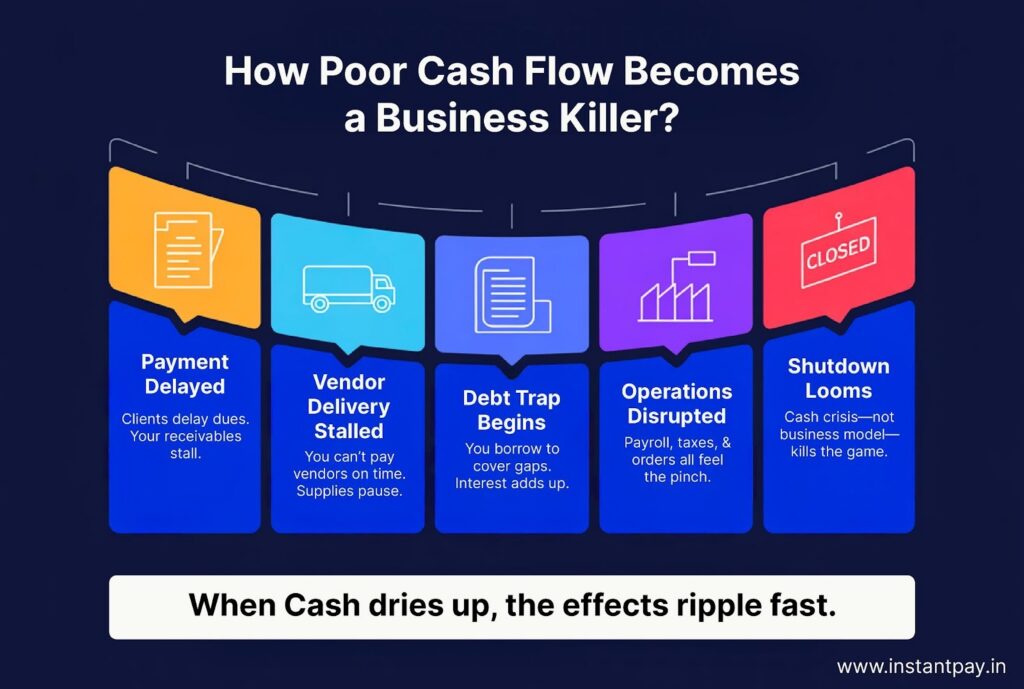
The impact of poor cash flow can be detrimental for all aspects of a business:
- Payment delays can lead vendors to companies to offer stricter credit terms.
- Failure to pay wages or taxes will result in penalties and the business losing its reputation.
- Businesses may have to depend on loans to fill the cash flow gaps, of which will increase the cost of borrowing.
- Reduction in margins can occur from missed opportunities such as faster inventory turnover or bulk discount offerings.
Most of the time, a business does not fail due to a lack of demand; rather, it fails as a result of a breakdown in the cycle of cash flow.
What Is Cash Flow Management?
The cash flow management system is designed to keep track of all incoming and outgoing cash from a business. Cash flow management allows an organization to know if there is enough money available to fund operational activities, make investments, and pay invoices.
There are three primary types of cash flow:
| Type | Description | Example |
| Operating | Cash from core business activities | Payments from customers, salary payouts |
| Investing | Cash used or earned from long-term assets | Buying new machinery, selling property |
| Financing | Cash from funding and credit lines | Bank loans, repayments, equity infusion |
The MSME Sector in India has a number of cash flow patterns that occur in different types of businesses. In logistics and consulting companies, cash flow varies based on expenses but the amount of cash received for payment remains relatively constant. In retail and manufacturing types of businesses, the high cost of raw materials often results in delayed payment which severely restricts cash flow. As a result, it is critical for companies in these industries to develop a well-defined cash flow planning process.
Core Elements of Cash Flow Management
Cash flow management today will require digital tools, planning tools, and cash flow visibility tools as follows:
1. Tracking – Identify and resolve cash flow issues by tracking the movement of cash
2. Forecasting – Predict inflow and outflow of cash to ensure there is sufficient cash
3. Receivables and Payables – Manage receiving money and paying money out
4. Cash Reserves – Maintain cash reserves equal to at least 2-3 months of operating expenses for unexpected disruptions
5. Technology – Use cash flow management tools including invoicing software, UPI dashboards, and automated cash flow alerts.
Common Challenges Faced by Indian SMEs
Indian small and medium enterprises (SME’s) encounter some common hurdles with cash flow as listed below:
- Late payment from major corporations or public sector contracts.
- Seasonality of income with monthly expenses and many sudden bursts of revenue.
- Lack of financial planning (forecasting or budgeting).
- Disconnected digital tools leading to a breakdown in financial information.
- There is little to no cash cushion due to thin margins, despite profit.
Effective cash flow management is essential for business continuity and growth in light of these challenges.
Why Managing Cash Flow Is Necessary for Small Businesses?
According to the Ministry of MSME’s 2023-24 Annual Report, cash flow issues that impacted operations were reported by over half of MSMEs, these problems include late payments from large buyers or government agencies, poor cash flow forecasting, rising fixed costs (rent, salaries), and a lack of rapid access to credit.
The drawback of cash flow issues can lead to:
1. Late employee paycheques
2. Poor relationship with Vendors
3. Stopping production
4. Business closure
Even profitable businesses can lack cash to continue operations.
Nonetheless, companies of all sizes will struggle to manage their cash flow in real time without the adequate tools for monitoring their cash flow efficiency. They are struggling to cope with the large seasonal fluctuations in consumer demand. Consequently, these companies are often unable to take advantage of discounts from suppliers, or they are unable to borrow when necessary.
Key Challenges of Cash Flow in the Digital Age
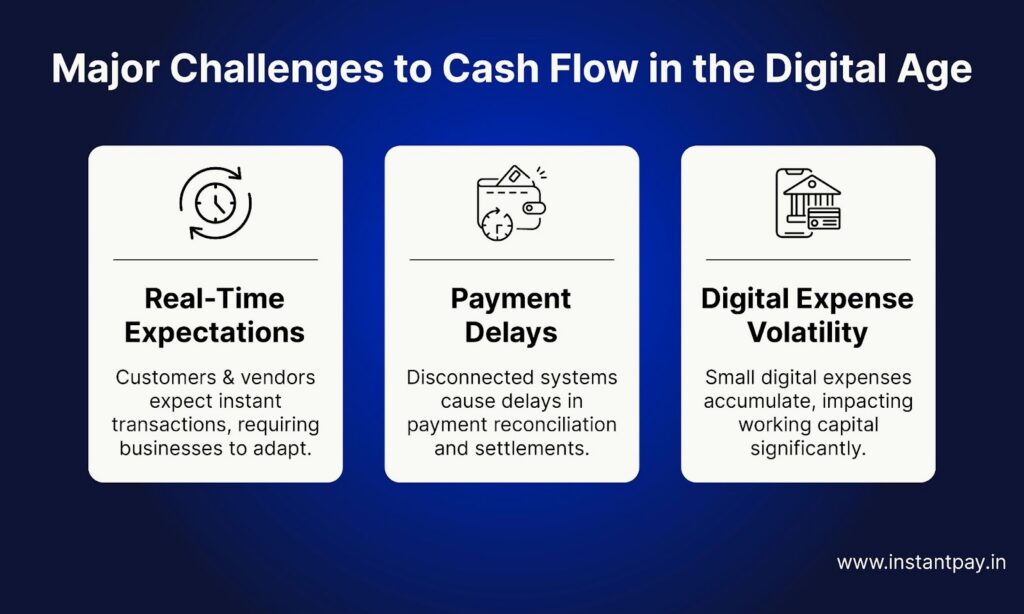
Cash flow management is both easier and more complicated due to digital solutions. Most small and medium-sized businesses are having difficulty adapting to the rapidly changing environment.
1. The Need for Speed
Clients are demanding immediate refunds; suppliers are demanding prompt payments. Many small and medium-sized businesses continue to use outdated manual systems or are experiencing delays in processing their invoices making it impossible for them to achieve real-time transparency into their cash flow efficiency.
2. Payment Lags and Gaps in the System
Invoices sent electronically still do not allow for immediate payment to the supplier. Consequently, whether an invoice is issued using paper or electronically, suppliers cannot expect payments to arrive in their bank accounts in a timely manner. Invoicing delays caused by the disjointedness of the banking, billing and GST systems are contributing factors to this issue
Did You Know?
In FY 2024, the MSME Samadhaan Portal reported that over Rs.25,000 crore in dues remained unpaid to MSMEs, despite digital invoice submissions.
3. Heightened Digital Costs
The new normal for businesses includes digital expenses from software as a service, digital advertising, and cloud computing, as well as payment services. These digital services, while appearing insignificant, can become a drag on working capital.
5 Steps to Effective Cash Flow Management
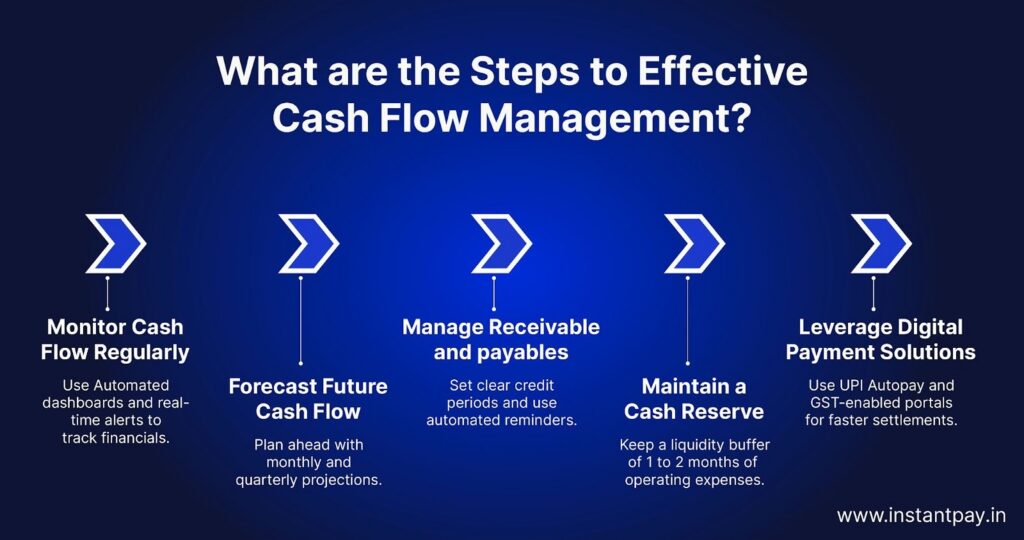
1. Monitor Cash Flow Regularly
Cash flow management mainly revolves around tracking sales and expenses (i.e., the money coming in and out of your business). To assist with managing both your expenses and your current cash balance, check out modern accounting software options such as Zoho Books, Tally Prime, Vyapar and Instantpay.
2. Forecast Future Cash Flow
One of the most important areas of cash flow management involves forecasting how much money will flow in and out of your business over any given period of time. Accurate forecasting involves knowing the seasonal nature of the inflow and outflow of your business’s cash as well as ensuring you set aside enough money to cover tax liabilities and other large, sporadic expenses like purchasing equipment for your business. Cashflow forecasting tools such as QuickBooks, Khatabook Business, CredFlow or Instantpay analytics can help you forecast the cash flow of your business.
3. Manage Receivables and Payables
Timely collections from customers and disciplined cash outflows to vendors are key components of healthy cash flow. All businesses must establish policies/rules for collecting cash from customers, and to document the rules via invoices and payment reminders. Payment and collection problem trackers, such as Razorpay, Paytm for Business, Instantpay, and MSME Samadhaan, can facilitate identifying cashflow disruptions.
4. Maintain a Cash Reserve
A cash reserve can address unexpected delays in cash flow and unexpected expenses as they arise. It is generally a good idea to set aside cash for one to two months of ongoing operational expenses for an average business, whereas, for a seasonal business, it is suggested to keep cash reserves for three to four months.
5. Leverage Digital Payment Solutions
Digital payments have greatly reduced the problems of delayed payments and lack of visibility associated with traditional means of receiving money. Automated payment and reconciliation processes can help in making management easier, including; UPI Autopay for regular payments, Razorpay or Instantpay for bulk/vendor payments, GST-enabled payment portals and the government-provided DigiLocker, GeM and TReDS initiatives which enhance digital payment systems for fellow MSMEs.
Smart Digital Tools for Cash Flow Management
1. Cash Flow Forecasting Tools
Cashflow forecasting tools serve the purpose of anticipating both incoming and outgoing cashflow for businesses
- Zoho Books comes with cashflow reporting features and also provides GST compliant accounting.
- For forecasting cash flow of Indian SMEs, CredFlow is purpose-built for tracking receivables and predicting cash flow on the basis of invoices.
- QuickBooks (for legacy users) offers cashflow planners with banking integrations.
- Without/outside of regular forecasting, businesses are thwarted by the absence of financial foresight, be it during tax season(s), festivals or during periods which are seasonally observed as hibernatory.
2. Payment Automation & Reconciliation Software
Automated reconciliation, management of invoices, and the availability of payment links are the automation of reconciliation and management with a reduction of manual effort, and the tracking of payouts.
- Instantpay: as a provider of automation for (digitally) automated bulk vendor payouts and financially digital tracking of transactions in real-time.
- RazorpayX: is a provider for payroll automation, the automation of vendor payouts as well as banking API’s
- It is the automation of transactions that assists businesses in the (virtually) non-existence of delays, errors or the manual (virtually) non-existence of reconciliation.
3. Dashboards for Real-Time Visibility
It’s the dashboards that provide a clear, real-time view of the finances of the business.
- Visual reporting of receivables and payables are the features of TallyPrime.
- GST ready books are also features of TallyPrime.
- Zoho Finance Suite: Personalized dashboards for collections, spendings, and cash burn rate.
- Instantpay Business Dashboard: Combines cash position, payouts, and transaction history.
MSMEs are able to make quicker and better financial decisions due to having financial visibility in real-time.
Cash Flow Improvement Strategies for MSMEs and Startups
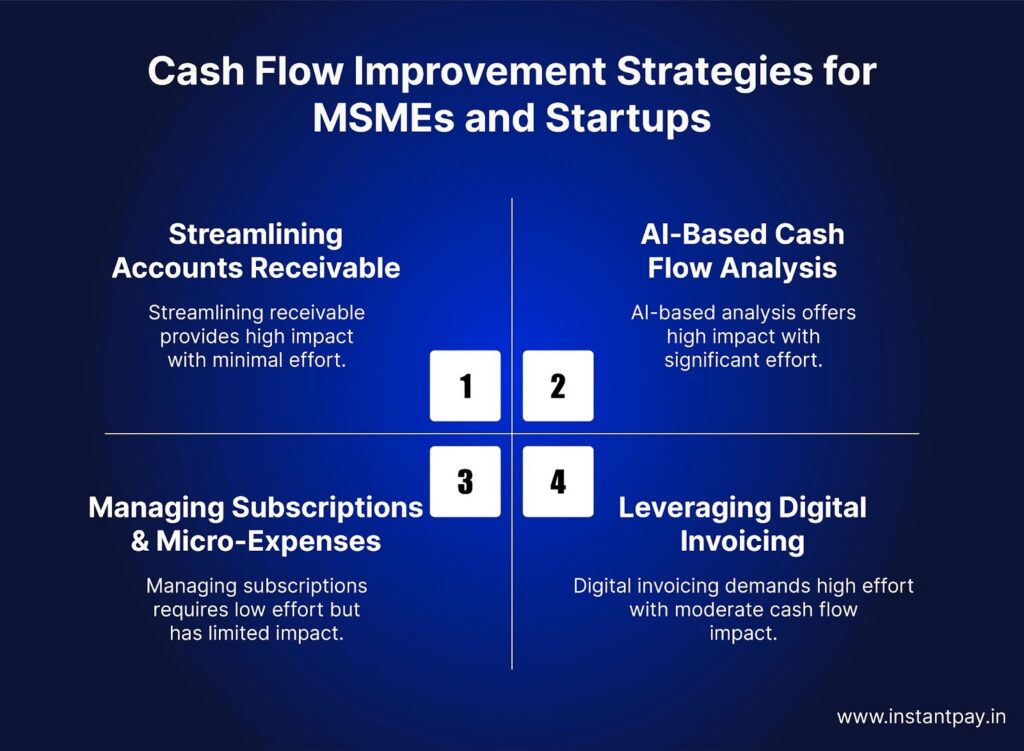
1. Streamlining Accounts Receivable
Accounts receivable have a huge impact on the overall cash flow of any business. MSMEs may consider making offers of small discounts when customers make a promise to pay early. Also using software such as collections management tools like Instantpay or Zoho Books can assist in automating invoice reminder systems and collecting payments in a timely manner. Timely collection will provide higher levels of positive cash flow as businesses will be able to limit the need for short-term loans.
2. Leveraging Digital Invoicing
Using digital invoicing software will enable the streamlining of the invoicing process by ensuring that invoices are properly recorded in compliance with tax laws; therefore, facilitating payment at an accelerated pace. Examples such as TallyPrime or Instantpay will provide businesses with the ability to generate GST-compliant e-invoices while also providing automated payment processing services.
3. Managing Subscriptions and Micro-Expenses
Enterprises should predict and manage minor electronic expenses (i.e. Software as a Service (SaaS), Advertising online, Software Subscriptions), as they can collectively add up to a substantial dollar amount. It is recommended to review these expenses every month, eliminate any unwarranted tools, and utilize financial dashboards to monitor these calendarized expenses over time. Monitoring these microscopic expenses will assist in conserving working capital.
4. AI-Based Cash Flow Analysis
The use of technology to assist in managing cash flow resulting in businesses being able to successfully monitor cash flow. Many modern-day fintech systems include cash flow management tools that can help identify unplanned expenses, cash shortages, and late payments. Other useful tools include cash flow management simulations that can be executed prior to making large-scale financial decisions.
Effective Cash Flow Tips for Startups and SMEs
1. Maintain a 3-Month Buffer
Having three months’ worth of cash reserves is a good strategy for any establishment to pay their employees and ongoing expenses. This will help mitigate the risk associated with late payments, experiencing a sudden decrease in income, or sudden changes in the market. New businesses especially need to refrain from spending money before they have established a consistent income from their operations.
2. Track Burn Rate vs Revenue
Startups need to be careful about runway – this is how long a company can operate before running out of cash. Even companies with good revenue can have cash flow problems if they are spending out faster than the cash is coming in. Initiatives put in place by the government, for instance the National Startups Award 2023 by DPIIT, are a recognition of the need to manage burn rates if companies are to be sustainably profitable.
3. Use Tiered Expense Controls
Not all costs have equal importance. Businesses may need to distinguish their expenses into: rigid – salaries, compliance, and infrastructure, and flexible – marketing spends, subscriptions, and perks, among others. This helps businesses manage their spending quickly if they are cash-strapped.
Government Schemes Supporting Cash Flow for MSMEs
| Pradhan Mantri Mudra Yojana (PMMY) Launched in 2015, PMMY offers collateral-free loans up to 10 lakh for small and micro businesses. Loans are divided into Shishu (up to Rs. 50,000), Kishore (Rs.50,001–Rs.5 lakh), and Tarun (Rs.5–10 lakh) based on business stage. In FY 2022–23, over 6.23 crore loans were sanctioned under the scheme. |
| Emergency Credit Line Guarantee Scheme (ECLGS) ECLGS provides 100% government-guaranteed collateral-free loans to MSMEs to help them manage liquidity and working capital, especially during economic disruptions. |
| Credit Guarantee Schemes (CGS) This scheme enables collateral-free loans up to Rs.5 crore for micro and small enterprises, improving access to formal credit |
| Udyam Assist Platform The Udyam Assist Platform, created by SIDBI, provides Udyam Registration support to informal micro-enterprises, allowing them to refine their processes and gain access to government programs and financial services. |

| Trade Receivables Discounting System (TReDS) The TReDS platform allows MSMEs to obtain financing through multiple financiers for their trade receivables from corporate buyers. MSMEs can access working capital and enhance their cash flow by factoring their invoices. |
The Role of Financial Reporting in Maintaining Healthy Cash Flow in MSMEs
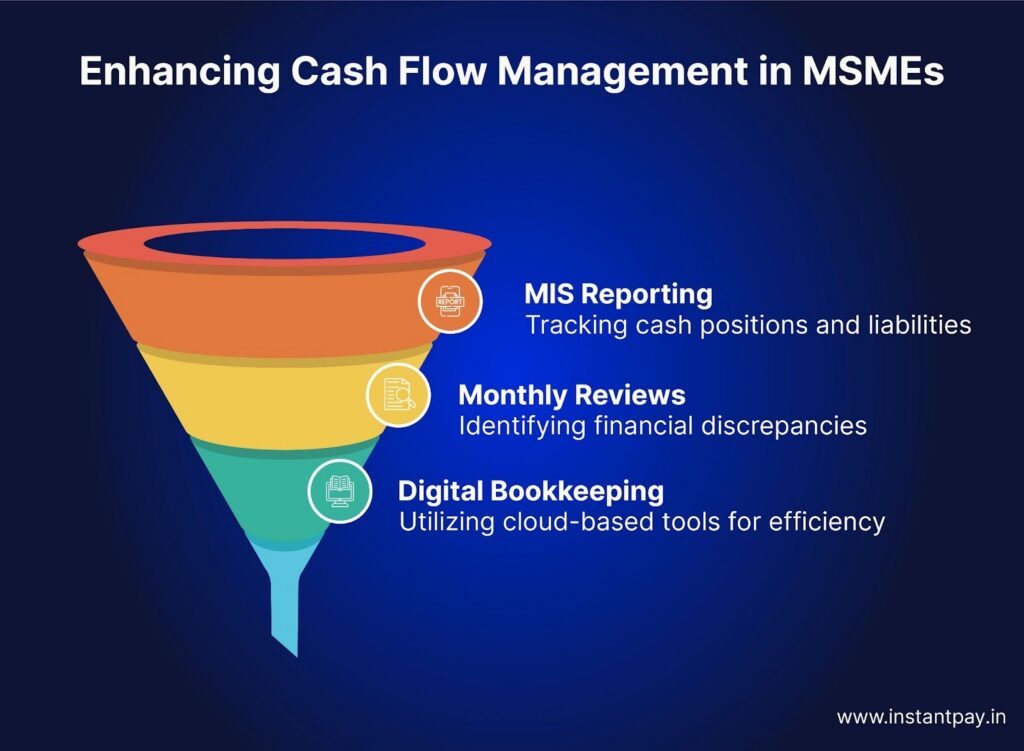
MSMEs can better understand their overall financial health through analytical financial reporting. If used effectively, basic Management Information System (MIS) reports can provide information to MSMEs regularly about their daily businesses’ financial position by allowing them to track daily inflows of cash, receivables, payments, and assess cash flow gaps proactively. This allows MSMEs an opportunity to consider the best strategy to address these issues.
Bank and cash reconciliation, payment processing, and identifying operational inefficiencies are caused somewhat by the internal audits performed by self-administered monthly controls, periodic evaluations on a monthly basis, and informal performance reviews.
An additional advantage to MSMEs is the increased number of digital bookkeeping applications available. TallyPrime is just one such service that can support MSMEs by automating their bookkeeping processes and supporting MSMEs by managing their cash flow. Other examples include milk smear analysis.
Zoho Books is just one example of an accounting system that can help MSMEs with overdraft issues caused by the inability to properly plan for cash flows.
Final Thoughts
It also means financial visibility and the ability to make informed business decisions. Startups and MSMEs are able to respond quickly to operational delays, supply chain disruptions, or market changes because of their visibility.
Cash flow management for MSMEs and startups can be done by forecasting cash requirements, expenditure control, maintaining liquidity, and the appropriate use of financial digital tools. The management of payments and liquidity by MSMEs has also been facilitated by the collaboration of the government and the MSME sector.
Regardless of whether you operate a small startup or an expanding SME, developing habits around real-time tracking, forecasting, and reporting will be crucial. Companies that successfully treat cash flow as a strategic priority are able to better confront and navigate operational uncertainty, as well as secure sustainable growth.
FAQs
1. What is cash flow management for?
Cash flow management helps businesses in tracking, forecasting and controlling money coming in and out of a business.
2. What are the 4 types of cash flows?
Operational, Investing, Financing and Company’s Free Cash flow.
3. Why is low cash flow bad?
Low cash flow hinders business in settling bills, salary payments and in emergencies.
4. How to manage cash flow as a small business?
Use digital tools to monitor financial positions, income and expenditure forecasting, scheduled payment and saving.
5. What is good cash flow for a small business?
Regular and predictable income that is sufficient to cover expenses while promoting business expansion/ growth.
6. What are the five rules of cash flow?
Regular tracking, forecasting, timely payments collection, cost control and maintaining a cash flow buffer.
7. What is a cash flow analysis for a small business?
Evaluation of cash inflow and outflow to determine financial safety and the associated risks.
8. What is the formula for cash flow?
Cash Flow = Cash Inflows – Cash Outflows
You can calculate it from financial statements or use tools like a cash flow statement.
9. Do 82% of small businesses fail due to cash flow problems?
Yes, as per the study by the U.S. Bank, 82% of small businesses fail due to poor cash flow management, a lesson equally relevant for Indian SMEs.
10. Why do SMEs fail?
Common reasons include poor cash flow, lack of financial planning, delayed payments, thin margins, and limited access to formal credit.