Term insurance is viewed by many as ‘essential,’ but what defines an attractive plan by year-end 2026? Most people don’t consider this subject daily; however, once you start considering how to secure your family’s future financially for many years to come, this is one of the most important financial decisions you will ever make. The real challenge isn’t necessarily acquiring a policy, it is the determination of how much coverage you will require, the features you wish to include, and any small print details affecting your claim.
Many families in India (despite increasing financial planning awareness) are underinsured. As per IRDAI’s latest report, India has maintained an insurance penetration rate of approximately 3.7% of GDP during both 2023-24 and 2024-25. Life insurance has declined from 2.8% to 2.7% and the non-life insurance penetration rate has been approximately 1% which is about half of the global average i.e., 7.3%). Simply put, many millions of families are still unprotected financially; therefore choosing a suitable term plan has never been more significant.
This guide is your quick go-to checklist for new buyers and also for those who may wish to replace their existing Rs. 25 lakh cover from 10 years ago.
What is Term Life Insurance?
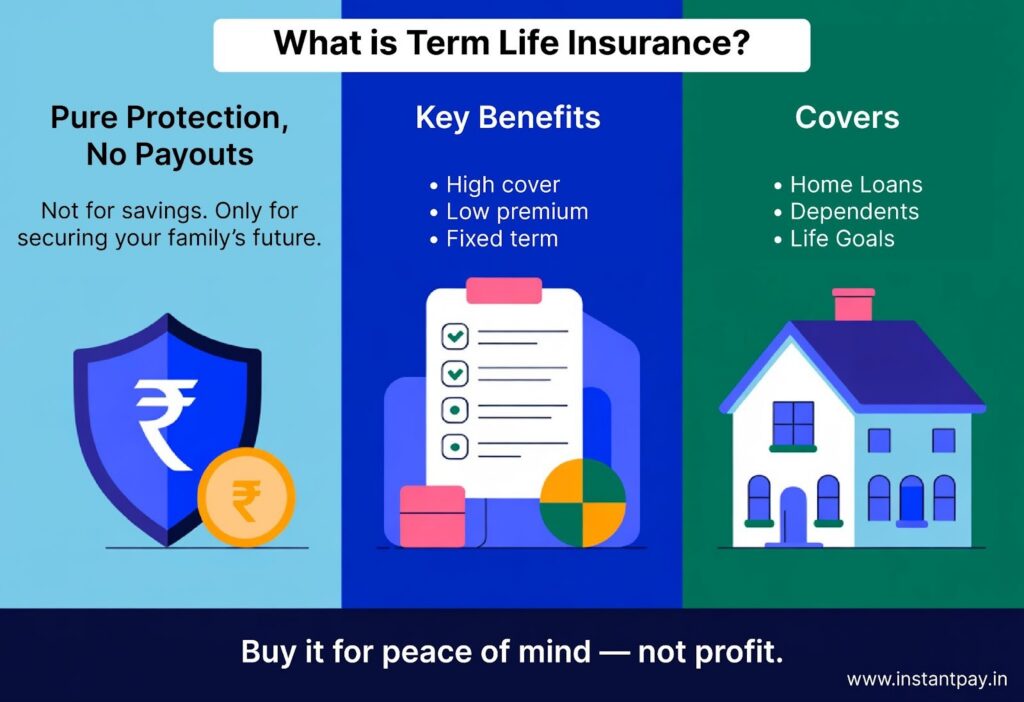
Some financial products have the potential to help you grow your funds. Others are made to simply protect your family’s income; one of those is term life insurance.
A term life insurance policy provides a death benefit to an individual, your beneficiary, if you die before the end of the policy term. Provided that the individual meets all other requirements of the policy, the term policy is strictly for protection and not an investment product.
Is term insurance good or bad?
Term insurance is beneficial for those seeking affordable life coverage without investment components. It’s ideal for individuals with dependents or financial liabilities. However, it doesn’t offer maturity benefits, so those looking for investment returns might consider other options.
Important Points to Know When Deciding on Term Life Insurance Coverage:
- Generally offers higher amounts of insurance at lower premium costs than the average (compared to whole life).
- There will be no payment to the policyholder if he or she outlives the policy.
- Coverage is designed to replace income lost due to the death of the policyholder.
In simple terms, you do not purchase this product as an investment; you purchase it to ensure that your family’s financial goals (for example, paying for a home, funding college tuition, and covering daily living costs) remain intact if something happens to you before they are fully achieved.
Key Features of Term Life Insurance
| Feature | Description |
| Affordable premiums | A young and healthy person can buy a Rs.1 crore life insurance policy for around Rs.500–Rs.520 per month, but actual premiums vary according to your age, health status, smoking status and how long you want the cover to last. |
| High cover, low complexity | These plans are predominantly designed for protection, rather than as a means of saving, so there are buys that are significantly larger than what you would get in traditional life insurance policies. |
| Long policy term options | Many modern plans allow you to extend the cover until you are in your later years, typically until you reach age 85, 99 or even 100 years old depending on the insurer and/or product. |
| Extra protection through riders | You can add riders like critical illness, accidental death, waiver of premium, disability or income benefit for wider protection. |
| Flexible claim payout | You and your family can usually select how you want to receive the payout. Either a single lump sum, monthly income, or an increasing monthly income for a more practical way of meeting living costs. |
| Return of premium option | There are even some plans which feature return of premium clauses that return the amount of premium paid back to you as a payout if you survive the term of the contract, but they typically come with a higher premium cost. |
What’s New for Term Life Insurance in 2026?
| Trend | Details |
| Easier to Buy Digitally | Maturing as a term plan (e-tab) can now be entirely online with e-applications, e-KYC and Video-based verification becoming the norm. |
| Subject to Medical Test | Not every buyer will be subject to a no-medical test for certain low-risk profiles. |
| Cover till 99/100 | Many buyers wish to have coverage for much longer than before (e.g. deep into retirement) based on life events. |
| Add-on/Customisation | Buyers are attracted to modern term plans, where they are allowed to upgrade, add riders, and enjoy different payout structures. |
| Smart Premium Payment Systems | The New Payment method has created an entirely new and published payment method for Insurers to use through the Bima-ASBA framework. |
Pro-Tip – Don’t just buy the cheapest plan. Look for claim settlement ratio, solvency ratio, customer service quality, and rider flexibility.
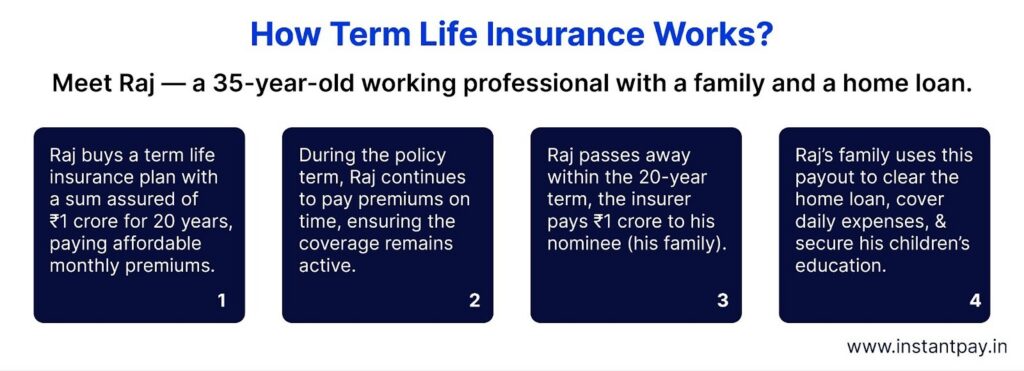
Which is better, whole life or term life?
Term life insurance provides coverage for a specific period at lower premiums, making it suitable for temporary needs. Whole life insurance offers lifelong coverage with a savings component, but at higher premiums. The choice depends on individual financial goals and needs.
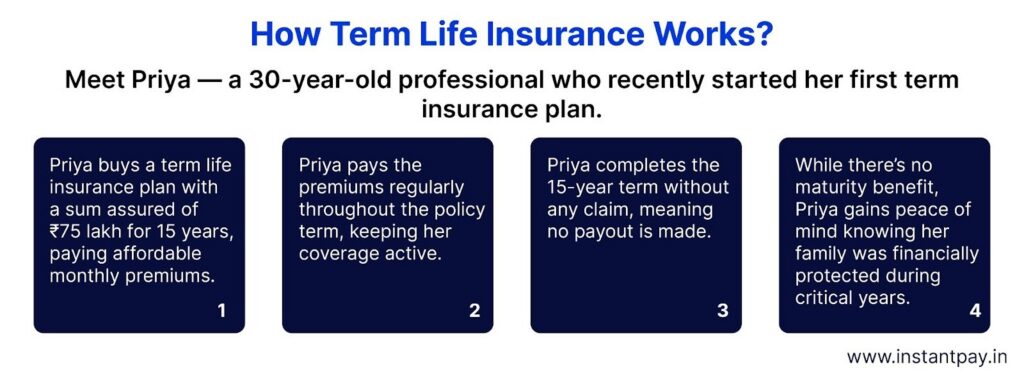
Example of term insurance when no claim is made during the term.
Term Insurance vs. Whole Life vs. Endowment Plans
| Feature | Term Insurance | Whole Life Insurance | Endowment Plan |
| Purpose | Pure risk protection; provides death benefit only | Lifetime coverage with a savings component | Combines insurance with savings; pays out on death or after a specific term |
| Coverage Duration | Fixed term (e.g., 10, 20, 30 years) | Lifelong coverage | Fixed term; coverage ends after maturity |
| Premiums | Lowest among all types; cost-effective | Higher than term; fixed premiums | Higher premiums due to savings component |
| Maturity Benefit | None (unless Return of Premium option is chosen) | Cash value accumulates over time; can be borrowed against | Lump sum payout on maturity or death, whichever is earlier |
| Cash Value | No | Yes; grows over time | Yes; guaranteed returns with possible bonuses |
| Flexibility | High; can choose term length and coverage amount | Less flexible; designed for long-term coverage | Moderate; terms and benefits are predefined |
| Ideal For | Individuals seeking affordable, straightforward protection | Those looking for lifelong coverage with a savings component | Individuals wanting a combination of insurance and savings for specific goals |
| Tax Benefits | Premiums eligible for tax deductions under Section 80C; death benefit is tax-free | Premiums eligible for tax deductions under Section 80C; death benefit is tax-free | Premiums eligible for tax deductions under Section 80C; maturity and death benefits are tax-free |
| Investment Component | None | Yes; part of the premium goes towards building cash value | Yes; combines insurance with investment returns |
Who should buy a Term Life Insurance Plan in 2026?
- Individuals with financial dependents (spouse, children, elderly parents)
- Breadwinners in single-income households
- Entrepreneurs looking for keyman insurance
- Loan borrowers seeking cover for large liabilities
- Startups/SMEs wanting to insure co-founders or promoters
What is 1 crore term life insurance?
It’s a term insurance policy with a sum assured of Rs.1 crore. This means that if the policyholder dies during the policy term, the nominee receives Rs.1 crore. Premiums vary based on age, health, and other factors.
Things You Must Know Before Buying a Term Life Insurance Plan in 2026
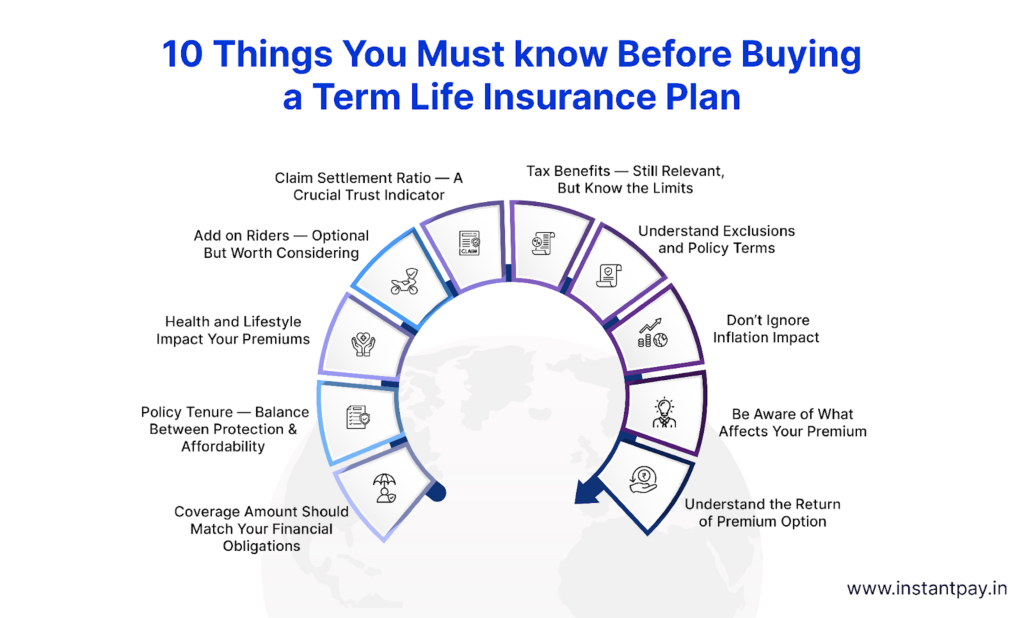
1. Coverage Amount Should Match Your Financial Obligations
When getting a term policy, one of the most important factors in deciding how much coverage you need is how much money will be required by your family to pay their day-to-day living expenses (bills) when you die. If they don’t have any source of income from you, they will not have any money to pay for the living expenses associated with your death.
Your coverage should typically be 10-15 times the amount of salary you currently receive.
You will also want to account for all major debts (e.g., home and automobile loans) that may exist at the time of your death.
Additionally, you will want to consider whether your family will need additional funds in the future (e.g., if you have young children who will require post-secondary education).
For some people, the DIME formula can help them with their coverage calculations. DIME stands for “Death,” “Income Replacement,” “Mortgage” and “Education Expenses.” Using this formula allows you to determine how much money you will have to provide for your family’s financial obligations after you die.
Example: If your annual income is Rs.10,00,000 and you have Rs.20,00,000 in debt and you expect that your children will require Rs.30,00,000 for their education, then your appropriate coverage would equal (Rs.10,00,000 × 15) + (Rs.20,00,000) + (Rs.30,00,000) = Rs.2,00,00,000 ($2 crore).
2. Policy Tenure: Balance Between Protection and Affordability
Your family’s life insurance policies have terms that dictate the length of time your life insurance will provide death benefit protection based on when claims will be paid. Almost all life insurance policies continue coverage to age 85 to 100; therefore, you must decide what policy term is appropriate for your existing liabilities.
- The length of time it takes for you to pay off your major debts.
- When your child/children will no longer depend on you for financial support.
- How many years you have remaining before you retire.
Example: Suppose that you have a five-year-old son and you want to provide him with life insurance until he is 25 years of age (i.e., he needs a 20-year policy). This makes sense because your policy must be in effect until your child is financially independent from you.
3. Health and Lifestyle Impact Your Premiums
When determining your premium, Insurer’s evaluate things like Smoking, Existing Medical History, and your Overall Health to determine what your premium is going to be:
Important things to remember:
- If you smoke, you will pay approximately 30-40% more in premiums compared to a non-smoker.
- If you have existing health issues (obesity, diabetes), you may see an increase in premiums.
- Some companies will consider the amount of health data on wellness programs (diet, fitness) when determining the price of your term insurance.
Ultimately, if you are getting healthier, your term insurance premium is going to improve as well.
Smoker vs. Non-Smoker: A Comprehensive Comparison
| Aspect | Smoker | Non-Smoker |
| Premium Cost | Higher premiums, typically 1.5 to 2 times more than non-smokers, due to increased health risks. | Lower premiums, reflecting lower health risks. |
| Life Expectancy | Reduced life expectancy owing to higher susceptibility to smoking-related illnesses. | Higher life expectancy with lower risk of chronic diseases. |
| Underwriting Process | May require additional medical examinations and detailed health disclosures. | Generally involves standard medical checks with fewer requirements. |
| Policy Terms | Certain conditions related to smoking-induced illnesses may be excluded. | Broader coverage with fewer exclusions. |
| Eligibility for Discounts | Limited; some insurers may offer reduced premiums after a specified tobacco-free period. | Eligible for various discounts based on healthy lifestyle habits. |
| Risk Classification | Classified into categories such as preferred, typical, or table-rated smokers based on usage and health status. | Standard classification with favorable risk assessment. |
Note: It’s crucial to disclose your smoking habits accurately when applying for a policy. Failure to do so can lead to claim rejections, policy cancellations, or even allegations of insurance fraud.
4. Add on Riders: Optional But Worth Considering
Many term plans offer to add riders that can give you broader protection; they will slightly raise the amount of your premium, but they are definitely worth it for the additional amount of coverage they will provide for you.
The most common riders that you can attach to a term policy are:
- Accidental Death Rider: This rider pays out an additional benefit if the insured dies from an accident.
- Critical Illness Rider: If you are diagnosed with one of the major illnesses covered under this rider, you will receive a lump sum payment.
- Waiver of Premium Rider: Premiums can be waived if the insured becomes disabled or ill.
Each of these riders adds to the amount of real-life risk that you have in addition to the basic death benefit provided by your term policy.
5. Claim Settlement Ratio: A Crucial Trust Indicator
The CSR is a measure of how many claims an insurance company paid out successfully over a given year. A higher CSR means that there is a greater likelihood that the insurance company will pay claims based on their past record for paying claims.
Here are some important things to know regarding CSR:
- Individual death claims in the life insurance industry had a CSR of 98.45% (based on IRDAI).
- In order to assess and compare an insurance company’s CSR, you need to assess the claim process and the service that they provide.
The typical claim process when an individual dies is as follows:
- The individual’s family must notify the insurer that there is a claim by way of a claim notification. The family must also send the death certificate and copy of the policy to the insurer for the claim to be processed.
- Once the claim has been received, the insurer will verify the details of the claim and pay the claim to the insured’s nominee.
6. Tax Benefits: Still Relevant, But Know the Limits
Term insurance can provide valuable tax benefits; however, it is important to note that the extent of these tax benefits will depend upon the individual’s selected tax regime.
The following are some key points regarding the tax advantages associated with term insurance:
- Section 80C : The payment of premiums for term insurance policies could be allowed as a deduction of up to Rs.1.5 lakh annually if the policy has been issued under the normal/old tax scheme.
- Section 10(10D) : The payment of death benefits to the named person (the nominee) under the terms of a term insurance policy is completely tax-free.
High-Premium Rule: For policies issued after April 1, 2023, the amount received as the maturity proceeds of a policy will be taxable for all those policies where aggregate annual premiums exceed Rs.5 lakh (although once again, death benefits will continue to be exempt from taxes).
In summary, term insurance is intended to provide protection to your family. The tax benefits associated with term insurance are minimal supplementary benefits and should not be the primary reason for purchasing a term insurance policy.
Is term insurance tax-free?
Yes. Premiums paid towards term insurance qualify for tax deductions under Section 80C of the Income Tax Act, up to Rs.1.5 lakh annually. Additionally, the death benefit received by nominees is tax-exempt under Section 10(10D).
7. Understand Exclusions and Policy Terms
You should always read the exclusions of the policy prior to purchasing said policy so that you will not get any surprises when filing a claim.
Some of the standard exclusions are:
- If you commit suicide within one year from policy inception or reinstatement
- If you die while participating in a dangerous activity that has been specifically excluded from coverage
- If, due to an error or omission in your health disclosure, you experience any claim issues
Essentially, the policy documents must be read very carefully. A policy will only be effective for you if you understand what is covered by the policy and what is not.
8. Don’t Ignore Inflation Impact
Inflation reduces the value of money over time. This means the coverage that seems sufficient today may not fully support your family years later.
To address this, some term plans offer an increasing cover option, where the sum assured rises gradually each year.
Why this can help:
- Keeps coverage aligned with rising living costs
- Helps protect long-term goals like education or loan repayments
- Often increases automatically by about 5–10% annually
For example, a Rs.1 crore cover today can grow significantly over time, helping your family maintain the same financial protection despite inflation.
9. Be Aware of What Affects Your Premium
The premium you’ll pay for term insurance will vary between individuals, and primarily will be determined based on your risk profile, and the level of cover you want.
Typically, the aspects that will have an impact on your premium would be as follows:
- Age: Buying insurance when you are younger will usually generate the lowest possible premiums.
- Smoking habits: Premiums for smokers could be as much as 35% – 55% higher than non-smokers.
- Health Conditions: Any pre-existing health conditions will generally lead to increased premiums.
- Occupation: Anyone employed in a high-risk job will generally be charged a higher premium.
- Policy Terms & Coverage: The longer the policy term, or the higher the cover, the higher the premium.
For the most part, if you bought your policy when you were younger or in good health, you can expect to have lower premiums.
10. Understand the Return of Premium Option
Some term insurance policies offer ROP as a feature. If you are still alive after the term of your policy, you will receive back all your base premiums.
Advantages to you:
1. You will receive your total base premiums back at the end of the term.
2. If you would normally turn to some form of investment (stocks, bonds, etc) to receive money at the end, an ROP would appeal more to your “money back” preferences.
Things to consider:
1. You will pay significantly higher premiums than if you had purchased non-ROP term insurance.
2. Any ROP would only include your base premiums without interest.
Example: paying Rs.20,000 a year, for 30 years = about Rs.6 lakh in principal. However, if you used this increased amount to invest (or generate a return elsewhere), you would probably receive a better return overall.
Tax Benefits When You Buy Term Insurance?
| Section | Benefit |
| 80C | Premiums paid, deductible up to Rs.1.5L/year. |
| 10(10D) | Death benefit is fully tax-exempt. |
Final Thoughts
To buy a term insurance policy you need to ensure that you make the right choice when purchasing your term insurance policy.
It is common for individuals to not necessarily choose an incorrect plan but select the incorrect level of coverage or term for the policy or neglect to follow proper procedures such as selecting the correct number of riders or checking the exclusions prior to purchasing their policy.
For example, while a Rs.50 lakh term insurance policy may seem adequate, it may not be sufficient for your family’s future financial liability (which is Rs.40 lakh due to your outstanding home loan). Therefore, it is essential to review your current coverage amount and adjust it accordingly, determine an appropriate coverage period based on your family’s ongoing financial obligations, and accurately answer the underwriting portion of your application to ensure you receive the highest possible level of coverage.
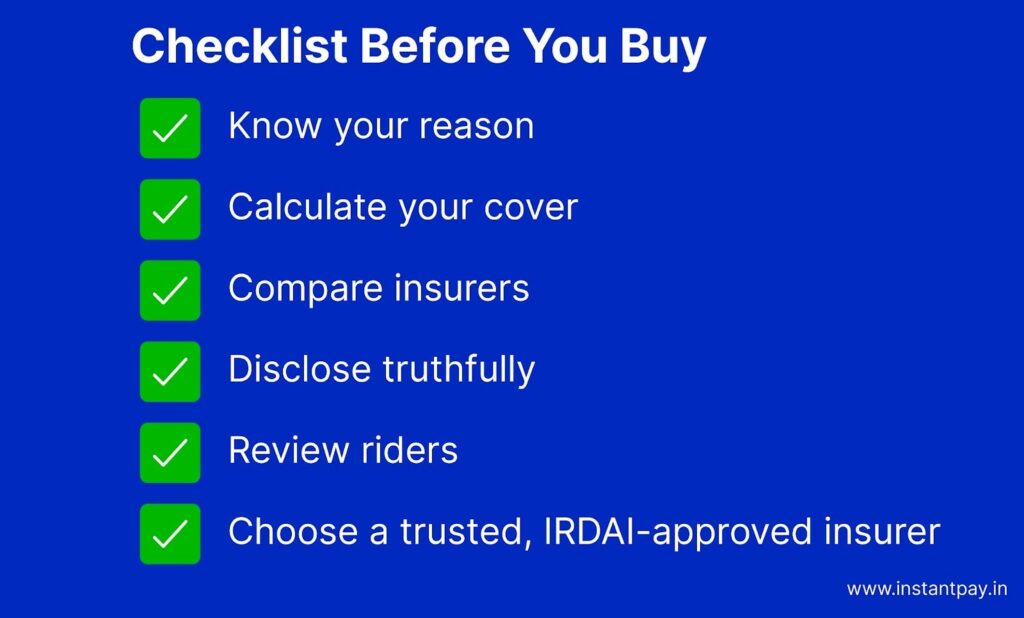
To assist you in making the best decision regarding your term insurance needs, we have compiled an easy-to-use checklist that will allow you to quickly evaluate your coverage needs, the coverage ratio, and your current term insurance coverage option.
Last, to make the best decision regarding your term insurance needs, please do not rush into your decision; by doing so, you will find ultimately, it will cost much more.
FAQs
1. What does term life insurance mean?
Term life insurance is a type of life insurance that provides monetary support for a fixed period of time. If the insured person dies during that time period, their designated beneficiary receives the value specified in the policy (the “sum assured”). If the insured person survives the term, there will be no benefit paid out at the end of the policy, nor will there be an investment return.
2. What are the four kinds of term life insurance policies?
There are four different kinds of term life insurance policies:
Level Term Insurance – at the same price you will receive the same amount of money if you die within the term as well as at the end of the term.
Increased Term Insurance – the amount you would receive if you died will increase each year, typically because of inflation.
Decreased Term Insurance – the amount you would receive if you died will decrease each year, usually because the amount of liability you owe (in the form of loans, and so on) will decrease over time.
Term Insurance with Return of Premium – if you die before the end of the term, your premium (the amount you paid into the insurance policy) will be returned to you.
3. Is LI or term life insurance better?
LIC has two kinds of insurance products; traditional and term insurance. How LIC stacks up against private insurance carriers is determined by how much premium they charge, how likely they are to pay out a claim for each dollar of premium, and other additional benefits included in their policies. Private insurance carriers tend to have lower premiums and have more flexible options available to their customers; however, you can also expect to find that LIC has been around longer and has built a substantial amount of trust.
4. Is ITR necessary for term life?
While not absolutely required by the insurance company, some may require ITR or proof of income for individuals purchasing a high-value life insurance policy. This is done to determine if you have a stable, verifiable source of recurring income.
5. Can a homemaker obtain term insurance?
Yes, a homemaker may purchase a term insurance policy. Many insurance companies provide specialized term insurance plans for homemakers as long as the homemaker has made, or will make, a contribution toward the family budget.
6. How much income must I earn to qualify for a term policy?
There is not an absolute fixed income that must be met before you would qualify for a term insurance policy; however, the amount of insurance coverage requested is closely related to your income stream. For example, to qualify for coverage of $10,000,000, you would probably need to be able to demonstrate an annual income of approximately $1,000,000.
7. Will I need to undergo a medical exam before I may purchase a term insurance policy?
Medical history and/or medical examination results are usually required before being approved for a term insurance policy; however, the need for a medical examination is usually only required for significant insurance purchases and for applicants who may be older than average. A medical examination may include blood tests, ECGs, etc. to assess the eligibility of the applicant.
8. Am I able to purchase a term insurance policy if I am unemployed?
As long as you can provide verifiable documentation supporting your income, you will typically qualify for a term insurance company; however, if you have no disclosure of income, this will limit the amount of life insurance you will be eligible to purchase, depending on your financial capacity.