When you purchase health insurance in India, it can be confusing to navigate the terminology, avoid hidden pitfalls, and find coverage that is appropriate for your needs. This could lead you to enter a policy thinking you are fully covered, only to find out you are not when it comes time to submit a claim.
By providing a comprehensive guide that breaks down the most important features of health insurance policy, briefly describing the feature, providing real-life examples, and providing India’s insurance regulatory authority statistics. We can help you choose your health insurance wisely and avoid many of the common pitfalls.
Co-payment Clause: Hidden Costs in Plain Sight
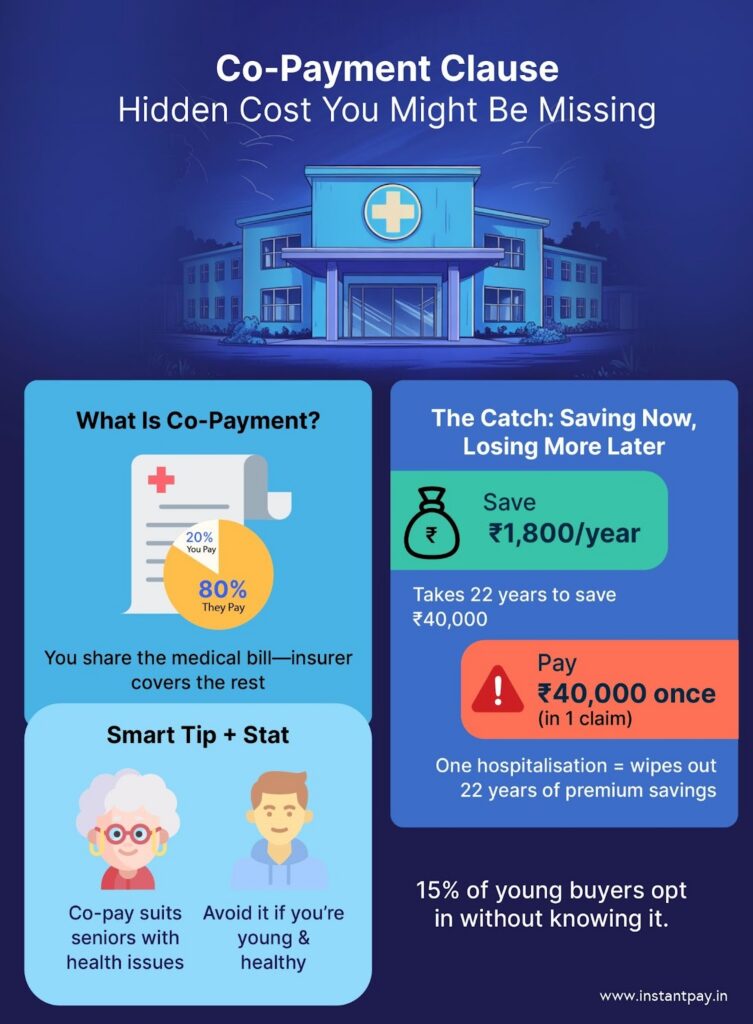
Scenario:
You purchase a health insurance policy with a sum insured of Rs.5 lakhs and a 20% co-payment clause to save Rs.1,800. If you were to incur an expense resulting from an accident of Rs.2 lakhs, you would have to pay Rs.40,000. You would have to wait over 22 years to recoup that expense through premium savings.
Insight:
Most senior citizen policies typically include a co-payment clause, which lowers premiums but increases the out-of-pocket expenses when making a claim. Younger buyers are typically able to use a co-pay option only when it is to keep their premiums affordable, and they would not want to use the co-pay if it will be so as to avoid even greater long-term risk.
Recommendation:
Do not voluntarily choose a co-pay unless you are purchasing insurance for senior citizens or those who have pre-existing conditions, and the premiums for those individuals are outside your financial scope.
Room Rent Limits: The Silent Budget Killer
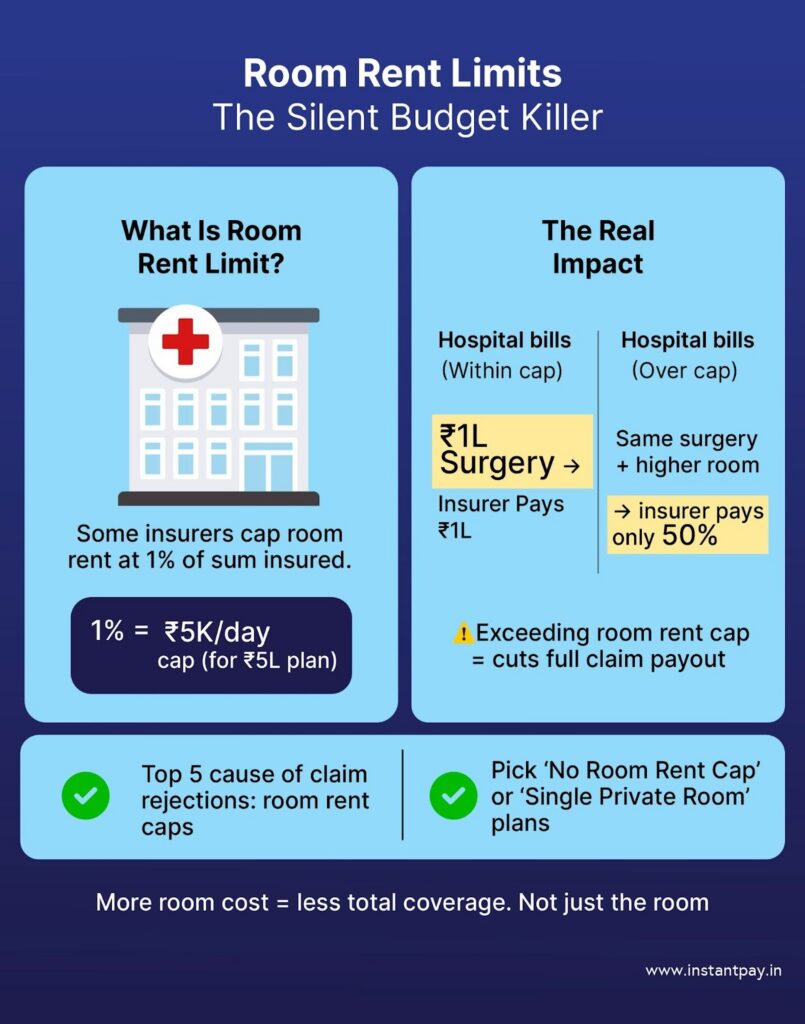
What It Means:
Usually, your insurer will limit the room rent to 1% of your sum insured, which will proportionally restrict your other hospital service coverage (like doctor fees, surgeries, etc.).
Example:
If your sum insured is Rs.5 lakh with a 1% room rent limitation (i.e., Rs.5,000 per day) and you are requesting a room that costs Rs.10,000 per day, the insurer will pay only 50% of the total bill—not just the additional cost of the room.
Insight:
According to the Insurance and Financial Regulatory Authority of India’s (IRDAI), Capping of the room rent limit is one of the five main reasons for rejection of Partial Claims.
Recommendation:
You should try and find a plan that does not have any room rent limits or one with “single private room with no limit” options.
Disease-wise Sub-limits: The Half-Cover Trap
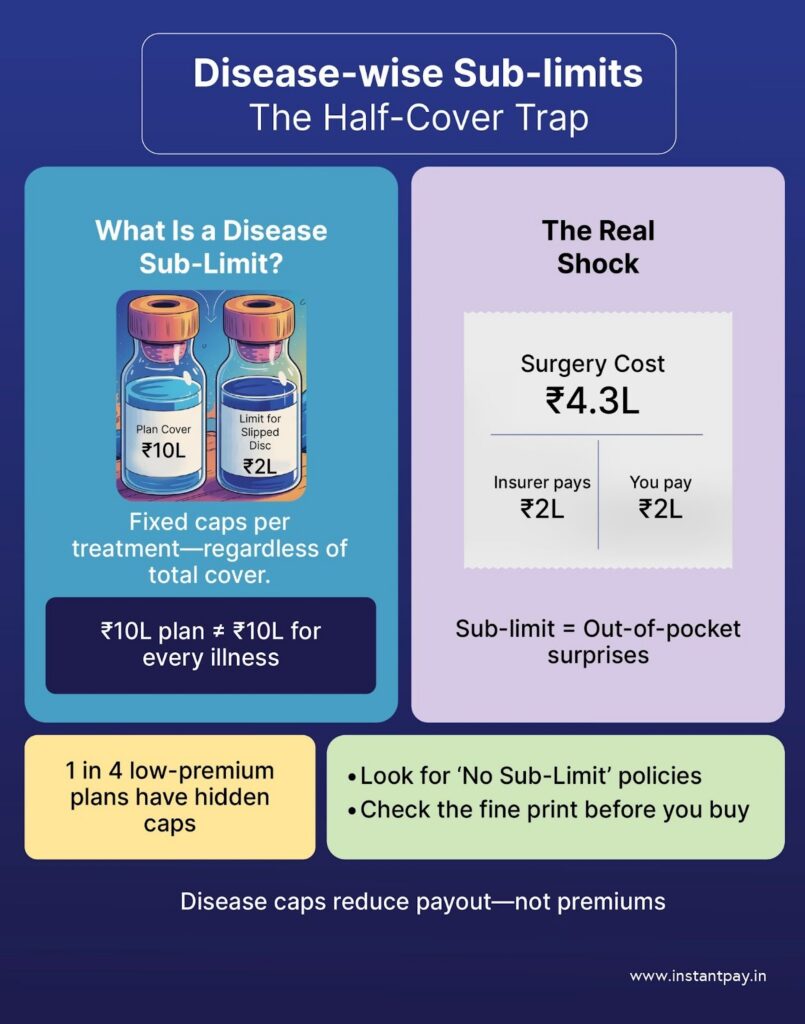
What It Means:
Most treatment plans will have specific limits for specific treatments, regardless of your total sum covered.
Example:
If you have a Rs.10 lakh plan to cover your medical expenses, only Rs.2 lakh of your plan will cover the treatment of a slipped disc, which costs Rs.4.3 lakh, because of the sub-limit for disease.
Insight:
According to NITI Aayog, entry-level individuals in the population are experiencing the most catastrophic costs for their family healthcare insurance due to both high out-of-pocket expenses and low financial protection, which result from the confusing characteristics of healthcare insurance plans, such as co-pays, deductibles, and sub-limits.
Recommendation:
Always check your brochure and policy wording for any sub-limits. It is better to buy a policy that has “no disease-specific capping.”
Waiting Periods for Pre-existing Conditions
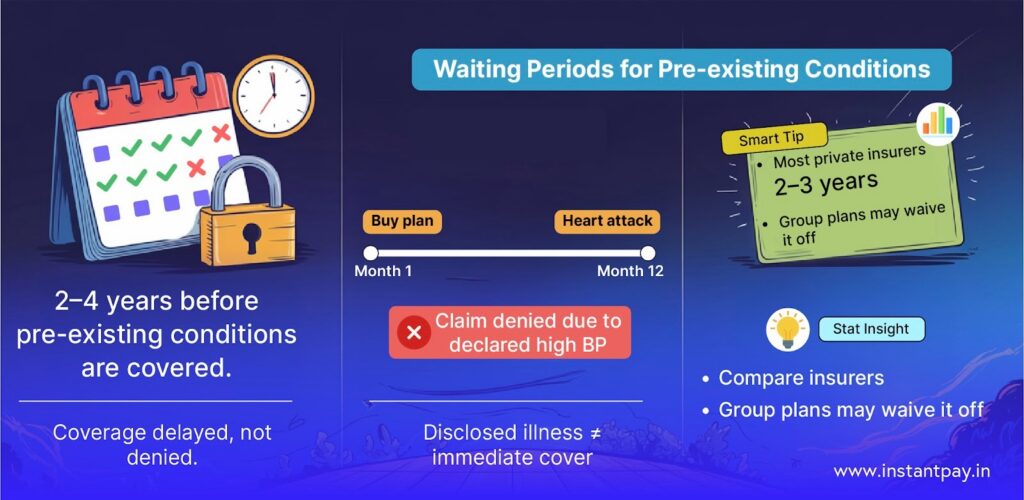
What It Means:
“Waiting period” refers to the period of time (generally 2 to 4 years) that you need to wait for pre-existing conditions (like diabetes, hypertension, etc.) to be included under cover by a health insurance policy.
Example:
If you have high blood pressure (BP) that is not declared and suffer a heart attack within 12 months of purchasing a policy, the insurer will deny your claim, stating that it is related to your undeclared BP, and you will be responsible for the entire cost of your treatment.
Insight:
The IRDAI requires all insurers to disclose their respective waiting periods, but a lot of private insurers have waiting periods of 2 to 3 years, and some group policies have no waiting period at all.
Recommendation:
You should compare the various insurers’ waiting periods; the shorter the waiting period, the better. With pre-existing diseases, you should seek plans with the shortest waiting period clause possible.
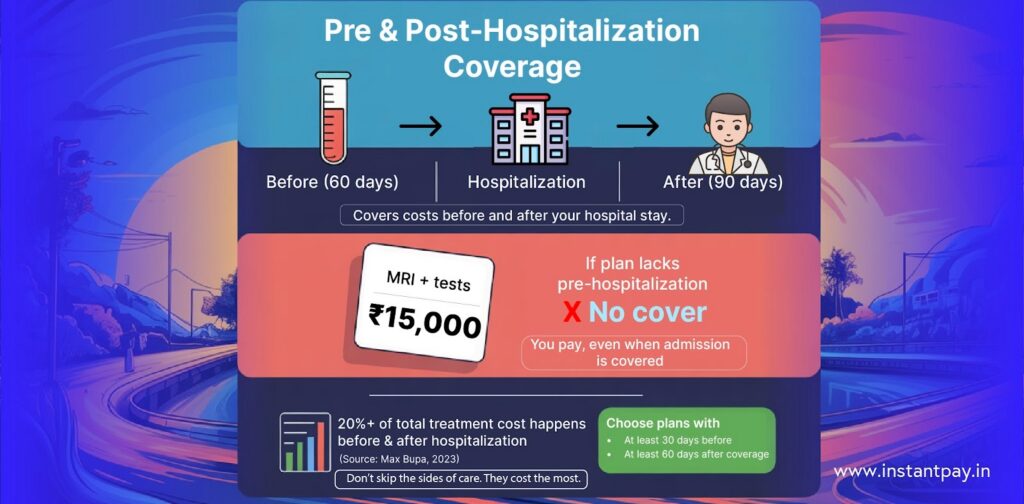
Pre & Post-Hospitalization Coverage
What It Means:
Provides coverage for tests, consultations, and medications that are incurred before hospitalization and after discharge, typically up to 60 and 90 days before and after hospitalization, respectively.
Example:
An MRI and other laboratory tests are conducted for Rs.15,000 prior to hospitalization. If you don’t have pre-hospitalization cover as part of your policy, this pre-hospitalization cost will be solely your responsibility as long as you have been hospitalized for the illness.
Insight:
Many comprehensive policies these days offer pre-hospitalization cover for 30-60 days and post-hospitalization cover for 60-90 days, acknowledging that treatment costs extend well beyond the period of hospitalization and into the pre- and post-periods.
Recommendation:
Always choose a plan that has at least 30 days of cover before the date of hospitalization and 60 days of cover after the date of hospitalization.
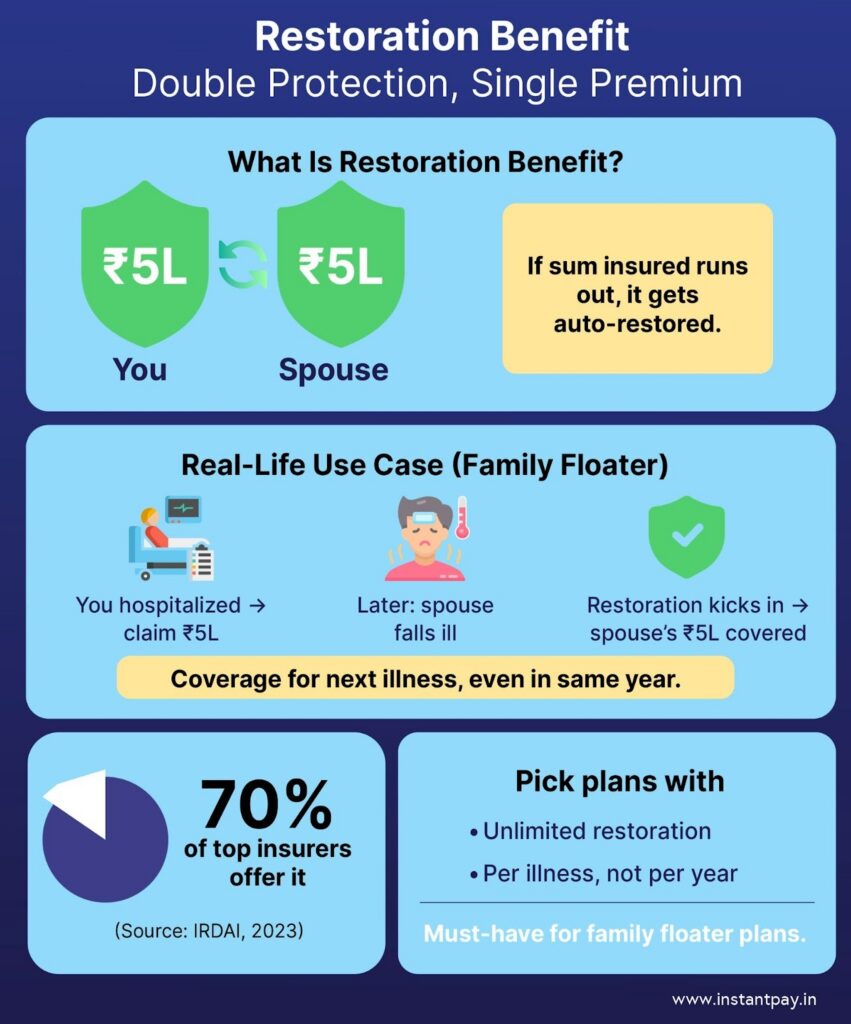
Restoration Benefit: Double Protection, Single Premium
What It Means:
‘Restoration’ allows you to resume coverage after using it originally for other unrelated medical treatment.
Example:
If you were to use your insurance benefit of your Rs.5 lakh floater plan to take care of you and your spouse needed treatment a few months later, you would have a remainder to continue your coverage (restored coverage).
Stat Insight:
Only about 70% of the large private insurers in India provide some type of restoration benefit per rule and there are different rules regarding how many times per year the benefit is restored.
Recommendation:
Make certain that you have unlimited restoration benefits and/or restoration benefits of each instance when someone in your family has incurred medical costs under your floater policy.
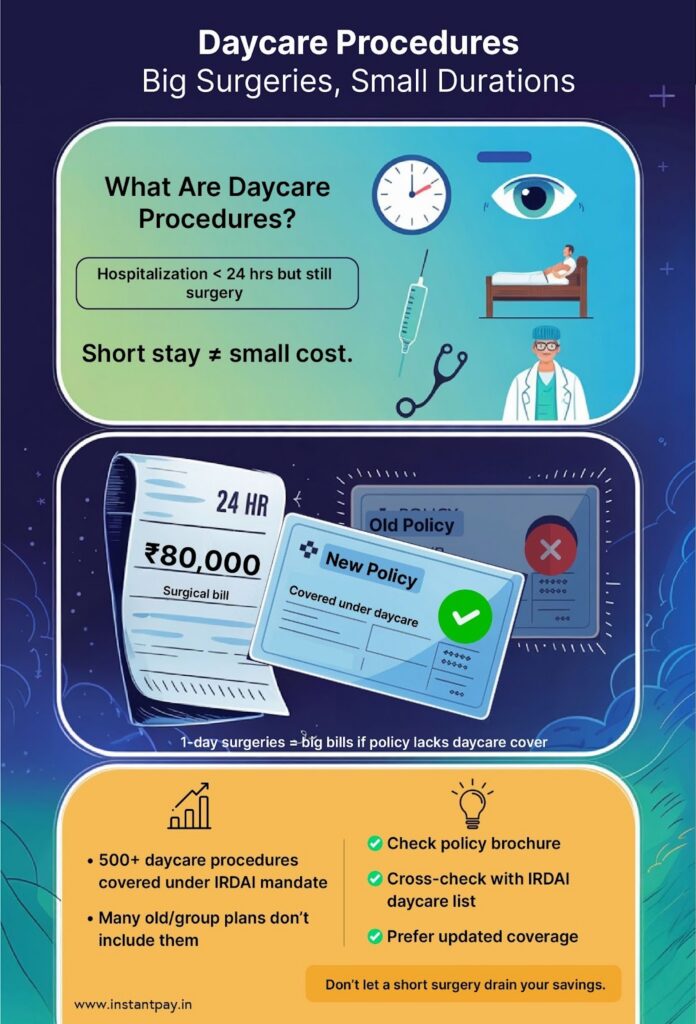
Daycare Procedures: Big Surgeries, Small Durations
What It Means:
Treatments such as cataract, chemo, or appendectomy qualify as daycare and take less than one full day to receive at the facility but will require an overnight hospitalization.
Example:
An Rs.80,000 appendectomy done the same day isn’t covered by old policies without daycare cover.
Stat Insight:
None of the older policies or group policies provided coverage for daycare treatments, even after the Indian Insurance Regulatory and Development Authority identified over 500 daycare treatments.
Recommendation:
Just as in finding out that you qualify for Restoration, ensure that your policy contains coverage for daycare. Also, confirm the coverage of your policy by checking with the official IRDA daycare treatment listing.
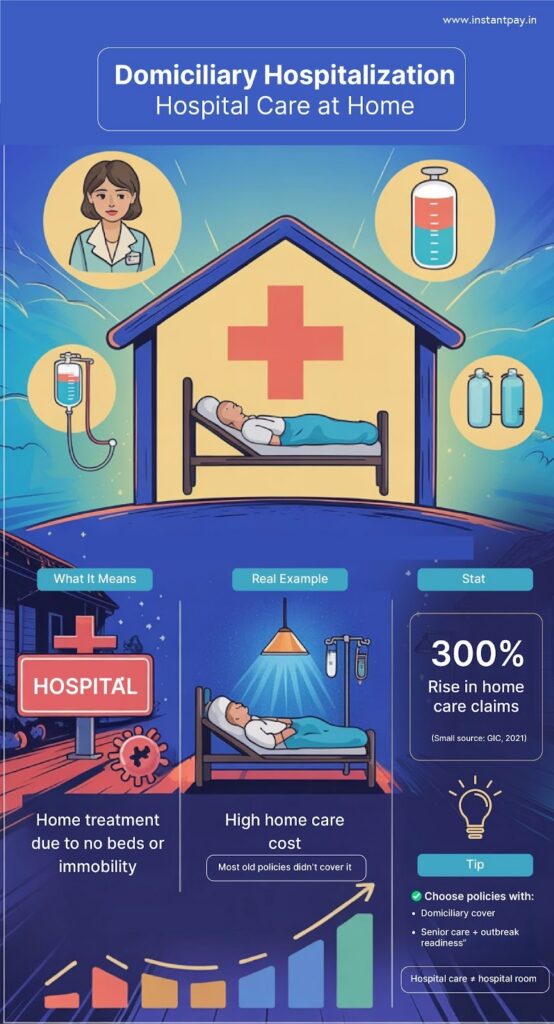
Domiciliary Hospitalization
What It Means:
Home treatment is an alternative to hospital treatment. For patients unable to be treated in the hospital due to lack of available beds or mobility, some policies may cover them.
Example:
During the peak of the COVID-19 pandemic, thousands were treated at home because there were no ICU beds available, and very few policies covered their high costs of treatment, including for oxygen, nurse care, and medication.
Insight:
Domiciliary Claims jumped over by 250% from before the pandemic to during the pandemic, Per the General Insurance Council of India (2021).
Recommendation:
Select an insurance policy that clearly states that domiciliary coverage will be provided, especially for seniors and when outbreaks occur, in order to avoid unexpected financial burdens.
No-Claim Bonus (NCB): Rewards for Staying Healthy
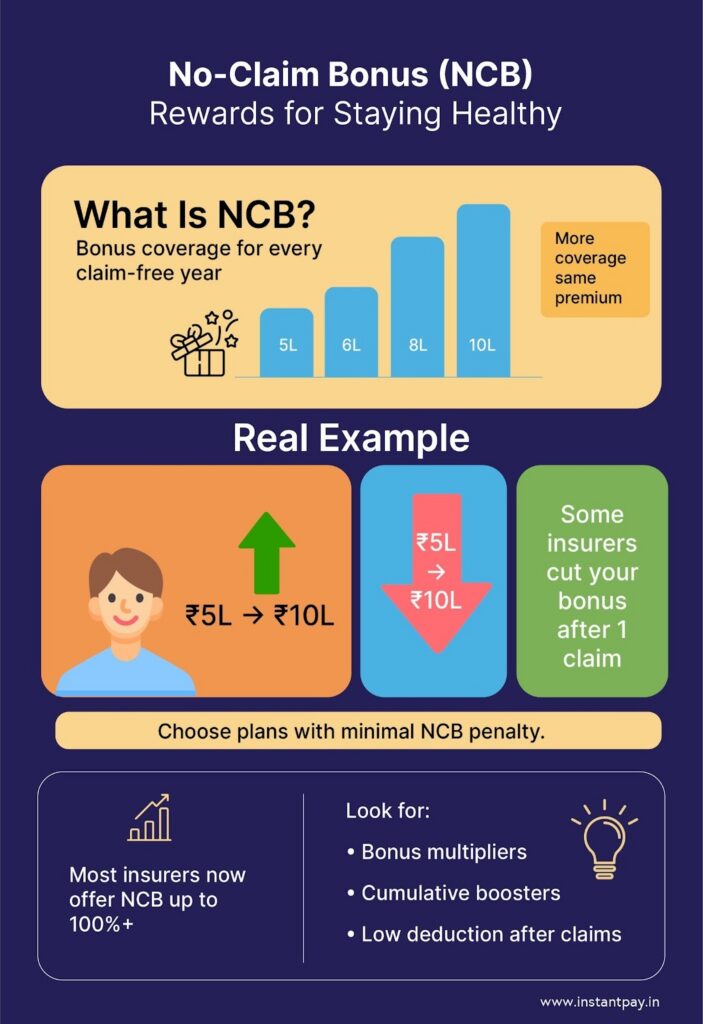
What It Means:
You get a 5%–50% increase in your sum insured for each claim-free year, usually up to 100%–150%.
Example:
Your Rs.5 lakh plan grows to Rs.10 lakh over 3 years of no claims—at the same premium.
Stat Insight:
Most private insurers now offer bonus multipliers or cumulative bonuses. However, some cut the bonus sharply after a claim.
Recommendation:
Look for policies with NCB up to 100% and minimal penalty after a claim.
Free Annual Health Check-ups
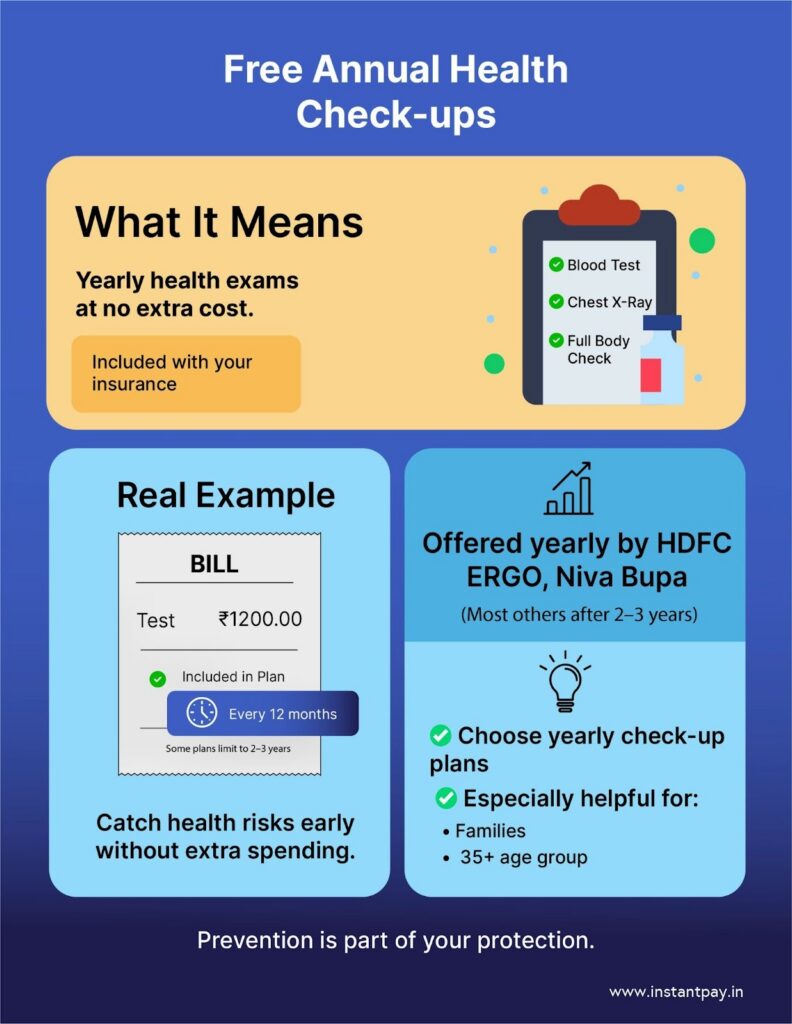
What It Means:
Many insurers offer complimentary health exams annually or biennially.
Example:
Full body tests worth Rs.1,200 included with your plan help you detect issues early.
Stat Insight:
Insurers like HDFC ERGO and Niva Bupa offer annual check-ups after 1 year, while others limit it to once every 2–3 years.
Recommendation:
Look for policies that offer yearly free tests—especially helpful for families and people aged 35+.
AYUSH Coverage (Alternative Treatments)
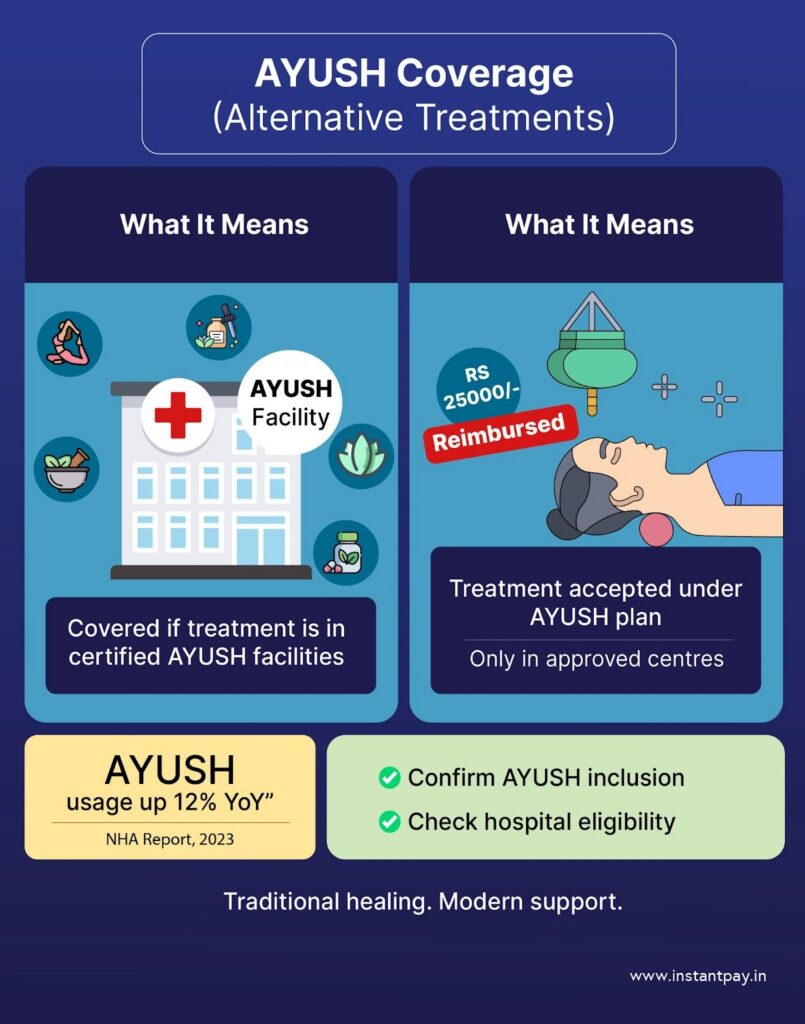
Some health insurance policies include AYUSH treatment coverage at certified facilities.
What It Means:
Policies are now covering treatments performed under Ayurveda, Yoga, Unani, Siddha, and homeopathy as long as they are performed in an accredited or government-recognized facility.
Example:
Your AYUSH Panchakarma treatment that was Rs.25,000 will be reimbursed, as it was performed in an accredited AYUSH hospital.
Stat Insight:
In India, in 2022-23, 53% of urban and 46% of rural residents sought out AYUSH treatment for the prevention or treatment of their ailments.
Recommendation:
Check that your plan provides AYUSH coverage and whether the facility is a certified AYUSH facility.
Maternity Benefits: Plan in Advance
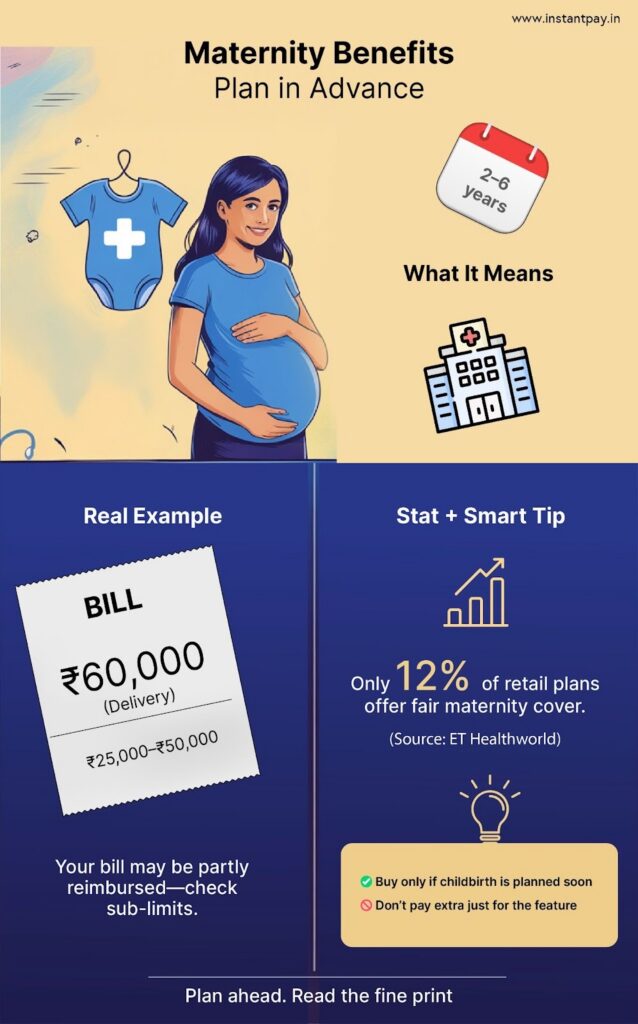
What It Means:
Some policies provide maternity coverage with a 2- to 6- year waiting period and may also cover newborn expenses.
Example:
If your plan reimburses some amount toward maternity costs, such as a total cost of Rs.60,000, there may be sub-limits ranging from Rs.25,000 to Rs.50,000.
Stat Insight:
According to ET Healthworld, only 12% of retail policies provide maternity coverage without a high premium or rider.
Recommendation:
Only purchase if you plan on having children within the next few years, and do not blindly purchase due to its popularity.
OPD Cover: Sounds Great, Often Isn’t
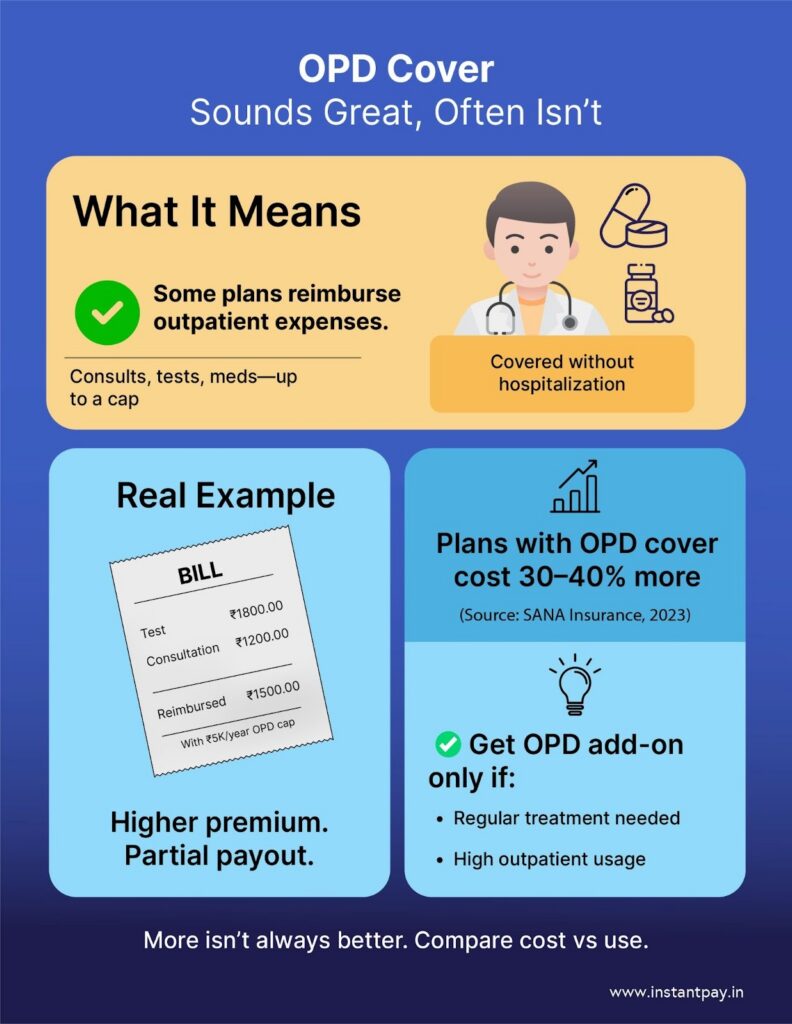
What It Means:
Some policies reimburse outpatient visits, physician consultations, medications, and diagnostics, not including inpatient hospitalizations.
Example:
You may spend Rs.1,800 on tests and Rs.1,200 on doctor consultation; you may receive a partial reimbursement from some policies.
Stat Insight:
Outpatient coverage costs 30-40% more than policies without outpatient coverage. Many policies only reimburse a maximum limit of Rs.30,000 per year.
Recommendation:
Consider costs and benefits, as premiums and costs of adding outpatient coverage may not offset any potential benefits if you have been treated in an outpatient setting very frequently.
Final Thought: Health Insurance Policy Isn’t just a product. It’s a Contract.
Insurance for health can provide you with protection from extremely high medical expenses, but many people will only look at the cost of the coverage and neglect to read the important details that are expressed in the document.
Specific features of an insurance policy, such as co-payments, room rent, waiting periods, and sub-limits, all have an impact on how much money will actually be paid by the insurer in a claim.
Before purchasing a health insurance policy, you will want to make sure you read the major sections of the document for coverage, limitations, and treatment exclusions.
Taking a few moments to read important sections of your health insurance policies today can save you significant amounts of money and anxiety going forward.
The bottom line is that the purpose of health insurance is to provide you with financial assistance from your health insurance carrier when you need medical care, which may require substantial amounts of money.
FAQs
1. What is co-payment in health insurance and is it good or bad?
Co-payment means you have to pay a part of the hospital bill yourself. It lowers your premium, but increases your expenses during a claim.
2. What happens if my health insurance has a room rent limit?
If you choose a room above the allowed limit, the insurer may reduce your entire claim, not just the room cost.
3. What are disease-wise sub-limits in health insurance?
These are limits on how much the insurer will pay for specific diseases, even if your total cover is higher.
4. How long is the waiting period for pre-existing diseases?
Usually, it is 2 to 4 years. During this time, claims related to existing illnesses are not covered.
5. What is a no-claim bonus in health insurance?
It is a reward where your coverage increases every year if you don’t make any claim, without increasing your premium.