Convenience is the new king, with all this convenience residing in our pockets as a result of the mobile economy! In fact, 85.5% of Indian households now own at least one smartphone, making mobile devices the primary channel for digital payments and services.
Today, there are more than 1.2 billion mobile users in India, and over 80% of digital transactions are made on mobile devices (Source: RBI, FY24). This makes mobile payment gateways an unsung champion of everyday commerce, from a cappuccino at Rs. 150 to a last-minute flight at Rs. 15,000. Each payment experience (from authentication to confirmation) takes just seconds to complete. Also, India’s mobile payments ecosystem continues to surge, with updated FY25 RBI data showing UPI handling 84% of retail volumes and total digital transactions reaching 221.9 billion (up 35% YoY).
Why Mobile Payment Gateways Are Essential?
- Adoption of mobile payment gateways via several different applications will continue to rise—prime examples being food delivery applications (Swiggy, Zomato) and ride-hailing applications (Ola, Uber)—enabling consumers to achieve an effortless and fully integrated “one-click” checkout experience. UPI accounts for around 85% of India’s digital payment transactions, highlighting the dominance of mobile-first payment systems.
- Payment technology will also further enhance the ways in which consumers can securely and quickly make payments through the use of advanced technologies such as device fingerprinting, two-factor authentication via one-time password (OTP), tokenization, and regulatory limits applied to transactions by the Reserve Bank of India (RBI).
- As a result, these new types of mobile payments will not only benefit consumers but also empower small retailers (Kirana) across the country to use their smartphones as if they were a portable Point of Sale (POS) system equipped with a QR code
Did You Know?
- 72% of Indian smartphone users prefer digital wallets over card swipes for under-500 transactions. (Source: Redseer Consulting)
- India saw over Rs.4,000 lakh crore in total digital transaction value in FY24—mobile being the dominant channel. (Source: RBI)
Let’s dive into how these digital wonders are optimizing transactions for busy folks like us.
The Evolution of Mobile Payment Gateways: From SMS to Seamless Taps
ITo stay competitive in today’s digital economy, it is essential for businesses to offer more than just convenience—they must provide an experience that meets the expectations of their customers. Customers today expect their transactions to be fast and easy, and they want to be able to make these purchases with a single tap of their smart device—whether ordering takeout food, reserving a ride share, or purchasing groceries. So, how did we reach this point?
Let us examine how mobile payments began, as well as its evolution from simple sent money via SMS to the secure, intelligent tokenized payment systems that exist today.
A Brief History of Mobile Payment Gateways
In the late 1990s, when the first mobile phone was introduced as a communication device, the notion of utilizing this device as a means of transferring money was considered far-fetched, although foundational work was done during that timeframe.
Key Milestones in Mobile Payments:
2016 – Present Mobile Payment Gateways-line – The introduction of UPI (Unified Payment Interface) has transformed the mobile payment landscape in India, enabling 24/7 instant transfers of money using mobile banking. The scale of UPI adoption highlights this transformation. In October 2024 alone, UPI processed more than 16.5 billion transactions, and monthly transactions crossed 21.6 billion by late 2025, making it one of the world’s largest real-time payment networks.
2001 – Mobile Payment Gateways-line – Finland began using SMS (text messaging) as a method of transferring funds to use for acquiring ringtone and purchasing fare tickets on the public transportation system.
2007 – Mobile Payment Gateways-line – Apple paved the way for app ecosystems by launching the iPhone, marking the midway point for the introduction of digital wallets.
2011 – Mobile Payment Gateways-line – In the United States, the launch of Google Wallet provided a method for transferring funds using NFC (near-field communication technology).
2014 – Mobile Payment Gateways-line – The launch of Apple Pay introduced a biometric method of securing payments using the fingerprint of the individual making the purchase, revolutionizing the way mobile wallets are secured.
Fact: In 2023, over Rs.137 lakh crore worth of transactions were conducted via UPI, with 82% initiated via smartphones. (Source: NPCI Annual Report 2024)
Key Players in the Market Reshaping the Mobile Payment Ecosystem
Today, global and Indian players compete in a high-volume, high-trust environment by offering speed, user experience, and layered security.
| Player | Launched | Unique Feature | Monthly Active Users (Est.) |
| Apple Pay | 2014 | Biometric + device-linked tokenization | 500M+ |
| Google Pay | 2011 | Peer-to-peer & in-store payments | 1B+ |
| PayPal | 1998 | Trusted cross-border payments | 430M+ |
| Samsung Pay | 2015 | Works with MST & NFC terminals | 100M+ |
Today, global and Indian players compete in a high-volume, high-trust environment by offering speed, user experience, and layered security.In India’s UPI ecosystem, market concentration is high. PhonePe, Google Pay, and Paytm together process over 87% of UPI payment volume, demonstrating the importance of platform ecosystems in shaping digital payment behavior.
Disruptive Startups:
- Square: Offers mobile POS systems with card readers for SMBs
- Venmo: Popular for peer-to-peer transfers among Gen Z and millennials
- PhonePe & Paytm (India): Dominate UPI-based payments with value-added services like bill payments, insurance, and investments
Fact: As of April 2024, Google Pay and PhonePe together processed over 65% of UPI transactions in India. (Source: NPCI)
Technology Driving the Mobile Payment Revolution
Wireless communications, encryption, and authentication protocol advancements have quickly evolved mobile payment gateways.
Core Technologies that Power Mobile Payments:
- NFC (Near Field Communication) – Makes it possible for two devices to experience “tap-and-go” enabled, contactless payments. According to Statista, 90% of the world’s contactless payments occur using NFC.
- Tokenization—Takes card data (PAN) and replaces it with a unique token that is worthless to an intruder if intercepted. From October 2022, tokenization must be followed in all electronic transactions conducted in India as specified in the Reserve Bank of India guidelines.
- Biometric Authentication—The use of fingerprints and facial recognition has dramatically reduced fraud caused by lost and/or stolen passwords. According to Juniper Research, biometric payment solutions will reach $3 trillion globally by 2025.
- QR Codes & UPI—QR code-based payments enabled by the UPI platform have democratized mobile payment solutions in India—enabling much smaller retail businesses the ability to accept mobile payments (over 250 million QR cards are currently active in India as of Q1 2024, according to the NPCI).
- Blockchain (up-and-coming) – Provides a distributed and unalterable record of transactions; while still evolving, it has the potential for rapid, low-cost international money transfers with high security
Benefits of Mobile Payment Gateways: Why They Matter in 2025 and Beyond
Both the technology and business sectors are changing how consumers around the world transact with a wide variety of business types through digital payment methods.
The magnitude of this change can be understood through National Payment Statistics, as digital payment transactions in India surpassed Rs. 1,572 lakh crores in early 2025, thus emphasizing the enormous economic impact on the global economy that mobile-first financial systems will enable.
Mobile payments are majorly providing financial convenience, cost-effectiveness, and exceptional customer experience; this will continue in India as mobile payments alone totaled more than Rs. 137 lakh crores during FY24 (Source: RBI).
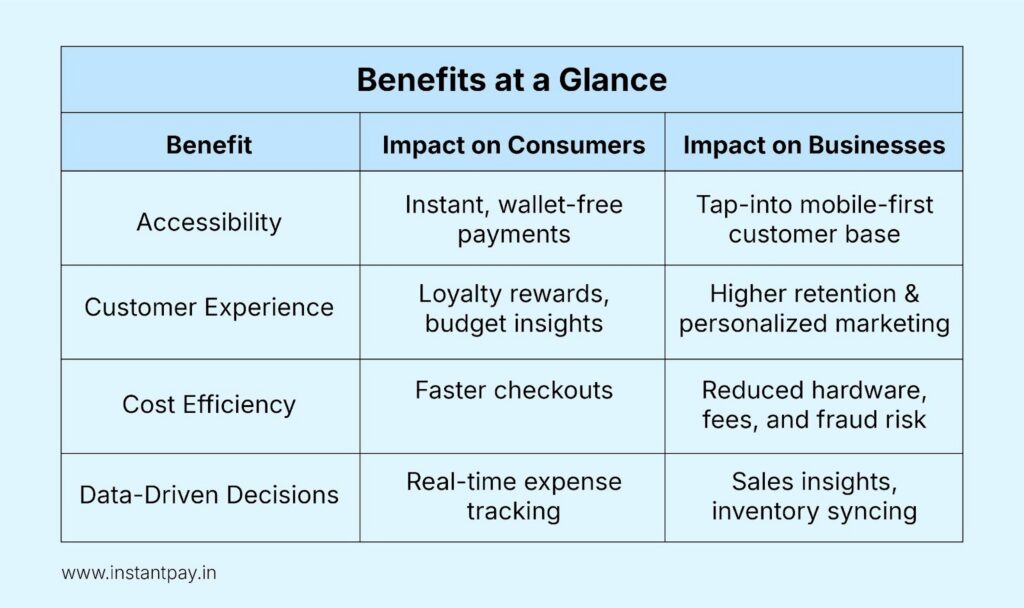
1. Accessibility for On-the-Go Customers
Being accessible is a given today, and with the rise of mobile as number one in the customer’s hand, mobile payments give consumers the ability to transact anywhere at anytime. India recorded over 18,000 crore digital payment transactions in FY 2024–25, driven primarily by UPI and mobile wallets
When booking a ride through Ola, ordering coffee using Swiggy, paying bills using PhonePe, a customer is able to use their mobile gateway or app for payments.
- A mobile wallet such as Paytm or Google Pay allows a customer to consolidate their cards, loyalty points, and coupons into one application without needing to carry a physical wallet or cash with them.
- The rise of contactless QR code payments has empowered small vendors at retail stores to accept mobile payments instantly.
Stat: As of May 2024, UPI-based mobile payments transactions reached over 11.75 billion or around 85% of the total amount of digital payments made within India (Source: NPCI).
How do mobile payment gateways improve accessibility?
They enable quick, wallet-free transactions from any location using smartphones or apps.
2. Enhanced Customer Experience
Mobile payment gateways not only provide a method for payment processing but have also changed how consumers experience the goods and/or services they purchase according to their lifestyle.
- Seamless UI/UX within the app/website eliminates friction in the checkout process for a consumer which results in a decreased cart abandonment rate.
- Instant notifications of spends, spending history, and categorized expenses help the user manage their finances.
- Loyalty integrations and personalized promotions promote interaction with the brand and encourage repeat purchases by consumers.
Fact: Businesses experienced an increase in repeat transactions of between 20% and 30% due to loyalty integrations and more efficient consumer interactions (Source: McKinsey Digital Payments Report, 2023).
What features of mobile payments enhance customer experience?
Fast checkout, real-time spending alerts, loyalty rewards, and intuitive interfaces.
3. Cost Efficiency for Businesses
For merchants, mobile payment gateways do not only provide quicker payment processing; they also improve operational efficiencies providing a higher return on investment.
- Mobile payment transaction fees are generally lower than those charged from traditional point of sales systems especially when accepting UPI and/or wallet payments.
- Mobile payments allow merchants to eliminate the need for dedicated card readers as smartphones or tablets can be used to process mobile payments.
- Mobile payments reduce fraud and chargebacks through the use of advanced encryption methodologies, biometric verification and tokenisation.
- Mobile payments streamline the operational efficiency of the retailer by providing access to real-time sales analytics, integration with inventory and a quicker queue turnover.
Fact: Merchants adopting mobile payment solutions reported a 40% increase in the speed of checkouts and an infrastructure cost decrease of approximately 15%-20% (Source: Deloitte Study).
How do mobile payment gateways save costs for businesses?
They reduce hardware needs, cut fees, prevent fraud, and speed up operations.
Future-Proofing Through Mobile Payments
5G, AI analytics and B2B blockchain payment technology are changing rapidly, resulting in mobile gateway technology providing enhanced opportunity for value creation. By adopting mobile gateways today, businesses could gain first-mover advantage through developing loyalty among early adopters, gaining more significant data insights, and having an integrated omnichannel experience.
Market Opportunity – By 2026, India’s mobile payments market will exceed $500 billion in annual transactions (PhonePe-PwC Digital Payments Report).
Security Features of Mobile Payment Solutions: How Your Data Stays Safe?
As mobile payments have grown with digital commerce, security is becoming the lynchpin of trust itself. In FY24, India processed Rs. 4 trillion in total digital payments of which 85% were mobile device initiated according to RBI, and therefore reliable security mechanisms for mobile payment systems are no longer optional; they are mandatory.
Enterprise-level security is given to both daily and high-value transactions undertaken through mobile payment systems through the whole transaction process, from electronic points of sale to merchants.
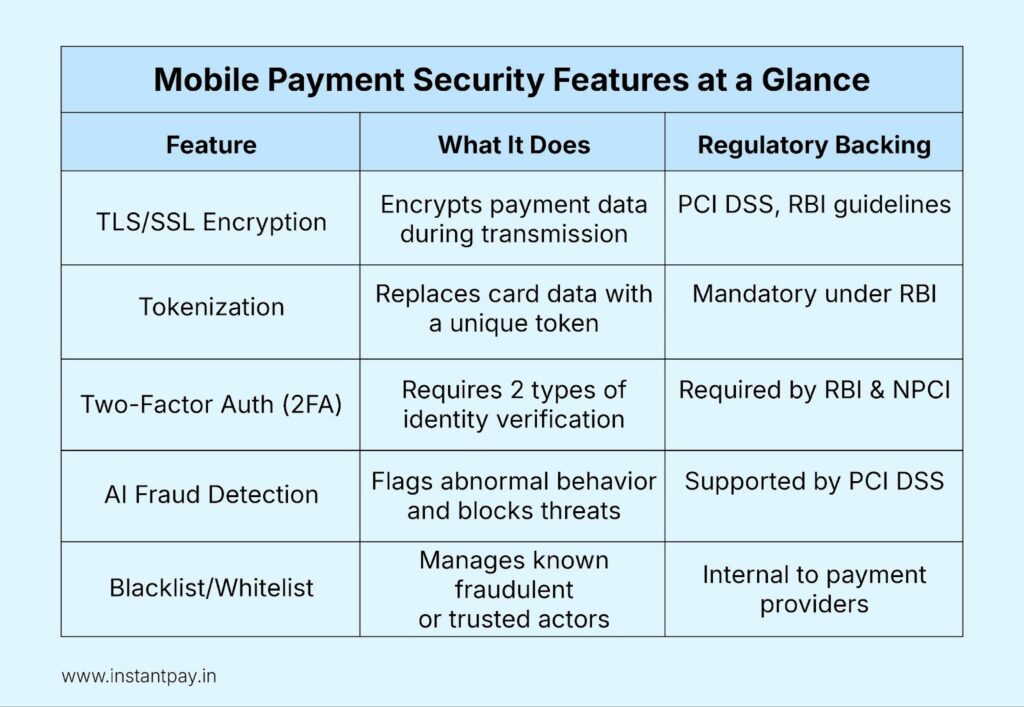
1. Encryption and Data Protection: Your First Line of Defense
Encryption is used to create unreadable data from sensitive data sent to and coming from the user during the transmission of digital payments, which makes it next to impossible for hackers/cybercriminals to intercept or decrypt sensitive data.
Technologies Used:
- The use of TLS (Transport Layer Security) and SSL (Secure Socket Layer) is how messages are encrypted and transmitted from the user’s mobile payment device to the payment processor.
- The encryption standard that is used in the industry is 256-bit, and no one has yet been able to obtain real encrypted data using brute force, meaning that even if a hacker/cybercriminal were to try to brute force their way through encrypted sensitive data, it would take them an extremely long time as a result of the controls that are in place to encrypt sensitive data pre- and post-transmission.
Stat: A survey found that 94% of all fintech companies in India currently use TLS encryption to keep their digital payments safe (PwC Fintech Survey 2023).
Tokenization: An Added Layer
Tokenization takes the actual card number and replaces/obscures it with a random number/token, and as such, cannot be exploited if intercepted.
- Starting in October 2022, Indian merchants have been required to tokenize all transactions. In accordance with the RBI guidelines, a merchant must not retain any card number data.
Fact: Transactions that have been tokenized experience a 20% reduction in fraud when compared to transactions that are not tokenized (Visa Security Report 2023).
2. Two-Factor Authentication (2FA): Double the Protection
The use of 2FA creates a second layer of verification of the user prior to completing the transaction.
How 2FA Works:
User authentication: (something the user knows)
User verification: (something the user has)
User Authentication
An example of the User Authentication process that the user goes through would be to enter a User ID and Password/PIN.
User Verification
An example of the User Verification process for the user would be to receive a one-time password (OTP) to a device endorsed by the user via text message or email or to use a biometric method like fingerprint or facial recognition (other methods such as voice print, retina scan, etc. may be used depending on the technical capabilities of the transaction infrastructure).
As finance transactions are required to use 2FA in India per the RBI, both CNP and UPI transactions must have 2FA in place .
Benefits:
- Preventing unauthorized access or fraudulent activity by users whose accounts have been compromised,
- Increased consumer trust with mobile payment transactions,
- Reduced likelihood of phishing and SIM-swapping crime.
Why is 2FA important in mobile payments?
It adds a second verification layer, making unauthorized access highly unlikely—even if login credentials are stolen.
3. Risk Management & AI-Driven Fraud Detection
The risk management tools allow for the continuous inspection of transactions in real-time to identify suspicious behaviour. Some examples of these tools would include the following:
- Machine-learning Algorithms are used to establish behavioural profiles of users so they can be analysed for unusual activity (for instance, if a user made a purchase from an area other than their own).
- Velocity Checks enable to detect if there are multiple transactions being made at high speed to/from the same user (or IP).
- Geolocation Monitoring will determine if any access requests are from devices/locations that have not been previously identified.
- Blacklist and Whitelist systems are designed to automatically prevent or allow access to certain users and/or geographic areas based upon their risk score.
Fact: Companies that use artificial intelligence (AI) to detect fraud will experience a decrease in chargebacks by more than 45% over the next 12 months (source: McKinsey Digital Payments Report 2023).
How do mobile payment systems detect fraud?
They use AI, geolocation, and pattern recognition to flag unusual behavior and prevent unauthorized transactions.
Integration with Mobile Apps and Wallets: The Core of Modern Digital Payments
According to the RBI report regarding the number of digital transactions processed by India (Rs. 18 lakh crore in a single month), it is apparent that the addition of mobile payment gateways into apps & wallets has become necessary rather than optional. With an RBI Digital Payments Index rating of 465.33 in 2024, this demonstrates a great deal of consumer and merchant support for the digital payment infrastructure.
From food delivery to ride-hailing to global e-commerce, seamless integration will provide fast, secure, and user-friendly experiences each time a user taps on their phone to pay for something.
Seamless User Experience: The New Benchmark
Mobile app and wallet integration provide users with the ability to check out with little friction. This is accomplished by decreasing the number of clicks needed, lowering the total processing time, and allowing users to make payments in a matter of seconds.
Key Features Driving UX Excellence:
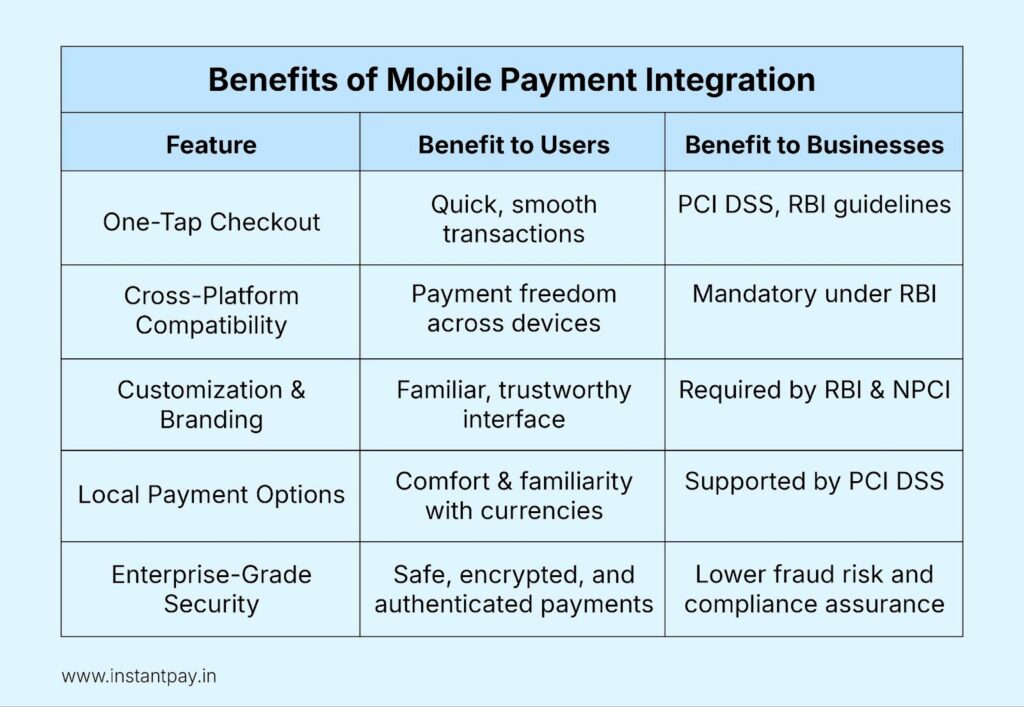
- One-Click Purchase: With Apple Pay, Google Pay and Paytm, you can pay with just one touch.
- In-App Wallets: As with Zomato, Swiggy, Ola and Flipkart, these apps provide integrated payment processes so that users do not have to be sent away from their app to make a payment.
- Biometric Security: Using Touch ID and Face ID allows users to access their accounts quickly and safely.
Fact: Did you know that businesses that have made mobile checkouts easier report a 35% drop in abandoned baskets? (Source: Baymard Institute, 2023)
Why is mobile app integration important in payments?
It creates a seamless, one-click payment experience with minimal friction and maximum convenience.
Cross-Platform Compatibility: Pay Anywhere, Any Device
Today’s consumers use multiple platforms; iOS, Android, Windows and Hybrid. For all of these different types of devices, the ability to provide a seamless payment experience requires a payment gateway that is fully integrated and provides cross-platform compatibility.
Benefits of Cross-Platform Integration:
- Providing a brand-consistent User Experience on Samsung, iPhone, tablets and desktops
- Providing browser-agnostic performance in Chrome, Safari, Edge and in app browsers
- Providing support for multiple SDKs/frameworks such as React Native, Flutter, and Kotlin, among others.
Stat: 73% of Indian smartphone users have more than one digital wallet app on their devices (Source: Redseer, 2024) making cross-platform compatibility one more way to set yourself apart from the competition.
What is cross-platform payment compatibility?
It ensures that mobile payments work smoothly across all devices, OS versions, and browsers.
Customization and Branding: Own the Payment Experience
Aside from functionality, integrating mobile payments allows for creativity as these integrations can reflect company brands in how they flow through the checkout and confirmation stages.
Tools That Enable Branding:
- White-label SDK and API — Create interfaces that allow your customers to see the same colors, typography, and tone as your application.
- Branded Receipts and Confirmations — Include your company logo, call to action, and custom message of thanks in receipt/responses to your customers after payment through the integrations.
- Localized Payment — You can accept local currency and methods of payment for international customers.
Fact: Companies offering localized payment options see up to 25% higher conversion rates when selling internationally. (Source: Shopify Globalization Report, 2023)
Example: A person shopping from France due to a D2C (direct-to-consumer) brand located in the U.S. can view all prices in Euros, select Apple Pay as their preferred method of payment, and see a user interface (UI) in French, as a result of integration features for such brands.
How does payment integration support branding?
It allows businesses to personalize checkout interfaces, enabling brand consistency and enhancing customer trust.
Security Isn’t Sacrificed for Convenience
Despite the speed and convenience that comes with using mobile app integrations, they continue to maintain enterprise-level security by following through on:
- Payment Card Industry Data Security Standards (PCI DSS)
- Tokenisation and encryption protocols
- Using biometrics and 2FA (two-factor authentication)
- Providing analytics of fraud in real time via risk engine integration
Stat: 91% of mobile payment app users residing in India believe that their payments using their mobile devices (mobile payments) are equally as secure or more secure than when they pay using payment cards (Source: PwC India Digital Trust Survey, 2024)
Future Trends in Mobile Payments
Mobile Payments: Mobile payments systems are growing rapidly in an ever-more connected world. What is the future of mobile payments? Let’s explore mobile payments using the following innovative trends.
AI and Machine Learning Integration
Artificial intelligence and machine learning are at the cutting edge of technological advancements and are changing the way we do transactions. Both AI and ML are providing new ways to process payments and creating new experiences.
– Detecting and Preventing Fraud: AI and ML can use large amounts of data to detect fraud through identifying previous activity patterns, which allows us to detect and act on fraud before it occurs.
– Personalizing the User Experience: AI will be able to personalize payment experiences based on users’ previous behaviors. Picture a shopping application showing you payment options that are tailored to how you have used that application before, making the checkout process completed in record time.
– Creating More Efficient Payments: Payment providers can optimize how long it takes to create transactions through predicting the actions and preferences of the user.
Biometric Payment Systems
Forget about forgetting passwords and PIN numbers, biometric payment systems will provide a more efficient way to pay by allowing the use of one’s body as identification. Biometrics will make the payment experience much smoother using unique physical characteristics (fingerprints, facial features, and voice) to identify a customer.
- Increased Levels of Security: To replicate a customer’s biometric markers is nearly impossible because they cannot be forged. This makes the biometrics opt to pay for something more secure than traditional methods of payment.
- Increased Ease of Transacting: The use of biometrics means that customers no longer have to struggle with their phones or remember their passwords to pay with their phones; they simply need to touch or look at their phones to authorize the payment, enhancing the convenience of mobile payments for busy customers.
- General Adoption: As biometric technology becomes more widely adopted, it will gain in popularity across an ever-expanding number of industries, from retail to hospitality, making it a common payment option for customers looking to use their mobile devices to pay.
Expanding Global Reach
Mobile payments influence how local businesses are doing business and growing the global market place to enable transactions by anybody, anywhere at any time.
Cross-Border Transactions: To expand their business internationally, more businesses are chasing business to business opportunities and as a result mobile payments are going to be a necessity to allow customers to pay for cross-border transactions. To accommodate payment across borders, payment gateways are creating new and more effective ways to manage multi-currencies while remaining compliant to local regulations.
Inclusive for Developing Countries: This allows businesses to expand into areas that were previously reliant on cash-based payment systems. Implementing mobile payment solutions gives emerging markets the ability to overcome the hurdles of traditional banking and experience all the advantages of digital payments which will drive further financial inclusion more than ever before.
Localized Payment Solutions: As payment methods continue to grow, they are becoming increasingly localized through collaboration with local payment companies and through developing product strategies that meet the unique cultural preferences of consumers in each region, by providing similar product features that will help enhance the overall payment experience of customers.
In summary, due to continued technological improvements and a succession of new innovations and developments in mobile payments, the mobile payment market will continue to grow. With the implementation of technological improvements and the use of technology such as Artificial Intelligence and biometrics, and the ongoing support of the development of global connectivity, mobile payments will not only remain safe, but also provide a simple payment experience to all consumers globally.
As the mobile payment market grows, all signs indicate that business will be transformed, and the world will become smaller and even more connected because of the improved experience for consumers who conduct business while on the go.
Conclusion
Today, any transaction made whilst on the move is a necessity in the fast-paced digital age. Mobile payment gateways are the cornerstone to providing customers a secure, efficient, and seamless payment experience, thereby improving the overall retail payment experience for each customer.
As businesses continue to satisfy consumer demand, they need to be more flexible in their strategies to create mobile-specific payment experiences. This means that businesses need to reach their consumers where they are (on their smartphones) and offer them convenient and secure payment methods.
Frequently Asked Questions (FAQ’s)
1. What is a mobile payment gateway, and how does it work?
A mobile payment gateway allows the customer to make a secure payment via smartphone using apps, wallets, or browsers and process payment transactions (i.e., conduct payment) in real-time.
2. Are mobile payment gateways safe to use in India?
Mobile payment gateways in India are very secure. Per the Reserve Bank of India (RBI), mobile payment gateways must use encryption, tokenization, and two-factor authentication (one-time password (OTP) and/or biometrics).
3. Which is the most popular mobile payment method in India?
In India, the most popular method of making a mobile payment is through UPI (Unified Payments Interface). UPI accounts for approximately 84% – 85% of digital transactions in India.
4. Can I make payments without a debit or credit card using my phone?
You can also make a payment using a UPI app, a mobile wallet (i.e., Paytm, PhonePe), or a bank app, without the usage of a physical card to make payment.
5. How fast are mobile payment transactions?
From authentication to confirmation, mobile payment processing generally occurs within seconds, making mobile payments perfect for fast payments on the go.
6. What technologies power mobile payment gateways?
Mobile payment gateways utilize several different technologies, such as NFC (tap to pay), QR codes, tokenization, biometric identification, and AI-based fraud detection.
7. Do mobile payment gateways work without internet?
Most mobile payment gateways will require access to the internet, but solutions such as offline UPI (UPI Lite or USSD-based payment) allow for payment acceptance without the need for active data.
8. Why are businesses shifting to mobile payment gateways?
Retailers choose to use mobile payment gateways because they help reduce overall exposure costs associated with payment acceptance, improve the speed of checkout processes, increase the satisfaction of the customer experience, and reduce the need for point-of-sale devices.
9. Can small retailers (Kirana stores) accept mobile payments easily?
Yes, small retailers will have the ability to instantly accept payments through the utilization of a QR code displayed at their location along with an internet-enabled smartphone—thereby converting their smartphones into mobile POS devices.
10. What is the future of mobile payment gateways in India?
In the future, mobile payment will incorporate AI-based personalization, biometric payments, the ability to process payments on a faster 5G network, and continued growth of cross-border and blockchain