Welcome to the evolving world of payment gateways. Here, finance and user experience come together for safe and quick transactions. India processed over 14.05 billion digital payment transactions in March 2025 (source: RBI). This highlights the importance of efficient payment systems today.
In our digital age, understanding new trends and technologies in payment gateways is essential. Whether you’re a fintech enthusiast, an e-commerce founder, or an online shopper, these changes are shaping how we pay and receive money.
Why should you care about payment gateway trends?
- Digital payments in India are set to exceed Rs.400 lakh crore by FY26 (Source: NPCI).
- A PwC report reveals that real-time payments in India make up over 46% of global transactions. This positions India as a leader in global payments.
- Mobile wallets are set to grow by 25.5% each year from 2023 to 2028. This growth will push payment gate
What’s Next in the World of Payment Gateways?
Let’s explore the future innovations and trends that are revolutionizing digital payments:
- AI and Machine Learning in Fraud Detection – AI-enabled payment gateways now prevent fraud with up to 99.5% accuracy, leveraging behavioral biometrics and real-time transaction monitoring.
- Tokenization and Enhanced Card Security – The RBI’s tokenization guidelines, enforced since October 2022, led to over 52 crore tokens being issued by mid-2024, drastically reducing card data exposure during online transactions.
- Embedded Payments and Invisible Checkout – Platforms are moving towards “no-click” payments, integrating checkout directly into the user journey, increasing conversion rates by 35% on average.
- Cross-Border and Multi-Currency Transactions – With global e-commerce booming, cross-border payments are expected to reach $250 trillion globally by 2027, making forex-friendly gateways a key innovation area.
- Voice-Activated Payments and Conversational Commerce – Enabled by AI assistants and UPI Voice, voice-based payments are predicted to process Rs.30,000 crore annually by 2027, especially benefiting Tier 2 and 3 cities.
- Buy Now, Pay Later (BNPL) Integration – BNPL is expected to grow by 25.5% annually, with payment gateways embedding credit-check-free EMI options directly into checkout flows
What is the future of payment gateways?
The future of payment gateways involves AI-powered fraud detection, tokenized security, invisible checkouts, cross-border support, voice payments, and integrated BNPL features—enabling faster, safer, and more user-centric transactions.
The Evolution of Payment Gateways: From E-Commerce Catalysts to Contactless Revolution
What is a Digital Payment Gateway?
A digital payment gateway is a tech platform that securely processes online payments between buyers and sellers. It acts like a point-of-sale terminal, encrypting sensitive financial data and allowing smooth transactions.
Did you know? In March 2025, India processed over Rs.14.05 billion digital transactions. This was driven by UPI, IMPS, and card payments. (Source: RBI)
How Did Payment Gateways Evolve Over Time?
From Simple Checkouts to Complex Platforms
The evolution of payment gateways spans three decades. They were first created to handle basic credit card payments for e-commerce. Early gateways faced challenges like fraud risks, limited scalability, and low consumer trust.
Fact: The global payment gateway market was valued at USD 26.79 billion in 2023. It is expected to grow to USD 67.52 billion by 2032 at a CAGR of 10.78%. (Source: Precedence Research)
Key Milestones in Payment Gateway Evolution
| Milestone | Year/Period | Impact |
| PCI DSS Standard Introduced | 2004 | Standardized global data security for card payments |
| Real-Time Payment Integration | 2010–2015 | Enabled faster and more reliable digital transactions |
| Mobile Wallet & UPI Adoption | 2016–2022 | Led by Paytm, Google Pay, PhonePe; expanded India’s digital payment base |
| Crypto Payment Support Emerges | 2020–Present | Enabled global, decentralized payment options in some ecosystems |
When did payment gateways become secure?Secure standards began evolving with the PCI DSS introduction in 2004, which mandated encryption, tokenization, and fraud detection protocols.
How E-Commerce Propelled Payment Innovation
Online Retail’s Impact on Gateway Technology
The rise of e-commerce—projected to cross $350 billion in India by 2030 (Source: IBEF)—has been the primary force behind payment gateway advancement.
During the COVID-19 pandemic, online shopping in India surged by 77%, pushing gateways to support:
- Digital Wallets: Used in 48% of e-commerce transactions in India (2024)
- BNPL (Buy Now, Pay Later): Growing at 25.5% CAGR
Subscription Payments: Fuelled by Netflix, Hotstar, Amazon Prime, Spotify, etc.
How did e-commerce change digital payments?
E-commerce drove gateways to diversify payment methods, enhance security, and enable auto-renewal billing for recurring services.
The Rise of Contactless Transactions
From Hygiene to Habit
The adoption of contactless payments accelerated during the pandemic and became mainstream by 2023. Consumers, especially in urban India, embraced NFC-enabled “tap and go” payments via cards and smartphones.
Stat: Over 90% of in-store card transactions in India’s Tier 1 cities are now contactless (Source: Mastercard India 2024).
Benefits of Contactless Payments
- Faster Transactions: Reduces checkout time by 50–70%
- Touch-Free Experience: Increases customer safety and satisfaction
- Supports Financial Inclusion: Used by rural merchants via QR-based UPI and Aadhaar Pay
What the Future Holds
Innovations like cashier-less stores, voice-based UPI, and facial recognition payments are already in pilot phases in India, especially in smart retail zones like Bengaluru and Hyderabad.
What is the impact of contactless transactions?
Contactless payments improve speed, reduce physical contact, and support financial inclusion by simplifying digital payments for both merchants and consumers.
Evolution of Payment Gateways: From Credit Cards to Crypto
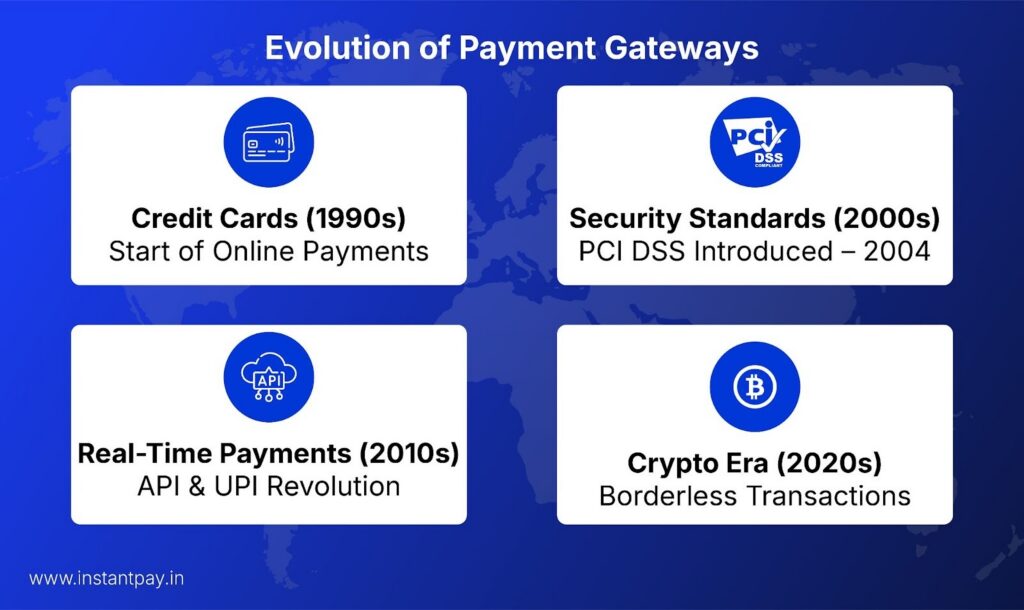
The evolution of payment gateways is a testament to how digital commerce and financial technology have transformed together. What started a few decades ago as basic checkout systems has today grown into intelligent, secure platforms capable of handling millions of transactions per minute across the globe.
When did payment gateways begin?
The first generation of payment gateways emerged in the mid-1990s, built to support online credit card transactions during the early days of e-commerce.
Stage 1: Basic Gateways for Credit Card Payments
Initially, payment gateways were introduced to facilitate card-not-present (CNP) transactions for online shopping—a revolutionary concept at the time. However, early systems struggled with:
- Weak encryption protocols
- Poor fraud detection
- Low consumer trust
Stage 2: Rise of Security Standards with PCI DSS
As internet usage and online retail exploded in the late 1990s and early 2000s, security became a critical concern. In response, the Payment Card Industry Data Security Standard (PCI DSS) was introduced in 2004 by Visa, Mastercard, and other card networks.
This became a global compliance framework for ensuring the following:
- Encryption of cardholder data
- Secure data storage
- Real-time fraud monitoring
Stage 3: Real-Time Payments and API-Led Platforms
Between 2010 and 2020, payment gateways evolved into real-time, cloud-based platforms that allowed businesses to:
- Process payments in under 1 second
- Accept UPI, NEFT, IMPS, and wallet payments
- Integrate seamlessly via RESTful APIs
The shift from monolithic to modular architecture allowed startups and enterprises to embed payments into mobile apps, ERPs, and e-commerce platforms with minimal effort.
Stage 4: Embracing Borderless & Crypto Transactions
The latest transformation in the payment gateway landscape comes from the integration of digital assets and cross-border payments:
- Gateways now support cryptocurrency wallets, stablecoins, and blockchain-based transactions.
- Smart contracts are enabling programmable payments for industries like gaming, Web3, and freelancing.
- Gateways like BitPay, Coinbase Commerce, and RazorpayX Crypto are offering plug-and-play crypto checkout solutions.
Consistent Goal: Seamless, Secure, Scalable Transactions
Despite this rapid evolution, the core objective of payment gateways has remained unchanged: To enable fast, reliable, and secure financial transactions—whether it’s a Rs.99 subscription or a 10,000 cross-border invoice.
| Era | Key Innovation | User Benefit |
| 1995–2004 | Basic credit card processing | Enabled first wave of e-commerce |
| 2004–2010 | PCI DSS, 3D Secure | Enhanced card security |
| 2010–2020 | APIs, mobile wallets, UPI | Real-time, omnichannel experiences |
| 2020–2025 | Crypto, AI, BNPL | Borderless, personalized transactions |
The Role of E-commerce in Payment Innovation
E-commerce has played a transformational role in the advancement of payment gateways, driving innovation in speed, flexibility, and user experience. As consumer habits shifted online—particularly during the COVID-19 pandemic—payment systems had to evolve from being functional to intelligent, integrated, and customer-centric.
Fact: India’s e-commerce market is expected to reach $350 billion by 2030, up from $63 billion in 2023, driven by rising internet penetration and smartphone usage. (Source: IBEF, Statista)
Pandemic-Driven E-Commerce Boom and Payment Gateway Acceleration
During the COVID-19 pandemic, online shopping surged as physical stores shut down and contactless commerce became the norm.
Stat: Between 2020 and 2022, India saw a 77% increase in first-time online shoppers, forcing payment gateways to scale up rapidly. (Source: Bain & Company)
To keep pace, payment gateways evolved with:
- Intuitive User Interfaces (UI)
- One-click checkouts
- Real-time fraud detection
- Mobile-first payment flows
How did COVID-19 impact payment gateways?
The pandemic accelerated the adoption of e-commerce, pushing gateways to support more payment methods, enhance user experience, and offer seamless digital transactions.
Expanding Payment Options for Digital Buyers
Modern e-commerce demands flexible and localized payment options. As a result, today’s gateways support:
- Digital Wallets (PhonePe, Paytm, Google Pay)
- Bank Transfers via UPI, NEFT, IMPS
- Buy Now, Pay Later (BNPL) services like LazyPay, Simpl, ZestMoney
- EMI Conversions and Subscription Billing
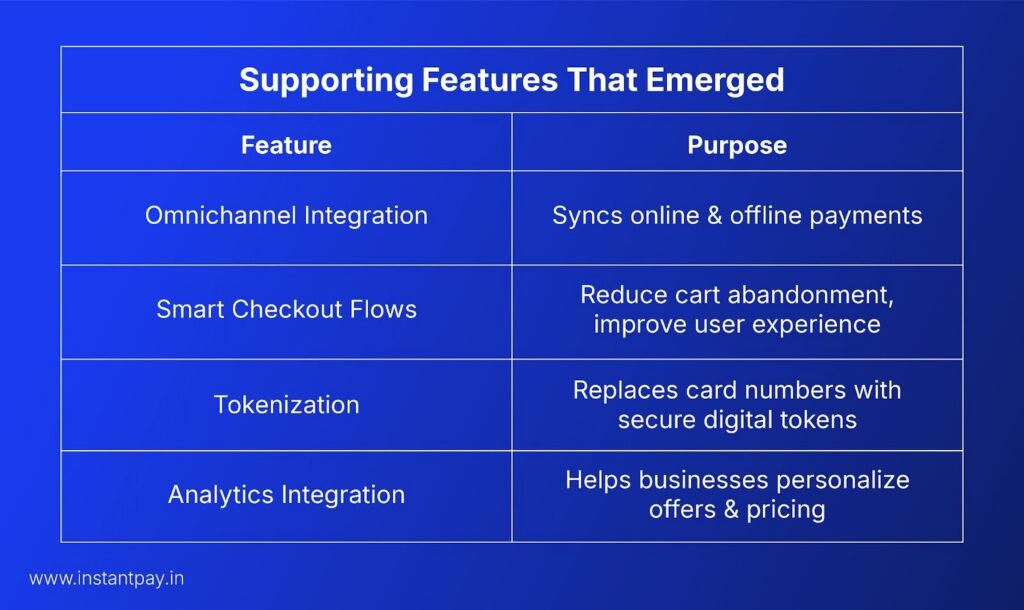
The Rise of Omnichannel Payment Gateways
Today’s consumers expect a unified experience whether they shop online or in-store. This has led to omnichannel payment solutions—platforms that connect POS systems with e-commerce checkouts to deliver:
- Unified payment history
- Loyalty syncing
- Cross-channel refunds and invoicing
- Real-time analytics dashboards
Example: A customer browsing on a mobile app can later walk into a store and complete the purchase using the same payment profile, synced through the gateway.
Subscription Economy: Fueling Recurring Payments
The rise of platforms like Netflix, Spotify, Amazon Prime, and Hotstar has normalized recurring payments across India.
Payment gateways have responded with:
- Automated debit features
- Tokenization for card data masking
- Retry logic for failed payments
- Billing cycle customization
Tokenization and Smart Checkout Experiences
To balance security with speed, gateways are implementing tokenization—replacing sensitive card data with encrypted tokens.
Fact: In India, over 520 million tokens were issued as of April 2024, following RBI’s tokenization mandate (Source: RBI), significantly reducing card-not-present fraud.
Smart checkouts further enhance conversions by offering:
- Pre-filled payment data
- Dynamic payment method suggestions
- AI-powered fraud checks
- A/B-tested UX flows
Data-Driven Commerce: Personalizing Payments
With every transaction, e-commerce businesses collect valuable behavioral and financial data. Advanced gateways now integrate real-time analytics dashboards and machine learning to:
- Track cart abandonment
- Personalize payment options
- Predict LTV (lifetime value)
- Segment users for tailored offers
The Rise of Contactless Payments: Transforming Transactions with a Tap
The rise of contactless transactions marks one of the most transformative shifts in the global payment ecosystem. Once viewed as a convenience, tap-to-pay technologies are now central to how consumers and businesses interact in the post-pandemic world.
Pandemic-Driven Acceleration
The demand for hygienic, fast, and touch-free payment options surged during COVID-19. Contactless payments became not just a preference—but a necessity.
Stat: In India, contactless transactions grew by over 6x between 2019 and 2022, with NFC-enabled cards and UPI QR codes becoming mainstream. (Source: NPCI, RBI)
Globally, over 60% of face-to-face Visa transactions outside the U.S. were contactless by 2023. (Source: Visa Annual Report)
How Contactless Technology Works
Near Field Communication (NFC) allows for secure, close-range wireless data exchange between a card or smartphone and a payment terminal. Users can pay by simply tapping:
- Smartphones (Google Pay, Apple Pay, Samsung Pay)
- NFC-enabled debit/credit cards
- Wearables like smartwatches and fitness bands
Key Benefits of Contactless Payments
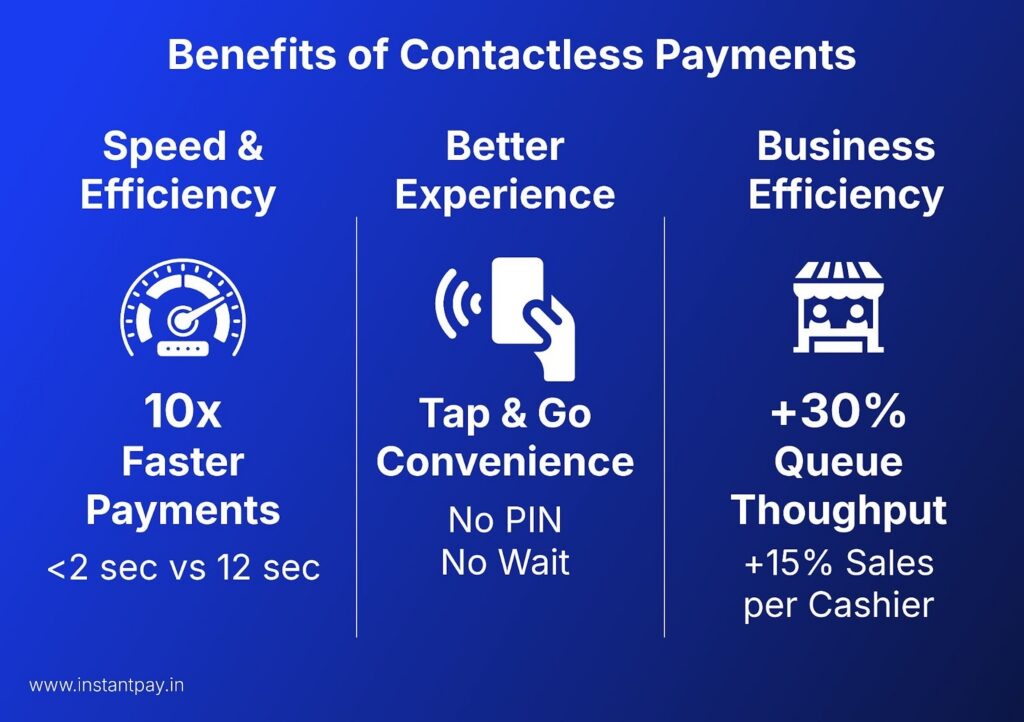
1. Speed and Efficiency
Contactless transactions are up to 10x faster than chip or cash payments, reducing queues and increasing checkout throughput.
Fact: Average contactless transaction time is under 2 seconds, compared to 7–12 seconds for chip-based cards. (Source: Mastercard India)
2. Improved Customer Experience
Consumers enjoy:
- No PIN entry for small transactions (limits vary by region)
- Minimal wait times
- Reduced physical contact and hygiene concerns
3. Operational Efficiency for Businesses
Retailers benefit from:
- Faster checkouts
- Fewer failed transactions
- Higher throughput and reduced friction
Data Point: Retailers using contactless tech report up to 30% improvement in queue management and 12–15% increase in sales per cashier/hour. (Source: Worldpay/FIS Global Payments Report)
Emerging Trends in Payment Technologies
Navigating the future of payment gateways means embracing cutting-edge technologies that are already beginning to transform transactions. Here, we will explore how innovations like artificial intelligence, enhanced security measures, and mobile wallets are defining the present and the future of digital payments.
Integration of Artificial Intelligence
Artificial intelligence (AI) is becoming a cornerstone in the evolution of payment gateways. With AI, payment transactions are receiving an intelligent upgrade that can significantly alter the way we perceive and perform digital payments.
AI facilitates smart payment processes by analyzing large datasets to gain real-time insights into consumer behavior patterns. It allows for personalized user experiences, such as predictive payment solutions that suggest when and how to make the next purchase.
Fraud detection is another critical area where AI shines. By using machine learning algorithms, payment systems can now detect odd transactions with unprecedented accuracy, learning and adapting over time to identify potential threats proactively. This capability not only enhances security but also builds trust, encouraging more users to adopt digital payment methods.
Moreover, AI-powered chatbots are being integrated into customer service interfaces, streamlining user interactions and providing assistance with payment-related queries instantly. These chatbots are evolving to carry out transactions directly within the chat platform, demonstrating how seamless and expansive online commerce can become with AI.
Advanced Security Protocols
The evolution of payment gateways is strongly tied to the advancement of security protocols. As digital payments grow, so do the efforts of cybercriminals, making strong security measures an absolute necessity.
We are witnessing an era where encryption is paramount. Advanced security protocols such as end-to-end encryption and two-factor authentication offer layers of protection that effectively safeguard sensitive information during transactions. But it doesn’t stop there. The rise of biometrics—using fingerprints, facial recognition, and even voice identification for authentication—is taking security to the next level.
Tokenization, previously touched upon, is becoming a standard practice. By replacing sensitive card details with a unique token during transactions, even if a breach occurs, no valuable data is exposed, effectively reducing the risk of theft.
Blockchain technology is another promising development for enhancing payment security. It offers a transparent and tamper-proof ledger system that can significantly curtail fraudulent activities. As businesses become more familiar and comfortable with blockchain, we can expect wider acceptance and implementation of this technology in payment systems.
The Growth of Mobile Wallets
Mobile wallets are among the most transformative trends in payment technologies today. As smartphones have become indispensable to our daily lives, mobile wallets have emerged as a convenient and secure means to manage finances on the go.
In essence, mobile wallets act like digitized versions of a physical wallet, storing payment card information and enabling quick, easy payments through a mobile app. Their appeal lies in the convenience and efficiency they offer—a simple tap or scan enables a payment, reducing the need to carry cash or plastic cards.
Globally, the adoption of mobile wallets is surging, powered by players like Apple Pay, Google Wallet, and Samsung Pay, which are continually expanding their capabilities. They’re not just for payments; these wallets are evolving into personal financial hubs. Users can now track their spending, manage loyalty points, and even engage in peer-to-peer money transfers within a single platform.
An essential aspect contributing to their growth is interoperability. Mobile wallets are increasingly becoming more adaptable, accommodating different currencies and processors, which is crucial for facilitating international payments in today’s global economy.
Crucially, mobile wallets also contribute to financial inclusion, providing access to digital banking and transaction capabilities for people in regions where traditional banking facilities are limited. Their continued evolution promises to blend convenience with innovation, redefining how we handle daily transactions.
As we embrace these emerging trends and technologies, payment gateways are becoming not just platforms for transaction completion, but integral parts of a holistic digital experience. Their future is exciting and filled with potential for innovations that we are only beginning to imagine. One thing is clear, however: the path is paved for an even more interconnected, efficient, and secure payment ecosystem.
The Impact of Blockchain and Cryptocurrency
The world of digital payments is undergoing a tremendous transformation, and at the heart of this revolution are blockchain technologies and cryptocurrencies. These innovations are not only reshaping how we think about money but also redefining the very nature of transactions themselves. Payment gateways, as intermediaries in these processes, are beginning to evolve in response to the burgeoning influence of blockchain and cryptocurrency in the financial landscape.
Decentralization of Payments
One of the most significant impacts of blockchain technology on payment gateways is the decentralization of payments. In traditional financial systems, transactions usually pass through multiple intermediaries, such as banks and clearinghouses, to reach their destination. This journey can be slow, inefficient, and often expensive due to fees imposed by these intermediaries. However, blockchain shifts the paradigm by allowing payments to occur directly between parties through peer-to-peer networks.
– Speed and Efficiency: By eliminating the need for third-party intermediaries, blockchain technology can make transactions faster and more efficient. Payments can be processed in real-time or near real-time, reducing the waiting period significantly.
– Lower Costs: Without financial institutions taking their cut, transaction fees lower considerably. This is particularly beneficial for cross-border payments, where traditional methods often involve exorbitant costs.
– Accessibility: Decentralized payment systems can significantly empower individuals in underbanked and unbanked regions, offering them access to global financial systems via mobile devices.
Decentralization through blockchain empowers users by giving them greater control over their transactions while minimizing reliance on centralized authorities, thereby democratizing finances in profound ways.
Blockchain as a Security Measure
Security has always been a prime concern in the world of digital payments. Given the nature of internet transactions, vulnerabilities often arise, making systems susceptible to fraud and data theft. Fortunately, blockchain technology offers novel solutions to these problems with its decentralized and transparent ledger system.
– Immutable Transactions: Once a transaction is recorded on a blockchain, it cannot be altered retroactively. This immutability acts as a robust safeguard against fraud since every transaction is permanent and traceable.
– Transparency: Blockchains operate with complete transparency. All transactions on a network are visible to its participants, providing a level of openness that deters malicious activity.
– Enhanced Authentication: With blockchain, every transaction requires cryptographic verification. This feature minimizes the risk of forgery and unauthorized access to funds.
These security improvements provide peace of mind, not just for individual users, but also for businesses that depend on secure payment systems to maintain trust with their customers. As more companies recognize these benefits, integrating blockchain into payment gateways is becoming an attractive option to enhance security measures dramatically.
Cryptocurrency Adoption and Its Challenges
The adoption of cryptocurrencies has been gaining steam globally, ushering in both enthusiasm and skepticism. Cryptocurrencies like Bitcoin, Ethereum, and others have presented viable alternatives to traditional currencies in various capacities. However, their widespread acceptance remains hampered by a range of challenges that stakeholders—from users to regulatory bodies—must address.
– Volatility: One of the major hurdles cryptocurrency faces is its volatility. Rapid fluctuations in cryptocurrency value can make it risky for investors and impractical for regular purchases. Mitigating this volatility will be crucial to broader adoption.
– Regulatory Concerns: As cryptocurrencies bypass traditional financial systems, they present new challenges for regulatory frameworks built around fiat currencies. Governments and regulatory bodies are still grappling with how best to oversee these digital assets without stifling innovation.
– Scalability Issues: Many current cryptocurrencies face scalability challenges. Networks like Bitcoin struggle with processing high volumes of transactions quickly, which could hinder their ability to compete with established payment methods.
– Public Perception and Education: Despite increasing awareness, there remains a knowledge gap about what cryptocurrencies are and how they work. Public perception is often skewed by associations with illicit activity, although industry advocates are working hard to change this narrative.
– Infrastructure Development: For cryptocurrencies to thrive, robust infrastructure for buying, selling, and securely storing digital assets must be in place. Progress is being made, but complete ecosystems are far from fully developed in most regions.
Despite these obstacles, a growing number of businesses and individuals see potential in utilizing cryptocurrencies for various transactional purposes. As technological advancements address these challenges, we can expect to see broader cryptocurrency integration within payment gateway solutions.
In conclusion, the impact of blockchain and cryptocurrency on the future of payment gateways is shaping up to be both profound and lasting. Through decentralization, enhanced security, and the burgeoning adoption of digital currencies, these technologies are setting the stage for a new era in financial transactions. Payment gateways must remain adaptable and forward-thinking to harness these advancements, ultimately facilitating more efficient, secure, and democratized digital payments. As these trends unfold, the once-complicated sphere of global finance could become more accessible and seamless than ever before.
Future Outlook: What to Expect in Payment Gateways
As we head into the future, payment gateways will evolve beyond our current expectations. The fusion of artificial intelligence and real-time analytics will offer deeply personalized consumer experiences. Imagine payments happening seamlessly through wearables or even biometric identifiers, streamlining transactions like never before!
Moreover, the rise of decentralized finance (DeFi) will likely integrate with payment gateways, providing enhanced security and reducing transaction fees. This, coupled with blockchain technology, will push boundaries, paving the way for truly global and inclusive payment systems. Stay tuned for a future where every transaction is fast, secure, and incredibly convenient!