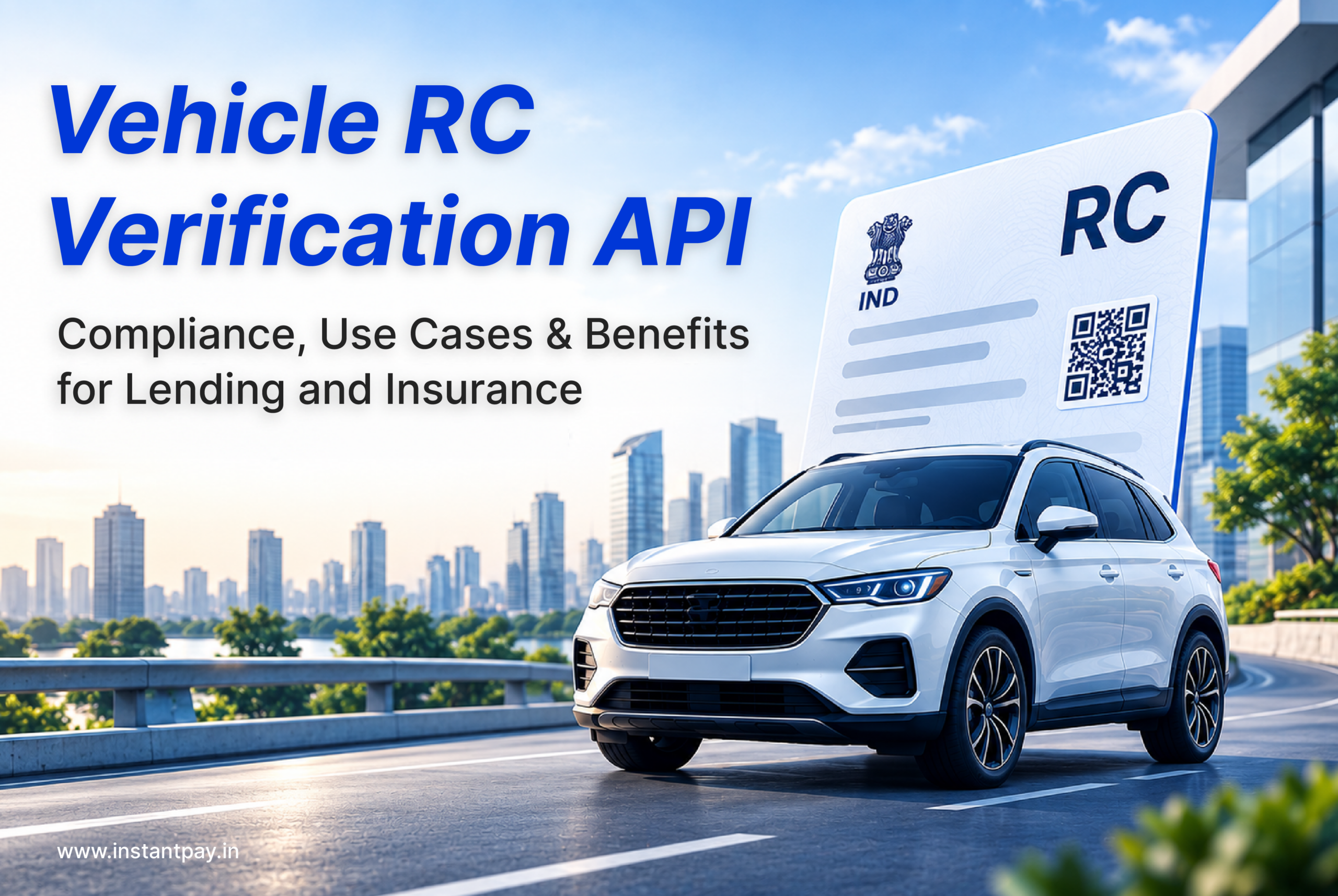
The VAHAN platform has more than 41 crore registered cars, which makes it difficult for lenders, insurance companies, and transport companies to carry out manual verification. An API for vehicle RC verification allows the user to verify vehicle registration using records from the VAHAN system and RTO records.
This guide discusses the operation of the API for vehicle RC verification, different use cases of the API in different businesses, and what the users must evaluate before they adopt the API for vehicle registration verification in their processes.
What Is a Vehicle RC Verification API?
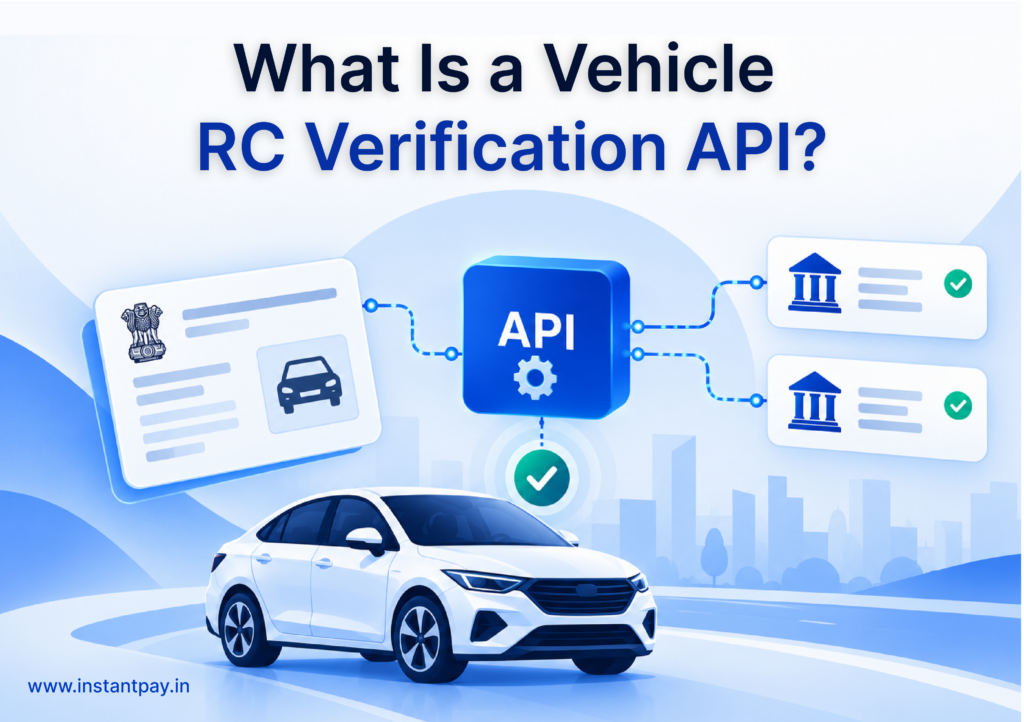
A Vehicle RC Verification API is an online verification process that provides industries with the ability to authenticate registration certificate (RC) details of a vehicle in real time by hooking up with the VAHAN and RTO databases. Unlike traditional methods that require uploading an RC copy or some manual checks, the API allows getting information about the vehicle by entering the registration number and ensures that one obtains precise and up-to-date registration details.
In case of fintech companies, banks, NBFCs, insurance providers, logistics operators, and mobility platforms, Vehicle RC verification is one of the most important components of Digital Onboarding and asset verification. With the API’s help, it becomes possible to determine if a vehicle has been registered, find out its owner’s identity, identify registration status, and avoid inconsistencies before loans are disbursed, insurance policies are signed, or commercial vehicles are onboarded.
What does a Vehicle RC Verification API verify?
A common RC verification API is capable of verifying:
- Confirms whether a vehicle is legally registered
- Verifies ownership and registration status
- Helps detect forged or incorrect RC details
- Enables faster underwriting and policy issuance
Typical inputs
- Vehicle registration number (mandatory)
- Partial engine number or chassis number (optional, for higher accuracy)
Typical outputs
- Registered owner name (masked where required)
- Vehicle make, model, and fuel type
- Registration date and current RC status
- Hypothecation or financing details
- Fitness validity and permit status (if applicable)
Quick takeaway: A Vehicle RC Verification API verifies the vehicle, not the customer. While KYC confirms an individual’s identity, RC verification validates the vehicle being financed, insured, or onboarded. Together, they create a stronger and more compliant Digital Onboarding process.
Why Vehicle RC Verification Matters for Modern Businesses
As business operations become more reliant on the use of vehicles as valuable assets, the process of checking vehicle records has turned into a necessity. Regardless of whether it is a vehicle loan application, an insurance policy, fleet partner companies onboarding, or the verification of the vehicles, Vehicle RC verification provides a reliable information basis for decision-making.
Most of the time, manual checks of vehicle RC include document screening, back-and-forth interactions, and sporadic information, which lead to higher operational costs and risks of fraudulent dealings. The use of Vehicle RC Verification API automates this operation, allowing users to check the information with the help of the information available in VAHAN and RTO databases.
Key Benefits of Vehicle RC Verification
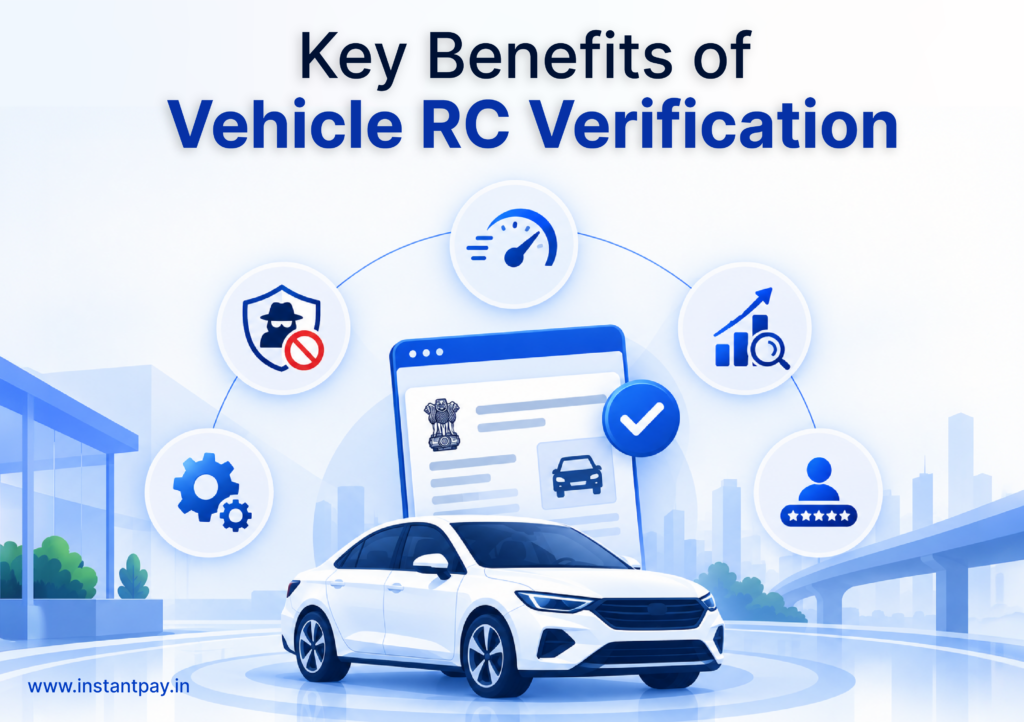
Reduce Fraud and Ownership Risks
By verifying the vehicle owner and registration details, it is possible to identify any altered RCs or mismatched ownership or invalid RC registrations before loan approval or policy issue.
Speed Up the Lending Process
By substituting the traditional protocol of verifying documents with the automated vehicle RC verification service, lenders can reduce the time required for underwriting, policy issuance, and onboarding.
Improve Risk Analysis
The lender has access to verified information, such as vehicle type, age, fuel, hypothecated status etc., to make better loan decisions, insurance pricing, and verification of assets.
Enhance Operating Processes
By automating repetitive document verification tasks, it is possible to diminish exceptions and to make vehicle verification easier across different branches.
Improving Customer Experiences
Lenders can obtain faster approvals while requiring fewer documents from their clients and making the process longer by only a couple of minutes.
Manual vs API-Based RC Verification
| Manual RC Verification | Vehicle RC Verification API |
| Relies on uploaded RC documents | Validates against VAHAN and RTO-linked records |
| Hours or days to verify | Real-time verification |
| Higher risk of manual errors | Standardized and accurate verification |
| Difficult to scale | Built for high-volume Digital Onboarding |
| Limited audit visibility | Supports audit-ready verification workflows |
Quick takeaway: Vehicle RC verification is no longer just a document check. It is a trust layer that helps businesses validate vehicle identity, reduce fraud, and automate lending, insurance, and mobility workflows with confidence.
How a Vehicle RC Verification API Work?
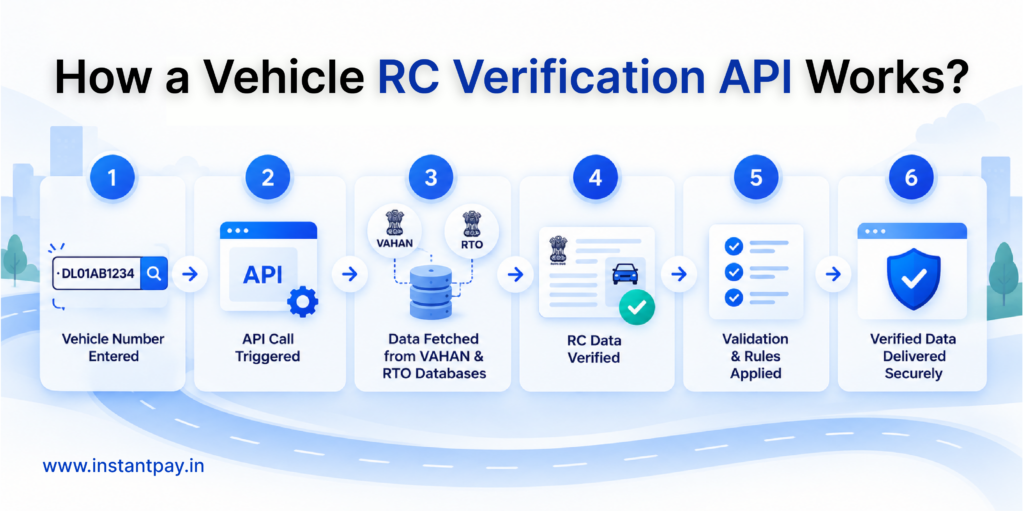
A Vehicle RC Verification API integrates seamlessly into lending, insurance, and Digital Onboarding workflows, enabling real-time vehicle registration verification in just a few seconds. Once a vehicle registration number is submitted, the API validates the information against VAHAN and RTO-linked records and returns structured, verified data that supports faster business decisions.
Step 1: Capture the Vehicle Registration Number
The customer enters the vehicle registration number during onboarding, or the system retrieves it from an application, dealer portal, or existing customer records.
Step 2: Trigger the RC Verification API
The application securely sends the registration number to the Vehicle RC Verification API, initiating a real-time verification request.
Step 3: Verify Against VAHAN & RTO Records
The API validates the submitted details against authoritative transport records, checking whether the vehicle is registered and whether the available registration information matches official records.
Step 4: Receive Verified Vehicle Data
The API returns structured vehicle registration details, including ownership information (where permitted), vehicle specifications, registration status, hypothecation details, and other available compliance-related attributes.
Step 5: Apply Business Rules
The verified response is evaluated against predefined business rules to:
- Approve the application automatically
- Flag it for manual review
- Reject the request if significant mismatches or invalid registration details are detected
Step 6: Store Only Required Information
Only the information required for underwriting, compliance, or operational purposes is stored, following DPDP principles, data minimization, and internal security policies.
Common Data Fields Returned
Depending on the available transport records, a Vehicle RC Verification API may return:
- Vehicle registration status
- Registered owner details (masked where applicable)
- Vehicle make, model, category, and fuel type
- Registration date
- Hypothecation or financer details
- Fitness certificate and permit validity (where applicable)
Quick takeaway: A Vehicle RC Verification API transforms a vehicle registration number into verified, decision-ready data, helping businesses automate asset verification, strengthen fraud checks, and accelerate Digital Onboarding.
Legal & Compliance Considerations for Vehicle RC Verification
To businesses in the financial technology space as well as lending and insurance sectors, the verification of the RC of a vehicle follows in addition to the implementation of an API. It allows for proper asset verification and to improve the Digital Onboarding process as well as compliance with the norms of the law and regulations related to the privacy of data. However, while carrying out the vehicle RC verification, the verification further requires conformity with the laws.
It Is a Requirement to Register the Vehicle
According to the Act of Motor Vehicles of India, every motor vehicle that goes on the road must be registered in the Regional Transport office, obtaining the Vehicle Registration Certificate (RC). Therefore, the verification process of the above becomes important to ensure if the vehicle that is to be financed or insured is registered legally.
The Vehicle Data Source Access Must Be Legal
The Vehicle RC Verification API should get its data from authorized sources from RTO records or agencies with which it is authorized to integrate. Other companies should choose API services that provide a transparent data collection system as well as safety of access and verifiability of the above data.
Adhere to DPDP Principles in the Handling of RC Records
The records of registration contain personal details associated with the owner of the vehicle. To comply with the DPDP (Digital Personal Data Protection) Act, the following measures should be adopted:
- RC records should only be processed for valid commercial purposes.
- Only the data that is essential for compliance or verification should be kept.
- Sensitive data must be secured through encryption and secured systems.
- Have strict policies regarding data deletion and retention.
RC verification is similar to KYC but not the same
A customer KYC procedure determines the verification of the identity of the individual, and the verification of the vehicle being financed or insured is the RC verification. The result of both verification processes is improved digital onboarding by ensuring the verification of both the vehicle and the customer.
Compliance takeaway: A compliant Vehicle RC Verification process relies on authorised data access, privacy-first data handling, and the combined use of customer KYC and vehicle verification to support secure, audit-ready onboarding.
Business Use Cases of RC Vehicle Verification API
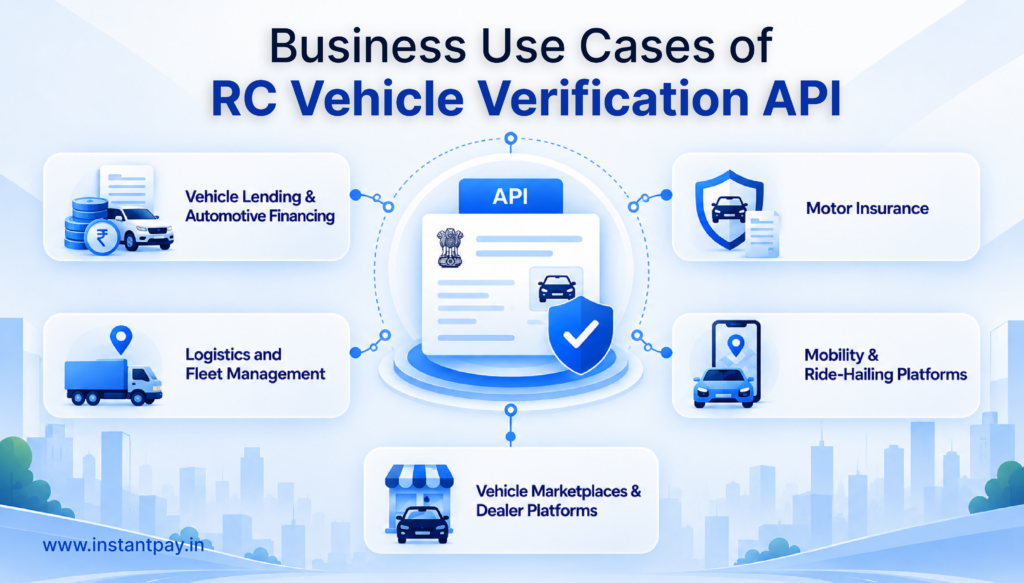
A Vehicle Registrations Verification API provides the maximum benefit when utilized as a seamless part of digital onboarding, underwriting, and operational processes. By substituting manual vehicle verification with instantaneous vehicle registrations verification, companies can lower fraud risks, enhance efficiency, and speed up decision-making across industries.
Vehicle Lending & Automotive Financing
In case of banks, NBFCs, and fintech lenders, Vehicle Registrations verification assistance is important for the validation of the vehicle before permitting the loan. By confirming vehicle ownership, status of registration, vehicle type, and hypothecation information, lenders can increase collateral checks, fraud reduction, and credit decisions.
Motor Insurance
In the field of motor insurance, the RC Verification API is used to check the data about the vehicle before issuing a policy and carrying out renewals and processing of claims. Verified registration information makes underwriting more precise and helps to detect discrepancies, meaning dishonest claims.
Logistics and Fleet Management
Logistics companies and fleet managers utilize vehicle registration verification to onboard commercial vehicles, keep fleet records and ensure the correctness of vehicle information across the regions. Automation simplifies compliance and lessens the amount of manual work needed with the documents and paperwork.
Mobility & Ride-Hailing Platforms
With the help of Vehicle RC verification, ride-sharing, taxi aggregators, and mobility platforms ensure the verification of vehicles prior to onboarding drivers and fleet partners. As a result, only valid and registered vehicles are allowed to operate on the platform, while trust and regulatory compliance are increased.
Vehicle Marketplaces & Dealer Platforms
Vehicle marketplaces, resale platforms, and dealer networks use RC verification to validate vehicles listed on the website, check ownership records and reduce the likelihood of fraudulent or double registrations before transactions occur.
Business takeaway: Vehicle RC Verification is used for any purpose including financing of the vehicle, issuance of insurance, onboarding of fleet partners and validation of marketplace listings.
Choosing and Integrating the Right API for RC Verification
Selecting and integrating an appropriate Vehicle RC Verification API is just as vital as the verification process itself. In addition to accurate vehicle information, companies must determine how well the API performs in the areas of digital onboarding, compliance issues, systems integration, and high-volume verification processes.
What should a person keep in mind when selecting an RC Verification API?
When studying about an API provider, a person needs to think about:
- Ability to get official data through the VAHAN system or related RTO systems (records).
- Availability in many regions.
- Sufficient speed and availability.
- Privacy-first approach to data handling and identity information.
- Error messages that help to understand which information is wrong.
- Ease of API integration by the developer.
Regular Use of the Integration System
Most organizations utilize Vehicle RC Verification API as part of their existing processes of lending, insurance, or onboarding.
Installation of Verification into Decision Initialization
Vehicle RC Verification is valuable when its results are applied. Companies can set automated workflow rules, for example:
- Owner details are verified ? Company begins onboarding.
- Registration status is inactive or suspended ? Company declines or prohibits the application.
- Ownership status differs and/or some records are missing ? Company starts manual reviews.
- Hypothecation is present ? Additional checks are introduced before lending or the underwriting process begins.
Advice on Implementation: An efficiently implemented Vehicle RC Verification API is more than a verification tool, but a reliable data source.
Final Thoughts
With the ongoing rise of digital lending, motor insurance, and mobility services, automated RC verification has become essential for businesses requiring quick and accurate verification processes. Vehicle RC Verification API enables real-time vehicle registration verification thus empowering organizations to validate vehicle ownership, minimize fraudulent activities, and conduct asset verification using VAHAN and RTO-related records.
When included within Digital Onboarding workflows, RC verification transforms beyond being a compliance step into a trusted verification level helping speed up underwriting, risk assessments, and informed business decisions at a larger scale.
FAQs
1. What is a Vehicle RC Verification API used for in lending?
A Vehicle RC Verification API verifies the details of vehicle registration, who owns the vehicle, the registration status of the vehicle, and details of hypothecation before giving a vehicle loan. It simplifies and automates the process of RC verification for banks, NBFCs, and fintechs by replacing manual RC verification with real-time vehicle registration verification.
2. How does a VAHAN RC Verification API differ from manual RC verification?
While manual verification uses the uploaded Registration Certificate (RC) document, the VAHAN RC Verification API checks the vehicle registration details against the VAHAN and RTO records. As a result, the API-based verification is quicker, more accurate, and less likely to rely on forged or modified documents.
3. Is Vehicle RC verification the same as KYC?
No. Vehicle RC verification is concerned with the verification of the vehicle being financed or insured, while KYC is dealing with the verification of the identity of the customer. The two processes are used together to ensure safer Digital Onboarding.
4. What information can a Vehicle RC Verification API return?
Vehicle RC Verification API provides verified vehicle registration information such as the registration status, details of the registered owner with the relevant portions masked, vehicle make and model, registration date, vehicle category, type of fuel, and hypothecation details. Some APIs may provide additional information about fitness certificates and permits.
5. How do insurance companies use Vehicle RC Verification APIs?
Motor insurers employ Vehicle RC Verification APIs to verify vehicle details at the time of issuance of policies, renewals of policies, and processing of claims. With real-time vehicle verification, accuracy of underwriting improves, errors in policy issuance reduce, mismatches in ownership can be identified, and fraud prevention process gets strengthened before the issuance of motor insurance policies.
6. What are the privacy best practices for handling RC data?
Legal entities have to use RC data for the legitimate business purpose only, collect only required information, and keep sensitive data secure by adequately protecting the data. Hence, it is advised that organizations should prospect RC data following DPDP Act principles like a clear data retention and deletion policy.
7. Why does Vehicle RC verification fail?
The various reasons for the failure of Vehicle RC verification are discrepancies in the registration number, unavailability or outdated transportation records, interim system problems, or missing information. The best practice for businesses in this regard is to utilize RC verification APIs that deliver clear error messages and allow them to retry or manually process exceptional cases.
8. Can Vehicle RC verification help prevent lending and insurance fraud?
Yes. Vehicle RC verification can help identify counterfeit Registration Certificates, incorrect ownership of vehicles, duplicate financing threat, or wrong registration status from happening before taking business decisions.