Managing cash flow is critical to running a successful business, especially when facing seasonal fluctuations, inventory demands, or daily operational costs. This is where a working capital loan becomes invaluable.
Whether you’re navigating short-term obligations or looking to scale smoothly, understanding working capital finance is a must. In this blog, we’ll break down the meaning of working capital loans, explore types, interest rates, seasonal needs, and smart ways to access this funding.
What is a Working Capital Loan?
A Working Capital Loan (WCL) is more than just emergency cash. It’s a strategic tool that helps businesses stay agile and ready for growth.
Many people link WCLs to short-term cash issues. However, their real strength is in managing daily liquidity, ensuring business continuity, and smoothing cash flow.
Why Does This Matter?
- 72% of Indian SMEs see working capital gaps as their main growth barrier (SIDBI, 2023).
- On average, 25–30% of a company’s revenue is tied up in receivables (CRISIL SME Tracker).
- Delayed vendor payments and payroll issues are the top risks of mismanaged working capital.
- In India’s seasonal economy (Diwali, year-end and wedding cycles), cash flow planning is crucial—that’s where WCLs excel.
Working Capital Loans vs. Term Loans: Key Differences
| Feature | Working Capital Loan | Term Loan |
| Purpose | Fund day-to-day ops | Long-term asset acquisition |
| Duration | Short-term (3–12 months) | Long-term (1–7 years) |
| Usage | Inventory, payroll, receivables, vendor payouts | Equipment, real estate, plant & machinery |
| Repayment | Often flexible (EMIs, bullet, OD) | Fixed EMIs or structured plans |
Where a WCL Makes the Difference
- Bridging Receivables Gaps: Your clients pay in 60 days, but salaries and rent need immediate attention. A WCL fills this timing gap.
- Scaling Ahead of Revenue: Expecting more orders during the festive season? A WCL lets you buy raw materials in bulk early, keeping reserves safe.
- Navigating Business Transitions: Starting a new line, restructuring, or changing your service model? A working capital loan smooths out the financial bumps during this shift.
- Sustaining Vendor Relationships: Paying vendors on time helps you keep credit terms and a stable supply chain. This is vital in industries with thin margins or low inventory turnover.
The Strategic Side of Working Capital Loans:
- Not Just for Emergencies: Many businesses also use working capital loans to stock up on inventory before demand rises. They also improve vendor payment cycles and put money into short-term marketing campaigns for quick returns.
- Buffer Against Delays: In industries such as manufacturing or export, payment cycles can take 60 to 90 days. These loans are crucial. They help companies maintain operations as they wait for payments.
- Customization Options: Lenders often change the loan structure to suit the borrower’s industry and business model. They provide custom repayment plans, credit limits, or mixed options, such as a loan with a line of credit.
Loan Forms: Beyond the Conventional
Many working capital loans today aren’t disbursed in lump sums. They can be structured as:
1. Drop-Line Overdraft (DLOD) – A credit line that reduces at regular intervals, ensuring disciplined repayment.
- How it works: You get a fixed credit limit (like Rs.50 lakhs), which decreases monthly or quarterly by a set amount.
- This setup helps prevent over-leveraging and promotes financial discipline, especially for MSMEs.
- Common in seasonal businesses, like agriculture or FMCG distribution, where sales peaks happen.
- Example: A Rs.24 lakh drop-line OD can decrease by Rs.2 lakh each month. This means full repayment happens in 12 months and liquidity stays intact.
- RBI reports (2023) show that more than 35% of SME credit via NBFCs in semi-urban areas now uses DLOD structures. This helps reduce NPA risks.
2. Hybrid Credit Models – A blend of revolving and term loan structures – offering flexibility and commitment.
- This model combines the flexibility of an overdraft with a structured repayment plan.
- A Rs10 lakh hybrid facility allows the borrower to withdraw funds as needed. It has a base amount that is paid under EMI and a revolving portion similar to a credit card.
- Favoured by growing SaaS, logistics, and export-led SMEs, where capital needs change but keeping up with repayments is key to managing interest costs.
- Bain & Company (2023) shows a 2.4x year-on-year rise in demand for hybrid credit products among early-stage B2B startups in India.
3. Supplier Financing (Vendor Financing) – Working capital provided indirectly through fintech platforms or anchor-led supply chains.
- Instead of taking a loan, the SME’s supplier is paid upfront by a financier, and the SME repays later.
- Platforms like CredAble, Vayana, and KredX have spurred quick growth in India’s MSME sector.
- SIDBI and the World Bank (2022) report that India has a supply chain finance gap of over Rs.60,000 crore. This is surprising given that mid-market businesses demand Rs.1.7 lakh crore in credit.
- Great for manufacturing, electronics distribution, and white-label production chains. Here, bulk buying power is key, but liquidity may be low.
- Fintech integrations provide real-time invoice checks, early payment discounts, and credit assessments based on buyer strength, not just SME balance sheets.
When It Makes a Big Difference:
- During business expansion into new markets where early revenue is delayed.
- When adopting Just-In-Time (JIT) inventory models, which rely on precise timing and liquidity.
- For companies with B2B clientele, where invoice cycles are slow but expenses are immediate.
In essence, a working capital loan is not just about plugging financial gaps—it’s about creating a flexible, responsive financial system that aligns with your business rhythm.
Working Capital Loan Meaning vs. Permanent Working Capital
Understanding the distinction between a working capital loan and permanent working capital is essential for any business making financial decisions. While both relate to managing cash flow and operational continuity, they serve very different purposes in financial planning.
Working Capital Loan Meaning
A working capital loan is a short- to medium-term financing option provided by banks, NBFCs, or financial institutions to cover immediate operational expenses. These are designed to manage liquidity issues that arise from:
- delayed customer payments,
- rapid growth phases,
- seasonal slowdowns, or
- temporary gaps in the operating cycle.
Key Traits:
- Typically repaid within 3–24 months.
- Can be revolving or term-based.
- May or may not require collateral.
- Helps smoothen short-term liquidity issues.
Think of it as a “plug-and-play” financial tool—access it when needed, pay it off when cash flows normalize.
Permanent Working Capital
In contrast, permanent working capital refers to the minimum level of working capital that a business must consistently maintain to run its operations smoothly. This is not borrowed money—it’s a long-term internal financial need that’s typically funded through owner’s equity or long-term loans.
For example, a retail company might always need Rs.25 lakhs worth of inventory and Rs.15 lakhs in receivables, regardless of sales cycles. This baseline Rs.40 lakhs becomes their permanent working capital.
Key Traits:
- Not a loan; it’s a foundational capital requirement.
- Remains tied up in the business permanently (unless scale changes).
- Usually funded by equity or long-term debt—not short-term loans.
- Forms the basis for calculating net working capital requirements.

Why Understanding This Matters
When you understand the difference, you’re better equipped to:
- Avoid misusing loans for long-term capital needs.
- Design a smarter financing structure that separates operational flexibility from core capital requirements.
- Maintain financial discipline and liquidity buffers without over-leveraging.
So, while working capital loans provide financial agility, permanent working capital ensures financial stability. A healthy business needs both—used strategically.
Uses of Working Capital Loans
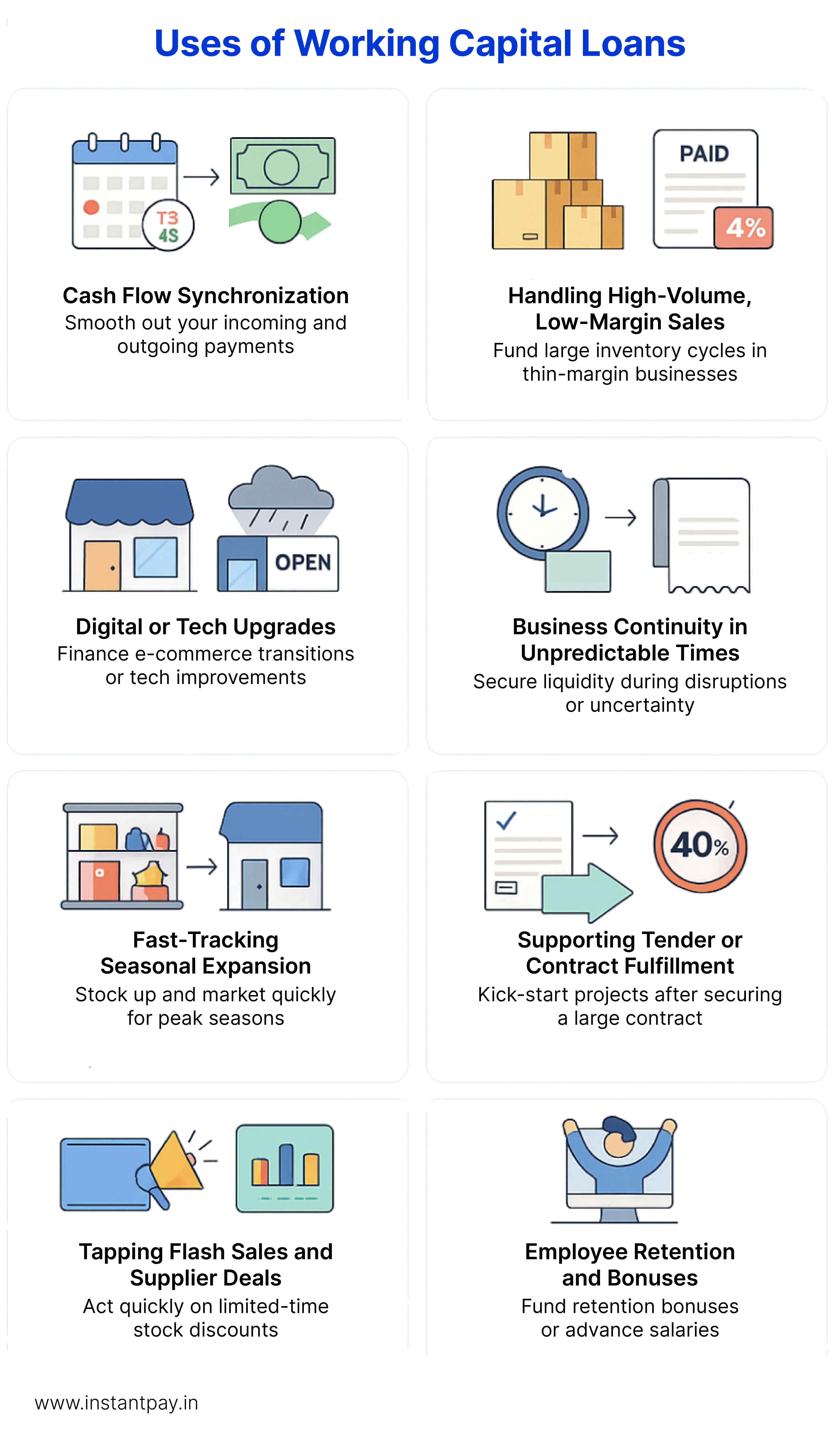
A working capital loan isn’t just for survival—it’s a strategic enabler that empowers businesses to stay agile, seize opportunities, and navigate change. While traditionally associated with bridging short-term cash gaps, today’s businesses leverage it in more innovative and proactive ways.
Here’s a deeper dive into how and why working capital loans are used across industries:
1. Cash Flow Synchronization
Every business experiences timing mismatches—customer payments come in late while salaries, rent, and vendor dues arrive like clockwork. A working capital loan allows you to smooth these inconsistencies without disrupting operations or credit terms.
Use Case: A wholesaler extends 45-day credit to retailers but needs to pay suppliers within 15 days.
2. Handling High-Volume, Low-Margin Sales
In industries like FMCG, where margins are razor-thin but volumes are massive, liquidity is key. Working capital loans help fund large inventory cycles, giving businesses the ability to sell more before they earn.
Use Case: A distribution business lands a bulk deal but needs upfront funds to fulfill the order.
3. Negotiating Early Payment Discounts
Suppliers often offer discounts (2-5%) for early or upfront payments. Businesses use working capital financing to leverage these offers, saving more than what they pay in interest—turning debt into profit.
Use Case: A company pays a vendor upfront using a loan and receives a 4% discount, while the loan interest is 2%.
4. Digital or Tech Upgrades
Digital transformation or e-commerce pivoting often requires fast investment—website overhauls, software licensing, marketing. Instead of disrupting long-term financial planning, companies use short-term working capital credit to finance these changes.
Use Case: An offline retailer moves online, investing in a CRM system and performance ads.
5. Business Continuity in Unpredictable Times
Whether due to global crises, natural disasters, or market volatility, business interruptions can strain cash flow. A working capital loan ensures continuity during black swan events without needing to dip into reserves or long-term funding.
Use Case: A restaurant chain uses short-term credit to reopen after an unforeseen shutdown.
6. De-risking Receivables from Large Clients
Sometimes, large clients delay payments without notice. Instead of letting this slow operations or strain vendor relations, businesses use loans to stay liquid until payments arrive—effectively absorbing external risk.
Use Case: A B2B service provider uses credit to pay salaries and rent while awaiting a delayed Rs.20L invoice.
7. Fast-Tracking Seasonal Expansion
Some businesses see massive spikes during festivals, tourist seasons, or school sessions. Rather than miss the moment, they use seasonal working capital funding to stock up, hire temporary staff, or run marketing.
Use Case: A D2C apparel brand pre-invests in Diwali marketing and inventory using a short-term loan.
8. Supporting Tender or Contract Fulfillment
Winning a big government or corporate tender is great—until you need the upfront cash to deliver. Working capital loans cover project kick-off expenses before milestone payments kick in.
Use Case: An IT firm needs funds to onboard staff and begin work after winning a 6-month contract.
9. Tapping Flash Sales and Supplier Deals
Sometimes, vendors offer limited-time discounts or clearance deals. Businesses with ready access to working capital credit can capitalize instantly, boosting profit margins and product variety.
Use Case: A retailer buys stock at a 40% discount during a week-long supplier clearance.
10. Employee Retention and Bonuses
During critical business phases—like scaling, transitions, or turnarounds—retaining top talent is vital. Companies use working capital loans to fund retention bonuses or advance salaries, preserving team morale.
Use Case: A startup pays retention bonuses before its next funding round gets closed.
Types of Working Capital Loans

Not all businesses have the same cash cycle. A startup with erratic revenue, a manufacturer with bulk raw material costs, and a retailer with seasonal peaks—each has unique liquidity challenges. That’s why working capital loans come in multiple forms, each tailored to different business models, risk profiles, and operational needs.
Here’s a detailed breakdown of the most relevant and widely-used types of working capital loans—and how to choose the right one:
1 Working Capital Demand Loan (WCDL)
What It Is:
A short-term loan disbursed in lump sum with a fixed repayment period—typically under a year.
When to Use:
- Sudden inventory buildup before festive season.
- Paying advance rent for a new branch.
- Clearing old liabilities during a temporary cash shortage.
Real Example:
An electronics distributor needs Rs.10 lakhs to stock up for a limited-time Diwali sale. A WCDL allows them to access the lump sum, repay in 6 months, and benefit from volume discounts.
2 Working Capital Term Loan
What It Is:
A structured loan repaid via monthly EMIs over 1 to 3 years. Ideal when the funding need isn’t a one-off and cash flows can support planned repayment.
When to Use:
- Long-duration projects with predictable returns.
- Managing a permanent increase in baseline working capital.
- Post-COVID business relaunch or restructuring.
Real Example:
A logistics company recovering from a slowdown takes a 24-month working capital term loan to manage fuel, salaries, and insurance until revenue normalizes.
3 Cash Credit Facility
What It Is:
A revolving credit limit sanctioned against assets like inventory or receivables. Interest is charged only on the used portion.
When to Use:
- Continuous cash flow fluctuations.
- Medium-scale manufacturing with raw material dependence.
- Traders and wholesalers with rolling receivables.
Real Example:
A textile exporter secures a Rs.50L cash credit limit. When invoices delay by 45 days, they draw Rs.30L to stay afloat without breaking the bank.
4 Overdraft Facility
What It Is:
Allows you to withdraw more than your bank balance—up to a set limit. Typically linked to a business current account.
When to Use:
- Handling short-term liquidity mismatches (1–30 days).
- Emergency purchases or urgent payments.
- Early-stage entrepreneurs with few assets but good credit.
Real Example:
A small marketing agency uses overdraft to cover freelancer payments, then repays after client settlement the following week.
5 Invoice Discounting / Receivables Financing
What It Is:
Monetizes unpaid invoices by borrowing a percentage of the invoice value—usually 70–90%.
When to Use:
- Long customer payment cycles (45–90 days).
- B2B services with delayed revenue recognition.
- Want to maintain liquidity without borrowing heavily.
Real Example:
A SaaS startup has Rs.25L in billed but unpaid invoices. Using invoice discounting, they get Rs.20L instantly and use it for team expansion.
6 Trade Credit / Vendor Financing
What It Is:
Credit extended by suppliers, allowing you to buy now and pay later—often without interest for a short duration.
When to Use:
- New product launches with uncertain demand.
- Businesses with good vendor relationships.
- Retailers managing multiple SKUs.
Real Example:
A pharmacy chain secures 30-day credit from its distributor. It sells fast-moving products before the payment due date, using sales to fund procurement.
7 Merchant Cash Advance (MCA)
What It Is:
Advance funds based on future credit/debit card sales. Repayments are made as a daily or weekly fixed % of card-based revenue.
When to Use:
- Retail, restaurant, or D2C brands with regular card sales.
- When traditional credit is denied.
- For flexible repayment aligned with sales.
Real Example:
A café chain gets a Rs.3L MCA and repays 10% of daily card sales until the balance is cleared—no EMI pressure, no fixed timeline.
8. Letter of Credit / Bank Guarantee (For Trade-Based Working Capital)
What It Is:
Bank commits payment to a supplier on your behalf, ensuring you receive goods while the supplier is assured of payment.
When to Use:
- Import/export businesses.
- Construction and government contractors.
- Businesses operating on trust-based long-distance trade.
Real Example:
An auto parts importer uses a letter of credit to secure a shipment from Germany. Payment is released only after goods are received and verified.
Pro Tip: Match Loan Type to Business Type
| Business Type | Best Loan Type(s) |
| Manufacturing | Cash Credit, WCDL, Term Loan |
| Retail (Offline/D2C) | Overdraft, MCA, Trade Credit |
| Export/Import | Letter of Credit, Invoice Financing |
| B2B Services | Invoice Discounting, Working Capital Term Loan |
| Startups | MCA, Term Loan, VC-backed working capital |
Working Capital Loan Example: Real-Life Scenarios That Make It Click
Understanding the concept of a working capital loan is only half the story—seeing it in action is what truly brings clarity. Whether you’re a startup founder, a retail store owner, or managing a growing manufacturing business, real-world examples can help you see when and why a working capital loan makes sense.
Here are a few business-specific scenarios that show how working capital loans function across different industries:
Retail Business: Managing Seasonal Inventory Surge
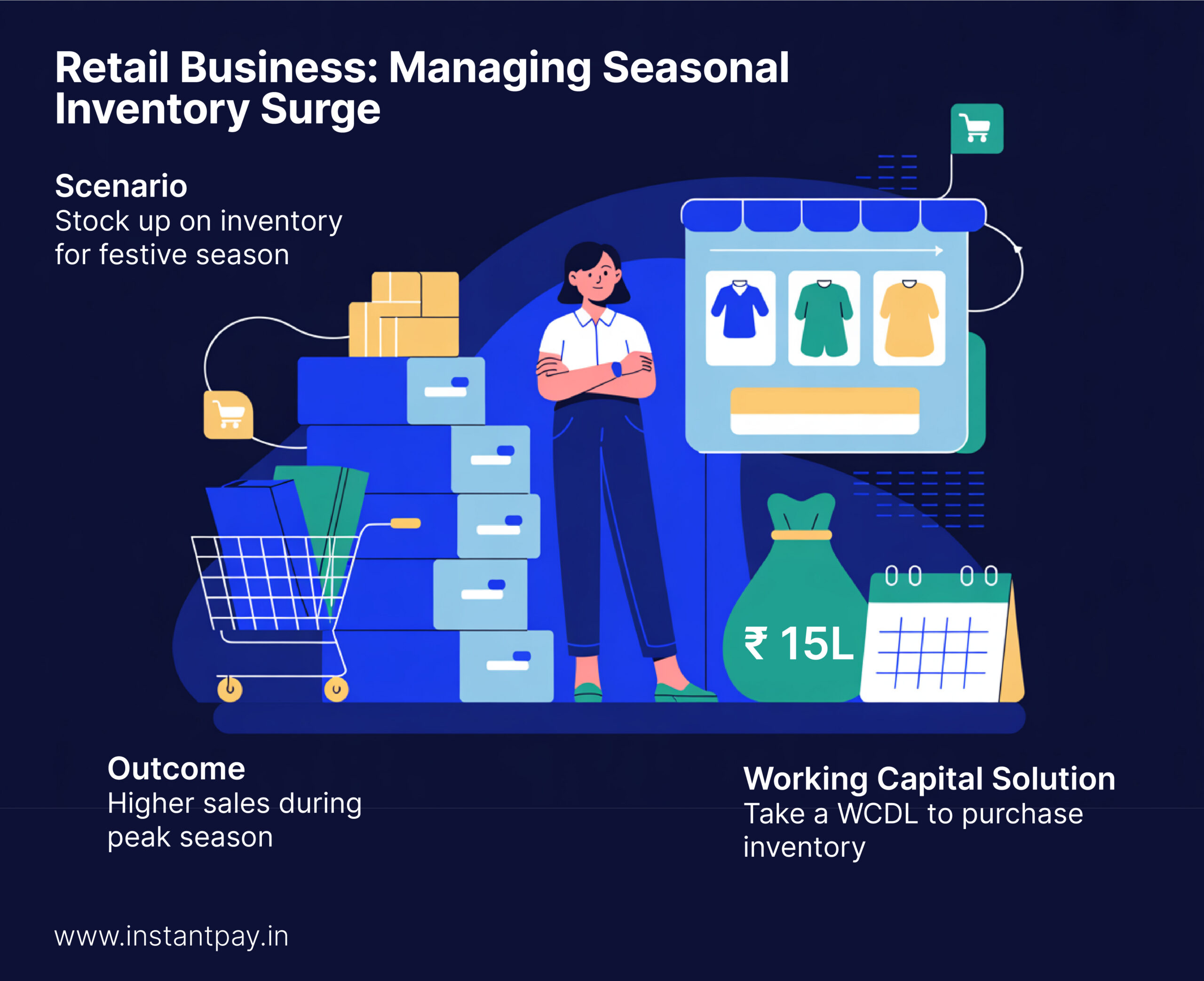
A fashion retailer anticipates a massive surge in sales during the festive season (e.g., Diwali or Christmas). However, to stock up on trending inventory, they need to make upfront bulk purchases from suppliers months in advance.
Working Capital Solution:
The retailer takes a Working Capital Demand Loan (WCDL) of Rs.15 lakhs to purchase inventory ahead of time, capitalizing on early-buyer discounts. The loan is repaid post-season using sales revenue.
Outcome:
- Higher sales during peak season.
- Improved profit margins due to early procurement.
- Smooth operations without touching reserve capital.
Manufacturing Business: Tackling Raw Material Price Hike
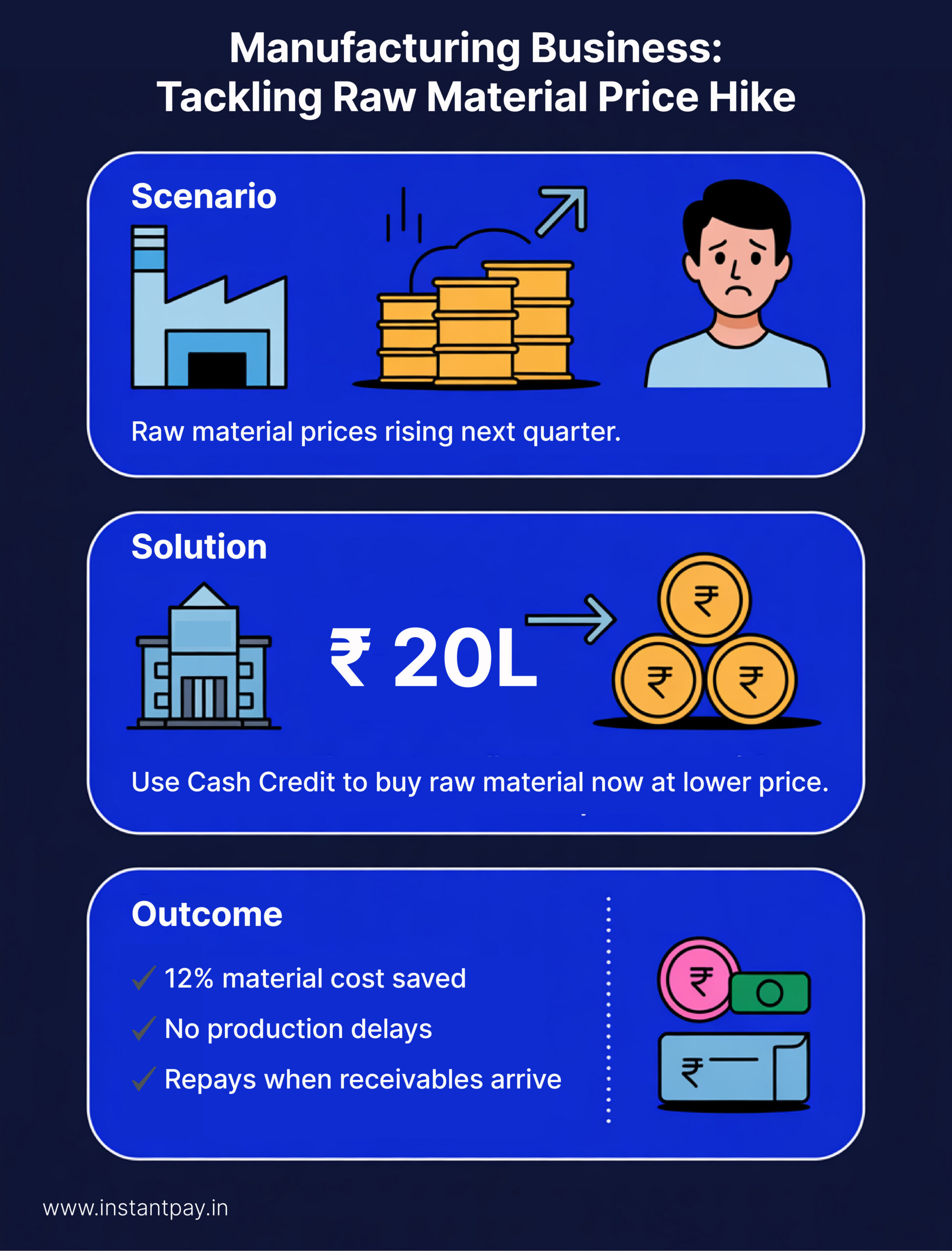
A mid-sized FMCG manufacturer learns that a core raw material (say, edible oil) will see a significant price increase in the next quarter. Buying in bulk now can save costs, but current liquidity is tied up in receivables.
Working Capital Solution:
They use their Cash Credit facility to draw Rs.20 lakhs and stock 3 months’ worth of raw materials at the lower price.
Outcome:
- Material cost savings of 12%.
- No production delays due to material shortages.
- Repayment covered once receivables convert in 45 days.
Startup: Delayed Client Payments Affecting Payroll
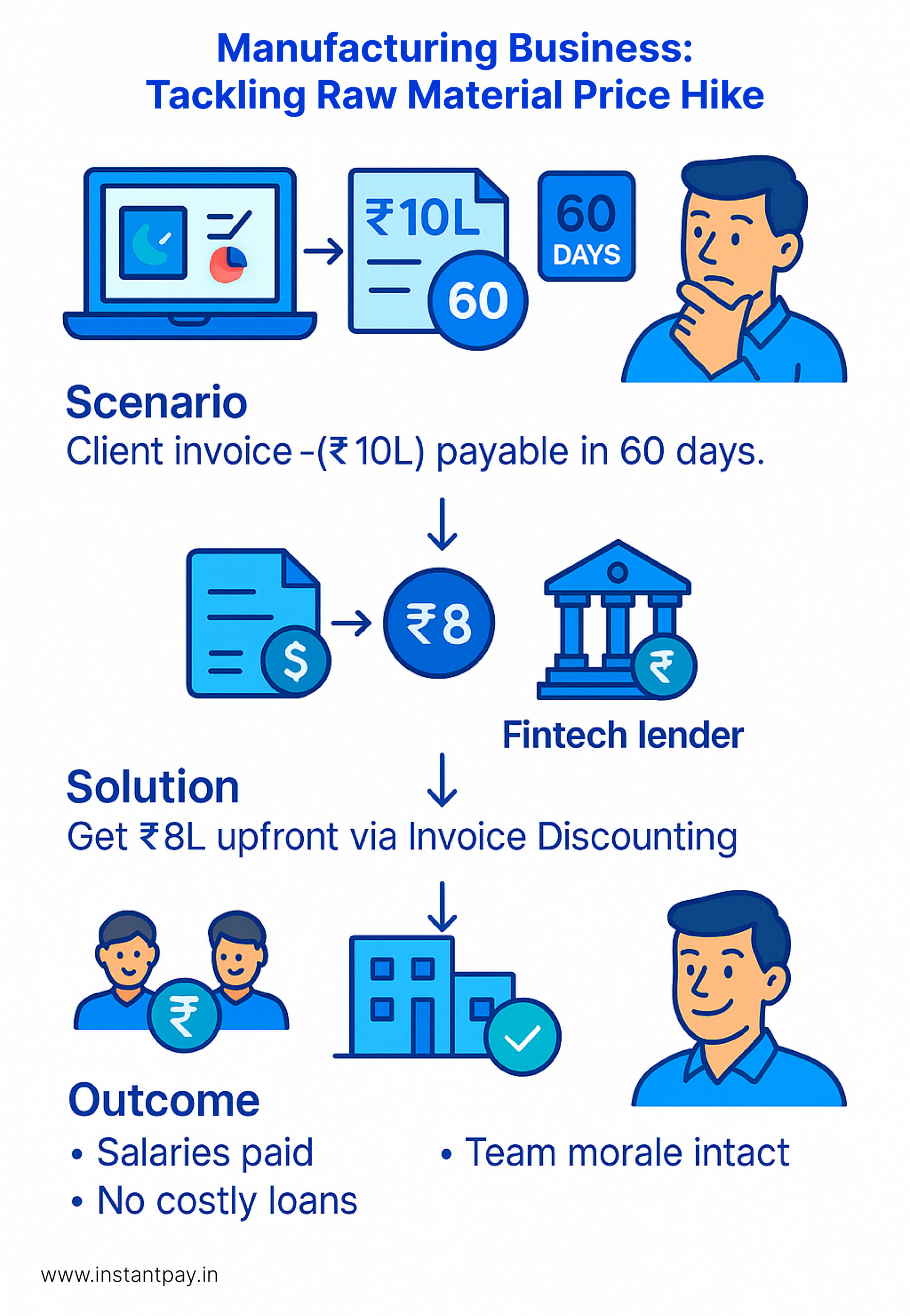
A SaaS startup has just onboarded a major corporate client. The service has gone live, but the first invoice (Rs.10 lakhs) has a 60-day payment cycle. Meanwhile, salaries and operational expenses are due.
Working Capital Solution:
The startup opts for Invoice Discounting, getting Rs.8 lakhs against the invoice upfront from a fintech lender.
Outcome:
- Salaries and rent paid without disruption.
- Avoided short-term borrowing at high interest.
- Preserved credibility and team morale.
Restaurant Chain: Funding Expansion Between Rounds
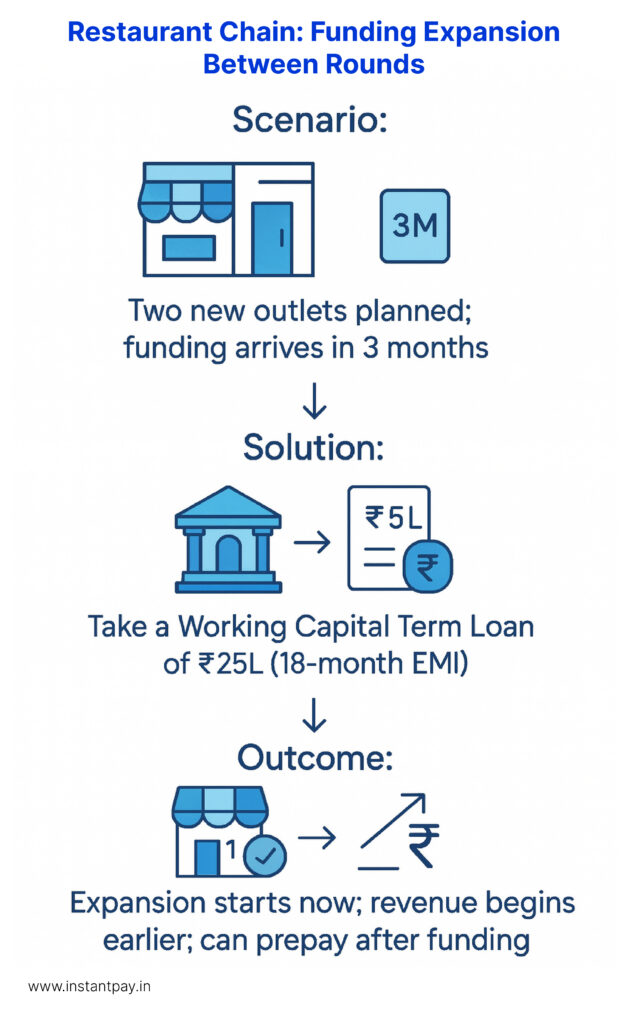
A quick-service restaurant chain is opening two new outlets. Its next funding round is expected in 3 months, but expansion work must begin now.
Working Capital Solution:
They secure a Working Capital Term Loan of Rs.25 lakhs with 18-month EMI-based repayment.
Outcome:
- Expansion doesn’t get delayed.
- Faster revenue generation from new outlets.
- Funding round proceeds can clear a portion early.
Export Business: Bridging Logistics and Payment Gaps
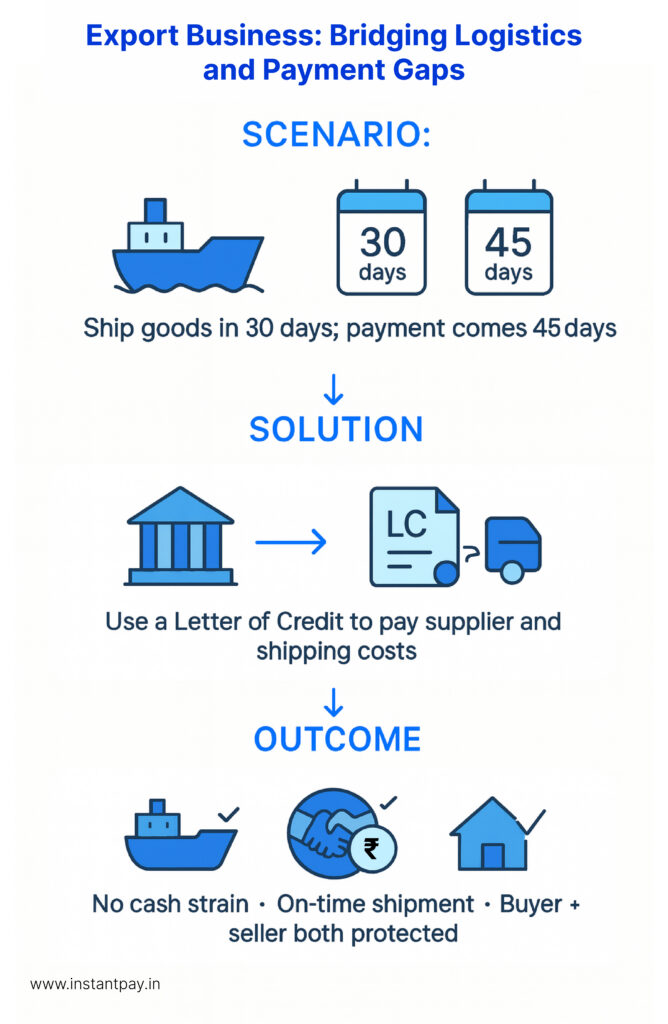
An exporter of home textiles receives a large international order. Goods must be shipped in 30 days, but payment will be released only 45 days after delivery.
Working Capital Solution:
The exporter obtains a Letter of Credit from their bank and uses it to pay the supplier and manage shipping costs.
Outcome:
- Order fulfilled without internal cash strain.
- On-time shipment avoids penalties.
- Buyer is assured, seller is paid—win-win.
Working Capital Loan Interest Rate
Interest rate is more than just a number—it directly impacts your business’s profitability, repayment planning, and long-term financial health. Understanding how working capital loan interest rates are calculated, what influences them, and how you can negotiate better terms gives you a significant edge.
Let’s unpack how interest rates work in this space—and how to make them work in your favor.
What Are the Typical Interest Rates for Working Capital Loans?
Working capital loan interest rates in India typically range from 9% to 18% per annum, depending on the following factors:
- Whether the loan is secured or unsecured.
- The borrower’s credit score and business vintage.
- Type of loan: term loan, overdraft, or cash credit.
- Relationship with the lending institution.
Note: Government schemes or MSME loans under SIDBI, CGTMSE, or Mudra may offer lower rates starting from 7%.
Breakdown by Loan Type
| Loan Type | Typical Interest Rate Range | Notes |
| Working Capital Term Loan | 10% – 15% | Lower rates for secured loans |
| WCDL (Demand Loan) | 11% – 16% | Shorter duration, fixed interest |
| Overdraft Facility | 9% – 14% | Charged on used amount only |
| Cash Credit | 10% – 16% | Depends on drawing power/collateral |
| Invoice Discounting | 12% – 18% | Higher risk = higher cost |
| Merchant Cash Advance | 18% – 30% (factor-based) | Repayment via daily card sales |
What Influences Your Interest Rate?
1 Creditworthiness
Your CIBIL or business credit score plays a major role. A score above 750 often secures better terms. Businesses with audited statements and clean repayment history typically receive favorable rates.
2 Collateral Availability
Secured loans backed by inventory, receivables, property, or equipment enjoy lower interest compared to unsecured loans, where the lender takes on more risk.
3 Loan Tenure
Shorter-term loans generally attract slightly higher annualized rates due to increased liquidity risk for the lender.
4 Loan Type
Revolving facilities (like overdrafts or cash credit) may have lower interest but may include hidden charges like commitment fees or renewal fees.
5 Business Profile & Sector
Sectors with high volatility or regulatory risk may attract premium rates, while stable sectors (like education, healthcare, etc.) often qualify for better rates.
Real-World Example: Understanding Interest Cost in Practice
Scenario:
An SME secures a Rs.10 lakh working capital term loan at 12% interest for 12 months.
Monthly EMI Breakdown:
- EMI: Rs.88,848
- Total Interest Payable Over the Year: Rs.66,170
- Total Repayment Amount: Rs.10,66,170
Now imagine the same loan at 16%—you’d pay nearly Rs.88,000 in interest, a Rs.22,000 difference over just one year.
This is why even a small % difference can significantly affect your bottom line.
Tips to Secure a Lower Interest Rate
- Strengthen Financial Statements
Show consistent profit, healthy cash flow, and minimal debt on your balance sheet. - Build a Good Credit History
Pay off previous loans or credit card dues early. Avoid late payments. - Offer Collateral if Feasible
Even partial security can help bring down the rate by 1–3%. - Negotiate as a Repeat Borrower
Lenders often give better terms to existing customers with good repayment track records. - Use Government Schemes
Explore options like the Credit Guarantee Fund Scheme (CGTMSE) or MSME-specific loans that cap interest rates. - Compare Multiple Lenders
Don’t jump at the first offer. Use digital marketplaces or aggregators to find the best deal.
Quick Recap: Know the Rate, But Also the Cost
| Variable | Why It Matters |
| Interest Rate (%) | Affects your monthly payout |
| Processing Fees | Typically 1–2%, added upfront |
| Prepayment Charges | May apply if you repay early |
| Disbursement Speed | Faster disbursal may come with premium |
| Effective Interest (APR) | Includes fees, gives true loan cost |
How to Apply for a Working Capital Loan
- Assess Your Need: Determine if you require permanent working capital or a seasonal boost.
- Choose the Right Type: Pick from WCDL, overdraft, invoice finance, or WCTL based on business goals.
- Compare Offers: Evaluate rates, repayment terms, and processing fees from multiple lenders.
- Prepare Documentation: Include business proof, income tax returns, GST returns, financial statements, and bank statements.
- Apply Online or Offline: Many NBFCs and banks offer easy online application procedures.
One Capital Loan or Multiple? What Works Best?
Choosing between a one-time capital loan or using multiple smaller working capital loans or credit lines can dramatically impact your business’s flexibility, cost-efficiency, and risk exposure. There’s no one-size-fits-all approach—what works best depends on your cash flow rhythm, repayment comfort, industry volatility, and financial discipline.
Let’s explore both strategies in detail to help you make a smarter funding decision.
What is a One Capital Loan?
A one capital loan is a single, lump-sum disbursement—often in the form of a working capital term loan, demand loan (WCDL), or SME business loan—taken to meet overall operational needs. It usually comes with a defined tenure and structured repayment plan.
Best When:
- You have a clear idea of total fund requirement.
- Cash flow projections are stable and predictable.
- You prefer a single EMI and streamlined repayment process.
What About Multiple Loans or Facilities?
Instead of a one-time lump sum, some businesses divide their working capital needs into categories and use multiple funding instruments—e.g., overdraft for daily needs, invoice financing for receivables, and a seasonal loan for inventory build-up.
Best When:
- Your business has cyclical or unpredictable cash flow.
- You want to match borrowing with specific use-cases.
- You seek flexibility to pay off certain loans early or adjust credit usage.
Pros and Cons at a Glance:
| Feature | One Capital Loan | Multiple Loans/Credit Tools |
| Ease of Management | Simple—single EMI, fixed tenure | Slightly complex—multiple repayments |
| Customization | Limited once disbursed | High—loans tailored to needs |
| Cost Efficiency | Can be lower if loan is secured | May pay higher cumulative interest |
| Flexibility | Low—locked structure | High—pay off or switch as needed |
| Risk Exposure | Higher if miscalculated requirement | Spread across smaller, purpose-led tools |
| Fund Utilization | May result in idle funds | Better matched with actual cash flow |
Key Considerations Before You Decide
1 Nature of Your Business Model
A stable cash-flow model (like utilities or education) may do well with one capital loan. Dynamic or seasonal businesses (like retail or construction) benefit more from modular credit.
2 Loan Management Bandwidth
If your team isn’t equipped to track multiple loans, a single capital loan simplifies accounting and reduces the risk of default.
3 Negotiation Power
You might get better terms with one large loan from a trusted lender vs. multiple smaller loans at varied rates.
4 Cash Flow Mapping
Break down your working capital cycle—daily needs, receivable gaps, peak season requirements—and see which tools align with each segment.
Hybrid Approach: The Best of Both Worlds?
Many growth-stage businesses prefer a hybrid model:
- A moderate one capital loan to anchor stable operations.
- A flexible line of credit or overdraft for fluctuating needs.
- Invoice discounting as a tactical tool for liquidity spikes.
This allows cost control, flexibility, and strategic borrowing.
Final Thoughts: Strategic Use of Working Capital Finance
Working capital finance is far more than a reactive funding option. For modern businesses, it represents the ability to move with confidence—whether you’re navigating uncertain demand, dealing with delayed payments, or preparing for an aggressive growth phase. It’s not simply about fixing a cash crunch; it’s about ensuring your operations never pause for the lack of liquidity.
Many business owners still approach working capital loans as last-resort solutions, used only when problems arise. But those with a long-term vision treat them as proactive tools—designed to give their business the momentum it needs during expansion, transition, or strategic repositioning. A well-structured working capital loan enables better decision-making, improved vendor negotiations, and greater freedom to pursue time-sensitive opportunities.
The key lies in alignment. When working capital financing is mapped against your cash flow cycle, supplier payments, receivable timelines, and business seasonality, it becomes a catalyst rather than a burden. Businesses that take the time to understand how different working capital instruments function—like term loans, overdrafts, invoice financing, or WCDLs—can build a customized mix that supports both stability and scalability. This approach helps avoid idle capital, reduces interest outgo, and creates a more efficient borrowing structure.
Equally important is the practice of reviewing your financing model regularly. Markets change, operational needs evolve, and repayment capacities shift. By continuously evaluating whether your current working capital setup still serves your business goals, you can adapt quickly and stay financially agile.
Above all, strategic use of working capital finance is about more than just accessing funds. It’s about developing smart relationships with financial partners, using borrowing to drive profitability rather than absorb losses, and turning short-term credit into long-term growth. In the hands of a thoughtful business owner, a working capital loan isn’t a liability—it’s a competitive advantage.
FAQs
1. What is a working capital loan?
A short-term loan used to finance daily business operations.
2. What is permanent working capital?
The minimum level of working capital required to keep the business running consistently.
3. What is WCDL in banking?
WCDL stands for Working Capital Demand Loan—a short-term facility typically renewed annually.
4. What is the interest rate on working capital loans?
Ranges from 9%–17% p.a. depending on credit score, collateral, and lender.
5. Can startups get working capital loans?
Yes, through NBFCs and alternate lenders, though at higher rates or with limited tenures.
6. Is collateral required for a working capital loan?
Not always. Many NBFCs and fintech lenders offer unsecured working capital loans, especially for MSMEs, though secured loans often come with lower interest rates.
7. What is the difference between working capital loan and term loan?
A working capital loan is typically short-term and used for day-to-day expenses, while a term loan is long-term and used for fixed investments like equipment or infrastructure.
8. How quickly can a working capital loan be approved?
With digital lenders, approval can take as little as 24–72 hours, especially if the business has clean financials and existing credit history.
9. What documents are required for a working capital loan?
Commonly required documents include bank statements, ITRs, GST filings, business registration proof, and audited financials—though this may vary by lender.
10. Can a business get multiple working capital loans at once?
Yes, as long as the overall credit exposure is within acceptable limits. Many businesses use a mix of overdrafts, invoice financing, and seasonal loans simultaneously for flexibility.