For many decades, small businesses have had very few traditional banking advantages, such as higher fees, fewer options for capital, and stricter processes limiting their ability to grow. However, API banking is revolutionizing these circumstances for small businesses.
In fact, industry sources indicate that API-first lending solutions will account for 40% of the total market for small business lending by 2026, meaning that in less than one year, nearly half of all loans issued to small businesses will be funded through digital connections that were previously not available (e.g., no more lengthy paperwork or waiting weeks) and through the platforms that owners use now.
Because many small businesses are often held back by lengthy approval times and restrictive criteria, API banking represents not just a technology improvement; it has created a level playing field for small businesses and is providing them with unprecedented access, speed, and flexibility in obtaining financing.
As the API banking industry moves from being a popular term to becoming the foundation upon which future financial services will be built, small businesses the world over will have the tools necessary to compete with larger corporations right from their personal computers and/or mobile devices.
What is API banking?
API banking is a way for businesses to utilize banking services through the use of application program interfaces (APIs), which allows for direct access to those services from within the business’s own applications or systems, as opposed to relying on traditional banking applications using paper methodologies.
In practical terms, using API banking allows a small e-commerce company to quickly integrate a payment gateway, automate reconciliation with its customers, and verify bank accounts in real time.
Traditional vs. API Banking: A Comparative Analysis
Below is a detailed comparison of the two models across critical dimensions:
| Dimension | Traditional Banking | API Banking |
| Flexibility | Siloed products; limited third-party integrations | Modular services; seamless fintech/e-commerce embedding |
| Speed | Days/weeks for loan processing; batch settlements | Real-time payments; instant loan approvals |
| Cost | High fees (maintenance, transactions) | Lower transaction costs; pay-per-use API models |
| Customer Experience | Branch-dependent; manual paperwork | Embedded finance; personalized digital tools |
Key Differences Explained
The structure of API banking is changing how small and medium enterprises (SMEs) are doing business within the financial services arena and is providing benefits that traditional models cannot provide. Below is a further description of how the two differ:
Flexibility
Traditional Banking:
- Traditional banks operate in a closed, siloed environment. Their products and services (i.e. payments, lending, KYC) are combined and delivered as bundles in a rigid manner.
- SMEs are often required to modify their business processes to adhere to the products an SME has with a traditional bank. In addition, they often have limited integration options between their business processes and the traditional banking processes and are frequently subjected to manual (and often time consuming) processes.
- All aspects of banking (payments, KYC, lending, etc.) are broken down into discrete and programmable APIs.
- SMEs only have to use those APIs that they desire. They have the capability to integrate those APIs into their existing toolset (i.e. accounting software, ERP, e-commerce platforms) and customize their financial stack as their businesses grow.
- Each component of the financial stack is modular. Therefore, an SME has the ability to develop or implement a solution that is not exclusive to a particular provider or a particular product set. As a result, more innovation is generated, and increased levels of competition exist in the market.
Speed
Traditional Banking:
- Batch processing with manual intervention is used for most operations, resulting in a time lag: A loan disbursal typically takes between 3 to 5 days; a loan disbursal can take even longer than 5 days.
- Paperwork and physical verification steps slow down common banking operations (e.g., opening accounts, payments and making credit decisions).
API Banking:
- Operations are completed in real-time: UPI settlements are instantaneous; account validation KYC, and credit verification can be done in minutes through digital data exchange methods.
- Open banking APIs allow for instantaneous dissemination of financial data and, hence, allow for quicker credit decisions and onboarding.
- Businesses can immediately access funds, reconcile their accounts faster, and manage their cash flow more efficiently.
Cost
Traditional Banking:
- Higher prices are charged for everyday services. Transaction fees and other hidden costs (like up to 5% per transaction) are frequent charges.
- Manual processes lead to increased administrative overhead and lack of integration in terms of administrative overhead for Small to Medium Enterprises (SME).
API Banking:
- Costs associated with payments are reduced as payments can be made directly from bank to bank without going through expensive intermediaries such as credit card networks.
- Accounting and reconciliation work is automated through APIs, reducing the manual labor and mistakes when completing these tasks, resulting in significant time and money savings.
- Pricing models are scalable and pay-per-use, enabling SME’s to only pay for services consumed, thus providing access to an enhanced set of financial features that most SMEs could not afford.
Customer Experience
Traditional Banking:
- Uses face-to-face customer interaction but usually loses out on ease of use—stopping at a bank branch, filling in forms, and waiting hours are the norm.
- Different financial needs are served through different relationships and systems that don’t communicate with each other (are siloed).
API Banking:
- Allows for hyper-personalized client experiences: using AI to provide personalized experiences, allowing ease of use in the checkout process by incorporating embedded lending, and providing visibility into both cash flow and accounts via a unified dashboard, all of which can be accessed any time of the day via digital channels.
- Provides an overview of all finances for SME clients, allows for the automatic payment of repeat invoices, and gives product recommendations to clients based on up-to-date data.
- Reduces customer satisfaction and loyalty due to smoother onboarding processes, fewer required documents, and improved integration with business applications.
Summary Table: Key Differences
| Aspect | Traditional Banking | API Banking |
| Flexibility | Rigid, closed systems | Modular, customizable, integrable |
| Speed | Slow, batch-based, manual | Real-time, instant, automated |
| Cost | High fees, manual overhead | Lower, pay-per-use, automated |
| Customer Experience | In-person, siloed, paperwork-heavy | Personalized, digital-first, unified, 24/7 |
Advantages of API Banking for Small Businesses
API banking directly addresses historical SME pain points:
- Access to Capital
- Problem: Approximately 70% of SME lending requests are denied by traditional banking institutions because the lack of a sufficient credit history..
- API Solution: Open banking APIs share real-time transactional data directly with lenders to allow for risk assessment to be done based on cash flow, versus simply relying upon credit scores and history. The result is an approximate 40% reduction in the time for loan approval.
- Operational Efficiency
- Accounting that has to do with tools like QuickBooks is synchronized automatically with bank transactions through the use of APIs, resulting in less manual entry of data and fewer mistakes being made.
- Payment processing (e.g., Stripe) from embedded payment processing will result in a reduction in fees by approximately 30%–50% over traditional card payment networks.
- Financial Agility
- Real-time (just-in-time) services are enabled by APIs. For example:
- Inventory financing: Loans can be triggered as stock levels dip below pre-determined thresholds.
- Dynamic cash flow management: AI can be used to determine future shortages of cash flow based on transaction-level activity
- Real-time (just-in-time) services are enabled by APIs. For example:
Advantages for Banks
Banks gain equally from API adoption:
- New Ways to Make Money: Use Subscription Methods to Charge Customers for Your APIs ($0.01 – $0.10 per call) or Offer Premium Services
- Speed of Innovation: Use Fintech Partnerships to Launch Products in Weeks Not Years—For Example, ICICI’s API Marketplace Has Over 400 Different Types of Services (from GST Verification to Instant Account Opening)
- Customer Retention: Businesses Using Embedded Finance Have 68% Greater Loyalty to Their Bank When Compared to Businesses That Don’t Use Embedded Finance
Challenges in Transitioning to API-Driven Platforms
- Outdated core infrastructures restrict banks’ ability for seamless API integration or availability.
- Systemic requirements from RBI, along with other local and international regulatory bodies related to consumer data protection create burdens on organizations to implement systems that meet required standards for consent-based consumers.
- Small non-technology businesses often do not have the internal technology skills to effectively integrate APIs or utilize them to their full potential.
- Many businesses have an aversion to changing from their trusted manual processes to an automated way of doing business.
6 Case Studies on How API Banking Help Small Businesses
Case Study 1: E-Commerce – Automating Cash Flow and Refunds
Background
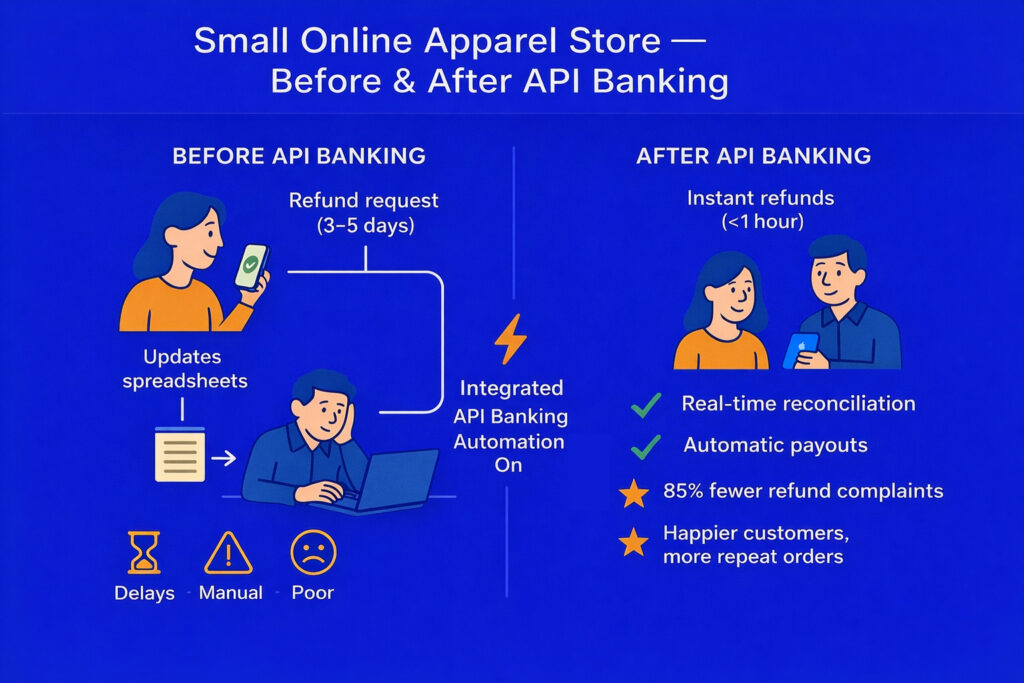
The online apparel store experienced challenges in the areas of delayed customer refunds, manual reconciliation of payments, and cash flow mismatches during times of high sales volume. As a result, the store had poor ratings from customers and operational stress.
Implementation
To eliminate dependence on end-of-day manual processes and visits to banks, the store implemented API banking to facilitate payment collection, real-time reconciliation of payments, and refunding customers instantly within the e-commerce platform.
Outcomes
- The store was able to reduce refund timelines from 3-5 days to under 1 hour.
- The store created real-time dashboards to measure how sales relate to payouts; therefore, improving cash flow visibility.
- The complaints from customers regarding refunds decreased by 85% as a result of implementing API banking. This resulted in more positive store ratings and repeat orders.
Lesson Learned
By using API banking, this small business can compete with larger market competitors by providing customers with a timely refund and transaction experience, without adding additional employees that would increase the operational costs associated with managing cash flow.
Case Study 2: Logistics – Streamlining Driver Payouts
Background
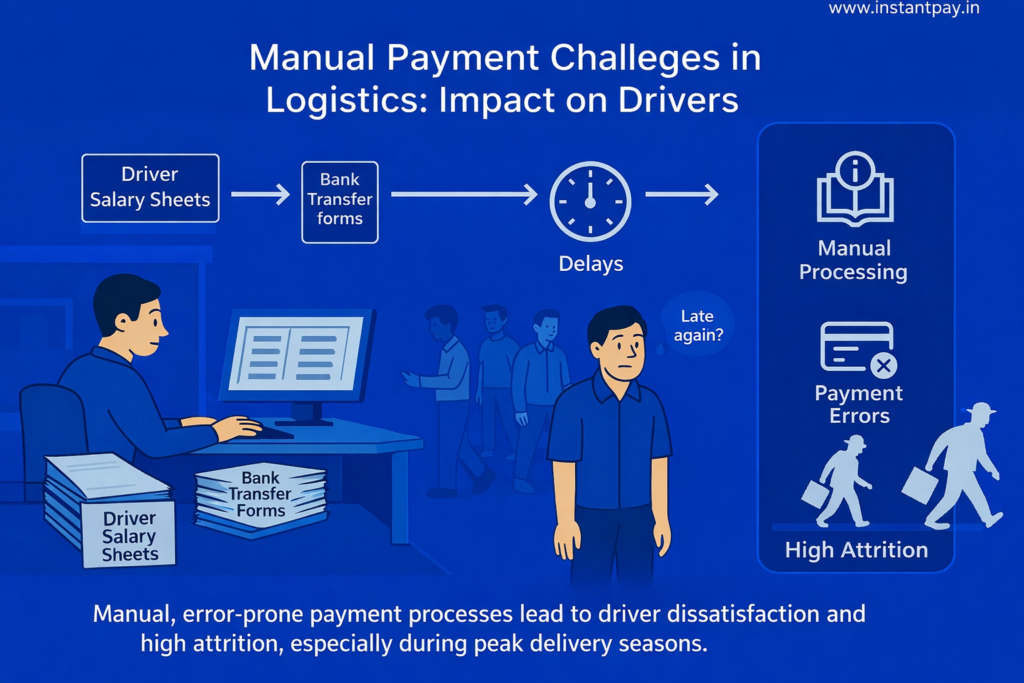
The management of drivers at a small locally-owned transportation company (logistics) led to inefficient processes resulting in dissatisfaction and high turnover (attrition) during peak delivery periods due to manually transferring driver’s pay electronically via bank transfers rather than making driver payments automatically via checks.
Implementation
They implemented API banking which enabled automatic direct deposits into driver’s bank accounts on the successful confirmation of driver’s delivery. They verified the accuracy of the driver’s beneficiary account number using real-time account verification APIs.
Outcomes
- The time required for a driver to receive payment was reduced from T+2 days (two business days) after confirmation of delivery to instant (0 time) after successful confirmation of delivery.
- By reducing both the number of erroneous and rejected driver payments made, the company has reduced its reconciliation costs by 95%.
- The direct deposit method of making payments to its drivers has increased driver satisfaction, which has decreased the number of drivers leaving the company (attrition) and improved the company’s delivery service commitment (Service Level Agreement [SLA]).
Lesson Learned
This small and medium size enterprise (SME) in logistics has utilized the API banking process to convert timely driver payments into a market differentiator (competitive mechanical advantage) and, at the same time, has improved operational efficiency without adding any additional manual effort in processing payroll.
Case Study 3: Healthcare Services – Simplifying Patient Payment Plans
Background
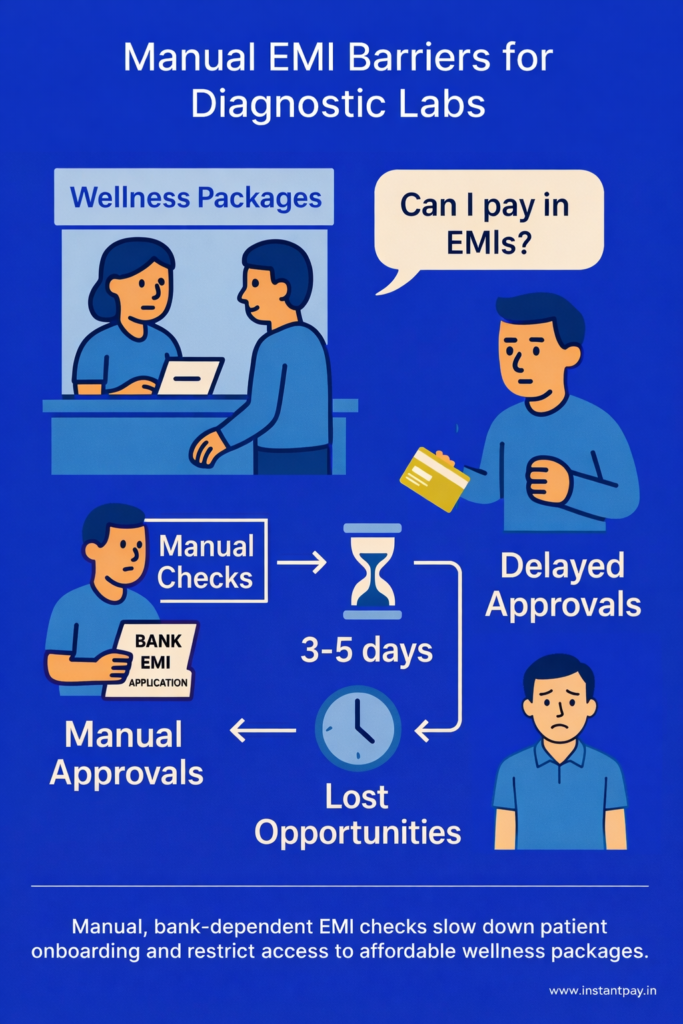
A small health diagnostic laboratory was providing wellness packages to patients but was struggling to provide patient-friendly EMI payment options. Instead, the labs had to do manual checks with banks before patients could have access to the EMIs for their coming health service packages. This limited the flexibility available to patients with regard to available funds.
Implementation
The laboratory implemented API banking to allow for embedded payment plans and EMI payment options to be available directly at the checkout counter and online when patients entered the laboratory’s booking site. The laboratory used API banking to find out how to collect KYC information, design payment schedules, and collect payments in real time.
Outcomes
- Patients now can separate their bills into multiple, easily repayable EMI without delays associated with collecting paperwork.
- The lab increased its collected accounts by 28% and decreased the time it takes to collect accounts receivable.
- Increased patient loyalty and a higher number of upgrades on service packages received during the patient’s checkup.
Lesson Learned
Implementation of API banking enabled the lab to provide equity (democratization) in providing access to healthcare diagnostics for patients, while improving the lab’s cash flow and demonstrating that financial flexibility was a service differentiator for the lab.
Case Study 4: Retail Distribution — Streamlining Loan Repayments and Partner Onboarding
Background
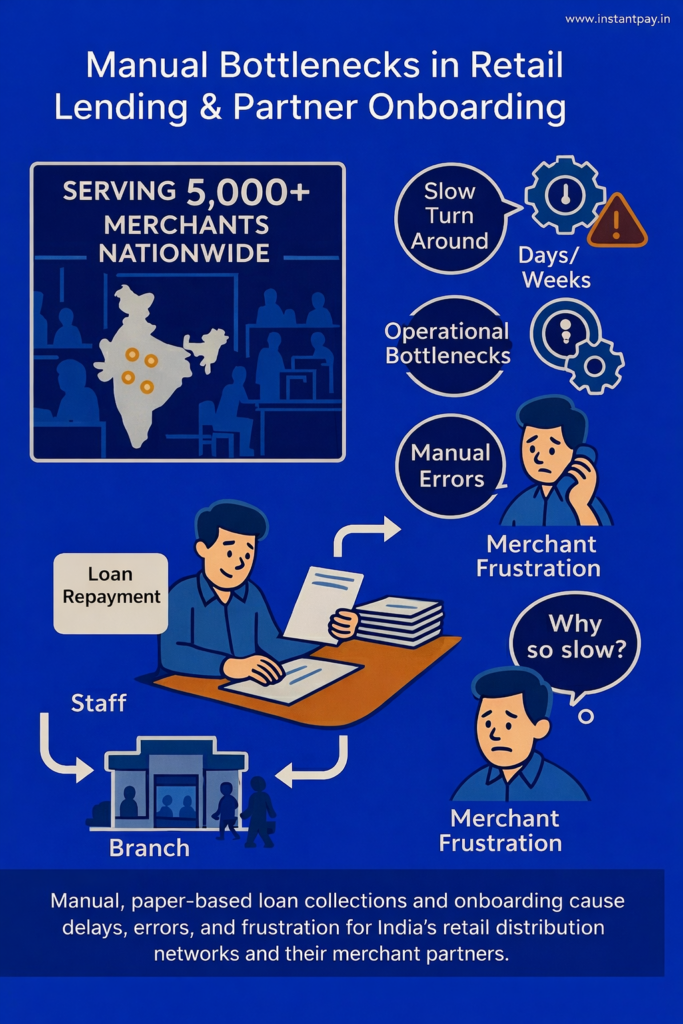
The fast-growth model for a distribution network consists of thousands of small merchants across India and continues to expand every day. The main challenges for the distribution network were related to the manual collection of loan repayments as a result of the many layers of bureaucracy (causing delays) and the length of time it took to onboard new retail partners.
Traditionally, the banking experience involved significant customer paperwork, required the client to go to the bank branch to complete the banking transactions and took too long to complete. The long turnaround time resulted in operational bottlenecks and delays for the merchant partners.
Implementation
Working with a small finance bank, the Distribution Network created a highly effective API stack that allows for the automation of loan repayment collections from merchant partners as well as digitization of the entire new retail partner onboarding process through the integration of the bank’s APIs. An API gateway provided the seamless exchange of data in real-time for the payment processing, account verification, and tracking of the loan repayment transaction status.
Outcomes:
- There were more than 1,000,000 automated loan repayment transactions completed each month without any operational issues to date.
- The reduced business turnaround time (TAT), both in terms of the onboarding of merchant partners and providing better service to those merchant partners.
- The improved experience for the merchant partners and their respective customers, as well as the resulting increase in customer satisfaction and retention levels.
Lessons Learned:
- API banking can be used to rapidly and reliably scale business operations, particularly in high volume business environments.
- Automating financial workflows using APIs eliminates manual errors and removes the need for your customers to go to the bank branch, allowing you to free up resources to help grow your business.
Case Study 5: Digital Payments — Empowering SMEs with Real-Time UPI Integration
Background
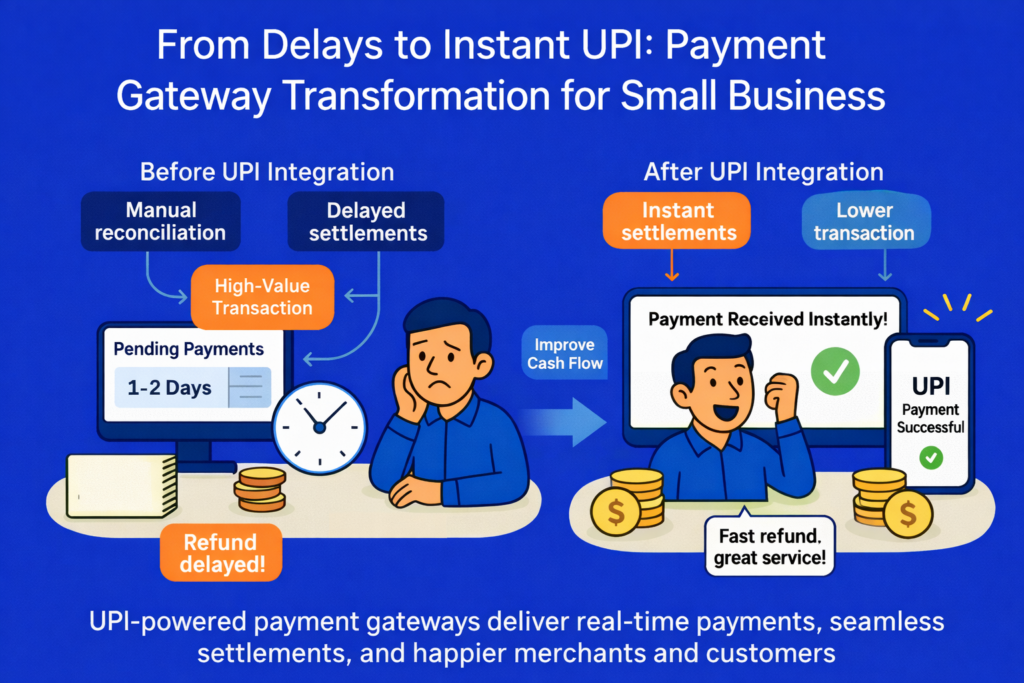
A digital payment gateway that works with small businesses and e-commerce merchants wanted to offer UPI (Unified Payments Interface) payments instantly for merchants and be able to settle the money instantly as well. Before using UPI and the payment gateway, merchants using traditional means of payment had long delays and expensive transaction costs affecting their cash flow and ability to satisfy their customers.
Implementation
The payment gateway was able to integrate UPI (Unified Payments Interface) APIs from their partner banks to allow merchants to accept instant digital payments from customers through the payment gateway and directly into their business platforms. In addition, through API integration, merchants can perform automated reconciliation in addition to receiving real-time transaction status notifications and supporting recurring payments.
Outcomes:
- Settlement times were reduced from days to seconds, which caused a significant increase in merchant cash flows.
- A frictionless payment experience helped to increase merchant satisfaction and retention.
- Allowed small businesses to provide their customers with modern and convenient payment options that enabled them to compete with larger businesses.
Lessons Learned:
- API-driven UPI integration is a “game-changer” for small businesses, creating speed and transparency that will outperform traditional banking.
The embedding of payments via APIs allows SMEs to keep up with the expectations of their digital customers while expanding their market reach.
Case Study 6: Manufacturing & Trade — Digital Transformation of Banking Operations
Background
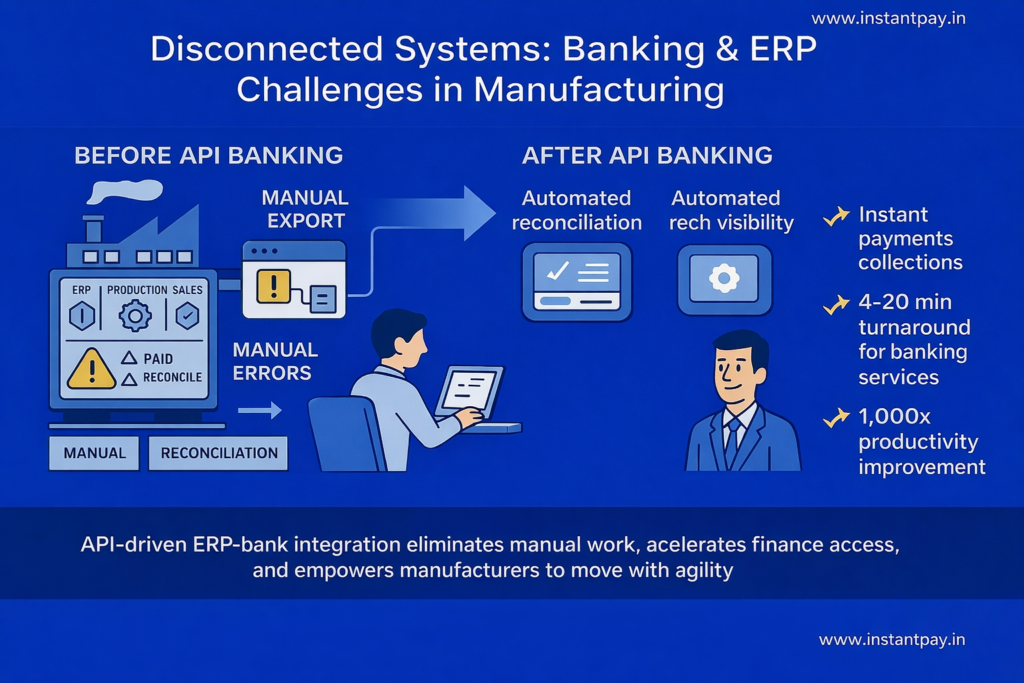
A mid-size manufacturer had issues with independent banking systems, manual reconciliation of bank transactions with ERP systems and caused delays to getting access to trade financing and working capital from banks. The failure for ERP Systems to integrate with banking systems resulted in lost production and opportunities for increased revenue.
Implementation
The manufacturer used a new API-based banking platform created by one of the largest private-sector banks. By using API’s for payments, collections, trade finance, and Supply chain management, the manufacturer automated reconciliation of cash via the API, created real time visibility into their cash-flow, and gained access to credit facilities more efficiently.
Outcomes:
- Delivery of services was improved from 2-3 days down to 4-20 minutes for core Banking services.
- Productivity improved 1000x and modernized 80% of Banking Services; e.g.. account opening, loan applications, & Trade Finance
- Increased agility providing the manufacturer with the tools needed to pursue new opportunities and build stronger supplier and customer relationships.
Lessons Learned:
- API Banking provides the ability to automate and integrate banking processes which transform traditional legacy banking into agile digital first banking workflows.
- API adoption allows SMEs to have access to enterprise quality efficiency and finance agility, which was previously available only for the largest corporations.
Strategies to Overcome Transition Challenges : API Banking for Banks and Small Businesses
Banks and small enterprises alike have encountered various barriers in transitioning towards API-based banking systems and can execute certain targeted strategies that will allow them to address these issues while achieving the full value of API-based banking.
For Banks
1. Invest in Middleware to Connect Legacy Systems with APIs
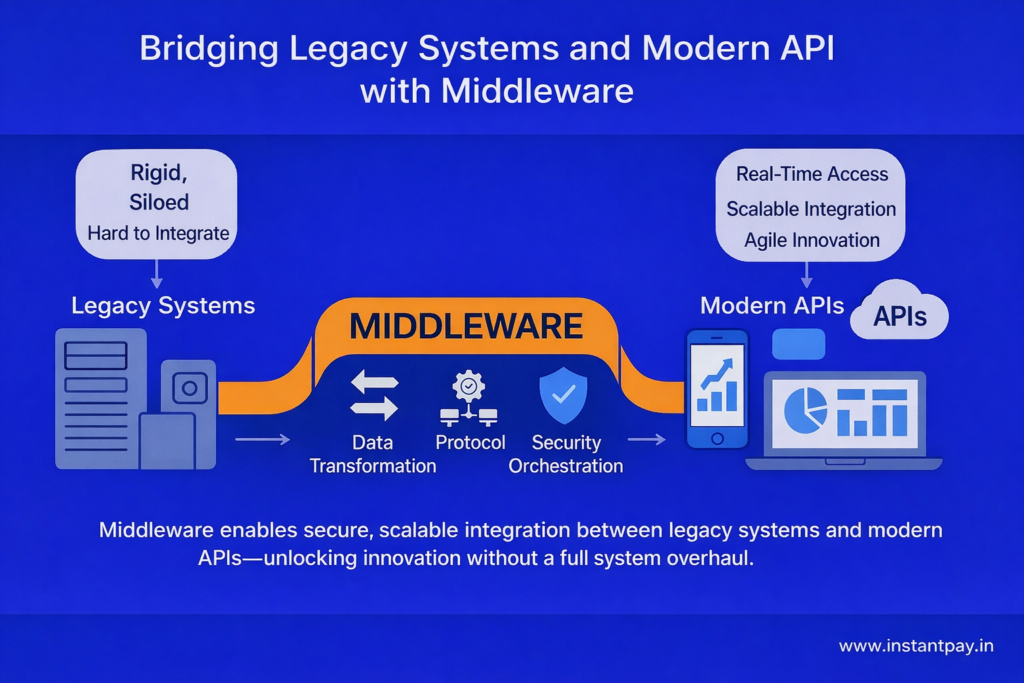
Why: Legacy core banking software was often built up as large systems that did not have the ability to be integrated quickly and in a modular approach. Middleware can assist in removing the difficulty of connecting these older systems to APIs by acting as a bridge to the legacy systems and exposing the functionality of the legacy systems as APIs that conform to specific standards.
How:
- Implement API Management platforms/middleware layers that can convert Legacy Protocols into an API; either RESTful or Event Driven.
- Migrate in stages the primary services (e.g. payments, KYC, lending, etc.) to this API layer thereby allowing for a more rapid deployment and easier maintenance of those services without causing disruptions to the core operations of the Bank.
2. Ensure Robust Security, Encryption, and Consent Management
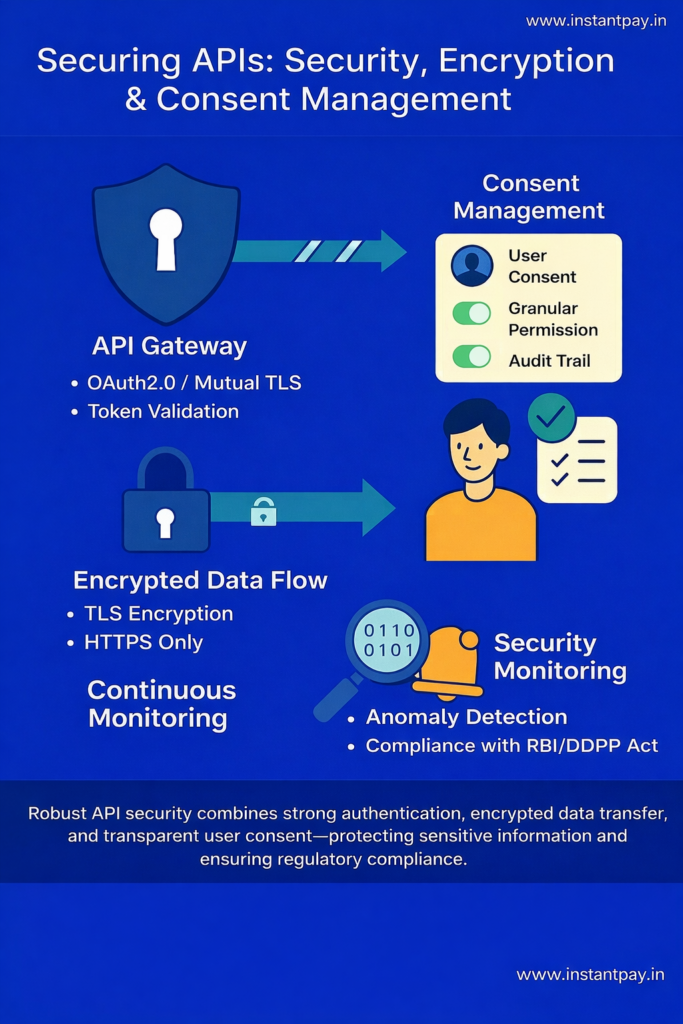
- Why: By making APIs available to the public (via an API portal), many banks may allow increased risk of a bank’s data being breached; in addition, there may be additional risk of fraud occurring as a result of access through an API vs. through a more traditional method. Therefore, it is imperative that all banks in India establish appropriate procedures, as outlined by the Reserve Bank of India (RBI) and the Digital Personal Data Protection (DPDP) Act, in order to obtain explicit consent, if any, to use Personal Data; establish secure mechanisms for handling Personal Data; and establish practices for tracking the movement of Personal Data.
- How:
- Implement strong authentication/authorization (e.g. OAuth2.0), TLS encryption, and role-based access control for ALL APIs.
- Implement Consent Management modules that will track, validate, and enforce the user’s consent to share data.
- Regularly audit APIs and their access and flow paths to ensure compliance with RBI and DPDP, and procedures have been established for monitoring compliance through the implementation of the API.
3. Partner with Fintechs for Smoother API Enablement
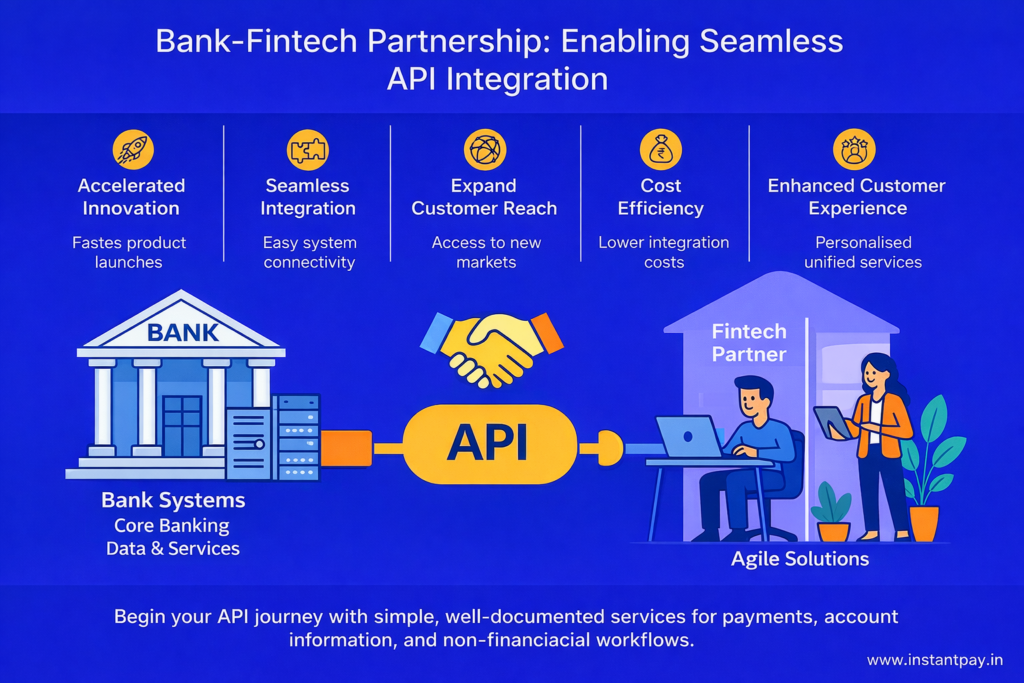
- Why: Fintechs can provide banks with the capability to rapidly accelerate the implementation of APIs through their technical ability, agility, and pre-built solutions.
- How:
- Partnering with fintech partners to co-create, test, and deploy an API-enabled offering will allow for faster implementation.
- Utilizing the plug-and-play capabilities of the fintech’s products, such as payment processing, lending, and customer verification, will help to streamline the development cycle and reduce the complexity of implementing these solutions.
- Using these partnerships will enable the bank to quickly add to their digital ecosystem while targeting a broader audience.
For Small Businesses
1. Start with Easy-to-Integrate API Services (e.g., Payment APIs)
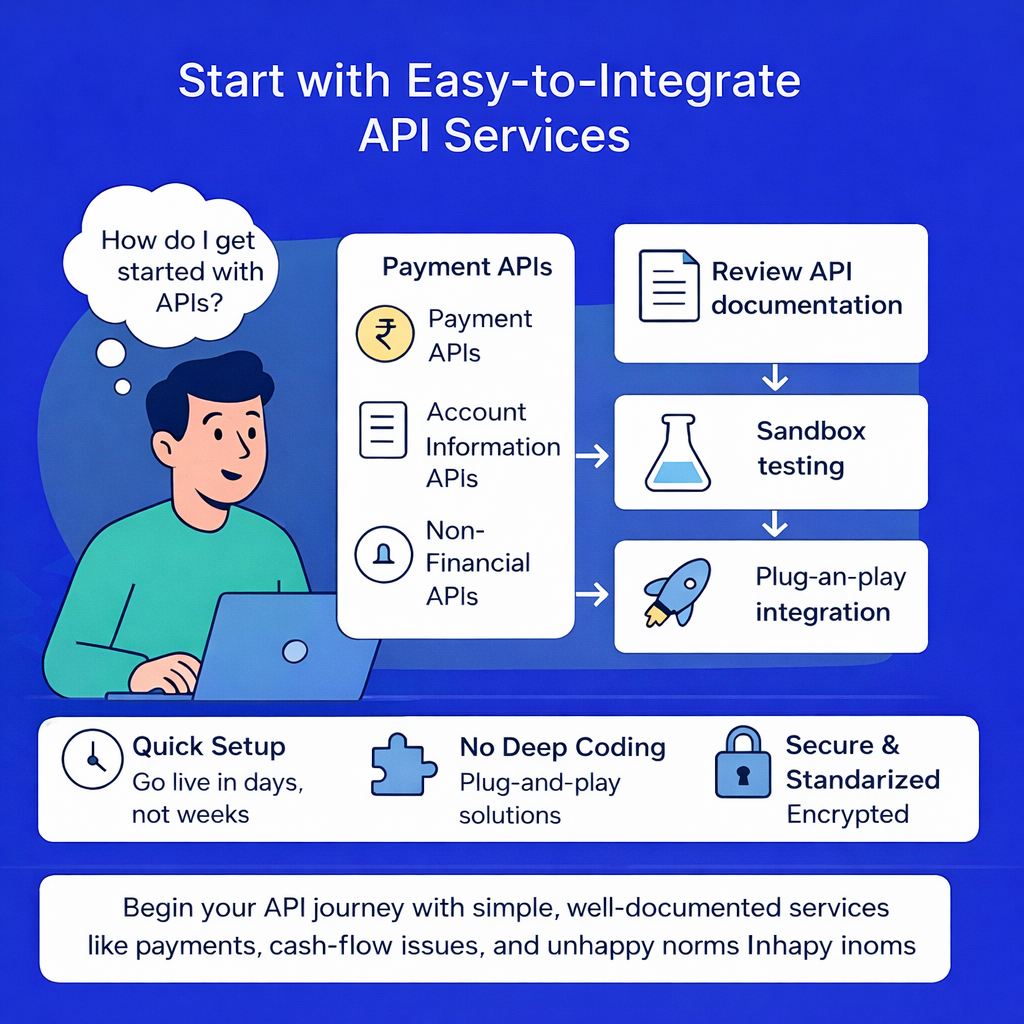
- Why: Payment integration offers many advantages, including speedier settlements and higher-quality cash flow. In addition, these integrations often have a wealth of documentation and community support.
- How:
- First, evaluate banking or fintech partnerships to identify those that offer extensive documentation and payment API compatibility with your existing platforms (e.g., ERP or e-commerce).
- Start by automating vendor payments or implementing systems that facilitate UPI payment acceptance, then grow into additional, more complex uses cases.
2. Use Fintech Partners Offering Plug-and-Play API Solutions
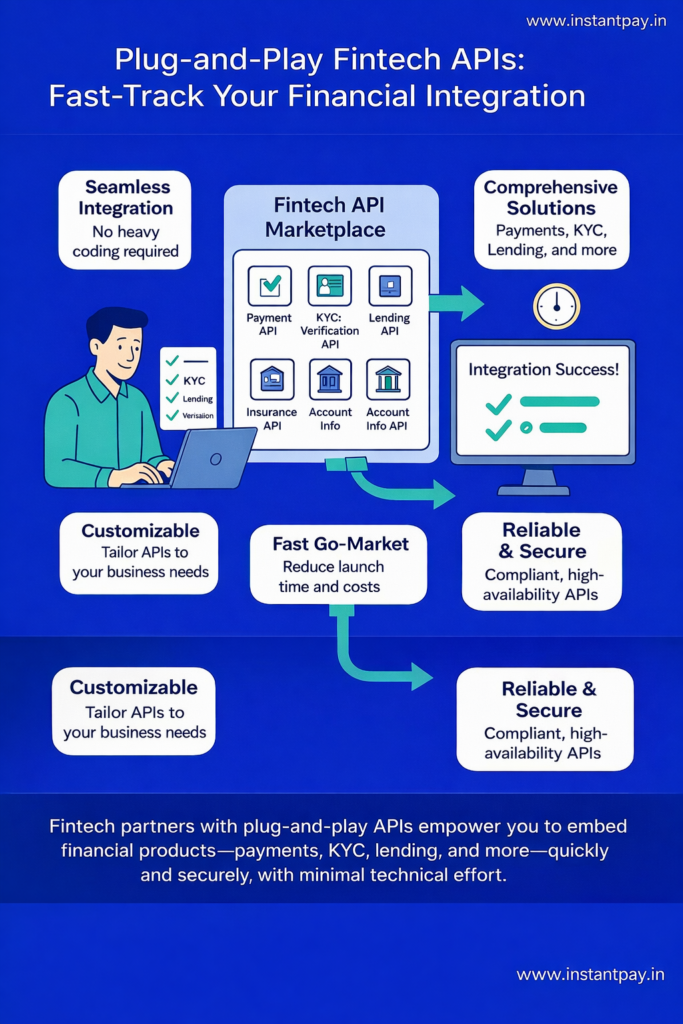
- Why: A lot of financial technology companies have created simple-to-use application programming interfaces (APIs) with well-documented instructions so small businesses don’t have to worry about dealing with the tech side of things.
- How:
- Pick partners with transparent pricing, well-documented codes, and fast response times to get quick answers.
- Use vendors that provide solutions needing minimal code/configuration so your company goes live more quickly than if using traditional method
3. Train Teams on API Workflows and Security Best Practices
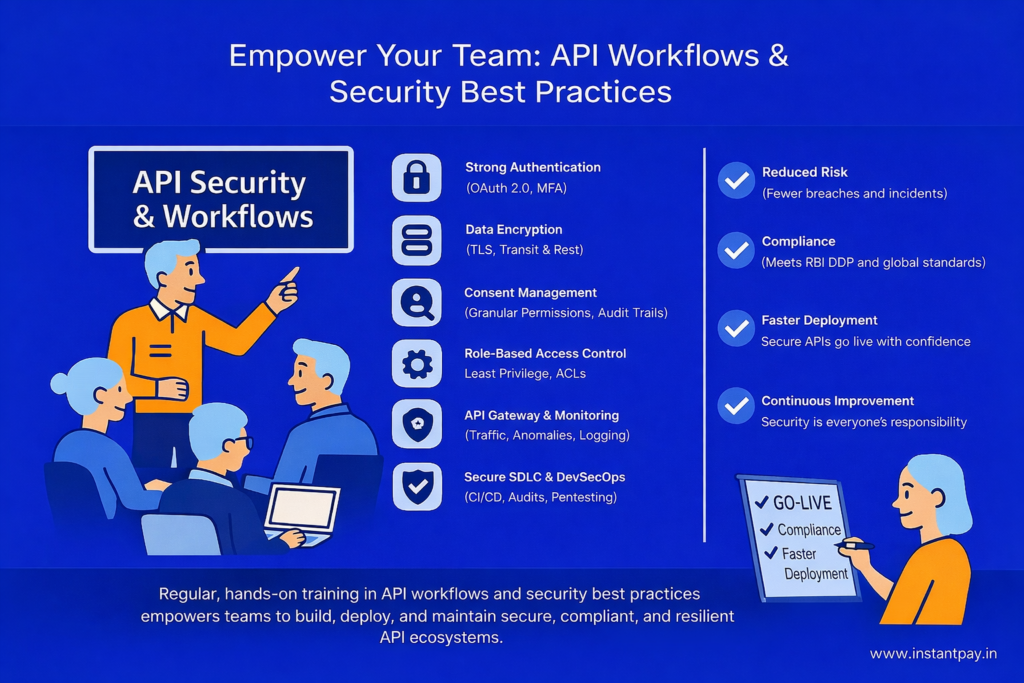
- Why: It’s imperative to understand the workings of APIs, as well as their security implications, to adopt them properly and securely.
- How:
- Host workshops or online classes about API fundamentals, privacy of data, and how to implement secure integrations.
- Help members of the team maintain their understanding of the evolving digital banking system in India and changing regulations relating to the fintech industry.
Summary Table: Strategies at a Glance
| Stakeholder | Strategy | Key Benefit |
| Banks | Middleware/API management | Unlocks legacy systems, enables modularity |
| Banks | Security & consent management | Ensures compliance, builds trust |
| Banks | Fintech partnerships | Accelerates innovation, reduces complexity |
| Small Businesses | Start with payment APIs | Quick wins, improved cash flow |
| Small Businesses | Plug-and-play fintech API solutions | Fast, low-code adoption |
| Small Businesses | Team training on APIs & security | Safe, informed, and scalable integration |
FAQs
1. What is API banking for small businesses?
API banking allows small businesses to integrate banking services directly into their systems using APIs, enabling seamless payments, reconciliations, and financial management.
2. How is API banking different from traditional banking?
API banking offers modular, fast, and cost-effective services integrated within business platforms, while traditional banking is rigid, slower, and often requires manual intervention.
3. What are the benefits of API banking for small businesses?
Benefits include operational efficiency, real-time cash flow management, improved customer experience, and easy access to financial services.
4. What challenges are there in adopting API banking?
Challenges include legacy systems, data privacy concerns, lack of technical skills, and trust issues with automation.
5. How can small businesses start with API banking?
They can begin by integrating payment APIs, using fintech partners offering plug-and-play solutions, and training teams on API usage.