As the HR manager of a Bangalore fintech startup, Renu successfully onboarded 50 new employees in just three weeks; however, just days after onboarding five of those 50 employees were unable to access their provident fund (PF) accounts due to issues with their accounts being delayed and frustrations with their new employer finding out that there were UAN/Aadhaar mismatches which were not caught at the time of onboarding.
In FY 2024-25, as reported by EPFO, 1.26 crore (12.6 million) new UANs were issued to employees and 65% of them did not activate their UANs. This creates a problem in the onboarding process, causing PF contributions not to be mapped, as well as creating a compliance risk for the employer.
This guide is for new employers and HR Managers that hire in India to provide a straightforward explanation of UAN verification, the reasons why it fails and how to successfully validate it.
UAN Verification: A Deep Dive Into India’s Workforce Identity Backbone

Prior to 2014, whenever an employee switched jobs, the employee would receive a different PF number, thus creating scattered records, obstacles to fund transfers, and opportunities for fraud.
The EPFO has addressed this issue by introducing a Universal Account Number (UAN) in 2014, which is a single, 12-digit identification number that will follow an employee throughout their entire career, regardless of how many times they change their employment. It is comparable to a PAN card, however it is specific to your provident fund.
What is UAN Verification?
UAN verification is simply the method in which an employer verifies that an employee’s UAN is current, valid, and connected; specifically, UAN verification confirms that the correct UANZ has been established in relation to the employee’s Aadhaar number and PAN cards, and that the employee’s PF account will be linked to their bank account.
The purpose of the verification of UAN is to provide answers to four basic inquiries:
| Check | What It Verifies |
| UAN Validation | Is the UAN established and current? |
| Aadhaar Link | Is the Aadhaar number linked properly to the UAN? |
| PAN Link | Is the PAN card verified for tax issues and withdrawals? |
| Bank Account | Will the PF funds go to the correct account? |
If any of these checks are incomplete, the employee cannot receive PF contributions, withdraw from his or her account, or transfer funds; consequently, the employer will not be compliant.
Data-Backed Significance: A Look at the Numbers
In 2023, EPFO reports show that over 3 lakh PF claims were delayed. This was mainly due to Aadhaar and UAN mismatch issues.
As of 2024, over 27 crore UANs have been allotted by EPFO.
Yet nearly 15–20% of UANs face KYC or linkage errors, often delaying PF access and salary credit.
When Does UAN Verification Apply?
UAN verification is not something that is only done once in someone’s working career. It can affect an employee’s PF records at three distinct times:
1. When the new employee begins working and will have money withheld from their salary.
2. When an employee transfers from one employer to another. Records associated with the previous employer will not be updated automatically, so if the employer does not verify the employee’s UAN, the employee’s PF contributions will go towards an inactive account.
3. When the employer submits Electronic Challan cum Return (ECR) files to EPFO (Employees’ Provident Fund Organization) each month. Any employees with unverified UANs will cause the ECR file to be rejected by EPFO.

Why is It Essential for an Employer to Comply with UAN Verification?
Maintaining verified employee records is not a matter of choice for employers; rather, it is mandated by law under the EPF Act and Ministry of Labour regulations. Employers will incur the following consequences for failing to complete UAN verification:
- EPFO (Employees’ Provident Fund Organization) will audit employers and assess fines.
- Employers will be unable to process salary and PF payments in a timely manner.
- The PF option will cause employee complaints and employee lawsuits.
- Will negatively affect employer branding.
The good news is that the process for ensuring that UAN verification is completed successfully is relatively simple and straightforward. The subsequent discussion in this document will provide specific guidance on how to complete the verification process correctly.
What Makes UAN Verification Crucial in 2026?
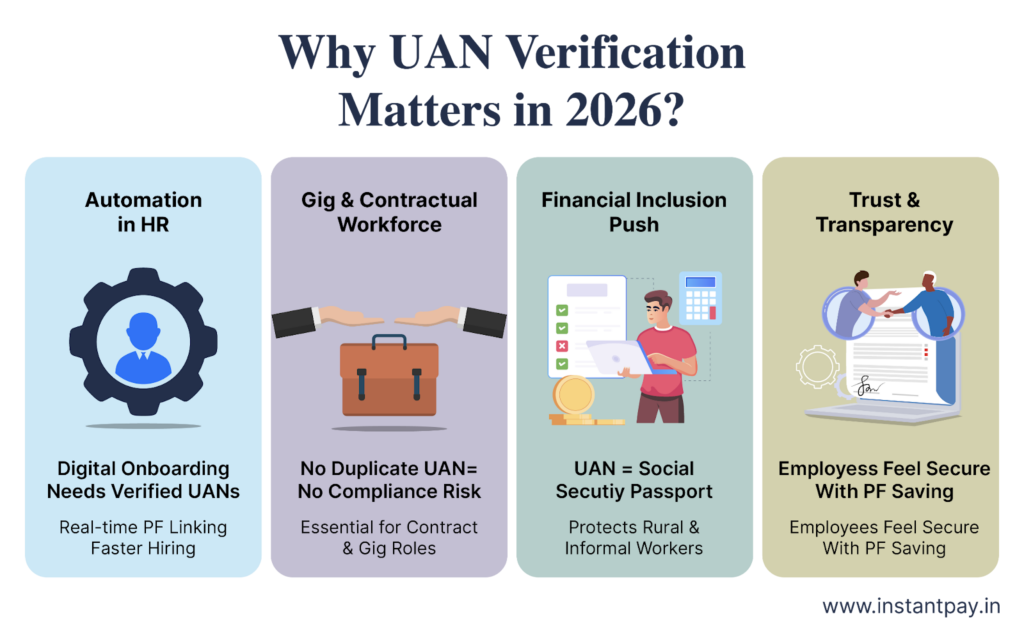
HR is transitioning to a digital format. Manual verification processes cannot efficiently keep up with verification processes. Automated verification of UAN numbers has been developed that can catch mismatches before payroll.
The gig worker population is beginning to enter the formal system of EPFO. There will be 7.7 million gig workers in India in 2020-2021, and it is projected that this number will increase to 23.5 million by 2030.
There is a compliance deadline that must be met. The EES (Employee Enrolment Scheme) will end on April 30, 2026, and this will be your last opportunity to have your employees fixed from penalties if they were left out of EPF coverage between July 2017 and October 2026.
Employees are aware of mistakes made in their PF. Any mistake in matching an employee with their UAN will result in delayed contributions to their PF and improper deposits into their accounts. It will also break any relationship built up with that employee, and ultimately cost you a competitive employee in an already competitive recruiting environment.
In conclusion, there will be an increase in new workers, increased regulations and a closing date, therefore there is no reason to not properly match UAN during the year 2026.
2026 and Beyond: Why UAN Verification Is More Than a Best Practice?
With more digital links between government databases like UIDAI, IT Dept., Banks, and EPFO, UAN verification will be used to:
Authenticate new salary account openings.
Automate ECR uploads with verified KYC-linked UANs.
Enable real-time PF transfers and withdrawals.
Pre-fill onboarding forms using verified UAN data.
How to Perform UAN Verification Online?
| Detail | Why |
| UAN (12-digit) | Core PF identifier |
| Aadhaar Number | Identity proof |
| PAN Card | Tax compliance |
| Full Name & Date of Birth | Must match Aadhaar exactly |
| Bank Account & IFSC | For PF deposits |
These should be gathered for each new employee at the time they accept the job offer, not on Day 1 of employment. This gives you time to resolve any discrepancies or issues prior to the new employee starting work.
Method 1 – EPFO Employer Portal

Step 1: Log into the EPFO Unified Employer Portal
Step 2: Go to Member and select Register Individual
Step 3: Enter the UAN, Aadhaar and PAN for the Employee
Step 4: Click Validate UAN name, date of birth and gender and the details will automatically populate if they match
Step 5: Fill in any missing KYC conditions
Step 6: Use your Digital Signature Certificate (DSC) to approve
If there is an error, resolve it prior to contributing to the employee’s EPF. If you contribute for an employee with a UAN that is not validated you will receive an error in ECR format.
Method 2: Automated UAN Verification via API
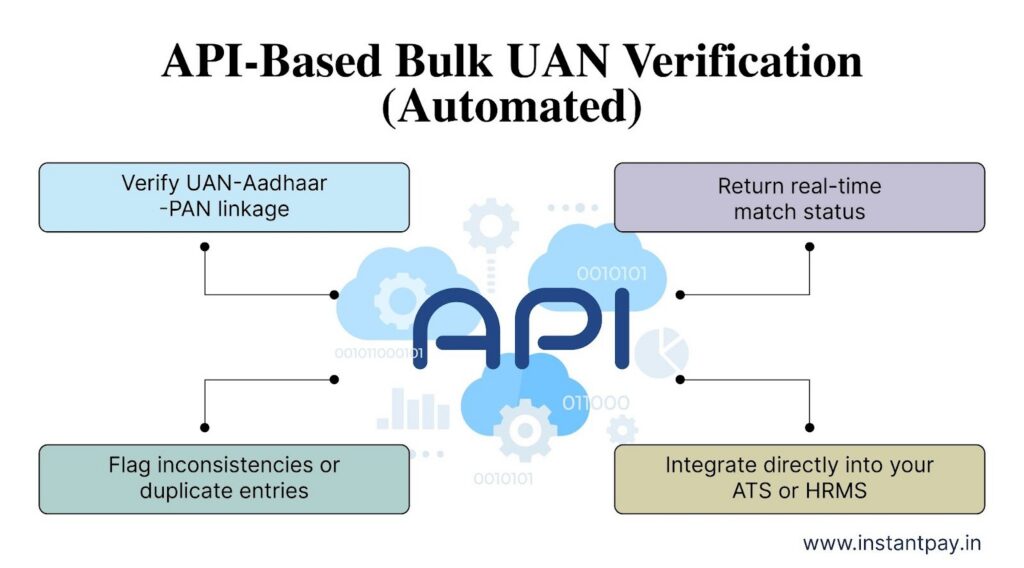
If your team does not have many employees (20+) joining on the first day of the month, go for API verification.
Step 1. Select an API provider for UAN verification integrated with the EPFO and Aadhaar databases (like Instantpay).
Step 2. The API has to be connected with your HRMS/Onboarding platform (The provider will assist you with setting this up).
Step 3. Simply bulk upload your employees’ information that includes UAN, Aadhaar, and PAN.
Step 4. The system verifies all records automatically; it shows the real-time verification status for each employee.
Step 5. You can identify flagged cases, mismatches, inactive UAN, or incomplete KYC data that need attention before the first day of work.
No need to log into a portal or manually check any information or case-to-case study; the API now empowers the onboarding team to perform background verification while they focus on successfully onboarding a new employee.
How UAN Online Verification Makes Hiring Easier?
- Being able to verify UAN with ease and accuracy at the time of employee commitment has a significant effect on the speed and ease of the hiring process.
- Faster Hire Process: Less back-and-forth on documentation. Real-time verification means you can remove days from the process.
- Immediate PF Contributions: When you verify UAN, you create the opportunity for PF contributions to begin the day following employee start date. This means you won’t have any backlog and/or errors related to employee contributions.
- Reduction in Fraud: Duplicate or suspicious UANs will be flagged before an employee is hired.
- Audit-Ready: The KYC (Know Your Customer) audit of UAN will be complete and provide a trail that inspectors look for.
How Common Are UAN Verification Failures?
According to data from the EPFO Grievance Management System (EPFiGMS) and media reports:
Over 15–20% of new PF account linking requests in 2023 were rejected due to UAN-Aadhaar-PAN mismatches.
More than 3 lakh EPF withdrawal or transfer claims faced delays last year due to verification failures.
90% of Aadhaar-based failures occur due to name, gender, or date of birth mismatches.
Common UAN Verification Errors And How to Fix Them?

Error 1: Mismatched Aadhaar
Failed authentication with Aadhaar: there is a mismatch between the information associated with your UAN and the information associated with your UIDAI.
Common causes of this error:
Your name format is different in each system, for example, S. Kumar in UAN and Suresh Kumar in Aadhaar.
Day and month of birth differ by one day.
Solutions:
- Update your Aadhaar information through the UIDAI Update Portal.
- Change your UAN information through Modify Basic Details in the EPFO Employer Portal.
- Re-initiate e-KYC once UAN and Aadhaar are consistent.
Error 2: PAN Verification Failed
Failed verification with PAN: there is a mismatch between the names associated with your PAN and Income Tax Department.
Common causes of this error:
Your name format is different in each system, for example, Amit R Singh on your PAN and Amit Rajendra Singh on your UAN.
Your PAN is not linked to your Aadhaar (this is a requirement per Section 139AA).
Solutions:
- Verify that your name format is consistent by checking the Income Tax e-filing portal.
- If your PAN is not already linked to your Aadhaar, link it.
- Your bank needs to update your PAN in the Manage KYC section of the EPFO Employer Portal.
Error 3: Invalid UAN or not active (UAN does not exist, or it is inactive for this member).
Common causes of this error:
Former employee provided an old/made inactive UAN associated with a prior employer. A former employee had a generated UAN but it was never activated.
Solution:
- Ask former employees to activate their UAN using the EPFO Member Portal or UMANG application.
- Use the “Know Your UAN” tool to view their past employment.
- If the former employee has an inactive UAN, generate a new PF ID for him/her and link it to the existing UAN, but do NOT create a new UAN.
Error 4: KYC is Incomplete (Bank Account Details Not Verified and KYC not Approved by Company).
Common causes of this error:
Incorrect IFSC code or account number was entered into an electronic form. The employer has not yet completed the process of approving a KYC Update.
Solution:
- Update the bank account at the Manage ? KYC area of the EPFO portal.
- Approve the request for Update with the digital signature of your entity.
- Repeat checking on the EPFO portal after a minimum of 24–48 hours.
Error 5: Duplicate UAN (Employee Has Multiple UANs).
Common causes of this error:
Former employees switched employers but did not provide their previous UAN. The new employer unknowingly issued a second UAN to the same Employee.
Solution:
- The two UANs can be viewed using the Employee Passbook on the EPFO website.
- Request to Merge UAN using EPFO member portal.
- Provide Aadhaar, PAN and past employment letters with request.
Quick Tip from Experts:
Always ask employees to activate their UAN on the EPFO portal and download their passbook before Day 1. This ensures all PF history is traceable, and their Aadhaar is correctly linked.
UAN Verification Is No Longer Optional, It’s Foundational
The hiring environment in India has undergone some major changes over the last few years. Labour Codes are stricter and more flexible than ever before, gig workers are moving into the formal workforce, while the EPFO’s connected systems are more precise and connected than ever before to each other and all of these factors have resulted in a situation where you’ll find yourself needing to verify UANs much faster in 2026 than you would have needed to prior to 2022.
If you are still reading, then you already know the answer to this question; Employers who have verified their employees’ UANs as soon as they begin hiring will spend less time correcting errors, incur reduced compliance risks as well as build greater trust with their employees.
Next Steps that You Should Take
Conduct an audit of the onboarding process to determine whether UANs are verified at the time the employee’s initial PF contribution is made for that employee
Automate UAN verification via API (application programming interface) for all employers who need to minimize manual errors when it comes to identifying a worker’s registered UAN
Stay up to date with EPFO’s various rule changes because after 2026 there will be 3 new EPFO rules which were put in place during 2020-21: the UMANG mandate, the EPFO 3.0 programme and the Monday enrolment scheme deadlines for new employees.
Final Thoughts
UAN verification lays the groundwork for onboarding compliance but can be used even more efficiently by including it as part of a larger kit of resources for compliance during the onboarding process.
When recruiting for roles at the field or contract level, you may wish to include Voter ID or Driving Licence Verification as additional verifications in addition to Aadhaar and PAN; this step could provide an extra level of identity verification if cash or other monetary material is being handled, or if you’re hiring for roles that are customer-facing.
TAN validation is also a necessity for gig and contract workers; the TAN helps to ensure that the employee’s taxes are reported accurately and that the employee’s EPFO contributions are accounted to the proper entity from day one of their employment.
Don’t forget to perform an IFSC code lookup; this quick check can prevent one of the most common obstacles to making employee contributions through a Private Fund; if you make a contribution to the wrong account it can take weeks to get it back.
To know more click here for detailed information