At the core of compliance, onboarding and fraud detection using artificial intelligence is text verification. Text Match allows for the accuracy and reliability of digital identities by checking that a customer’s name matches agency records, that two people are not applying for the same benefits/everything they get from government agencies at once, etc. However, in AI/ML systems, the matching process must go beyond simple “exact” match testing; the engine must perform “approximate” matching due to: typos, small variations, different languages, etc., and interpret meaning and context, not just compare two strings of characters like most current text match products.
Since approximately 80% of all global enterprise data is unstructured, reliable decision-making is only possible if organizations use appropriate text matching solutions.
In India, the problem is magnified; there are over 22 officially recognized languages, 121 spoken languages, and over 1,600 dialects that the engine will need to interpret in order to effectively match or compare against the text of the application or submission. Several initiatives are in place to work toward this goal, such as Bhashini under the National Language Technology Mission (NLTM). As fintech, edtech, and e-governance continue to develop, these solutions will continue to improve accuracy, reduce errors, and speed up the onboarding process.
What is Text Match?

A modern AI will answer the simple question, “Do the two pieces of text refer to the same thing?” To do so, the AI follows several steps closely.
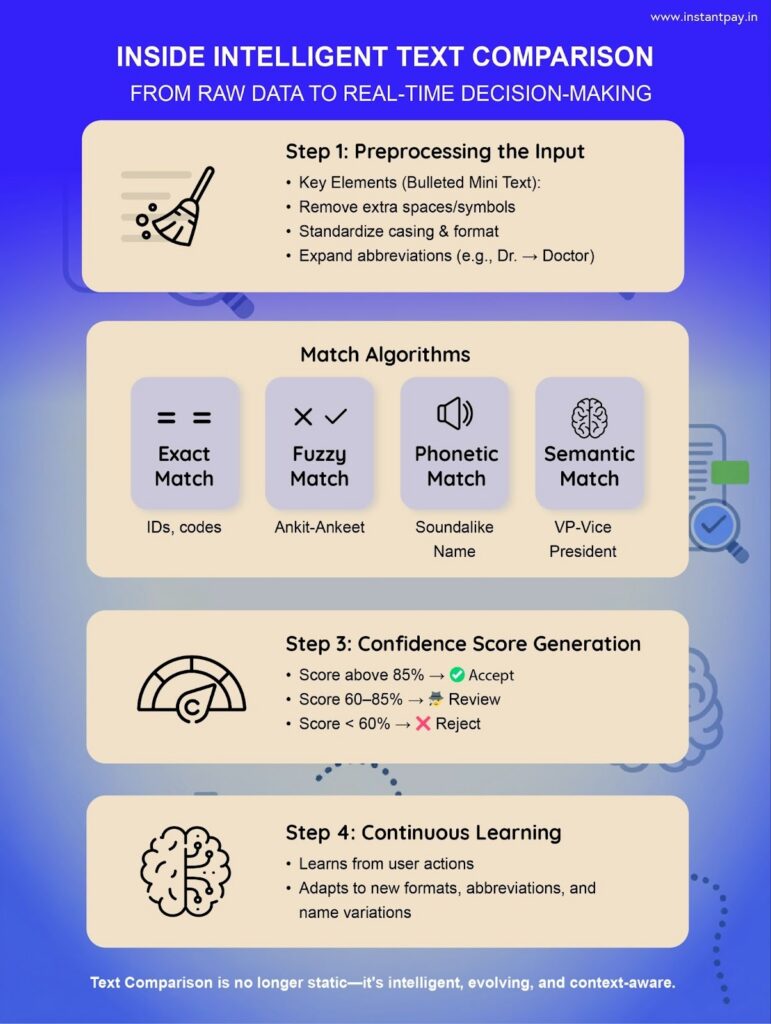
1. Data cleaning (Preprocessing)
To begin, the AI will standardize the text by correcting spacing issues, standardizing how the text is formatted, and expanding abbreviations (for example, converting “Dr.” into “Doctor”). By doing this, it ensures that minor formatting differences do not create an unintended mismatch.
What is a text match?
A text match refers to the process of comparing two or more strings to evaluate similarity, exactness, or semantic alignment using predefined rules or algorithms.
2. Text comparison by various methods
- Exact Matching: The AI will check to see whether the pieces of text are exactly the same. This is the fastest method of matching text, but will only produce accurate results if both pieces of data have been thoroughly cleaned.
- Fuzzy Matching: In this case, there can be minor errors in the texts (for example, typographical or spelling errors such as, “Ankit Sharma” vs “Ankeet Sharma”). This method is great for the more “messy” real world types of inputs.
- Phonetic Matching: This will allow for the identification of names that sound similar, which is particularly useful for companies operating in more than one language (e.g., India).
- Semantic Matching: This will identify the meaning of two phrases and, therefore, will allow for the proper matching of phrases with a common intent. Like “VP Sales” and “Vice President Sales” are treated the same.
3. Confidence score assignment
Finally, the AI will assign a score to reflect the level of similarity between the two checked pieces of text. This score will fall somewhere between 0%–100%. Based on this score, it will determine whether the two pieces of text should be accepted, rejected, or flagged for review.
Over time, as the AI develops a history of its own determinations, the accuracy with which it can conduct these processes will continue to improve, and its ability to manage exceptions will continue to develop.
Applications of Text Matching Across Industries
Text matching has become an important tool for organisations to increase the ability of their systems to analyse and compare human language more effectively across industries. It plays a crucial role in developing more effective systems, by reducing errors, improving productivity and providing a better user experience.
Search Engines: Text matching is used by search engines to determine what users intend to find even though they may have made a typo, (for example, searching for “doc verification” will return results for “document verification”). This allows users to find information that is relevant to them as quickly as possible.
Plagiarism Detection: Plagiarism detection will compare the text line by line to identify copied or altered text. This helps ensure that both academic and published works are original.
Financial Services (Fraud/KYC): Banks will perform text matching between names, addresses and transaction details to identify instances of fraud and/or verify customer identities. This reduces the level of risk associated with customer onboarding and payment processing.
Hiring (HR Technology): Text matching helps HR technology systems match resumes to job descriptions in order to identify the most qualified candidates regardless of whether the candidates describe the same skills using different words.
Customer Feedback: Text matching provides businesses with the ability to aggregate their customer feedback based on common characteristics (e.g. group all of their negative reviews about shipping delays). This allows businesses to quickly recognise common issues and take action to improve the products/services they offer.
Across all industries, text matching is playing an important but often unnoticed role in enabling organisations to make better decisions, and to provide more efficient and seamless digital experiences for their customers.
How to compare text in Excel?
Use functions like =IF(A1=B1, “Match”, “No Match”) or =EXACT() for case-sensitive checks. For fuzzy matches, consider Power Query or VBA scripts.
The Role of Text Matching in AI/ML Systems

To make it easier for machines to compare and comprehend large amounts of text, text matching is essential to AI/ML systems. Additionally, it increases accuracy, decreases errors, and contributes to intelligence-based decision making across various applications.
Feature Creation: Through text matching for similarity scores, the system converts text into a numerical representation (e.g., matching PAN name against form entry), allowing the decision on whether or not to continue with onboarding or require further review.
Supervised Learning: The similarity between data points within a model allows for better predictions (e.g., if an incoming email is similar to already identified spam, the email is flagged).
Unsupervised Learning: The system groups similar records together without any identifying labels (e.g., grouping records “Dr R. Mehra” with “Mr Raj Mehra” as the same profile).
Record Linkage: Text matching provides an important function in determining if a record contains information on the same person in multiple data sets (e.g., “Anaya S” is the same person as “Ananya Sharma”).
NLP + Embeddings: Text matching functions with state-of-the-art models aid in finding the meaning of the query. For example, when searching for “can’t access dashboard”, text matching finds that it is similar to a query of “login issue”.
In summary, text matching enables the AI systems to remain accurate, scalable, and reliable.
Challenges in Text Matching

Textual Matching may seem trivial, however, when looking at how humans use words, it can be pretty chaotic, unsystematic, variable and not easily predictable.
1. Variability in Language and Formatting
Different ideas can be variedly expressed by individuals, such as with disparate dates, names, and abbreviations. Furthermore, if these expressions are not formatted in a consistent manner, a machine could have difficulty identifying relevant details about those expressions.
For example, “Dr Rajiv Sharma” does not represent the same information as does “Sharma, Rajiv.” Also, “2025.05.03” does not represent the same information as does “May 3, 2025.”
The solution: Textually preprocess all text formats, standardize formatting, eliminate titles from name formats, and standardize abbreviations.
2. Context Confusion in Industry-Specific Language
In financial contexts, the term “charge” refers to a payment, while in a legal context it refers to an accusation. A generic system that attempts to match terms across industries may misinterpret the meaning of “charge” which can have serious consequences for both legal and financial purposes.
The solution: Use industry-specific AI models that learn from the context of the language in your industry.
3. User-Generated Content: Noisy, Informal, and Inconsistent
When utilizing online communication tools, people will typically write informally, without concern for the convention of formal writing.
For example, a frustrated customer may communicate the following via text: “luv ur svc bt slow delvry” which in a more formal form of English would be “I really liked your service, but I found the delivery to be very slow.” Without a system being able to interpret this type of communication, it is possible for customer complaints to be mistaken for expressions of gratitude.
The Solution
Make use of spelling checkers, linguistic normalization tools and fuzzy match techniques.
What is Levenshtein text matching?
This method measures how many edits (insertions, deletions, substitutions) are needed to change one string into another for fuzzy matching applications.
4. Multilingual Diversity and Script Variations
We can receive the same information in three languages: Hindi, English, and Hinglish; this can confuse recipients; if they do not have access to more than one of the languages, then important messages will get lost.
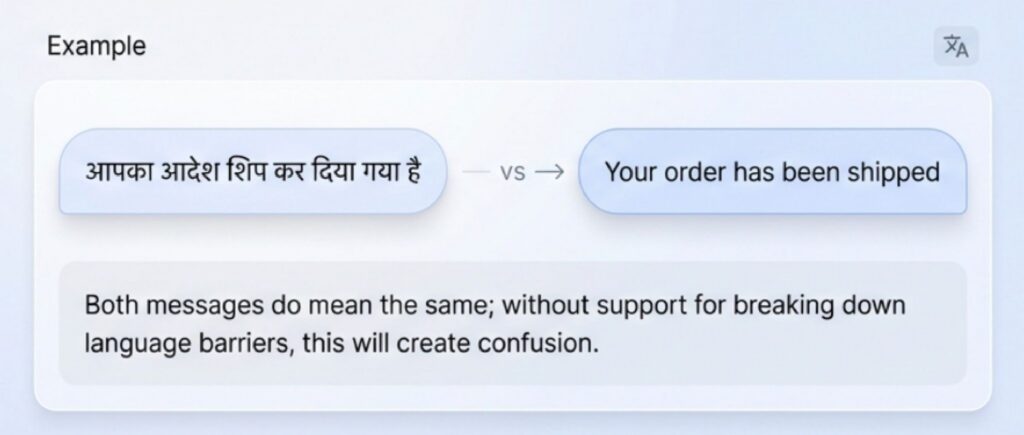
The Solution:
To process regional languages through multiple language models like mBERT or IndicBERT.
5. Computational Trade-offs: Accuracy vs. Speed
While fast systems may not be intelligent and intelligent systems may not be fast, in situations where real-time results matter (e.g., fraud detection, KYC), you need to have both; delays or bad decisions in these types of applications could lead to serious damage.
The Solution:
Use both Hybrid rule-based filter systems and Hybrid intelligent databases to achieve both speed and accuracy.
6. Poor Data Quality and Incomplete Information
Data from multiple databases may or may not match due to missing information or data being preserved differently from what we expected, therefore creating duplicates or resulting in failed verification.
The Solution:
Acquire missing records and identify low confidence matches with an extra person(s) reviewing records for confirmation of their connection(s).
From Automation to Accuracy: The Value of Smart Text Matching
Every day organizations handle a significant volume of unstructured text. Smart text matching enables these disparate fragments of information to be transformed into clear and actionable insight. This provides value in five different ways:
1. Improved Accuracy of Your Decision-Making
Automating the verification of documents will reduce human errors, which is crucial in the finance industry, legal documentation, and healthcare.
Take, for example, a bank that validates KYC (Know Your Customer) documents automatically; it is able to catch document mismatches that a human would likely have missed.
2. Quicker Processing of Tasks
By utilizing smart text matching, the amount of time it takes to perform routine tasks such as screening resumes or verifying forms is now measured in seconds rather than hours.
For example, an HR platform can rank hundreds of resumes against a job description in real time.
3. Smarter Fraud Detection
Using matching algorithms, it is possible to identify patterns that would indicate possible fraud from the data entered.
Therefore, an example would be a lending application program being able to flag multiple applications that share the same address and, at the same time, have different first or last names.
What is text pattern matching?
Text pattern matching is the identification of particular arrangements or sequences in a file of text through the use of rules, such as regular expressions (Regex); this technique is applied widely in the validation of data and along with filtering of content.
4. Multilingual Reach
Modern models of smart text matching work in a multilingual environment and will be very beneficial in a highly diverse location like India.
For example, a government site can match submitted documents that are written in Hindi, Bengali, and Tamil very accurately.
5. Insights from Unstructured Data
Using smart text matching, organizations are able to analyze and obtain insights from the millions of free-text fields that are frequently encountered in ordinary daily transactions within the organization.
As an example, an edtech platform may identify issues with students’ experiences by analyzing open-ended feedback (free text fields).
Emerging Trends in Text Match: Key Development in 2026
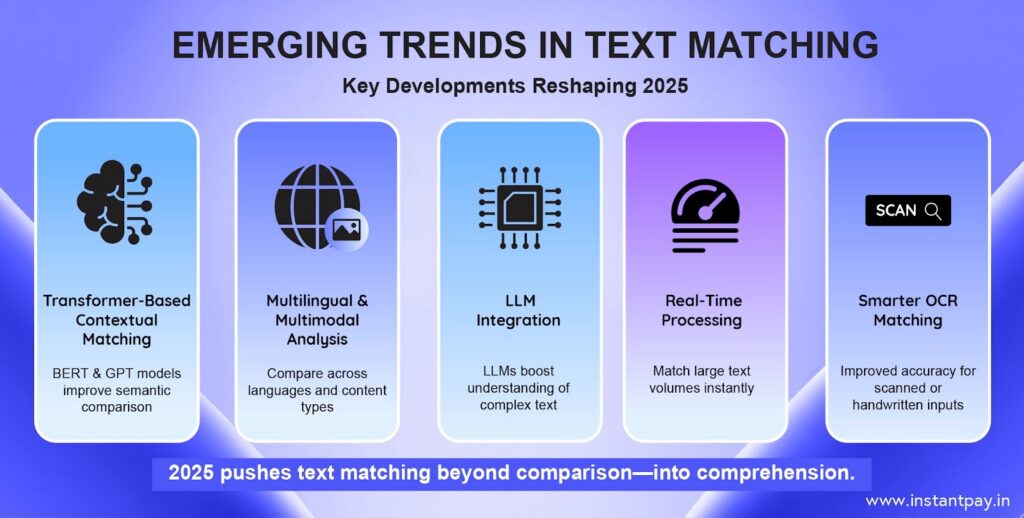
As artificial intelligence progresses, text matching technologies are becoming faster and more efficient.
More Intelligent Context Understanding: With advancements such as BERT and the current version of GPT, a model understands the foundation of every word found in a piece of input; it also understands how the words fit together, the overall meaning and the intended tone being expressed from that input to assist in identifying the intended meaning of phrases that may have been written differently.
Ease of Comparing Different Languages and Text with Images: Comparing text written in two different languages is made easier through the use of multimodal and multilingual systems that enable users to compare text from many different languages to determine its similarity, and to integrate both text and images together in a useful manner that can be put to use in common everyday situations.
Text Matching with Models Based on LLM: Text matching systems based on large language models (LLMs), compared to traditional text matching systems, present themselves as more human-like and accurate.
Ability to Support Real-Time Assessment on a Massive Scale: Current text matching systems can support real-time assessments for activities such as assessing the validity of a fraud, onboarding customers and assisting customers to complete other customer service activities using the system’s large database of information to accomplish any of these processes.
Enhanced Application of Artificial Intelligence and Optical Character Recognition: Systems that utilize both AI and OCR to create improved methods for analyzing unstructured data.
Did You Know?
In 2026, transformer-based models have achieved F1 scores exceeding 90% on benchmarks like GLUE and SQuAD, indicating their superior performance in text understanding tasks.
Industry-Specific Use-Cases of Text Match for Verification
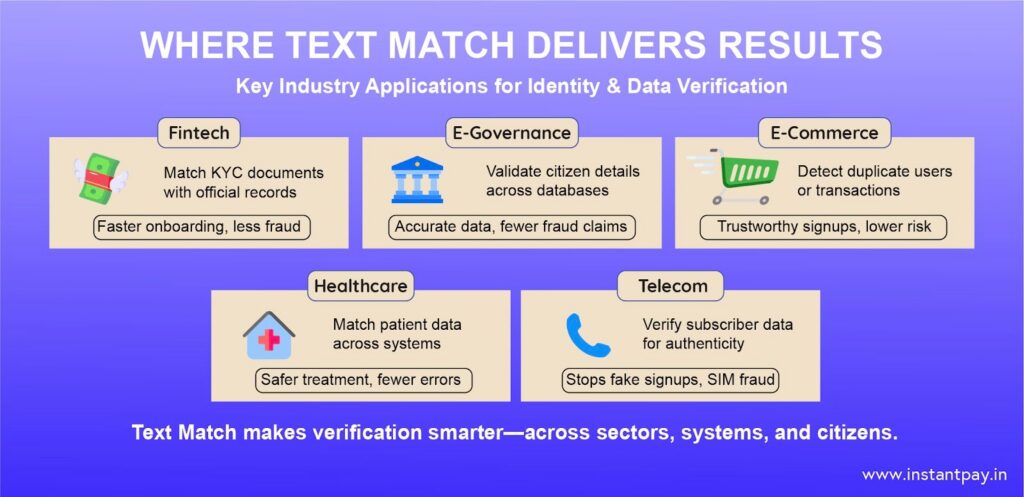
Caption – Smart text match verification across industries, systems and citizens
Across many fields, text matching is an important verification method that helps systems process client data at high speeds and accurate rates; irrespective of minimal data variance.
1. FINTECH: IDENTIFICATION OF CUSTOMERS FOR ONBOARDING
The details of a customer’s document (e.g., Aadhaar, PAN) such as their name, date of birth and address can be matched against the details inputted by them at the time of onboarding as a customer to help identify potential identity fraud while speeding up the customer onboarding process.
2. E-GOVERNANCE
Citizen databases in government systems such as welfare and tax are matched against one another as a way to verify a citizen’s record and ensure the appropriate maintenance of benefits for citizens and eliminate fraudulent submissions.
3. E-COMMERCE
Emails, phone numbers or names can be matched against existing records to identify duplicate accounts or suspicious purchases by preventing one customer from creating many different accounts.
4. HEALTHCARE
Patient files can be matched from multiple systems, even if a patient’s name is spelled differently in different records, to avoid duplicate files and reduce the probability of errors in the delivery of care.
5. TELECOM
When a new customer registers for a SIM card, their customer information is verified against records by comparing their identity information to help eliminate the establishment of false accounts and prevent telecommunications fraud.
Real-World Implementation: How It’s Done Right?
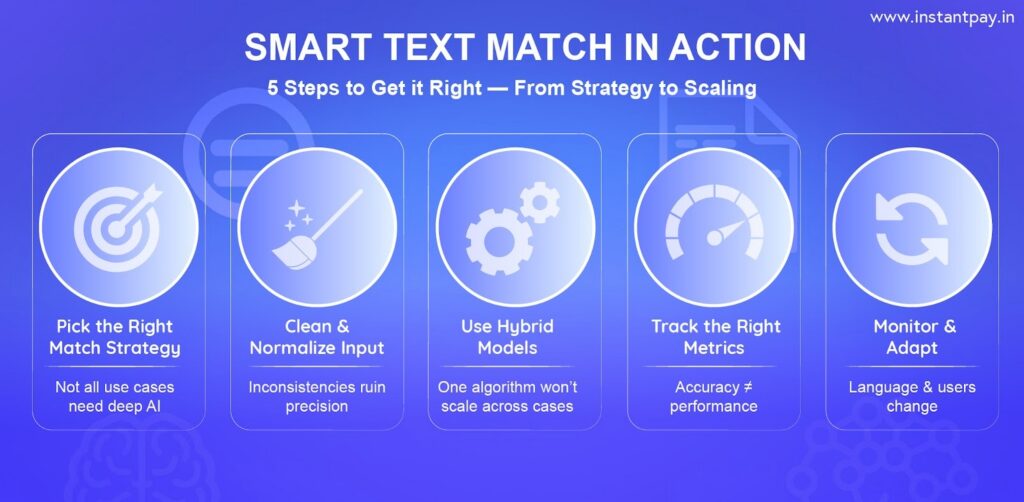
Both a sound strategy and an excellent understanding of related underlying technologies to the issue are needed to develop a text matching system.
Find the Correct Approach: Different problems require different solutions. The KYC process uses fuzzy matching due to minor input errors, while semantic matching of question variations is typically used for edtech-related questions.
Clean Your Data: Consistency in data format is essential (ex: “color” shouldn’t be matched to “colour,” and “résumé” shouldn’t be matched to “resume”). Take the necessary time to ensure that your data is properly formatted to minimize unwanted matches as much as possible, so that you can produce optimal results.
Combine Methods: Basic methods for a match can be rapidly filtered out by faster methods; advanced reasoning can be deferred to deep meaningful matches, or artificial intelligence for advanced reasoning. A classic example of a combined method would be using a keyword and artificial intelligence comprehension on an eCommerce site.
Properly Measure Performance: Measuring and monitoring errors is crucial. The goal in fraud detection is to minimize the falsely identified fraud through legitimate transactions by correctly identifying the fraud.
Continuously Improve the System: Based on data and new input from users, the system should be continuously improved. As language continues to change quickly, it is essential to have a system that can adapt quickly to any language changes that occur.
Final Thoughts
With the ongoing expansion of digital language generation, intelligent comparison/interpretation of text will continue to gain importance. Today, more than ever before, the modern way of analyzing written content is at the core of ‘smarter’ & ‘scalable’ systems; whether it’s increasing efficiencies in fraud detection/monitoring processes, improving the search experience, or providing multilingual support with chatbots.
From an initial focus on simple string-matching algorithms, textual analysis has matured into a complex discipline that includes machine learning, context-aware embedding vectors and domain-specific adaptation. And there appears to be no slowing down as low-code platforms become more popular, cloud-based NLP application programming interfaces (APIs) are being developed, and multilingual pre-trained text classifiers are being created.

FAQs
1. How to compare two texts online?
You could use one of several online comparison tools, such as Diffchecker or Text Compare which allows you to see the differences between two text blocks immediately.
2. What is text matching software?
A matching program for text uses algorithms to find duplicate texts and similarities or patterns within those duplicate strings of texts. Matching programs are utilized for detecting fraud, checking for plagiarism, and comparing documents.
3. What is the text match formula in Excel?
The =EXACT(text1, text2) function in Excel checks if two cells contain the same text. You can also use =IF(A1=B1, “Match”, “No Match”) for simple logic-based comparisons.
4. What is the best algorithm for text matching?
There is not a definite answer to this question. The Levenshtein Distance algorithm is a great option for performing basic text-matching tasks; however, the use of BERT or SBERT models may be more effective for matching text in context.
5. What is matching in AI?
In AI, matching refers to comparing inputs, like text, images, or data to identify similarities, often for decision-making or recommendation tasks.
6. What is the concept of string matching?
String matching is the fundamental technique of searching for one string within another or comparing strings to find matches, used in search engines and compilers.
7. What is the fuzzy matching algorithm in Excel?
Excel doesn’t natively support fuzzy matching, but Power Query and add-ins like Fuzzy Lookup can be used to compare similar but not identical text values.
8. What is the AI tool for comparing documents?
Tools like Diffbot, Amazon Comprehend, and Microsoft Azure Text Analytics offer AI-based document comparison features tailored for enterprise use.
9. How do you compare texts?
Texts can be compared using basic string comparison, similarity scoring algorithms, or semantic matching via NLP models, depending on the complexity required.