Did You Know?
Industry estimates suggest more than 1 billion surveillance cameras existed by the end of 2021, and the total global surveillance camera market grew to about USD 43-44 billion by 2024. Most of that growth is due to AI-based video analytics (such as facial recognition and face detection). Today, that technology can be found all over the place, whether you unlock your smartphone, tag a photo on social media, watch security feeds, or control entry at the border.
However, most people use face detection every day but do not understand how it works. Every time you unlock your phone quickly or apply a filter to your photo on social media, machine learning, image processing and pattern recognition play a role. As AI-driven surveillance increases, it will be critical for companies, developers and end users to gain knowledge about how face detection works and the related privacy issues.
How Face Detection Identifies Human Faces Within Images and Videos?

Facial detection is used to determine if there is a person present, or if a person has facial features such as eyes, nose, cheeks, etc. The face detection software scans the image/video to find patterns of human faces using the following method:
- Check the image/video for a chance of human features.
- If so, the face detection software will analyze those types of patterns in the area found in the first step.
Based on this information, and by comparing it to the background, the face detection software can find the individual to the best of its ability given its training data set.
- Face detection technology allows for the ability to:
- Autofocus on faces in phones.
- Apply filters to video collaboration tools (Zoom/Teams).
- Use facial recognition systems in airports/public security.
- Understand how long someone has stayed in retail stores (retail analytics).
Face detection is also used as the first stage for more advanced technologies such as face sellers (face recognition), liveness detection and emotion detection.
The Role of Image Processing and Pattern Recognition in Accurate Detection
Finding faces in real-life photos or videos presents many challenges due to things like fluctuations in lighting, shadows, movement, and disarray in the background, all of which can confuse computers. A computer will employ two principal technologies for performing face detection: image processing and pattern recognition.
1. Image Processing
Before an artificial intelligence attempts to identify human faces in an image, that image must first undergo a process of cleansing and simplifying so that machines can analyze it more quickly and easily. Steps typically taken during this process include:
- Grayscale conversion reduces the complexity of the image by eliminating colour.
- Contrast enhancement increases the contrast in an image, allowing for more visible facial features.
- Noise filtering removes any visual disturbances or noise that the camera may have recorded.
- Scaling allows for the detection of faces regardless of their size or distance from the camera.
2. Pattern Recognition
Following the image cleansing and simplification process, the AI attempts to locate the areas where faces are located through pattern recognition based on a series of facial structures such as:
- The position and symmetry of eyes
- The relationship between the eyes, nose and mouth.
- The unique shape and proportions of the face.
Many older face detection systems operated according to pre-determined rules such as Haar features (Viola-Jones). In contrast, today’s modern face models are based upon teaching facial structure through deep learning techniques on large datasets.
For instance, in a recent study performed on the LFW benchmark, the rates of accuracy of face recognition by the various technical systems improved from the 80% range of accuracy a decade ago to approximately 97%-99% accuracy today. The accuracy of DeepFace and GaussianFace is close to or exceeds human accuracy in face recognition.
Accurate face detection is essential for everything from unlocking phones, utilizing security systems, and identifying someone who is not supposed to be where they are; misidentifying a person or failing to properly identify a person can create serious issues.
Exploring the Viola-Jones Algorithm for Real-Time Face Detection
In 2001, Paul Viola and Michael Jones developed the Viola-Jones Algorithm for the detection of faces in images, and it was the first system that could detect the face in real-time. It was revolutionary in the field of computer vision, and was used extensively in early digital cameras and security systems.
Here’s how the algorithm works (Simplified):
- Haar Features- Detect contrast patterns such as the darker region of the eyes compared to the lighter region of the cheeks.
- Integral Image- Improves the speed of computing Haar features so that they can be calculated quickly.
- AdaBoost Training- Chooses only the most useful features and combines them to form a much stronger classifier.
- Cascade Classifiers- Very quickly remove areas of an image that do not contain faces and use the computing power on those areas that most likely contain faces.
Advantages of this system include:
- Speed,
- Efficient implementation,
- Ease of implementation (e.g. OpenCV).
Disadvantages of this system include:
- Difficulty in detecting faces when angle,
- Illumination, or
- Obstruction of the face is present and inability to identify the individual.
Advancements with Convolutional Neural Networks (CNNs) in Visual Recognition
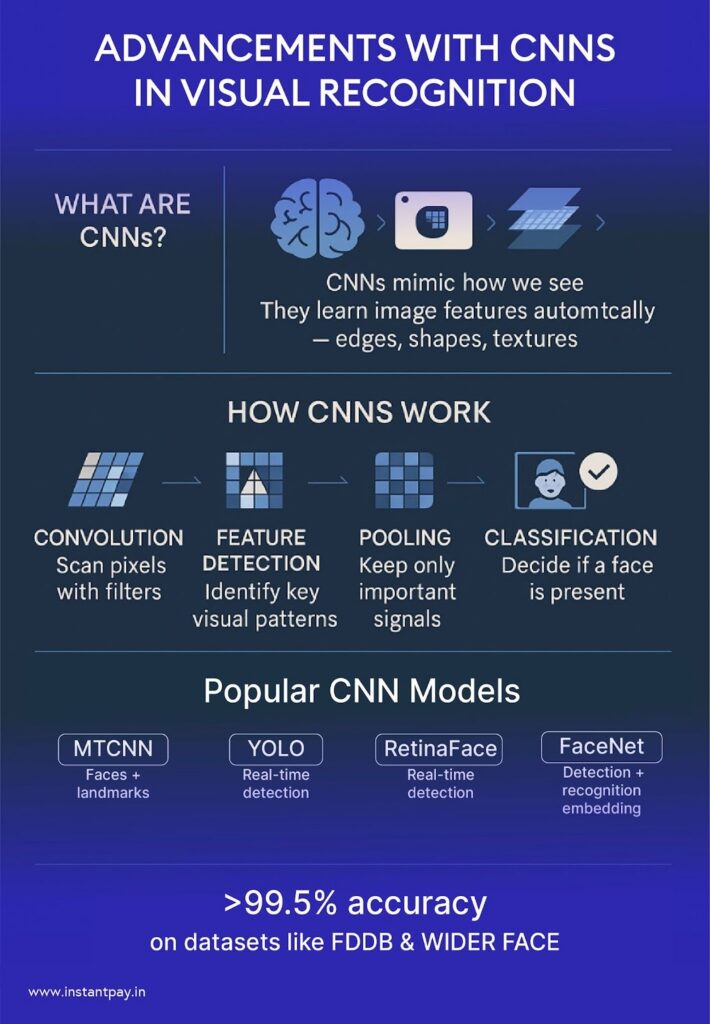
Face Detection has changed from older method-based face detection like Viola-Jones to newer Deep Learning face detectors such as Convolutional Neural Networks (CNNs). CNNs are Deep Learning networks that automatically find facial patterns in large datasets of images.
In other words, a CNN:
- Reads image pixels with different sets of filters through multiple layers
- Identifies the edges, textures and shapes that form a face
- Finds areas of the image that appear to contain a face
- Determines whether or where a face is located in the image.
Some popular CNN based systems include MTCNN, YOLO and RetinaFace.
These systems are used in many tools we use every day, including Smartphone Face Unlocking, Security Cameras, and Contactless Identity Solutions.
Summary: Viola-Jones vs CNNs
| Feature | Viola-Jones | CNNs / Deep Learning Models |
| Feature Engineering | Manual (Haar) | Automatic (learned from data) |
| Speed | Fast (frontal only) | Fast with optimization |
| Accuracy | ~85–90% | >99% |
| Adaptability | Low | High (handles occlusion, angles) |
| Use Cases | Legacy systems | Modern real-time apps |
How Feature Extraction and Machine Learning Enable Each Process?
Feature extraction is a required step in both Face detection and Facial recognition, which describes how AI can identify relevant features about a person’s face.
For example, in Face detection, the system will attempt to find patterns that have an overall structure (i.e., head shape) and general shapes of specific features (i.e., eyes, nose, mouth).
Among the early methods, Viola-Jones was an example of using Haar features in order to detect differences between areas of the face.
Modern day methods use a lot of image files and find the same patterns through Neural Network (CNN) models, and classify whether an area of an image contains a face.
For Facial recognition, this process occurs at a deeper level. AI translates a person’s face into a unique numerical “embedding,” which is a distance measurement of each landmark on the face.
For example, FaceNet and DeepFace produce a vector between 128 and 512 dimensions, which can be used to uniquely define a person’s face.
Real-World Table: Detection vs Recognition
| Aspect | Face Detection | Facial Recognition |
| Output | Bounding box for face | Identity of person |
| Identity Knowledge | Not required | Required for comparison |
| Techniques Used | Haar features, CNN, MTCNN | FaceNet, DeepFace, ArcFace |
| ML Complexity | Low to moderate | High (deep embedding + comparison) |
| Use Cases | Filters, focus, surveillance alerts | Identity verification, fraud detection |
| Data Requirement | General face datasets (e.g., WIDER FACE) | Identity-labeled face datasets (e.g., VGGFace2) |
Why Feature Extraction Matters for Human Face Detection in Videos and Images?
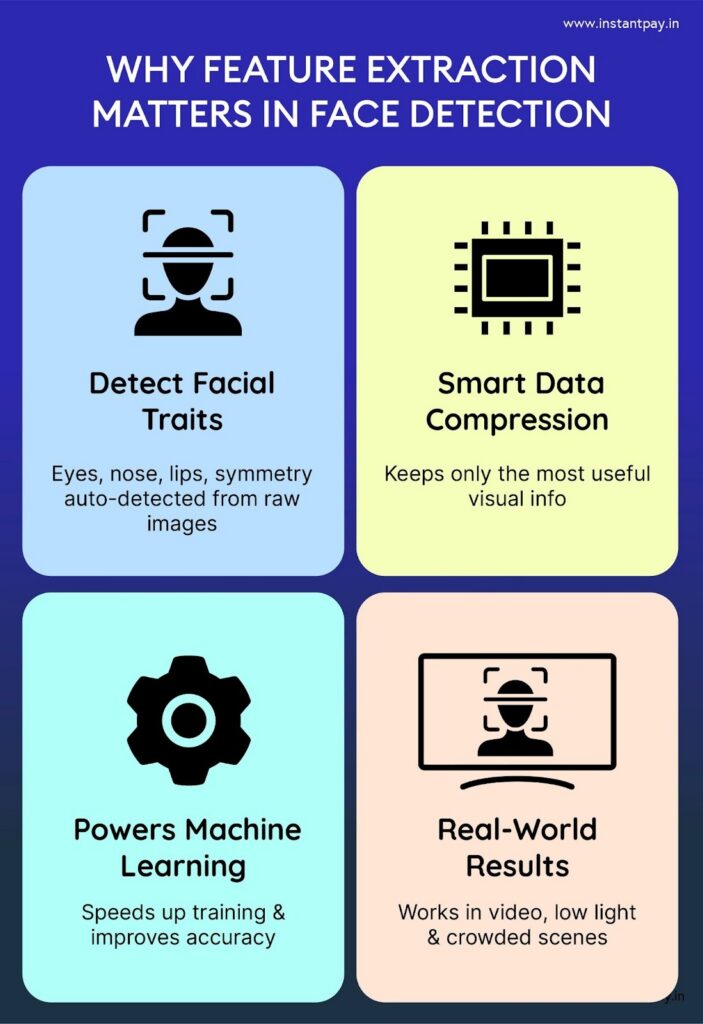
The vital part of finding a face in an image or video is through feature extraction. To do this, AI doesn’t evaluate every pixel, rather, it takes into account features that are essential to identify a face.
For example, below are some common features extracted:
- Structural Features: distance between eyes, width of nose, and shape of jaw
- Textural Features: patterns of skin, shadows, and wrinkles
- Geometric Features: shape of eye sockets, shape of cheeks, position of mouth
One of the most common methods for feature extraction to identify faces is called Viola-Jones. In this method Haar-like features are used to extract facial features, such as; dark area of the eyes vs light area of the nose, etc.
By using feature extraction AI systems become faster, and more accurate as there are fewer data points to process.
Step-by-Step Guide: How Face Detection and Analysis Works (with Instantpay API Integration)?
The modern process to detect and analyze faces can be explained as a basic pipeline.
1. Image Capture
The system takes in visual information from the camera, image file, or video frame.
2. Image Preprocessing
Various techniques are utilized to clean and standardize the image, which may include:
- Grayscaling the image
- Reducing noise
- Adjusting contrast
Each of these techniques enhances the system’s ability to detect faces in different light conditions.
3. Face Detection
AI models (using CNN-based face detection algorithms) are used to identify and create bounding boxes around the faces that were detected in the image.
Choose a Model Based on Needs:
| Model | Best For |
|---|---|
| Viola-Jones | Lightweight, frontal face detection |
| MTCNN | Multi-face detection with landmark output |
| YOLOv5-Face | Real-time performance, higher accuracy |
| RetinaFace | Occlusion handling, facial features |
Or… Skip Manual Modeling Entirely
Use Instantpay’s Face Detection API
Instantpay’s Face Detection and Analysis API simplifies everything:
- Just send an image or video frame to the API
- Receive face coordinates, bounding boxes, and landmark positions
- Get results in real time with high accuracy
Why Instantpay?
- Built for scale (batch and real-time support)
- Handles multi-face detection and complex angles
- Returns clean, structured JSON for easy integration
Sample Output:

No need to handle model tuning or retraining—it’s all handled behind the scenes.
4. Face Feature Extraction (Optional)
To assist with further analysis, key features can be obtained from each face including the eyes, tip of the nose, and corners of the mouth.
5. Analyze Face or Utilize Result
Various methods are used to analyze the faces based on how the system is set up, such as:
- Verifying identity (face recognition)
- Determining emotions or engagement levels
- Performing security checks or attendance
Today, there are many real-world applications of this pipeline including cell phone authentication, security, and retail analytics.
How Machine Learning Algorithms Improve Accuracy in Face Detection?
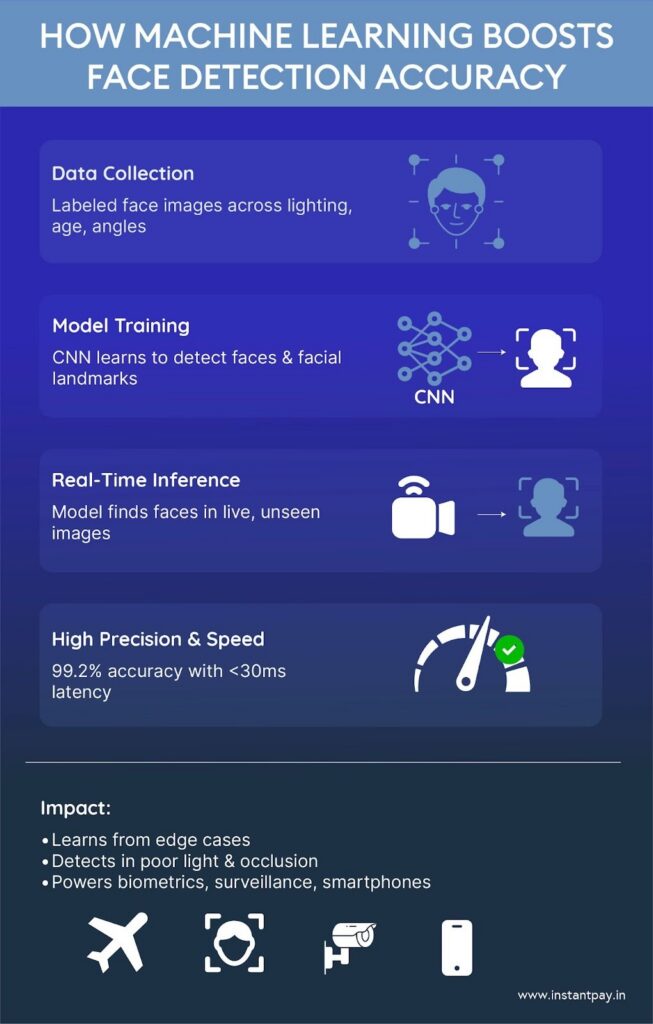
Machine learning, instead of rule-based systems, is the driving force behind contemporary face detection. Rather than being programmed to recognize the features of a face, artificial intelligence (AI) learns the characteristics of a face through training on a large quantity of images that are clearly labelled (those labelled as either “face” or “not a face”).
Here’s an overview of how face detection actually works:
Data Gathering: Millions of images are collected displaying faces in multiple different lighting conditions, different ages, different expressions, from different angles, and whether or not someone is wearing glasses or a mask.
Training: Deep learning networks (going under different names such as convolutional neural networks or CNNs) then use the data to train the network to:
- Identify whether or not a face is present in the image.
- Create a bounding box that encompasses the facial feature(s).
- Determine where the landmarks of the face are (eyes, mouth, etc.).
Inference: Once the deep learning network has been trained, it can quickly and accurately identify faces in images and video in real-time.
Fact: Today’s state-of-the-art computer vision or face detection models are backed by very advanced CNN-based technology such as the YOLOv5 model and the RetinaFace model, which have shown to attain Average Precision values of > 90% for the WIDER FACE dataset and comparable benchmarks, while running near real-time on modern general purpose graphics processing units (GPUs).
Pattern Recognition Techniques Supporting Large-Scale Image Processing
Machine learning relies on pattern recognition to understand facial structures.
Common techniques include:
- Template matching compares image regions with stored face patterns
- Statistical classifiers (SVM, HMM) used in earlier AI systems
- Neural networks, modern deep learning models such as CNNs
- Clustering methods group similar pixel regions during preprocessing
These methods allow systems to analyze large volumes of visual data quickly.
Today, this combination of machine learning and pattern recognition powers applications like airport security, biometric verification, smartphone cameras, and real-time surveillance analytics.
Case Study: How Face Detection and Analysis Transformed Outcomes Across Industries?
Industry #1: Fintech – Enhancing eKYC & Fraud Prevention

A Delhi-based Fintech company providing digital loans was facing significant obstacles with their manual KYC (know your customer) verification process. Not only were KYC checks taking an excessive amount of time, they also presented an opportunity for fraudulent activity because people were trying to use printed photographs or fake identities.
To solve this issue, the company integrated the Face Detection and Analysis API from Instantpay into their mobile onboarding system so they could:
- Verify user’s live face during video-based KYC
- Compare user’s live face to the photograph on their PAN (Permanent Account Number) card
- Use liveness detection to prevent counterfeit attempts
As a result of this implementation:
- KYC verification times have decreased from 30 minutes to under 2 minutes
- In one quarter alone, over 12,000 fake KYC attempts were prevented
- Loan processing speeds were increased by 40%
Benefits of automating face verification: Automating face verification expedites the onboarding process and improves fraud prevention; enhances the credibility of digital financial service providers with customers.
Industry #2: Retail – Understanding Customer Sentiment & Footfall
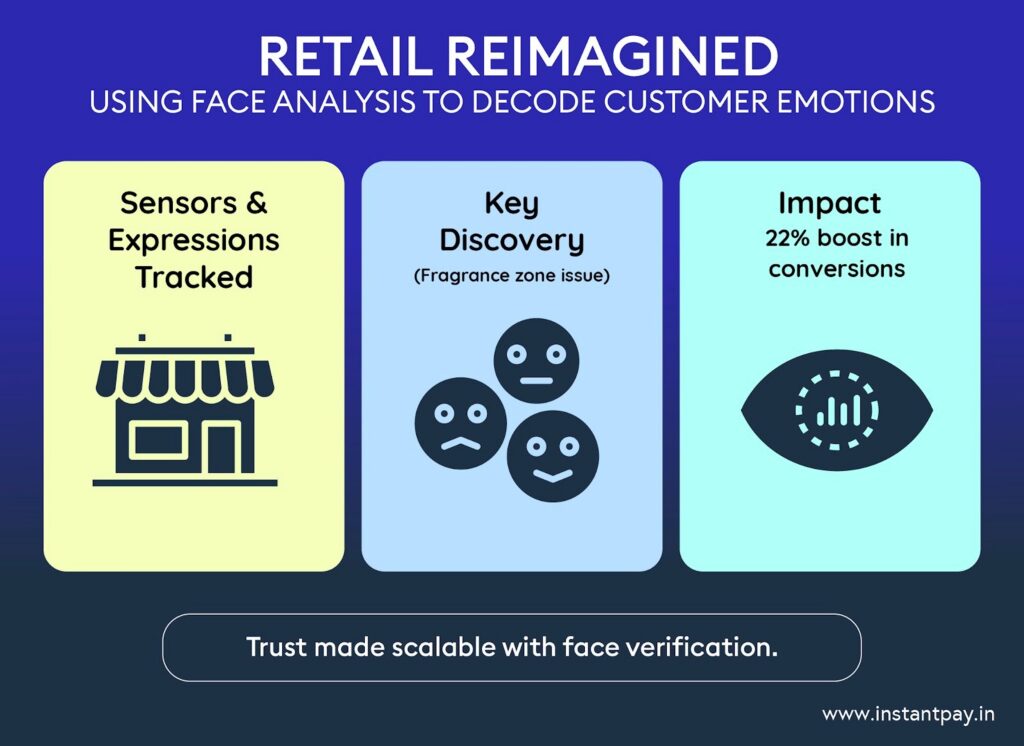
A Mumbai-based high-end luxury fashion retail fails to understand the behavior of customers who visit the store and make purchases. The retailer collected visitor data manually via footfall logs without knowing how engaged customers are with their store experience or what their feelings are about the products.
After installing face detection and facial expression analysis software via Instantpay’s API, the retailer is now able to:
- Track the number of unique visitors to their store each day
- Evaluate basic facial expressions (smile, frown, neutral)
- Determine how long customers are spending in particular areas within their stores.
Results:
- The retailer discovered that there was high engagement in the fragrance department, but low sales.
- The retailer’s staff were provided with information regarding when to interact with customers to assist them in their buying decisions.
- Conversions in the fragrance department increased by 22% in two months.
Lesson Learned: Face detection with facial expression analysis provides retailers with insights to evaluate customer behaviors and create a better in-store experience for consumers.
Industry #3: Education – Automating Attendance & Exam Monitoring

A private institution in Bangalore had experienced issues maintaining reliable attendance records and tracking multiple instances of proxy attendance at examinations.
The institution implemented Face Detection Solutions powered by Instantpay across their campus to help solve these issues. The Face Detection Devices installed at classroom entry points and in examination locations.
The Face Detection Systems performed three critical functions:
1. Captured student images at entry points to classrooms/examination locations.
2. Matched captured images with images already stored in the university’s database.
3. Logged attendance automatically and flagged unauthorized or mismatched images simultaneously.
Result:
Attendance tracking was automated at 98% of total attendance records, 87 attempted impersonations were detected during a single semester for examinations.
Overall administrative time spent by faculty was reduced by hundreds of hours per semester.
Using face detection for identity verification will promote increased exam integrity as well as reduce the amount of time faculty spend on administrative tasks.
Conclusion
Since the introduction of rule-based face detection systems like the Viola-Jones method, the face detection field has progressed significantly. Face detection used to be primarily an area of computer vision research, but now it is a primary technology for security, smartphones, retail analytics, and digital identity verification.
As we examined in the guide, we learned about how facial detection operates from preprocessing images to analyzing facial landmarks. Secondly, faced with the options of either detecting faces or recognizing who someone is, we discussed how this distinction is related to the underlying technology. Thirdly, we looked at the benefits of machine learning, edge detection, and pattern recognition to improve accuracy, and fourthly; we discussed how the use of APIs for face detection and analysis, like Instantpay’s Face Detection and Analysis products, is helping businesses set up facial analysis systems quickly.
In summary, facial detection is now a critical technology. If used responsibly and transparently, it will enable many organizations to provide enhanced security, automate many labour aspects and improve customer service as we move toward an AI-driven world.

Frequently Asked Questions (FAQ’s)
1. What is face detection and how does it work?
Face detection is a computer vision process that locates human faces within images or videos. It works by analyzing visual patterns like eyes, nose, and mouth using algorithms such as Viola-Jones or deep learning models like CNNs.
2. What is the difference between face detection and facial recognition?
Face detection identifies the presence and location of a face, while facial recognition determines who the face belongs to by comparing it with a database of known faces.
3. How accurate is face detection technology today?
Modern face detection models like RetinaFace and YOLOv5-Face achieve over 99% accuracy on benchmark datasets such as FDDB and WIDER FACE, even under challenging conditions like poor lighting or partial occlusion.
4. What are the main applications of face detection across industries?
Face detection is used in:
- Fintech for eKYC and fraud prevention
- Retail for customer engagement analysis
- Education for attendance automation
- Security for surveillance and access control
Healthcare for emotion tracking and diagnostics
5. How does Instantpay’s Face Detection & Analysis API help developers?
Instantpay’s API enables developers to detect multiple faces, extract facial features, and analyze landmarks in real time—without building or training models. It returns structured JSON data and supports scalable batch processing.
6. Can face detection be performed on mobile or low-power devices?
Yes. Lightweight models such as BlazeFace or MobileNet enable on-device face detection, while APIs like Instantpay’s offload computation to the cloud, making real-time detection possible even on mobile apps.
7. Is face detection compliant with data protection regulations in India?
Face detection, when used without identity linkage, is generally not classified as biometric data. However, if used for facial recognition or stored with user metadata, it must comply with India’s Digital Personal Data Protection (DPDP) Act, 2023.
8. What are the common challenges in implementing face detection?
Some key challenges include:
- Low accuracy in poor lighting or angled faces
- Detecting partial faces or multiple subjects
- Handling spoof attempts using printed images or masks
- Balancing accuracy vs performance for real-time use
9. Can face detection work with live video streams?
Yes. With optimized models and APIs, face detection can run on live video feeds with latency as low as 30ms per frame, making it suitable for real-time surveillance, conferencing, or biometric access systems.
10. Is it possible to combine face detection with emotion or age analysis?
Absolutely. After detecting a face, additional models can analyze facial expressions, age, gender, or engagement levels. Instantpay’s API stack supports layering such analysis into business workflows or apps.