Face comparison technology is working behind the scenes every time you unlock your smartphone using just facial recognition, fly without a boarding pass, or open your bank account while sitting on your couch.
Face comparison technology is one of the fastest-growing identity verification methods globally for several good reasons. It provides fast, contactless access and is much harder to fake than a password or physical identification card.
In India alone, there were more than 1 billion face identification transactions in FY 2024–25, which is 78% of all face identification transactions that took place during that period, demonstrating that face comparison technology has moved beyond pilot-phase testing.
This guide explains how face comparison works, its applications, and why it’s important, all in simple, easy-to-understand language.
What is Face Comparison?
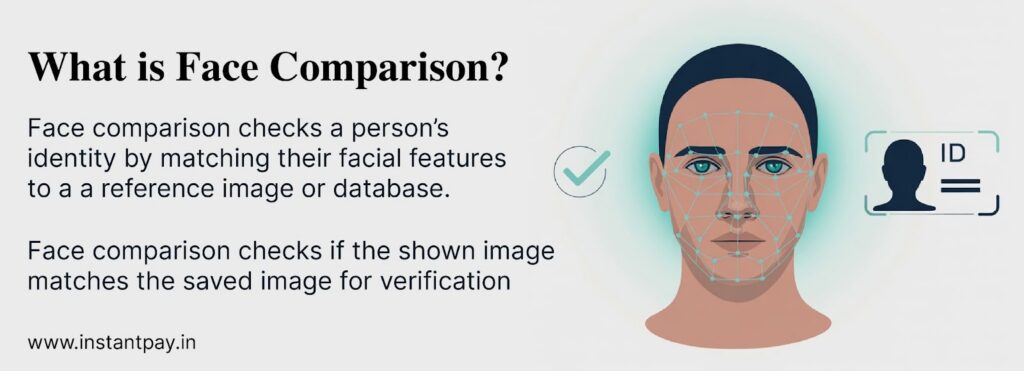
Face comparison involves taking two photos of a person’s face and determining if those photos are of the same person. This process does not identify who you are but rather verifies that you are who you say you are. In a sense, this would be like a digital doorman who had to check your ID by looking at the picture of your face located on the photo on your ID (or your government issued ID) against the picture of your face that was taken at the door (via the camera).
One example of face comparison would be opening a digital bank account; upon opening an account, the bank’s app will request you to take a selfie. Once you provide the selfie, the app will compare the image of the selfie to the image of the photo that is on your Aadhaar (or passport). If the two faces match, the bank will consider you to be who you are stated to be, meaning there will be no paperwork, nor will you have to go to a branch to sign documents, nor will you have to wait in line to be served.
Did You Know?
UIDAI has partnered with homegrown GenAI firm Sarvam AI to elevate the user experience across Aadhaar services
How Face Comparison Works?
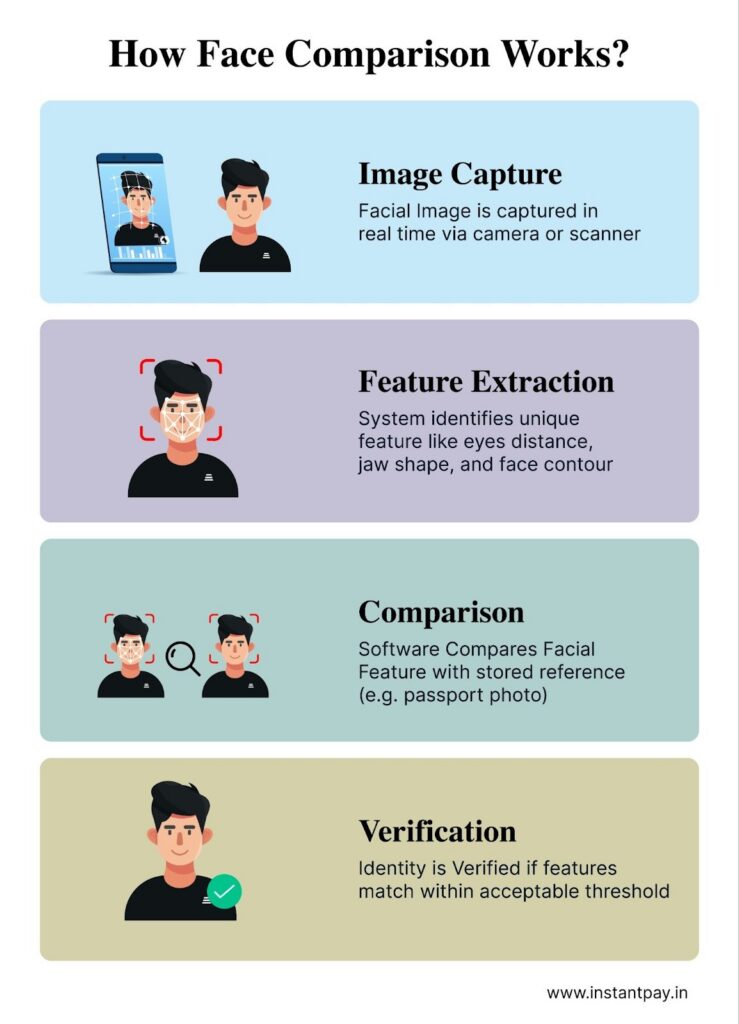
- Captured Image – A photograph of the person’s face is taken (usually by a camera or some type of biometric scanner) at an instant, such as during an airport check-in procedure or during a transaction at a bank.
- Extraction of Features – Certain kinds of sophisticated systems, search and analyze facial photographs, identifying several unique characteristics, or features (such as the distance between the eyes, the shape of the jaw, and the overall contour of the face.)
- Comparative Analysis – The digital features extracted are compared (using specialized computer software) against stored reference images (i.e., passport and driver’s license) to determine whether they differ significantly from the corresponding features.
- Verification of Identity – Following the comparative analysis, a system can verify or reject the individual’s identity. If the similarity of the extracted features is above the pre-set threshold level, the individual’s identity is considered to have been verified.
Face Comparison vs Face Recognition vs Face Detection
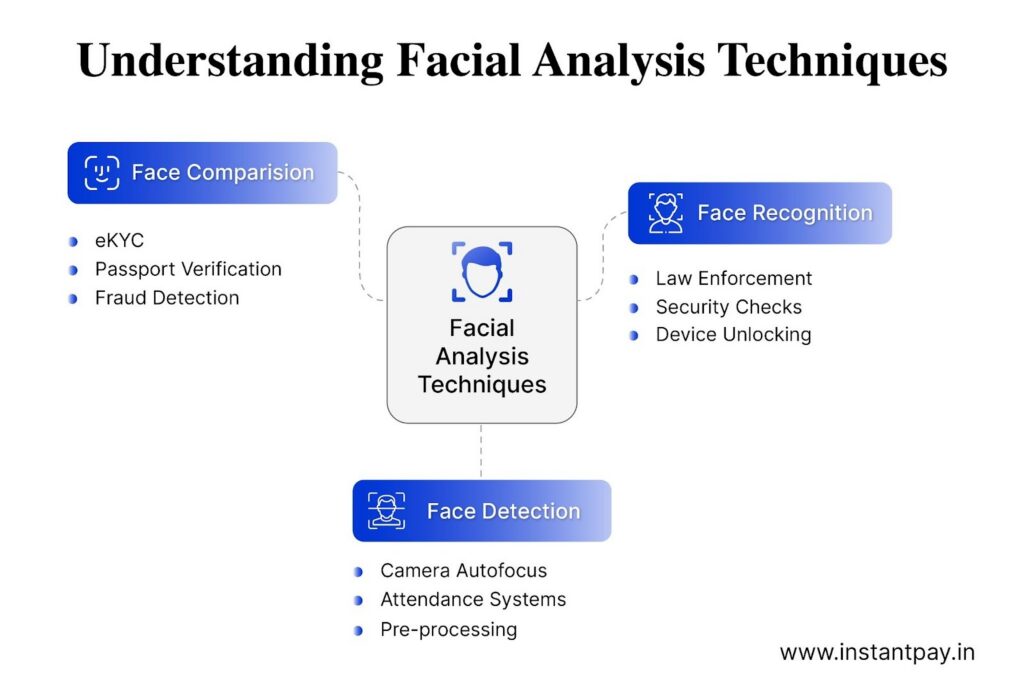
Many confuse the three terminologies and even those who work in the industry have issues distinguishing these terms from one another.
Face Detection – is the foundation and works to detect any type of human face regardless of who they are, there is no name or match associated with the person found. When you take a picture using your phone camera the camera will put a little box around your face and that is how it uses face detection to focus on your face. From here it can build upon that original information with either Face Comparison or Recognition.
Face Comparison – It allows entities using this technology to send images or text messages of themselves. The technology will then receive two images of the same person to make a determination if both photographs belong to the same person. The technology does not look at any other identifiers or names; it simply finds both faces in images and then compares them. This technology is most commonly used in banking, travel, and digital onboarding of people that have previously supplied a reference image to use to compare current images with prior images. Examples of reference images may include an “Aadhaar” photograph and a passport image.
Facial Recognition – This is the most advanced of the three facial recognition technologies readily available. Unlike “Face Detection” and “Face Comparison” technologies that compare or use controlled images against another separate controlled image, both of these methods only utilize one image of a particular individual but then seek and compare against the same individual in a database containing thousands or tens of thousands of photo images of previously identified individuals. An example of FR in action is the ability of “Face Recognition” to compare an image of a face in line at a security checkpoint with images of individuals on a watchlist.
A simple way to remember how the three technologies differ from one another: Detection finds a face; Comparison finds two comparing faces; Recognition identifies a particular individual based on their face or infrastructure/matching other characteristics.
The chart below provides a summary of how each form of facial identification technology differs from one another:
| Face Detection | Face Comparison | Face Recognition | |
| What it does | Finds a face in an image | Checks if two faces match | Identifies who a person is |
| Question it answers | Is there a face here? | Are these the same person? | Who is this person? |
| Common use | Camera autofocus, attendance systems | Bank eKYC, airport check-in | Law enforcement, surveillance |
| Need a database? | No | No, just one reference image | Yes, large identity database |
What are The Core Technologies Behind Face Comparison?
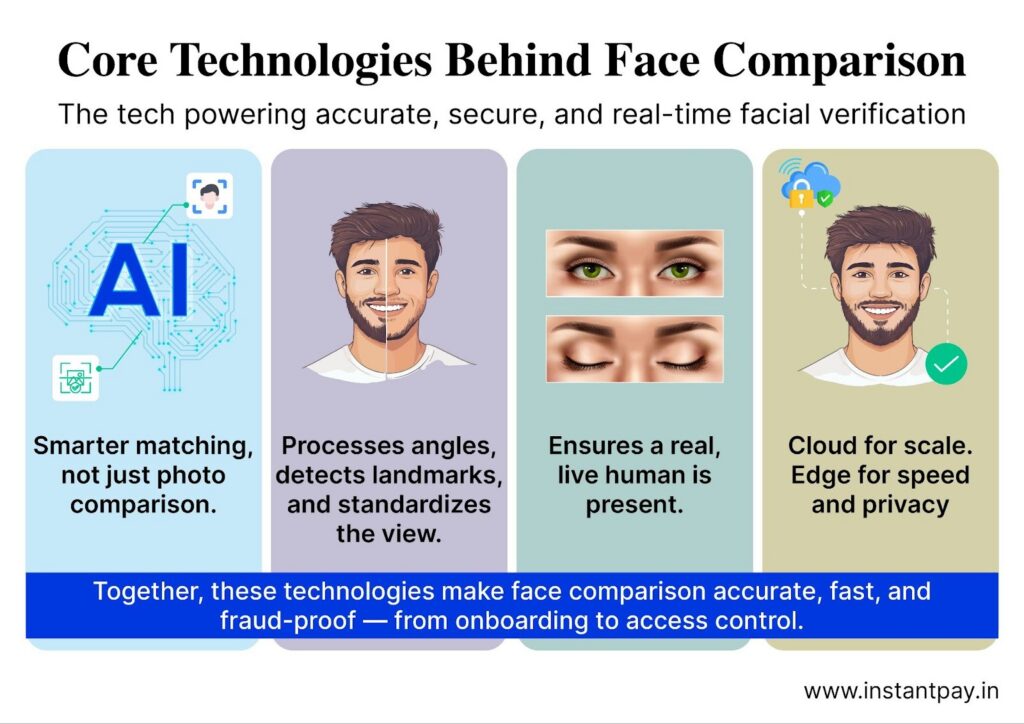
Fortunately, you don’t have to be a tech expert to understand how this all works. There are four fundamental technologies used by the process of face comparison:
1. AI & Machine Learning
This is the brains behind the operation. AI systems are trained using millions of face images to recognize certain patterns like the relative positions of various facial features (eye distance, chin shape). As the AI becomes more familiar with those relationships, it increases its accuracy and ability to find a match, even if your passport photo is five years old or your selfie was taken under poor lighting.
2. Computer Vision
Computer vision enables the system to “see” and interpret images the way a human eye would. Before the two faces can be compared, computer vision communication techniques will align the two faces for comparisons with respect to angle, zoom level, or tilt. Without this methodology, even a genuine match might be improperly aligned when compared against other genuine matches.
3. Liveness Detection
In order to prevent fraudsters from using a printed photo or a video as a means of tricking the system, liveness detection uses technologies to detect that the person’s face being scanned is real, alive and physically there at the moment of scanning. Some liveness detection systems accomplish this silently by analysing skin texture and natural micro-movements while others prompt users to blink, smile, or turn their heads during the scanning process. Whichever method is used to detect whether a person is really standing there at the time they are being scanned, it will serve as the first line of defence against spoofing.
4. Cloud & Edge Processing
After a face has been captured, the scanned image must be compared to a previously scanned image or existing database record. This function (comparison) can occur in two ways, one being via cloud processing whereby the scanned image is sent remotely to large-scale servers for comparison and the second via edge processing, whereby the device you’re using does the comparison directly and locally. Each method has its own pros/cons. For example, although cloud processing is scalable and powerful, it can be slower (high latency) and lacks privacy (your image will be stored on somebody else’s server). On the other hand, edge processing is typically faster than cloud processing and thus allows comparisons to occur nearly instantly, but can also provide higher levels of privacy (your image will only be stored locally) etc. As a result of the advantages of both methods, most current applications will use some combination of both cloud & edge processing for processing facial recognition verification results.
Applications of Face Comparison Technology in Different Industries
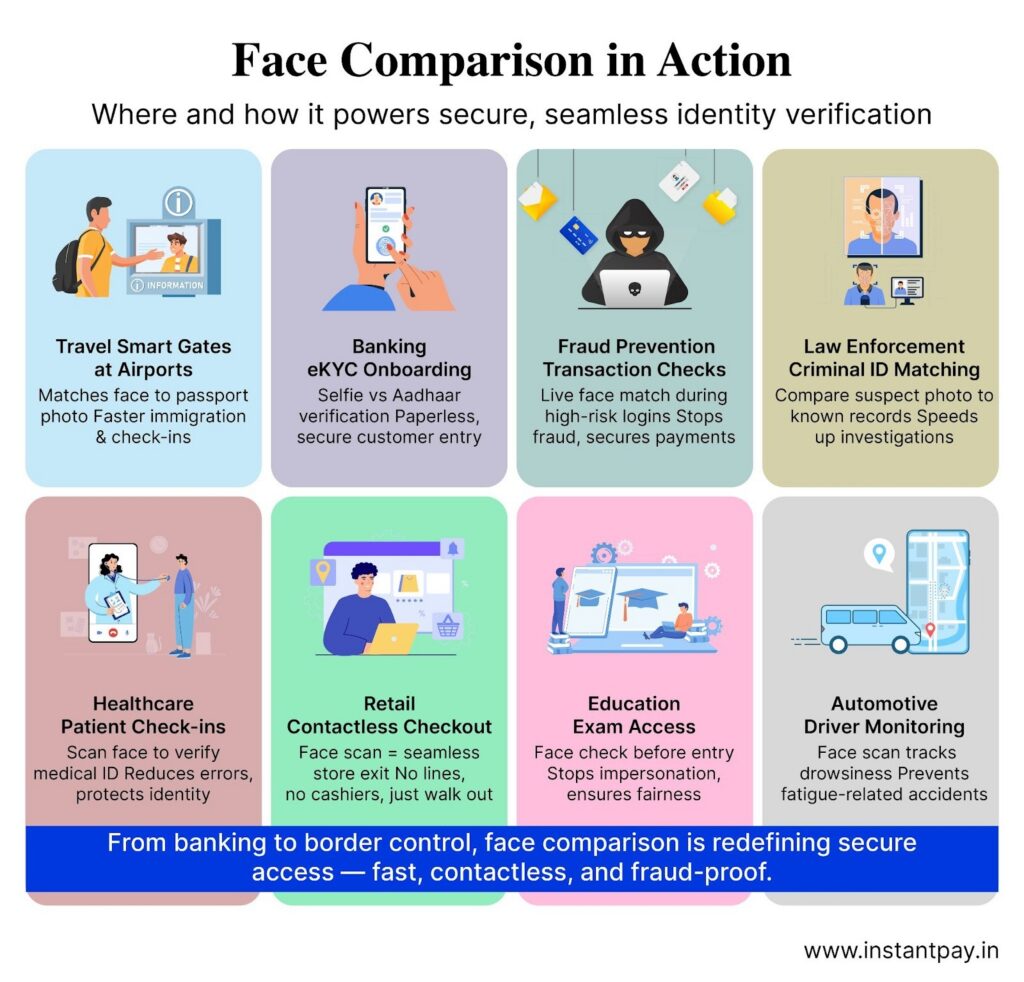
Catching flights and criminals alike, facial recognition plays a silent but huge role in many critical situations in our everyday lives. The examples below illustrate just how much impact it has:
1. Airports/Borders
Facial recognition technology allows people to move through airport immigration faster than ever before. No more waiting in long immigration lines such as at major airports like Dubai, Singapore (Changi) London (Heathrow), with facial recognition technology travelers pass through smart gates where their faces are scanned and matched to the image on their passports as they enter (or leave country) with no paperwork required.
2. Banks/Financial Services
Most people know that opening a bank account or obtaining a loan requires a visit to a bank branch with paperwork and proof of your identity. However, the use of facial recognition technology has made the process of opening a bank account quick and easy because now you can do all of your Know Your Customer (KYC) verification on your mobile device, simply by taking a selfie and having it matched against the photo stored in your Aadhar card. Additionally, banks are using facial recognition technology to verify your identity when you are performing banking transactions (for example, logging into your account on a different device).
3. Law Enforcement/Public Safety
The Automated Facial Recognition System (AFRS), run by the National Crime Records Bureau (NCRB) of India, is a law enforcement tool that allows investigators investigating crimes to quickly identify possible suspects. After an arrest has been made, police may search for additional offences against the suspect through the use of facial recognition technology to image match the suspect against other images from their databases. In addition to verifying criminal suspects and determining if they are wanted, the AFRS is used to determine if missing persons have been located and to help law enforcement reunite missing persons with their loved ones.
4. Healthcare
Once you arrive at a hospital, you will be able to verify your identity through facial recognition before you fill out any documentation to ensure you are properly identified when you check into your appointment or while using telemedicine services so as to reduce any chance of wrongfully identifying you.
5. Retail & E-Commerce
With Amazon Go, you walk in; pick up the items that you want; and walk out, with your face completing the payment. You do not have to wait in line at a cashier or use a checkout counter. Retailers now use face comparison in their loyalty programmes to help customers who are members get immediate recognition of their member status, thus enabling retailers to give personalised offers when they come into the store without the customer having to take any action.
6. Education & Campus Security
Exam impersonation is a real challenge and face comparison is solving that issue. The Tata Institute of Social Sciences in Mumbai, India is using face comparison to validate that students entering the exam room are in fact the students registered to take the exam by comparing their photo to their identity when they arrive, thereby ensuring no one other than the registered student gains access to the exam. The use of face comparison is also being explored by academic institutions to automate attendance taking for classes and lectures.
7. Smart Homes & Consumer Electronics
With the ability to recognise your face, your front door can allow access because of that recognition. Both the Google Nest and Apple HomeKit smart home systems will grant access to the owner based on their face.
8. Automotive Sector
Today’s vehicles have integrated facial recognition technology to detect suspicious behavior at the driver’s seat via real time monitoring with brands like BMW and Mercedes-Benz. If any of these behaviors are observed (e.g., lazy eyelids, less concentrated) then an alert will be sent out immediately to notify you that there is something wrong. You’ll also receive an additional measure of security that ensures the registered driver is actually operating your vehicle before starting it.

Benefits of Face Comparison Technology
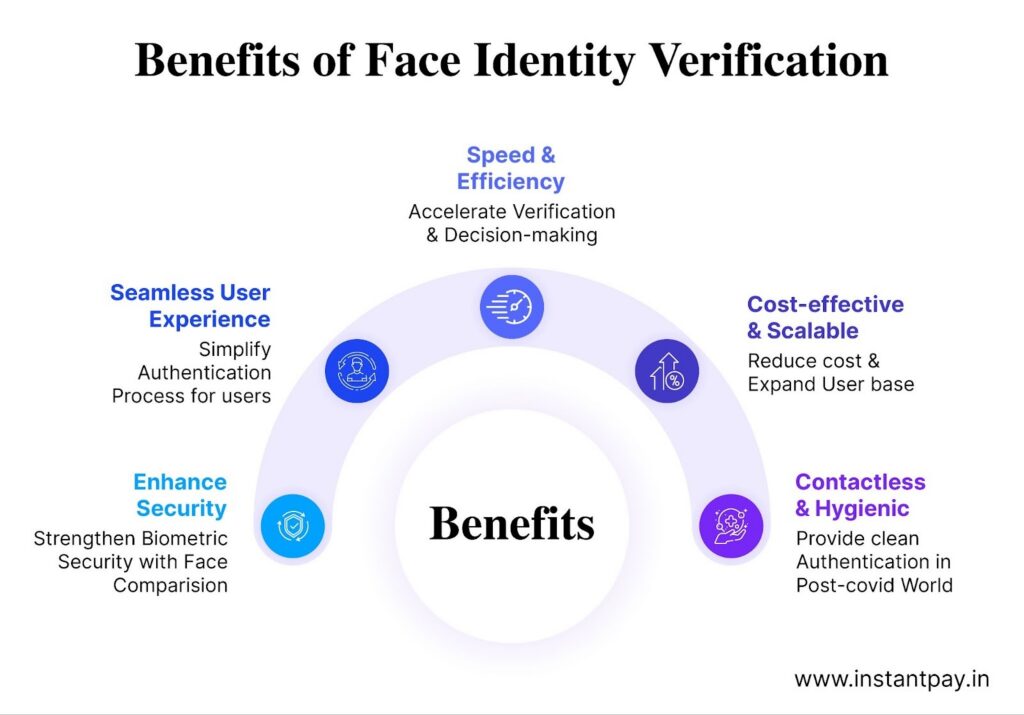
Face Comparison Technology isn’t just another neat gadget – it can solve issues that traditional identity verification systems cannot.) There are many reasons why businesses and other organisations are choosing to use Face Comparison Technology:
1. Stronger Security
An individual with stolen email credentials could log in to your online account. On the other hand, if a forged ID is presented to a tired security officer, it will often fool them. Your face, however? It is much harder to copy. Face Comparison Technology provides instant, real-time verification of your identity and makes it nearly impossible for someone else to attempt identity fraud; for example, if someone is attempting to open their own bank account using your name and/or gain access to your financial records.
2. A Smooth Experience for Users
Forms to fill out, documents to upload, complex passwords to remember… Nobody enjoys completing any of these types of processes. With Face Comparison Technology, all those problems disappear! A quick selfie photo (taken with a mobile phone or webcam) is all that is required. For example, a Telecom company can now activate a new SIM card in minutes (rather than hours or days) by matching a person’s live photo to their Aadhaar image, with no paperwork, no waiting time, and no stress for the customer.
3. Speed That Scales
What used to take minutes (or days) can now be completed in seconds. At boarding gates in airports, passengers have their passports verified against their facial photos instantly! For organisations that are processing thousands of verifications each day.
4. Cost Efficient at All Programs
After you implement the system, it allows for millions of verification so there’s no need for adding staff or more buildings. Government programs such as eKYC and Voter Verification have shown this by successfully processing large amounts of identity verification without any additional staff or physical documentation being required at each location during the verification process.
5. No Contact or Hygienically Clean
The pandemic has changed how we look at shared touching surfaces. Using face comparison technology for identity verification allows you to do it completely hands free with no need for any fingerprints or PIN entry devices or sharing technology with other people. Your face is doing all the work while being at a safe distance away, whether it’s at an ATM, an airport kiosk when checking in, or when being seen for help at a hospital.
Challenges of Face Comparison Technology
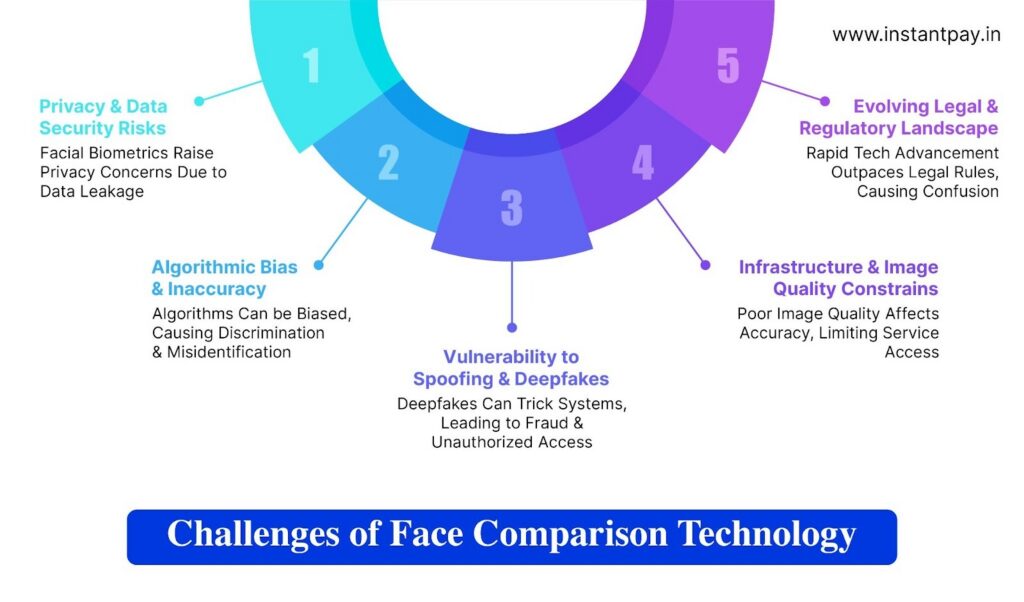
The technology used for facial comparison has advanced significantly, however, it still presents challenges. Knowing how to use this technology is very important to you and your community as it is used more frequently in daily life.
1. Privacy and Data Security Risks
Facial recognition technology uses a person’s face to authenticate them. However, your face is unique, and once you have used it to authenticate yourself, you cannot change it if it is compromised; therefore, the manner in which a person’s facial data is collected, stored, used, and destroyed must be treated with extreme caution. The incident in 2021 involving Clearview AI, where hundreds of millions of photographs of individuals’ faces were collected and stored without their consent, is an example of the consequences of not treating an individual’s biometric data with care and safeguarding it by implementing strong encryption, providing clear consent, complying with privacy laws regarding the protection of biometric data, and ensuring that this information can only be accessed for specified purposes.
2. Algorithmic Bias and Inaccuracy
Facial comparison algorithms do not perform equally on all skin tones, genders, or age groups. In a study by the National Institute of Standards and Technology (NIST), facial scanning algorithms were found to have higher error rates for both African and Asian men than for other ethnic groups. When facial recognition algorithms are used in criminal justice, banking, or other applications where individuals’ rights are affected by the results of the recognition process, the consequences of being incorrectly identified by the technology can be serious.
3. Vulnerability to Spoofing and Deepfakes
As technology advances new ways to beat technology also develop. One example of this is deepfakes, or hyper-realistic fake videos, which are getting increasingly reliable. In 2024, an employee at a Mezzanine Finance Company in Hong Kong was tricked into sending $25 million over a video call using a deepfake version of his CEO. Use of both liveness detection and multi-factor authentication can help lessen risks associated with this type of vulnerability; however, there is still an ongoing “arms race” between fraud and security.
4. Infrastructure and Image Quality Constraints
Face comparison works best when using quality, well-lit, high-resolution photos. When using lower quality cameras, in poorly lit locations, or when on an unreliable internet connection (like in many rural and underserved communities) the face comparison system may not function properly. It is a significant issue leading to a two-tier user experience for individuals’ access to service based on their geographic location and/or the device they have access to.
5. Evolving Legal and Regulatory Landscape
Technology is developing at a faster rate than legal systems are developing laws to regulate that same technology. The passage of the Digital Personal Data Protection Act 2023 in India provides a more structured approach to how an organisation can collect and use biometric data, which is an encouraging development for effective regulation of related technologies. However, there continues to be significant variance across jurisdictions throughout the world regarding how biometric data are regulated, providing an opportunity for increased misuse or inconsistent regulation between jurisdictions.
Future Trends in Face Comparison Technology
India is already the world leader when it comes to using face comparison technology and as this foundation continues to grow, the future will be very exciting for this technology
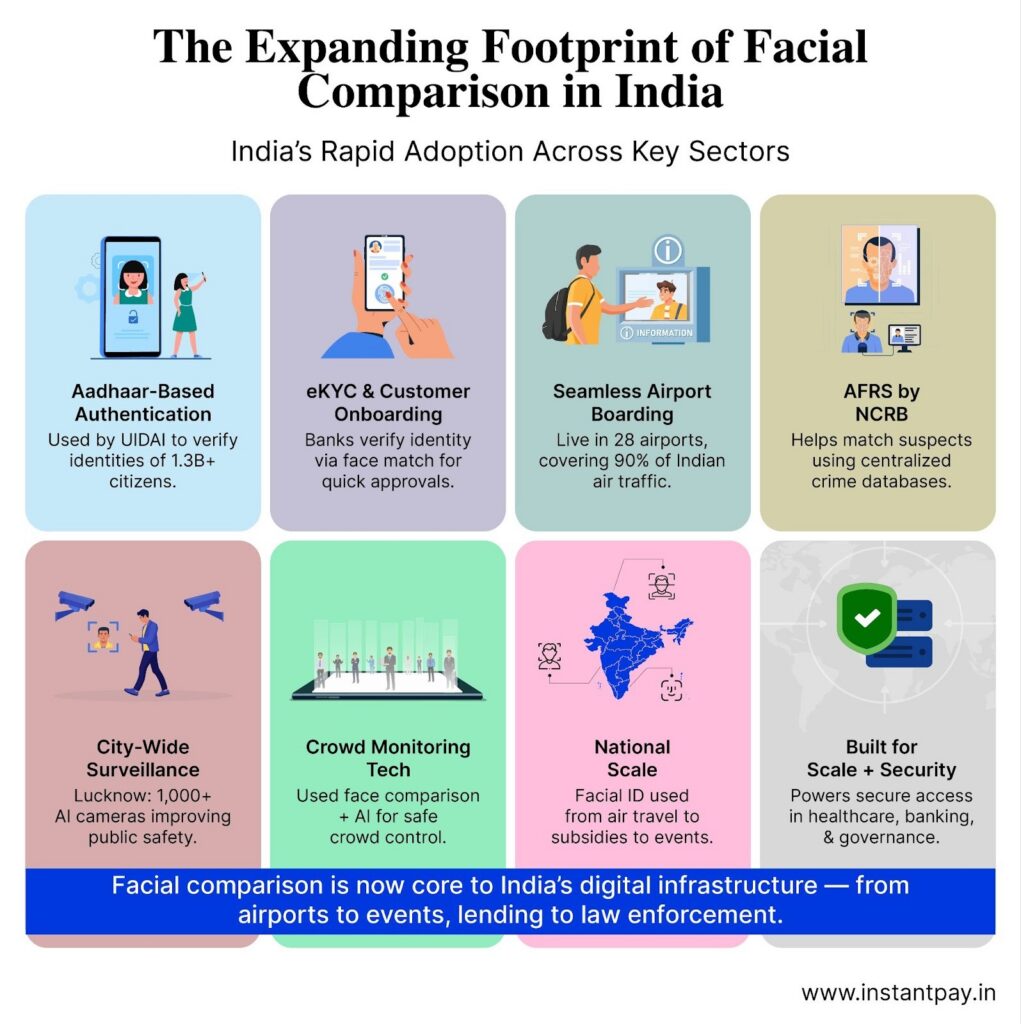
With the strong foundation in place, this technology is developing at a rapid pace. The following trends will be key in determining how we will use this technology in the future:
1. Paying With Your Face
Forget about cards, phones or PINs. Facial recognition is currently being tested as a payment method at retail stores in China and Brazil. Customers simply look into a camera and their payment is approved. With India’s UPI system expanding at a rapid rate, similar facial recognition payment methods could soon be available in India.
2. Improved Liveness Detection to Combat Deepfakes
With the rapid growth of deepfake technology, the technology used for detecting liveness has also advanced rapidly. Future systems for validating liveness will move beyond simply requiring you to blink. These systems will analyze the tiniest changes in your skin colour due to blood flow, calculate the depth of the image, and use voice data along with facial data to validate that you are a real person. Intel’s FakeCatcher technology is capable of detecting deepfakes in real time with 96% accuracy by analyzing these very small physiological signals.
3. Processing on the Device: More Privacy
Most of the time, face comparisons are done on a server. The move is to instead do all processing on your device; this means face comparisons will happen faster, in a more private manner and will no longer require a strong internet connection to function. This change is particularly important for individuals who live in rural areas or areas with poor connection or reliability issues, as these users usually have difficulty with systems that are solely based on cloud computing and use online verification.
4. AI That Explains Itself Builds Trust
As face comparison systems are used in increasingly important situations, such as getting loans approved or passing through borders or being involved in criminal investigations, individuals are beginning to ask: what logic/system is being used to make the decision? In the future, face comparison AI will be able to generate an explanation in simple words to justify its matching and non-matching results. Being transparent about how the decision was made and giving an explanation will help the public trust the technology and comply with regulations like the Digital Personal Data Protection Act in India.
5. Customised to Fit the Business
Face comparisons will no longer work the same for everyone or every industry. For example, hospitals will have technology specific to their interactive and patient records check-ins, universities will have systems geared towards their proctored exams and attendance. Each industry will be able to configure its systems based upon their own privacy, accuracy, compliance, and functional needs in a unique way instead of having a general or generic configuration for every sector/business/image type developed for this technology.
Final Thoughts
Face comparison is now a key tool in digital identity. It quietly handles daily tasks, such as checking loan applications and processing airport immigration. Its power comes from matching faces quickly and inclusively. This process is contactless and maintains accuracy and privacy.
As technology improves, we must adopt it responsibly. We must balance innovation and regulation, convenience and consent, and automation and accountability. This balance will shape how we use face comparison in the future. The aim is not just smarter security; it’s about creating a safer, more trusted digital world for everyone
FAQs
1. What are the three types of facial comparison?
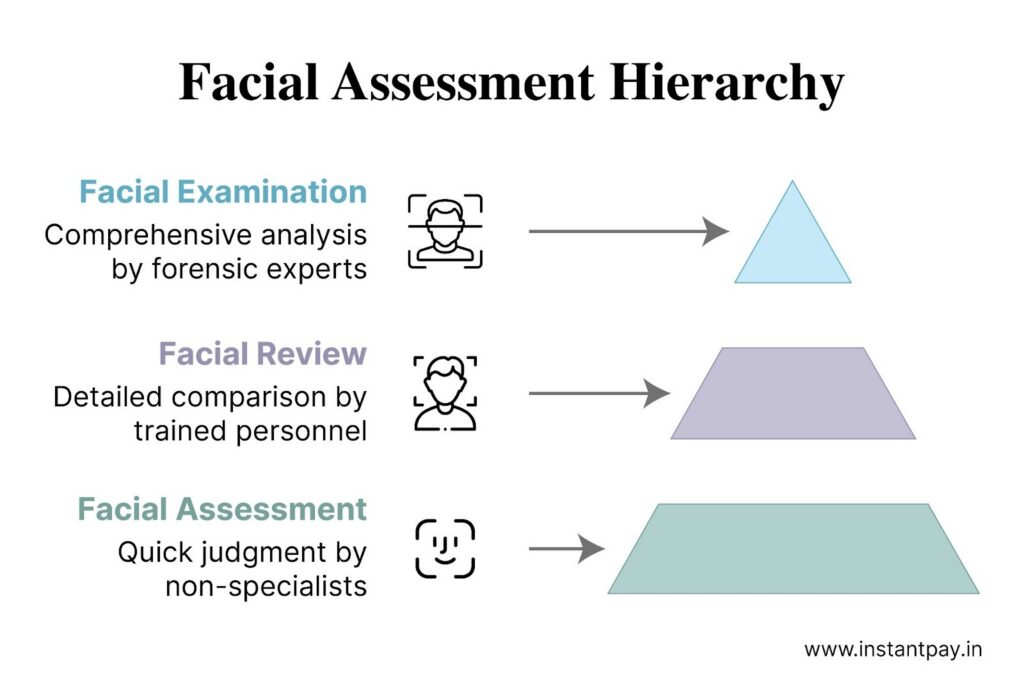
The three types of facial comparison are assessment, review, and examination. Assessment includes fast, automated checks for basic identity verification. A review is a detailed comparison often used in security settings like passport control. Examination is the most detailed method and is often used in legal or criminal cases.
2. What is the golden ratio face comparison?
Golden ratio face comparison is a way to analyse facial features using the “golden ratio.” This ratio is about 1.618. It helps assess facial symmetry and beauty. In facial assessment, it can show ideal facial traits and measure how closely a person’s face matches these proportions. This method can be useful in medical, cosmetic, or security fields.
3. Can face comparison be used for fraud prevention?
Yes, it helps check that the person seeking services matches their ID. This cuts down on fraud in banking and online services.
4. Is face comparison technology secure against spoofing?
Yes, enhanced liveness detection, including micro-movements and blood flow analysis, helps prevent spoofing by ensuring the person is real, not a photo or video.
5. How is face comparison used in law enforcement?
It helps verify suspects’ identities by comparing facial images with criminal databases, aiding in investigations and public surveillance.
6. How can businesses implement face comparison for customer verification?
Businesses can use face-based assessments during digital onboarding (eKYC) to ensure the person applying is the rightful individual, commonly seen in banking and travel apps.