Did you know that there are currently 4.87 crore of cases pending in India’s district court; 70.87% of which have been pending for over 1 year Each one of these cases represents an individual and/or business behind the scenes. That one person could become your next employee, supplier, or business partner.
Missing a single red flag can lead to fraudulent behaviour, legal problems, and/or millions in losses. This is why you have to conduct a litigation check before engaging with any person (businesses too), as it is an absolute necessity. This article will provide you with an overview of what a litigation check consists of and how it is conducted, as well as the step by step process of automating it.
What is a Litigation Check?
A litigation check is not just a verification of your PAN or Aadhaar or even a standard background check; it is a thorough search of all court records, FIR databases, and tribunal filings for both pending civil and criminal cases and cheques that have bounced under section 138 of the Negotiable Instruments Act, as well as those that are ongoing in other bodies such as the NCLT and DRT.
The gap is significant because even if a person has a legitimate GST registration, has completed KYC, and has an active bank account, that person may still be involved in a Rs.50 lakh fraud case being heard in a district court. A standard check only verifies the identity of a person whereas a litigation check verifies the individual’s legal status. These two items are very different from one another.
Criminal Litigation Scan: Avoid Missing an Uncoverable FIR
A Criminal Litigation Scan performs a thorough search of criminal databases available to local, state, and federal law enforcement for documentation including FIRs, charges, and convictions. This type of search is designed to disclose results not available through a typical background check.
The unfortunate reality is that many organizations unknowingly hire delivery drivers, make vendor-appointed directors, and accept loan applications from individuals who were currently being investigated for a crime not through negligence or disregard but simply because the pertinent information is not reported through standard KYC processes.
For example, an NBFC based in Delhi performed a criminal background check on 6 apprehensive borrowers/rejectors in 2021 and found active FIRs against all 6 of them related to securing fraudulent documents and committing identity fraud in classification with one or more of the following states: Gujarat, Haryana, Jammu & Kashmir, Uttar Pradesh, Maharashtra, Rajkot and Telangana. If the NBFC had approved these too unwise risky borrowers, they would have realized collections on a total lending value of over Rs.18 lakhs at (risk) to expire.
4 Layer of Business That Most Companies Don’t Check for Regulatory Risk
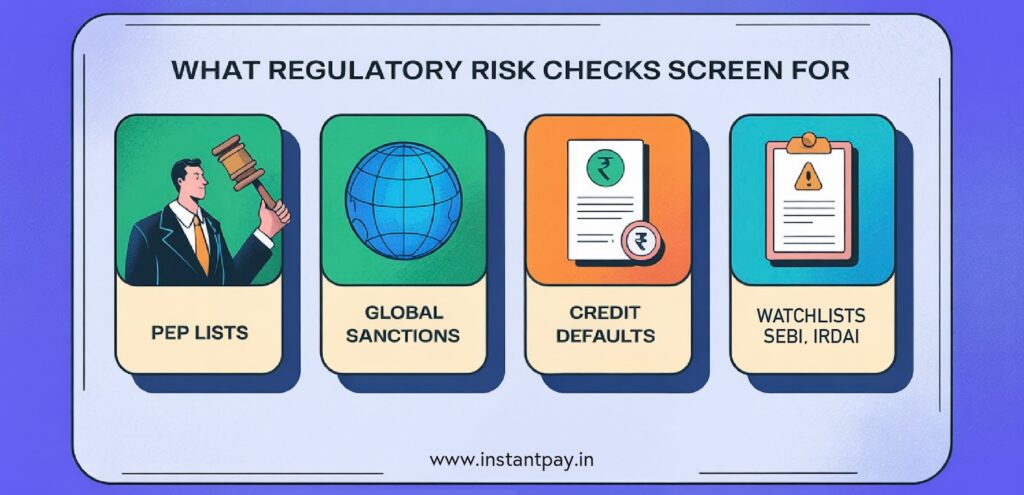
Legal issues are identified through courts and FIRs. However, there is a significant number of risks that do not end up in court and can therefore create as much harm as those that take place.
Regulatory Risk Checks Use Four Sources:
- Politically Exposed Persons (PEPs) list – PEP lists include politicians, government officials and their immediate families, who need extra due diligence per Indian law
- Sanction lists are based on the blacklisting by the United Nations, OFAC and European Union of individuals and entities from financial transactions
- Credit default lists – list companies and individuals who have been blacklisted by banks and NBFCs as a result of failure to pay loans
- Regulatory watch lists – Include defaulters and enforcement lists published by the RBI, SEBI and IRDAI
If you skip performing a regulatory risk check, you run the risk of bringing in a company that is “clean” on paper but “dirty” financially or politically, resulting in regulatory penalties, audit flags and AML violations.
Three Different Checks Provide a Whole Picture of the Risk:
None of the checks provide “everything,” but the three checks help the user understand the risk presented by the company.
| Risk Type | What It Checks | What It Prevents |
| Legal Risk | Court cases, FIRs, restraining orders | Unfamiliar legal problems |
| Criminal Risk | FIRs, charge sheets, convictions | Fraud, identity theft, insider threats |
| Regulatory Risk | PEPs, sanctions, defaulter listing | AML violations, penalties charged by regulators |
How to Perform a Litigation Search in India: The Simple 6-Step Process
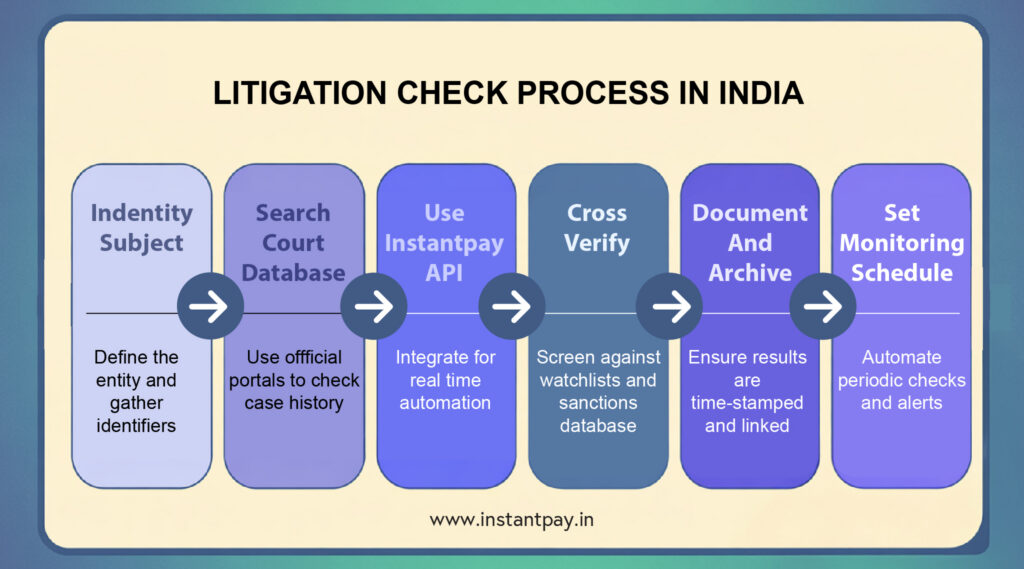
Step 1: Know Who You are Looking For
To begin with, you need complete names, dates of birth, PAN numbers and addresses. For individuals, you will also require their CIN and registered name if it’s a company or organisation. If you have a common name like “Amit Singh’ or “Rahul Sharma”, be aware that you will find a number of results when searching on court systems. To ensure that you are looking up the correct individual, always use the PAN Number or date of birth to cross-check your results.
Step 2: Search the Official Court Databases
India has a multi-tiered court system with different portals for different levels. You should check the portal for the correct level of court as follows:
| Court Level | Search Portal |
| District Courts | E courts services |
| High Courts | Individual portals like Bombay HC |
| Supreme Court | Supreme Court of India |
| Tribunals/NCLT | NCLT Website |
Searching by party name, FIR number or case number will give you the most accurate results.
Step 3: Use an API to Speed Up Your Searches
If you’re searching for one or two people, then manual searches will do the trick; however, if you’re trying to onboard a large number of employees, vendors or loan applications, it’s not effective. With Instantpay’s Litigation Check API, all that you need to do is enter the name and PAN and you will obtain real-time data from all court records and FIR databases, including the case type, current status, next hearing date and the court in which the matter is pending.
Step 4 – Verify the Entity Against Watchlists
Court documents don’t tell you everything; run an individual/entity against PEP lists (Politically Exposed Persons), global sanction lists, and criminal watchlists so you can have full information. This is especially critical for companies regulated by organizations like RBI, SEBI and IRDAI.
Step 5 – Store and Document Your Findings
Every time you run an individual/entity through a check you must be able to save that (in a time-stamped form), link it back to the record of the individual/entity you ran through the check on, and have the documentary available for download in PDF/CSV formats. This documentation could prove critical if you find yourself being audited by a regulator.
Step 6 – Don’t Consider It A One-Time Task
What is a clean record today may or may not be a clean record tomorrow; therefore, you should implement a periodic alert system (monthly for medium/high risk entities; quarterly for other entities) to advise you of any change in the status of an individual/entity. You can accomplish this by using API webhooks set up just for this functionality, so that you will not be surprised by any change in status of individuals/entities that you checked.
Case Study: A Rs.1.2 Sore Loss That Could Have Been Avoided With One Check Of A Company In The U.S.
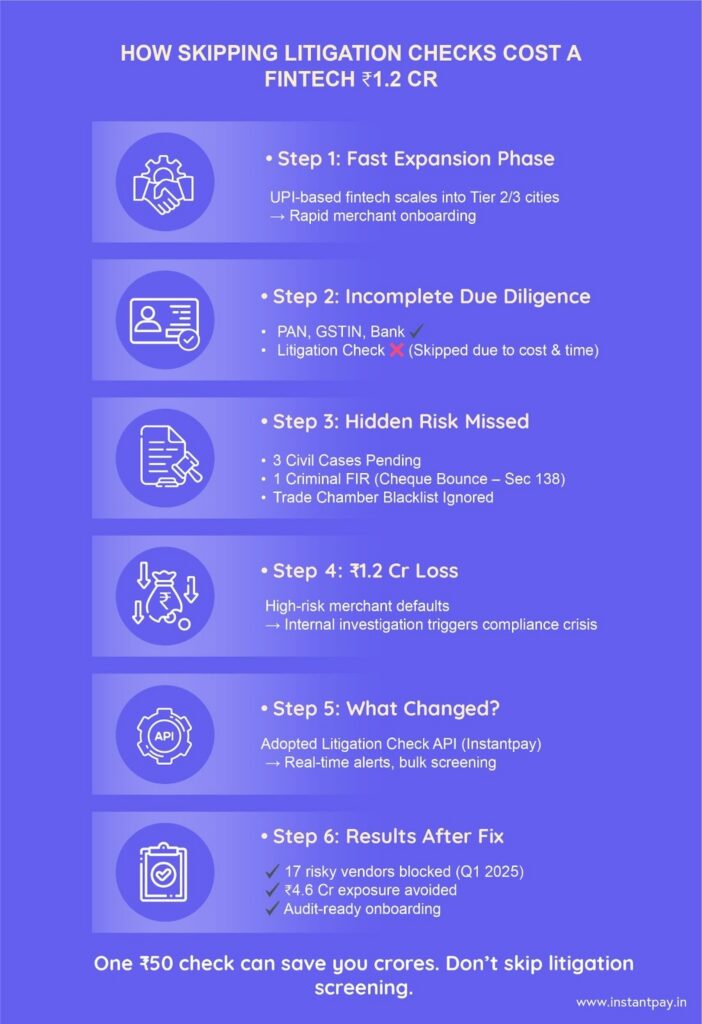
A financial technology (fintech) startup in Mumbai has been rapidly adding partners through UPI payment systems. The company did due diligence by validating PAN, GSTIN, and bank account data; however, litigation checks were not performed because they believed they took too much time.
Nine months later, one of its partner merchants defaulted on a loan of Rs.1.2 crores. After an internal investigation into what due diligence the company performed during onboarding, three facts that should have been revealed through a lawsuit check were discovered.
1) A pending district court case with Rs.48 lakh in financial fraud against the merchant.
2) A criminal FIR against the director of the partner company for a bounced cheque under Section 138 in Madhya Pradesh.
3) A blacklisting from the local trade chamber that was not disclosed during onboarding.
All three of these pieces of information would have emerged through a lawsuit check right away.
After this incident, the company rebuilt the onboarding process from the ground up by adding Instantpay’s Litigation Check API to screen every merchant in real-time during their onboarding process. As a result, by Q1 of 2026, they identified and flagged 17 high-risk vendors and an estimated loss of Rs.4.6 crores due to these same risky vendors.
The cost for each litigation check was between Rs.10 to Rs.50. The cost of not executing one Rs.1.2 crores continues to grow.
5 Common Myths of Litigation Checks that Indian Companies Still Believe in
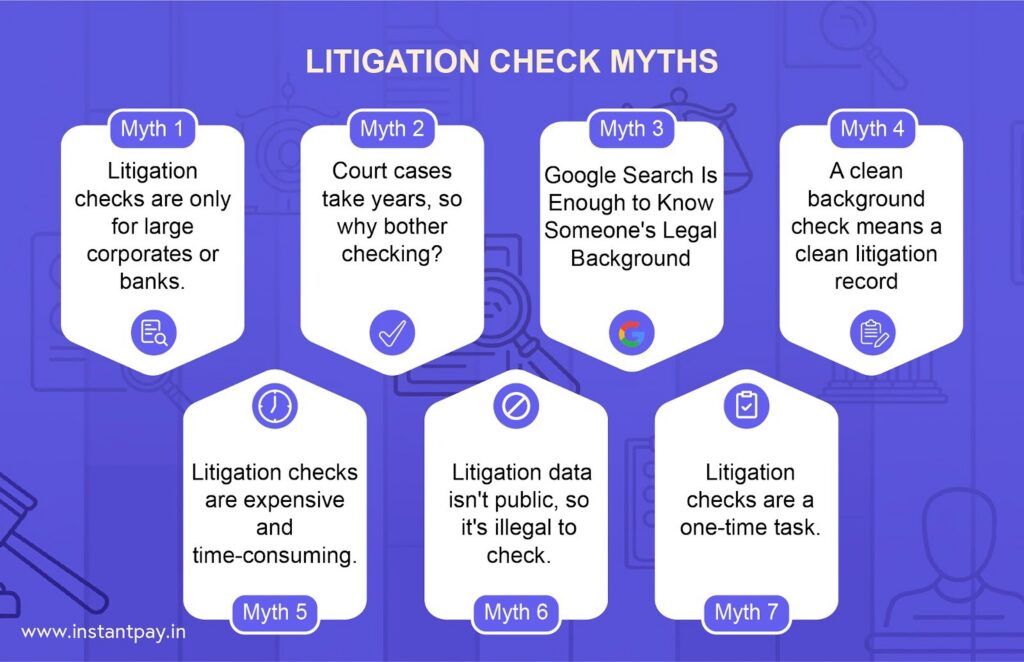
Litigation checks are one of the most misjudged assets for Indian Businesses.
Here is a list of some of the most commonly believed myths regarding Litigation Checks in Indian Business; and the reality for each.
Myth 1 – “Litigation Checks are only for Large Corporations and Banks”
This is far from the truth. All SMEs, FinTechs, NBFCs, Logistics Firms, HR Departments and companies of all sizes alike, will face on-boarding risks, if the requisite litigation checks were not to be undertaken. The size of a business provides no barrier to an on-boarding risk.
An example of this would be a small Logistics start-up company operating in Pune, flagged a delivery Aggregate Company with whom they were about to commence doing business with. The delivery Aggregates founder was flagged as having a bounced cheque case of Rs.2.5 crore and this was only highlighted because of the Litigation Check. A larger business can easily miss this on-boarding risk and thus will likely lose out.
Myth 2 – “A Background Check indicates a Legal Check”
These are in fact 2 separate processes. A Background Check will confirm your identity through PAN, Aadhaar and employment history. A Litigation Check will confirm the legal standing of the prospective employee and provide details of any current or pending Litigation, Court cases, FIRs, Tribunal Proceedings or Default Lists. Neither provides the other with any cover.
Myth 3 – “I can Google it”
Court Records as it pertains to pending legal cases exist in multiple formats across many District Courts, High Courts, NCLT and the Supreme Court and would not all be indexed under Google. Therefore, all litigation will need to be conducted either by a Name or Case Number and will either require access to an official Court Portal such as eCourts, or through an API (Application Programming Interface) such as Instantpay’s Litigation Check. Therefore, you will not be able to locate a Pending FIR in Nagpur via a search on Google.
Myth 4 – Accessing judicial records in India is a form of private information and against the law to obtain
Court records in India are considered to be public records; therefore obtaining these records for verification techniques such as onboarding, risk management and complying with regulations is 100% legal. In fact, regulators in the financial technology, lending and banking sectors would encourage the use of official sources or a legally compliant API supplier to ensure you are complying with current laws.
Myth 5 – We did our due diligence and checked when they first became known; we are safe now
The legal status of any business can change at any moment; a criminal case could arise from an FIR next week, a civil case could turn into a criminal case and a settlement may fall apart tomorrow. Therefore, any one time check will only give you a limited perspective; it does not guarantee you any degree of protection going forward. To mitigate this risk to your business, schedule recurring or automated checks every 3-6 months on the high-risk entities. You can also automate with webhook notifications to proactively receive alerts if the high-risk business category changes.
FACIS, Credit Default & PEP Screening: 3 Checks to Complete Your Picture of Credential Verification
Importance of FACIS (Fraud Abuse Control Information System) in Credential Verification in Healthcare
If your company provides a provider (Doctor), Labs for the diagnosis of patients or Labs performing a Medical test on patients, there’s a high chance for credential fraud to occur in India while recruiting employees, but it is rarely reported.
For credentialing a provider to have a license and not having a history of committing fraud, serving you from the NMC registry and State Medical Council records.
Credit Default Database: Check Who Owes You, Before Onboard
The credit default database provides vital information about individuals’ payment histories that you won’t find in any court records. Lenders, NBFCs, and businesses providing credit or high value contracts must check this database. This database can provide flags for:
- Blacklisted loans from banks or NBFCs due to non-payment by borrowers
- Names listed on the RBI Defaulter List
- Persons with repeated instances of financial delinquency across multiple institutions
A clean litigation history does not guarantee loan payment history or vice versa. Checking both gives you the complete picture of a borrower’s financial state.
What is OIC Check and SAM Check?
OIC Check – Validate Insurance Companies in India
OIC Checks are used throughout the world to ensure that a company is an accredited and legitimate Insurance provider. In India this is done through the Insurance Regulatory and Development Authority of India (IRDAI).
You should always verify your Insurance providers’ IRDAI details before dealing with them. Check for any disciplinary actions against them. Dealing with an unlicensed Insurance Provider represents a level of financial risk to you as well as possibly getting you into trouble with the regulating authorities.
SAM Check – Verify Suppliers Who Were Awarded Government Contracts
A SAM Check is used in the US to ensure that reviewed suppliers are on the federal Debarment List. In India, the Government e-Marketplace (GeM) portal will verify the details to see if the supplier is registered with the GeM and then the supplier may be on the Central Vigilance Commission (CVC) blacklist.
Be sure to take the time to check both of these lists if you have any dealings with government contracts/public sector purchases:
• GeM registration and status
• CVC debarred entities list
• Any pending Vigilance/Fraud cases
By using just one debarred supplier you could end up losing the contract and the relationship.

Frequently Asked Questions (FAQ’s)
1. What is a litigation check in India?
A litigation check in India is a way to see if an individual or entity is currently involved in any civil/criminal/regulatory litigation. A litigation check includes searching for lawsuits in district courts, looking at tribunal data for litigation records, and checking for FIR’s from multiple locations to assess potential legal exposure.
2. Why are litigation checks important for businesses?
Businesses will use litigation checks to avoid hiring people/companies that have a high likelihood of involvement in fraud, litigation, or criminal activity. By doing so, they will remain compliant with laws and regulations, protect their brand and reputation, and limit their level of financial/lawful exposure.
3. What sources are used for conducting litigation checks in India?
Litigation records come from the following sources:
- eCourts for lower court cases
- High Court websites
- Supreme Court of India
- Tribunals (NCLT, DRAT)
- FIR data from the State police.
4. Can I perform litigation checks manually?
Litigation checks can be done manually by visiting court websites and searching for party names, case numbers, or lawyers’ names. Manual processes can take a significant amount of time, are prone to human error, and are very difficult to scale if you are working with a high volume of data.
5. What is the role of APIs like Instantpay in litigation checks?
Using an API like Instantpay’s Litigation Check API allows for automatic litigation screening processes by getting real-time data from various Indian courts and police records—all at one time.
6. What types of cases can be identified through a litigation check?
The types of cases that can be discovered during a litigation check include civil suits (e.g., property disputes), criminal matters (e.g., FIRs and fraud), fraud/cheque fraud issues (Section 138), tribunal matters (e.g., insolvency matters), and cases that are pending, have been discharged or are the subject of an appeal.
7. Are litigation checks legal and compliant with Indian regulations?
Litigation checks are legal and comply with Indian law. The records being examined are considered public records in India, and if there is a valid business purpose for obtaining the information (e.g., onboarding, assessing risk, determining compliance), it is also legal. It is generally advised that litigation checks be performed under the guidance of various regulatory agencies (i.e., Reserve Bank of India [RBI], Securities and Exchange Board of India [SEBI], and Anti-Money Laundering/Know Your Customer [AML/KYC]).
8. How frequently should litigation checks be conducted?
Litigation checks should be performed upon the onboarding/verification of an individual or entity and may be repeated on a periodic basis. For example, periodically conducting litigation checks every six months or once a year is considered standard; however, high-risk or regulated entities must have automated alerts available to monitor litigation checks on a continuous basis using webhook technology.
9. What are the risks of not performing litigation checks?
The potential consequences of not performing litigation checks include the opportunity to be involved with fraudulent financial activity, expose oneself to regulatory penalties for onboarding blacklist individuals/entities, damage one’s reputation by public association with individuals/entities that have defaulted or have criminal records, and be subjected to fines for failing to comply with the defined due diligence requirements.
10. Who should conduct litigation checks in an organisation?
Litigation checks are typically managed by:
- HR and Talent Teams (for employee background screening)
- Compliance and Legal Departments (for KYC, AML, and vendor due diligence)
- Risk and Credit Teams (in the lending or insurance sectors)
11. What is the meaning of litigation in court?
Litigation in court means resolving disputes between two or more parties through the judicial system. This process involves filing cases, attending hearings, and receiving final judgments.