The rapid development of digital payments in India is impressively high. The nation recorded an approximate 16,000 Crores digital payment transactions during FY 2023-2024, while in FY 2024-2025 (through January 2025), that figure will have surpassed 18,000 Crores. Digital payment transactions have gone from being considered a convenience to being essential forms of business across the nation.
Small businesses (6.3 million+) in India have begun to experience how digital payments control the way they do business through UPI payments at street vendors and through POS systems at local stores. Digital payments allow for quicker payment processing, income tracking, trust-building with consumers, and much more than cash used to allow for. Through digital payments, small businesses can now gain access to more formal credit, keep a more accurate financial record, and obtain growth potential that cash will not provide.
What Are Digital Payments?
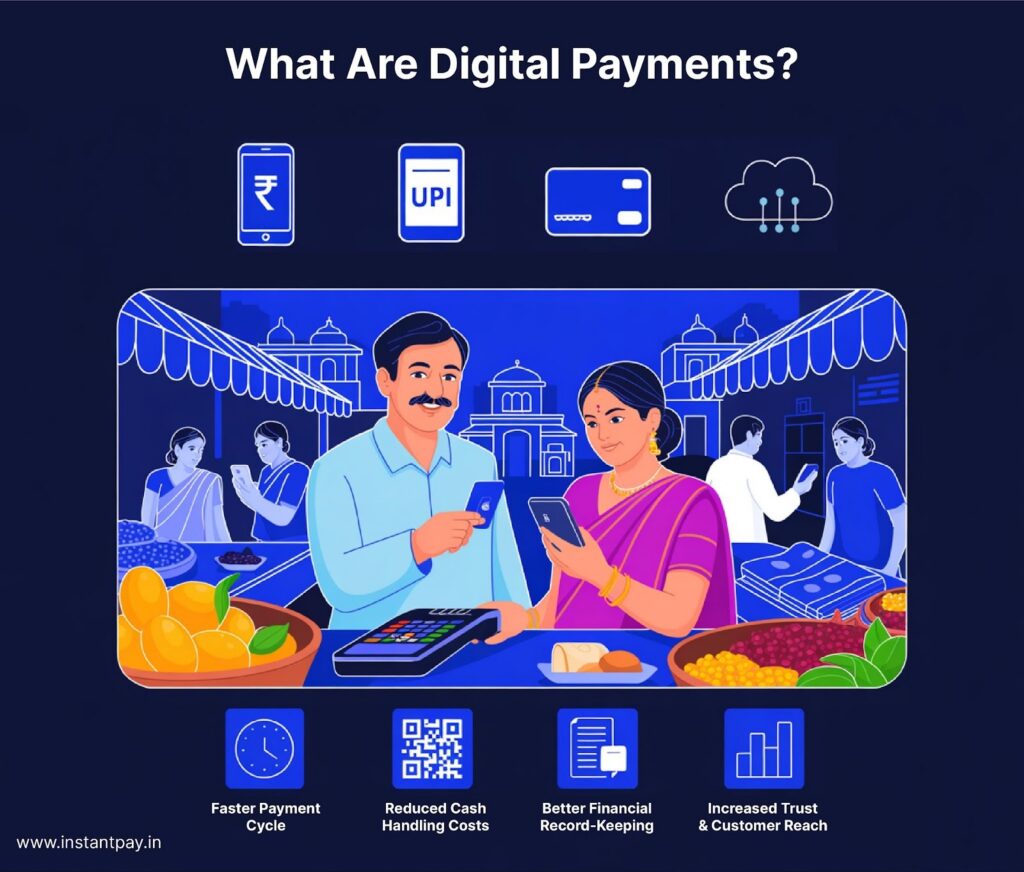
Payments made via electronic means and not using cash are called digital payments. Instead of using cash notes to make a payment, the funds will be transferred electronically via an app, card, or online method over the internet or by a cellular network. This allows small companies to accept payments electronically through faster and more secure methods.
Some examples of common digital payment types include:
- UPI apps (PhonePe, Google Pay, Paytm)
- QR code payment for retailers or street vendors
- Credit or debit cards
- Point of Sale machines (POS) within retail stores
- Internet banking or PG networks
- Embedded payment systems
Why It Matters to Small Businesses?
As digital payment is a means of exchanging currency for something else other than cash, it will allow ordinary companies to operate as efficiently as possible, in particular:
- Quick payment means that a business’ cash flow is now improved with an instant transfer using UPI.
- Reduces the need for physical cash handling within a company because there is less cash to steal and less chance to make manual counting errors.
- Digital proves as an effective record of your company’s transaction history, which is great for filing GST and improving the company’s ability to get loans.
- Finally, the digital payment system will give your customers more trust in you as a business because you will be able to offer a digital-first experience to your customers and also sell online as well.
Types of Digital Payment Methods Used in India
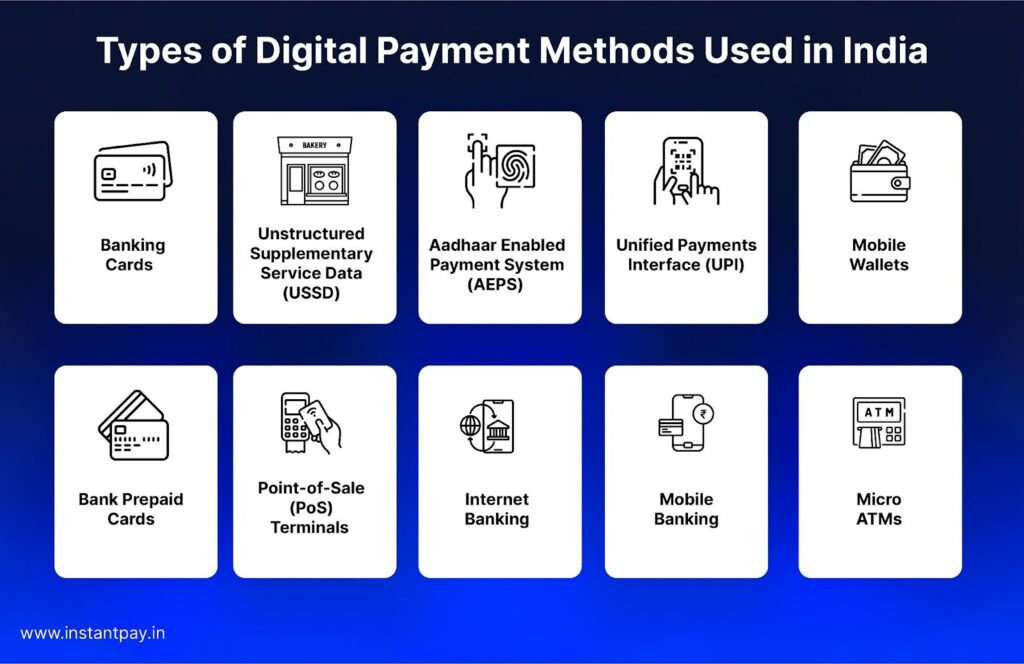
In India, many small companies already accept digital payments to facilitate instant payments and decrease their reliance on cash.
Digital payments are used by a variety of businesses, including street vendors and retailers.
Examples of digital payment methods include:
- UPI Payments: This is the most common method for making instantaneous payments through mobile apps or by scanning QR codes.
- Debit cards and credit cards: Can be accepted with or without the use of point of sale (POS) devices.
- Mobile wallets: Applications such as Paytm and PhonePe are used to make instant payments as they securely hold consumer funds.
- Point of Sale (POS) and Mobile Point of Sale (mPOS): Equipment used by restaurants and stores to accept card payments.
- Internet banking and mobile banking: Many businesses in India use these methods to send supplier payments and for transfers.
- AEPS, USSD, and Micro ATMs: Useful for citizens living in rural areas where access to a smartphone and/or internet is limited.
- The numerous digital payment alternatives now available aid small and mid-sized businesses across India as they adjust to an increasingly digital economy.
5 Factors Fueling the Growth of Digital Payments for Small Businesses
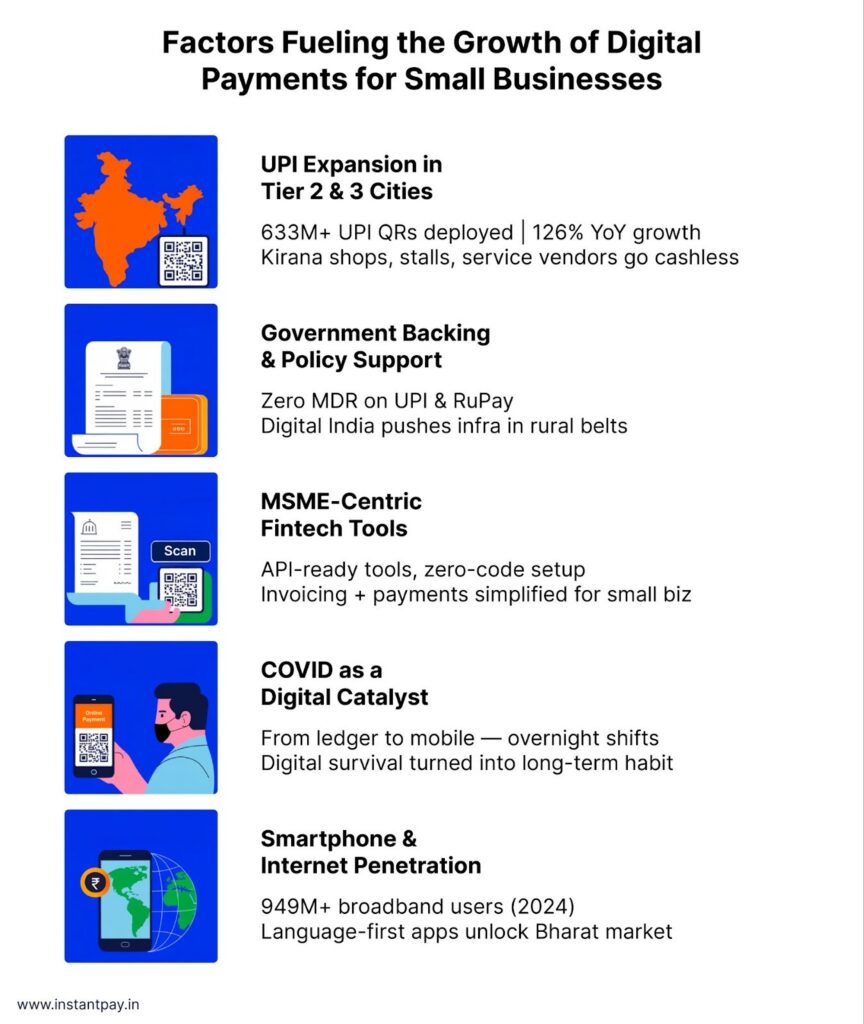
The growth of digital payments among small businesses has taken a while and was fueled by multiple factors making digital payment acceptance easier, cheaper and more accessible in India.
- Expansion of UPI in Small Towns: There are more than 709 million UPI QR codes deployed in India today. Many of these QR codes are being used by kirana stores and other small sellers, especially in Tier 2 and Tier 3 towns.
- Government Initiatives: Digital India, PM SVANidhi and no MDR (Merchant Discount Rate) on UPI and RuPay enable even the smallest of merchants to accept payments without any incremental cost.
- Fintech Tools Helping MSMEs: Payment gateways, QR solutions and API based solutions are making it easier for businesses to accept payments and manage transactions.
- COVID-19 Culture Shift: The pandemic has created a more favourable environment for small retailers to use QR and UPI payments, with many small retailers who did so during the pandemic are still doing so today.
Access to Internet is Increasing: India now has more than 1 billion internet users, creating an increase in the number of consumers and merchants joining the digital economy.
Top Benefits of Digital Payments for Small Businesses in India
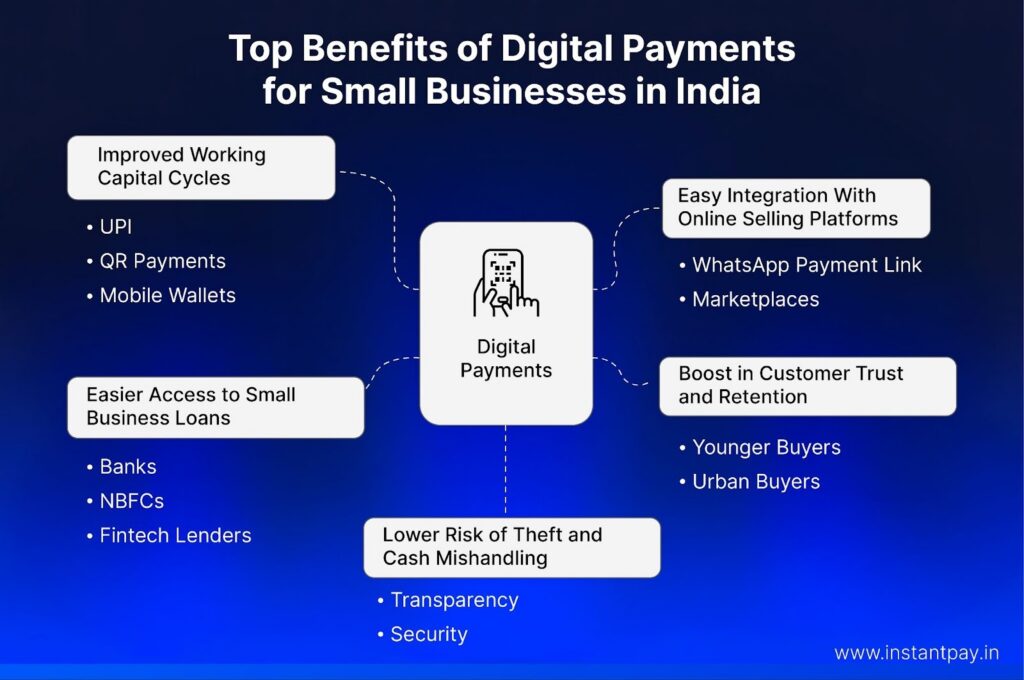
Using digital forms of payment now operates beyond supplanting cash, but enables small enterprises to operate more efficiently and expand their operations. Digital payment options are associated with numerous clear practical benefits, such as providing improved cash flow and providing opportunities for greater access to financing.
- Overall improvements in cash flow: The timeliness of payments is greatly improved with UPI payments (or payments made by scanning an appropriately designed QR code) and with wallet payments. With instant payment confirmation, no time is wasted waiting for funds to clear the bank, and therefore businesses are able to more easily manage stock and pay vendors without delay.
- More agreeable lending options: Due to the fact that small enterprises that utilize digital payment methods are able to create a transparent payments history, lenders (both banks and fintech companies) are able to provide small business financing with reduced and often minimal documentation.
- Less cash-related risk: Digital payment solutions reduce the potential for theft, loss, or mistakes resulting from the handling of physical cash.
- Greater customer trust: By offering digital payment solutions to customers, businesses project a higher degree of professionalism than they would if accepting only cash. In today’s digital-first world, customers who only pay by digital means will be attracted to businesses that also accept digital payment means.
- Ability to sell products online with greater ease: With a digital payment link, or by scanning a QR code, or by posting a product to an online marketplace, virtually any small business can begin selling online in a matter of minutes.
Challenges Faced by Small Businesses in Adopting Digital Payments in India
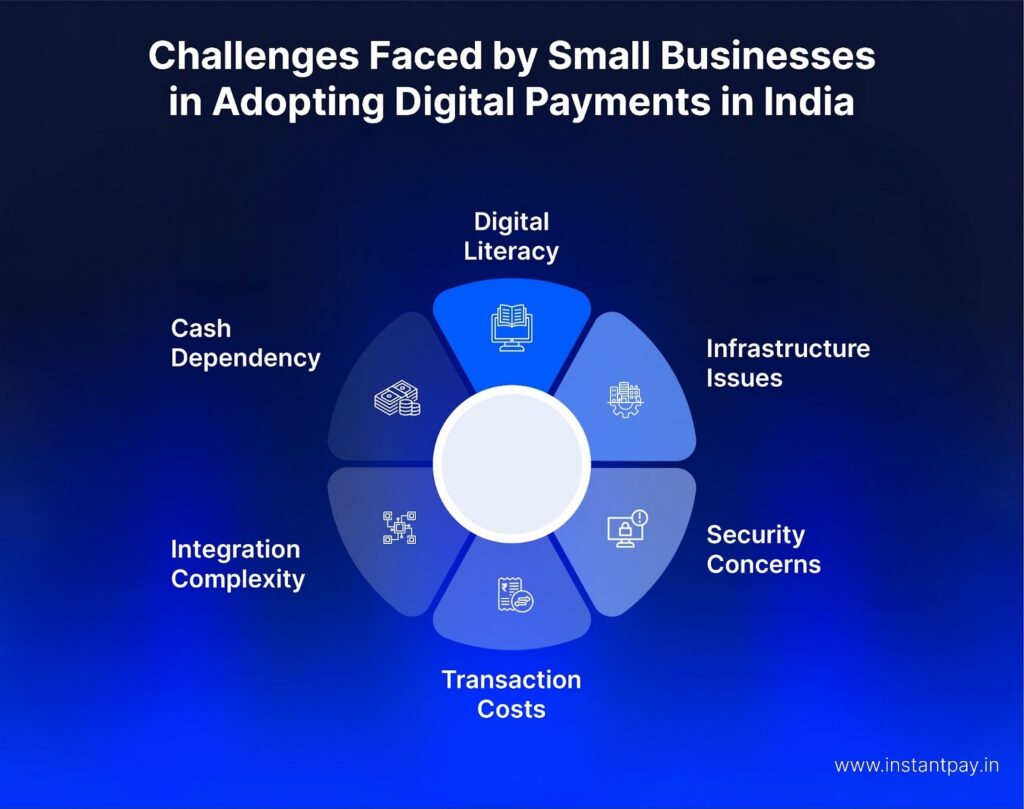
Digital payment methods are increasingly becoming mainstream in India; however, there still remain a number of barriers that prevent local enterprises from taking advantage of the benefits associated with these technologies. For the vast majority of retailers and local sellers, the transition from cash-based systems to a cashless society is still a work in progress.
Some of the significant barriers confronting local businesses in adopting digital payment methods to date include:
- Limited knowledge about digital technologies – A lack of familiarity with payment app or digital tools often results in small business owners (particularly those located in tier two-three cities) being uncomfortable utilizing them; hence, slow adoption rates.
- Issues with connectivity and data access – In rural and semi-urban areas where internet access is sporadic, temporary service interruptions can disrupt payment transactions forcing local suppliers back to a cash payment method.
- Trust issues – Many merchants are reluctant to utilize digital payments due to concerns about identity theft, phishing scams, and potential payment failure.
- Cost and hidden fees – While the costs associated with transaction processing are very small (to most people), they can be significant to small businesses operating on small profit margins.
- Habitual preference for Cash-based transactions – Many customers prefer to pay in cash, especially at the local vendor level which causes the retailer to remain reliant upon cash payment as XX.
With continued education and advancing technology, the number of small businesses taking advantage of the benefits offered by digital payments will continue to increase in the months to come.
How to Get Started with Digital Payments?
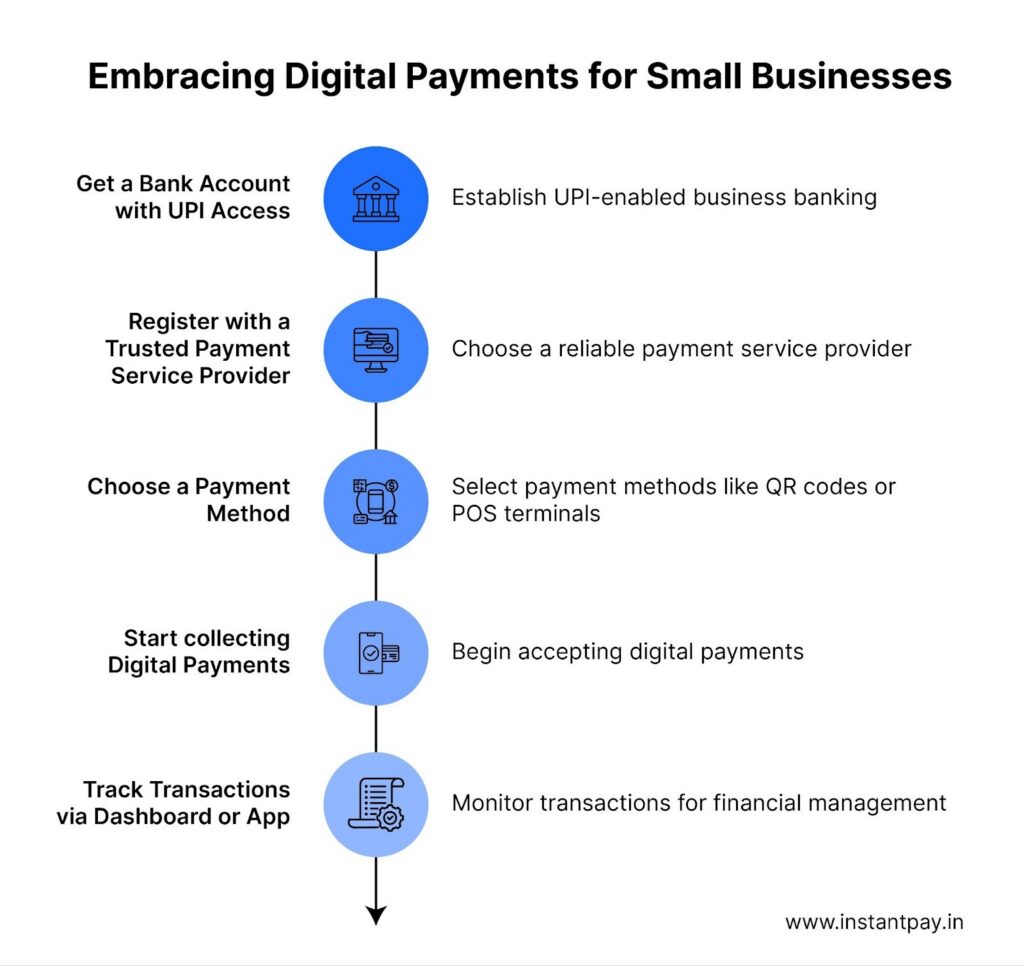
Starting from cash-based to using digital payment options might be difficult and confusing for most of the small business owners. But starting digital payments is really simple if you just take it one step at a time.
Here’s one simple way to start the digital payments:
First, you need a bank account at a bank that offers UPI (India’s most popular method of instant payment) to receive fast payments.
Once you have a bank account, the next step is to select a good and trusted payment solution provider that is reliable and has products designed specifically for small businesses to make onboarding easy.
Then you have to select your payment provider, the next step is to decide how you would like to receive payments.
You can receive payments by:
- Scanning the QR code to complete a quick payment
- Using POS terminals to accept card or contactless payments
- Creating a payment link and sending it via SMS or messaging to your customers
Once you have decided on how you will be receiving payments, the next step is to start receiving payments by displaying your QR code or by sending a payment link to your customers.
You want to keep track of all your transactions. Most providers will have an app or dashboard available to you that can help you keep an eye on payments coming in and out, as well as help you with cash flow and accurate bookkeeping.
Final Thoughts
Changes in the small business payment ecosystem in India have progressed from a convenience to a necessity. Digital payment systems have improved businesses ability to receive payments on time, manage their cash flows, and increase customer trust.
Store owners, local businesses, and service providers have benefited from going digital in the European economy. Digital systems simplify loan access and online sales. Digital payment systems streamline competition and growth.
Instantpay has improved small businesses ability to use digital payment systems. Using Instantpay’s UPI payments, QR Codes, PoS systems, wallets, and micro-ATM functions, merchants can begin engaging in digital transactions without the need for complex systems.
Digital payment systems supply small businesses with the means to become more efficient in their operations and consumer transactions. , as businesses in India adjust to the ever-evolving eurocentric economy.
FAQs
1. What is a digital payment for a small business?
A digital payment allows small businesses to accept or send money electronically through platforms like UPI, cards, wallets, or internet banking.
2. What online payment system is best for small businesses?
UPI and integrated solutions like Instantpay offer fast, low-cost, and scalable options ideal for Indian small businesses.
3. How to set up online payments for a small business?
Choose a digital payment partner like Instantpay, complete KYC, and integrate UPI, cards, or wallets via APIs or web tools.
4. Can I create my own payment gateway?
Yes, but it requires significant tech, security, and regulatory compliance. Most small businesses prefer third-party platforms like Instantpay.
5. How to start UPI without debit card?
You can use Aadhaar-based onboarding via select banks or apps like BHIM and Instantpay that support such features.
6. How can I accept payments online for free?
Use UPI-based platforms or QR codes that don’t charge setup or monthly fees. Instantpay offers zero-cost UPI acceptance options.
7. How much online payment can be done?
Limits depend on the method: UPI often has Rs.1 lakh/day limit, while NEFT/RTGS and cards vary by bank and account type.
8. What is the cheapest way to accept online payments?
UPI and bank transfers via platforms like Instantpay are among the lowest-cost options with minimal or zero fees.
9. What is the safest online payment?
UPI with PIN authentication, card payments with OTP, and platforms using tokenization or biometric verification are considered safest.
10. Which online transaction is free?
UPI transactions are mostly free for individuals and affordable for businesses through platforms like Instantpay.