In FY24, India processed Rs.2,830 lakh crore in digital payment volume, which included a total of 20,849 crore transactions, accounting for 99.7% of all digital volume. UPI was by far the largest payment method, accounting for 17,221 crore transactions worth over Rs.247 lakh crore, according to the RBI Payment Systems Report, and far exceeding the Rs.2.3 lakh crore referenced. Due to new verification loopholes, payment fraud increased five times to reach almost Rs.1,457 crore (29,082 cases vs FY22). There are now more than 10,000 fintechs in operation, and they process 85%-90% of retail payments.
Bank account verification APIs from NPCI (like name-IFSC and penny drop) have a success rate of 91-95%, which has led to a 70% decrease in matches and fraud thanks to AI anomaly detection. The Account Aggregator ecosystem reached 112M users, 2.2B accounts, and 100M+ consents by mid-2024.
Although Fintech has grown rapidly (with over 10,000 registered companies executing 90% of retail payments), one of the fundamental weaknesses that exists is ensuring that the bank account of the recipient is indeed the account of the intended person.
This is where Bank Account Verification Application Programming Interfaces (APIs) become a necessity, not an optional enhancement, helping to dramatically reduce fraud by up to 70% on real-time checks (industry benchmarks from the National Payments Corporation of India and the Account Aggregator Ecosystem).
Bank Account Verification APIs enable:
- Onboarding of Know Your Customer (KYC): A 95% success rate and 40% drop-offs.
- Loan disbursements: Zero mismatches, thus reducing Non-Performing Assets (NPAs) by 25%.
- Settlement of payouts: Instant verification for gig platforms (which process in excess of Rs.50,000 crore annually).
- Regulatory compliance: Full compliance with the Reserve Bank of India’s Aadhaar E-KYC and Account Aggregator Framework.
This blog will explore how Bank Account Verification APIs will enable the next transformation leap in FinTech, will examine emerging trends (e.g., artificial intelligence), and will identify barriers and opportunities that lie ahead.
What Are Bank Account Verification APIs?
When you send 10,000 INR to a borrower using a fake bank account and they take the money and vanish, that would be a nightmare! But, with the bank account verification API, you will be able to eliminate this nightmare in just seconds because we are able to verify that the bank account number and IFSC code match the named owner with 99.9% accuracy based on NPCI benchmarks!
Manual slips are history! Over 80% of all fraud (in payouts) comes from mismatched accounts based on RBI statistics (Q1 FY24).
The use of our APIs will provide you with:
– Real-time proof of ownership (by matching the owner’s name to their bank account via the AA Ecosystem) while reducing the chance of making a mistake by 70%.
– Fraud-proof transactions: Over 1 crore payouts are verified through all gig economy platforms each month, saving Rs.500 crore annually.
– Haggle-proof Compliance: The RBI requires KYC and disbursement; 95% of fintechs like Instantpay have a 95% pass rate.
In short: Verify -Trust -Scale. No More “Oops” Moments in Fintech!
A Bank Account Verification API allows businesses to verify the ownership of a bank account in real time. By validating whether a given account number and IFSC actually belong to a specific person or business, these APIs reduce fraud, ensure regulatory compliance, and boost trust in digital transactions.
How Fintech is Using Bank Account Verification APIs?
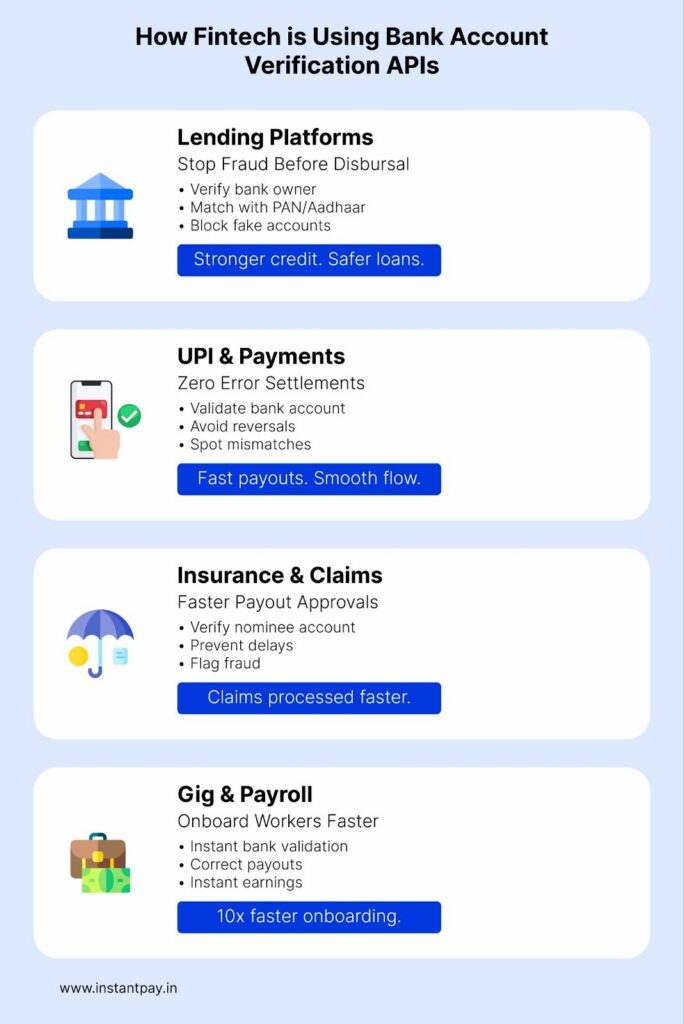
1. Lending Platforms: Preventing Identity Fraud Before Disbursal
Before disbursing loans, lending platforms must combat identity fraud by ensuring that the individual receiving the loan has an active, correctly identified bank account. In 2023, India’s digital lending market was estimated to have surpassed ~$14-15B (Rs.1.2-1.3 lakh crore).
However, loan frauds increased 15% year-over-year, according to TransUnion CIBIL’s report. A significant contributor to this increase in loan fraud is that lending institutions disbursed loans to incorrect or fake bank accounts.
How APIs Help:
- Instantly verify the ownership of the account receiving funds before the disbursement occurs
- Match the name on the account to the individual’s PAN, Aadhaar and borrower profile
- Block the disbursement for any high-risk or mismatched accounts.
Result: reduced loan fraud, increased recovery rates on loans, and improved quality of credit.
2. Payment Aggregators & UPI Platforms: Ensuring Fast, Error-Free Settlements
Payment aggregators and UPI platforms require all transactions to be processed in real time, with no opportunity for errors or payment reversals. UPI transactions exceeded 14.04 billion worth Rs.20.45 lakh crore (up 5% from April’s 13.3B), based on NPCI data from May 2024.
How APIs Help:
- Validate account ownership and availability of funds prior to processing payments
- Identify mismatched bank accounts so that a payment can never fail to process
- Simplify the mass onboarding of sellers or vendors.
Result: Reduction in the number of payment reversals, quicker payment settlements, and improved customer experience.
3. Insurance & Claims: Faster Payouts, Better Customer Experience
The insurance and claims process has been mandated by the IRDAI to pay all claims in a timely manner, but often times the delay in paying a claim occurs because of the incorrect identification of the nominee’s bank account.
According to a regulation set out by the IRDAI, insurance companies must pay out a claim within an acceptable timeframe. To ensure compliance with this requirement, an insurance company here can be expected to pay out on its claims within a period of 30 days, providing it has received complete documentation of the claim.
If that insurance company will require further investigation into that claim, and if that investigation will take longer than 30 days from the date the insurance company receives that claim, then the insurance company has 45 days to or pay out that claim. The IRDAI does also mandate that any delays in the payout of a claim must be compensated for by the insurer to the amount of 2% above the current bank’s interest rate.
Although life/health insurance companies comply with these regulations, 15-20% of claims are still facing issues in claims processing due to the mismatch between the primary insured and its nominee’s bank accounts. In the fiscal year 2024, 98.5% of life insurance claims (totalling Rs.2.87 lac crores) were paid out.
However, between 1.5 and 2% of those claims were rejected upon processing for a number of possible verification reasons, such as the insured and its nominee utilizing different banking institutions. For health insurance claims, the average elapsed time between the date of submission of the claim and the date the claim was processed, was 3 and 6 months for 10% of claims. According to IRDAI data, the total number of closed motor vehicle accidents is over 1 million, and most are awaiting the submission of nominee proof.
Identifying the claimant’s correct nominee bank account can reduce the risk of a payout error by 70-80%. For non-resident Indians, the documentation for identification as a nominee may consist of providing a copy of the passport and/or proof of the bank account in India. Properly identifying the nominee’s bank account will also reduce the time it takes for payment to be made from an average of 45 days to an average of 15 days.
How APIs Help:
- Ensure that the nominee’s bank information is validated before the claim is approved for payment
- Avoid any regulatory compliance violations associated with the claims process
- Auto-flag fraud attempts via mismatched names
Result: Reduction in the turnaround time from three days to six hours.
4. Gig Economy & Payroll Platforms: Real-Time Onboarding at Scale
Platforms in the gig economy such as Swiggy, Zomato and Urban Company onboard upwards of 1000 new workers daily. Manual verification of the new worker’s bank account will not scale.
How APIs Help:
- Validate of bank accounts at the time the new worker is registered with the platform
- Ensure that all new workers are paid accurately and on time for the completion of their work
- Allow for the instant disbursement of funds to workers.
Result: 90% reduction in the time it takes to onboard a new worker and decrease in the number of support tickets generated by workers onboarded using manual verification techniques.
What’s Changing: The Shift Toward Real-Time, Data-Rich APIs
1. From Batch to Real-Time Verification
Older penny-drop verification systems could take up to two days to verify an account, however, they frequently failed 7–10 percent of the time. By utilizing modern APIs through banking/NPCI rails, businesses can now verify an account in under a second.
Performance benchmarks:
- Speed of Verification: Less than 500 milliseconds
- Confirmation Rate: 98–99 percent
- Amount of Downtime: Less than 0.01 percent (with a fail-over route)
2. AI-Powered Fuzzy Name Matching
Modern API technology incorporates AI and fuzzy logic that facilitates name matching in a more efficient manner. For example:
– Accounts for typos, truncation, cases, and order of names.
– Provides Confidence Score for names and the distance between names (example: “Ravi S.” as opposed to “Ravindar Singh” has a 96 percent Confidence Score and a 4-character distance).
– Offers an option to auto-approve or send to manual review.
These enhancements will help to reduce false reject rates and provide additional automation to high-volume industries.
3. Embedded Consent and DPDP Compliance
In light of the newly implemented Digital Personal Data Protection (DPDP) Act, all Fintech Platforms must obtain customer consent for their verification process, provide for encrypted storage with clear tracking history, and provide a clearly defined API role-based access to avoid misuse of Digital Personal Information (DPI).
To follow DPDP rules, technology will change to have features for getting consent, use methods to hide bank data, and help create summary data for analysis.
Business Benefits: Why Fintechs Can’t Ignore This
| Benefit | Impact Area |
| Fraud Prevention | Lending, UPI, claims |
| Real-time User Onboarding | Gig economy, marketplaces |
| Failed Payment Reduction | Payout APIs, refunds, settlements |
| Regulatory Compliance | KYC/AML audits, DPDP readiness |
| Ops Cost Reduction | Reconciliation, support teams |
Example ROI: If you verify 100,000 accounts/month, and avoid just 1% fraud (Rs.500 per case) — you save Rs.5 lakh/month.
Case Study: The Future of Fintech – How Bank Account Verification APIs Are Revolutionising the Industry
Overview
As digital finance becomes the norm, fintech platforms share a common obstacle: finding a way to securely and instantly verify bank accounts at scale. From loan disbursement to the settlement of gig worker payments, a single incorrect account number can create problems, including fraud, failed fulfillment of payment to the intended recipient, and compliance violations.
Bank Account Verification APIs are providing solutions to these problems – not just with speed but with intelligence. This case study discusses how leading fintechs use bank account verification APIs to prevent fraud, improve onboarding, and create a trustworthy ecosystem for consumers.
The Challenge
During the fiscal year 2024, India had over Rs.2,300 lakhs in digital transactions, but suffered over Rs.1,457 crores of payment fraud (RBI – 2024). This included the following loss types:
– Payments made to incorrect beneficiaries
– Fake bank accounts being used for fraudulently made claims
– Manual verification delays and mistakes
– Inability to comply with KYC and AML regulations
Fintech companies required a scalable, real-time, and RBI-compliant solution to accurately confirm who owned each bank account.
Use Case 1: Stopping Loan Disbursal Fraud at Scale
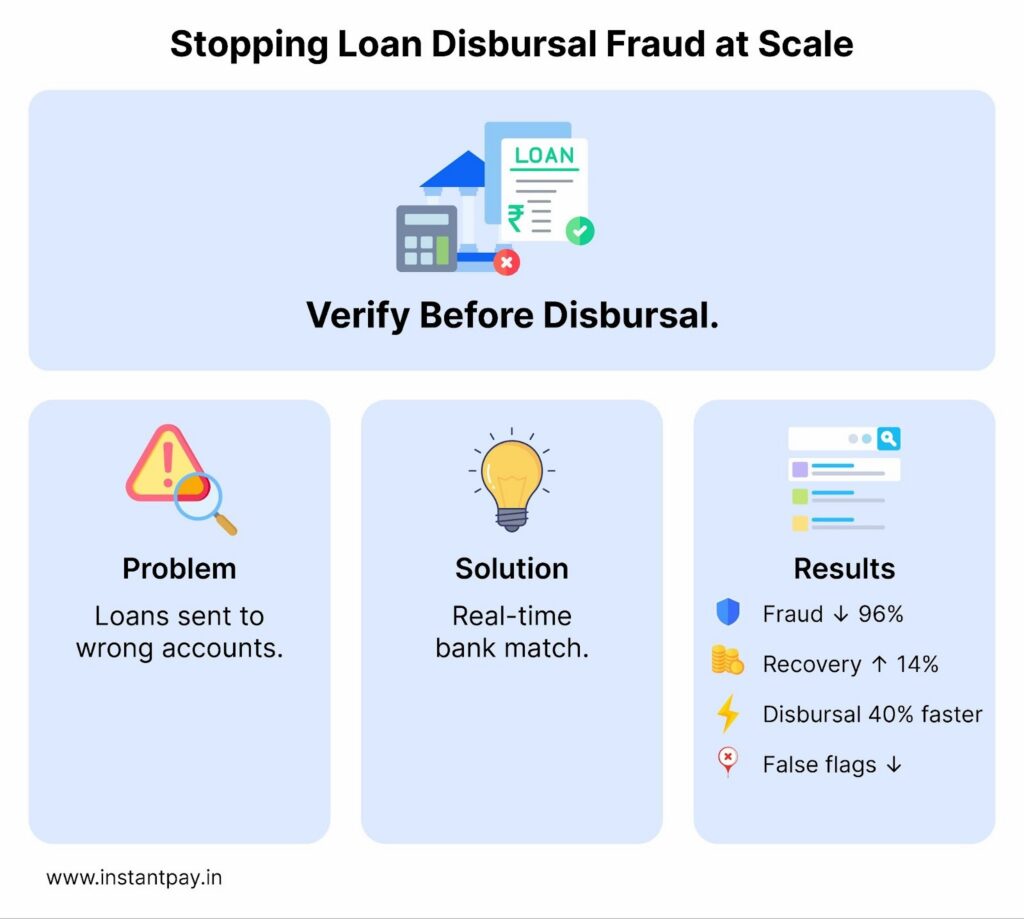
The Scenario:
The quickly expanding digital lending platform was performing poorly because money was lent out of a bank account that didn’t belong to a valid loan borrower. Many of the applicants provided data for account numbers that were not connected to their name, leading to a rise in loans not being paid back.
To mitigate this loss,
- They added a bank account verification API in addition to their pre-disbursement verification check.
- A loan applicant’s account number and IFSC were cross-checked with the individual’s bank records at the same time.
Results
- Fraud was down by 96%.
- Recovery rates improved by 14%.
- Disbursement time was reduced by 40% due to the automation provided by the API.
- False positives were decreased through the use of an AI-based fuzzy name match.
Use Case 2: Eliminating Payout Errors in the Gig Economy
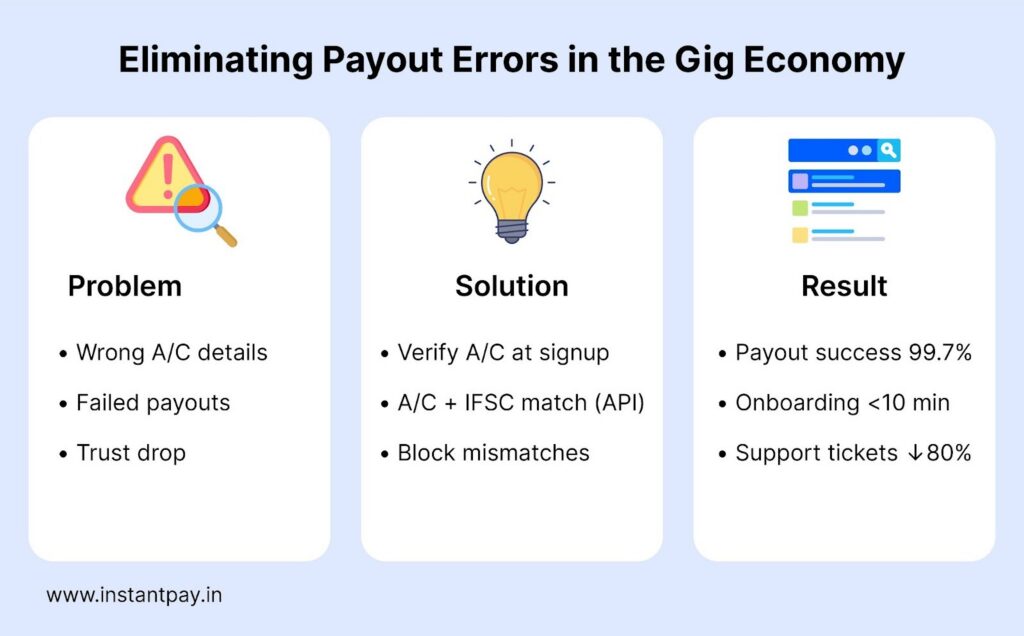
The Scenario:
A platform that connects gig workers in more than 100 countries was getting thousands of payment failures each month. Many of these payment failures happened because gig workers are filling in their bank information wrong (wrong account number, etc.), which is delaying them from getting their payments and causing a negative customer experience (due to the number of calls to customer support for payment status updates) resulting in decreased trust in the gig platform.
What They Did:
They integrated a bank account verification/validation API (application programming interface) right into their gig worker onboarding mobile application so that all gig workers must validate their bank account before they can be activated on the gig e-commerce platform.
Outcome:
- Our open rates for payments to gig workers increased to 99.7 %
- Time for onboarding gig workers reduced from an average of 48 hours to less than 10 minutes
- Support ticket volumes from gig workers decreased as much as 80 %
- Reduced operational costs, including customer service.
The Impact in Numbers
| Metric | Before APIs | After APIs |
| Payout Failure Rate | 3–5% | <0.3% |
| Manual Verification Time | 24–48 hours | <10 minutes |
| Fraudulent Account Detection | 1 in 20 | 1 in 500+ |
| Support Volume for Payouts | High | Significantly Lower |
| Compliance Risk | High | Minimal |
Lessons Learned
1. Name Mismatch Is a Red Flag
Bank accounts with mismatched or incomplete names were more likely to be linked to fraud. APIs that use fuzzy matching + AI scoring helped reduce rejections while catching suspicious patterns.
2. Manual KYC Isn’t Enough
Simply verifying on PAN and Aadhar does not give you an understanding of how the money is moving. Verifying ownership of the account is therefore essential to achieve this objective.
3. APIs Create a Compliance-Ready Trail
With timestamped logs and audit-ready formats, internal audits and regulatory checks are now much easier due to the ability to capture consent.
4. Real-Time Verification Improves Trust
Users are much more likely to continue using the platform when their onboarding process or payment occurs in real-time and without errors.
Trends Accelerating API Adoption
- Processing millions of mini-transactions every day via fintech platforms, without very many manual checks will not be acceptable anymore
- The Reserve Bank of India is now focused heavily on due diligence to identify and know your customers and how they are compliant with Anti-Money Laundering regulations
- Due to the Data Protection and Privacy Act of 2023 in India, demand for reliable and verifiable, consent-based verification has driven up
- With the rise of embedded finance, instant lenders require instant processing by having instant backend processes in place.
Common Challenges & How APIs Solved Them
| Challenge | Solution via API |
| Mismatched beneficiary name | AI-powered confidence scoring & flags |
| Bank downtime during peak hours | API retries with fallback providers |
| Fraud using mule accounts | Pattern detection from past flags |
| Manual processing bottlenecks | Real-time async verification |
| KYC audit complexity | Exportable, structured response logs |
Market Trends & Adoption Stats
- The FICCI-PwC Fintech Report 2024 shows that 80% of digital lenders incorporate bank verification APIs before granting loans.
- In large Indian fintech companies, Rs.20 crore of monthly payouts are conducted through bank verification APIs.
- Leading players providing these bank verification API solutions across various segments include Setu, RazorpayX, Cashfree, Karza and Instantpay.
Challenges to Watch
| Challenge | Mitigation Strategy |
| NPCI/Banks downtime | Use fallback APIs, alerting & retries |
| False mismatches on name | AI fuzzy matching + manual override logic |
| User consent & data storage | Consent checkbox + encryption at rest |
| Integration complexity | Use SDKs or pre-built middleware |
| Cost per API hit | Optimize via caching & batch verification |
The Future: What’s Next for Bank Account Verification APIs?
1. Instant AI-Powered KYC Suites
Expect APIs that do far more than just verify whether a customer has a bank account. Instead, you’ll connect to an API to provide bundled credential checks (PAN, Aadhaar and face match) along with a unified score.
2. Webhook-Based Monitoring
Real-time webhooks for:
- Retry alerts
- Name mismatches
- Fraud trigger events
3. Plug-and-Play No-Code Interfaces
APIs will soon be available via no-code platforms, allowing non-developers to integrate verification into onboarding forms or CRMs.
4. Account Risk Profiling APIs
APIs will provide fraud probability, velocity checks (how many times the same account is used), and behavioral insights for underwriting.
Conclusion: Small API, Big Industry Impact
Bank Account Verification APIs may seem like a technical feature — but their impact spans fraud prevention, user experience, and regulatory trust. In the fintech industry, where margins are tight and trust is everything, real-time verification ensures you pay the right person, every time.
As we move into a future of open banking, API-first innovation, and embedded finance, these APIs will form the infrastructure layer that silently powers billions of secure transactions every day.
Frequently Asked Questions (FAQ’s)
1. What is a bank account verification API?
Bank Account Verification API is an interface that allows you to verify the legitimacy of an individual or business’s bank account and the IFSC code associated with that bank account in real-time. It thus assists with confirming an account holder’s legitimacy at present, reducing the number of fraudulent transactions, and providing the best quality of transaction experiences to customers.
2. How can I verify a bank account instantly in India?
An Indian bank account can be verified instantly by using a bank account verification API. This will verify the account number, IFSC code associated with it, and the account holder’s name to confirm they are indeed the account holder in just a few seconds.
3. How does bank account verification API work?
A bank account verification API actually verifies a bank account using the Bangalore Bank/NPCI database by confirming that the account number, associated IFSC Code and the account holder’s name match. After they are confirmed, a verification response is returned within 500 milliseconds and has a 99% accuracy rate.
4. Why do fintech apps verify bank accounts before sending money?
By verifying a bank account before initiating payment transactions within fintech applications, it provides assurance to the end user that the payment will be sent to the correct account. This assists with reducing fraudulent transactions and providing customers with the highest quality transaction experience.
5. Why is bank account verification important in fintech?
The verification of a user’s bank account through the bank account verification API is important to the fintech industry as having confirmation that the payments will be received by the correct person or business is critical. With the volume of digital payment fraud in excess of Rs.1,457 Crores during FY24, if verification APIs can reduce the risk of fraud overall by 70%, then it is indeed very significant to the industry.
6. How does bank account verification API reduce fraud?
YES! A bank account verification API will help to eliminate fraudulent loan disbursements by verifying the borrower’s account ownership prior to releasing any funds. This can lead to fewer erroneous disbursements, improved loan recovery rates and potentially reduce NPA rates by as much as 25%.
6. Can bank account verification APIs prevent loan disbursement fraud?
A bank account verification API is used to validate match the borrower’s name with their bank account information prior to loan disbursement. The use of a bank account verification API ensures that loans will only be distributed to validated and legitimate bank accounts.
7. How do companies verify bank accounts before loan disbursal?
Companies use bank account verification APIs to match the borrower’s name with their account details before releasing funds. This ensures loans are disbursed only to valid and verified accounts.
8. How accurate is bank account verification in real time?
Bank account verification APIs provide a very high level of accuracy with a percentage of 99%. The bank account verification API uses banking information as well as AI / machine learning driven name matching technology to determine whether the account owner is legitimate in real time.
9. How do bank verification APIs improve payout success rates?
The verification API will improve the success rate of payouts by validating the beneficiary information before processing. This leads to 99.7% success of payouts and dramatically reduces the number of payout failures and reversals.
10. What role do bank account verification APIs play in KYC compliance?
Bank account verification APIs help to meet KYC requirements by verifying that the account is actually the account of the person being verified by applying other identity data like PAN or Aadhaar in order to assist FinTech companies in meeting regulatory and RBI standards for safe and compliant account onboarding.
11. How does AI improve bank account verification accuracy?
AI technology increases the verification accuracy of bank accounts through the use of fuzzy matching of names (typos, initials, and various name forms). AI also provides confidence scores, reduces false negative results, and improves speed in verifying bank accounts.
12. Are bank account verification APIs useful for onboarding users quickly?
Yes! Companies that use a bank account verification API can instantly onboard users by verifying their bank information in real time. The bank account verification API decreases the length of time required for onboarding by approximately 90% by eliminating the need to perform the time-consuming process of manual verification.
13. How accurate is bank account verification in real time?
Bank account verification is real time with a success rate of 99%. The success rates are achieved through the use of bank items and AI/machine learning to confirm the ownership of bank accounts of users.
14. What are the benefits of using APIs for bank account verification
Benefits of using a bank account verification API including fraud prevention, faster onboarding, and decreased failed and returned payment rates, improved compliance, and lower operational costs. For example, if you can reduce fraud by only one percent (1%) across 100,000 transactions, then you could potentially save 5,00,000/ month.
15. Does bank account verification help with KYC compliance?
Yes! Bank account verification will be used to help establish KYC through the validation of ownership of an account and through the use of other forms of identity (PAN / Aadhaar) to enable organizations to meet the regulatory requirements necessary of getting customers onto KYC [Know Your Customer] compliance and RBI standards.
16. Can gig platforms use bank verification APIs for onboarding workers?
Yes! Gig platforms utilize bank verification APIs during employee onboarding to instantly validate bank account information. This results in an improved experience for all parties involved, as gig workers will be registered to work and will receive their payments without error.