Opening a current account in India might seem straightforward, but for many businesses and professionals, it’s anything but. As of June 2025, India’s banks together service over 56 crore accounts, meaning that every confusing term sheet, unclear balance rule, or hidden fee can impact millions of businesses and professionals.
In this guide, we break down everything you need to know about business banking accounts, how they work, who needs one, what documents are required, and how banks differ when it comes to minimum balance, transaction limits, interest rules, and digital access. Whether you’re a startup, a freelancer, or a growing enterprise, this is your go-to explainer for choosing the right business banking account with confidence.
What Is a Current Account?

A current account, also known as a business banking account or demand deposit account, is a type of bank account designed specifically for businesses, professionals, and high-volume transaction users. Unlike savings accounts, it allows unlimited withdrawals, higher deposit thresholds, and seamless fund movement, often without offering interest.
As per the Reserve Bank of India (RBI), a current account is a non-interest-bearing deposit maintained by individuals or businesses primarily to facilitate frequent transactions. These accounts do not accrue interest and are primarily used for daily business operations, such as vendor payments, salary disbursements, or bulk transfers.
They are typically offered with value-added features like overdraft facilities, cheque issuance, and API-integrated payout options. You’ll find multiple variations of this account, from zero-balance current account types to premium business accounts tailored for high-volume or enterprise use.
“A business or demand-deposit account allowing unlimited withdrawals, often with zero interest but essential for high-frequency transactions.”
Current Account vs Savings Account: What’s the Difference?
What is the difference between current account and savings account?
A current account is built for businesses and allows unlimited transactions, no interest, and overdraft features. A savings account is for individuals, offers interest, and limits free transactions monthly.
If you’re still wondering whether a business banking account is different from a savings account, you’re not alone. Many new entrepreneurs or freelancers initially use their personal savings accounts for business, only to later discover that they have limited transactions, added restrictions, and may even violate bank terms.
Here’s a quick comparison to help you understand the difference between a non-savings business account (current account) and a personal savings account:
Comparison Table: Current vs Savings Account
| Feature | Current Account (Business Use) | Savings Account (Personal Use) |
| Purpose | High-volume transactions for businesses | Personal savings and limited transactions |
| Interest Earned | No (non-interest-bearing account) | Yes (2.5% to 7% p.a. approx.) |
| Monthly Average Balance (MAB) | Higher MAB (Rs. 5K to Rs. 1L+ based on bank type) | Lower MAB (Rs. 500 to Rs. 10K depending on bank) |
| Transaction Limit | Unlimited withdrawals & deposits | Limited free transactions per month |
| Overdraft Facility | Available (depends on bank profile) | Not available |
| Cheque & RTGS/NEFT Access | Fully enabled | Enabled, but less frequent use |
| Target User | Businesses, freelancers, professionals | Salaried individuals, general public |
Key Features & Benefits of a Business Banking Account
A non-savings business account isn’t just for holding funds—it’s built to move money efficiently, handle high-volume transactions, and power business operations. Whether you’re a growing enterprise, a freelancer, or managing vendor payouts, these features make a current account essential.
Core Features of a Digital Current Account

1. Zero Balance Options
Many banks and fintechs now offer zero balance current accounts—meaning no monthly average balance (MAB) is required. For example, InstantPay’s digital current account offers no monthly fees, API access, and paperless onboarding—ideal for startups and remote-first teams.
2. Overdraft Facility
Depending on your profile and bank, overdraft support allows you to withdraw beyond your available balance, ensuring uninterrupted operations during cash-flow crunches.
3. Unlimited Transactions
Unlike personal accounts, a business banking account allows unlimited NEFT/RTGS/IMPS transfers without upper monthly caps. This is vital for enterprises managing salaries, supplier payments, or bulk vendor settlements.
4. API-Integrated Access & Real-Time Payouts
Many platforms like InstantPay integrate bulk payouts, smart reconciliation, and real-time UPI-based fund transfers through APIs, giving businesses a plug-and-play backend for financial operations.
5. Cheque Book & Multi-Channel Banking
You also get cheque books, branch-level support, and access to mobile/internet banking across all major channels.
Business Benefits You Actually Use
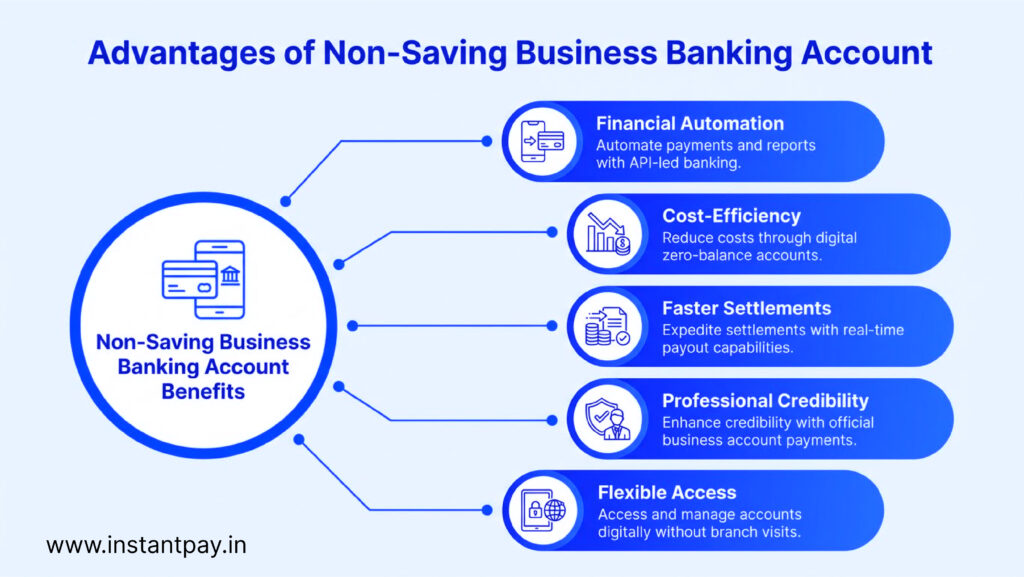
- Financial Automation: Reconcile vendor payments and transaction reports instantly via API-led banking.
- Cost-Efficiency: Save on penalties, paper costs, and physical processing through zero-balance digital accounts.
- Faster Settlements: Speed up customer refunds, commissions, or loan disbursals using real-time payouts.
- Professional Credibility: Clients and vendors prefer payments from official business accounts.
- Flexible Access: No need to visit a branch—open, operate, and scale digitally.
Did You Know?
Interest earned on current accounts, if any is at the bank’s discretion and often taxable under TDS regulations. Most Indian banks classify current accounts as non-interest-bearing, and you should not expect returns the way you would on a savings product.
Whether you’re running payrolls or issuing hundreds of payouts daily, a zero-fee business banking account can help you stay agile, reduce costs, and operate entirely online.
Types of Business Banking Accounts in India

When it comes to choosing a non-savings business account, one size doesn’t fit all. Different types of current accounts are tailored for specific users whether you’re a startup, a large enterprise, or a merchant managing online transactions. Understanding these options helps you avoid unnecessary fees, unlock the right features, and choose an account that supports your growth.
Below is a breakdown of the most relevant types of current accounts, followed by a real-world bank-wise comparison table.
Common Types of Demand Deposit Accounts:
1. Standard Current Account
The most widely used type, this account comes with basic features like cheque books, NEFT/RTGS access, and debit cards. It requires maintaining a monthly average balance (MAB), typically ranging from Rs. 5,000–Rs. 25,000.
2. Premium Current Account
Meant for large businesses or high-value customers, these accounts offer higher free transaction limits, more cheque leaves, and fee waivers but demand a high MAB (Rs. 1L or more).
3. Packaged Current Account
Sitting between standard and premium tiers, these include add-ons like travel insurance or business advisory services. Ideal for small to mid-sized firms that need more than the basics but aren’t ready for premium costs.
4. Startup Current Account
Designed for early-stage startups and MSMEs, these accounts offer lower MAB requirements, easier onboarding, and reduced transaction fees. Fintechs like Instantpay are known for zero-fee accounts with API access and real-time reconciliation.
5. Merchant Current Account
Ideal for e-commerce sellers or POS-driven businesses. These accounts provide perks like lower swipe charges, online gateway compatibility, and lower cash deposit fees, great for high digital transaction volumes.
6. Foreign Current Account
Useful for businesses dealing with international transactions. These accounts support inward/outward remittances with forex services and compliance tools.
What types of current accounts are available in India?
Indian banks offers standard, premium, startup, merchant, packaged, and foreign current accounts—each designed for different transaction volumes, business needs, and access levels.
Bank-Wise Comparison: MAB, Penalties & Overdraft
Bank / Platform | Account Type | MAB Requirement | Penalty (if not met) | Overdraft Facility |
| SmartUp / Startup | Rs. 10,000–Rs. 25,000 | Rs. 750–Rs.1,000 | Available? |
| Roaming / Elite Corporate | Rs. 1,00,000–Rs. 10,00,00 | Rs.2,500–Rs. 10,000 | Available |
| Regular / Plus Current | Rs. 5,000–Rs. 25,000 | Rs. 500–Rs. 750 | Limited |
| BOI Star Current | Rs. 5,000–Rs. 1,00,000 | Rs. 250–Rs. 1,000 | Available |
Minimum Balance Requirements & Charges You Need to Know
Maintaining a monthly average balance (MAB) is one of the most overlooked yet costly aspects of choosing a business banking solution. While some providers offer zero balance business accounts, most traditional banks enforce balance thresholds and charge steep penalties if you don’t comply.
If you’re comparing options, pay close attention to minimum balance requirements, fee structures, and whether the services justify the cost. Here’s what you need to know.
Bank-Wise MAB & Penalty Comparison
Bank / Platform | Min. Monthly Avg. Balance (MAB) | Penalty (If MAB Not Met) | Notable Charges / Features |
|
| Rs. 25,000 (SmartUp) | Rs. 700–Rs. 1,000 | Overdraft option, cheque book, POS |
|
| Rs. 10,000 – Rs. 1,00,000 (Classic–Elite) | Rs. 1,000–Rs. 10,000 | Rs.2,500–Rs. 10,000 |
|
| Rs. 10,000 – Rs. 25,000 (Standard) | Rs. 500–Rs. 750 | Access to online trade & GST tools |
|
| BOI Star Current | Rs. 250–Rs. 1,000 | Quarterly average balance model |
What is the minimum balance required for a business account in India?
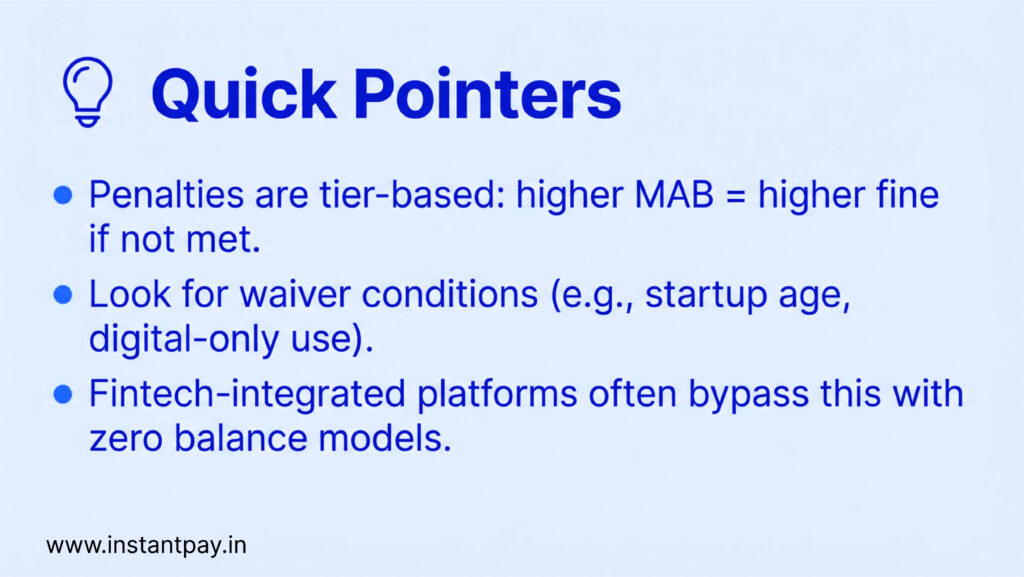
It varies by bank—from Rs. 2,500 in semi-urban branches to Rs. 1,00,000 in premium accounts. Falling below the limit can result in monthly penalties between Rs. 250 and Rs. 10,000 monthly depending on account type, bank, and location (urban vs rural).
Interest & Tax Considerations You Shouldn’t Miss
Unlike personal savings products, a transaction-focused business account is not meant to earn returns. Most Indian banks do not offer any interest on these non-savings deposits, and even when they do, it’s rare, discretionary, and subject to taxation.
If you’re wondering whether your business account can passively earn interest or how it’s treated for tax purposes, here’s a quick breakdown.
| Aspect | Details |
| Interest Eligibility | Not standard; most accounts don’t earn interest |
| Exceptions | Some banks offer interest on premium or bundled plans |
| Interest Frequency | If applicable, credited monthly or quarterly |
| Tax Treatment | Treated as ‘Income from Other Sources’ |
| TDS Applicability | Yes, if interest crosses the exemption threshold |
| Regulatory Context | Current accounts are classified as non-interest-bearing under RBI norms |
Does a business banking account earn interest?
Typically, no. These accounts are non-interest bearing, as per RBI norms. However, some banks may credit nominal interest for specific account holders (e.g., staff accounts, special categories), but this is not standard.
When is interest paid (if any)?
In rare cases where interest is offered, it’s credited monthly or quarterly. Any such earnings fall under ‘Income from Other Sources’ and are liable for TDS deductions above specified thresholds.
“Business banking accounts are non-interest-bearing; any credit interest, if offered, is subject to TDS under applicable tax rules.”
Tip: If your business needs returns on idle cash, explore sweep-in FD features (offered by some banks) or link short-term investment products, rather than relying on the core account for interest.
Who Should Open a Business Banking Account?
If you’re managing income from clients, vendors, or customers, even as a solo entrepreneur, you probably shouldn’t be using a personal savings account. A transaction-first banking solution is designed to support your cash flow, reduce risk, and build professional credibility.
Here’s who typically benefits from opening one:
Ideal for:
- Startups
Especially those in their early stage with funding, payments, and vendor contracts. Choose zero balance options to keep costs low while enabling real-time payments. - Freelancers & Consultants
If you invoice clients or manage payouts regularly, using a non-savings account separates your personal and business finances, simplifies accounting, and avoids GST or income tax confusion. - SMEs & Microbusinesses
For businesses with daily transactions like wholesalers, service providers, or retail, this account supports unlimited transfers, cheque handling, and bulk payouts. - Digital-first founders
Running an e-commerce store, app, or digital product? Opt for a fintech-powered business account that integrates with APIs, dashboards, and automated reconciliation tools.
Who needs a business transaction account?
Startups, freelancers, and small business owners use it to manage high-frequency payments, separate business income, and access tools like cheque books, NEFT/RTGS, and overdrafts.
How to Open a Business Banking Account?
Opening a non-savings business account today is easier than ever, especially with digital-first platforms and instant onboarding APIs. But before jumping in, it’s important to understand the steps and documents required, whether you apply online or walk into a branch.
Online vs. Offline Process: What to Expect
| Method | Steps Involved | Timeframe | Ideal For |
| Online | 1. Visit bank/fintech website2. Fill form3. Upload KYC documents4. eSign & verify via Aadhaar/OTP | 10–15 minutes | Startups, freelancers, remote users |
| Offline | 1. Visit nearest branch2. Fill account opening form3. Submit KYC documents in-person4. Physical verification by bank | 1–3 working days | MSMEs preferring face-to-face help |
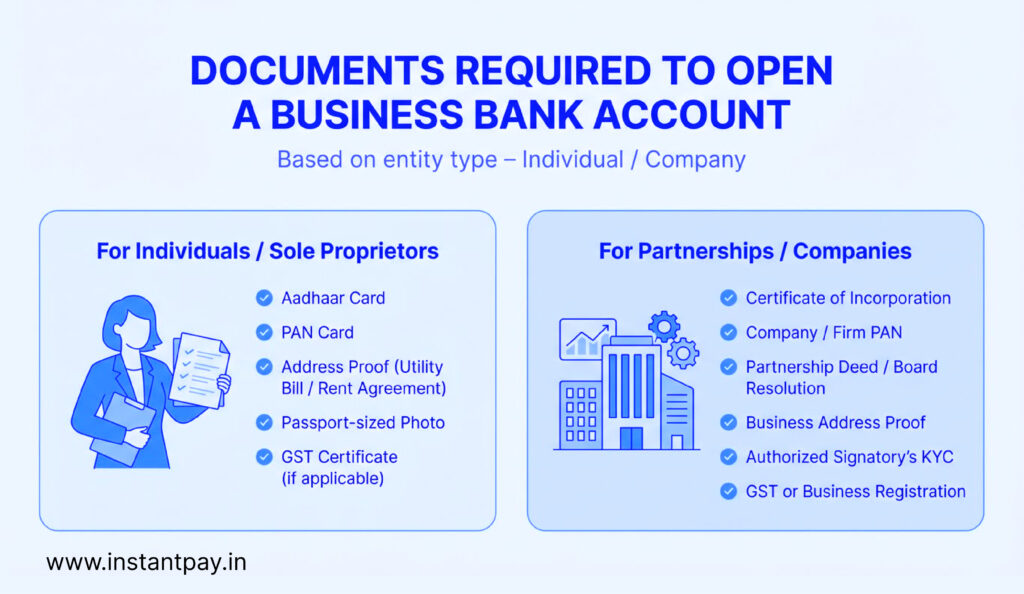
Pro tip: Digital-first banks may allow e-KYC with just Aadhaar and PAN for quick onboarding, especially helpful for new-age founders.
Cash Deposits & Access: How Funds Flow In and Out?
One of the core purposes of a current deposit account is seamless access to your funds, whether you’re depositing daily earnings or paying vendors in bulk. Businesses need multiple access points, and that’s where current cheque facilities, payout APIs, and UPI integrations come in.
Here are the common modes of depositing and accessing funds:
Cash Deposit Methods
| Mode | Description |
| Branch Counter | Deposit cash directly at your bank’s physical location |
| Cash Deposit Machines (CDM) | Available in metro/urban branches; allows 24×7 cash drop |
| NEFT/RTGS Transfers | Instant transfers from other bank accounts |
| Cheque Deposits | Via drop boxes or branch counters, subject to clearing time |
| Payment Gateways | Collect payments digitally from clients; direct credit to business account |
Real-Time Access Through Instantpay APIs
Digital-first businesses can use advanced API rails to automate vendor payouts, reimbursements, and salary processing, without logging into net banking every time. Let users or vendors claim money through a secure payout link, no account details needed upfront. Push hundreds of payouts across bank accounts, UPI, and cards instantly and at scale.
Instantpay APIs come with:
- Real-time reconciliation
- Multi-mode payout support (IMPS, NEFT, UPI, Cards)
- Retry automation and webhook callbacks
- Smart dashboards for insights
Pro Tip:
Use a current account cheque when you need a traditional paper trail or high-value clearance. For faster, tracked payments, APIs and RTGS/NEFT are more efficient.
How to Close a Business Bank Account Smoothly?

Sometimes, switching banks or consolidating finances becomes necessary. If you’re planning to shut down your non-savings business account, here’s how to do it without hiccups:
Step-by-Step Process to Close Your Account
1. Clear all dues: Ensure there are no negative balances, cheque bounces, or pending charges.
2. Withdraw remaining funds: Transfer the balance to another account or collect via demand draft.
3. Collect closure form: Most banks require a physical closure request with your signature.
4. Attach KYC: Submit ID proof and PAN card copy again, if required.
5. Submit cheque leaves & cards: Return unused instruments like cheque books and debit cards.
6. Get written confirmation: Ask for an official closure letter or email acknowledgment.
Note: You’ll be required to settle any penalties for not maintaining your monthly average balance (MAB) before account termination. Some banks charge a processing fee or require a 7–10 day closure window.
Which Bank is Best for a Business Account?
Choosing the right banking partner goes beyond just brand reputation. It depends on your business size, digital needs, and transaction volume. While traditional banks offer robust infrastructure, fintech-driven platforms like InstantPay offer zero balance, API-first flexibility, and real-time reconciliation—ideal for fast-scaling businesses.
Here’s a quick comparative view to help you decide:
| Bank / Provider | Monthly Average Balance (MAB) | Overdraft Facility | Digital Access & API | Chequebook & RTGS/NEFT | Target Audience |
| HDFC Bank | Rs. 10,000 – Rs. 25,000 | Yes | Good (NetBanking, App) | Included (limited free) | SMEs, Traders, Retailers |
| ICICI Bank | Rs. 10,000 – Rs. 25,000 | Yes | Excellent | Included (tiered fees) | Corporates, Professionals |
| SBI | Rs. 5,000 – Rs. 10,000 | Yes (selective) | Decent | Included | Sole props, Local businesses |
| Axis Bank | Rs. 10,000 – Rs. 25,000 | Yes | Strong Mobile Access | Included | Traders, Freelancers |
| Kotak Mahindra | Rs. 10,000 – Rs. 25,000 | Limited | Decent | Conditional | Small Businesses, Startups |
Key Factors to Consider Before Opening an Account
1. What Is the Minimum Balance Required—and What If You Don’t Maintain It?
Before opening any business banking account, understanding the monthly average balance (MAB) is critical. Whether it’s Rs. 10,000 or Rs. 25,000, failing to meet it can attract monthly penalties ranging from Rs. 250 to Rs. 1,000+ depending on the bank.
Some banks waive MAB rules for digital-only accounts or new startups, but this is often temporary.
Always check the minimum balance & penalty chart before you choose your provider.
2. Does It Offer an Overdraft or Credit Line?
If your business has working capital cycles or unpredictable cash flows, an overdraft facility or linked credit line can be a game-changer.
Not every account includes it automatically—it may require a separate application or collateral. Look for accounts where overdraft is either:
- Pre-approved based on cash flow, or
- Easily requestable from your dashboard.
3. How Digital-First Is the Platform?
Ask: Can you operate entirely online—from KYC to cheque issuance alternatives to bulk payouts?
Many modern business accounts now offer:
- NEFT/RTGS/IMPS access via dashboard
- API integrations for automated payments and reconciliations
- Instant payout links without needing net banking logins
4. Branch Network vs. ATM Reach—Which Matters More?
While some prefer wide branch access for deposits, others value nationwide ATM coverage.
If you deal mostly with cash deposits or in-person verifications, a large branch footprint helps.
If you’re 100% digital or operate across cities, free ATM access and mobile banking may matter more.
5. How Responsive Is the Customer Support?
Most businesses only realize the importance of good customer support when something goes wrong—whether it’s a failed transaction, an account block, or a tax query.
Look for:
- 24×7 support channels (chat, voice, email)
- Business banking managers
- Online grievance portals with turnaround SLAs
Bonus: Some digital-first accounts offer automated status updates and dispute resolutions via dashboard, removing long wait times.
Final Thoughts
Choosing the right non-savings business account goes beyond interest rates or branch access. It’s about building a financial foundation that matches your operational needs, scales with your business, and gives you the tools to manage transactions, taxes, and vendor flows with ease.
Throughout this guide, we’ve broken down the most important aspects—minimum balance rules, penalties, overdraft access, cash deposit methods, interest and TDS concerns, digital onboarding, and account types tailored for every business profile. From freelancers and consultants to startups and growing enterprises, every entity deserves a setup that supports scale and simplicity.
If you’ve ever felt confused by fine print, overwhelmed by hidden charges, or unsure about digital options—this explainer was built for you. As fintech adoption grows, India’s banking ecosystem is rapidly evolving—and it’s time to align your business tools with that momentum.
What’s Coming Up Next?
Your business banking solution will not just hold funds—it will become an intelligent financial assistant. The future is here, and here’s how it’s unfolding:
- Automated Reconciliation
AI-powered tools already match hundreds of transactions in seconds, drastically cutting manual effort and errors. For example, machine-learning systems now identify discrepancies and reconcile bank statements with invoices—faster and more accurately than human accounting teams. - Finance Dashboards with Real-Time Insights
Advanced analytics platforms are enabling real-time tracking of cash flow, trends, and performance—all within your banking dashboard. These are less “reports” and more proactive business-betterment tools. - Integrated Ecosystem Connectors
Expect seamless connections between your account balance, accounting software, vendor workflows, and payroll—via API or open finance frameworks. The goal is smarter automation and reduced admin.
This isn’t an upgrade—it’s quickly becoming the new baseline for business-grade financial management.

FAQs
1. What is a current account for?
A current account is used for frequent business transactions, such as payments to vendors, salary disbursals, or inward remittances. It allows unlimited deposits and withdrawals without earning interest.
2. What is another name for a current account?
It’s also known as a business banking account, demand deposit account, or non-savings business account, especially when used by freelancers or companies.
3. What is a current account example?
A retail shop owner using a bank account to accept UPI payments, pay vendors via NEFT, and withdraw cash daily for inventory is using a typical current account.
4. Who can open a current account?
Individuals, businesses, professionals, startups, freelancers, and NGOs can open this account, depending on the documents they provide (like PAN, GSTIN, etc.).
5. Can I have two current accounts?
Yes. Businesses can open multiple current accounts with different banks, especially if they operate in multiple locations or need separate accounts for different branches or divisions.
6. What are the 4 components of a current account?
This term also appears in macroeconomics and includes:
- Trade balance
- Net income
- Direct transfers
- Investment income.
(For personal banking, it refers to withdrawals, deposits, cheque facilities, and payments.)
7. Is a current account taxable?
While the account itself isn’t taxed, any credited interest or cash transactions may trigger TDS or audit flags under income tax rules.
8. Who should open a current account in India?
If you run a startup, consulting firm, or small business—or handle high transaction volumes—you need a non-savings business account for regulatory and accounting reasons.
9. How do I open a current account online?
Choose a bank or fintech, upload ID/address/KYC documents, and verify details via OTP or video KYC. Most platforms complete the process within 24–72 hours.
10. Which bank is best for a current account?
SBI, HDFC, ICICI, and Axis offer strong options. Choose based on MAB, overdraft needs, integration options, and digital tools.
11. How much can I deposit in a current account?
There’s no fixed deposit cap, but large cash transactions may attract scrutiny under RBI guidelines or require PAN disclosure.
12. How is net profit calculated for current account holders?
Net profit isn’t calculated in the account, but for businesses using one, it’s determined via accounting: Revenue – Expenses – Taxes.