Introduction: A New Chapter in Health Assessment
For decades, Body Mass Index (BMI) has dominated health evaluations — a simple calculation of weight and height used by doctors, fitness experts, and insurers alike. However, as healthcare becomes more personalized and data-driven, a single number can no longer define your health profile.
Enter Health Scores — dynamic, multifaceted tools that provide a more holistic picture of your wellbeing. These scores are gaining traction not just in medical circles but are quietly revolutionizing how insurance companies assess risk, determine premiums, and personalize policies. This evolution could have serious implications for policyholders and the insurance ecosystem alike.
Why BMI Isn’t Enough Anymore

Understanding BMI: The Basics
Body Mass Index (BMI) is a numerical value derived from a person’s weight and height, calculated using the formula:
BMI = (weight in kilograms)/(height in meters)2
While BMI has served as a quick screening tool for decades, its limitations are becoming increasingly evident in a world that values precision and personalization. One of the main criticisms of BMI is that it treats the body as a two-dimensional equation — height & weight — ignoring the rich complexity of human health.
But there’s more to the inadequacy of BMI than just oversimplification.
1. It Doesn’t Reflect Metabolic Health
Many individuals with a “normal” BMI may still suffer from metabolic disorders such as insulin resistance, high cholesterol, or hypertension. This condition, often referred to as TOFI (Thin Outside, Fat Inside), highlights how someone can appear lean but carry harmful visceral fat around vital organs — something BMI fails to capture entirely.
2. It Can Misclassify Health in Aging Populations
As we age, muscle mass naturally decreases while fat mass tends to increase — even if body weight stays the same. BMI doesn’t reflect this shift. Older adults with low muscle mass (sarcopenia) may fall within a normal BMI range but face increased frailty, mobility issues, and higher health risks.
3. It Ignores Lifestyle and Functional Capacity
Two people with identical BMI scores may have radically different health outlooks depending on their lifestyle habits — like physical activity, diet quality, stress levels, and sleep hygiene. BMI fails to consider how well a person functions in daily life, which is a growing focus in modern preventive healthcare.
4. It Lacks Predictive Accuracy in Diverse Populations
BMI was originally developed using data from primarily European populations, which makes it less accurate when applied to other ethnic groups. For example, studies have shown that Asians are at higher risk of diabetes and cardiovascular diseases at lower BMI thresholds, while Black individuals may have higher lean mass at the same BMI as white individuals.
5. It Doesn’t Adapt to Body Type Diversity
People have different somatotypes — ectomorphs, mesomorphs, and endomorphs — which naturally predispose them to different body compositions. BMI applies a one-size-fits-all standard that may stigmatize or overlook individuals based on genetic predisposition and body structure.
6. It’s Not Behaviorally Actionable
BMI doesn’t offer guidance on what actions to take to improve one’s health. A score of 28 tells you you’re overweight — but it says nothing about whether your issue is due to poor sleep, sedentary behavior, emotional eating, or hormonal imbalance. It’s a diagnostic label, not a roadmap.
What Are Health Scores?
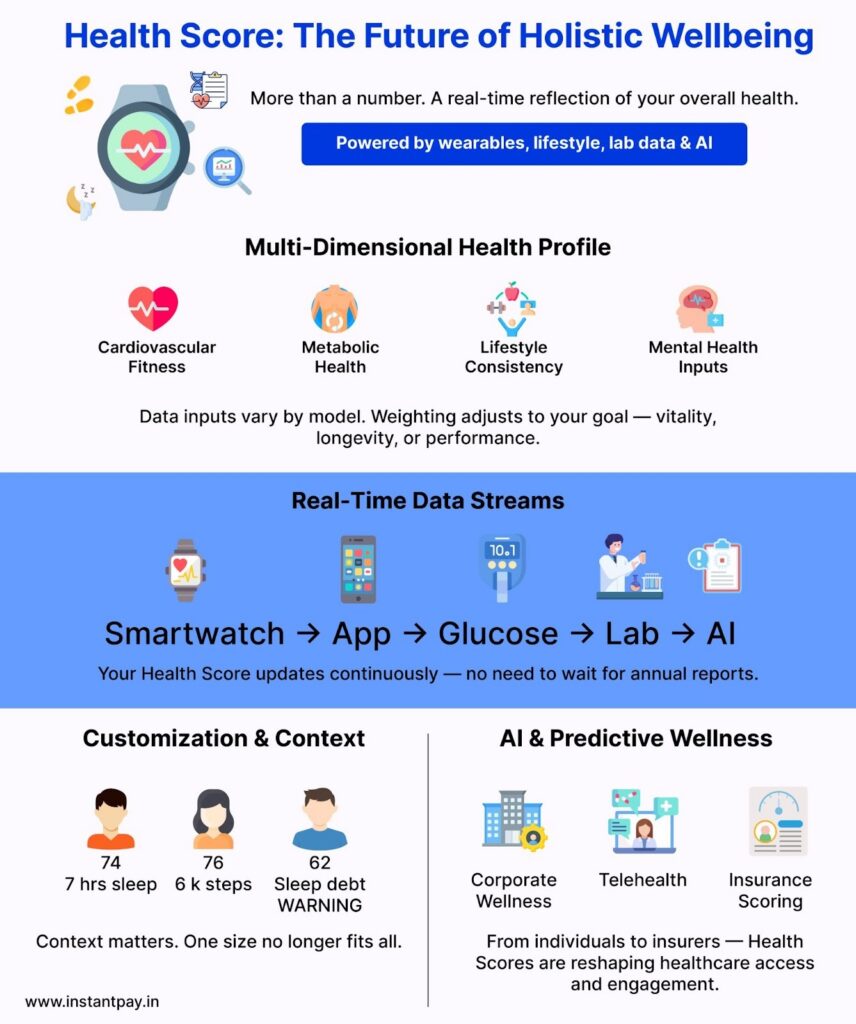
Health Scores are rapidly emerging as the modern-day alternative to traditional health metrics — designed to offer a comprehensive, real-time snapshot of your overall wellbeing. Unlike conventional indicators that focus on a single measurement or a moment-in-time assessment, Health Scores combine multiple data points across various dimensions of health into a single, dynamic index.
But what exactly goes into a Health Score, and why is it being hailed as the future of risk assessment and wellness management?
1. A Multi-Dimensional Health Profile
Health Scores are built using a holistic framework that reflects how your body is performing, adapting, and recovering over time. These scores aren’t just based on physical stats — they blend in biological, behavioral, and psychological data for a fuller picture. Core categories often include:
- Cardiovascular fitness (resting heart rate, VO2 max)
- Metabolic health (blood sugar variability, cholesterol levels)
- Recovery indicators (HRV, sleep cycles, stress levels)
- Lifestyle consistency (hydration, step count, screen time, etc.)
- Mental health inputs (mood logs, anxiety or depression scales)
Each element is weighted differently depending on the scoring model and the specific health goal (e.g., longevity, vitality, performance).
2. Real-Time Data Flow from Multiple Sources
Modern Health Scores aren’t calculated during annual checkups — they’re powered by continuous data streams. Here’s where the real innovation happens:
- Wearables like smartwatches and rings track movement, sleep, heart rhythm, and more
- Smartphone apps monitor dietary habits, screen exposure, or even voice patterns to detect stress
- Home medical devices log blood pressure, glucose, or oxygen saturation
- Lab integrations with electronic health records provide verified clinical insights
All of this data is synced into AI-powered algorithms that update your Health Score in real-time — creating a living, breathing representation of your health status.
3. Customization and Contextual Intelligence
Unlike BMI, which treats everyone the same, Health Scores are adaptive and personalized. Algorithms factor in your age, gender, baseline health, and even personal health goals. Two people with the same raw data (say, 7 hours of sleep and 6,000 steps daily) might receive different scores based on how those numbers compare to their unique profiles.
This contextualization makes Health Scores more actionable, helping users know what’s working and what needs to change.
4. Evolution Through AI and Predictive Analytics
Some advanced health platforms are evolving beyond simple scoring to offer predictive health forecasts. For example:
- Early warnings about fatigue or burnout
- Insights on the impact of sleep debt on immunity
- Forecasts for when you’re most likely to be physically or mentally sharp
- Tailored fitness, nutrition, and mental wellness recommendations
As machine learning models mature, Health Scores will transition from passive trackers to interactive wellness advisors — guiding users toward better long-term outcomes.
5. Integration with Broader Health Ecosystems
Health Scores aren’t standalone anymore. They’re being integrated into:
- Corporate wellness programs to encourage employee health
- Health insurance platforms for dynamic underwriting
- Telemedicine dashboards to assist doctors in remote monitoring
- Preventive care systems to detect risk early and intervene before diseases escalate
This integration makes Health Scores more than just numbers — they’re becoming the currency of modern healthcare and insurance.
How Health Scores Are Changing the Insurance Landscape
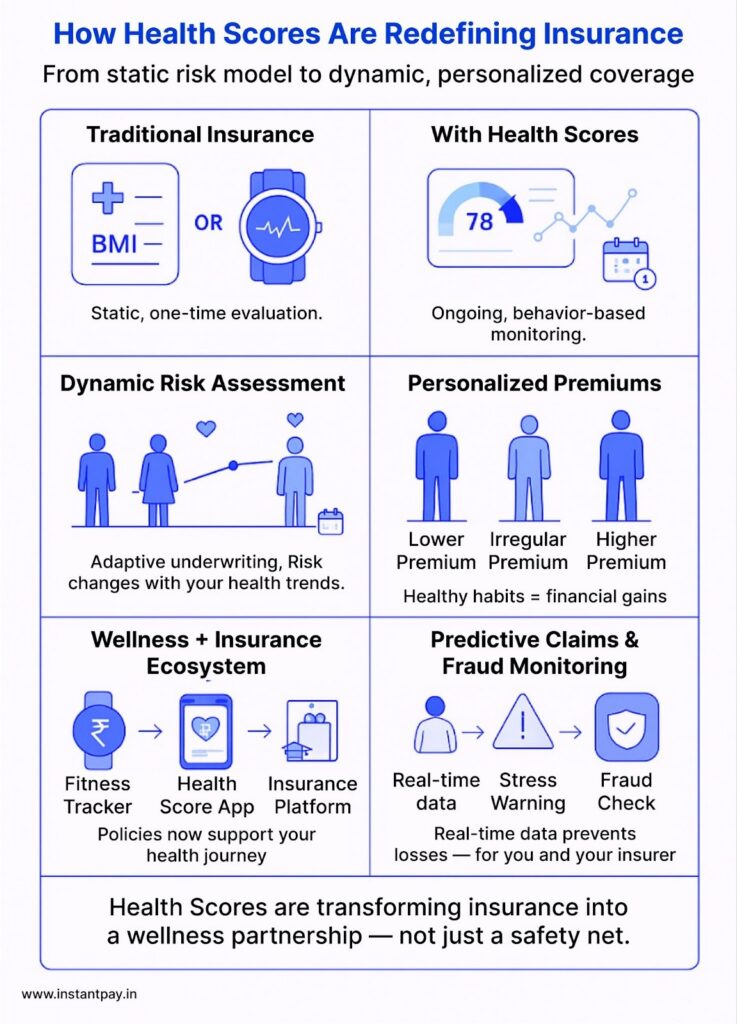
The insurance industry has long relied on static risk assessment models, many rooted in legacy metrics like age, gender, BMI, and family medical history. But these models offer only a fragmented glimpse into someone’s real health status — and often ignore how actively someone is managing their wellbeing.
Now, with Health Scores becoming a viable metric, the insurance industry is experiencing a shift — one that moves away from generalized underwriting toward real-time, personalized, behavior-driven policies. Here’s how this transformation is unfolding:
1. From One-Time Underwriting to Ongoing Risk Assessment
Traditionally, once an individual passed a medical exam and bought a policy, their health status was “locked in.” But Health Scores allow insurers to monitor risk in an ongoing, adaptive way. Instead of a one-time evaluation, risk profiles can be updated dynamically based on recent activity, lifestyle changes, or health milestones, similar to how telematics transformed auto insurance.
This shift enables more accurate risk modeling and supports new types of products like usage-based or time-sensitive coverage.
2. Personalized Premium Pricing Models
One of the most disruptive applications of Health Scores is in hyper-personalized premium pricing. Rather than charging based on population averages, insurers can:
- Reward active, health-conscious individuals with lower premiums
- Introduce micro-discounts for improvements in sleep, activity, or nutrition
- Penalize high-risk behaviors like smoking, sedentary lifestyle, or sleep deprivation (if consented to via data-sharing)
This transforms insurance into a two-way relationship, where healthier habits directly lead to financial benefits.
3. Digital Wellness Integration with Insurance Products
Forward-thinking insurers are integrating Health Scores with wellness platforms, turning policies into lifestyle ecosystems. These integrations offer:
- Fitness-based challenges with rewards (gift cards, lower premiums, etc.)
- Monthly reports or health coaching based on score trends
- Goal-oriented insurance products, like policies that activate full coverage only when a certain Health Score is maintained
The result? Insurance becomes not just protection but a partner in preventive health.
4. Claims Forecasting and Fraud Detection
Health Scores also help insurers detect patterns that could lead to preventable claims — such as rising blood pressure, sleep disturbances, or signs of stress-related illness. With predictive analytics, companies can reach out early, offering care management or virtual check-ins to prevent claims before they occur.
At the same time, these continuous data streams aid in fraud detection, identifying inconsistencies between reported behavior and biometric records.
5. New Policy Categories for the Digital-First Generation
Millennials and Gen Z consumers increasingly expect technology-integrated insurance products. Health Scores enable:
- Instant digital approvals without medical exams
- Flexible plans that adapt based on lifestyle
- Pay-as-you-live insurance where premiums change with score fluctuations
This aligns well with a generation that prioritizes transparency, control, and real-time feedback in all services — including insurance.
6. Strategic Partnerships with Tech and Health Ecosystems
Insurers are now collaborating with tech companies, fitness brands, and telehealth platforms to build a new data-sharing economy. These partnerships allow seamless score syncing, better analytics, and broader customer engagement.
For example:
- A health insurance app might sync with your smartwatch or nutrition tracker
- Premiums could be adjusted through connected health goals on Apple Health or Google Fit
- Your virtual check-up might auto-update your Health Score and notify your insurer
This interconnected model is forming the foundation of what could become a more intelligent, adaptive, and equitable insurance system.
Ethical Concerns and Data Privacy
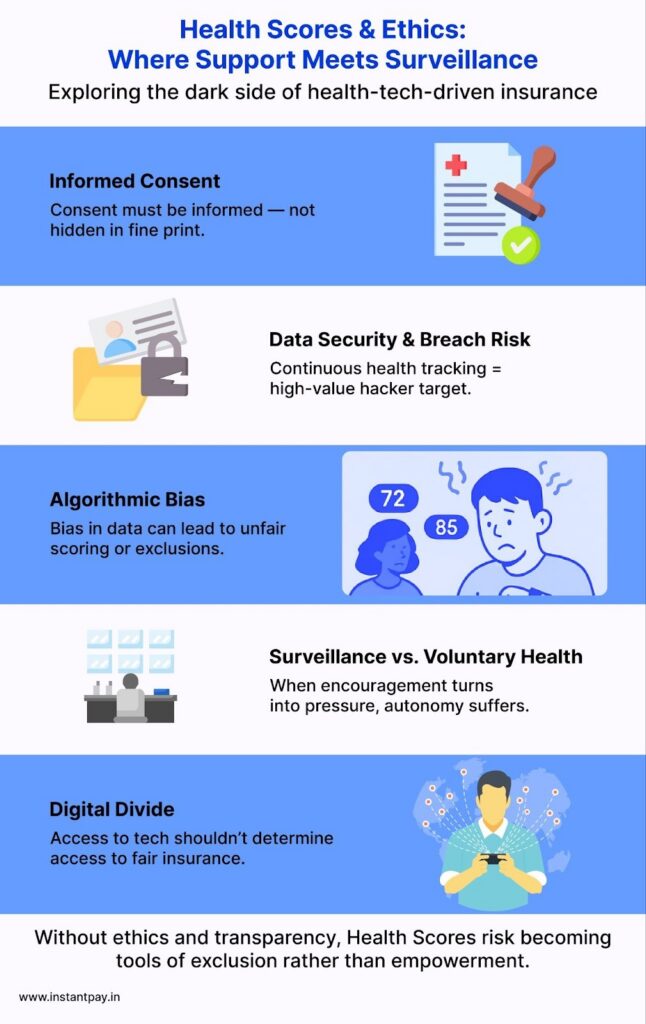
While Health Scores hold the promise of personalized insurance and proactive wellness, they also introduce a host of ethical dilemmas and data privacy challenges that can’t be overlooked. As we enter a world where insurers may track your steps, heart rate, or sleep cycles, it’s critical to ask: Where do we draw the line between support and surveillance?
Here’s a closer look at the major concerns and why they matter.
1. Informed Consent: Are Users Truly Aware?
Many health platforms and apps bury their data-sharing permissions deep in user agreements. As a result, consumers often unknowingly grant insurers access to intimate health data. The ethical issue here is not just consent, but informed consent — do users really understand what they’re signing away?
- Who owns the data: you, the app, or the insurer?
- Can data be reused or resold to third parties?
- Is there a right to withdraw consent without losing coverage?
Transparency must become a core principle of health-score-powered insurance.
2. Data Security and Breach Risks
The more detailed and continuous the data stream, the higher the risk of a massive breach. Health Scores aggregate information from wearables, clinical labs, mobile devices, and cloud storage — creating a high-value target for cybercriminals.
A data leak could expose:
- Medical conditions
- Daily routines
- Location-based activity
- Mental health fluctuations
This isn’t just a privacy issue — it’s a matter of personal safety and dignity. Insurers need to invest in bank-grade cybersecurity and zero-knowledge encryption models to keep user data airtight.
3. Algorithmic Bias and Discrimination
Health Scores are powered by algorithms, which means they can inherit bias from the data they’re trained on. This could lead to:
- Disadvantageous scores for underrepresented communities
- Penalization of individuals with chronic conditions or disabilities
- Misinterpretation of cultural health practices (e.g., fasting, herbal medicine)
If not designed ethically, scoring systems could reinforce existing health inequities, rather than address them. Insurance companies must invest in ethical AI audits, inclusive data sets, and fairness metrics.
4. Behavioral Surveillance vs Voluntary Engagement
There’s a fine line between encouraging healthy behavior and monitoring it coercively. For instance:
- What if a policyholder chooses not to wear a tracker?
- Can declining to share data lead to higher premiums?
- Will people be judged for “unhealthy days” like skipping workouts or sleeping in?
These questions raise concerns about autonomy and psychological freedom. Health engagement should remain voluntary and self-directed, not forced through fear of penalties.
5. The Digital Divide and Accessibility
Not everyone has access to wearables or smartphones. If Health Scores become a standard metric, there’s a risk of excluding or unfairly pricing those without access to technology — such as the elderly, low-income groups, or digitally illiterate individuals.
To be truly ethical, insurers must ensure that tech-driven models don’t replace accessibility with elitism. Alternative methods or hybrid models should be considered.
6. Regulatory Vacuum and Legal Grey Zones
Despite the growing use of health analytics, most countries still lack clear legal frameworks around:
- What insurers can collect
- How they use it
- When they must delete it
- What rights consumers have to dispute or correct their scores
Until robust regulation is in place, users are largely dependent on internal corporate policies — which vary in strength and often lack accountability.
What This Means for You as a Policyholder
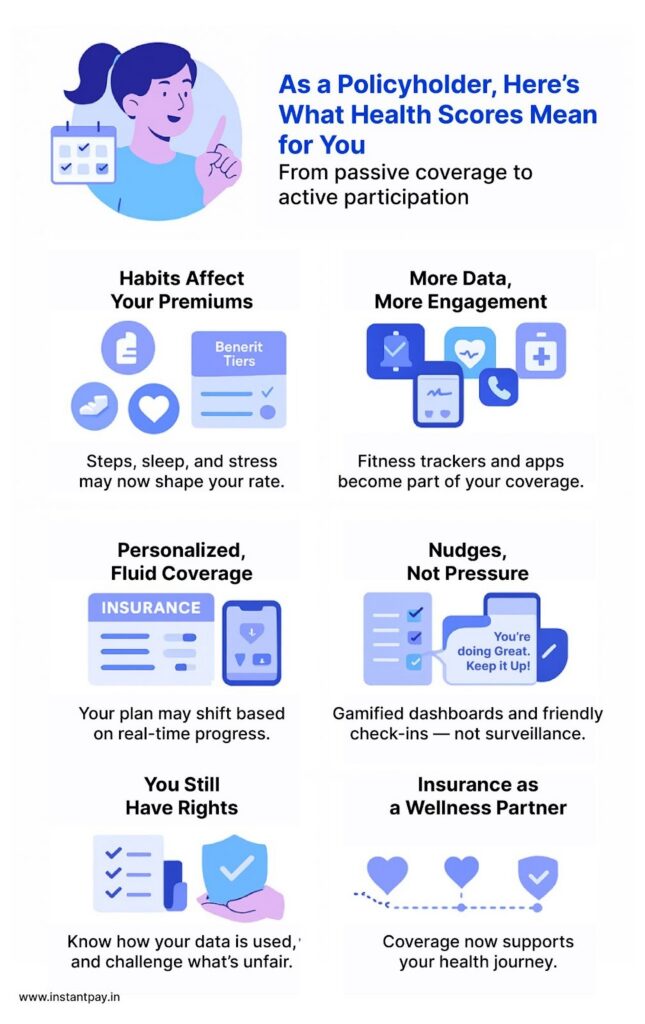
The rise of Health Scores in the insurance industry doesn’t just affect underwriting policies or corporate strategies — it directly reshapes your experience as a policyholder. From how your premium is calculated to the way you interact with your insurer, the dynamics are shifting toward continuous engagement, personal responsibility, and digital transparency.
Here’s what this evolution means for you:
1. Your Everyday Habits Could Influence Your Premiums
One of the most immediate impacts is that your lifestyle choices are now measurable — and insurers are paying attention. Instead of relying solely on age or past illness, your current behaviors may determine your rates. This means:
- Daily steps, sleep hours, or stress levels might earn you discounts
- Smoking, poor sleep hygiene, or erratic exercise patterns might raise red flags
- Consistent healthy habits could lead to tiered benefits or loyalty rewards
This shift creates an opportunity for proactive policyholders to take more control over their insurance costs — but it also demands sustained effort.
2. You May Need to Share More Than You’re Used To
Gone are the days when a one-time health checkup was enough. To tap into dynamic benefits or personalized coverage, you may be asked to consistently share data from:
- Fitness trackers
- Nutrition apps
- Mental health tools
- Even your smartwatch’s stress monitor or sleep log
This makes data-sharing a new form of engagement — and possibly a gatekeeper for better coverage. It’s essential to understand how your data is being used, and to regularly review privacy settings and permissions.
3. Your Coverage Could Become More Personalized — and Fluid
Instead of flat-rate policies, you could see modular plans that adjust based on your health score. For example:
- Premiums that decrease after 3 months of improved cardio fitness
- Emergency benefits that unlock with consistent stress management
- Wellness perks tied to a minimum monthly activity score
This fluid, responsive model means your insurance is no longer static — it’s a living agreement that evolves with you. But with personalization comes complexity, so staying informed and digitally literate is key.
4. You’ll Be Encouraged — But Not Forced — to Engage
The best insurers understand the difference between nudging and pressuring. As a policyholder, expect to see:
- Gamified wellness dashboards to keep you motivated
- Non-intrusive alerts or check-ins when your score drops
- Educational content around sleep, diet, or resilience tailored to your trends
You’re still in the driver’s seat — the key is to treat your Health Score as a supportive tool, not a surveillance mechanism.
5. You Have Rights — But You Must Advocate for Them
With this new system comes a new responsibility: understanding your rights as a data-sharing consumer. You should be empowered to:
- Access your full health score history
- Correct any inaccuracies in your data
- Opt-out of specific data streams without penalty
- Get clarity on how your score affects your coverage
Read policy fine print, ask your insurer questions, and don’t hesitate to challenge decisions that feel unfair or opaque.
6. Your Insurance Will Feel More Like a Wellness Partnership
Ultimately, Health Scores are nudging insurance from a reactive model to a proactive partnership. As a policyholder, this could mean:
- More tools to understand and improve your health
- Early interventions before major issues develop
- A closer alignment between your lifestyle and your financial planning
The shift isn’t just technological — it’s philosophical. You’re no longer just a risk to be priced — you’re a whole person with dynamic needs, goals, and the power to shape your own outcomes.
The Road Ahead
Health Scores aren’t just another wellness trend — they’re redefining how insurance works. Instead of static risk models based on age or BMI, insurers are shifting toward personalized, real-time assessments rooted in your lifestyle and health behavior.
A 2023 report by Feathery notes that 63% of insurers plan to fully digitize operations by 2025, which includes integrating health and wellness data into risk modeling. This shift could soon mean your policy evolves dynamically — with premiums and coverage tailored to how active, well-rested, or stress-managed you are.
Technology is fueling this transformation. From wearables to AI, insurers are collaborating with tech and healthcare platforms to create interconnected systems that promote early intervention. Accenture estimates these tools could reduce preventable claims by up to 30%, showing clear economic and health incentives.
But the innovation must be inclusive. Pew Research reveals that 27% of low-income adults rely solely on smartphones for internet access, which could limit their ability to fully participate in data-driven health programs. Without thoughtful design, Health Scores may unintentionally deepen inequalities.
Ultimately, the road ahead is promising — a future where insurance adapts to you, supports wellness proactively, and rewards healthy living. But its success will depend on transparency, accessibility, and a commitment to putting consumers first.
Final Thoughts: A Shift from Risk to Responsibility
For decades, insurance has been rooted in the language of risk — assessing it, pricing it, and reacting to it. The traditional model looked backward, relying on demographic averages and outdated health indicators to calculate how likely you were to get sick or file a claim. But with the emergence of Health Scores, that paradigm is shifting. We’re entering a future where the conversation is less about what might happen to you, and more about how your actions today shape what’s possible tomorrow.
This is more than just a data upgrade or a technological evolution — it’s a reimagining of the very role insurance plays in your life. Instead of stepping in only when things go wrong, insurers are now positioning themselves as long-term wellness partners, encouraging healthier behaviors, earlier interventions, and continuous engagement.
Health Scores are the tools that make this possible — providing real-time feedback, incentivizing consistency, and aligning individual wellness with systemic sustainability.But this shift also demands more from policyholders. Where once a policy was a passive product you bought and filed away, now it’s an active relationship that responds to your choices and changes over time. That means taking responsibility for your health data, engaging with your insurer beyond annual renewals, and being proactive about understanding how your behavior influences your benefits.
At the same time, insurers must recognize that this responsibility isn’t a one-way street. They must build systems that are transparent, equitable, and respectful of consumer rights. They must ensure that data-driven innovation doesn’t become a barrier to access or a source of exclusion. Trust, after all, is the currency that will determine whether Health Scores become tools of empowerment — or instruments of surveillance.
Ultimately, this new model holds immense promise. It has the potential to make insurance more affordable, more personal, and more responsive. But it will only succeed if we embrace this shift not just as a technological upgrade, but as a shared responsibility — between insurers who build with ethics and empathy, and consumers who engage with awareness and intention.
The future of insurance is no longer about predicting the worst. It’s about unlocking the best in all of us.
FAQs: Understanding Health Scores and the Future of Insurance
1. What exactly is a Health Score and how is it calculated?
A Health Score is a dynamic, data-driven metric that reflects your overall health and wellness. It’s calculated using a range of inputs such as physical activity, heart rate, sleep quality, stress levels, medical history, and sometimes even social and environmental factors — all collected through devices, apps, or health records.
2. How is a Health Score different from BMI?
Unlike BMI, which only measures your weight in relation to height, a Health Score takes a holistic view of your well-being. It considers real-time, personalized data to provide a more accurate picture of your physical and even mental health, rather than relying on a single, outdated measurement.
3. Can my Health Score affect my insurance premiums?
Yes. Many insurers are beginning to use Health Scores to customize premiums, coverage benefits, and rewards. A better score could mean lower premiums or additional perks, while a poor or declining score might lead to higher costs or limited benefits, depending on the insurer’s model.
4. Is my personal health data safe when shared with insurers?
Data privacy is a major concern. Reputable insurers are expected to comply with strict data protection laws and transparency standards. However, it’s important to read your insurer’s data use policy, understand what’s being collected, how it’s stored, and whether you can opt in or out of certain data-sharing agreements.
5. What if I don’t use wearable devices or apps — can I still get a Health Score?
Yes, but the score may be less detailed. Some insurers offer manual tracking options or use clinical data from health check-ups instead. However, using wearables or health apps typically results in a more accurate and real-time Health Score.
6. Will Health Scores lead to discrimination in insurance access or pricing?
That’s a valid concern. Without proper regulation, there is a risk that people with chronic conditions, disabilities, or limited access to wellness tools could be unfairly penalized. Ethical insurers and emerging regulations aim to prevent this by promoting fairness and inclusivity in scoring models.
7. How can I improve my Health Score over time?
You can boost your score by consistently engaging in healthy behaviors like regular exercise, balanced sleep, stress management, good nutrition, and regular medical checkups. Many platforms even provide recommendations or health coaching to guide your improvements.
8. Are Health Scores used only in health insurance, or do they impact life or critical illness insurance too?
Health Scores are increasingly being explored across multiple insurance types, including life, critical illness, and even wellness-linked investment plans. The goal is to provide a more personalized and predictive assessment of your overall risk.
9. What happens if my Health Score goes down? Will I be penalized?
That depends on your insurer’s policy. Some may use declining scores as a reason to increase premiums or reduce benefits over time, while others may take a more supportive approach — offering guidance to help you improve rather than penalizing you outright.
10. Is this the future of all insurance? Should I prepare for it?
Yes, Health Scores are part of a larger movement toward personalized, data-informed insurance models. While adoption is still growing, preparing now by engaging with your health data, improving wellness habits, and understanding your insurer’s approach can give you a meaningful advantage.