In addition to being used to get mail from one location to another, postal codes help businesses confirm where an item or person should be sent or delivered, allow deliveries to occur smoothly, and create a better experience for customers. A PIN code lookup system enables finding the approximate location of a service area to help correct errors that may be due to missing or incorrect information regarding an address. Each year, poor address data worldwide costs businesses approximately $20 billion due to failed deliveries, incorrect routing of parcels, and verifying a person’s identity through the use of a postal code.
In India, a larger problem exists, with over 19,000 PIN codes covering 154,725 post offices. As e-commerce continues to grow rapidly, accurate addresses are also becoming increasingly important, as more than 25% of COD (Cash On Delivery) purchases are unsuccessful due to errors and/or incorrect information (such as using the wrong PIN code). Therefore, for fintech, logistics and digital companies, having a PIN code lookup system is much more than a basic backend tool; it is critical for geo-verifying locations, working efficiently and, most importantly, building trust with customers.
What is a PIN Code Lookup?

A lookup or reference on a PIN code connects a postal code to a specific location. Thus, when you enter your PIN code, you can get information about a delivery area, the district it belongs to, what state it is in, and how to find it from Google Maps.
Each PIN code listed in the India Post system refers to a particular geographical area. This is how it assists companies in validating their address records and making sure that deliveries are made correctly in India.
What Type of Information do you Get from a Lookup for a PIN Code?
The lookup results show key geographic information for a location, including:
- Region: a broad description of an area (such as Central Delhi for postal code 110001)
- State: the state in which an area is located (such as Maharashtra for postal code 400001)
- District: the local governmental area (such as Hyderabad for postal code 500001)
- Taluka/sub-district: the smaller administrative area, usually found in rural areas
- Delivery Company: whether there are normal delivery service companies or speed post delivery services available in an area
The India Post Card or PIN Code records the exact name of each post office associated with a PIN code.
All of this information helps companies reduce shipping errors, improve shipment deliveries, and improve their customers’ overall shipping experience.
Real-Time Lookup vs. Static Databases

Businesses use two main methods for PIN code lookup, real-time systems and static databases. Each has its own use depending on speed, cost, and accuracy needs.
| Feature | Real-Time Lookup | Static Database |
| Data | Always up-to-date from live sources | Updated periodically (monthly/quarterly) |
| Accuracy | Very high, fewer errors | Can become outdated |
| Speed & Experience | Instant validation, smoother checkout | Slower, may need manual checks |
| Cost | Higher due to tech and integration | More affordable and simple |
| Internet Need | Requires internet | Can work offline |
| Best For | E-commerce, fintech, logistics | Small businesses, bulk checks |
In short, real-time lookup offers accuracy and speed, while static databases are simpler and cost-effective for basic needs.
Why Accurate Postal Data Matters?
Accurate postal code data is essential for businesses to fulfill orders on time, decrease address errors, and enhance customer service. When companies use updated postal codes, they have fewer delays, fewer returns, and fewer complaints from consumers.
Key Insight:
Inaccurate addressing in India has significant economic implications, with estimates suggesting annual losses between $10 billion to $14 billion due to misdeliveries, inefficiencies, and fraud.
How Postal Code Lookup Works?

A postal code lookup works by converting a six-digit postal (PIN) code to useful geographic information through the following process:
1. The user provides a PIN code (i.e., when making a purchase, signing up, or verifying addresses).
2. The postal code lookup system searches a live or previously stored postal database to identify the specific geographic area associated with that PIN code.
3. The postal code lookup system retrieves states, district, area, post office and status of the delivery if the PIN code is correct.
4. The postal code lookup system confirms/immediately validates if the address provided is the correct address or needs to provide another corrected address, at the time of entry by the user.
5. Some postal lookup systems have advanced features, which utilise geotagging/mapping to provide routing and/or fraud-check capabilities as well!
Why Is This Important?
- Reduces failed deliveries and returns/less expensive.
- Makes it easier for merchants to complete the checkout process or onboard consumers.
- Provides the ability to detect mismatched and/or suspicious addresses.
- Reducing time/cost/and manual effort associated with completing an order.
Thus, providing a practical method for both efficient business processes as well as building customer confidence through the use of postal code lookups.
Example: An e-commerce warehouse in Gurugram uses a postal code resolver to validate serviceability before dispatch. If a new housing society is not present in the static database, the system flags it, prompting a manual check, saving time, costs, and reputation.
Benefits & Limitations
| Aspect | Benefits | Limitations |
| Automated Mapping | Speeds up onboarding and address collection processes. | May misfire with typos or legacy codes. |
| Geospatial Accuracy | Enables location-based analytics and route planning. | May vary by provider, not all datasets are enriched. |
| Scalability | Works for both high-volume and low-volume systems. | Static systems might miss newly assigned codes. |
Top 5 Industry Use-Cases for PIN Code Lookup
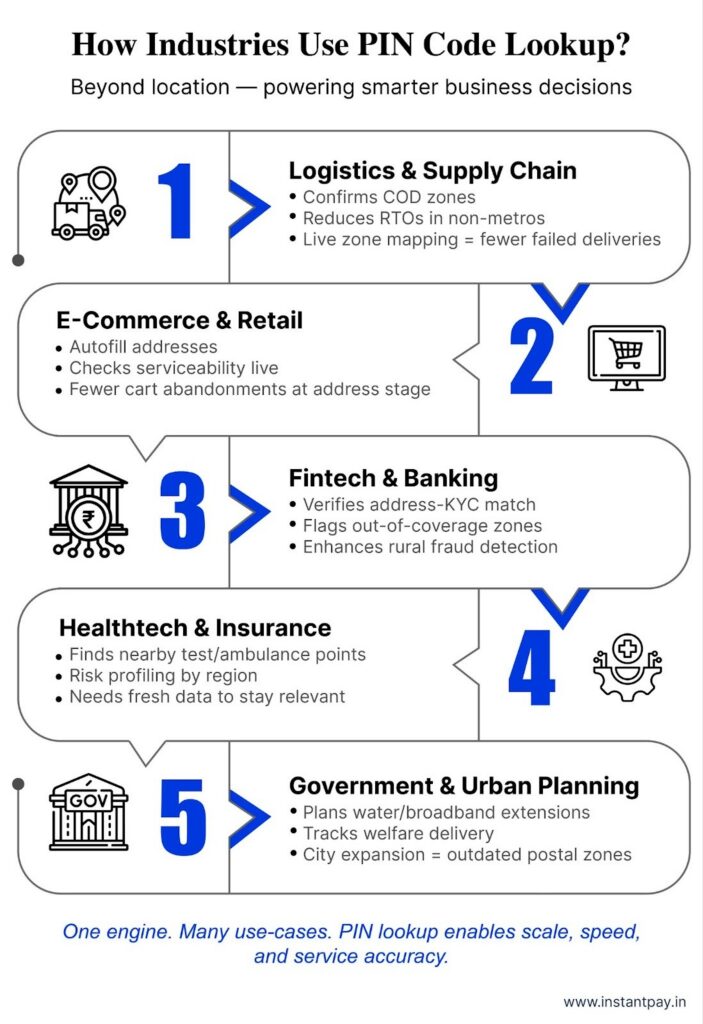
Some companies don’t only need to know where their shipments go; they can also use pin codes to identify other aspects of their operations, such as:
1. Supply Chain & Logistics
Impact: In order to deliver packages correctly, a company must be able to determine where an address is located.
Example: A logistics company will check the pin code for a village in Uttar Pradesh to see if it is located on an active route or if an outside partner will be needed to handle the shipment.
Benefit: Fewer failed deliveries and expense associated with the shipment (gas) is saved in addition to reducing time and costs associated with returning a product.
2. E-Commerce & Retail
Impact: Many purchases fail because the person providing the purchase has submitted false or missing information related to the address.
Example: The e-commerce or retail provider validates the pin code entered by a user in Delhi or Mumbai (along with the area) while also validating that the address is in a serviceable region prior to completing a purchase.Benefit: By verifying this information before completing the sale, retailers can avoid many last minute cancellations and improve the purchasing experience.
What sectors benefit most from postal region lookup?
Those industries that depend on postal deliveries and are most likely to rely on the service, such as ecommerce, logistics, banking and government services, use the postal region lookup to verify customer addresses prior to delivery and use them as a basis for onboarding (i.e. business-to-customer relationship).
3. Banking & Financial Services
Impact: Banks must confirm that the mailing address provided is valid and within their service area.
Example: A lender will verify a person’s mailing pin code in Rajasthan against the actual address provided and will flag any discrepancies.
Benefit: Fraud can be minimized and the accuracy of the loan decision will be improved.
4. Healthcare Technology & Insurance
Impact: Accessibility of healthcare services are reliant upon distance to Hospital/Healthcare Centers.
Example: A patient located in Assam identifies their PIN code and through mapping software will disclose the nearest Labs/Ambulance Services.
Benefit: Decreased time waiting for healthcare services, especially in rural areas.
5. Government and Urban Planning
Impact: Accurate and truthful data is critical for the creation of governmental services such as roads, water and other public infrastructure.
Example: Projects in Bengaluru use PIN Code Mapping to identify locations that are missing basic service needs.
Benefit: Improved planning and effective use of resources.
Key Initiative:
To address these challenges, the Indian government has launched the Digital Address Code (DAC) initiative. This project aims to create a standardized, geo-coded addressing system across the country, enhancing the accuracy of address data and facilitating better service delivery. The DAC is part of a broader effort to develop a Digital Public Infrastructure (DPI) for addresses, ensuring interoperability and ease of access for various stakeholders.
Key Benefits of Address Resolution Systems
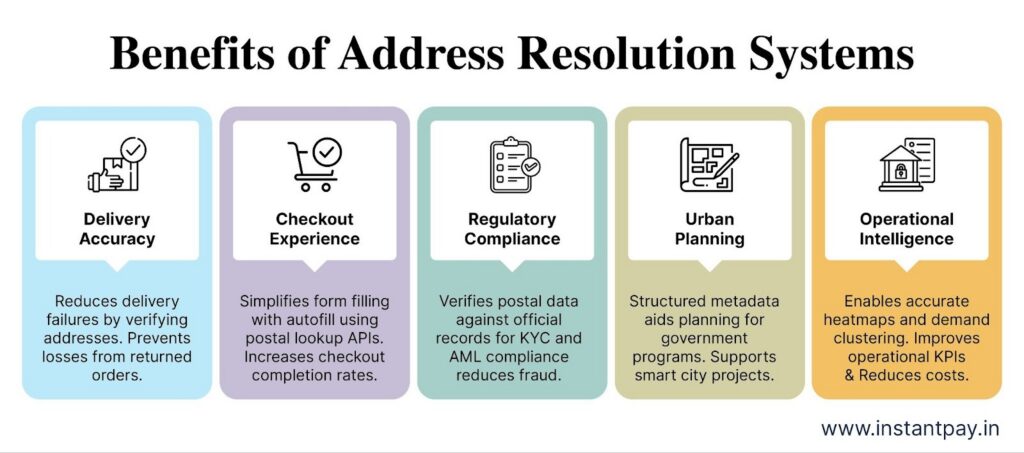
Address resolution systems assist businesses in cleaning, verifying and analyzing address data. This results in less errors and an improved customer experience while providing a smoother operating environment.
1. Improved delivery accuracy
Why it is Important – Small errors in a delivery address often lead to a failed delivery; especially in densely populated areas for example Delhi NCR and Kolkata.
To ensure an address exists and can be delivered successfully a logistics company validates the PIN Code of a delivery address prior to dispatching an order.
Benefit – Returns due to an incorrectly fulfilled delivery can cost upwards of Rs.1,500.
2. Improved checkout experience
Why it is Important – Long and or complicated address forms can frustrate consumers during the checkout process.
When customers in Mumbai input the PIN Code of their delivery address into the checkout process, the locality (address) and city are automatically populated with the appropriate data; all a customer has to do is check and confirm the information is correct.
Benefit – Quicker checkout process and therefore increased conversion rate by as much as 15-20%.
3. Better compliance and detection of fraud
Why it is Important – Banks and other Fintechs are required to verify the address of users prior to completion of their KYC process.
To verify the address of a user in Jaipur; a lender can compare the user’s PIN to government tax rolls to determine if the user’s reported address is valid and can, therefore, expedite the KYC process.
Benefit – Reduces fraud and reduces the time taken for the KYC process to be completed.
4. Better planning and provision of public services
Why it is important – Government requires accurate information about population and business activity within a jurisdiction to properly develop and implement an infrastructure plan.
For example; Pune and Bhubaneswar are developing smart city projects that utilize PIN-based mapping software to identify service gaps within each city.
Benefits – Better planning and allocating of resources.
5. Operational Efficiency and Cost Savings
Why it is important – Businesses rely on accurate geographical information for routing/shipping (delivery) and inventory.
For instance, a courier company in Bangalore is using cleaned `address` data to optimise shipping routes.
Benefit – Lower fuel cost and more timely delivery.
Are PIN code datasets government-approved?
Most of the systems that use PIN code data rely on governmental authority sources such as India Post or other government related data (making it safe to use) especially when it comes to banks and other financial institutions.
Challenges and Limitations in PIN Code Lookup

Despite recent developments, the PIN Code Lookup systems and existing tools within them face multiple challenges in a very diverse country like India.
1) Given the rapid expansion of cities, older Pin Codes are still used for old areas and hence are now causing overlaps with newer Pin Codes.
An example of this is in Gurgaon (Gurugram), there are still older Pin Codes being used which causes sorting issues. In the creation of new systems, additional data such as street names and GPS are used to assist identify the correct location.
2) Due to incomplete and informal addresses in rural areas such as Jharkhand or Chhattisgarh, it is very challenging to create a map or accurately map those addresses.
Given the need to create accurate locations, there is development underway to use GPS tagging and Smart Matching to improve the accurate identification of locations.
3) Postal address data records are not always automatically and immediately updated which may prevent delivery of mail due to inaccurate address records.
For example, delays in updates have resulted in undelivered mail in states such as Bihar and Karnataka. To help reduce these types of issues, new systems are using real-time synchronization or API’s and AI to reduce such errors.
4) Verifying addresses instantly at the physical level has been much more difficult as compared to verifying through the phone as well as email.
Some of the fintech companies were unable to complete the onboarding of customers as a result of using obsolete address information. However, through real-time and location API’s, service providers are able to check whether they service the location and provide coordinates of the location, should they provide inaccurate addresses.
Integrating PIN Code Lookup with Business Systems
Integrating a postcode lookup feature into any kind of platform (such as websites, apps, customer relationship management (CRM) systems, etc.) significantly reduces the amount of errors made by businesses, allowing them to work more effectively and efficiently, while also ensuring that users have presented only valid, usable data for the entirety of the transaction via address validation being a part of the workflow.
Why Integration Matters?
The quality of addresses used in sending packages around the world has a direct impact on whether a shipment was successfully delivered, how quickly it gets there, and how happy the customer is afterwards.
For example, when a user provides a postal code on an online store website they can have their appropriate city and district automatically populated into the checkout process speeding up their shopping experience and helping to prevent any future problems with missed deliveries due to incorrect address information.
Additionally, financial service providers can check if there is proper serviceability to the residence of a potential customer prior to accepting them as an account holder; likewise, logistics personnel can validate the delivery address prior to dispatching to ensure timely, error-free deliveries.
Methods of Integration
- Application Program Interface (API): Validation in real time through app/web form interfaces
- Batch Processing: Bulk address validation via batch processing operation
- Plugin/SDK: Pre-built integrations with platforms (ex: Shopify, Salesforce)
Benefits
- Fewer address verification errors
- Faster shipping/onboarding process
- Able to check for real-time serviceability availability
- Reduced cost due to fewer returns/re-route
How is AI improving postal address systems in India?
AI can help identify invalid/incomplete addresses, improve recognition of local language inputs and suggest the correct location/addresses – resulting in faster and more accurate address validation.
Compliance and Data Sources in Address Lookup Systems
Address Verification systems rely on reliable data sources and must comply with local laws; this is particularly true for industries such as logistics, Fintech and Government Agencies. The use of trusted address data sources enables accurate address verification, thereby building trust in address verification systems.
Primary Data Providers in India
The vast majority of Postal Code Lookup systems utilise trusted government referenced data sources representing a significant amount of verified government information relating to postal code and delivery information. The principal Government Data Sources in India, which are used to provide postal code and delivery information, Include:

| India Post: The largest government source due to managing over 19,000 postal codes with detailed delivery information. |

| National Informatics Centre (NIC): National Informatics Centre (NIC): Provides location and administrative data for use in government applications. |
| Census of India: Established through population census data; provides detailed area/population information to enable more precise mapping. |

| Survey of India: generates maps/geographic data for use with advanced location trackers. |
When the above government data sources are combined they allow a postal code to be matched with sufficient detail to capture accurate state, district, and postal delivery area of an address, creating a higher level of reliability when performing an Address Verification.
Open-Source vs. Proprietary Data
| Type of Dataset | Description | Use Cases | Limitations |
| Open-source | Data from the Census Bureau or India Post directories. | A government website, academic research or even a lookup for an address all provide access to a limited number of baseline datasets. | Most of these sources of information may be more than 2 years old and not very accurate |
| Proprietary/enriched | Data previously curated and continuously maintained and regularly updated by third-party data providers (like Amazon). | APIs associated with logistics, e-commerce, and/or ticketing services. | Typically require payment and licensing to use. |
Tip: Always review the “last updated” date of the dataset being used, especially if you’re deploying it in high-risk industries like lending or insurance.
Compliance and Security Considerations
The accuracy of data is just one half of the equation. Tools that are used to validate addresses in today’s world, particularly those integrated through lookup application programming interfaces (APIs), also need to adhere to a data governance framework.
• Data Protection – Any service involving customer-provided location input, needs to comply with the Digital Personal Data Protection Act 2023 in India and, where applicable, worldwide regulations like GDPR.
• Auditability – For example, in a RegTech (regulatory technology) environment or in a digital KYC (know your customer) environment, the validation of addresses must be transparent, traceable and be able to comply with many other requirements for audit trails and/or API logs.
• Updating Mechanisms – When validators are capable of synchronising in real time with authoritative sources, they’re not relying on out-of-date data that can create issues that lead to legal obligations or logistical problems.
The implications of this are significant. Inaccurately or non-compliant-mapping of postal addresses can negatively impact KYC compliance, increase the incidence of fraud in the delivery chain, and lead to financial, criminal and regulatory penalties, particularly in the case of Fintech and Insurer firms.
How to Choose a Reliable PIN Code Lookup Solution?
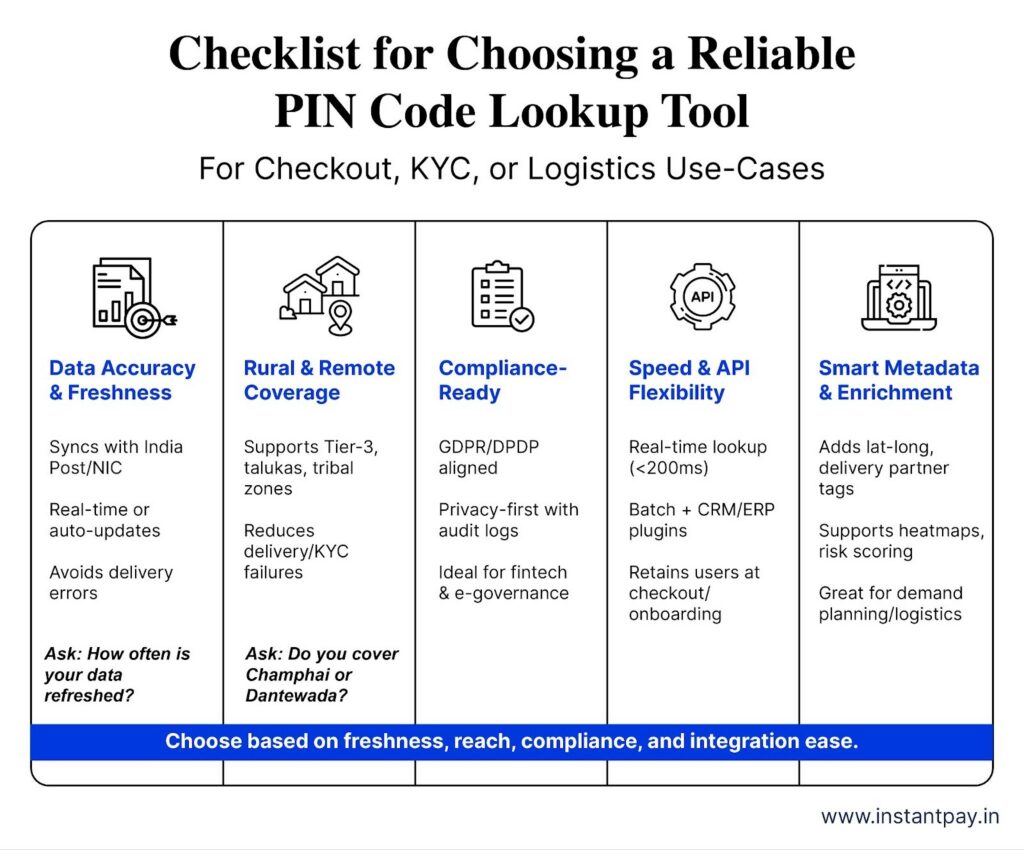
When implementing PIN code lookup to your system, it’s essential you find the right provider as a poor choice can cause wrong deliveries, failed onboarding, and/or bad customer experience.
Here are some important features to look for:
1. Data Freshness and Accuracy
Providers should constantly refresh their data from any appropriate source such as India Post to provide the best accuracy and incorrect/outdated data can cause an e-commerce site to incorrectly mark an area as ‘not serviceable’ therefore losing them the order.
2. Coverage Throughout India
Confirm that your provider’s service performs well throughout all areas of India; e.g. both urban and rural outlying areas such as Champhai (Mizoram) or rural Chhattisgarh, both of which have weak address data.
3. Compliance and Data Security
For any financial services (FinTech) and banking the provider should adhere to all data privacy laws and provide the necessary documentation to allow for audit or for KYC verification.
4. Quick & Easy Integration/Speed
Your Provider’s solution should provide rapid execution and APIs so you can integrate easily with your website or application having minimal delays for both you and your users during the checkout or onboarding process.
5. Additional Insights/enrichment of data
Other providers may also provide additional types of data such as geolocation coordinates and/or delivery flags; examples of the use of data would be in helping plan delivery routes, prevent delivery fraud, and identify demand more accurately.
Why Opt for Instantpay for Smart Address Intelligence?
If you are trying to find an answer that gives you accuracy, coverage, and ensures you follow the rules, then Instantpay has an amazing alternative. A product created by fintechs, logistics providers, and verification platforms to include the following:
- Real-time with mail match and enriched with mail metadata
- Covering all rural, subs, and metros
- Integrate API’s without interruption for bulk mail address verification from the source.
- We meet regulatory compliance (DPDP) infrastructure standards for regulated industries.
Using the vast amount of contextual information associated with the address, such as state, county, sub-county, delivery feasibility, etc. Instantpay allows businesses to make decisions, as fast and accurately as possible, with the least delay from the origination of the address.
The Future of PIN Code Lookup in India
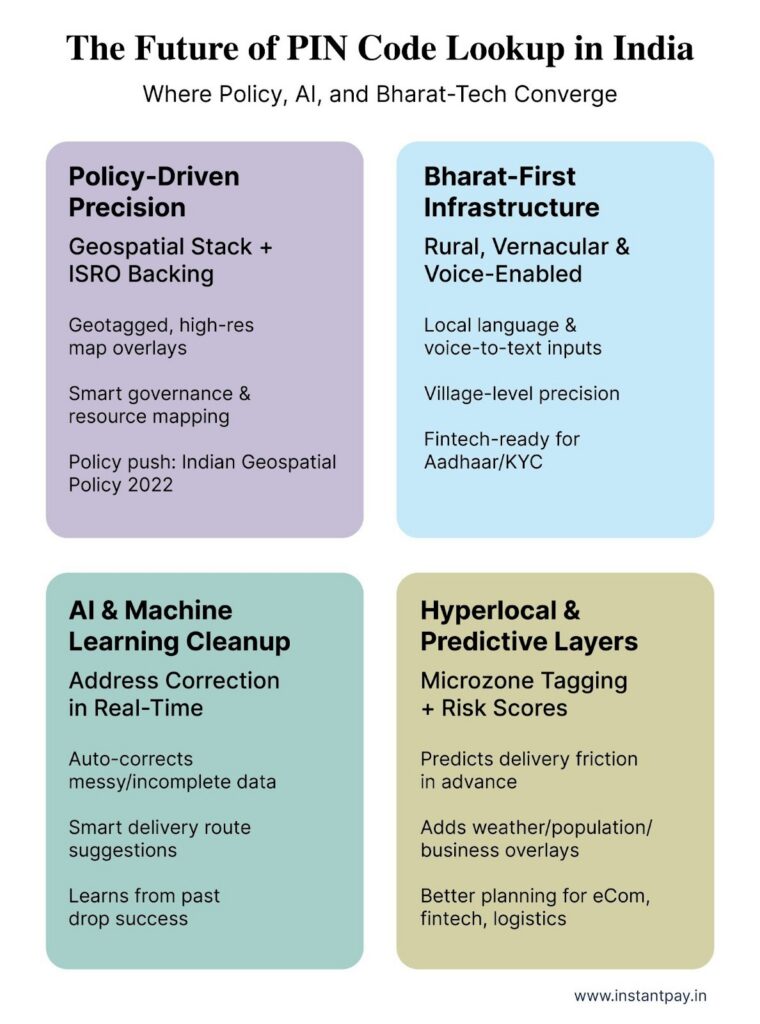
Address systems continue to become more than just basic postal data; they are evolving into smarter and more dynamic ways for businesses to make better decisions.
Smarter location data with Support from Government
Governmental programs and policies are enhancing access to reliable location data.
Smarter maps, accurate addresses, and enhanced planning capabilities for businesses and government agencies.
Better coverage of Rural India
70% of rural places still have limited access to all forms of address systems. Future address systems will include the following:
Ability to use local languages and voice recognition for address input,
Ability to provide improved village & Taluka level data.
Overall, these improvements will assist in improving service delivery across all of India.
Using AI to Improve Address Intelligence
AI can improve delivery accuracy and automatically fix missing or inaccurate addresses. AI also has the ability to identify incorrect or missing addresses and provide alternate suggestions.
Predictive & Hyperlocal Analytics
New address systems will be able to identify issues with the delivery and provide businesses with advance notice of potential problems.
This will allow businesses to plan better and minimize delays.
Final Thoughts
Now there is much more to a basic PIN code when launching a business today than just a simple tool, PIN code lookups can be extremely helpful for businesses. In addition to helping improve delivery to the cities as they continue to grow, they also will support many financial services to those that live in rural areas through the use of accurate address information.
Because AI has improved technology in many cases, and better government data is available, the methods for gathering, storing, and using address information can be much more accurate and reliable. By using a solution that provides real-time accurate address information, businesses can reduce errors, lower their costs, and improve their overall customer experience.
In short, the better your address data is, the greater your overall success will be in the marketplace
FAQs
1. What is a PIN code lookup and why is it important?
A PIN code lookup allows a user to find information about a specific location such as the city, district, and whether or not they are eligible for that delivery via their postal code. The importance of a PIN code lookup lies in its ability to minimize errors in the address and prevent failed deliveries, in addition to improving customer experience.
2. How does a postal code lookup tool work?
The tool compares the entered postal code against a reference database and subsequently returns the recorded details for that postal code (area, region, etc.) allowing users to determine whether the location they have searched for is in service (delivered to that area).
3. Is real-time postal lookup better than using static databases?
Yes, real-time postal lookup can provide updated, accurate data; however, static databases do not include many updates (data from government sources are not always current).