Face recognition is used to lock/unlock phones, authorize payments and check the user’s identity when conducting business online. However this convenience presents a problem, how do systems know if a face is legitimate and present (live) or just in a photo, video or AI-generated (deepfake)? With the increasing use of face recognition (authentication) has come the development of several methods to compromise it such as using masks, reproducing images (printing the right photo for example), and modifying videos to impersonate someone else.
As face recognition applications expand, so too does the risk from criminals attempting to spoof face recognition processes. A 2026 prediction from the industry indicates that the face liveness detection industry will exceed $250 million by 2027, with an estimated 50 billion liveness checks in 2027. In India, Aadhaar has conducted more than one billion face authentications as of the middle of 2024. As digital identity (identity on the internet) continues to develop, Face Liveness Detection is an important factor in establishing the authenticity of the identity behind the device.
Understanding Face Liveness Detection

Think about accessing your bank account or confirming your identity through the use of your face before you even know about it! It’s that easy and quick. However, what happens if the system is fooled?
For example, the person trying to fool the system may have used your picture, video or even created a fake likeness of you; this is actually a very real risk as biometric login technology continues to proliferate.
To prevent this type of situation the institution uses Live Face Detection technology; it ensures that the face being viewed by the camera belongs to a real person who is present live and not a fake image or recording.
Live Face Detection provides an additional level of security due to the fact that it does not merely compare two images of the same face (with facial recognition); instead, it provides verification of the presence of a real human by measuring various forms of physical human characteristics, which include:
- Evidence of blinking and other normal facial expressions and behaviors
- Skin texture and light reflections
- The three-dimensionality of the face
Incorporating this additional method of security is essential as the industries of Banking, FinTech, Telecommunication, and the Digital Identity Sphere continue to absorb more and more fraud; when implemented effectively, organizations that use Live Face Detection will be able to greatly reduce their fraud while also improving the speed and convenience of biometric authentication.
Key Insight:
Amazon’s AI-driven identity verification tool, Rekognition Face Liveness, played a pivotal role in the success of eLogic’s biometric solution, helping reduce fraud and risk by 95%. Beyond security, the implementation also enhanced inclusivity and user accessibility, demonstrating how modern liveness detection can deliver both protection and a seamless user experience at scale.
The Evolution of Face Liveness Detection
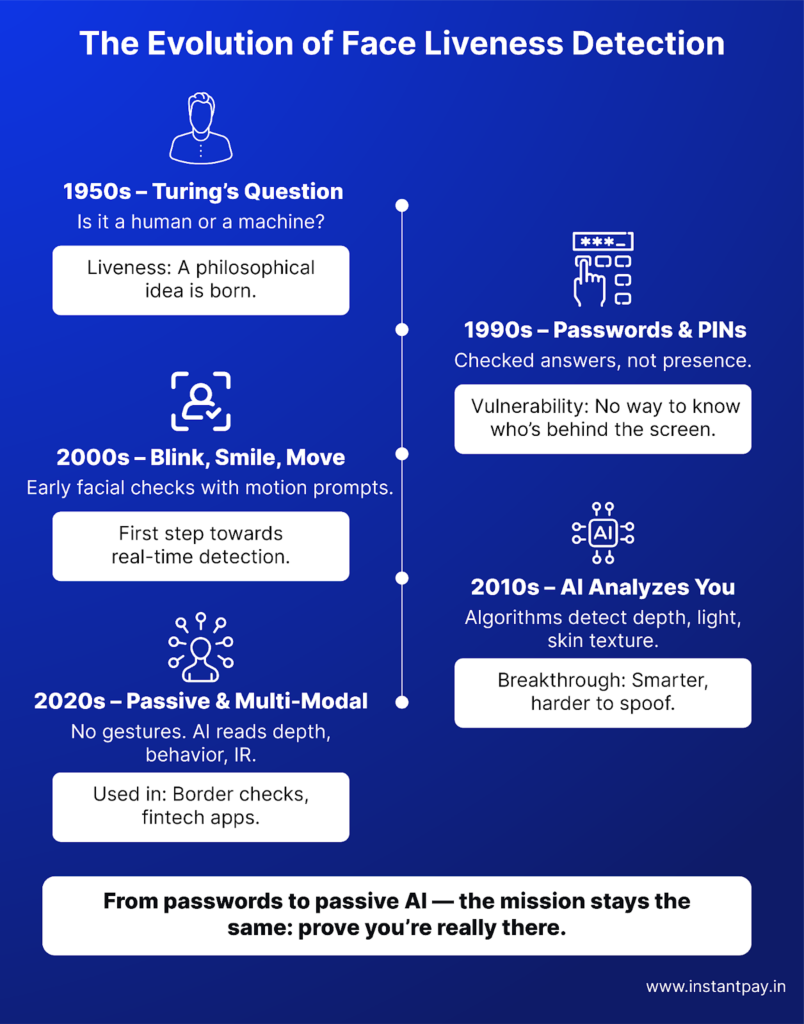
Identification of Face Liveness was not created by accident. This area of technology emerged as digital technologies faced up against the same question: How can an electronic device know you are really a human being?
The initial concepts (the 1950s)
The idea began with the concept first described by Alan Turing in 1950, as part of his Turing Test, to determine whether a digital system could identify a human versus a machine. This laid the foundation for digital “Liveness” tests used today.
Knowledge Tests (the 1990s)
Digital Systems used passwords, PINs, and security questions to authenticate users. They confirmed that the user knew the correct information but couldn’t authenticate them as actually being present.
Face Recognition (2000s)
Face Recognition systems started to ask for additional physical actions to prove live user presence such as blinking, smiling, or tilting your head.
AI and Machine Learning (the 2010s)
AI Algorithms began to analyze the user’s facial characteristics, such as skin texture, light reflection, and depth of facial features to determine whether they were authentic or being spoofed.
In The Present Day (Beyond 2020s)
Current technologies utilize Passive AI techniques, Behaviors, and Multi-sensor types of Analysis to detect Deepfake Videos, spoof the user of a 3D mask, while enabling real-time speedy and seamless Verification.

Types of Face Liveness Detection Methods
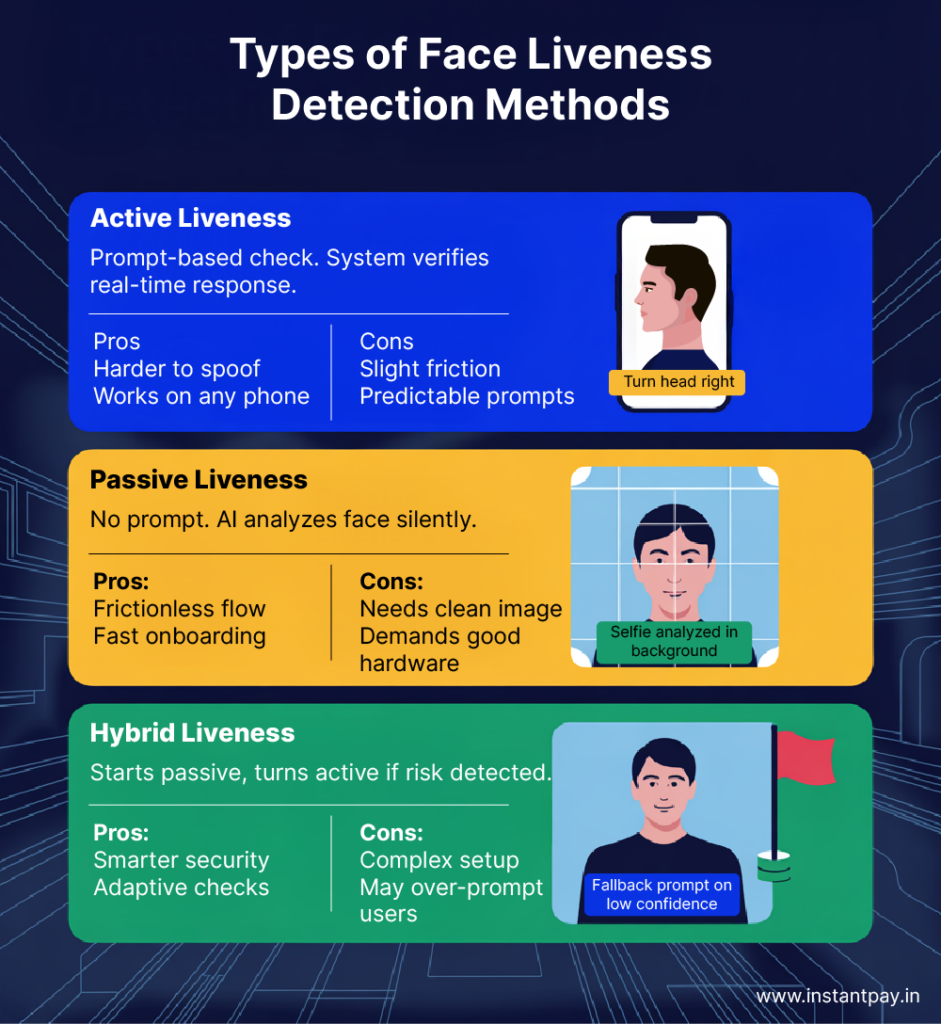
There are three fundamental types of liveness detection methods: Active Liveness Detection, Passive Liveness Detection, and Hybrid liveness detection.
1. Active Liveness Detection
Users perform an action to demonstrate that they are physically present (e.g., smile, blink, turn your head, recite the numbers aloud). While these liveness checks are relatively easy to do with photos/videos, they are significantly more challenging to do and fool the system.
- Uses everyday smartphone cameras.
- Requires users to follow the instruction set and may take marginally longer than passive facial recognition methods.
2. Passive Liveness Detection
The system conducts liveness checks “silently” while evaluating a selfie or video, by detecting the following light sources, texture of skin, depth, and micro-movements.
- Provides a seamless customer experience, with no user action required.
- Widely utilized for digital onboarding, and eKYC, in 2026.
3. Hybrid Liveness Detection
A combination of both active liveness checks and passive liveness checks. The system starts with passive checks. It will notify the user when there are risk signals present, thus requiring them to perform a quick (usually, small) action to validate their physical presence.
- Provides strong security and smooth user experiences.
Did You Know?
The global face liveness detection software market was valued at approximately USD 2.2 billion in 2023 and is projected to reach USD 11.8 billion by 2033, growing at a CAGR of 18.5% from 2026 to 2033.
How Face Liveness Detection Works?
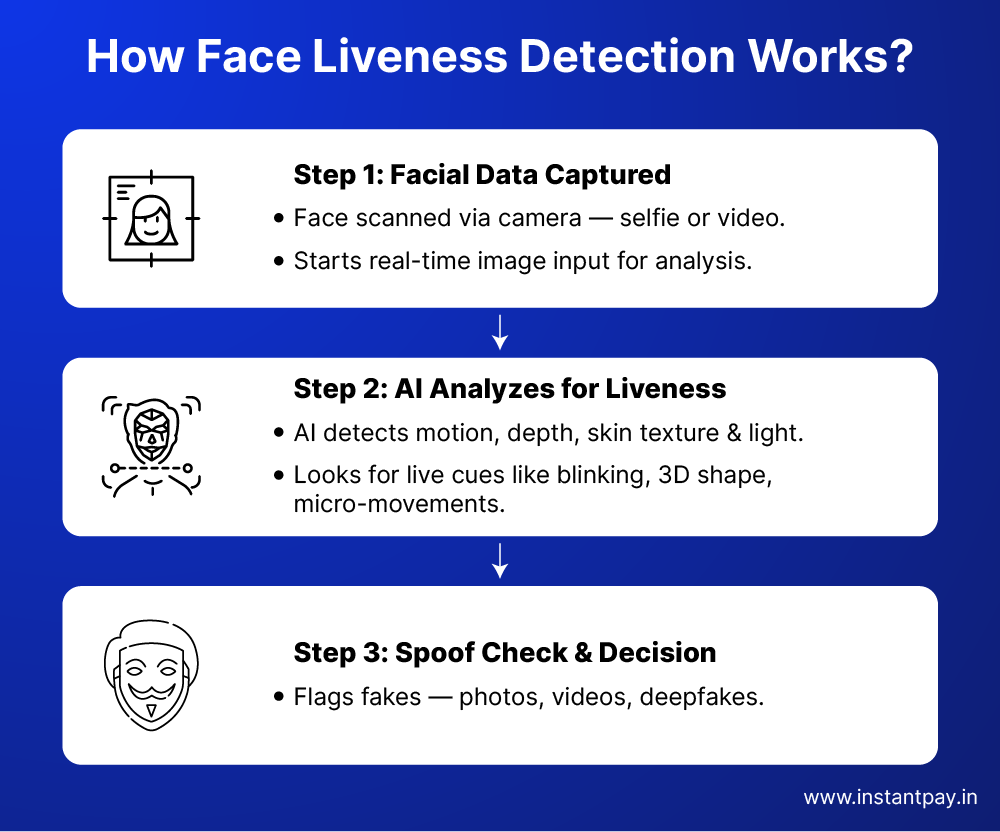
Face Liveness Detection does not only determine if someone’s face corresponds to his/her photograph; it is also an assurance that an actual human being is in front of the camera and not just a printed picture, a recorded video or a deepfake. Nowadays, effective systems employ artificial intelligence (AI), computer vision and live biometric assessment in a matter of seconds for this functionality.
1. AI and Machine Learning Assessment
Typical training of artificial intelligence models are through patterns such as detecting behaviours of real people versus fake people.
For example, computer algorithms will identify natural eye movement, timing of face parts, and behaviours which will be impossible to replicate for a spoofed transaction.
2. Visual Detection Signals and Micro-Details
To assist in differentiating a real human face from a picture, screen or synthetic media, the system uses various visual cues such as:
- Texture of skin and reflection of light
- Shape and depth of face
- Micro-movement and facial expression
- Consistency in shadow/lighting
3. Spoof Detection Verification
The system alerts for suspicious behaviours and indicators, such as flat surfaces, unnatural blinking, and digital artefacts often displayed in deep fake images or video replay.
Once liveness has been proven, the system can securely proceed with facial recognition or digital identity verification to complete any of the login, onboarding or identity verification processes.
Real-World Applications and Use Cases of Face Liveness Detection
Face liveness detection is now extensively implemented in digital security systems outside of the laboratory. As identity fraud, deepfakes, and spoofing attacks continue to rise, companies are now utilizing liveness detection as an additional verification method to ensure that they are dealing with an actual person instead of just a photo of the person.
1. KYC and Onboarding Processes
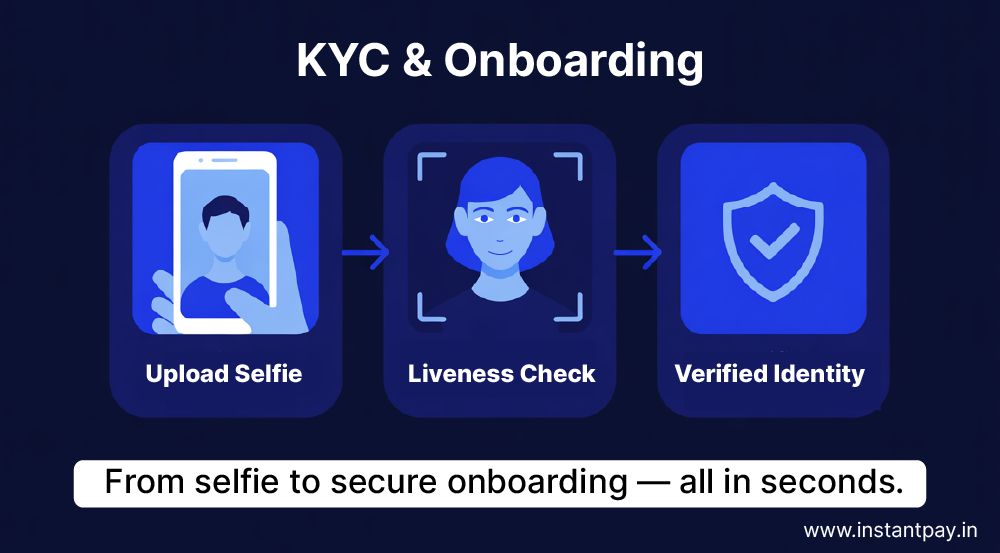
Financial institutions, fintech services, and telecoms use liveness detection as part of their remote identity verification procedures.
Example: An individual creates an account and takes a selfie to complete the verification process. The photo that was taken must be “live” and not re-used from another source (i.e. their social media account or another device).
Benefits:
- Protects against identity-related fraud through the use of stolen photos/documents
- Reduces the amount of manual check processes associated with KYC onboarding
- Provides secure complete end-to-end remote KYC verifications
2. Access Control Systems
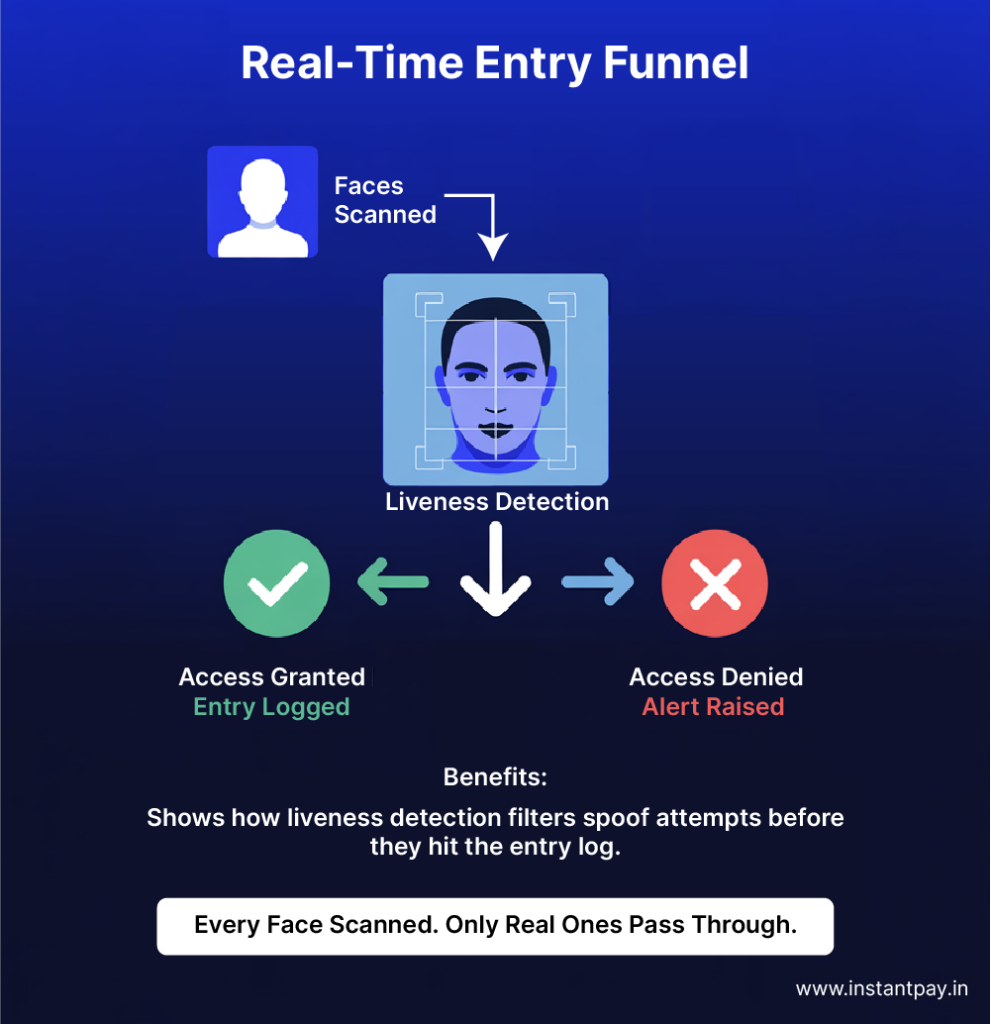
Facial-authentication access control systems are utilized by government agencies, data centers, and corporate office buildings utilizing liveness detection.
Example: For identity authentication and authorization to gain access to the office, a user must present themselves to a smart gate. Upon entering and having their photo scanned, the liveness detection system will verify identity and provide permission to enter the premises.
Benefits:
- Does not permit entry via use of a mask, a photo, or a stolen access badge;
- Provides users the ability to gain access to buildings in a contactless (via camera) and secure manner.
3. Online Platforms and Social Apps
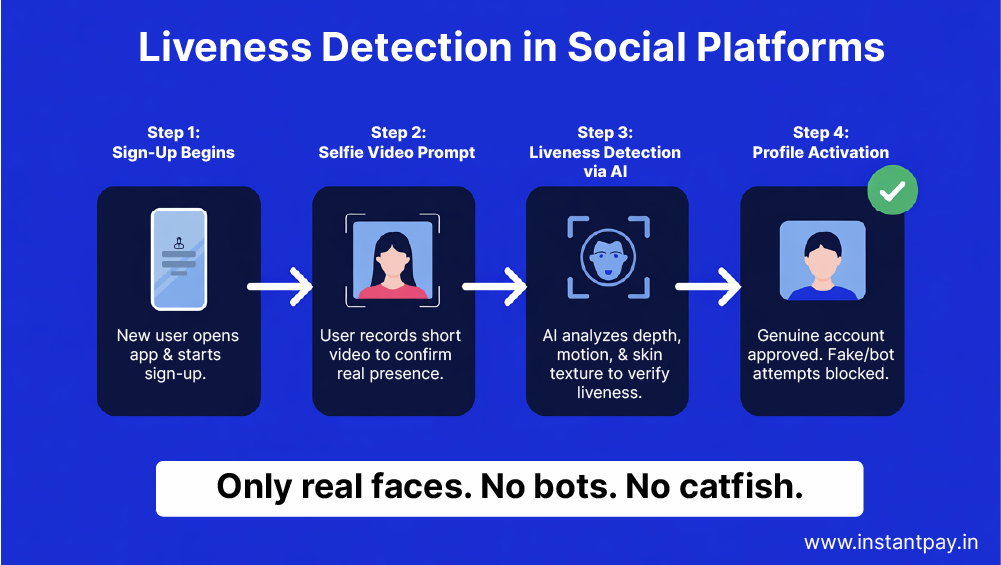
Online social networks, online gaming, and online dating applications conduct a liveness check to confirm that a potential user is real.
Example: An online dating application requires its new members to record themselves in a short video providing minimal movement of their head to establish that they are a real person behind their profile.
Benefits
- Eliminates fake profiles, fake accounts, and impersonation-based scams.
- Creates confidence with users and provides a safer digital community.
4. E-commerce and Digital Payments
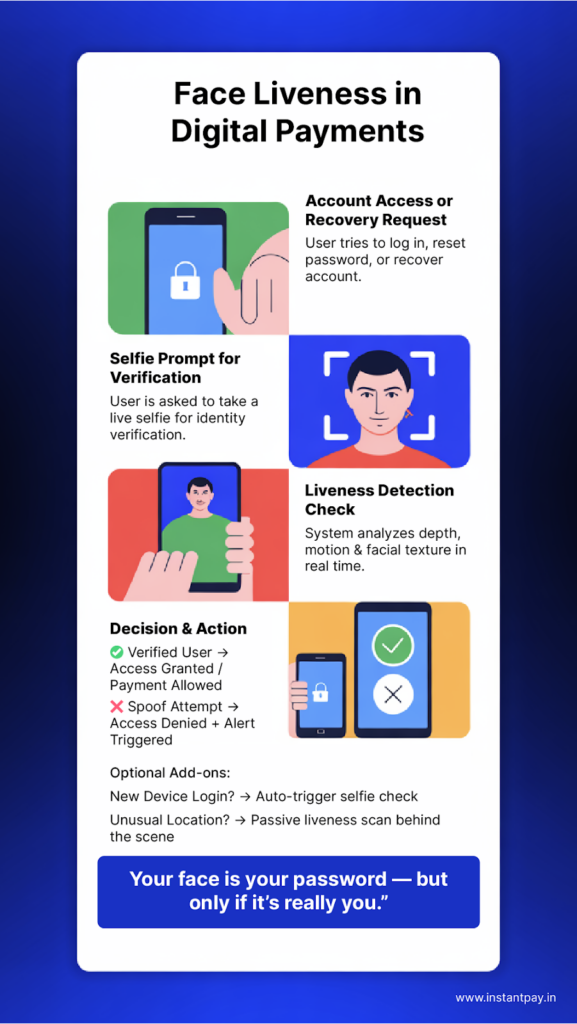
Online payment platforms complete their liveness verification process on sensitive mobile digital payment transactions, including a password reset.
Example: An online payment user seeking to reset their e-wallet password must submit a photo of their face for liveness verification prior to being given a new password.
Benefits
- Helps eliminate fraud associated with stolen identities or credentials and prevents users from using a fake ID.
- Provides a secure method for users to log into their accounts without the need for a password.
- Both of these cases allow organizations to provide real digital user-to-business experiences in the current identity-based economy.
Navigating the Hurdles: Key Challenges in Face Liveness Detection
While liveness detection has made huge advances in providing digital security, there still are challenges facing it. With online identity verification being implemented more than ever before and deep-fake technologies more affordable than ever in 2026, organizations need to overcome an array of technical, operational and ethical challenges to continue providing reliable and trusted systems.
1. Spoofing Attack Evolution
Fraud methods are still developing at the same pace as the security technologies designed to combat them. Today fraudsters use artificial intelligence (AI)-driven deepfake technologies, high-quality video replay of authentic users’ movements and realistic 3D masks, among other methods of mimicking real users. Consequently, organizations have to constantly update their algorithm to detect these new methods of spoofing effectively.
2. Environmental and Device Limitations
Liveness detection must function effectively under many different real-world conditions. Sub-optimal lighting (dark or bright), low-quality cameras, unstable internet connections and cluttered environments can all interfere with the accuracy of system facial signal readings. Thus, it is possible for a system to fail to verify even when the user is genuine.
3. Data Protection/Privacy Concerns
Facial data is sensitive biometric data and organizations must comply with privacy regulations such as the General Data Protection Regulation (GDPR) and India’s Digital Personal Data Protection Act (DPDPA). All biometric data must be collected with proper consent, encrypted and secured according to strict guidelines. Any usage or breach of biometric data can seriously undermine an organization’s credibility and could lead to penalties from regulatory bodies.
4. Accessibility and Inclusion Problems
All users do not interact with technology in the same way so some procedures that require users to demonstrate their facially mobile limitations will not work for those who have facial scars or any other disability and cannot perform the needed checks. Therefore, it is critical that all systems are designed carefully so that they are not influenced by skin color, the type of devices being used or the quality of the cameras being used.
5. Infrastructure and Cost Issues
Most complex liveness detection depends on an AI model and real-time calculations and processing with large amounts of computing resources to operate. For large organizations processing millions of verifications every day, building and maintaining these infrastructures can be costly. Therefore, striking a balance between high security and low-cost deployment will continue to be one of the biggest issues.
6. User Experience Friction
Security must not be too frustrating for legitimate users. If it takes too long to verify or if users are repeatedly denied verification due to difficult prompts, the users will be discouraged from completing the verification. Modern systems are attempting to create less friction by using passive methods of verifying users’ identities that are quick and require minimal effort from the user.
How Instantpay Enhances Face Liveness Detection?
Instantpay has developed an API that performs Face Liveness Detection. As the user verifies their identity, real-time analysis of facial features verifies that the user is physically present, and differs from a fraudulent user.
Key Features for Face Liveness Detection API include:
1.) Liveness verification through real-time analysis of facial movements, which protects against identity verification with static images or depersonalized video.
2.) A user-friendly solution that allows seamless integration into existing systems, which improves the user experience while maintaining a high level of security.
3.) Comprehensive reporting – Detailed view of the session’s results, including a confidence score and audit images, in order to support a thorough identity verification.
By leveraging the Face Liveness Detection API provided by Instantpay, businesses can strengthen their identity verification processes and perform user authentication safely and efficiently.
The Future of Face Liveness Detection
The digital service industry is growing rapidly through the use of banks, stores, and social services. Identity verification will be critical as these services expand in number and complexity. Better identity verification means that facial liveness detection technologies will need to be smarter, faster, and almost transparent to end-users.
1. Advanced Protection from Deepfake Detection
The continuous improvement of AI-driven synthetic video technology will drive the evolution of deepfake detection systems. To combat the growing realism of deepface images, detection systems will also begin to analyze micro-expressions, depth-of-field signals, and behaviour patterns. Each of these signals will provide additional points of comparison that are much more difficult for genuine attackers to recreate with video or synthetic images.
2. On-Device Artificial Intelligence for Improved User Privacy
As more devices become connected, future identification systems will use on-device processing to conduct liveness tests, rather than sending liveness results to remote data centres for analysis. This improved method of conducting liveness tests will provide faster identity verification and help organizations comply with privacy regulations around the world.
3. Multi-Layered Biometric Technologies
Diamond layering face, voice, and gesture recognition networks will improve the quality of identity verification and reduce the number of false positives produced by authentication systems.
4. Worldwide Regulatory Compliance and Best Practices
The global regulatory landscape continues to grow and adapt through security standards such as ISO/IEC 30107 and recent legislation in India, such as the Data Protection and Digital Privacy Act, and the European Union’s proposed eIDAS 2.0 law.
5. User Experience Improvements with Little to No Friction
Future identification systems will place more emphasis on passive liveness testing, which will enable users to be verified without having to actively participate in a verification session by engaging in eye-blinking or smiling to the camera, as required by some current systems.
Final Thoughts
The digital services continue to grow, and therefore remote identity verification has become one of the biggest challenges for companies, platforms, and organizations all over the world. Recognising someone’s identity with just facial recognition will no longer be sufficient as systems need to be able to check that: the person in front of the camera is a real person and not an impersonation, they are actually there in real-time and that there is sufficient evidence that the individual’s identity cannot be spoofed (known as liveness detection).
Liveness detection is becoming a key element of the identity security landscape for banks and financial technology organisations for their call centre, remote onboarding, access control solutions and social media sites and digital payment solutions. By combining liveness detection with AI, use of biometric analysis and real-time verification, organisations can detect and mitigate instances of fraud occurring and allow for a better user experience.
The innovation of this technology will continue to grow, and future systems will focus on detecting deepfakes, improved user privacy and seamless user verification; these will change the face of identity verification.
FAQs
1. What is facial liveness?
Facial liveness means using technology to verify that the face being presented for verification is that of a real live individual and not just a photo or video or a mask.
2. What is the face liveness detection algorithm?
The face liveness detection algorithm uses AI (artificial intelligence) and computer vision to analyse various aspects of the face through comparison of facial features, movements, textures and depth in order to identify any possible spoofing attempts and ensure that the subject being presented to them as the verification process is a live human being.
3. What is the difference between liveness and face recognition?
Liveness detection confirms that the face presented for verification is both real and live – i.e., it’s not just a fake representation or photo while face recognition is a process by which people can have their identities identified or verified following their face features alone.
4. What is liveness mode in face unlock?
Liveness mode is an added security measure during face unlock that ensures that the subject being presented (the face used to unlock the device) is alive by looking for signs of life (such as blinking, moving the face etc.) and not just a still photograph/video.
5. What are the 2 main types of facial recognition?
The two major types of facial recognition systems are:
- 1:1 verification facial recognition system – The matching of an identification to one specific face such as unlocking a device with a face.
- 1:N identification facial recognition system – Searching for one specific identification against multiple identifications, such as those who are in their database, or one or more than one identification in a surveillance system.
6. What is the concept of liveness?
Liveness defines the ability to know whether the biometric sample is a live person or false sample created to fool the system.
7. What is a liveness image?
Liveness Images are facial images that we capture as you verify your identity, a liveness image will be analyzed to check your facial expressions, texture, depth, & other characteristics.
8. What is liveness detection for KYC?
Liveness detection will help to verify that an individual is physically present as they complete his/her identity verification for KYC. Liveness detection will help to reduce the risk of identity fraud.