A customer clicks the “Buy Now” button, but may not complete their purchase. The payment page seems strange to them, choices are limited, and/or the purchase is viewed as unsafe. As a result, the customer abandons the purchase before completing any of the steps necessary for finalizing the sale. This is where a business can lose revenue due to an unappealing payment processing system (i.e. weak or absent payment gateway).
This is being witnessed at great levels, too. India recorded a total of Rs.265 trillion in digital payments for FY24, and UPI alone accounted for 131 billion transactions within that total volume. Additionally, UPI is projected to be responsible for over 21.7 billion monthly transactions in January 2026, while cart abandonment rates globally are estimated to exceed 70%, with friction in the checkout process and/or security issues leading to abandoned carts primarily attributed to these factors. It is therefore important that any organisation conducting business over the Internet has a firm understanding of what a payment gateway is, how a payment gateway operates, and why payment gateways are important.
What is a Payment Gateway?
A payment gateway is a safe way for businesses to accept payments from customers on the internet. It connects the buyer and seller and their banks so that the payment can be processed, confirmed, and completed in real time all over the world.
Think of a payment gateway as a digital checkout clerk. When you type in your credit or debit card number, your UPI ID, or your net banking account information, the gateway checks to see if the payment will go through and will let you know whether or not the payment has gone through.
What a Payment Gateway Really Does?
When you pay online (via a website or app, or by scanning a QR code), the money does not go directly to the merchant. Instead, your money passes through a process as follows:
- Your banking details are secured,
- Your banking details are sent to your bank
- Your bank approves the payment
- the payment sends a confirmation back to the payment gateway
- The payment completes.
- Your payment gateway completes this entire payment process.
Importance of a Payment Gateway to the Business Community
Investing in a Payment Gateway will benefit your company through an improved level of customer confidence, higher conversion rates, and increased success of executed payments as well as an overall improved user experience.
A slow payment process may cause customers to abandon their transaction if there is any doubt regarding the security or clarity of the process; however, an efficient and secure Payment Gateway will improve customer conversion rates and enhance customer loyalty.
In summary, a Payment Gateway provides a secure electronic system for processing online transactions by encrypting customer data, forwarding it to a banking institution, and immediately validating the requested transaction.
How Does a Payment Gateway Work?
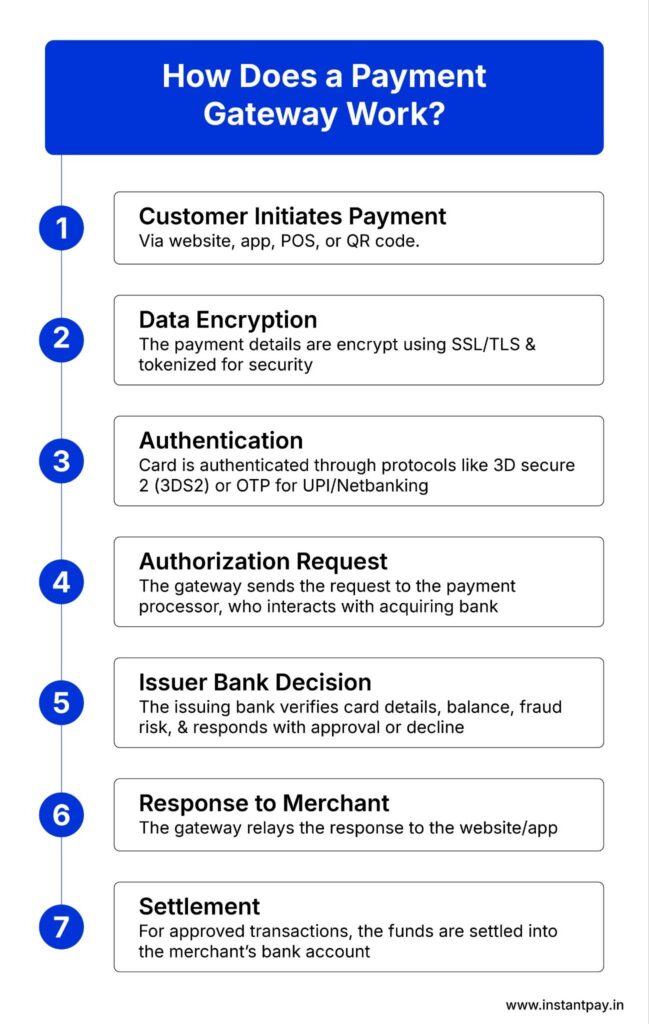
The process of an online payment may give the appearance of being completed in seconds; however, there are numerous steps involving multiple parties to ensure that the transaction is completed securely and in real-time.
1. Customer Makes a Payment
The first step in the process is the customer selecting a product or service and checking out (by entering their card information, UPI ID, bank account details, or digital wallet).
2. Payment Information is Secured
Before the payment information is sent from the customer’s device to the payment gateway, the payment gateway encrypts it. This protects against sensitive information such as card numbers and UPI credentials being used by unauthorized individuals.
3. Authenticate Customer
The next step is for the payment gateway to verify that the person making the payment is the actual customer. This is usually accomplished through any combination of the following steps:
– OTP verification
– Biometric authentication
– Back-end risk checks at banking institutions
4. Payment Request Sent to the Bank
Once the payment gateway verifies that the customer is authentic, it forwards the transaction request to the payment processor. The payment processor sends the payment to the customer’s bank (the issuing bank).
5. Bank Authenticates Payment Request
The bank checks (1) whether the payment request is valid; (2) whether the customer’s account has enough funds to cover the payment; and (3) whether the payment request appears to be fraudulent. If the bank finds that the payment request is valid, has sufficient funds, and is not fraudulent, it approves the payment. Otherwise, the bank declines the payment.
6. Response Returned
Once the bank approves or declines the payment, the result of the decision is sent back through the entire sequence of steps outlined above to the customer.
Key Components and Ecosystem Players
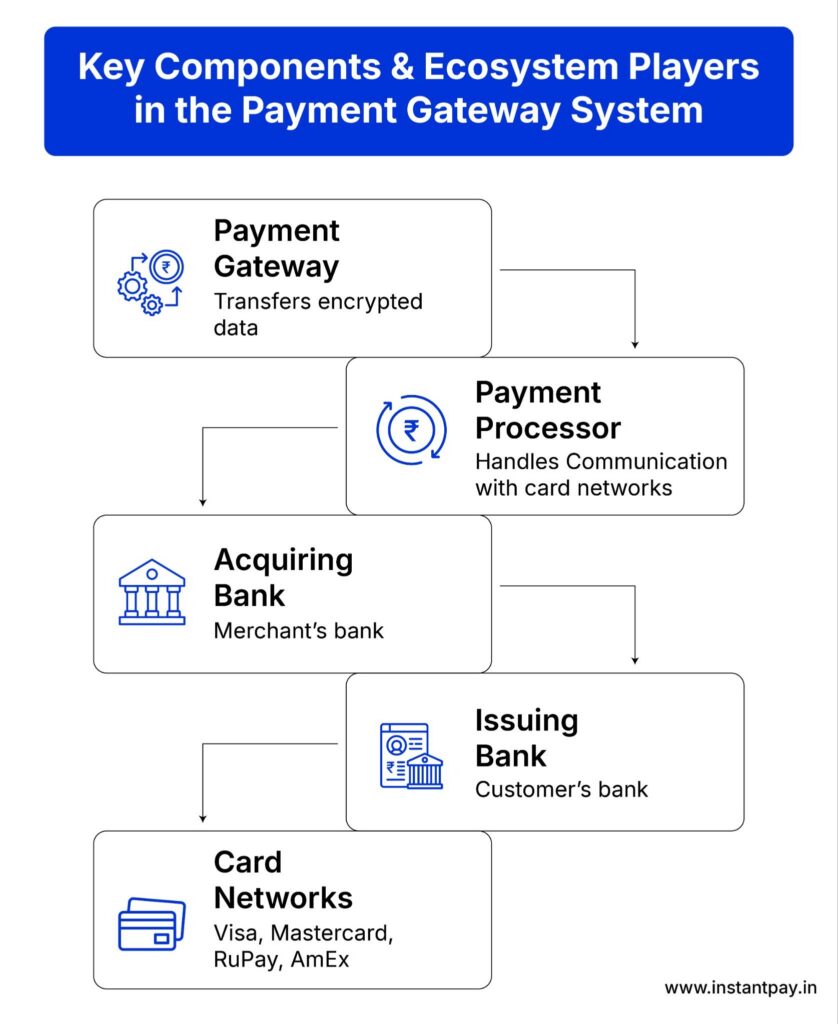
Payment processing may seem straightforward when we see a payment performed in seconds. However, there are many different systems, partners, and processes that work together to facilitate this payment.
1. Payment Gateway- The Connector
The first party in the payment ecosystem is payment gateways. They take the customer’s payment information and collect the information about the purchase. They also secure the information and give it to the next party in the payment process.
The payment gateway acts as the main entry point for both the website or app and the corresponding financial system. All communications and activities have to pass through the payment gateway in order for the payment to go through.
2. Payment Processor: The Communicator
Payment processors are the backend component of the payment gateway that facilitates the transaction. They take the request for the transaction from the payment gateway and route it accordingly to the applicable card association (Visa, Mastercard, etc.) and then to the customer’s bank (issuing bank).
When the transaction is approved, the payment processor takes the same transaction request and sends it back to the payment gateway in order to complete the payment process.
3. Issuer Banks: The Customer’s Bank
Issuing banks are the banks that give out cards to customers. Each time the customer purchases something using their card or UPI app, the transaction is processed by their issuing bank.
Issuing banks approve or decline the purchase through a series of steps as outlined below:
- Card validity
- Account balance
- Security risk
4. Acquirer Banks: The Merchant Bank
Acquiring banks are the banks that receive funds from the issuing bank on behalf of the merchant. When a purchase is approved, the funds are sent directly to the acquiring bank.
5. Card Network: The Payment Rails
Visa, Mastercard and RuPay are examples of card networks that serve as the infrastructure between banks and facilitate communications between the issuer’s bank and the receiving or acquiring bank, and cards, via regulations governing card transactions.
6. The Merchant and Customer: Two Ends
- Customer: is the party that initiates the payment
- Merchant: is the party that receives the payment
Every one of the other players’ reasons for existing is to establish a safe connection between customers and merchants.
In A Nutshell
A payment gateway ecosystem is a collection of various systems that make interconnections by connecting a customer (and their respective banks) with the bank’s processor to facilitate the routing of the request from customer to bank and for the bank(s) to approve and complete the payment.
Why This Is Important
When any one of these component players fails and/or fails to perform; the result can either be the transaction will not occur, the payment will be late or lost and/or there will be diminishing levels of customer confidence.
This is why payment gateways must function perfectly in conjunction with all of these components to achieve success as a reliable payment gateway.
Types of Payment Gateways
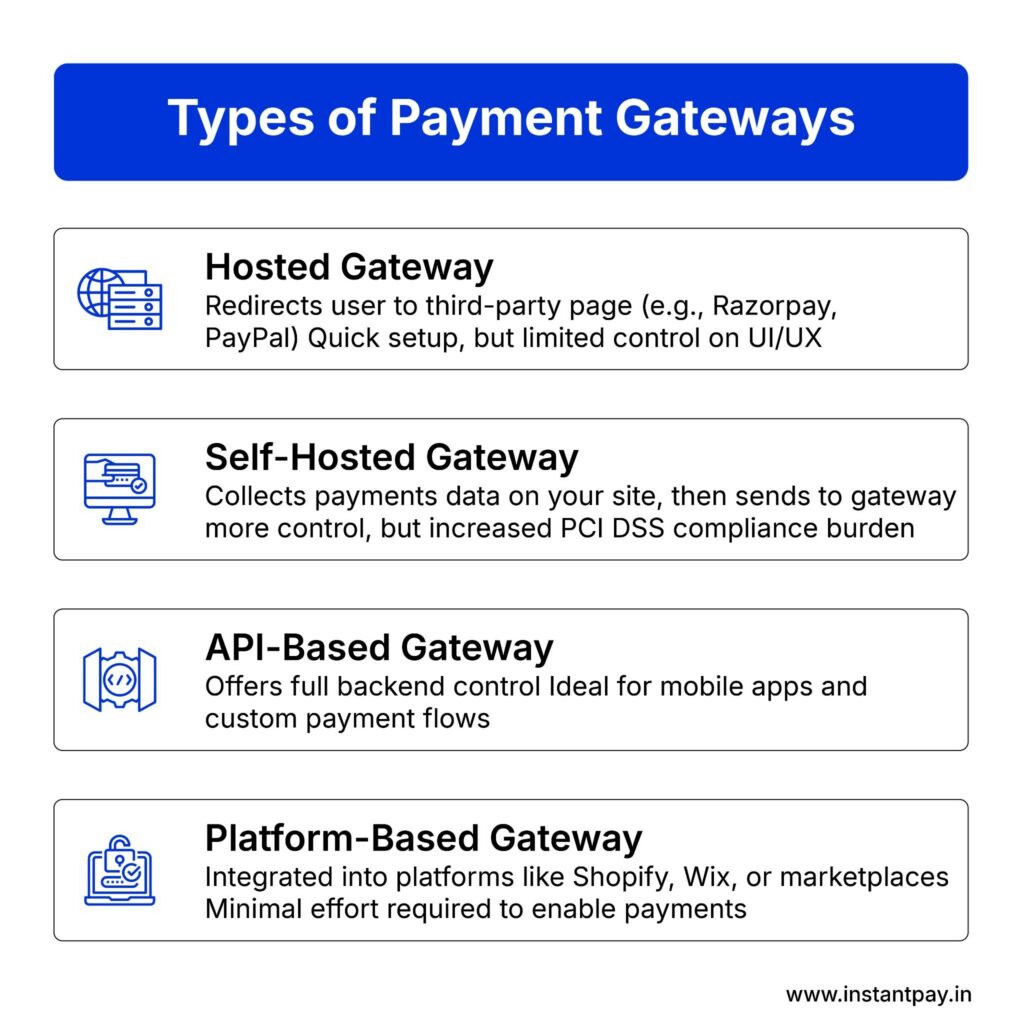
The way a payment gateway operates will depend on the type of payment gateway you choose, your business model and your users’ experience when using it. You will have a choice of four main types of payment gateways to integrate into your business.
1. Hosted Payment Gateway
How it Works:
Once a customer clicks the button to “Pay Now”, they will be taken to a third-party site, like PayPal or PayU, where they will process their payment; after completing the payment, they will be returned back to your website.
Best For:
Small or start-up businesses, quick launches
Pros of Hosted Payment Gateways:
- Quickest and easiest to set up
- No security or compliance responsibilities
- Inherently secured with fraud protection
Cons of Hosted Payment Gateways:
- Some customers may feel less secure since they are redirected to a 3rd party
- Less control of the checkout process
2. Self-Hosted Payment Gateway
How it Works:
Customers enter their payment information on your web site and it securely passes on to the gateway for processing.
Best For:
Growing businesses where there is a greater need for control over user experience
Pros of Self-Hosted Payment Gateways:
- Greater control of the checkout process
- More consistency of your brand with all transactions
- Easier for the customer’s user experience; seamless from the payment screen (your site) to final transaction confirmation screen
Cons of Self-Hosted Payment Gateways:
- Greater responsibility for security
- Must comply with Payment Card Industry Data Security Standards {PCI DSS}
3. Using an API-Based Payment Gateway
How it Works:
Typically, companies will use an API-based payment gateway to allow their business website or app to fully have control over the payment experience and (backend) logic.
Best For:
Fintech, SaaS, marketplace, and large-scale applications.
The Pros:
- Total customization and flexibility
- Enables advanced functionality (ex: subscriptions, split payments and smart routing)
- Suitable for fast-growing businesses
The Cons:
- Requires a well-experienced technical person to create and maintain.
- More complicated integration and maintenance
4. Using a Platform-Based Payment Gateway
The Process:
The different platforms like Shopify, Wix, etc. have pre-integrated gateways that allow the customer to enable payments quickly and easily, with minimal or no setup.
Best For:
D2C companies, creators, and individuals who are using website builders.
The Pros:
- No-code or minimal-code implementation
- Speed to market
- The platform handles security
The Cons:
- Only limited customization opportunities
- Platforms typically charge additional fees
To Put It Simply
Different payment gateways give you differing degrees of control. Hosted payment gateways are generally the simplest to implement, and API-based payment gateways offer the most flexibility for a business that is looking for more advanced payment options (and scalability).
The Importance of Payment Gateways (Their Primary Functions and Advantages)
Good payment gateways do more than enable payment processing; they can also impact customer confidence and trust in your online business, conversion and retention rates, and overall efficiency in operations.
Here are some important features that can greatly benefit both customers and merchants.
1. Security of Payments
Payment gateways offer the secure processing of payments through the use of various types of encryption, tokenization, and authenticating technologies. These security layers will ensure that customer information, including credit card numbers are not compromised at any time during their entire transactional processes.
2. Efficient and Seamless Checkout
A well-designed gateway promotes efficient payment processing through the use of as few steps as possible. As a result, consumers should experience a quick, friction-free, and seamless checkout process, particularly on mobile devices.
3. Increasing Your Opportunity for Transaction Success
Modern payment gateways allow for customers to choose from many different types of payment options, e.g. card, UPI, net banking/wallets, international purchases, etc. The availability of multiple types of payment methods are used by consumers to complete their transactions.
4. Effective Management of Failed Transactions
By using advanced payment gateways, your business will have access to robust and smart features, e.g., retry logic and intelligent routing, to assist with managing transactions that have failed. If a specific payment route fails, the payment system will automatically attempt to complete the transaction through some other payment routing method.
5. Subscriptions and Recurring Payments
With regard to automated billing for subscriptions, EMI’s (Installments), and memberships, a payment gateway not only retains payment credentials (via tokenization) but also allows the merchant to create dates when customers will be charged for the subscribed service.
Thus, predictable income is received and the merchant has less manual effort to collect debts.
6. Monitor Real Time and Dashboard
A majority of the payment gateways have built-in dashboards providing merchants with information about their daily transactions and trends of success, refunds, and failures for each payment type accepted at the business. Using this information, merchants can monitor the operation and address issues as they are identified.
This results in better decision making for merchants, allowing them to improve payment performance over time.
7. Integration and Scalability Support
With APIs, SDKs, and flexible infrastructure, payment gateways can support their merchants’ growing transaction volumes and increasing complexities by accommodating the development of future digital contracts.
Thus, businesses can continue to grow without the need to change their existing payment infrastructure.
Critical Security Standards for Payment Gateway
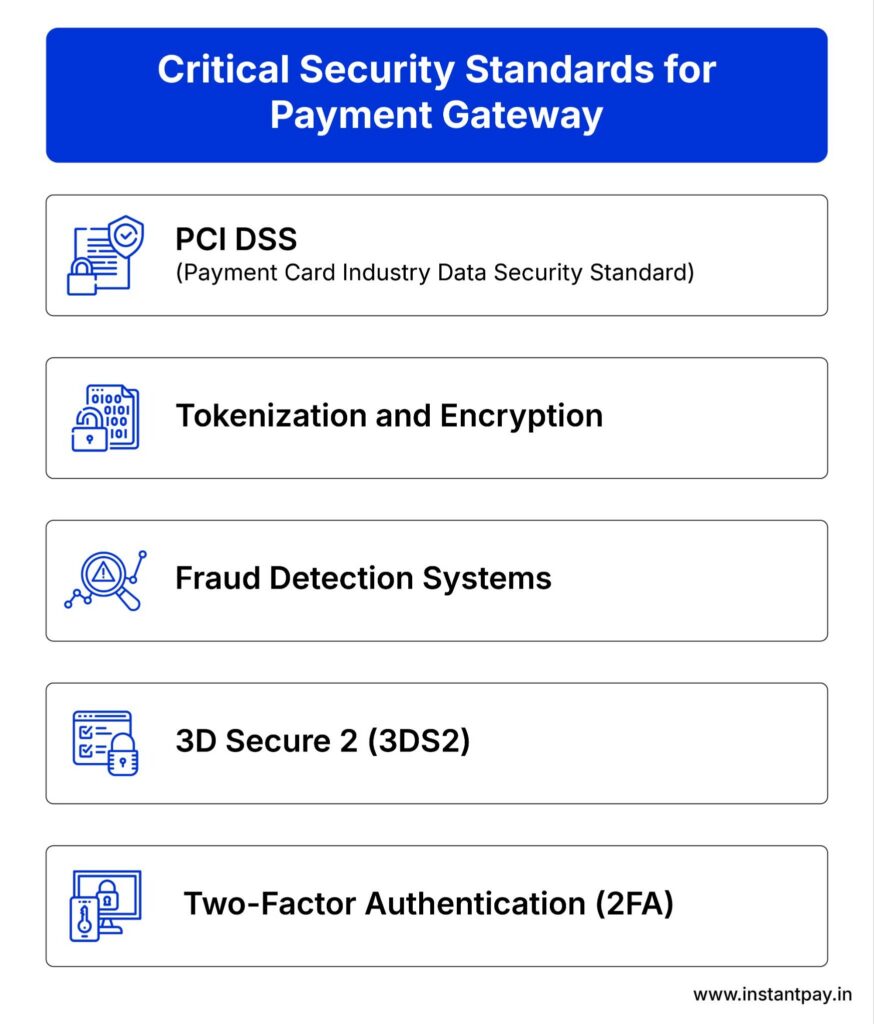
payment gateway is able to meet this expectation by implementing consistently stringent security measures and protocols.
Below are the three basic security measures every payment gateway should have:
1. PCI Compliance
Any company that accepts card payments must adhere to the Payment Card Industry Data Security Standard (PCI DSS Standards) to ensure that cardholder data is kept secure and meets global regulatory standards.
This will provide consumers with the security of knowing that sensitive data such as:
• Card numbers
• Card security codes (CVV)
Are protected when stored & transmitted by the payment gateway.
2. Encryption & Tokenization
Encryption translates payment information into code while it is being transferred, making it very difficult to read, intercept and/or steal. Tokenization replaces sensitive data with a unique identifier (token) that is meaningless in any other part of the network except for the payment gateway.
Together these methods enable the prevention of unauthorized access to consumer data through theft of payment information.
3. 3D Secure (3DS2)
3D Secure also adds an additional layer of authentication for card payments as a result of requiring some type of one-time password (OTP) or smartphone-based authentication to complete the payment. Newer implementations of 3D Secure (3D secure authentication 2.0) enable fast and easy authentication of the card holder while maintaining a user-friendly check out process.
As a result of implementing additional authentication for the cardholder, there are reduced incidences of fraud, as well as having created a more seamless check out process for the cardholder.
4. Social Security
2FA necessitates that users establish their identification using two different methods – a password and then either an OTP or a fingerprint scan, for example. In India, this is necessary for the majority of online financial transactions.
By utilising this extra verification layer, it provides an added security measure against fraud and any other unauthorised system access.
5. Fraud Detection Systems
To assist in detecting fraudulent transactions in real-time; the Most online payment gateway uses systems that monitor your payment transactions as per its rules.
The major forms of analysis they perform include reviewing transaction patterns including non-standard geographic locations, recent transactions and the fact that the payment method has been made using a device that appears to be unauthorized.
RBI Security Mandates for Indian Payment Gateways
In India, the Reserve Bank of India (RBI) has some of the toughest security rules for payment intermediaries:
Key Requirements:
- Gateways must be approved payment aggregators (PAs) according to RBI guidelines from the March 2020 circular.
- Must implement multi-level KYC, fraud detection systems, and real-time risk monitoring.
- Must store card data only in tokenized form (as per October 2022 RBI circular).
- Must provide grievance redressal and refund systems under regulatory service-level agreements (SLAs).
- RBI’s 2022 tokenization mandate removed more than 50 crore stored card records. This change boosted gateway security throughout the ecosystem.
Why Does This Matter for Businesses?
Failure to comply with these security standards can result in:
- Failed transactions (due to issuer rejections)
- Data breaches and brand damage
- Legal penalties or blacklisting
Businesses should partner with a PCI DSS-compliant, tokenization-enabled, RBI-authorized payment gateway to ensure security, trust, and compliance.
Use Cases by Industry: How Different Sectors Use Payment Gateways
A payment gateway isn’t just a tool for online transactions—it’s a business enabler tailored to specific industry workflows. Below is an in-depth explanation of how gateways add value across major sectors:
1. E-commerce
a) Cart Abandonment Recovery via One-Click Payments
- Many shoppers abandon their carts at checkout due to friction (long forms, redirects, slow pages).
- Payment gateways offering one-click payments through tokenized cards or saved UPI IDs dramatically reduce friction and increase conversion rates.
b) EMI-Based Checkouts
- Gateways partner with banks to enable instant EMI options at checkout for high-ticket purchases like electronics or appliances.
- Boosts AOV (Average Order Value) and makes products accessible to mid-income buyers.
2. SaaS (Software-as-a-Service)
a) Recurring Billing with Automated Invoicing
- Payment gateways integrated with subscription billing modules automate monthly/quarterly charges.
- Helps businesses focus on growth while the gateway handles retries, invoicing, and dunning.
b) Freemium to Paid Upgrades
- SaaS platforms often offer free trials or limited access models.
- Gateways support plan-based triggers and allow instant upgrade to paid plans via saved cards or wallets.
3. Lending
a) Instant Loan Disbursements
- Gateways allow NBFCs and lending platforms to instantly credit approved loan amounts to borrower bank accounts or wallets via IMPS, UPI, or AEPS.
b) Auto-Debit Mandates (eNACH, UPI AutoPay)
- Lending platforms use e-mandate setups to collect EMIs automatically on the due date.
- Reduces defaults and improves cash flow.
4. Education / EdTech
a) Fee Collection through Payment Links & QR Codes
- Educational institutions and coaching centers use gateways to send payment links or display QR codes for collecting tuition, exam fees, or hostel charges.
b) EMI Options for Course Payments
- Higher education and premium skill platforms (like coding bootcamps) integrate no-cost EMI or BNPL (Buy Now, Pay Later) options via fintech lenders.
5. Logistics & Hyperlocal Delivery
a) Cashless Delivery via QR or Payment Link
- Delivery agents can carry QR codes or send payment links via SMS/WhatsApp to collect payments digitally at the doorstep—eliminating cash handling.
b) COD (Cash-on-Delivery) Reconciliation
- Gateways help with automated reconciliation of COD transactions, settlements to delivery partners, and fraud tracking.
Developer-Friendliness: The Modern Gateway Mandate
In the earlier days of digital payments, businesses relied on basic hosted forms and redirects. But in today’s API-first world, businesses want more than just the ability to process transactions—they want to build, customize, automate, and scale payments as an integral part of their product or platform.
This has led to a massive shift in how payment gateways are evaluated: developer-friendliness is no longer a bonus—it’s a business-critical requirement.
Let’s break down what that really means.
1. RESTful APIs (Application Programming Interfaces)
Why it matters: Modern businesses, especially SaaS, fintech, e-commerce, and D2C platforms, rely on custom backend systems. RESTful APIs enable direct, programmable control over payments—everything from initiating a charge to issuing a refund or checking transaction status.
Use Cases:
- Automatically collect subscription payments
- Trigger a refund when a user cancels a service
- Verify payment success before issuing a digital license
2. Mobile SDKs (Software Development Kits)
Why it matters: With over 85% of digital transactions in India happening on mobile devices (as per NPCI and RBI reports), having a smooth in-app checkout experience is crucial. SDKs make it easier for mobile developers to integrate payments into iOS and Android apps.
Features Typically Included:
- Drop-in UPI, card, and wallet checkout screens
- Biometric-based 2FA
- Tokenization for one-click repeat payments
3. Webhooks for Real-Time Alerts
Why it matters: Webhooks are HTTP callbacks that alert your backend whenever a payment-related event happens. This allows for real-time, event-driven workflows.
Use Cases:
- Instantly activate the user account after payment confirmation
- Send failed payment notifications to support teams
- Retry failed auto-debits via backup payment method
4. Dashboard Analytics
Why it matters: Beyond payment collection, developers and ops teams need visibility into transactions, failure rates, refunds, chargebacks, and success funnels.
Key Features:
- Filters by payment type, source, geography, and gateway status codes
- Visualized failure trends and funnel analysis
- Instant access to transaction logs and payout reports
5. Uptime SLAs and Sandbox Environments
Uptime SLA (Service Level Agreement): Gateways used in production must guarantee 99.9%+ availability with fallback infrastructure. Downtime during peak sales hours (like during flash sales or fintech settlements) can cause massive losses.
Sandbox Environment: A sandbox is a test environment with mock data, allowing developers to test every payment scenario without touching real money.
Importance:
- Speeds up QA and deployment cycles
- Ensures integration stability before go-live
- Enables edge-case simulation, like timeouts or OTP failures
Compliance in India: What You Must Know
The Indian digital payments ecosystem is expanding quickly. UPI handles over 12 billion transactions each month. By 2026, online payments could hit Rs.25,000 lakh crore. However, with this growth comes the need for strong regulatory oversight, especially for sensitive financial data.
The Reserve Bank of India (RBI) has set strict and changing compliance rules for all payment gateways (PGs) and payment aggregators (PAs) in the country.
Here’s what businesses need to know when selecting or integrating a payment gateway in India:
1. Must be licensed payment aggregators (PA) or payment gateways (PG)
Definition:
- Payment Aggregators (PAs) help e-commerce transactions by receiving payments from customers and sending them to merchants.
- Payment Gateways (PGs) offer the technical setup for processing payments but don’t hold funds.
RBI Mandate:
- RBI’s March 2020 circular says all payment aggregation services need RBI’s authorization and license.
- Unlicensed PAs cannot onboard new merchants or process funds.
Business Implication:
- Always pick a licensed gateway or aggregator. This helps keep your funds safe and within regulations.
- Licensed PAs include Razorpay, Cashfree, PayU, CCAvenue, and PhonePe (merchant side).
You can find the list of RBI-approved PAs on RBI’s official website.
2. Need to maintain nodal accounts for settlements
Definition: A nodal account is a non-interest-bearing account held by the payment aggregator with a bank. It temporarily holds customer payments before transferring them to the merchant’s account.
RBI Mandate:
- Settlement timelines (e.g., T+1 or T+2 days) are closely monitored.
- Funds in the nodal account can only be used for merchant settlements.
Why This Matters:
- This ensures that customer money is not misused or delayed.
- It adds transparency and auditability to fund flows.
- If a PA breaks nodal account rules, it might get its license suspended or face fines.
3. Must support tokenisation for card data
Definition: Tokenisation replaces actual card numbers with randomly generated tokens that can be stored safely for repeat payments.
RBI Mandate (Effective October 2022):
- Merchants and gateways cannot store card details unless they are tokenized.
- Card networks (Visa, Mastercard, RuPay) must provide token generation and management.
- Tokenized data must be specific to the merchant device and require consent for access.
Business Impact:
- This improves data privacy and security.
- It lessens the PCI DSS compliance burden for merchants.
- Not implementing tokenisation can cause transaction failures and customer loss.
Due to this mandate, over 500 million stored card records were deleted or tokenized by Indian platforms in 2022–23.
4. Require strong fraud detection and grievance redressal systems
Fraud Monitoring Requirements:
- Gateways must use real-time fraud detection with:
- Risk scoring models
- Blacklists/whitelists
- IP/device tracking
- Transaction velocity monitoring
Customer Grievance Redressal:
- An online system for raising disputes must be in place.
- Issues should be resolved within 5–7 working days.
- Reporting of disputes and refunds is required.
RBI’s Expectations:
- Gateways must display customer support and dispute channels on their websites.
- Repeated service failures or many unresolved complaints can result in penalties or license reviews.
The RBI Ombudsman Annual Report showed over 80,000 grievances in FY23, mostly about delays and failed transactions, highlighting the need for effective redressal.
How to Choose the Right Payment Gateway?
Finding the ideal payment gateway is not simply a selection of convenience; it impacts customer satisfaction, rates of successful payment transactions, and overall growth.
The following will discuss the most important factors to consider:
1. Understand Your Business Model
Determine how your business operates. (E-commerce, SaaS, Subscription models, Marketplace)
Different models require different types of functionality (i.e., one-time payments, recurring billing, Split Settlement)
2. Payment Options Must be Available to Customer
Make certain the payment method(s) that the gateway supports are the payment methods that your customers use.
The more payment methods available to customers at checkout, the less likely they are to drop out of the checkout process.
3. Security Standards and Compliance Must Exist
Choose a payment gateway provider that has strict standards for security (i.e., PCI DSS, Tokenization, RBI Guidelines).
Ensuring secure transactions leads to purchasing confidence for your customer.
4. Time Frame for Receiving Funds
Investigate how long it takes to receive funds into your bank account once your customer makes a purchase. Most providers require either T+1 or T+2 to complete the transfer.
Receiving funds in a timely manner will assist you with cash flow and daily expense management.
5. Understand Pricing and Fees
Consider the total cost structure of the payment providers:
- Transaction fees
- Set-up fees
- Maintenance costs
- Chargeback fees
Hidden fees can be detrimental to your profit margin over the long haul.
6. Evaluate Integration and Ease of Use
Some have a plug-in connection, but others require a developer to create a separate connection using an API to connect to the payment gateway.
Select one that you can integrate easily based on your abilities and timeline.
7. Evaluate Support and Reliability
High levels of customer service and up-time for your payment processing will be most critical when you are processing peak transaction volumes.
Any time you do not process transactions successfully will reduce your revenue.
Final Thoughts: Why Your Business Needs the Right Payment Gateway
Whether you’re launching a D2C brand or expanding your fintech app, choosing the right payment gateway affects:
- Conversion rates
- Customer trust
- Operational efficiency
- Scalability across markets
By investing in secure, reliable, and developer-friendly payment gateway services, businesses can future-proof their digital payments infrastructure and stay ahead of market expectations.
Frequently Asked Questions (FAQ’s)
1. What is a payment gateway?
A payment gateway is a technology that securely processes online payments between a customer and a merchant. It encrypts sensitive information, such as credit card details, and transmits it to the acquiring bank for authorization.
2. How does a payment gateway work?
When a customer initiates a payment on a website or app, the payment gateway encrypts the payment details and sends them to the acquiring bank. The bank then communicates with the issuing bank to approve or decline the transaction. The response is sent back through the gateway to the merchant and customer.
3. What are the types of payment gateways?
There are several types of payment gateways:
- Hosted Gateways: Redirect customers to a third-party site for payment.
- Self-Hosted Gateways: Collect payment data on the merchant’s site and send it to the gateway.
- API-Based Gateways: Integrate directly with the merchant’s site, offering full control over the payment process.
- Platform-Based Gateways: Integrated into platforms like Shopify or Wix, requiring minimal setup.
4. Is UPI a payment gateway?
No, UPI (Unified Payments Interface) is not a payment gateway. It is a real-time payment system developed by the National Payments Corporation of India (NPCI) to facilitate inter-bank transactions. Payment gateways can process UPI payments as one of the payment methods.
5. Are payment gateways safe?
Yes, reputable payment gateways implement multiple security measures, including SSL encryption, PCI DSS compliance, tokenization, and two-factor authentication, to ensure secure transactions and protect sensitive data.
6. What are the fees associated with payment gateways?
Payment gateway fees can include:
- Setup Fees: One-time charges for setting up the gateway.
- Transaction Fees: A percentage of each transaction processed.
- Maintenance Fees: Ongoing charges for using the service.
- Chargeback Fees: Fees for handling disputed transactions.
These fees vary among providers and depend on factors like transaction volume and business type.
7. How long does it take for funds to reach the merchant’s account?
Settlement times vary by provider but typically range from 1 to 3 business days. Some gateways offer instant or same-day settlements for an additional fee.
8. Can I use a payment gateway without a website?
Yes, many payment gateways offer alternatives like payment links, QR codes, and virtual terminals, allowing businesses to accept payments without a traditional website.
9. What documents are required to set up a payment gateway in India?
To set up a payment gateway in India, businesses typically need:
- PAN card (personal or business)
- Bank account details
- Business registration certificate
- Address proof
- Canceled cheque
- KYC documents (Aadhaar, passport, or driver’s license)
- GST number (optional but recommended)
10. Can I use one payment gateway for multiple websites?
Yes, many payment gateways allow merchants to use a single account across multiple websites or applications. However, it’s essential to check with the provider for any specific requirements or limitations.