In an era where digital transactions and high-value deals are increasing daily, the need for secure, trust-based financial tools has never been greater. One such mechanism is the escrow arrangement—a trusted intermediary solution used in everything from real estate and mergers to e-commerce and fintech platforms. In fact, under RERA, developers are required to hold 70% of customer payments in a dedicated conditional settlement structure—ensuring funds are used only when construction milestones are met.
Whether you’re a business, buyer, seller, or investor, understanding how this structured holding system works—and when to use it—can save you from financial mishaps, legal entanglements, and broken deals. Let’s explore how these tools function, their key use cases, updated regulatory frameworks, and what you should know before opening one in India.
What is an Escrow Account & How Does It Work?
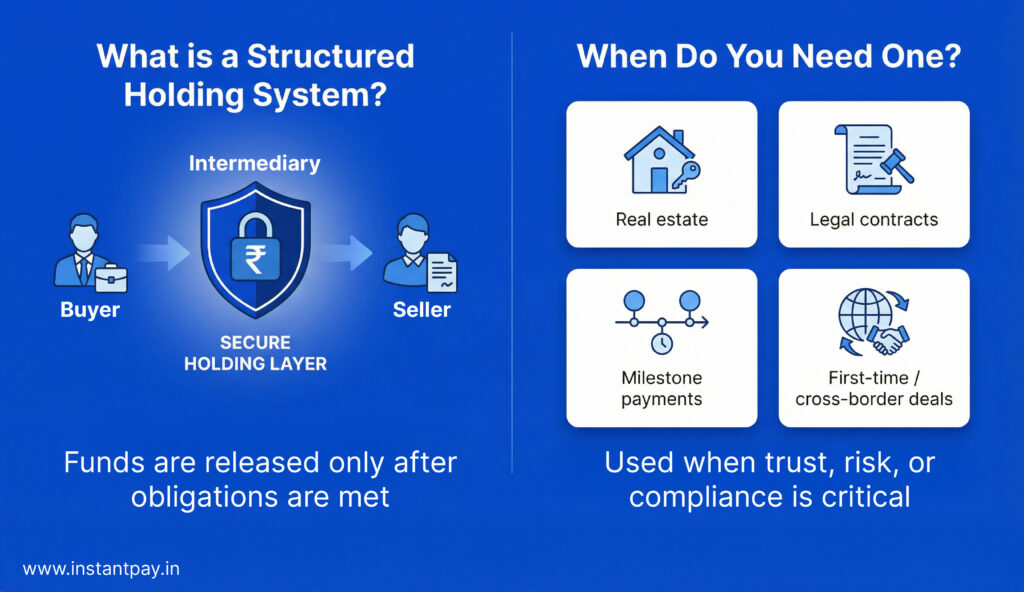
An escrow arrangement is much more than just a holding account—it acts as a critical trust mechanism in complex transactions. It’s a specialized financial structure where a neutral third party (the escrow agent) safely holds money, documents, or digital assets until all involved entities fulfill specific contractual obligations.
What makes it truly powerful is its structured neutrality. It creates a protective buffer for both the buyer and the seller, shielding them from the premature release of funds, incomplete obligations, or legal disputes.
What is an Escrow Account?
It’s a neutral financial setup where a third party holds money or assets until all terms of a contract are fulfilled. Commonly used in high-value deals, it ensures security, trust, and compliance.
The Role of Escrow in Modern Finance
In today’s digitally driven economy, where many transactions occur between unknown or geographically distant parties, these systems are increasingly used to:
- Prevent transactional risk in high-value or milestone-based payments (such as service-based contracts or vendor agreements).
- Support cross-border payments where trust, regulation, and timelines may vary.
- Comply with industry-specific regulations, particularly in sectors like fintech, real estate, pharmaceuticals, and infrastructure.
- Facilitate multi-phase project payments, such as construction or software development, where funds are released upon each completed phase.
When Does an Escrow Account Become Necessary?
While traditional bank transfers and contracts suffice for small-scale purchases, this tool becomes essential when:
- There’s a lack of trust between transacting parties (first-time transactions or new vendors).
- The transaction is legally binding or high-risk (real estate, M&A, IP licensing).
- The payment flow requires step-by-step milestones, like staggered delivery or development.
- There’s a compliance requirement under contract law or sectoral regulations (such as SEBI, RBI, or IRDAI guidelines).
When do I need a third-party settlement solution?
When you’re dealing with new vendors, legal contracts, or phased payments that require secure, condition-based fund release.
Evolution of Escrow: Beyond Banks
While traditionally managed by banks or law firms, modern escrow solutions have evolved into flexible, digital-first tools that serve a wide range of industries and use cases.
Today’s leading alternatives include:
1. Digital Escrow Platforms
These platforms integrate directly into payment workflows, enabling seamless fund holding and automated release based on predefined triggers like document signing, delivery confirmation, or milestone completion.
Facts & Figures:
- Indian digital escrow players like Castler process over Rs. 10,000 crore per month and support more than 600 enterprises via API-based solutions.
2. Blockchain-Based Escrow Models
Built on smart contracts, these escrow solutions allow tamper-proof execution of fund release without intermediaries—ensuring decentralization, transparency, and automatic enforcement of terms.
Facts & Figures:
- Another market analysis expects this growth to USD 1.5 billion in 2024 and up to USD 11.5 billion by 2033, at a CAGR of 27.2%
3. Multisig Wallets in Crypto Ecosystems
Used to secure cryptocurrency transactions, multisignature (multisig) wallets require approval from multiple parties before funds are released—ideal for decentralized governance, OTC trades, and joint ventures.
Facts & Figures:
- According to Chainalysis and other Web3 reports, over 50% of DeFi projects use Gnosis Safe or similar multisig wallets for treasury and governance.
- Multisig setups are credited with reducing crypto fraud and exit scams by over 60%.
This evolution allows even small businesses, freelancers, and early-stage startups to leverage the security and trust of escrow, without incurring large legal or banking costs. It also enables faster transactions, automation, and global scalability in today’s digital economy.
Why is an Escrow Account Used?
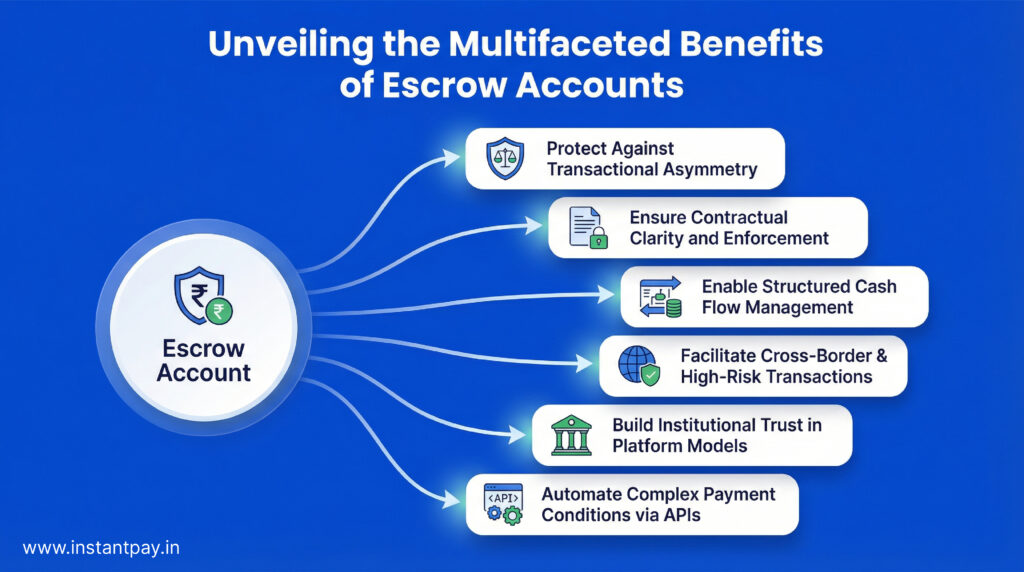
An escrow arrangement is not just a formality—it’s a critical financial tool designed to manage trust, mitigate risk, and create structured accountability in any transaction involving conditions, multiple stakeholders, or future obligations.
While its conventional purpose is to hold funds until a condition is met, its underlying strategic value lies in its ability to:
1. Protect Against Transactional Asymmetry
In many business dealings, one party must act first, such as a buyer paying in advance or a seller delivering a service upfront. This creates an imbalance of trust and exposure, where one side is inherently more vulnerable.
Escrow solves this by serving as a neutral holding zone, ensuring:
- The seller only gets paid when the buyer receives and approves the product/service
- The buyer cannot revoke payment once the agreed-upon conditions are fulfilled
Why do businesses use escrow-like systems?
Businesses use structured holding mechanisms to protect both parties in a deal, manage staged payments, enforce contracts, and improve trust during high-risk or cross-border transactions.
2. Ensure Contractual Clarity and Enforcement
In complex deals, particularly those governed by legal frameworks or milestone-based deliverables, escrow mechanisms are used to enforce performance-based releases. These are typically tied to:
- Construction phases
- Legal settlements
- Licensing or intellectual property transfers
- Vendor performance contracts
Without such a structure, disputes over timing, partial delivery, or subjective fulfillment can quickly escalate.
3. Enable Structured Cash Flow Management
For businesses, especially in sectors like real estate, infrastructure, SaaS, and fintech, this financial tool helps segment funds for specific purposes, such as:
- Allocating investor capital until regulatory approvals
- Setting aside user deposits or subscription fees until service activation
- Creating sub-accounts for different clients or project phases
This structure supports cleaner audits, better working capital control, and regulatory reporting.
4. Facilitate Cross-Border & High-Risk Transactions
In international trade or partnerships, dealing with unknown vendors or buyers can be risky. Escrow structures:
- Reduce dependency on foreign legal systems
- Avoid currency conversion risks until the transaction is complete
- Offer a trust bridge in jurisdictions with different enforcement rules
This is especially relevant in export-import, global SaaS licensing, and outsourced services.
5. Build Institutional Trust in Platform Models
For digital platforms (like marketplaces, crowdfunding sites, or lending apps), escrow acts as a consumer protection layer and regulatory shield:
- Funds collected from multiple users are held until the platform’s service is delivered
- Acts as a compliance requirement under RBI/SEBI guidelines for NBFCs and crowdfunding portals
- Increases customer confidence in pre-paid models
What are the benefits of conditional fund holding?
Conditional fund holding protects against fraud, enables milestone-based payouts, supports regulatory compliance, and ensures service delivery before releasing money.
6. Automate Complex Payment Conditions via APIs
Modern fintech applications use programmable escrow via APIs to automate release conditions, such as:
- “Release on delivery confirmation”
- “Release upon contract digitally signed by all parties”
- “Partial release every 30 days for ongoing service”
This allows scalable automation of complex transactions while still keeping safeguards in place.
Key Industries Using Escrow Accounts
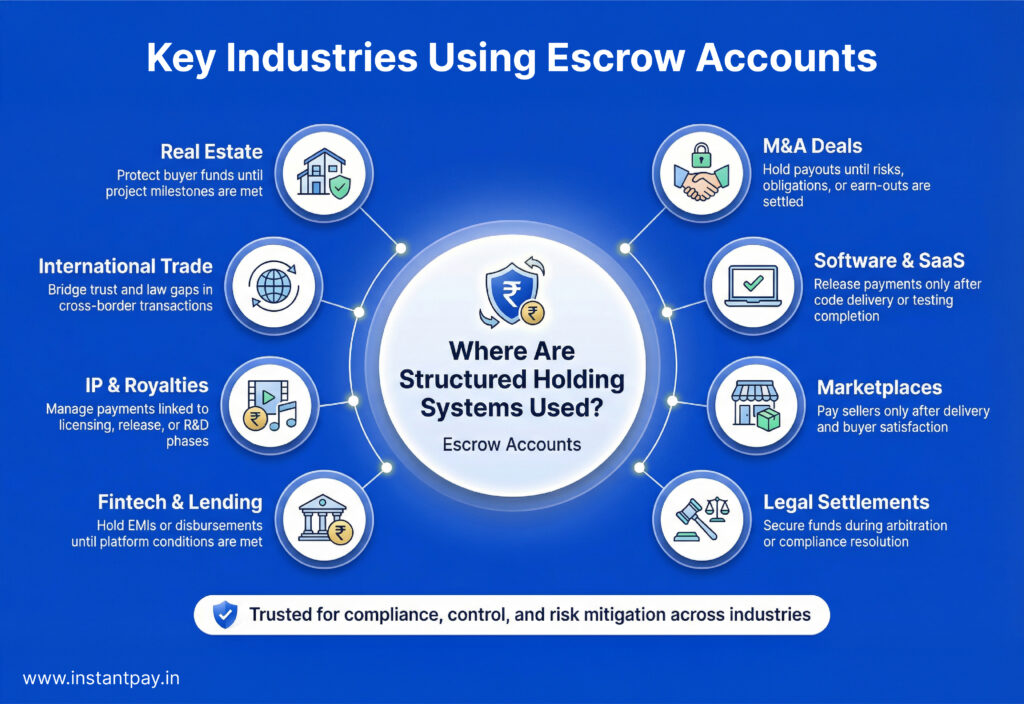
Escrow arrangements are no longer limited to real estate transactions or legal settlements. Today, they are a vital tool across a wide range of industries and transaction models, especially where funds, trust, and timelines must be tightly controlled.
What are the main use cases of a structured holding system?
Structured holding systems are used in real estate, M&A, software, fintech, and international trade to protect funds, enforce contract terms, and reduce risk during complex or high-value transactions.
Let’s explore how different sectors leverage these holding mechanisms to simplify operations, reduce risk, and ensure transaction integrity:
1. Real Estate & Infrastructure Projects
Escrow in real estate is one of the most widely known applications. But its utility extends beyond just buyer-seller arrangements. In large infrastructure or construction projects, this system is used to:
- Hold advance payments until site inspections or approvals are completed
- Disburse contractor payments in phases (e.g., foundation, structure, finishing)
- Ensure compliance with RERA (Real Estate Regulatory Authority) rules in India, which mandate that 70% of buyer payments be held in escrow for project development
Key Benefit: Protects buyer funds from being misused and ensures builders complete the promised work.
2. Mergers, Acquisitions & Corporate Transactions
These accounts play a pivotal role in M&A deals, especially when:
- The buyer wants to safeguard against post-closing liabilities
- The deal includes performance-linked payouts (earn-outs)
- There are ongoing legal or tax obligations post-acquisition
Funds are held in escrow for a defined indemnity period, releasing partial or full payments only after risks are cleared.
Key Benefit: Acts as a risk management cushion for both acquirer and target company.
3. Software & Tech Services
Escrow is widely used in the technology and SaaS sectors, where:
- Payments are tied to development milestones (e.g., MVP delivery, final testing, deployment)
- IP ownership is transferred upon final payment
- Ongoing maintenance or support contracts require periodic disbursals
It’s also common in white-label software delivery, where the buyer needs assurance that code or service will be delivered as agreed.
Key Benefit: Aligns development payments with real deliverables.
4. E-commerce & Marketplace Escrow
Marketplaces and B2B platforms use escrow to ensure:
- Buyers receive goods as promised before funds are released to sellers
- Sellers get paid only after shipping, delivery, or return windows are fulfilled
This is especially useful in high-value B2B purchases, international dropshipping, or custom orders where buyer risk is higher.
Key Benefit: Reduces chargeback disputes and builds platform trust.
5. Legal Settlements & Arbitration
These secure accounts are used during legal negotiations, divorce settlements, or commercial arbitrations to:
- Hold agreed compensation until all legal procedures are completed
- Manage phased release of payments upon compliance
- Act as evidence of financial commitment to the settlement
Key Benefit: Ensures neither party backs out mid-process and avoids future litigation.
6. Fintech, Lending & Payment Platforms
Modern digital financial products such as peer-to-peer lending, loan servicing, and BNPL (Buy Now, Pay Later) models integrate escrow systems to:
- Temporarily hold user funds or EMIs until disbursal or reconciliation
- Ensure regulatory compliance (especially for NBFCs)
- Segment funds per customer or merchant to avoid commingling
Platforms offering Escrow-as-a-Service (EaaS) are revolutionizing how fintechs manage compliance and settlement risk.
Key Benefit: Enables scalable, secure fund flow in regulated environments.
7. Licensing, IP, and Royalties
In industries like publishing, film, biotech, or software, these conditional accounts are used to:
- Secure royalty payments until distribution or licensing terms are met
- Protect creators during disputes or contract negotiations
- Manage milestone-based funding for R&D partnerships
Key Benefit: Ensures creators are compensated and licensees receive value.
8. Cross-Border & International Trade
In global trade, escrow solves the challenge of dealing with unfamiliar jurisdictions, customs delays, and differing payment norms. It is used for:
- Import/export transactions
- Equipment leasing
- Consulting agreements
Key Benefit: Acts as a financial “middle ground” when legal systems or enforcement tools are weak or slow.
How Does an Escrow Account Work?
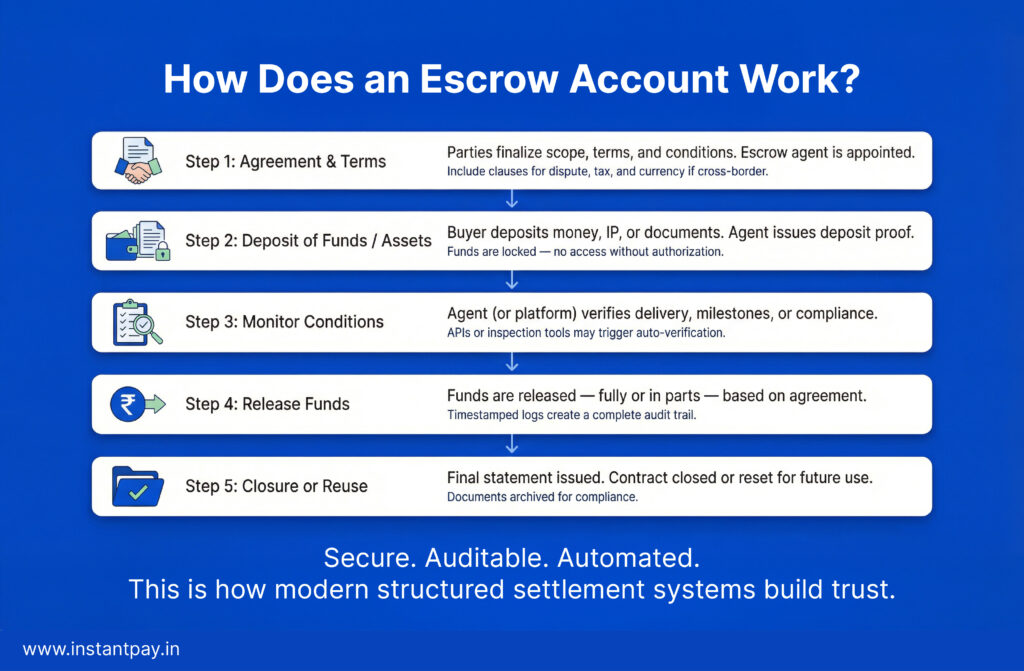
While the concept of escrow is simple—a trusted intermediary holds funds until terms are fulfilled—its execution is structured, strategic, and process-driven. Understanding how this mechanism works will help you evaluate whether it fits your use case and how best to implement it without friction.
Let’s walk through the step-by-step breakdown of how this system functions in a real-world scenario—whether for real estate, B2B contracts, or digital marketplaces.
Step 1: Agreement & Term Finalization
The process begins when all parties (typically buyer, seller, and escrow agent) agree to the terms of the transaction. This includes:
- Defining deliverables, timelines, and conditions for fund release
- Assigning roles and responsibilities
- Choosing the escrow agent (a bank, fintech platform, or law firm)
Pro Tip: For corporate or cross-border transactions, ensure your agreement also includes clauses on dispute resolution, taxation, and currency handling.
Step 2: Deposit of Funds or Assets
The buyer (or payer) deposits the agreed amount into the holding arrangement. In some cases, escrow can also hold:
- Documents (e.g., title deeds)
- Licenses or IP
- Digital assets (like code repositories or crypto tokens)
The agent confirms receipt and issues a proof of deposit to all parties.
Important: This is not a standard current/savings account. The escrow agreement governs it, and funds cannot be accessed or redirected without proper authorization.
Step 3: Monitoring of Conditions
This is where the escrow mechanism adds real value. The agent monitors and verifies:
- Completion of contractual obligations (e.g., goods delivered, services rendered, documents signed)
- Compliance with agreed terms (such as performance benchmarks, milestones, or deadlines)
Depending on the complexity, this could involve:
- API triggers in digital platforms
- Physical inspection reports (real estate)
- Legal verification (IP transfers, litigation)
Automation Tip: Modern escrow platforms allow integration with APIs or project management tools to automatically release funds upon reaching set milestones.
Step 4: Trigger Release of Funds
Once the agent receives formal confirmation from all parties (or system triggers if automated), the funds are released to the seller or beneficiary. Release may be:
- Lump sum (all at once)
- Partial/milestone-based
- Time-based (recurring disbursals)
The agent may also retain a fee from the balance before disbursing the remaining amount.
Audit Advantage: Every release is documented, timestamped, and logged—creating a clear, auditable transaction trail.
Step 5: Closure or Reconciliation
After all obligations are fulfilled and funds/assets are disbursed, the arrangement is either:
- Closed permanently, or
- Reset for recurring use (in case of long-term or subscription-based contracts)
A final statement is issued, and compliance documents are archived for future reference.
What Happens If Terms Are Not Met?
If any party fails to meet the agreed conditions, the escrow setup:
- Freezes disbursement until the issue is resolved
- May refund the deposit (depending on agreement terms)
- Can escalate to arbitration or legal action if disputes arise
Compliance Alert: In India, if funds are held for extended periods, the agent must ensure adherence to RBI regulations, including reporting under FEMA or AML guidelines if applicable.
Variations in Escrow Workflows
| Transaction Type | Unique Steps |
| Real Estate | Title clearance, site inspection, RERA compliance |
| Fintech | API-based triggers, real-time KYC checks |
| M&A | Legal due diligence, holdback release after 12-24 months |
| E-commerce | Delivery confirmation, refund window integration |
Key Components of an Escrow Agreement
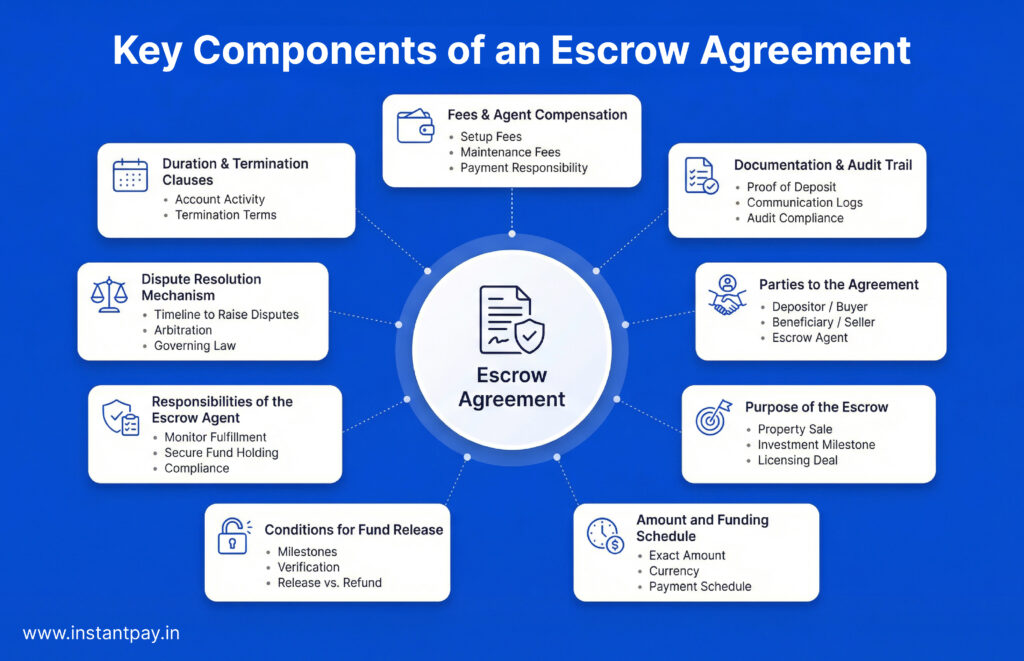
An escrow account is only as strong as the agreement that governs it. The escrow agreement is a legally binding contract that outlines the terms, obligations, and conditions for the involved parties and the escrow agent. It acts as the operational backbone of any escrow transaction—setting the stage for how, when, and under what conditions funds or assets will be handled and released.
What are the key elements of an escrow agreement?
A standard escrow agreement includes the parties involved, purpose of escrow, conditions for release, agent responsibilities, dispute resolution clauses, funding schedules, duration, and required audit trail documents.
Whether you’re involved in a simple property deal or a multi-stage tech delivery contract, understanding the components of an escrow agreement is critical for managing risk, timelines, and accountability.
1. Parties to the Agreement
Clearly identify and define the roles of:
- Depositor / Buyer – The party providing funds or assets
- Beneficiary / Seller – The party receiving funds upon fulfillment
- Escrow Agent / Service Provider – The neutral third-party managing the escrow
Note: In more complex deals, there could be multiple beneficiaries, joint depositors, or agents (like co-trustees or advisors).
2. Purpose of the Escrow
Every agreement must explicitly mention the reason for opening the escrow account, such as:
- Property sale
- Investment milestone disbursal
- Licensing deal
- Legal settlement
- M&A retention fund
This provides legal clarity and can help in regulatory disclosures (especially for real estate and financial services in India).
3. Conditions for Fund Release
This is the core of the agreement. It outlines:
- What milestones, documents, or actions must be completed
- Who is responsible for verifying completion
- What triggers a release vs. refund
Examples:
- “Release Rs. 5 lakh upon final inspection certificate”
- “Disburse 50% upon contract signing, 50% on delivery”
- “Refund if product not delivered within 30 days”
Important: In digital workflows, these can be tied to system triggers (e.g., a signed e-contract or confirmed API webhook).
4. Amount and Funding Schedule
Define:
- The exact amount to be deposited
- The currency in case of international transactions
- Whether funds will be deposited lump sum or in tranches
- Payment source and timelines
This ensures no confusion or delay in activation of the escrow process.
5. Responsibilities of the Escrow Agent
The agent isn’t just a passive fund holder—they’re expected to:
- Monitor fulfillment of conditions
- Ensure secure fund holding and segregation
- Report milestones or discrepancies
- Manage compliance (especially under RBI or AML laws)
The agreement must state whether the agent acts in a ministerial (mechanical) or discretionary (interpretative) capacity.
6. Dispute Resolution Mechanism
Include a fallback process in case there is a disagreement over whether conditions are met. This typically involves:
- Timeline to raise disputes
- Arbitration or court jurisdiction
- Instructions on fund handling during a dispute (e.g., freeze account)
For cross-border deals, mention the governing law and jurisdiction (e.g., Indian Contract Act, English Law, etc.).
7. Fees & Agent Compensation
Define:
- Escrow setup fees
- Ongoing maintenance or release fees
- Responsibility for payment (usually borne by buyer or split)
- Refundability in case of cancellation
In digital escrow platforms, pricing is often tiered based on number of releases or automation complexity.
8. Duration & Termination Clauses
Clearly mention:
- How long the account will remain active
- What happens if conditions are not met by a deadline
- Who can initiate termination and under what terms
Example:
“If Buyer does not submit final verification documents within 45 days of deposit, escrow will be terminated and funds refunded after deducting agent fees.”
9. Documentation & Audit Trail
Specify the types of records the escrow agent must maintain:
- Proof of deposit and release
- Communication logs
- Confirmation of condition fulfillment
- Final settlement statement
This is especially important in regulated sectors like real estate, fintech, or capital markets, where audit compliance is mandatory.
Escrow Accounts in India: Rules, Compliance & Documentation
In India, the use of escrow mechanisms has evolved from being a legal safeguard to a regulatory requirement in several sectors. As business models become more digital, collaborative, and compliance-driven, the Reserve Bank of India (RBI), SEBI, IRDAI, and other bodies have introduced guidelines to ensure such financial operations are transparent, accountable, and legally sound.
If you’re opening or managing this type of conditional holding system in India, here’s everything you need to know—from eligibility to documentation, legal boundaries, and compliance pitfalls to avoid.
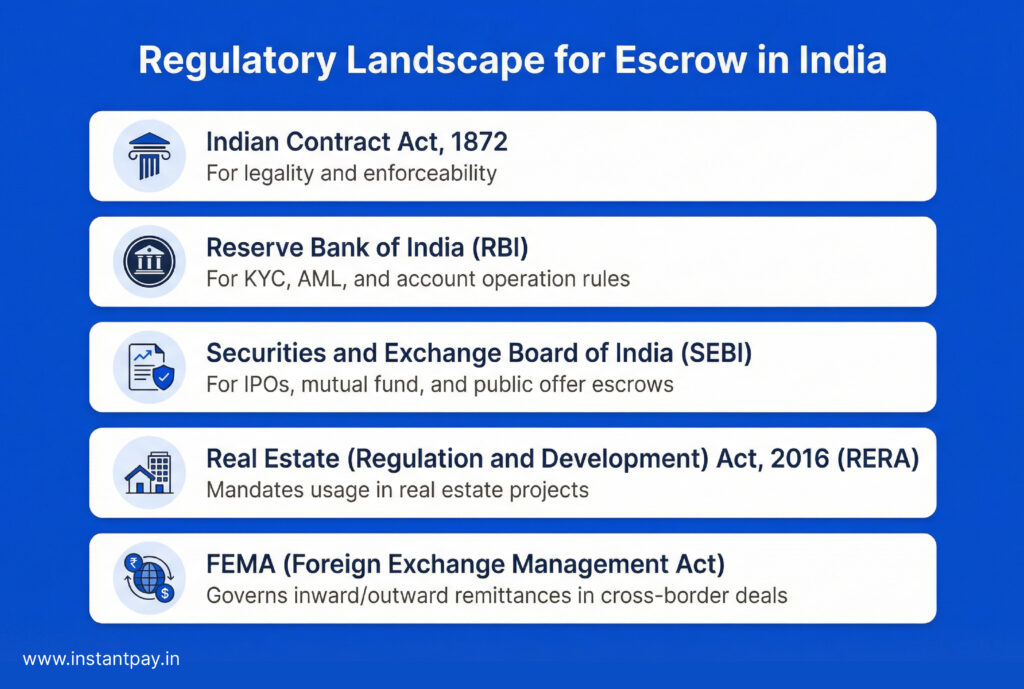
Eligibility Criteria to Open an Escrow Account in India
Before setting up this type of secured holding arrangement, entities must meet certain baseline criteria:
- Clear Purpose & Defined Agreement
A written contract outlining why the escrow is required and what conditions will govern it. - KYC & AML Compliance
- All parties (depositor, beneficiary, agent) must be KYC-compliant.
- PAN, Aadhaar (or company registration details), GSTIN, etc., are mandatory.
- PEPs (Politically Exposed Persons) or foreign nationals may need enhanced due diligence.
- RBI-Licensed Escrow Agent
Only banks or RBI-regulated entities (like Payment Aggregators or NBFCs with special permission) can act as escrow agents in India. - Contractual Neutrality
The agent cannot be a party to the dispute or transaction. They must act independently, with no financial interest in the outcome.
Key Documents Required to Open an Escrow Arrangement
Here’s a standard checklist for setting up a corporate or business escrow set up in India:
| Document Type | Description |
| Escrow Agreement | Legally binding contract detailing conditions and responsibilities |
| KYC Documents | PAN, Aadhaar/Company CIN, address proof, etc., of all parties |
| Board Resolution | Authorizing company representative to open and operate escrow |
| Purpose Proof | Property deed, invoice, investor agreement, contract copy |
| Bank Details | Cancelled cheque or account verification letter for release destination |
| Regulatory Clearance (if applicable) | RERA registration, SEBI approval, FEMA compliance certificate |
RBI-Specific Guidelines & Recent Developments (as of 2024–25)
- Escrow accounts must not earn interest for either party unless explicitly allowed by regulation.
- Funds must be released only after proper authentication, such as digital signatures, system logs, or third-party verifications.
- In cases of non-performance or default, the escrow must have a clause for refund (partial or full) with deduction of fees.
- Foreign transactions through escrow must be aligned with FEMA rules, and require AD Category I bank involvement.
New RBI Circular (2024): Fintechs offering Escrow-as-a-Service must:
- Maintain separate nodal and settlement accounts
- Enable automated reconciliation within T+1 timelines
- Disclose beneficiary risk grading to the bank and client
Common Mistakes to Avoid
- Using a standard current account in place of escrow (violates purpose-specific fund use)
- Ambiguity in release conditions, causing disputes or freeze
- Delayed or incomplete KYC, leading to account suspension
- Omitting regulatory disclosures, especially in public-facing platforms
Types of Escrow Accounts
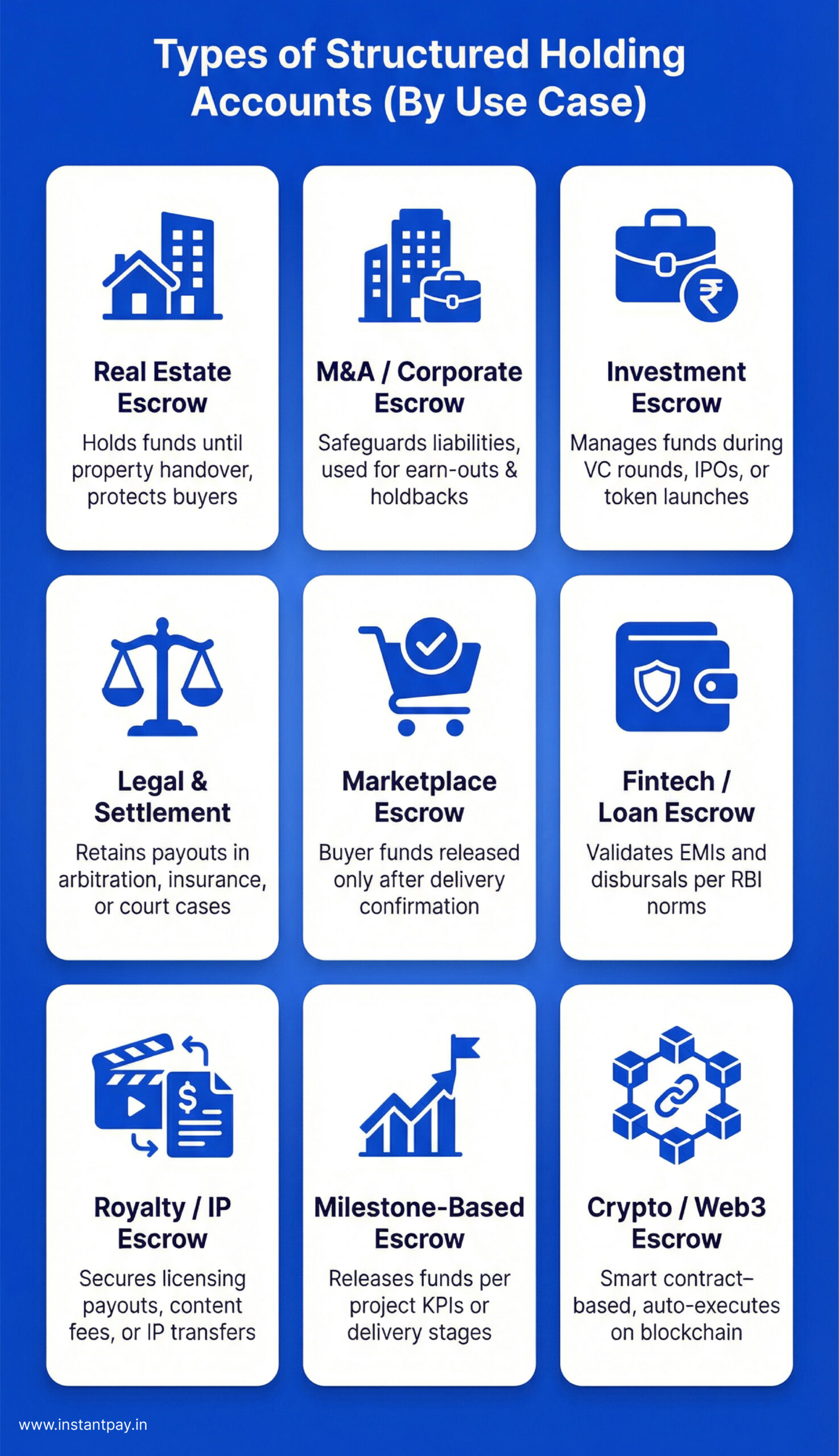
Escrow structures are not one-size-fits-all. Depending on the nature of the transaction, the industry involved, and the regulatory framework, different types are structured to address specific risks, conditions, and release mechanisms.
Here’s a breakdown of the most common (and emerging) escrow types, categorized by use case, functionality, and relevance, especially for Indian and global markets.
1. Real Estate Escrow
Used to facilitate secure property transactions, these arrangements:
- Hold buyer’s funds until title verification, registration, and handover are complete
- Protect buyers from fraud or project delays
- Are mandated by RERA in India for developers to keep 70% of project funds in escrow
Use Case: Residential, commercial property sales, under-construction projects, land development deals
Who uses it: Homebuyers, real estate developers, brokers, banks
2. M&A / Corporate Escrow
In mergers, acquisitions, or corporate restructuring, these accounts serve as:
- Holdbacks for post-closing adjustments or indemnity claims
- Assurance for deal commitments and future liabilities
- Disbursement tools for milestone-based payouts (e.g., earn-outs)
Use Case: Acquisition deals, joint ventures, asset transfers, private equity exits
Who uses it: Corporates, VCs, legal advisors, investment banks
3. Investment Escrow
These are specialized accounts used to manage funds raised during:
- Seed or venture capital investments
- Private placements
- Angel funding rounds
- IPOs or token launches (STOs, in crypto environments)
Funds are typically:
- Released upon due diligence clearance or regulatory approval
- Linked to startup performance or milestone triggers
Use Case: Startups, fintech deals, fund syndication
Who uses it: Investors, founders, syndicates, regulatory consultants
4. Legal & Settlement Escrow
Legal holding accounts retain compensation or settlement amounts during:
- Commercial disputes
- Divorce or inheritance cases
- Arbitration proceedings
- Insurance claim negotiations
These accounts provide financial assurance that once the legal resolution is achieved, the funds will be distributed fairly and in compliance.
Use Case: Court-mandated settlements, mediated agreements
Who uses it: Law firms, courts, individuals, insurers
5. E-commerce & Marketplace Escrow
Used by platforms to:
- Hold buyer funds during delivery/shipping
- Release payment to the seller only after product/service confirmation
- Enable refunds or reverse settlements in case of disputes
This protects both parties and builds trust in high-value transactions or custom product orders.
Use Case: Marketplaces (B2B/B2C), high-ticket sellers, vendor dropshipping
Who uses it: Aggregators, platform operators, payment gateways
6. Loan Repayment / Fintech Escrow
Common in modern lending platforms, these setups:
- Hold EMIs or loan disbursals until KYC and underwriting are validated
- Facilitate repayments between borrowers and NBFCs
- Enable compliance with RBI and AML norms for digital lending
Some NBFCs use this model for co-lending, where funds from two institutions are routed through a shared channel.
Use Case: Digital loans, BNPL, invoice discounting, revenue-based financing
Who uses it: Fintechs, NBFCs, payment aggregators
7. Licensing & Royalty Escrow
Used to:
- Secure payment for creative IP before rights are transferred
- Manage royalty payouts across multiple beneficiaries
- Hold publishing fees, distribution payments, or content license advances
Often used in film production, music, SaaS/IP licensing, and scientific R&D collaborations.
Use Case: Licensing deals, streaming platforms, R&D partnerships
Who uses it: IP owners, producers, scientists, labels
8. Performance-Based / Project Milestone Escrow
These financial tools are configured to release funds:
- Based on delivery milestones in a service contract (e.g., software modules)
- In phases tied to performance KPIs
- On approvals or audits tied to SLAs (Service Level Agreements)
Use Case: Software development, consulting, marketing retainers
Who uses it: Freelancers, agencies, tech companies, procurement teams
9. Crypto / Digital Asset Escrow (Emerging)
These are typically smart contract-based systems used in:
- Crypto OTC (over-the-counter) transactions
- NFT sales
- Token sales (with vesting conditions)
Smart contracts automate release based on pre-coded conditions—without human intervention.
Use Case: Blockchain trades, DeFi platforms, digital art or gaming
Who uses it: Web3 startups, investors, DAOs, marketplaces
Escrow-as-a-Service (EaaS): The Fintech Twist
Startups and digital platforms now offer EaaS—Escrow-as-a-Service—helping businesses:
- Open and manage escrow digitally
- Automate release triggers via APIs
- Integrate escrow into checkout/payment workflows
- Stay compliant with RBI and KYC guidelines
Examples: Instantpay Escrow APIs
Benefits of Using an Escrow Account
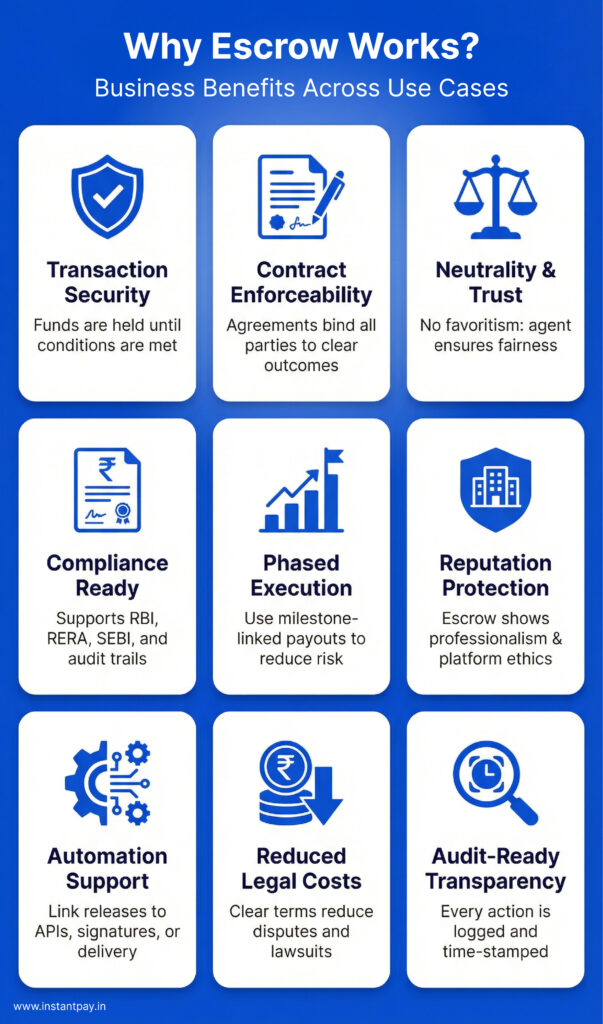
An escrow arrangement is not just a risk-management tool—it’s a business enabler. It creates a controlled, transparent, and trust-driven environment for completing complex or high-value transactions with peace of mind. Whether you’re a startup, enterprise, freelancer, or investor, the right structure can simplify operations, enhance compliance, and build stakeholder confidence.
Let’s break down the core advantages of using escrow across industries and use cases.
1. Transactional Security for All Parties
An escrow account protects against transactional asymmetry by ensuring neither party gains unfair access to funds before obligations are met:
- The payer (buyer, investor, platform) knows their money won’t be released unless the agreed conditions are met.
- The receiver (seller, service provider, contractor) has assurance that the funds are available and secured.
Why it matters: Minimizes the risk of fraud, defaults, or “no-shows” in payment and delivery.
2. Enforceability of Terms & Conditions
An escrow account ensures contractual clarity by linking fund release strictly to documented milestones and agreed conditions.:
- Funds are only released upon meeting clearly defined obligations
- Any deviation or dispute can be handled using predefined mechanisms
Why it matters: Supports legal enforceability and strengthens commercial contracts, especially where conditions are milestone-based or performance-driven.
3. Neutrality and Trust Building
By acting as a neutral intermediary, an escrow account builds trust in first-time, high-value, or cross-border transactions.
Why it matters: Establishes trust in first-time transactions, long-distance deals, or situations involving power imbalances between parties.
4. Better Compliance & Financial Control
In sectors like fintech, real estate, NBFCs, or cross-border trade, escrow:
- Helps comply with RBI, RERA, SEBI, or FEMA guidelines
- Provides an audit trail for regulators and financial institutions
- Prevents fund diversion, misuse, or misreporting
Why it matters: Keeps you compliant and audit-ready, especially when dealing with large volumes, investors, or users.
5. Supports Complex or Phased Transactions
Escrow structures are ideal for:
- Projects that involve multiple phases or deliverables
- Investment tranches based on milestones
- Ongoing service contracts with variable payouts
Why it matters: You can structure your deal to unlock payments step-by-step—reducing risk at every stage.
6. Protects Business Reputation
For platforms, businesses, or developers, offering such a system shows:
- Professionalism and financial ethics
- Commitment to fairness and security
- Transparency in user/vendor relationships
Why it matters: Builds long-term credibility and reduces reputation risk—especially in disputes or delays.
7. Enables Automated, Scalable Transactions
Modern setups can be:
- API-integrated into your platform or product flow
- Linked to system events like digital signature, delivery confirmation, or feedback submission
- Fully or semi-automated for release and reconciliation
Why it matters: Saves time, reduces manual intervention, and supports scalable growth in digital-first business models.
8. Reduces Legal Costs and Disputes
By establishing clear guidelines upfront:
- Legal ambiguity is minimized
- Disputes are often resolved without litigation
- Arbitration or mediation is faster and less costly
Why it matters: Saves you money, time, and stress—especially in cross-border or multi-party arrangements.
9. Full Transparency and Audit Trail
Every action in the agreement lifecycle—from deposit to release—is:
- Documented
- Time-stamped
- Verified by the agent or platform
Why it matters: Helps with bookkeeping, tax compliance, and investor reporting. Especially crucial in regulated sectors or due diligence phases.
Things to Consider Before Opening an Escrow Account
- Who is the escrow agent? (Bank vs. platform vs. legal)
- What are the associated fees?
- What dispute resolution process is defined?
- How is compliance (KYC, AML, tax) handled?
- What automation or API integrations are available?
RBI Guidelines on Escrow (Updated 2023–24)
In 2023–24, the Reserve Bank of India (RBI) reinforced provisions around escrow arrangements—especially for Payment Aggregators (PAs), cross-border payment entities, fintech firms, and regulated financial institutions—ensuring enhanced security, transparency, and systemic integrity.
Core Circular: RBI/2023-24/80 CO.DPSS.POLC.No.S-786/02-14-008, dated October 31, 2023 — titled “Regulation of Cross-Border Payment Aggregators (PA-CB)”
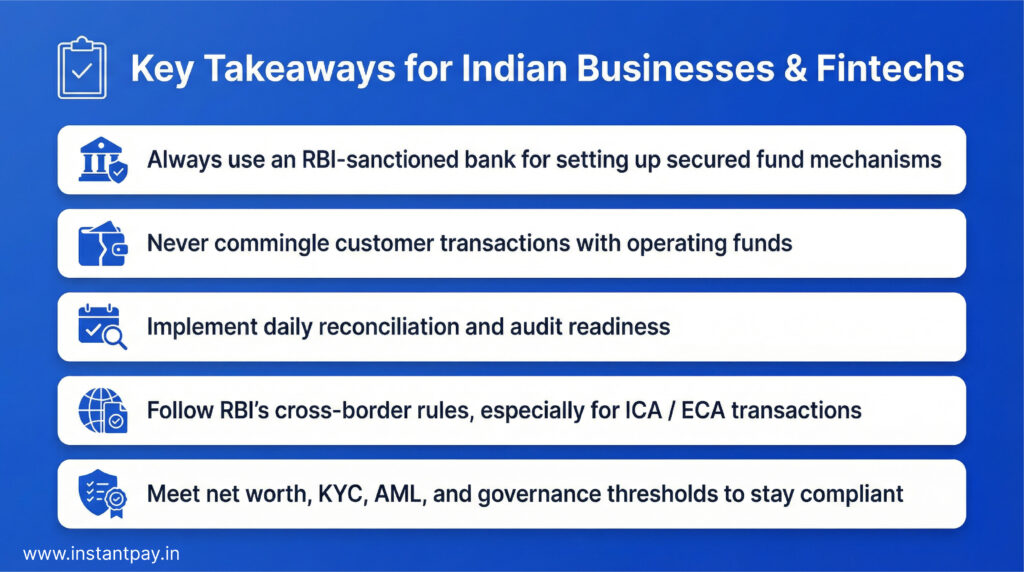
1. Mandatory Use of RBI-Licensed Escrow Agents
- These secured holding accounts must be opened exclusively with RBI-regulated AD Category-I banks. Non-bank entities providing such services must obtain RBI approval before handling settlement-related flows.
- This ensures all escrow flows are clearly monitored and auditable.
2. Segregation of Funds & Allowed Transactions
- Strict separation of customer funds from operational or merchant accounts—mixing is prohibited.
- Only pre-defined transactions allowed: customer deposits, merchant payouts, refunds, and chargebacks.
- All fund movements must be reconciled daily, with built-in traceability
3. Cross-Border Payment Aggregator (PA-CB) Rules
- Entities enabling cross-border ecommerce must maintain:
- A domestic escrow arrangement
- An Import Collection Account (ICA) and/or Export Collection Account (ECA).
- ICA/ECA flows must follow RBI transaction rules, especially KYC procedures for high-value transactions (Less than Rs. 2.5 lakh) .
- Net worth and compliance thresholds apply (e.g., Rs. 15 crore minimum)
4. Release Timelines & Account Operation
- Settlements to merchants must adhere to prescribed timelines (e.g. T+1 daily schedules) with no undue delay
- Any debits from escrow must strictly follow the “permissible debit categories” defined by RBI; usage beyond this may be disallowed.
5. Comprehensive Governance and Reporting
- Escrow agents must maintain full audit trails, implement strong KYC, AML, and fraud-prevention frameworks .
- Non-compliance can lead to license revocation, monetary penalties, or legal sanctions.
Final Thoughts: Escrow Accounts Are the Future of Trust in Transactions
As the world moves toward digital-first, risk-aware financial ecosystems, escrow-based solutions are becoming essential—especially in real estate, cross-border trade, fintech lending, and legal settlements.
From traditional banking setups to API-powered Escrow-as-a-Service, the evolution has made it easier, faster, and more accessible to secure transactions at scale.
If you’re handling high-value payments, uncertain jurisdictions, or multi-party contracts, using a trust-driven financial layer isn’t just smart—it’s strategically essential.
Frequently Asked Questions on Escrow Accounts in India
1. What is an escrow account used for?
An escrow account is used to securely hold funds or assets until contractual conditions—such as delivery, approval, or milestone completion—are met.
2. Is an escrow account mandatory in India?
Yes, escrow accounts are mandatory in certain sectors like real estate (under RERA), payment aggregation, fintech lending, and public offerings regulated by RBI and SEBI.
3. Who controls an escrow account?
An escrow account is controlled by a neutral escrow agent, typically an RBI-regulated bank or licensed financial institution, not by the buyer or seller.
4. Can escrow accounts earn interest in India?
In most regulated use cases, escrow accounts do not earn interest unless explicitly permitted by regulation or agreement terms.
5. Are escrow accounts safe for high-value transactions?
Yes. Escrow accounts are designed to reduce fraud, enforce compliance, and provide full audit trails, making them suitable for high-value and regulated transactions.