Did you know that nearly 25% of payout failures in India stem from incorrect or unverified bank account details? According to NPCI and leading fintech reports, a large portion of refund rejections, delayed disbursals, and failed vendor payments trace back to inaccurate beneficiary information — most often due to manual errors or lack of real-time verification.
The Real-World Impact:
- 6,000–10,000 crore worth of digital transactions fail every year due to data mismatches or inactive accounts. (Source: NPCI and banking sector estimates)
- Disbursal failures increase TAT by 3–5 business days on average, requiring manual intervention, reconciliation, and customer support.
- In sectors like gig economy, fintech lending, and insurance, a single failed payout can lead to customer drop-offs, reputation loss, and even regulatory scrutiny.
What This Means for Businesses:
Whether you’re a lender disbursing loans, an insurer settling claims, or a marketplace paying vendors, every transaction hinges on one thing — a verified, correct bank account. Without real-time validation:
- You risk duplicate disbursals, fraudulent claims, or settlement errors
- Compliance audits become more difficult due to unverifiable records
- CX suffers, especially in time-sensitive use-cases like instant refunds or gig worker payments
Why Real-Time Bank Account Verification Is No Longer Optional
In today’s fast-paced, API-driven financial ecosystem:
- Customer expectations = instant everything
- RBI & FIU-India expect financial service providers to implement KYC/AML controls including account validation
- Scalability and trust depend on automation, not Excel sheets and manual calls
Real-time bank account verification is now foundational to:
- Preventing fraud and errors before money moves
- Automating onboarding and disbursal flows
- Maintaining compliance with RBI’s operational risk and KYC guidelines
- Boosting first-time payout success rates from ~75% to 98–99% (based on verified Instantpay client outcomes)
Impact of Unverified Bank Details on Payment Failures in India
| Metric | Value | Source |
| % of digital payout failures due to invalid account details | 24–26% | NPCI Operations Summary (2022–24) |
| Total digital payment failures in FY24 | 6,400+ crore | RBI Digital Payments Report |
| Average TAT increase due to account verification issues | 3–5 business days | BCG–Fintech Survey 2023 |
| First-time payout success rate (with vs. without verification) | 98% vs. 74% | Instantpay Internal Benchmarks |
| % of NBFCs experiencing disbursal fraud due to wrong accounts | 36%+ | FIDC Compliance & Risk Survey 2023 |
| RBI Advisory on Verification | Ensure beneficiary validation before initiating high-value transfers | RBI Circular: DPSS.CO.PD No. 316/02.01.014/2020-21 |
The Problem: Manual Checks Lead to Failed Payments, Fraud & Poor User Experience
Manual bank account verification and outdated methods like penny-drop validation are not just slow — they are also highly error-prone and operationally expensive.
Let’s break down the impact with facts:
1. Payout Failures Due to Incorrect Beneficiary Details
- According to NPCI, 24–26% of payout failures in India stem from incorrect or unverified account details.
- In FY24, India saw Rs.6,400+ crore in failed digital transactions — a significant portion attributed to faulty bank account inputs.
- In manual setups, businesses often rely on spreadsheets, uploaded documents, or even self-declared details — leading to a ~25% first-time payout failure rate.
2. Fraud Risks Due to Lack of Real-Time Verification
- A 2023 survey by FIDC reported that 36% of NBFCs experienced disbursal fraud linked to incorrect or fake bank accounts.
- Without real-time checks, fraudsters can manipulate account details to route funds to unauthorized destinations.
- This is particularly risky in sectors like lending, insurance, and marketplaces, where large volumes of funds are moved to users, vendors, or policyholders.
3. Poor Customer Experience in Fast-Moving Sectors
- For gig economy platforms, onboarding delays of even 1–2 days can result in high drop-offs or workforce churn.
- In fintech apps or consumer lending platforms, users expect instant refunds or disbursals — a mismatch in bank name and account details leads to frustrationand support escalations.
- TrueLayer estimates that customer abandonment rates are 2x higher when account verification fails during onboarding.
4. Reconciliation Overheads and Support Costs
- Every failed payout triggers a chain reaction: support tickets, refund queues, operational follow-ups, and manual validation.
- Industry estimates suggest that each payout failure costs businesses Rs.100–Rs.150 in indirect support and reconciliation expenses.
- For businesses processing 10,000+ monthly payouts, that’s a potential Rs. 10–15 lakh/month loss — purely due to verification inefficiencies.
Penny-Drop: Why It’s No Longer Viable
| Issue | Penny-Drop Verification |
| Speed | 2–3 hours to reflect |
| Cost | Requires actual transactionNo name match in many banks |
| Accuracy | No name match in many banks |
| Failure Scenarios | Delays, bank rejections, no response |
| Fraud Detection | Minimal — doesn’t flag suspicious accounts |
With RBI tightening norms on digital fraud prevention, relying on penny-drop or manual verification now carries both operational and regulatory risk.
The Need for a Smarter Alternative
Businesses today require:
- Real-time bank verification with name match accuracy
- Fraud risk flags integrated at the point of onboarding or payout
- Developer-ready APIs that scale with transaction volumes
- A solution that reduces drop-offs, errors, and overheads — all in milliseconds
With Instantpay’s Bank Account Verification API, that alternative is not only possible — it’s already live and trusted by India’s top fintechs, NBFCs, and insurers.
Why Traditional Verification Fails?
Imagine disbursing a loan to the wrong bank account or facing delays in claim settlement due to a name mismatch. These aren’t rare — they happen every day.
Here’s what’s broken in manual systems:
- Payout Failures: Due to incorrect account numbers or mismatched names.
- Fraud Risks: Especially in gig, insurance, and fintech industries.
- Poor User Experience: Long wait times, repetitive document uploads.
- High Operational Overheads: Manual reconciliation, customer support loops.
According to the RBI’s Digital Payment Index, India saw over 45 billion UPI transactions in FY24, but a small percentage failing due to incorrect beneficiary info still translates to millions of problematic cases — and lost trust.
Key Benefits of Bank Account Verification APIs
1. Instant Verification = Instant Trust
With real-time verification, you know if an account belongs to the correct person in under 2 seconds.
2. Reduced Fraud & Risk
AI-based name matching and fraud detection algorithms flag inconsistencies — stopping impersonators before they access funds.
3. Lower Operational Costs
Save on support costs, manual checks, and refund processing. No more customer complaints about failed payouts.
4. Improved Customer Experience
Whether you’re onboarding a vendor, freelancer, agent, or policyholder — onboarding becomes a breeze.
5. Regulatory Compliance
Ensure your processes align with RBI-mandated KYC norms, support AML checks, and maintain audit logs for every verification attempt.
Comparing Popular API Providers in India
Here’s a comparison of leading Bank Account Verification API providers:
| Provider | Match Accuracy | AI Confidence Score | Batch Support | Pricing (/API hit) | Compliance |
| Instantpay | High | Yes | Yes | 0.30–0.60 | RBI-aligned |
| Cashfree | Medium | No | Yes | 0.80–1.20 | Yes |
| RazorpayX | Medium | No | Yes | 1.00+ | Yes |
| Setu (via Belvo) | High | Yes | No | Custom pricing | Yes |
| Karza | High | Yes | Yes | 1.00+ | Yes |
Instantpay’s Bank Account Verification API: Real-Time, Accurate, Compliant
Key Features:
- AI-Powered Name Matching
Our API intelligently matches the beneficiary name returned from banks, even if there are abbreviations, character swaps, or name order issues. - Real-Time Verification
Responses in under 1 second, integrated directly with 140+ Indian banks including PSU, private, cooperative banks. - Bulk & Batch Processing
Whether you’re paying gig workers or onboarding 10,000 merchants, verify accounts at scale via file upload or API triggers. - Fraud Detection & Risk Scoring
Get flagged alerts for suspicious accounts, frozen accounts, or repeated mismatches using machine learning models. - PAN + Bank Cross Check (Optional)
Combine bank verification with PAN verification for added compliance and reduced financial risk.
Industry Use-Cases: Who Benefits Most?
| Industry | Use-Case | Benefit |
| NBFCs & Lending | Disbursal verification before loan transfer | Prevent misdirected funds |
| Insurtech | Validate bank for claims & refunds | Reduce claim rejection risk |
| Gig Economy & Logistics | Onboard partners/workers instantly | Faster KYC & payroll setup |
| Fintech & Payout Providers | Validate recipients for payouts | Improve success rate |
| Marketplaces | Verify seller bank accounts | Prevent fraud and settlement delays |
Why Instantpay? What Sets Us Apart
- 99.8% match accuracy powered by proprietary AI models
- <1 second latency during peak business hours
- Nationwide bank coverage, including PSU and cooperative banks
- Pre-integrated with Instantpay ecosystem (PAN, Aadhaar, Payouts, UPI)
- Developer-first tools: sandbox, docs, real-time logs, and webhook integrations
Sample API Flow: What Happens in a Verification Call?
Here’s how a real-time bank verification works:
- Business sends account_number + IFSC to our API
- The API pings the connected bank/NPCI database
- The official account holder name is returned
- Our AI engine matches it with the expected name
- A structured response is sent:
- Match status (Exact/Partial/Failed)
- Confidence score
- Fraud flags (if any)
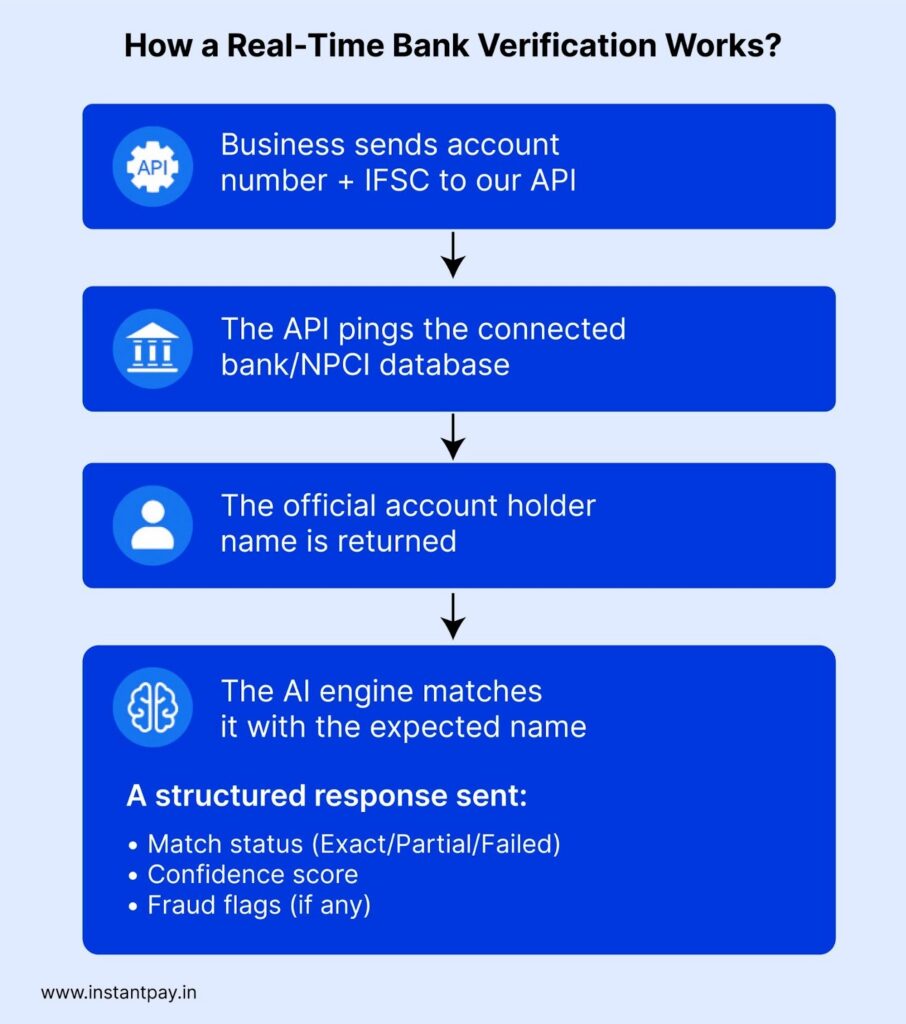
This all happens within milliseconds.
Performance Benchmarks and Metrics
| Metric | Value |
| Verification Speed | <1 second |
| Match Accuracy | 99.8% |
| Uptime SLA | 99.95% |
| Bank Coverage | 140+ banks |
| Bulk Capacity | 1M rows per batch |
How Instantpay’s Bank Account Verification API Supports Compliance Teams ?
As digital transactions and financial disbursals grow, regulatory bodies like the RBI, FIU-India, and SEBI have become increasingly focused on beneficiary validation, anti-fraud frameworks, and audit readiness. Instantpay’s real-time bank verification API is designed to support these mandates directly and efficiently.
1. RBI-Compliant Verification Practices
- The Reserve Bank of India (RBI) in multiple circulars — including DPSS.CO.PD No. 316/02.01.014/2020-21 — has emphasized the need for validating the identity of beneficiaries before initiating high-value or bulk payments.
- Instantpay’s API performs:
- Name matching as a proxy for identity confirmation
- Account status verification (active/inactive/invalid)
- Cross-validation with banking partners or NPCI
- Name matching as a proxy for identity confirmation
Why it matters: This reduces the risk of misdirected funds, supports operational risk management, and aligns with RBI’s expectations on digital payment integrity.
2. Supports AML, KYC, and Audit Traceability
- AML (Anti-Money Laundering): By verifying if the bank account matches the claimed identity, businesses can flag suspicious account usage, especially when discrepancies occur in high-risk segments (e.g., loan disbursals, refunds).
- KYC (Know Your Customer): Integrating bank verification with PAN or Aadhaar checks helps validate the end-to-end financial identity of the user.
- Audit Trail: Every API call and verification outcome is timestamped, logged, and traceable, ensuring a complete audit trail for internal or regulatory review.
Why it matters: This supports compliance with PMLA guidelines, FIU-India reporting standards, and internal risk controls.
3. Consent Layer for Additional Transparency
- For businesses following a privacy-first approach or dealing with sensitive user segments (e.g., insurance, healthtech, gig economy), Instantpay supports a consent-driven verification process.
- Features include:
- Custom consent forms
- API-triggered consent capture
- Audit logs of user authorization
- Custom consent forms
Why it matters: This aligns with the Data Protection Bill and anticipated Digital Personal Data Protection Act (DPDP) mandates for financial data use in India.
4. Exportable Logs for Reconciliation and Compliance Filing
- All verification activity can be downloaded as structured reports or fed into your internal systems via:
- Webhooks
- Batch exports (CSV/JSON)
- Automated audit reports
- Webhooks
- These logs are useful for:
- Internal audits
- RBI inspections
- Customer complaint redressals
- Board reporting and compliance documentation
- Internal audits
Why it matters: For regulated entities like NBFCs, PSPs, and fintech platforms, this reduces compliance workload and enhances transparency.
Instantpay’s Bank Account Verification API is not just a tech tool — it’s a compliance enabler that helps businesses:
- Stay aligned with RBI, PMLA, and FIU guidelines
- Prevent fraud and money laundering
- Establish transparent, consent-backed user verification
- Prepare for regulatory scrutiny with complete data logs
Getting Started is Easy
- Sign up and access your Instantpay developer sandbox
- Review detailed API documentation
- Test real-time verification in a simulated environment
- Go live within 48 hours with full onboarding support
Ready to try? [Test in Sandbox] or [Talk to Sales]
ROI Snapshot: Is It Worth It?
Let’s say you onboard 10,000 users per month.
| Metric | Manual Process | API-Based Process |
| Avg verification time | 48 hours | <2 seconds |
| Verification success rate | 85% | 99%+ |
| Support queries for failures | High | Minimal |
| Cost per user (including ops) | 20–30 | 0.50–1 |
| User satisfaction (NPS proxy) | 40 | 75+ |
Final Thoughts: Don’t Let a Wrong Account Cost You a Customer
Every failed payout hurts. Every fraudulent transfer costs. With Instantpay’s real-time Bank Account Verification API, businesses can protect their funds, boost onboarding speed, and stay fully compliant.
Start verifying with confidence. Explore our API. Book a demo. Let your onboarding and payout processes run flawlessly.
FAQs
- What is verified in a bank account check?
Account number, IFSC, and account holder’s name. - Does the API return the account holder’s name?
Yes, with a match confidence score. - What if the name doesn’t exactly match?
The API flags it as partial match or mismatch, allowing manual intervention. - Can I verify corporate accounts too?
Yes, for most banks. - How many verifications can I do per second?
Supports thousands of TPS based on plan and infrastructure. - How is this different from penny-drop?
No waiting, no transaction, no cost. Verification happens in milliseconds. - Do I need customer consent?
Optional based on use-case; recommended for compliance. - What happens if a bank server is down?
The system retries and reports fallback status in response. - How secure is this process?
256-bit encryption, ISO/IEC 27001:2013 certified infrastructure. - Can I combine PAN and bank verification?
Yes, for high-risk or high-value verifications.