In today’s digital economy, securely verifying a user’s bank account is essential before initiating payouts, disbursing loans, or completing refunds. With increasing regulatory scrutiny and fraud risk, Bank Account Verification APIs have become a critical component of any fintech, lending, payroll, or gig platform stack.
This guide walks developers through everything they need to know to integrate, secure, and scale a bank account verification API — from authentication and data formats to fraud prevention and compliance.
What is a Bank Account Verification API?

A Bank Account Verification API allows you to confirm if a bank account number (usually combined with IFSC) is valid and belongs to the expected beneficiary. It prevents fraud, failed transactions, and regulatory non-compliance.
Typical Use Cases:
- Verifying bank details before sending payouts
- Validating beneficiary ownership in loan disbursals
- KYC compliance for onboarding
- Bulk bank verification for vendors or freelancers
Core API Functionality: What It Does
Most APIs follow this basic flow:

Sample JSON Response:

Authentication & Authorization
1. API Key or OAuth 2.0
Most APIs require one of the following methods:
- API Key in header
- JWT or OAuth2 tokens for added security

Pro Tip: Use short-lived tokens and rotate them frequently.
2. IP Whitelisting
Restrict API access to your server’s IPs for higher security.
3. Rate Limiting
Avoid abuse by implementing client-side throttling and handling 429 Too Many Requests.
Supported Data Formats
- JSON is the industry standard for request and response formats.
- CSV or XLSX batch uploads are typically supported for bulk verification.
Bulk API Sample:


Error Handling: Do It Right
Here are common errors and how to handle them:
| HTTP Code | Error Description | Developer Tip |
| 400 | Invalid input or parameters | Validate IFSC and Account Number before call |
| 401 | Unauthorized / token expired | Refresh or re-authenticate |
| 403 | Access denied | Check IP whitelisting or permissions |
| 404 | IFSC not found | Validate IFSC before API hit |
| 429 | Too many requests | Implement exponential backoff |
| 500 | Internal error | Retry or contact support |
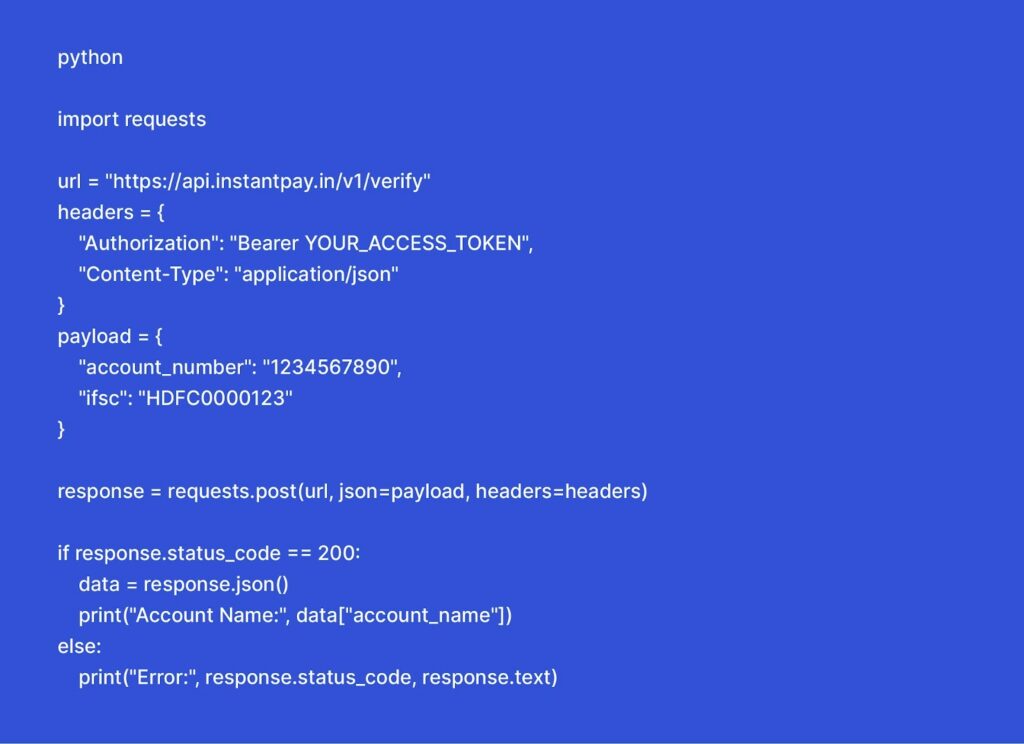
Code Snippet in Python:
Security Best Practices
1. TLS/HTTPS
All communication should happen over HTTPS (TLS 1.2 or higher) to prevent MITM attacks.
2. Input Validation
- Sanitize and validate account numbers and IFSCs.
- Ensure no special characters are passed from the frontend.
3. Logging and Monitoring
Log every API attempt with:
- user_id
- account_number (masked)
- match_status
- timestamp
- response_time
Use these logs for audits and monitoring fraud patterns.
4. Data Encryption
Encrypt all PII at rest and in transit. Follow RBI and DPDP Act norms for Indian data.
5. Consent Collection
For compliance with India’s Data Protection Bill, add user consent before initiating bank verification:

Account Ownership & Fraud Detection
Bank account verification APIs help detect:
| Risk Type | How API Helps |
| Mismatched names | AI/ML fuzzy match reveals misspelled or fake names |
| Mule accounts | Repeated failed matches can flag suspect activity |
| Bot attacks | Rate limiting and fingerprinting stop automation |
| High-value fraud | Pre-verification before disbursal mitigates loss |
Compliance Checklist
If you’re verifying accounts in India, you must comply with RBI and other data regulations.
- RBI/SEBI/KYC Mandates
- Real-time name matching ensures valid beneficiary identity.
- Must include consent-based checks for storing and processing financial data.
- AML (Anti-Money Laundering)
- Combine with PAN, Aadhaar, and mobile verification to identify shell accounts.
- Audit-Ready Logs
Maintain logs of:
- Input data (masked)
- Response status
- API user
- Consent timestamp
- Retry attempts
Implementation Tips
1. Retry Logic for Network Failures
APIs may occasionally fail due to upstream issues (e.g., NPCI downtime). Use exponential backoff retries for robustness.
2. Fallback Options
If real-time fails, offer:
- Manual document upload
- Penny drop fallback (for low-risk flows)
3. Batch Automation
For platforms verifying 10,000+ accounts daily (e.g., payroll or lenders), use:
- Asynchronous batch APIs
- CSV upload with webhook notification
4. Caching for Repeat Checks
If a user re-verifies the same account, check your database first to avoid redundant API calls.
Test Environments (UAT)
Before going live, always use sandbox or test environments.
Sample Test Credentials:

Mock data helps simulate edge cases like:
- Partial match
- Mismatch
- Invalid IFSC
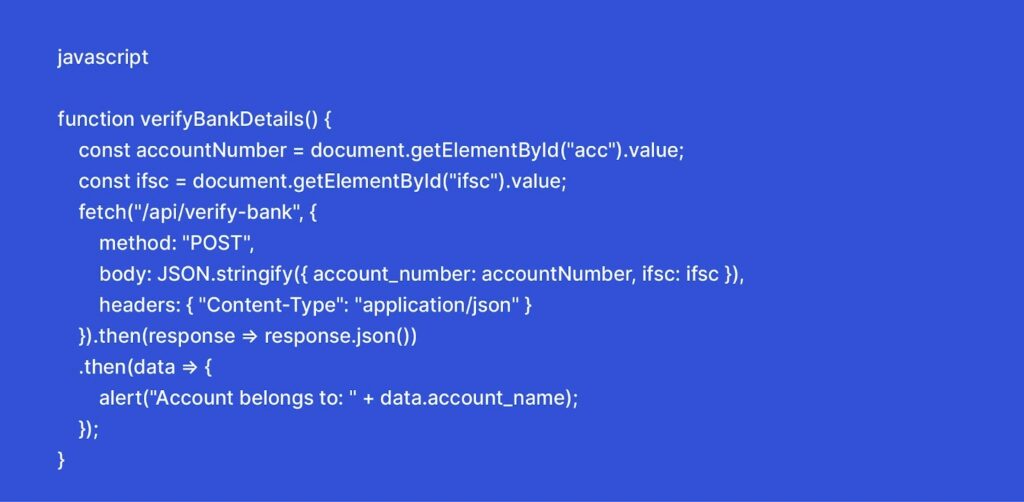
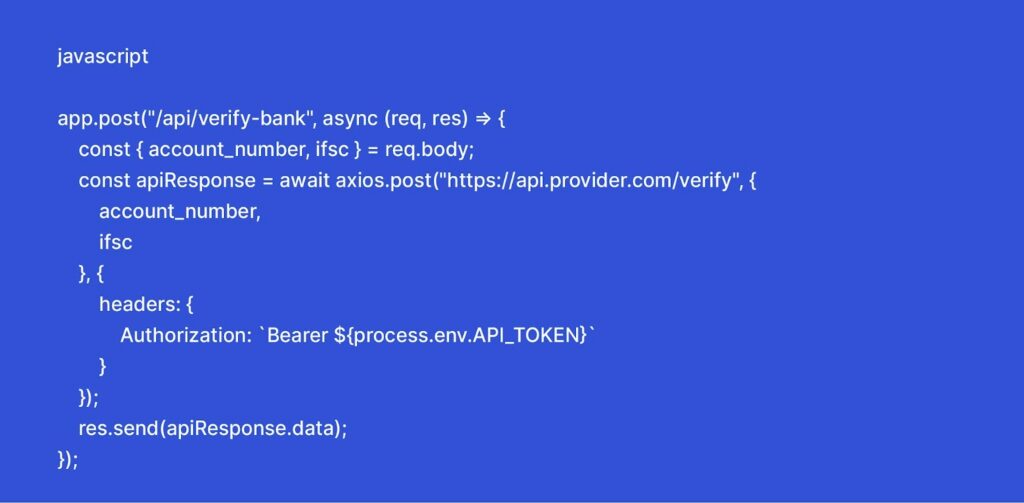
Example Integration Flow (Frontend + Backend)
Frontend:
| Metric | Description |
| API Response Time (ms) | Target < 500ms for real-time workflows |
| Match Accuracy (%) | Exact vs. Partial vs. Failed |
| Failure Rate (%) | Monitor network/API downtime |
| Fraud Detection Hits | Count of flagged mismatches or risk scores |
| Verification Cost/User | Optimize via caching or bulk plans |
FAQs
1. Is it mandatory to use a bank verification API?
While not legally mandated, it’s strongly recommended for fraud prevention and KYC/AML compliance.
2. How fast is the response time?
Typically 300–500 ms per request for real-time endpoints.
3. What if IFSC is wrong?
The API will return a 404 or invalid response — always validate the IFSC format first.
4. Can I verify NEFT/IMPS accounts?
Yes — account + IFSC-based verification supports standard bank transfer-compatible accounts.
5. How do I ensure user consent?
Use a checkbox or digital consent form before initiating the API call and log it.