In the past, term insurance provided ultimate security by guaranteeing a payout if you died. But, there’s one possible outcome not covered by a term insurance policy in the event of your permanent disability from surviving after an accident.
The Ministry of Road Transport and Highways reported that India experienced more than 4.8 lakh road accidents and 1.72 lakh deaths, with more than 1.5 lakh survivors left permanently disabled in 2023 alone, which means that there were almost 400 individuals left with permanent disabilities every single day of the year, and the majority of these people were working age.
This is where the Accidental Total and Permanent Disability (ATPD) rider becomes very important.
The ATPD rider protects your income if you can’t work due to an accident, even if you’re alive. Unlike a term insurance policy, the ATPD rider will provide a lump sum payout to replace your earnings once you have permanently lost your ability to earn due to total and permanent disability.
The ATPD rider will protect your ability to earn money throughout your lifetime and is an additional layer of protection when your life can change in a split second.
This article will explain how the ATPD rider works, the reasons it is frequently misunderstood, and how to determine if it is a necessary part of your term insurance plan.
What Is an Accidental Total and Permanent Disability (ATPD) Rider?
An Accidental Total and Permanent Disability (ATPD) Rider is an additional benefit available within term insurance that provides a one-time payment, or an income payment (dependent on the plan), in the event that an insured individual suffers from an injury that is life-altering and results in a permanent inability to earn income as a result of an accident.
Although the base term insurance policy is designed to provide financial support to a family if the insured dies, there is no coverage under the term insurance policy for life-altering injuries where the insured does not die but loses his or her ability to earn money in the future. An ATPD Disability Rider provides the necessary financial support in the event that this occurs.
An ATPD Disability Rider is different from the Total Permanent Disability (TPD) benefit in terms of the types of disabilities it covers.
- A TPD disability could arise from an illness (e.g., a stroke that results in paralysis); and
- An ATPD disability would only apply to those disabilities that result from external, accidental accidents.
ATPD Rider vs Total Permanent Disability: Quick Comparison
| Feature | ATPD (Accidental TPD) | TPD (Total Permanent Disability) |
| Trigger | Accidents only | Illness or accident |
| Covered Under Term Plans | Optional rider | Often included in broader policies |
| Common Examples | Paralysis due to road accident, loss of limbs | Stroke, degenerative disease, or traumatic injury |
| Benefit Type | Lump sum or monthly income | Typically lump sum |
The Indian insurance regulator, IRDAI, has included the ATPD Rider in its list of additional features for individual term insurance policies. Major life insurance providers such as SBI Life Insurance, HDFC Life Insurance, and ICICI Prudential Life Insurance include these add-on riders as part of their standard procedure, defined processes, and maximum benefits for claims.
When you first look at your available options, you want to know how your term insurance policy will provide protection; without a rider such as ATPD coverage, your income may not be protected and you may not receive any benefit should you have an accident.
Why Does the ATPD Rider Deserve More Attention?

When buying a term insurance policy, you may come across an accidental disability rider and not fully understand its value. Most people focus on death benefits; however, if you are the primary income provider of your family or you perform a physically demanding role for work, an accidental disability rider may cost you much more than you think.
An accidental disability rider differs from a basic life insurance policy because it provides the income replacement aspect. Anyone who works as a gig worker, contractor, or delivery person or regularly commutes using an alternate mode of transportation will always be at risk for injury. In the case of an accident resulting in a permanent disability, you will not receive any financial support under your term insurance policy alone
According to multiple IRDAI-approved product brochures (e.g., SBI Life – Smart Shield UIN 111N067V03), the maximum benefit for ATPD riders is capped at RS.50 lakh, or up to the base policy’s sum assured—whichever is lower. That’s not just a number. It’s the income bridge your family needs if you’re no longer able to provide.
Did You Know?
ATPD rider benefits typically cap at Rs.50 lakh or your base sum assured — a powerful buffer when your income stops after a serious accident.
Source: SBI Life ATPD Rider, UIN 111B016V03
While you are understanding how base cover works, it’s worth seeing what you should know before buying a term life insurance plan in 2026, especially if income protection matters more than just payout amounts.
What Conditions Are Covered Under ATPD Riders?
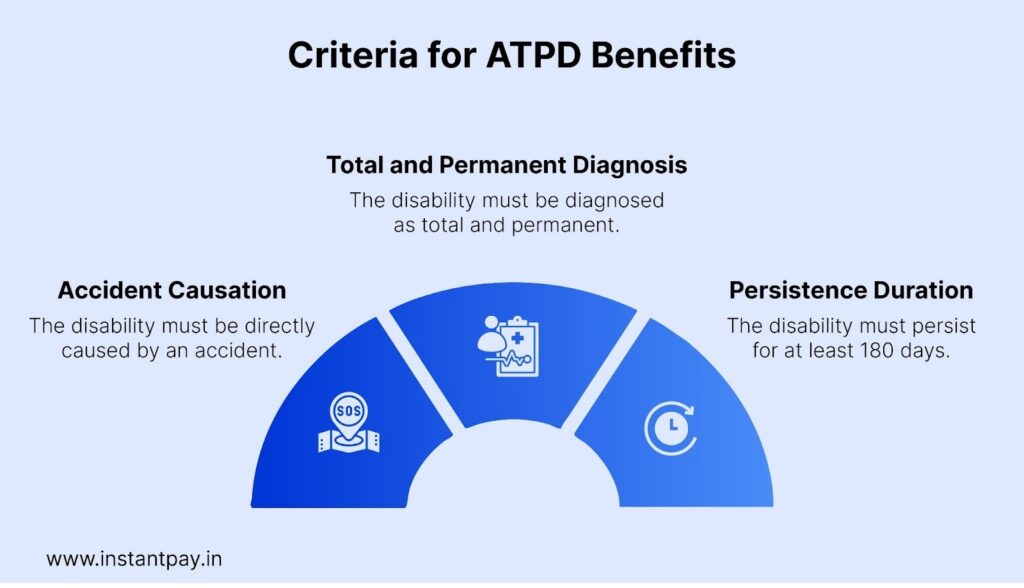
Not all accidents qualify for disability insurance claims when using the term ‘accidental total permanent disability’ (ATPD). Each insurer can have its own definition of what constitutes an ATPD and these definitions will be limited to a number of criteria that determine if the accident is “total” and “permanent” in nature. The disabling injury must also be one that is not temporary and does not allow any ability to re-enter the workforce.
To qualify for ATPD benefits, the disability must be:
– An accident exclusively
– Diagnosed as total and permanent
– Documented to exceed the 180-day duration requirement from the IRDAI
Let’s clarify the above-mentioned definitions of the ‘accidental total permanent disability’ benefits.
Commonly Covered Conditions Under ATPD Riders
| Covered Condition | What It Means | Seen In Products Like |
| Loss of both hands, feet, or limbs | Amputation or loss of function in two or more limbs | SBI Life Smart Shield, HDFC Life Protect Plus |
| Loss of vision in both eyes | Permanent blindness from trauma or explosion | Bharti AXA Life eProtect, Max Life Online Term |
| Loss of one limb and one eye | Combined impairment affecting vision and mobility | ICICI Pru iProtect Smart |
| Complete paralysis | Full loss of voluntary movement in major limbs | Edelweiss Life Zindagi Plus |
| Irreversible brain injury or coma | Severe trauma leading to permanent vegetative state | Available as per insurer-specific definitions |
| Total inability to perform daily living activities | Inability to do 3+ core functions like dressing, bathing, mobility | Bharti AXA, HDFC Life Income Benefit Rider |
Note: Every insurer uses slightly different wording, but all require certification of the disability by a medical board and confirmation that it has persisted for at least 180 consecutive days.
What qualifies as a permanent disability under term insurance riders?
A permanent disability in term insurance riders usually includes the loss of two limbs, both eyes, or complete paralysis due to an accident. It must be certified by medical experts and last continuously for at least 180 days.
How ATPD Riders Work in Real Life?
Understanding how an accidental disability rider works in real life is easier if you look at an example.
Consider someone who has a terrible accident and loses both legs. They can’t work or support themselves anymore. This scenario means that if the person had a term insurance policy, he/she wouldn’t be able to collect the death benefit from it since the death benefit will never become payable due to the accident.
However, if that same person has an Accidental Total and Permanent Disability Rider, then they will be able to claim the benefits from the rider if the disability meets the standards established by the insurance company and is considered to be permanent.
The guidelines set forth by the IRDAI (Insurance Regulatory and Development Authority of India), which are the same as those that govern major insurers like SBI Life and ICICI Prudential, include that the disability must occur because of an accident, that it must be a total and permanent functional loss, and that it must occur for at least 180 days after the accident has occurred.
When the disability has been appropriately certified as permanent and total by an authorized medical board, then the amount due can either be paid in one lump sum or paid out on a monthly basis based on the policy provisions.
How to File a Total & Permanent Disability Rider Claim
Steps to make a claim for the Accidental Total and Permanent Disability Rider:
- Notify the Insurance Company of the Accident within thirty (30) days of the accident
- Provide the Insurance Company with the necessary medical records, including a medical certificate documenting the accident resulting in disability, hospital reports, and a copy of the FIR if available
- Wait 180 days from the date of the accident according to the Policy provisions to be assessed as Total & permanently disabled.
Receive your benefits either in a lump sum or in monthly amounts.
How Is ATPD Different from Other Term Insurance Riders?
Key Differences: ATPD vs Other Riders
| Rider Type | Trigger | Benefit Type | Ideal For |
| ATPD | Permanent disability from accident | Lump sum/monthly income | Breadwinners, field workers |
| Critical Illness | Diagnosis of major illness | Lump sum | Medical risk cover seekers |
| Accidental Death | Death by accident | Nominee payout | All policyholders |
| Waiver of Premium | Disability or illness | Future premiums waived | Income-sensitive buyers |
Who Should Opt for an ATPD Rider?
An accidental disability rider is more than an optional benefit; it can be critical to the financial security of individuals whose work depends on being physically present or able to interact with others. This type of rider can be of most value to the following types of workers:
- Blue-collar workers & field technicians
Many of whom work with equipment that requires them to be at their job site or traveling to various job sites; a disabling injury could immediately terminate their income with no chance to return to their job until they recover from a disabling injury - Delivery agents, drivers, and logistics staff
Who are in their vehicles daily — if these workers suffer a serious injury while working, they may not have any employer-provided benefits to help cover their lost income until they can return to work. - Freelancers & gig economy professionals
Those who work for themselves normally do not have health benefits or paid time off; if they are unable to work because of an accident, their income will cease, but their expenses will continue. - Small business owners & self-employed individuals
May rely heavily on their ability to physically be at their business to run the day-to-day operations; if a business owner suffers a long-term disability, that could severely affect their business and/or household finances. - Anyone without long-term disability or income protection
They will be financially vulnerable due to their inability to work after a catastrophic accident, especially if they are employed by an employer that does not provide any supplemental income replacement benefits beyond a few weeks or has no sick leave policy.
An ATPD rider steps in when a base term plan stays silent—helping you replace income when your ability to earn is lost, not your life.
What Is Not Covered Under This Disability Cover?
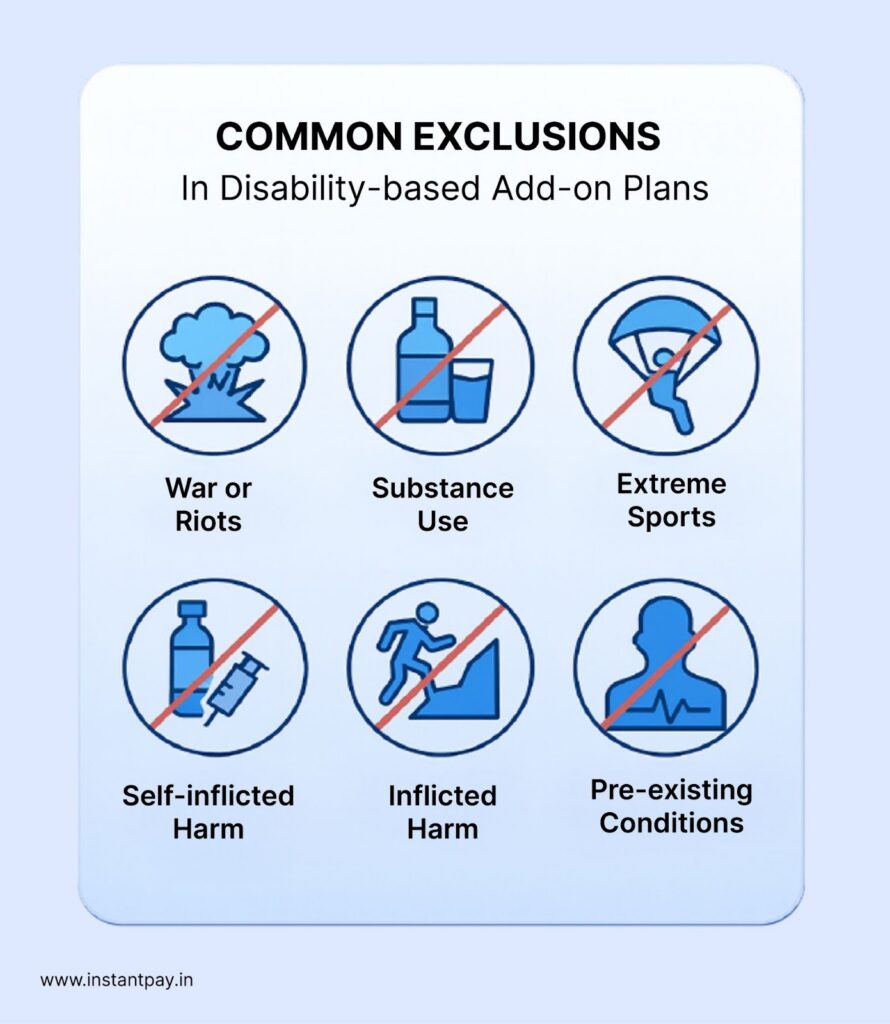
Insurers of permanent disability insurance have the strictest guidelines when it comes to approving claims; therefore, knowing what is not covered under the various policies is essential to avoid assuming there is coverage and will allow for better planning.
Here are the most common exclusions you’ll find across leading insurers:
1. War, Riots, or Nuclear Events
Injuries that arise from war or civil unrest are considered to include injuries resulting from armed conflict, as well as injuries sustained due to nuclear radiation. Examples of these types of injury claims include those related to political protests and riots. The insurance industry has long used language related to “riots” to deny claims in situations such as the 1921 Tulsa race riots, as evidenced by historical documents showing that insurance companies invoked policy language directing denial of claims related to instances of unrest across the country in the early twentieth century.
In India, personal accident policies regulated by the Insurance Regulatory Development Authority of India (IRDAI) include these types of injury claims as excluded from the scope of coverage, thereby contributing to the 8% national claim denial rate for the fiscal year ending March 31, 2025, down from 11% during the prior year.
2. Accidents Due to Substance Use
Insurers routinely deny claims for accidents involving insured intoxication or drug use, even if the intoxication did not contribute to the accident.
The IRDAI prohibits the payment of health insurance claims for “treatment of alcohol, drugs, or controlled substances,” but courts require evidence of a “direct relationship” between the insured’s actions and such denial of the claim; however, substance abuse denials are a part of the 25% of claims that fall within the “exclusion ambush” category (80% of all IRDAI grievance filings).
In the fiscal year ending March 31, 2025, the overall claims settlement rate was 87%. However, denials based on substance abuse were frequently cited as one of the top two reasons for claims being denied, along with missing documentation, which accounted for 35% of all claims.
3. Hazardous or Adventure Sports
Adventure and hazardous activities fall under the definition of “hazardous” and are classified as such by standard insurance terminology. Many standard forms of term life insurance, including additional benefits from the insurance company, exclude coverage for any injury resulting from these types of activities.
On average, 18% to 28% of the total number of claims submitted to insurance companies for the Mexican travel insurance service are related to undisclosed “extreme” sporting events, 1,4% or more of which have occurred during the course of performing activities such as river rafting and operating a motorcycle of greater than 150 cc engine displacement. The IRDAI requires rules about “professional” contestants in sports, but they do offer some coverage to “recreational” participants, which leads to about 20%-60% of complaints made to the IRDAI because their claims are denied due to previous exclusions.
4. Self-Inflicted Harm or Suicide Attempts
If an insured individual purposely injures themselves or attempts to commit suicide, that individual will not receive benefits for the resulting injury in the event that they become permanently disabled as a result of the insured’s actions, regardless of whether the individual is covered under an individual or group health plan.
The IRDAI health insurance regulatory agency mandates that health insurers shall not make any payments for any medical claims based upon any act or omission of the insured to injure themselves. During the fiscal year ending March 31, 2025, the total number of grievances filed with the IRDAI was 258,000, with the vast majority being related to claims.
5. Pre-Existing Medical Conditions
Pre-existing medical conditions, even where the condition is not disabling when the policy was issued, will always be denied by insurance companies. The IRDAI broadly defines pre-existing conditions for the purpose of determining if a medical condition is pre-existing (signs, diagnosis of the condition, and/or treatment received within the 48 months immediately preceding issuance of the insured’s health policy), which results in claim denials of 15% due to insurance portability or non-disclosure issues.
For example, $7,200 of neurology follow-up care was denied by the insurance company due to the insured failing to disclose their history of vertigo even though they had pursued recreational adventure sports years prior to the date of the claim. In total, approximately 25% of claims currently denied by insurers are due to pre-existing exclusion provisions, despite having an average settlement rate of 85% to 90%.
Think of this as, no matter the outcome of your injury, you may have been eligible for payment according to the terms of your policy, provided the terms of your policy are met. The origin and the cause of the injury are critical.
What are the exclusions in a disability add-on plan?
Accidents caused by war, riots, intoxication, hazardous sports, or self-inflicted injuries are not covered under total and permanent disability add-ons. Most insurers also exclude pre-existing conditions and non-accidental causes.
Behind the Claim: How Insurers Decide What’s Covered (and What’s Not)
1. Claim Approved: Loss of Both Legs at Work
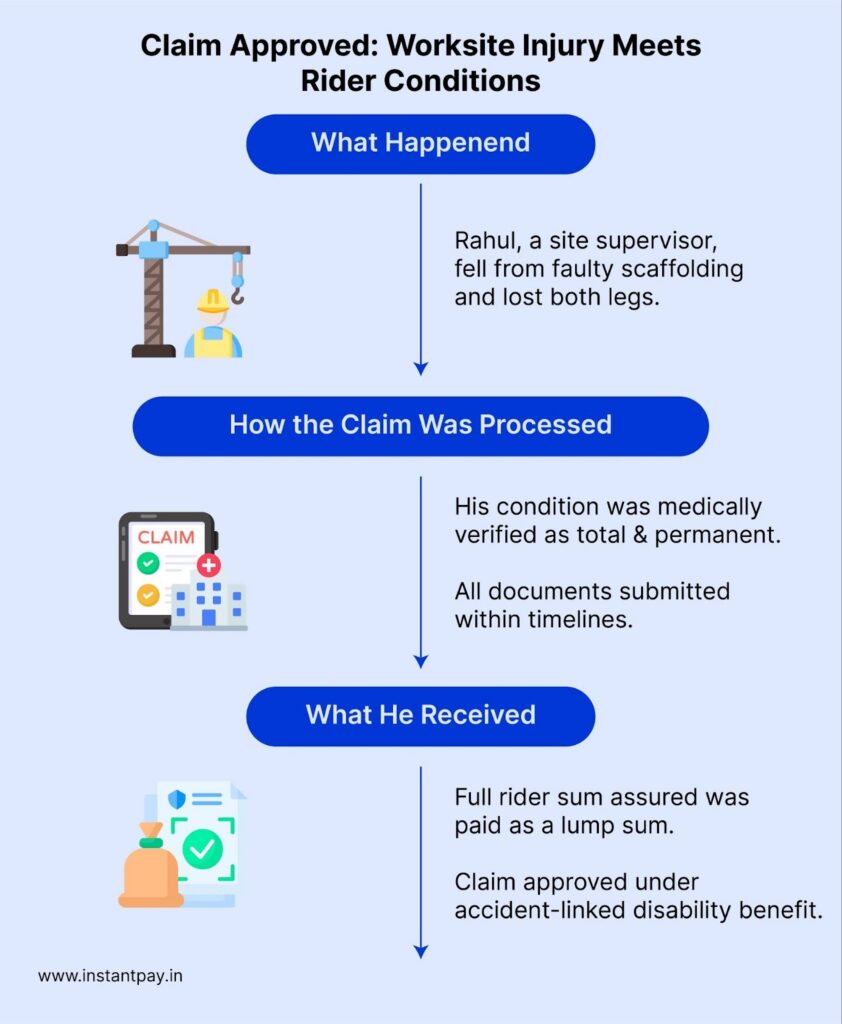
Scenario: Rahul, a site supervisor, lost both legs after falling from faulty scaffolding at a construction site. The accident was work-related, sudden, and the disability was certified as permanent by a medical board.
Result: Full sum assured released under the disability benefit.
2. Claim Rejected: Skydiving Accident Resulting in Paralysis
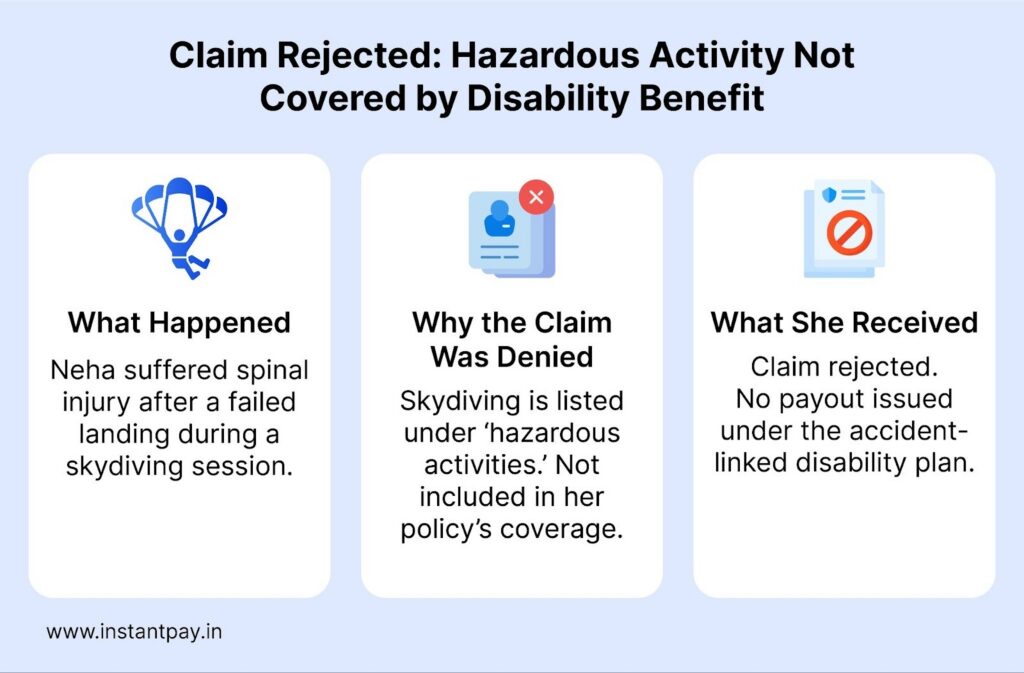
Scenario: Neha, a software engineer, suffered permanent spinal damage during a recreational skydiving trip. Although the injury caused total disability, the activity was listed under “hazardous sports” in her exclusion list.
Result: Claim denied under the adventure sports clause.
3. Claim Approved: Permanent Blindness from Lab Explosion
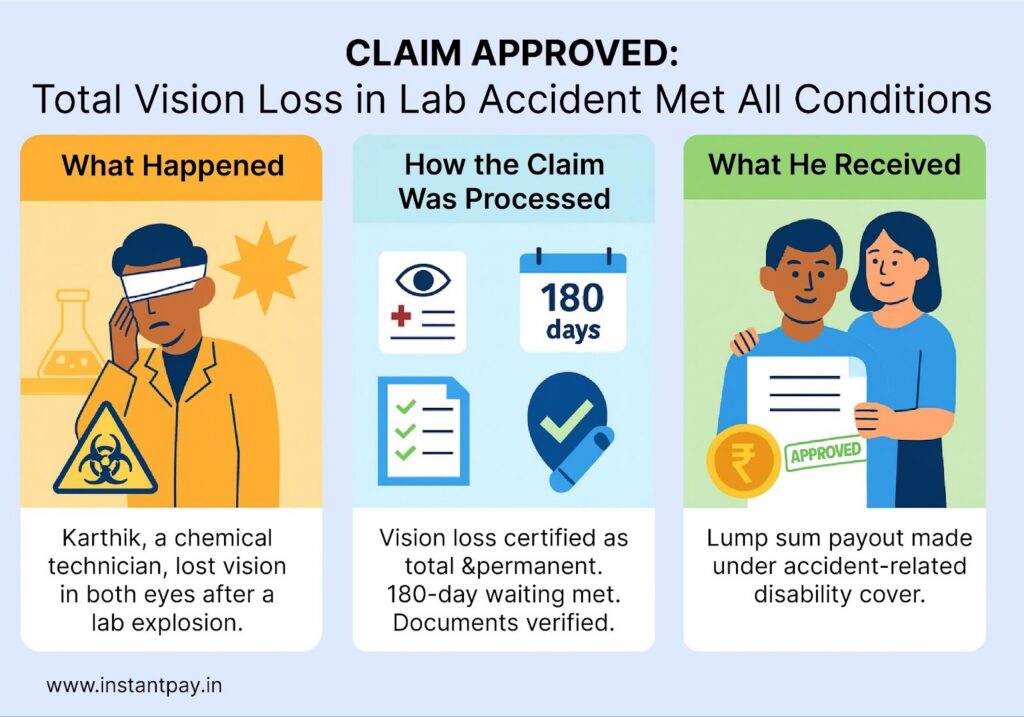
Scenario: Karthik, a chemical technician, lost vision in both eyes following a lab explosion. After 180 days of observation and confirmation from a specialist panel, the insurer accepted the disability as permanent.
Result: Lump sum payout issued.
4. Claim Rejected: Accident While Intoxicated
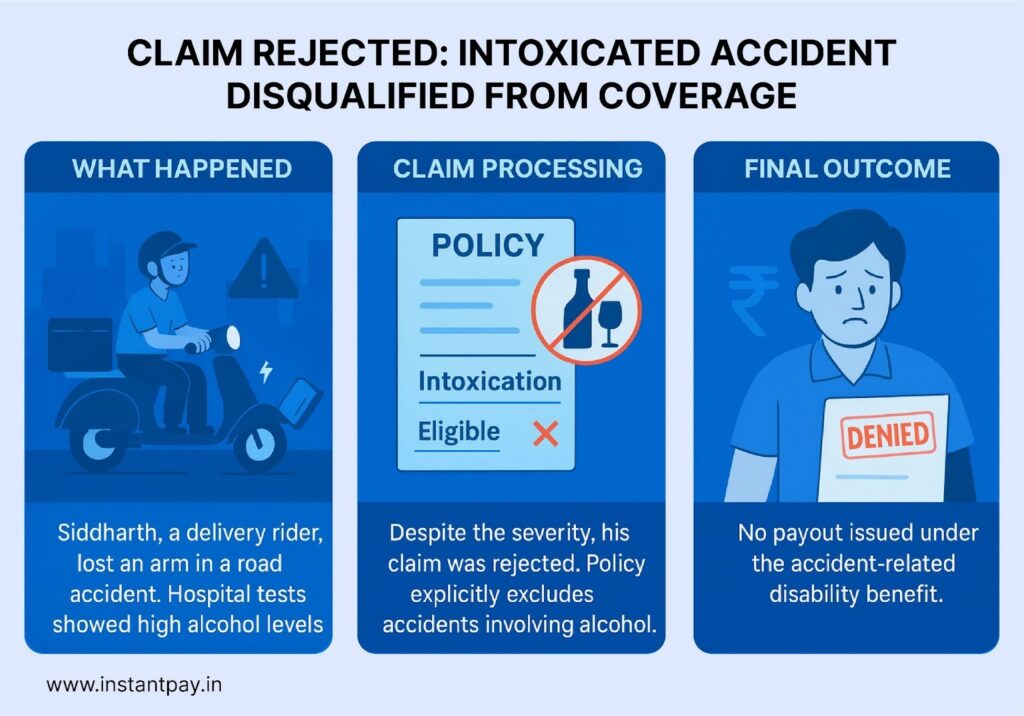
Scenario: Siddharth, a delivery rider, was involved in a major accident that resulted in the loss of one arm. Hospital records showed high alcohol levels at the time of admission.
Result: Claim rejected due to intoxication at the time of the incident.
How Much Does It Cost? ATPD Rider Premiums Explained
A disability-benefit option is a very low-cost product that can be added to your term plan to provide you with a level of income protection in circumstances with tremendous impact. Ultimately, the premium for this option is minimal.
One example is the ICICI Prudential disability cover, which has a base annual premium of approximately the following for a Rs.10 lakh payout:
| Premium Payment Term | Policy Term | Approx. Annual Premium |
| 5 years | 10 years | Rs.724 |
| 6 years | 12 years | Rs.759 |
| 10 years | 12 years | Rs.525 |
| 12 years | 20 years | Rs.705 |
| 20 years | 20 years | Rs.460 |
(Source: ICICI Pru Life Smart Protect – Premium Illustrations 2024)
Premium vs. Benefit Logic
The payout for your injury will depend on the accident protection option you choose. For example, the HDFC Life income option will pay 1% of the base amount for 10 years each month to you.
The limit for the cost of this extra option is typically 30% of your base policy’s premium. Therefore, if your base term plan is Rs.5,000 per year, the maximum possible premium for this disability option would be approximately Rs.1,000–Rs.1,500 Additionally.
You will have some degree of protection if you lose the ability to provide for your family due to an accident.
Most insurers also offer flexibility in premium payment terms—allowing you to align this protection with the tenure of your base coverage.
What to Look for Before Adding ATPD Rider?
Smart Buyer’s ATPD Checklist
- Sum assured is at least 50% of your annual income
- Benefit payout type suits your household needs
- Insurer’s past claim settlement ratio is 95%
- Rider is active throughout the base policy tenure
- You’re aware of exclusions and documentation
Future of Disability Protection: Trends to Watch
1. IRDAI’s Focus on Inclusivity in Cover Options
Emergency-type health riders must be included in all life insurance policies according to IRDAI’s (Insurance Regulatory Authority of India) latest master circular. Insurers must communicate the terms, conditions, clarity, and transparency of the emergency-type health riders.
What that means for you is that your term plans will now have an ATPD (Accidental Total and Permanent Disability) rider as an added benefit rather than just optional. Source
2. Mental Health-Related Disability on the Horizon
In March 2023, IRDAI issued a directive for insurers to develop products for people who have disabilities (including mental illness or impairment).
Why it matters: The importance of this for you is that this allows for disability policies to provide coverage for someone with a permanent mental illness, rather than only for those who have suffered an injury. This should start in 2026 (Source)
3. Enhanced Claim Digitization & AI-Based Validation
IRDAI has required all insurance companies to have e-KYC (provided by the Aadhaar/Aadhaar authentication) for all insurance policies starting January 2023. They have also established a committee to simplify the onboarding process for digital and to reduce the incidence of fraud.
The goal of the IRDAI is that by 2025-26 all insurers will use AI-based disability validation models for processing claims resulting in timelier and more accurate claims processing (Source)
In summary, the entire insurance industry will continue to move toward more inclusive, consumer-friendly, and technology-based products. If you evaluate a policy in 2025 or 2026 expect broader coverage (including coverage for mental illness) and more efficient claims processing.
Final Thoughts
Most people know that term life insurance pays for family members in the event of death; however, they frequently are unaware of many other ways families can be placed at risk for lack of financial security, such as being injured in an accident and being unable to continue earning a living for your family due to the injury. There may also be many extra expenses or bills related to your inability to earn a living due to the injury.
In this situation, the disability coverage found in a life insurance policy more than an add-on to your existing coverage; it upholds both your dignity and the dignity of those who depend on you regardless of whether you are able to carry out the aspects of managing your own life because of the injury. Therefore, obtaining the proper types and amounts of coverage necessary for you as a wage earner (via either employer or self-employed income) is imperative.
Persons who earn income from an active source will find they should think of disability insurance as a key benefit as opposed to one that may simply be considered an addition to another piece of coverage. Furthermore, this type of insurance should be perceived as critical by gig workers, field staff, small business owners, and ultimately any type of employee, whether they are trying to make ends meet through use of physical capability.
FAQs
1. What is an accidental total and permanent disability rider?
An accidental total and permanent disability (ATPD) rider is an optional add-on in term insurance that pays a lump sum or monthly income if you’re permanently disabled due to an accident and can no longer earn a living.
2. What is term insurance with permanent disability riders?
It’s a term life insurance plan that includes a rider offering financial support if the insured becomes totally and permanently disabled due to an accident. It ensures income protection even when death doesn’t occur.
3. What is the total and permanent disability (TPD) benefit?
A TPD benefit provides a payout if the policyholder suffers an illness or injury that permanently prevents them from working again. It’s broader than ATPD, covering both accidents and medical conditions.
4. What is term accidental disability insurance?
Term accidental disability insurance offers a payout when an accident causes long-term or permanent disability. It works within a term plan as a rider and typically covers loss of limbs, vision, or paralysis.
5. What is the benefit of a disability rider?
A disability rider ensures continued financial support if you can’t work due to a permanent physical loss. It supplements your main life cover, protecting your income even if you survive the accident.
6. What does 100% permanent and total disability mean?
It means the person has lost the complete ability to earn due to irreversible physical or mental impairment, such as loss of both limbs, complete blindness, or paralysis, confirmed by medical assessment.
7. How many times can you claim TPD?
You can claim TPD only once per policy. It’s a one-time benefit paid upon confirmation of permanent and total disability, and the rider typically terminates after the claim is settled.
8. Is asthma a permanent disability?
Mild or controlled asthma usually isn’t considered a permanent disability. However, severe chronic asthma that limits daily function or work capacity may qualify under certain TPD policies with medical documentation.
9. How do I claim total and permanent disability?
To claim TPD:
- Notify the insurer within the required timeframe.
- Submit medical reports and a disability certificate.
- Undergo the mandatory waiting/assessment period (usually 180 days).
- Once verified, receive the approved benefit payout.