In a hospital, choosing a room isn’t just a comfort decision—it’s a financial one. Most policyholders remain unaware that a higher room category can lead to substantial out-of-pocket expenses, even when they have comprehensive health insurance. From hospital room charges per day to the confusing term proportionate deduction, this guide offers a detailed breakdown to help you avoid unexpected costs and make well-informed hospitalization choices.
Understanding Room Rent Limit in Health Insurance
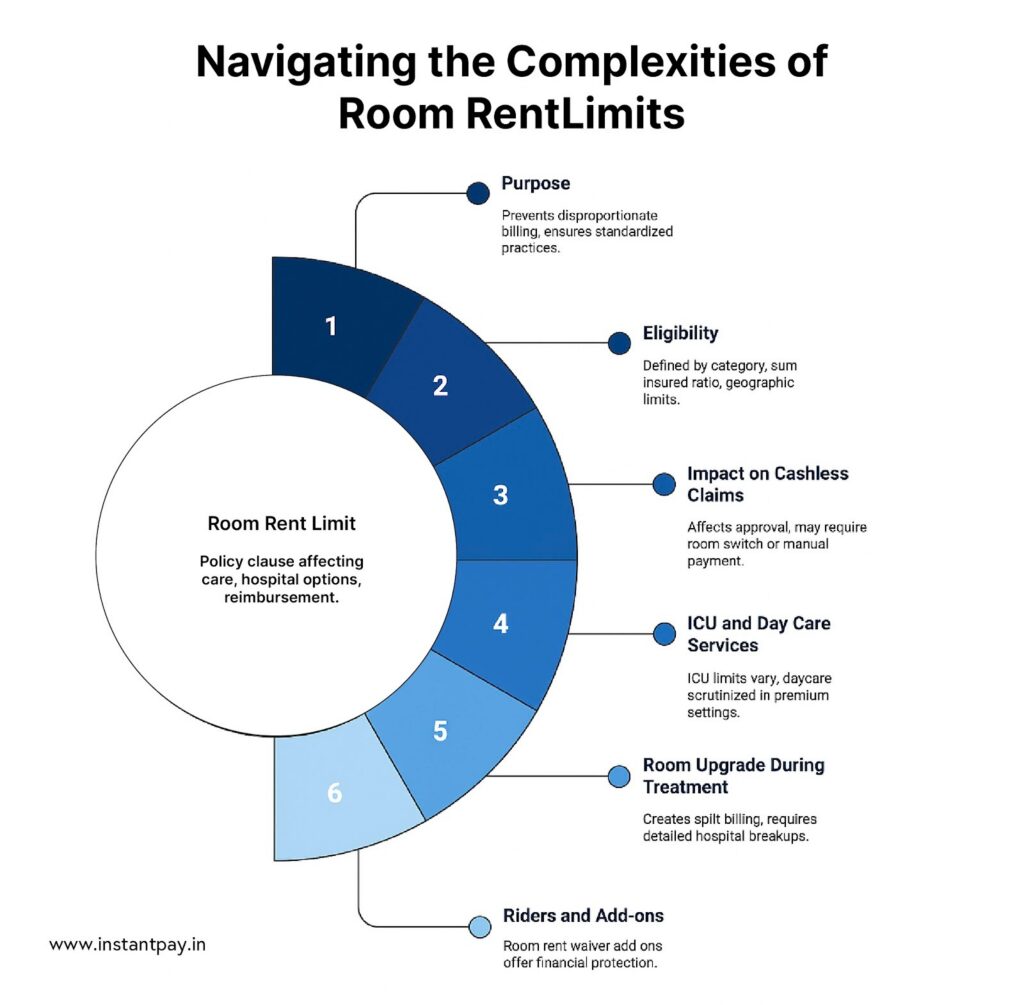
Health insurance policies often come with nuanced terms, and one of the most critical yet misunderstood is the room rent limit. Beyond just a fixed cost ceiling, this clause directly influences the type of care you receive, the hospital options available to you, and the total claim reimbursement you’re eligible for.
Let’s explore some deeper, lesser-known dimensions of this limitation:
Why Room Rent Limit Exists in the First Place
The idea behind room rent limits is not merely to control costs—it’s to prevent disproportionate billing. Hospitals frequently link the cost of various medical services to the room category. For instance, a patient in a deluxe room may be billed a higher rate for the same diagnostic test than a patient in a general ward. To maintain fairness and contain inflation, insurers cap room eligibility to ensure standardized billing practices.
How Insurers Define Eligibility (Beyond Just Daily Caps)
While most people assume the room rent cap is a flat daily amount, insurers may also define it using more complex structures:
- Room Category Restriction: Rather than specifying an amount, some policies permit only certain categories, like “shared room” or “non-AC general ward.”
- Sum Insured Ratio Models: In comprehensive or family floater policies, room rent is expressed as a percentage of the overall sum insured, which can vary depending on insured age or plan type.
- Geographic-Based Limits: A few insurers offer dynamic room rent limits based on the city or zone of hospitalization. For instance, policies may allow higher room rent in metro cities versus tier-2 towns.
How Room Rent Limit Impacts Cashless Claims Approval
Even in cashless hospitalization, room rent cap becomes a decisive factor. If the selected room exceeds your policy’s entitlement:
- Your cashless claim might be partially approved, with the excess amount billed directly to you at discharge.
- The TPA may ask you to switch rooms midway through treatment if the discrepancy is flagged late in the pre-authorization process.
- In some hospitals, you may be denied cashless admission altogether in higher-category rooms unless you commit to paying the excess manually.
ICU/Day Care Services: What You May Not Know
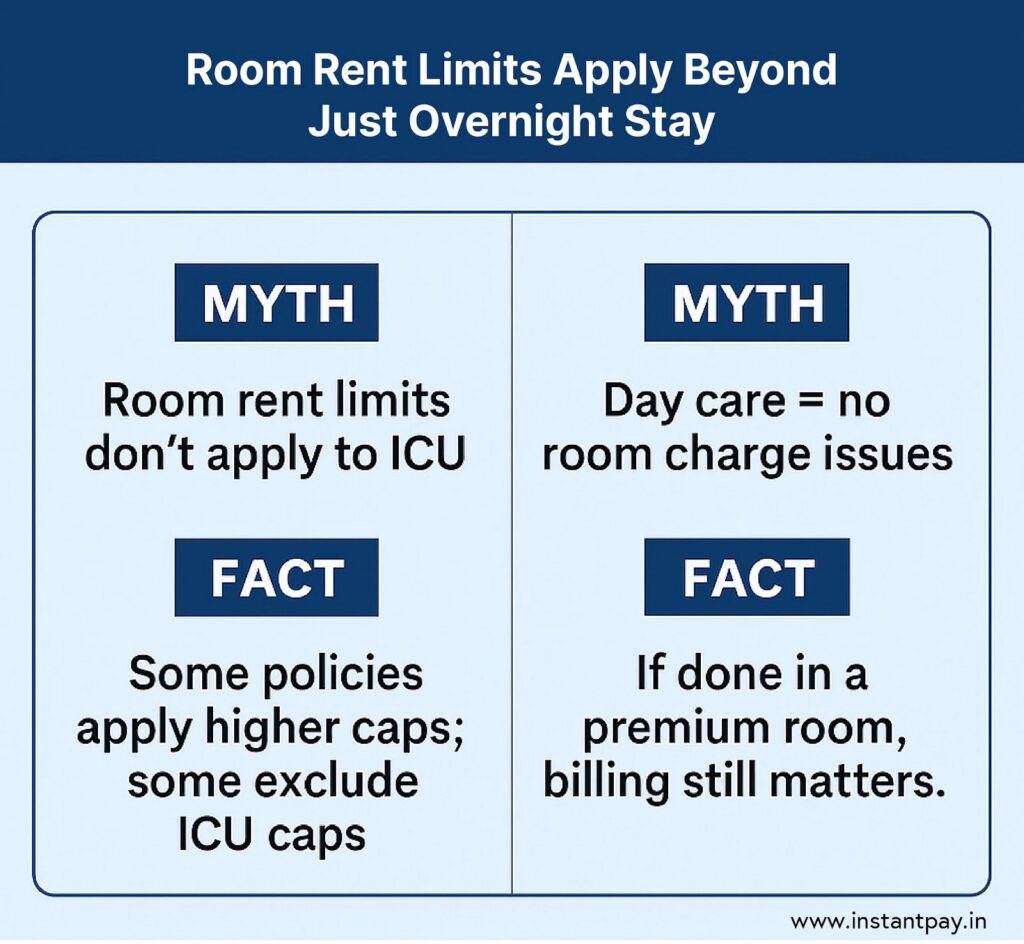
Many assume room rent limits apply only to overnight hospital stays, but this isn’t always true.
- ICU charges: Some policies exclude ICU stays from the room rent limit, while others apply a higher cap (e.g., twice the normal room limit). Always check if your policy differentiates ICU limits.
- Day care treatments: While these don’t usually involve a room stay, some high-cost daycare treatments administered in premium hospital settings may still face scrutiny if billed from higher-category rooms.
What Happens in Case of a Room Upgrade During Treatment
Changing room categories mid-treatment—for instance, from a shared room to a private room after a surgery—creates a split billing structure. Here’s how insurers may handle it:
- The claim is often divided proportionally, and deductions are applied only to the period you stayed in the higher-category room.
- However, this requires detailed daily breakups from the hospital—something many hospitals are unwilling or slow to provide—potentially delaying reimbursement.
The Role of Riders and Add-ons
Some insurers now offer room rent waiver add-ons—a small extra premium that lifts the cap entirely. While these may increase the upfront cost of your policy slightly, they can offer significant financial protection during major surgeries or long hospital stays. Unfortunately, many policyholders skip this without fully understanding the potential long-term impact.
What is a Proportionate Deduction and How It Works
While most policyholders are aware of the concept of room rent limits, very few understand the true financial impact that exceeding those limits triggers—through what is known as a proportionate deduction. This term, although seemingly technical, is central to how your insurance payout is calculated, and it can leave you with unexpectedly large bills, even if your treatment is fully covered under the policy.
Let’s break this down further and go beyond the surface.
Where the Term “Proportionate Deduction” Comes From
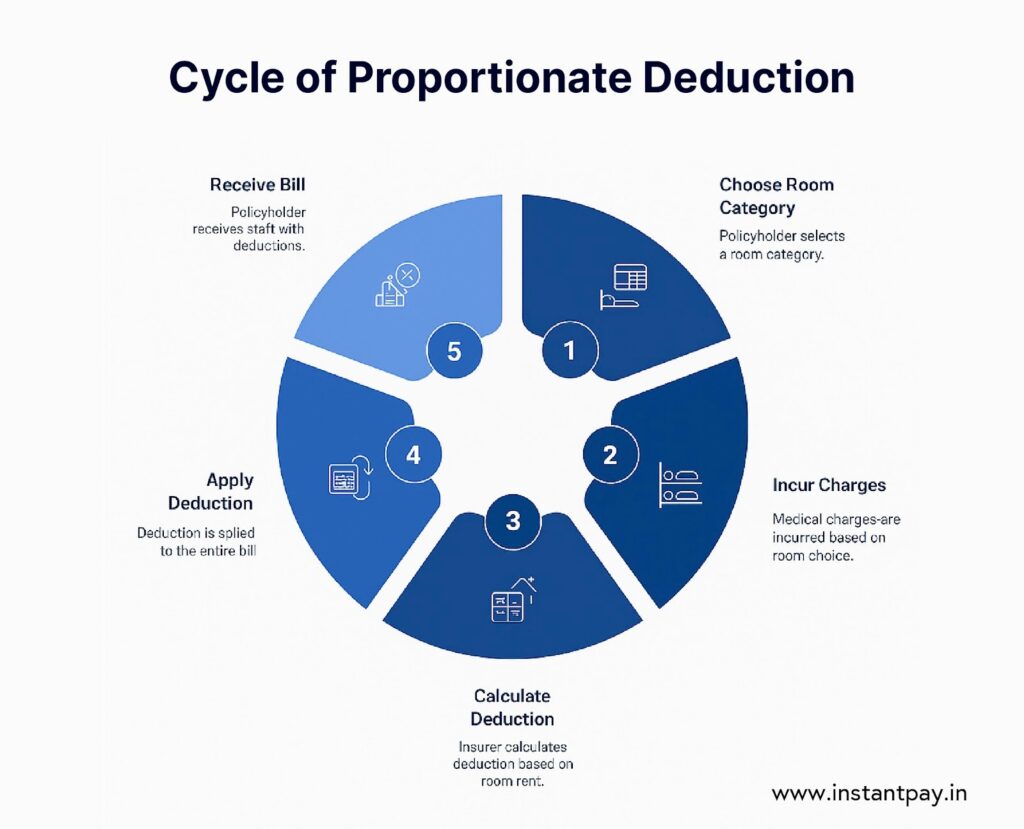
This deduction originates from a cost-sharing formula used by insurance companies. It assumes that all charges—doctor fees, nursing, OT charges, and diagnostic services—are proportionally linked to the room category. The higher the room rent, the higher these charges are assumed to be. Therefore, if you choose a more expensive room, insurers reduce their liability across the entire bill to reflect what the charges would have been if you had chosen the correct room category.
This logic is controversial because:
- Charges like medicines or surgical implants do not always vary by room type.
- Yet insurers apply blanket cuts across the full bill.
How It Is Calculated: The Formula Few Know
Here’s the actual formula used by many insurers for applying proportionate deduction:
Payable Amount = Total Bill × (Eligible Room Rent ÷ Actual Room Rent Availed)
Note: This calculation isn’t applied line-by-line. Instead, it’s often imposed on the entire claim amount, which includes services that may not logically depend on room category.
Some newer plans apply this deduction only to room-category-dependent costs, but that distinction is not always clear or documented in policy wording.
Which Charges Are Affected (and Which Are Not)?
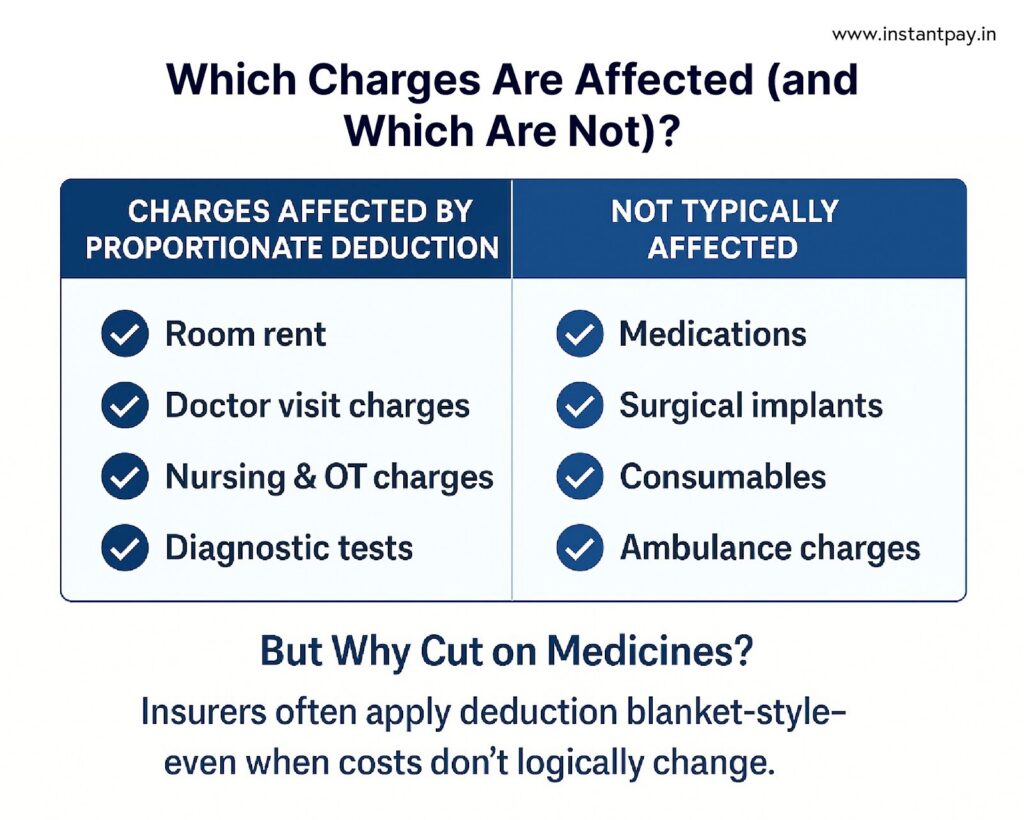
While proportionate deduction often affects the entire bill, the following charges are specifically impacted:
- Surgeon’s fees
- Anesthetist charges
- Operating theatre charges
- RMO charges
- Nursing services
- Daily consultation fees
These are tied to the “package rate” for each room category. However, these are not usually impacted:
- Pharmacy bills
- Medical implants (e.g., stents, pacemakers)
- Consumables
- Ambulance charges
But beware: Not all insurers follow this distinction consistently, and hospitals may bundle these costs under a single head, making it difficult to separate affected vs. unaffected components.
How Hospitals Factor This In (and Sometimes Miscommunicate)
Hospitals often bill patients at higher tariff slabs when they choose premium rooms. While this seems logical, it complicates claims because:
- Many hospitals don’t disclose how rates differ by room category.
- Some fail to provide separate breakups by room type, leaving patients helpless during claim settlement.
- TPAs often request multiple documents and clarifications, leading to claim delays or partial rejections.
Case Scenarios: The Hidden Price of Comfort
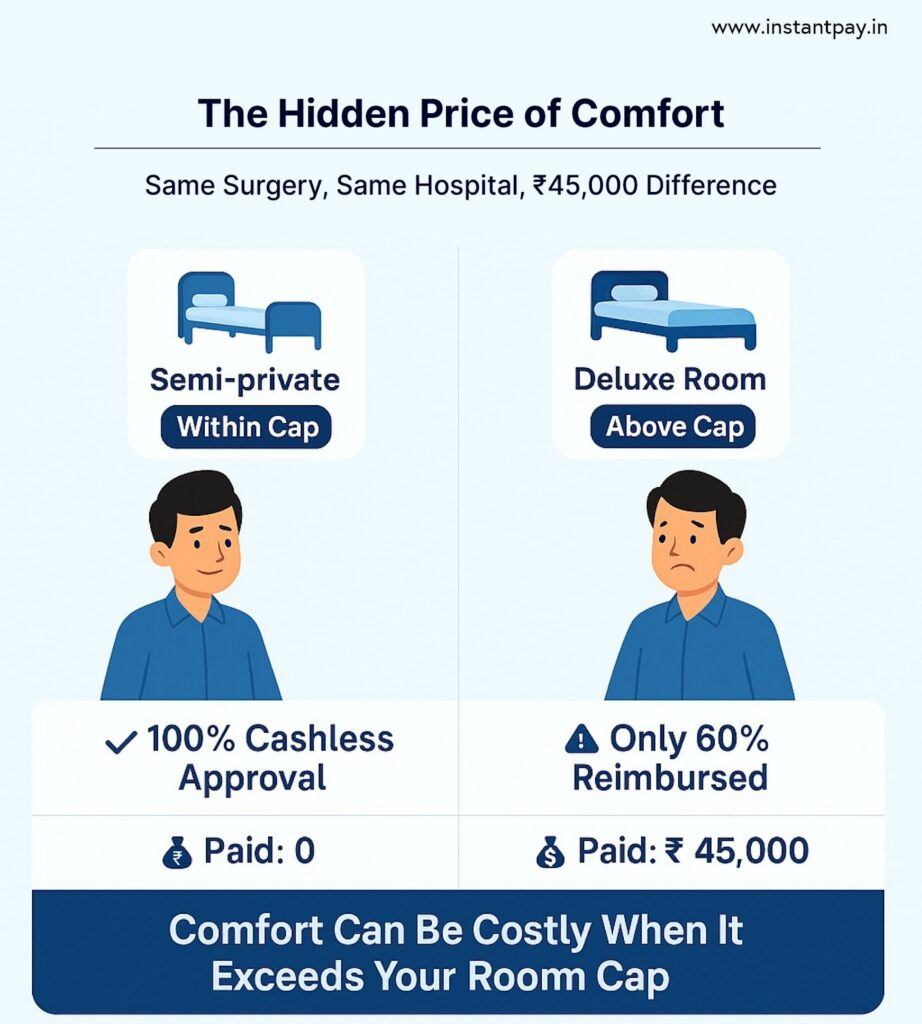
Case A – Two Friends, Same Surgery, Different Rooms
- Ajay chooses a semi-private room (within his cap)
- Ravi opts for a deluxe room (above his cap)
Both undergo gallbladder surgery, with the same doctor at the same hospital. But:
- Ajay’s bill is settled 100% cashless
- Ravi receives only 60% reimbursement due to proportionate deduction
- Despite the same treatment, Ravi pays Rs.45,000 more just for choosing a better room
How IRDAI and Court Rulings Have Intervened
Over the years, several consumer forums and High Court rulings have questioned how fairly proportionate deduction is applied. In some cases:
- Courts have ruled that non-room-related charges should not be subjected to proportional deduction.
- IRDAI has advised insurers to apply deductions only to specific line items, not the entire bill.
Still, in practice, many insurers and TPAs default to applying it across the board, leaving patients with little recourse during urgent medical situations.
Can You Reverse a Proportionate Deduction?
In some cases—particularly if:
- The hospital has misclassified charges
- The insurer has misapplied the formula
- The deduction has been applied to non-eligible costs
—You can raise a dispute with the insurer or the IRDAI ombudsman. But this requires:
- Strong documentation
- Hospital’s cooperation for line-item clarification
- Willingness to engage in a claims dispute resolution process, which can take weeks or even months
Insider Insight: What You Should Always Ask Before Admission
- What is the eligible room rent under your policy?
- What room categories match that budget in this hospital?
- Will the hospital’s package pricing increase with room category?
- Can you get a written confirmation from the TPA or hospital billing team?
These few pre-admission checks can help you completely avoid proportionate deduction surprises.
How Room Categories Affect Your Costs
Hospitals offer several room types, each tied to specific charges:
| Room Category | Description | Common Charges Per Day |
| General Ward | Shared with 4–10 patients | Rs.1,000 – Rs.2,000 |
| Twin Sharing Room | Shared by 2 patients | Rs.2,500 – Rs.4,000 |
| Single Private Room | Private, basic amenities | Rs.4,000 – Rs.6,000 |
| Special Room in Hospital | Spacious, premium fittings, sometimes semi-deluxe | Rs.6,000 – Rs.10,000+ |
| Infirmary Room | Designed for post-op rest or observation | Varies widely; limited category |
Choosing a room “just one level up” can result in huge deductions due to proportionate logic—even if it seems like a minor upgrade.
Understanding Hospital Charges Beyond Room Rent
Many patients assume that hospital expenses are mostly about room charges. But the reality is, room rent is just one part of a much larger cost structure. What often goes unnoticed—and ends up being a financial shock—is how various other charges are subtly tied to your room selection.
Understanding the full billing matrix is essential for anyone trying to decode how hospitalization expenses grow, and why they vary dramatically from one room category to another—even for the same treatment.
How Hospitals Structure Their Billing System
Hospital billing typically includes several broad heads, each of which may or may not be influenced by the type of room you choose. These include:
- Consultation charges
- Surgical and OT charges
- Nursing charges
- Monitoring/Observation (RMO) fees
- ICU/HD charges (if applicable)
- Consumables and disposables
- Diagnostics and pathology
- Pharmacy
- Service charges or administrative fees
The room rent is just one line item—but it has ripple effects throughout.
Linked vs. Non-Linked Charges: The Hidden Tariff Ladder
Not all charges are created equal. In hospital billing systems, charges are often categorized as:
- Room-Linked Charges
These scale with the type of room chosen. For example:
- Surgeon’s fee
- Anesthetist fee
- Nursing charges
- Monitoring charges (RMO charges)
- Room-Neutral Charges
These generally stay consistent regardless of the room category:
- Medicines and implants
- Diagnostics
- Blood transfusion charges
- Ambulance
Pro Tip: If your insurer applies proportionate deduction, only the room-linked charges should be reduced. Yet in practice, many insurers or TPAs apply it to everything, unless explicitly challenged.
RMO Charges in Hospital: A Common Confusion
RMO (Resident Medical Officer) charges are often misunderstood by patients. They reflect the cost of daily bedside monitoring by an in-house medical officer and are almost always tied to room category.
- In basic rooms, this may be Rs.300–Rs.600/day
- In single or deluxe rooms, this can rise to Rs1,000–Rs.1,500/day
Since RMOs provide similar services across rooms, patients are often surprised that charges vary so significantly, but this is part of the hospital’s tariff logic.
Package Pricing and Room Dependency: The Silent Cost Driver
For surgeries or common procedures, hospitals often have predefined packages that bundle all costs: room, OT, surgeon’s fee, post-op care, and consumables. These packages are not fixed universally—they vary depending on the room category selected.
Example:
| Procedure | Twin Sharing Room | Single Private Room | Deluxe Room |
| Gallbladder Surgery | Rs.85,000 | Rs.1,10,000 | Rs.1,35,000 |
Even if your health condition and treatment remain the same, the room choice escalates the total bill due to this package pricing difference.
The Administrative Uplift: Invisible Charges That Add Up
High-category rooms sometimes carry non-clinical markups that are rarely explained clearly in the bill:
- Service/administrative fees
- Consumable packaging charges
- Higher security deposit or file charges
- Premium food and nursing care add-ons
These costs don’t fall under specific medical heads but inflate the total bill—and are not always covered by insurance.
Diagnostics and Pharmacy: Not Always Neutral
While many assume diagnostic tests and medicines are unaffected by room choice, there are caveats:
- Some hospitals charge higher consultation and reading fees for specialists if you’re in a private or deluxe room.
- In-network pharmacies sometimes offer tiered pricing based on hospital wing (especially in luxury or specialty hospitals).
Always ask: Are these diagnostics or pharmacy bills at standard rates, or based on room class?
Understanding Room Par or Room Matrix
“Room Par” refers to a hospital-specific rate chart that maps each room category to a different set of charges for every service. Think of it as a dynamic pricing grid. Knowing this matrix can help you:
- Predict how your room choice will affect non-room expenses
- Ask smarter questions at the time of admission
- Estimate what you’ll actually pay—even with insurance
Unfortunately, most hospitals don’t disclose this unless asked.
Billing for Shared Services (Hidden Charges in Twin Sharing Rooms)
In twin-sharing rooms, you may see odd charges like:
- “Split OT usage charges”
- “Shared medical attendant”
- “Second-bed monitoring fee”
These costs are unique to shared room setups and can be confusing. They’re intended to represent shared infrastructure or staff utilization, but they often create billing ambiguities that complicate insurance claims.

How to Avoid Proportionate Deductions: Actionable Tips
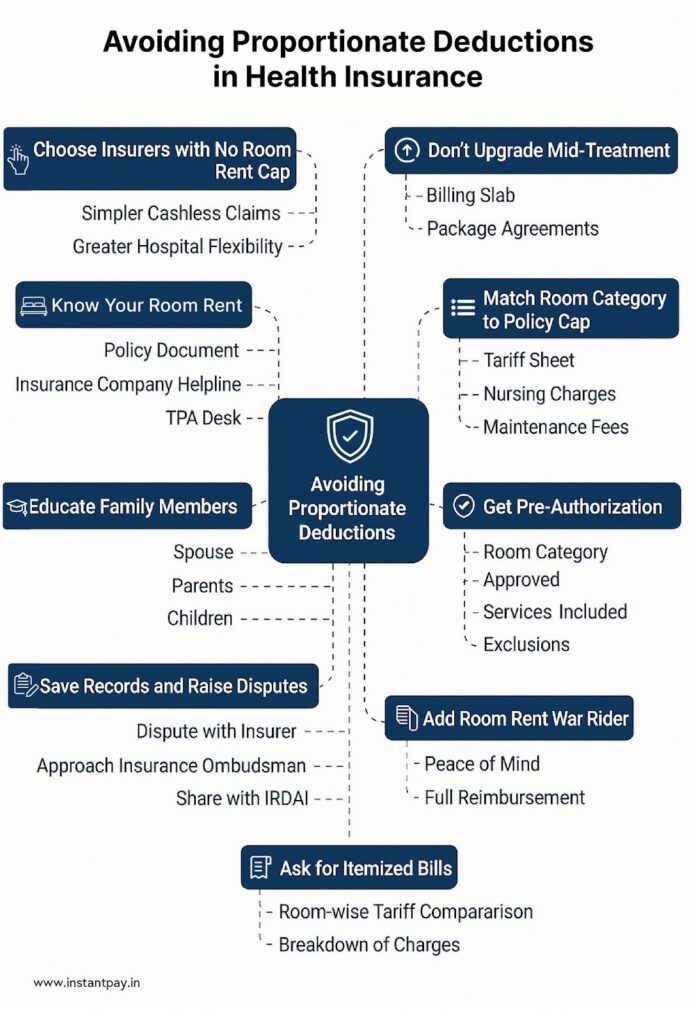
Proportionate deductions are among the most avoidable financial setbacks in health insurance claims—yet they catch thousands of policyholders off guard every year. The good news? With the right strategy and a few preemptive steps, you can completely sidestep these surprise expenses and secure full reimbursements on your hospitalization bills.
Below are practical, experience-backed tips to help you stay protected.
1. Know Your Room Rent Limit in Advance—Don’t Assume
The first and most crucial step is to confirm your exact room rent entitlement before hospitalization. Don’t rely on general assumptions like “I have a Rs.5 lakh cover, I must be eligible for a private room.”
Instead, check:
- Is it a fixed daily limit (e.g., Rs.3,000/day)
- Or a percentage of the sum insured (e.g., 1% of Rs.5 lakh = Rs.5,000/day)
- Are there category restrictions (e.g., “twin sharing room only”)
Get this information directly from:
- Your policy document
- Your insurance company’s helpline
- Or your TPA desk at the hospital
Tip: Note this down and carry it with you during admission.
2. Match Your Room Category to the Policy Cap
Once you know your room rent limit, ensure the actual room tariff (before taxes) falls within that cap.
Example:
- If your cap is Rs.4,000/day, avoid booking a Rs.4,500 room—even that rs.500 extra can trigger a 20–30% deduction on the full bill.
Instead:
- Ask for the tariff sheet of available rooms
- Choose the room that’s equal to or below your limit
- Confirm whether the quoted room rent includes nursing charges and maintenance fees
Watch out: Some hospitals club basic services into room rent, inflating the base cost.
3. Add a Room Rent Waiver Rider When Buying or Renewing Your Policy
Most modern insurers offer a room rent waiver rider at an additional premium. This upgrade removes the room rent limit entirely and allows you to select any category—without proportionate deductions.
While it slightly increases your premium, it offers:
- Peace of mind during hospitalization
- No last-minute scrambling for room availability
- Full reimbursement, even in private or deluxe rooms
Insider insight: It’s especially valuable in metros or tier-1 cities where even twin-sharing rooms can exceed Rs.5,000/day.
4. Choose Insurers With “No Room Rent Cap” Plans (If Budget Allows)
When comparing policies, look beyond the sum insured. Choose plans that:
- Have no capping on room rent
- Or have a high limit with clear ICU separation
- Clearly state “no proportionate deduction applicable” in policy wordings
These plans may cost a bit more annually, but they ensure:
- Simpler cashless claim approvals
- No math gymnastics at discharge
- Greater hospital flexibility
Tip: Some retail policies and high-end floater plans for families now include this feature by default.
5. Get Pre-Authorization Clarity From the TPA Desk
Before admission (or immediately after emergency entry), get a clear pre-authorization note from the TPA/insurer team that mentions:
- The room category approved
- Services included under cashless coverage
- Any exclusions or special conditions
This confirmation can protect you in case of billing disputes later.
Request the TPA to email or hand you a written summary of this approval.
6. Don’t Upgrade Mid-Treatment Without Financial Assessment
In emotional or urgent situations, patients often switch to a better room midway—after surgery or when the patient stabilizes. However, doing this:
- Alters the billing slab
- Often invalidates earlier package agreements
- Triggers proportionate deductions retroactively unless properly negotiated
If you must switch rooms:
- Confirm whether the new charges apply from the date of upgrade
- Get the hospital to provide a room-wise daily cost breakup
- Inform your insurer or TPA immediately about the change
7. Ask for Itemized Bills and Segregated Charges at Discharge
If your claim is being processed for reimbursement (vs. cashless), ask the hospital for:
- Room-wise tariff comparison sheet
- Breakdown of room-linked and non-linked charges
- Separate mention of doctor, OT, diagnostics, and pharmacy charges
This documentation will help you dispute unfair deductions later and increase your odds in claim appeals.
8. Educate Family Members on Room-Related Insurance Limits
During hospitalization, patients are often unable to make decisions. Ensure your:
- Spouse
- Parents
- Children
- Or caregiver
are aware of your room rent cap and how it affects billing. Provide them with a copy of your insurance card, policy summary, and any rider confirmations.
9. Save Records and Raise Disputes If Deductions Are Unjustified
If you suspect a wrongful deduction, you have every right to:
- Dispute it with your insurer within 15 days
- Approach the Insurance Ombudsman
- Share your grievance with IRDAI’s Consumer Education and Grievance Cell
Documentation, timelines, and clear billing will be your strongest defense.
How to Get a Room on Rent (For Long-Term Care or Recovery)
Not all medical journeys end at hospital discharge. For many patients—especially the elderly, post-operative cases, or those with chronic conditions—home may not yet be the ideal place to continue recovery. In such scenarios, renting a recovery room or long-term care facility becomes essential.
But where do you begin? What kind of room is suitable? Is it covered under insurance? Here’s a complete breakdown.
When Do You Need a Recovery or Long-Term Care Room?
Getting a room on rent becomes necessary when:
- Patient is medically stable but still needs assistance (post-surgery, stroke, fractures)
- ICU or hospital stay is no longer required, but home care is not feasible
- Elderly or palliative care demands round-the-clock attention
- Post-COVID rehab, cancer recovery, or neurological cases need close monitoring
These are not hospital admissions but are classified as step-down care or respite care arrangements.
Types of Rental Rooms Available for Medical Recovery
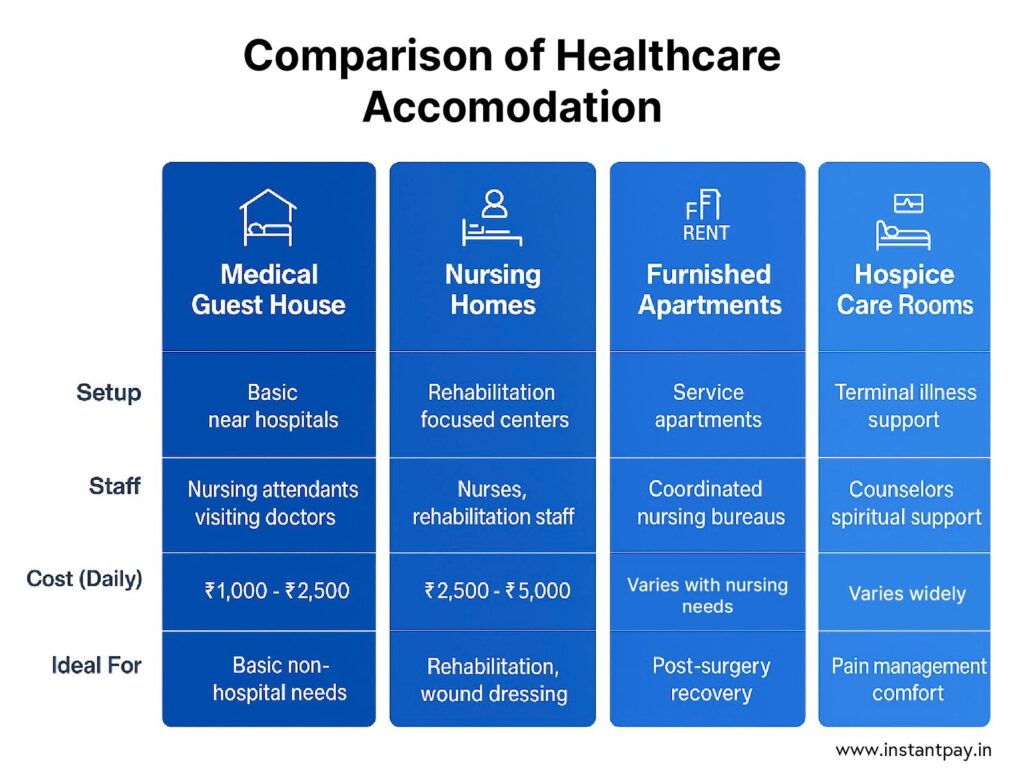
Depending on patient needs and budget, you can choose from:
- Medical Guest Houses
- Basic non-hospital setups, often attached to or near a hospital
- Staffed with nursing attendants or visiting doctors
- Daily rent ranges from Rs.1,000 to Rs.2,500
- Nursing Homes or Extended Care Centers
- Provide rehabilitation services, nursing, wound dressing, etc.
- Often have semi-private or private rooms with medical beds
- Cost: Rs.2,500–Rs.5,000/day, depending on city and services
- Furnished Apartments with Nursing Services
- Short-term stays in service apartments, coordinated with nursing bureaus
- More privacy and comfort
- Ideal for patients recovering post-orthopedic, cancer, or cardiac surgeries
- Hospice or Palliative Care Rooms
- For patients with terminal illnesses needing pain management and comfort care
- Typically include counseling, family accommodation, and spiritual support
- Offered by NGOs or private setups (charges vary widely)
Where to Find Medical Recovery Rooms on Rent
Finding the right place requires a mix of online search, hospital networking, and home care coordination:
- Ask hospital case managers or social workers: They often have tie-ups with care homes or guesthouses.
- Use verified platforms like:
- Portea, Nightingales, Care24 (home nursing + room rentals in select cities)
- Justdial or Practo for local listings (filter with “medical rooms on rent”)
- Look for hospital-affiliated lodging: Many hospitals have nearby hostels or rest houses for recovering patients.

What to Look for in a Rental Room for Recovery
Whether it’s a basic infirmary room or a special room designed for long-term stay, evaluate the facility on:
- Accessibility: Ground floor or elevator access for wheelchairs
- Medical amenities: Oxygen support, suction, adjustable beds
- Hygiene protocols: Regular sanitization, clean bathrooms, proper linen
- Nursing care: 24×7 vs 12-hour availability, emergency response setup
- Food and caregiver support: Especially if family can’t be present full-time
- Location: Proximity to a hospital in case of sudden complications
Is It Covered Under Health Insurance?
Here’s where it gets tricky.
- Most retail health insurance plans DO NOT cover rental rooms post-discharge unless:
- It’s within the hospital and part of the treatment plan
- It falls under a rehabilitation package prescribed and pre-approved
- Home care benefits or add-ons in certain plans may allow partial reimbursement for:
- Nurse visits
- Physiotherapy
- Medical equipment (like oxygen cylinders or hospital beds)
If you’re planning to rent a room, check with your insurer in writing to understand:
- What’s covered under domiciliary or home care clauses
- Documentation needed to justify such expenses
Always collect bills and prescriptions—even for non-hospital care. They may help during reimbursement or tax deductions under Section 80D.
How Much Does It Cost to Rent a Recovery Room?
While prices vary by city and service type, here’s a general estimate:
| Type of Room | Daily Rent | Included Services |
| Medical Guest House | Rs.1,000 – Rs.2,500 | Bed, fan/AC, basic nursing, emergency care access |
| Assisted Care/Nursing Room | Rs.2,500 – Rs.5,000 | 24×7 nurse, meals, vitals monitoring |
| Service Apartment + Nurse | Rs.3,000 – Rs.6,500 | Fully furnished flat + part-time/full-time nurse |
| Hospice/Palliative Room | Rs.2,000 – Rs.7,000+ | Pain mgmt, spiritual care, end-of-life comfort |
Bonus: Some eldercare homes now offer temporary post-discharge care with hospital partnerships.
Red Flags to Watch Out For
- Unlicensed setups with no medical affiliation
- No emergency backup or tie-up with nearby hospitals
- Overpromising care without trained staff
- Hidden charges for oxygen, doctor visit, or cleaning services
Always verify licenses, read reviews, and ask for referrals when possible.

Final Thoughts: Awareness Today, Savings Tomorrow
Health insurance is designed to protect you—not just from medical uncertainty, but from the financial unpredictability that often accompanies it. Yet, for many policyholders, a lack of awareness about room rent limits, hidden hospital charges, and proportionate deductions leads to massive out-of-pocket expenses, even when they’re insured.
The message is clear: Understanding your policy is no longer optional—it’s essential.
The concept of room rent capping might appear like a small clause in your policy document, but in practice, it’s the trigger for a cascade of deductions that can shave off 30–50% of your entitled claim. Likewise, knowing the difference between a twin-sharing room and a private room, or the impact of hospital room categories on billing slabs, could be the difference between a smooth settlement and financial strain.
But knowledge is only one part of the solution.
To truly avoid unpleasant surprises, you need to match awareness with action:
- Read and understand the fine print of your health insurance policy.
- Ask your insurer about room rent caps, RMO charges, and what’s considered “proportionate.”
- Choose hospital rooms wisely, in line with your policy’s entitlement.
- Consider riders or better plans with no room rent limits if affordability allows.
- Use the tools available—TPA desks, insurer helplines, and hospital billing advisors—to your advantage.
- Be proactive, not reactive, especially during the admission process.
And when it comes to long-term recovery or rented rooms, knowing what facilities exist, what’s covered, and what to expect makes recovery less stressful—for both the patient and the family.
Ultimately, your insurance plan is only as effective as your understanding of its mechanics. The more informed you are today, the more financially protected you’ll be tomorrow.
Because when it comes to healthcare expenses, awareness isn’t just power—it’s peace of mind, financial stability, and sometimes, even life-saving.
FAQs: Understanding Hospital Room Charges and Insurance Deductions
1. What happens when you exceed the room rent limit of your health insurance?
If you stay in a hospital room that costs more than your eligible room rent limit, your insurer may apply a proportionate deduction. This means not just the extra rent but other associated hospital expenses (like doctor fees, nursing charges, and surgery costs) could be partially reimbursed, leading to significant out-of-pocket expenses.
2. What is the meaning of the no room rent limit in health insurance?
A no room rent limit policy allows you to choose any hospital room category—from twin-sharing to deluxe private—without triggering proportionate deductions. It gives you complete flexibility during hospitalization and typically comes as a feature in premium plans or with an added rider.
3. What is the maximum rent limit?
The maximum rent limit depends on your policy. It can be:
- A fixed daily amount (e.g., Rs.3,000/day), or
- A percentage of your sum insured (commonly 1–2% per day)
Always refer to your policy schedule to find your specific limit.
4. What is the room rent in IRDAI?
IRDAI (Insurance Regulatory and Development Authority of India) does not fix a standard room rent cap but allows insurers to define it within their policies. However, IRDAI mandates transparency and disclosure of such limits so policyholders can make informed decisions.
5. What is the maximum benefit limit in HMO?
In Health Maintenance Organizations (HMOs), the maximum benefit limit is the total amount the plan will cover annually for your medical needs. It varies by policy type and coverage level. Room rent limits and other sub-limits often fall under this cap.
6. What is a proportionate deduction and why is it applied?
A proportionate deduction is a penalty insurers apply when you opt for a room above your eligible rent cap. The logic is that room upgrades increase all other service costs (like ICU, surgery, and doctor charges), so insurers reduce payouts in proportion to your room selection.
7. Are RMO charges and nursing charges included in room rent?
In many hospitals, Resident Medical Officer (RMO) and nursing charges are bundled into the room rent. So, if your room rent is capped, these bundled services may also be partially reimbursed, resulting in lower overall claim amounts if you exceed the cap.
8. Can I upgrade to a better room during hospitalization?
Yes, you can upgrade, but be cautious—upgrading midway can change the billing structure and may apply proportionate deductions on your entire hospital bill, not just from the date of the upgrade. Always check with the TPA or insurance desk before switching.
9. Are twin-sharing or private rooms covered in all policies?
Not necessarily. Many entry-level policies only cover general wards or twin-sharing rooms, while private or deluxe rooms may only be covered under higher premium plans or policies with no room rent restrictions.
10. Can I buy a rider to remove room rent capping?
Yes, many insurers offer a room rent waiver rider that eliminates the cap. It’s a smart add-on, especially if you live in metro cities where hospital room rates are high. This ensures you get full claim settlement regardless of the room category you choose.