Health insurance is more than just a safety net—it’s a financial and healthcare empowerment tool. But most people only scratch the surface of what their policy can do. Whether you’re paying premiums monthly or have employer-provided coverage, it’s time to optimize your benefits and stop leaving value on the table.
1. Understand What “Comprehensive” Really Means — Beyond the Buzzword
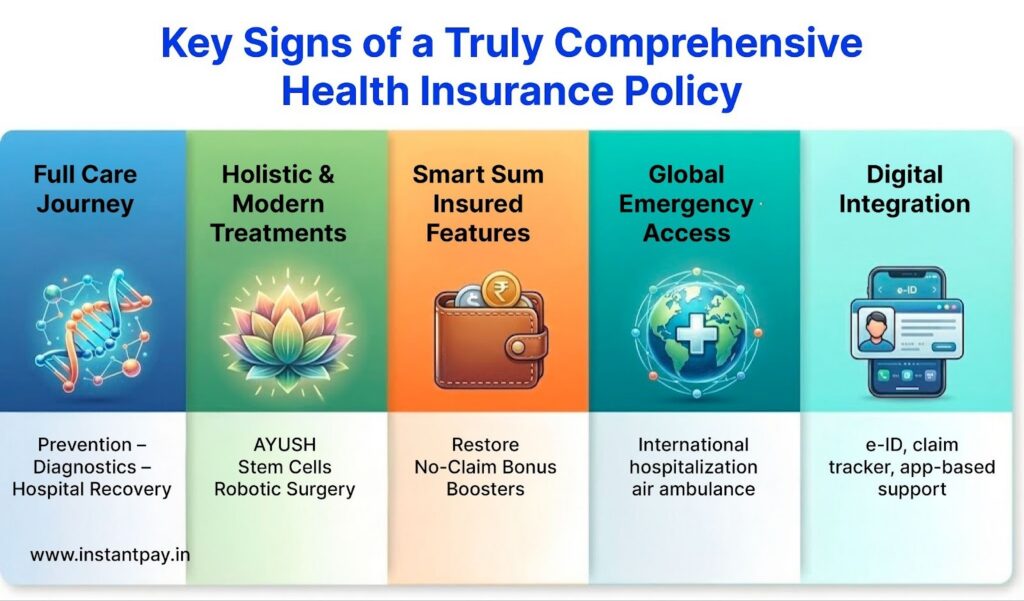
The word “comprehensive” in health insurance often gets thrown around, but many don’t truly grasp its full depth. It doesn’t just mean “covers more”—it means covers smarter, deeper, and more dynamically across your healthcare journey.
Let’s break down what truly makes a health plan comprehensive—and what signs to look for that you have (or don’t have) one:
a) Covers Treatment Across the Entire Healthcare Spectrum
A truly comprehensive policy doesn’t just cover hospitalization—it supports your health journey before, during, and after treatment.
- Prevention: Vaccinations, wellness coaching, disease risk profiling
- Early-stage care: Online doctor consultations, diagnostics without hospitalization
- Recovery: Physiotherapy sessions, rehabilitation support, second opinions
Look for plans that mention coverage for recovery care, not just treatment care.
b) Includes Modern & Alternative Treatments
In today’s healthcare world, Ayurveda, Homeopathy, Unani, Siddha, and even advanced therapies like stem cell treatment are gaining ground.
- Some insurers now include AYUSH benefits (non-allopathic systems) as part of comprehensive care.
- Also, therapies like robotic surgery, gene therapy, or targeted cancer treatment may be available in progressive policies.
Check whether your plan only covers traditional hospitalization or embraces evolving medical tech and approaches.
c) Dynamic Sum Insured Options
One often-overlooked marker of a comprehensive plan is automatic sum insured restoration or booster options:
- For instance, if you exhaust your coverage during the year, some plans automatically refill your sum insured for a second claim.
- Others offer No-Claim Bonus (NCB) add-ons that increase your cover every year without increasing the base premium.
These are not optional extras—they are part of a truly modern comprehensive policy.
d) Global Emergency Coverage
Some top-tier comprehensive plans now offer global emergency hospitalization cover, especially for life-threatening situations or accidents abroad.
- Includes emergency evacuation, air ambulance, or treatment at international hospitals.
- Some even provide concierge support services during international travel.
If you travel often, a policy with international emergency protection might be essential.
e) Built-in Digital Ecosystem
A comprehensive policy in today’s world is not paper-based. It is tech-enabled, offering:
- AI-driven claim tracking
- Integrated health records
- Digital ID cards and policy documents
- App-based symptom checkers or teleconsultations
Convenience and real-time visibility are now part of a complete coverage experience.
2. Leverage Preventive Services — They’re More Than Just Free Check-ups
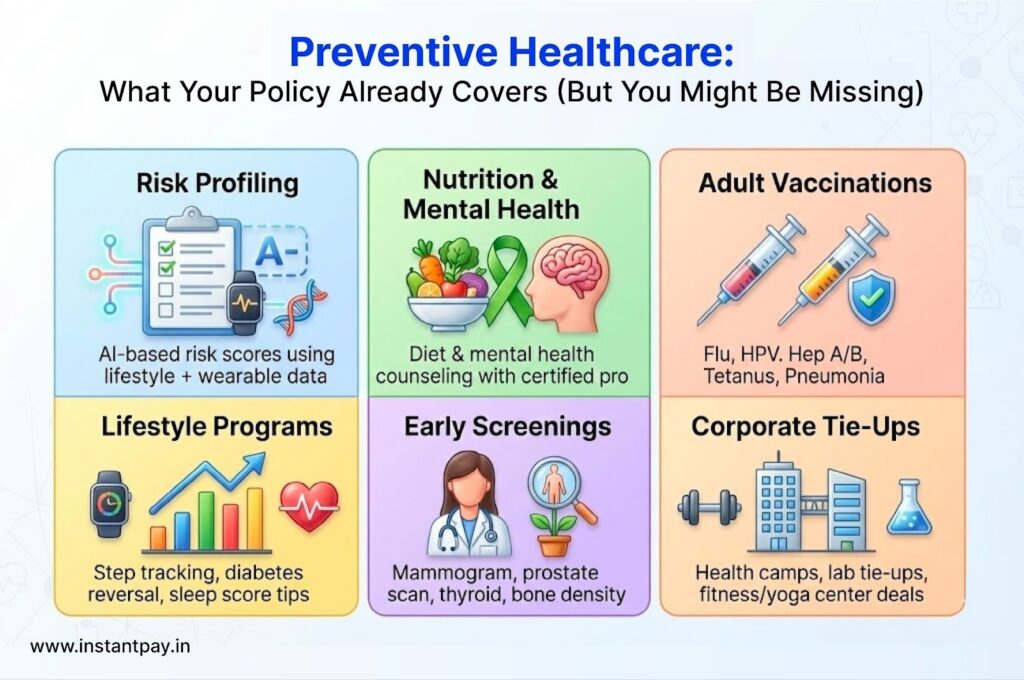
Most people associate preventive healthcare with free annual check-ups, but the truth is, modern comprehensive health plans go far beyond basic diagnostics. The aim isn’t just early detection—it’s risk reduction, wellness optimization, and lifelong cost savings.
Here’s how to tap into the full spectrum of preventive services your policy might already include—and how to make the most of them.
a) Risk Profiling & Predictive Assessments
Some insurers offer AI-powered risk profiling tools that assess your likelihood of developing lifestyle diseases like diabetes, hypertension, or heart conditions based on:
- Family history
- Lifestyle inputs (diet, sleep, stress)
- Wearable data integration (fitness bands, smartwatches)
These risk scores are often used to customize wellness advice and unlock targeted discounts or rewards.
b) Nutritional & Mental Health Counseling
Modern preventive coverage often includes access to:
- Licensed nutritionists to help you manage weight, gut health, and chronic fatigue
- Mental health counselors or therapists for stress, anxiety, or burnout—especially post-COVID
If your policy app has a “Health Coach” or “Mental Wellness” section, it’s likely included in your plan—no extra payment required.
c) Vaccination Coverage for Adults
Vaccines aren’t just for kids. Many comprehensive plans now include:
- Flu shots
- HPV vaccines
- Hepatitis A/B
- Tetanus boosters
- Pneumococcal vaccines for senior citizens
Instead of paying out-of-pocket at clinics, check if your insurer offers cashless coverage at select diagnostic centers.
d) Lifestyle Health Programs & Habit Trackers
To promote a healthier lifestyle, some insurers now provide structured programs such as:
- Weight management or diabetes reversal programs
- Step count challenges with rewards
- Sleep score tracking with AI-based recommendations
These programs often come with milestone-based incentives—you could earn points, vouchers, or even lower premiums.
e) Early Screening for High-Risk Groups
Certain policies are now beginning to offer age/gender-specific preventive screenings, such as:
- Breast cancer screening (mammography) after 40
- Prostate screenings for men above 50
- Bone density scans for post-menopausal women
- Thyroid panels, especially for those with autoimmune risks
f) Corporate Tie-Ups with Wellness Clinics
If you’re under a group or employer-provided policy, you might have exclusive partnerships that offer:
- Free or discounted diagnostics at partnered labs
- Access to premium health clubs or yoga centers
- Wellness days or quarterly health camps at the office
These are highly underutilized benefits. Don’t wait for HR—ask your TPA for a full list.
3. Know Your Network Hospitals—And Why That Matters
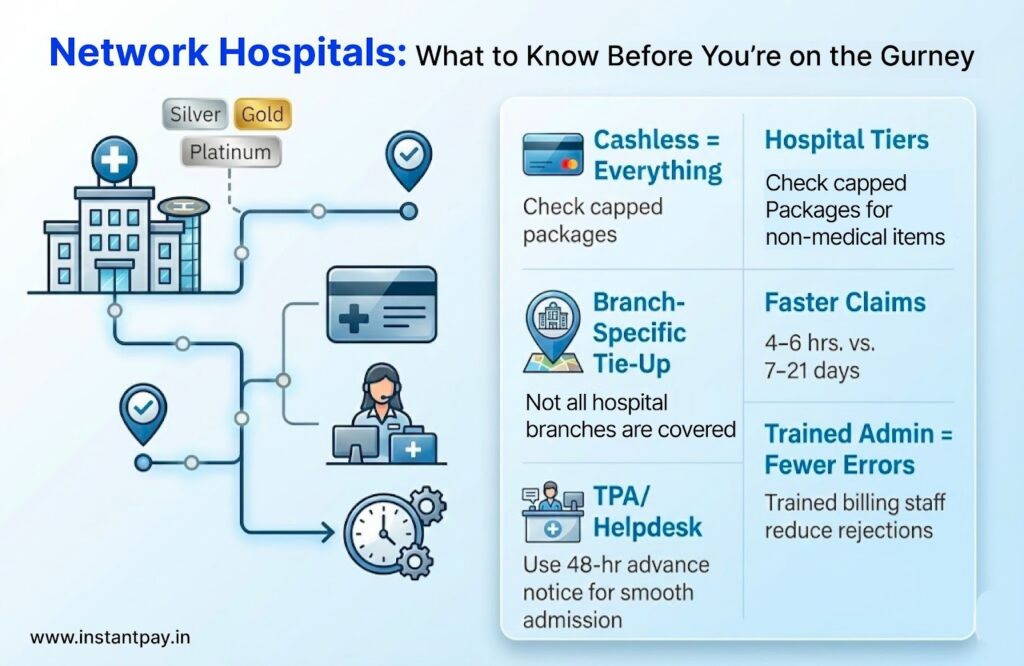
When you’re in the middle of a medical emergency, your focus should be on care—not claims. That’s where network hospitals come in. But understanding their role goes beyond just identifying where you can get cashless treatment. Smart use of network hospitals can maximize convenience, reduce rejections, and even enhance the quality of your care.
a) Cashless ? Unlimited
Network hospitals offer cashless facilities—but that doesn’t mean all expenses are covered automatically.
- Package rates are pre-negotiated by the insurer, meaning certain treatments are capped—even at premium hospitals.
- Some costs like non-medical items (gloves, syringes, etc.) may still be billed to you.
Actionable Tip: Ask the hospital billing desk for the pre-approved treatment package rate before proceeding with surgery.
b) Tier-Based Network Hospital Access
Insurers often classify network hospitals into tiers—Silver, Gold, Platinum—each with varying services and costs.
- Tiered hospitals may come with different co-payments, room rent caps, or deductibles.
- Higher-tier hospitals may offer faster authorizations but could also exhaust your sum insured more quickly.
Strategy Tip: For non-emergency treatments, opt for mid-tier hospitals that offer balance between quality and claim efficiency.
c) Not All Branches Are Covered
A hospital brand might be listed as a network partner—but not all locations are included.
- Example: Fortis in Delhi may be empanelled, but not Fortis in Mumbai.
- Each branch has its own TPA code and cashless contract.
Double-Check: Confirm specific location status via your insurer’s app or call center before hospitalizing.
d) Faster Claims = Better Recovery
Cashless claims at network hospitals are generally processed within 4–6 hours—versus 7–21 days for reimbursement claims in non-network hospitals.
- Faster processing reduces discharge delays
- Less out-of-pocket stress on patients or caregivers
Pro Tip: Always carry a physical or digital copy of your e-health card—it accelerates TPA verification.
e) Access to Insurance Helpdesk & TPA Desk
Network hospitals usually have a dedicated insurance helpdesk (or TPA desk), making documentation and coordination smoother.
- These reps help you get pre-authorization, understand inclusions, and avoid billing shocks.
- Some even offer 24/7 support for emergency admissions.
Insider Hack: If your admission is planned (e.g., for surgery), call the hospital’s TPA desk 48 hours prior to reserve a cashless slot.
f) Enhanced Service Experience
Network hospitals often train their billing and admin teams on insurer protocols, reducing chances of documentation errors or claim rejection.
- This can also include faster report sharing with insurers, real-time claim tracking, and error-free discharge summaries.
- More polished documentation = fewer follow-ups and rejections.
Peace-of-Mind Move: Choose a hospital with a proven track record of handling cashless claims from your insurer.
4. Use Health Apps and Wellness Rewards — Your Policy’s Hidden Value Layer
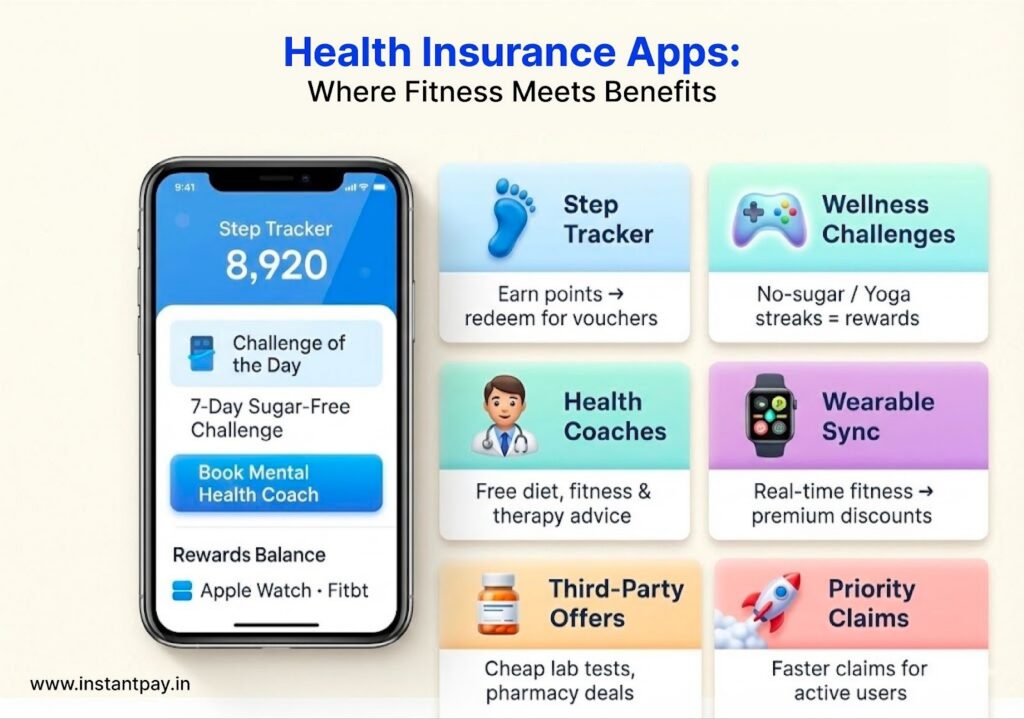
Think your insurance policy is only for hospital bills? Think again. Today’s health insurance ecosystem is tech-integrated, and many insurers now offer dedicated apps that go beyond servicing claims—they actively reward you for staying healthy.
These apps are more than just dashboards; they’re platforms designed to gamify wellness, encourage healthy habits, and unlock exclusive benefits tied directly to your health behavior.
a) Track Steps, Earn Points, Reduce Premiums
Many insurers offer step tracking integrations with wearables or smartphones. By walking regularly and meeting activity goals, you earn health points that can be:
- Redeemed for vouchers (pharmacy, grocery, apparel)
- Used to reduce future premiums
- Exchanged for extra medical services like free OPD visits
Example: Walk 10,000 steps a day for 30 days, and unlock ?500 worth of pharmacy credit or a discount on your next policy renewal.
b) Gamified Health Challenges
Insurers are launching gamified wellness challenges such as:
- “No Sugar for 10 Days”
- “7-Hour Sleep for a Week”
- “Yoga for 30 Days”
Completing these missions earns you badges, wellness currency, or even free tele-consultations.
Smart Move: Use these challenges as micro-goals to maintain discipline while passively building insurance-linked rewards.
c) Access to Health Coaches and Specialists
Many apps now include free or discounted health coaching, giving you access to:
- Certified nutritionists
- Fitness consultants
- Mental wellness experts
- Physiotherapists or chronic disease coaches
This adds real-time, personalized care support—without eating into your main insurance sum insured.
d) Integration With Wearables & Health Tech
Modern health apps seamlessly sync with devices like:
- Apple Watch, Fitbit, Garmin
- Samsung Health or Google Fit
- BP monitors or glucose meters (via Bluetooth)
This real-time data helps insurers:
- Offer dynamic advice
- Spot health trends
- Encourage consistency with monthly wellness scores
Over time, this data may even qualify you for dynamic underwriting—where your premiums are adjusted based on actual behavior.
e) Discounted or Free Third-Party Services
Some insurer apps partner with third-party platforms to offer:
- Discounted lab tests and home sample collection
- Free diet plans or fitness app subscriptions
- Reduced rates on medicines via partner pharmacies
Example: Your insurer app might offer a ?250 diagnostic test at ?49 through an integrated lab partner.
f) Priority Claims for Active Users
In some plans, policyholders who are actively engaged in wellness programs are given priority during claims—a “fast lane” for those proving to be low-risk.
Staying engaged doesn’t just keep you healthy—it builds a trust profile with your insurer, speeding up future benefits.
5. Utilize Family Floater Wisely
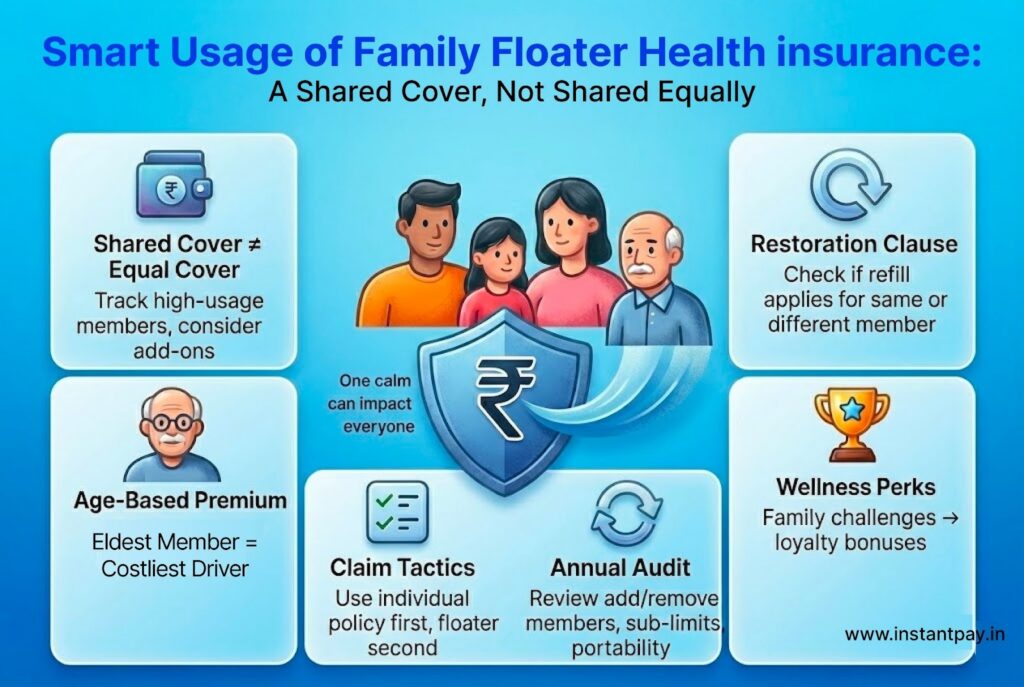
A family floater health insurance plan seems like a simple shared cover, but smart usage can mean the difference between just having coverage and maximizing its true potential. This type of plan isn’t just about pooling coverage—it’s about managing risk, optimizing utilization, and knowing when to supplement.
Here’s how to extract the best value and avoid common mistakes when managing a family floater.
a) Understand How the Cover is Shared
In a floater policy, one sum insured is shared across all family members. But this doesn’t mean equal entitlement.
- A single major claim (e.g., surgery for one member) can deplete the entire coverage, leaving others with zero protection for the rest of the year.
The more dependents you add (especially senior citizens), the higher the risk of fast exhaustion.
Optimization Tip: Track past medical usage by each member—if one person has recurring conditions, consider separate individual coverage for them.
b) Don’t Forget the Refill or Restoration Clause
Good floater plans now offer automatic restoration of sum insured—but only under certain rules:
- Often, the restoration is triggered only after full exhaustion of the original cover.
- Some plans allow restoration only for a different family member than the one who made the original claim.
Know the Rule: Don’t assume restoration = double cover. Understand exactly how and for whom it reactivates.
c) Age-Based Premium Dynamics
In a family floater, the premium is usually based on the age of the eldest member.
- Including elderly parents in the same floater can inflate premiums significantly.
- A more cost-effective strategy may be to buy a separate senior citizen policy with higher disease-specific limits.
Cost Strategy: Keep floater plans for the nuclear family, and create separate buffers for senior dependents.
d) Prioritize Claims Strategically
If you or your spouse have multiple health policies (like one individual + one floater), think tactically about how to file claims:
- Use the individual policy first, especially for smaller claims, to keep floater sum intact for larger emergencies.
- This gives you flexibility during the year, especially if children or other dependents need hospitalization later.
Claim Planning: Think long-term—don’t burn your biggest asset (the floater) on small, frequent claims.
e) Look for Wellness or Loyalty Perks
Some family floater policies offer:
- Family-based wellness rewards (e.g., if all members complete step challenges)
- Loyalty bonuses like top-ups, increased sum insured, or discounts for zero claims over 2–3 years
Encourage the whole family to engage in the insurer’s app for bonus perks and possible long-term discounts.
f) Evaluate Portability and Add-On Flexibility
If you started your policy years ago when your family structure was different, it’s worth reviewing if:
- New family members (e.g., newborns, spouse) can be added smoothly
- Porting to a different insurer will offer better sub-limit relaxations or additional benefits
Don’t assume your current plan is still optimal—do an annual floater health audit before renewing.
6. Track Deductibles, Sub-Limits, and Co-Payments — The Fine Print That Affects Big Claims
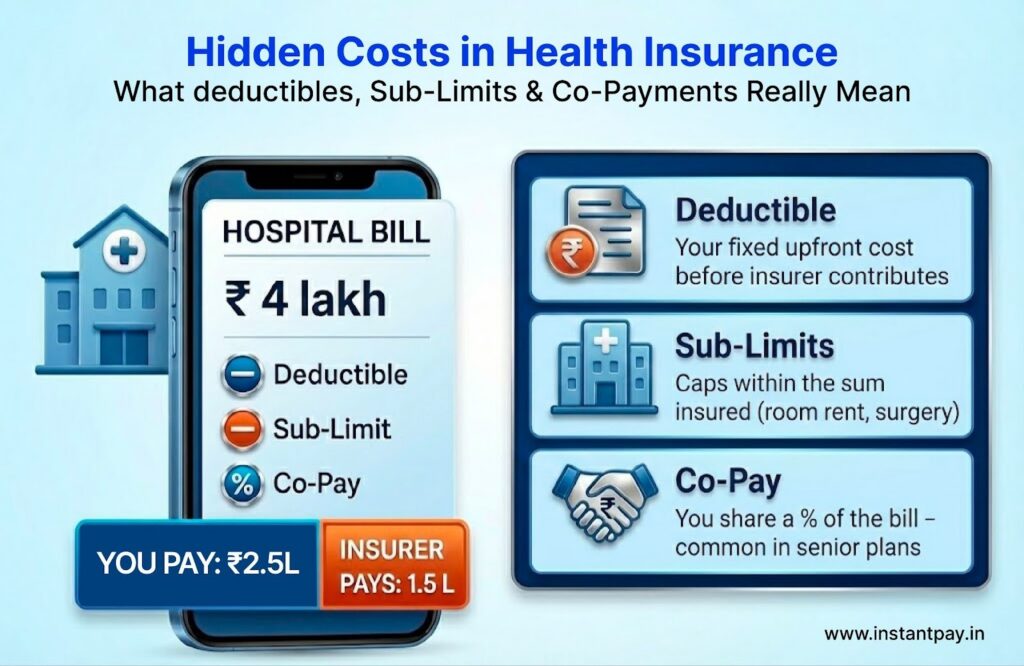
A comprehensive insurance policy may look perfect on paper, but its real power lies in the details—and often, those details include deductibles, sub-limits, and co-payment clauses. These aren’t just technical terms—they directly influence how much you pay during a medical event and how much your insurer covers.
Ignoring them can turn a “cashless claim” into a costly surprise. Here’s how to track, interpret, and plan around these hidden clauses.
a) Deductibles — Your Out-of-Pocket Commitment
A deductible is the fixed amount you agree to pay before the insurer steps in. It could be:
- Voluntary: Chosen by you to lower premiums
- Mandatory: Imposed by the policy, especially in super top-up or international plans
Example: If your deductible is ?1 lakh and your hospitalization costs ?1.5 lakh, your insurer pays only ?50,000.
Smart Move: If you’ve chosen a high voluntary deductible, set aside an emergency fund that covers it.
b) Sub-Limits — Cap on What’s Payable
Sub-limits are internal caps within your total sum insured. Even if you have ?10 lakh coverage, you might face:
- ?1,000–?2,000 room rent per day limit
- ?25,000 cap on cataract surgery
- ?50,000 on knee replacement
- ?1,500 daily ICU charges
These caps often don’t rise with inflation, leaving you to pay the balance out-of-pocket.
Strategy Tip: Before elective procedures, ask for a cost estimate from the hospital and cross-check with your policy’s sub-limits.
c) Co-Payments — Shared Billing, Shared Burden
A co-payment clause means you pay a percentage of the claim, usually between 10%–30%. It’s common in:
- Senior citizen policies
- Group plans for parents
- Some regional hospital networks
Example: A 20% co-pay on a ?2 lakh bill means you shell out ?40,000—even in a cashless setup.
Cost Insight: Higher co-pays = lower premiums, but they’re not ideal if you expect frequent hospital visits.
d) When These Three Combine: Be Cautious
Some policies contain all three: deductibles, sub-limits, and co-payments. This combination can drastically reduce the effective payout, even on large claims.
Illustration:
- Bill: Rs4 lakh
- Deductible: Rs 1 lakh
- Co-pay: 20% on balance
- Sub-limit hit: Rs 25K room rent max used instead of Rs40K actual room rate
Final result: Your insurer may only cover Rs 1.4–Rs 1.6 lakh, and you bear the rest.
Takeaway: Always evaluate the net value your policy provides—not just the sum insured.
e) How to Monitor These Better
Modern insurer apps often show:
- Claim breakdown reports
- Remaining sub-limit balances
- Out-of-pocket estimates before admission
Use these tools before hospitalization to preempt financial surprises.
f) Consider Upgrades or Add-Ons
If your existing plan has tough sub-limits or high co-pays:
- Explore riders to remove room rent caps or reduce co-pay percentages
- Ask your insurer if they offer top-up or super top-up plans with minimal conditions
These upgrades are often cheaper than switching policies entirely.
7. Raise Claims Smartly
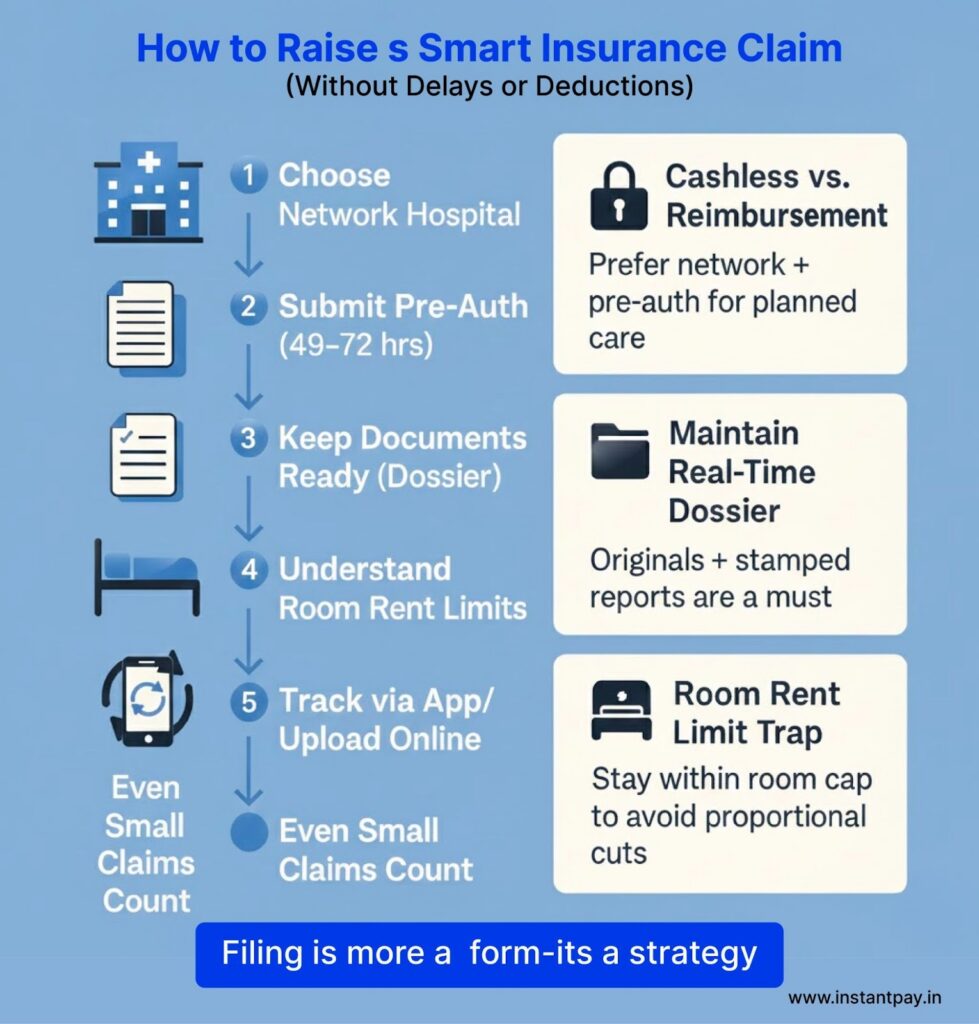
Raising a claim is where your insurance actually delivers. But whether it’s cashless or reimbursement, the way you file, document, and follow up can significantly impact the speed, approval rate, and payout of your claim. In short: it’s not just what you claim, it’s how you claim it.
Here’s how to raise claims smartly—without leaving money on the table or getting tangled in red tape.
a) Know the Difference: Cashless vs. Reimbursement
Cashless claims are faster but limited to network hospitals.
Reimbursement applies anywhere, but takes longer and needs complete documentation.
Best Practice: For planned treatments, always prefer a network hospital and pre-authorize your admission 48–72 hours in advance.
b) Pre-Authorization = Fast-Track Entry
For cashless claims, a pre-auth form must be submitted—either at the TPA desk or through the hospital.
- It includes treatment details, tentative diagnosis, and doctor’s sign-off.
- Most insurers respond in 4–6 hours for elective care, and within a few minutes in emergencies.
Time Saver Tip: Keep digital copies of your ID proof, e-health card, and policy handy on your phone.
c) Maintain a Claim Dossier — Real-Time
For reimbursement claims, documentation is everything. Maintain a real-time dossier during treatment:
- Hospital bill (original with breakup)
- Final discharge summary
- All test reports
- Doctor’s prescriptions & consultation notes
- Pharmacy and diagnostics receipts (stamped)
Avoid Pitfalls: Missing any one item—especially original bills—can lead to partial payment or outright rejection.
d) Understand Room Rent Impact Beforehand
If your policy has a room rent limit, your entire claim could get proportionally reduced—even for unrelated treatments (like surgeries or ICU).
For example: If your limit is ?3,000/day and you stay in a ?5,000/day room, your claim could be settled at just 60% of the eligible amount.
Prevention Tip: Ask the hospital in advance for rooms that fit your policy’s entitlement.
e) Break Down Multi-Policy Claims Intelligently
If you have multiple insurance policies (personal + corporate + top-up):
- Start with the base policy
- Use top-up only after base sum is exhausted
- Attach settlement summary of the first claim while filing the second
Insurers will reject duplicate claims, so your paperwork must clearly show non-overlapping usage.
f) Use the App for Claim Tracking and Updates
Most insurers now allow:
- Real-time claim status updates
- Uploading missing documents
- Raising service requests for faster follow-up
Some even offer claim helpline support via WhatsApp or AI chatbots for instant resolution.
Efficiency Tip: Enable app notifications to catch deficiencies early before they delay settlement.
g) Raise Claims Even for Small Bills
Don’t think of insurance as just for big emergencies. Daycare procedures, minor surgeries, and outpatient therapies are all valid.
- Root canal, cataract, dialysis, chemotherapy, minor fracture treatments, etc. are often covered.
- Raising such claims builds claim history and helps you unlock loyalty perks or free top-ups in the future.
Bonus: In policies with a No Claim Bonus (NCB) structure, some plans allow small claims without losing NCB—check your terms.
8. Add Riders, Not Just for Emergencies

Most people think of riders (also called add-ons) as extras meant only for worst-case scenarios—like accidental death or critical illness. But in today’s insurance landscape, riders can do far more than protect you from rare events. They can fill coverage gaps, cut out-of-pocket costs, and even enhance everyday utility from your policy.
The right set of riders makes your health insurance not just comprehensive, but personalized and proactive.
a) What Are Riders in Health Insurance?
Riders are optional coverages you can add to your base policy for an extra premium. Think of them as policy boosters that address specific needs not fully covered in the base plan.
They’re useful for:
- Narrowing down exclusions
- Adding value-based services
- Avoiding financial shocks from common but underestimated risks
b) Useful Riders Beyond Emergency Events
Some of the most underutilized yet impactful riders include:
- Room Rent Waiver: Removes sub-limits on hospital room category—prevents proportional claim deductions.
- OPD Cover: Includes consultations, diagnostics, and medicines for day-to-day ailments.
- Maternity & Newborn Cover: Offers structured benefits around delivery, prenatal/postnatal care, and vaccinations.
- Hospital Cash Rider: Pays a daily fixed amount (e.g., ?1,000–?5,000/day) during hospitalization—useful for lost income or non-medical costs.
- AYUSH Rider: Extends full-fledged cover for Ayurveda, Yoga, Unani, Siddha, and Homeopathy treatments.
These riders extend the scope of usage far beyond hospitalization—into preventive, complementary, and convenience-focused care.
c) Riders That Enhance Financial Efficiency
Some riders can help you protect your savings by capping your exposure:
- Reduction or Waiver of Co-pay: Ideal for senior citizens or group policies with high co-payments.
- No Claim Bonus (NCB) Protector: Lets you retain NCB even after small claims.
- Deductible Buy-Back Rider: Removes or reduces the deductible on super top-up plans—useful if you want first-rupee coverage.
These can reduce long-term costs, especially when medical inflation bites or claims become frequent.
d) Riders for High-Risk Profiles or Special Needs
Riders also help tailor your coverage if you:
- Work in hazardous environments
- Travel frequently (domestic or international)
- Have hereditary risk of lifestyle diseases
- Need frequent OPD care for chronic conditions (e.g., diabetes, asthma)
Example: Someone with a family history of cancer may add a critical illness rider to receive a lump sum on diagnosis—helping with both treatment and recovery downtime.
e) Are Riders Cost-Effective?
Absolutely—when chosen wisely.
- Riders come at a fraction of the cost of a full policy.
- They don’t require separate paperwork or underwriting (in most cases).
- They offer targeted protection—paying for themselves the first time you use them.
Pro Tip: Always compare the cost vs. benefit for the rider. ?300 extra a year might save you ?30,000 on room rent capping.
f) How to Choose the Right Riders
To select riders strategically:
- Audit your base policy for common exclusions or caps
- Assess your lifestyle, life stage, and medical history
- Review your actual usage (e.g., are OPD visits frequent?)
- Compare what your insurer offers vs. what you need
Some insurers now offer custom rider bundles or modular health plans—perfect for a curated approach.
9. Contact Customer Care—Don’t Hesitate
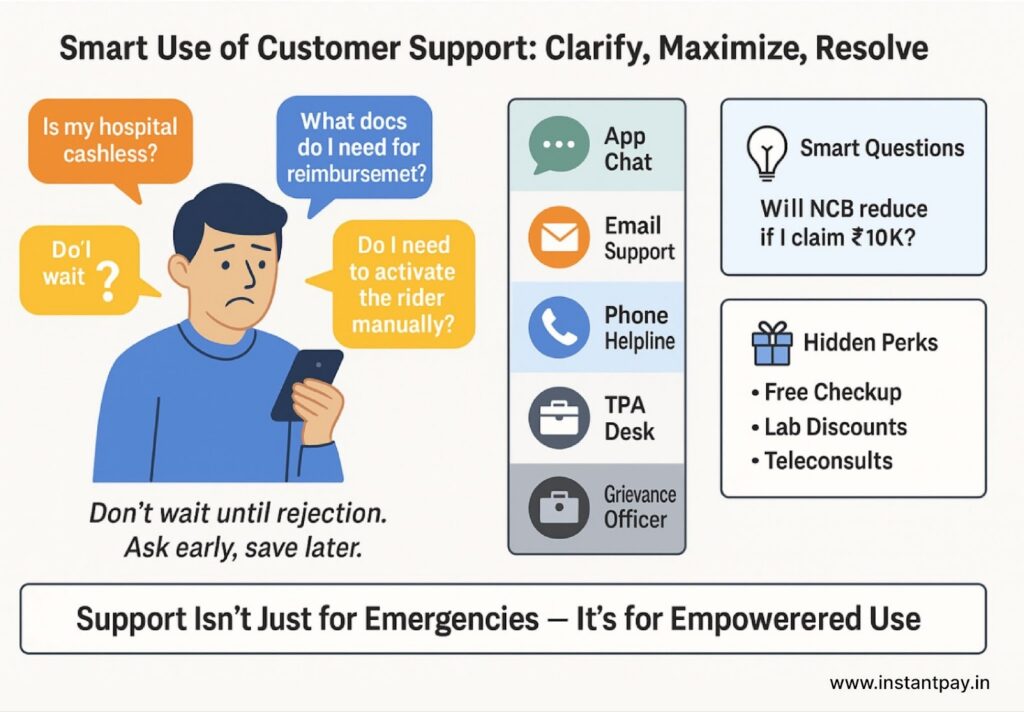
Too often, policyholders stay confused or make costly mistakes simply because they didn’t ask. But here’s the truth: your insurer’s customer support is there to be used, not avoided. Whether it’s a minor doubt or a major issue with claims, reaching out can clarify grey areas, unlock hidden features, and even help you avoid rejections.
When it comes to maximizing health insurance benefits, proactive communication is not just helpful—it’s essential.
a) Don’t Wait Until a Crisis
Most people think of customer care only when things go wrong—like a delayed claim or hospitalization snag. But many issues can be avoided upfront by seeking clarity early:
- What documents are needed for reimbursement?
- Is a particular treatment or test covered?
- Which hospitals in your city are cashless?
- What happens if you miss a premium payment?
Prevention Tip: Contact support before a procedure or claim, not after a denial or confusion arises.
b) Use the Right Channels for Faster Responses
Insurers today offer multiple customer care touchpoints. Use them smartly:
- App-based chat support: Great for quick FAQs and status updates.
- Email support: Ideal for attaching claim documents or escalation.
- Phone helpline: Use when you need urgent clarification or step-by-step guidance.
- In-person TPA desks (at hospitals): Perfect for real-time intervention during admissions or discharge.
Some insurers even offer dedicated health advisors or concierge services for premium policies—use them!
c) Ask These Often-Ignored but Important Questions
A few clarifications can go a long way in preventing disputes later:
- “Will this OPD treatment need pre-authorization?”
- “Is ICU stay covered at full cost in my policy?”
- “Does my rider kick in automatically, or do I have to activate it?”
- “How is the No Claim Bonus applied after a partial claim?”
You’ll be surprised how many critical answers are missing from policy documents but known by support teams.
d) Use Customer Support to Unlock Additional Benefits
Many people don’t realize their policies come with extra perks that they never use:
- Free annual health checkups
- Wellness reward programs
- Teleconsultations
- Discounts at labs and pharmacies
A quick call can reveal unused benefits worth thousands—especially near policy renewal time.
e) Don’t Hesitate to Escalate—Politely
If you’re stuck with claim delays, unjust deductions, or poor service:
- Escalate to the Grievance Redressal Officer (details in policy document)
- Lodge a complaint on the IRDAI’s Integrated Grievance Management System (IGMS)
- Use social media (politely) for faster response—insurers monitor this closely
Keep communication factual, polite, and well-documented—support teams will respond faster when you’re organized.
f) Log & Track Every Interaction
Maintain a record of:
- Date/time of the call or chat
- Name of the support person
- What was promised (approvals, timelines, next steps)
This protects you if you need to escalate or refer to past discussions.
10. Review and Update Annually — Because Life (and Healthcare) Changes Fast
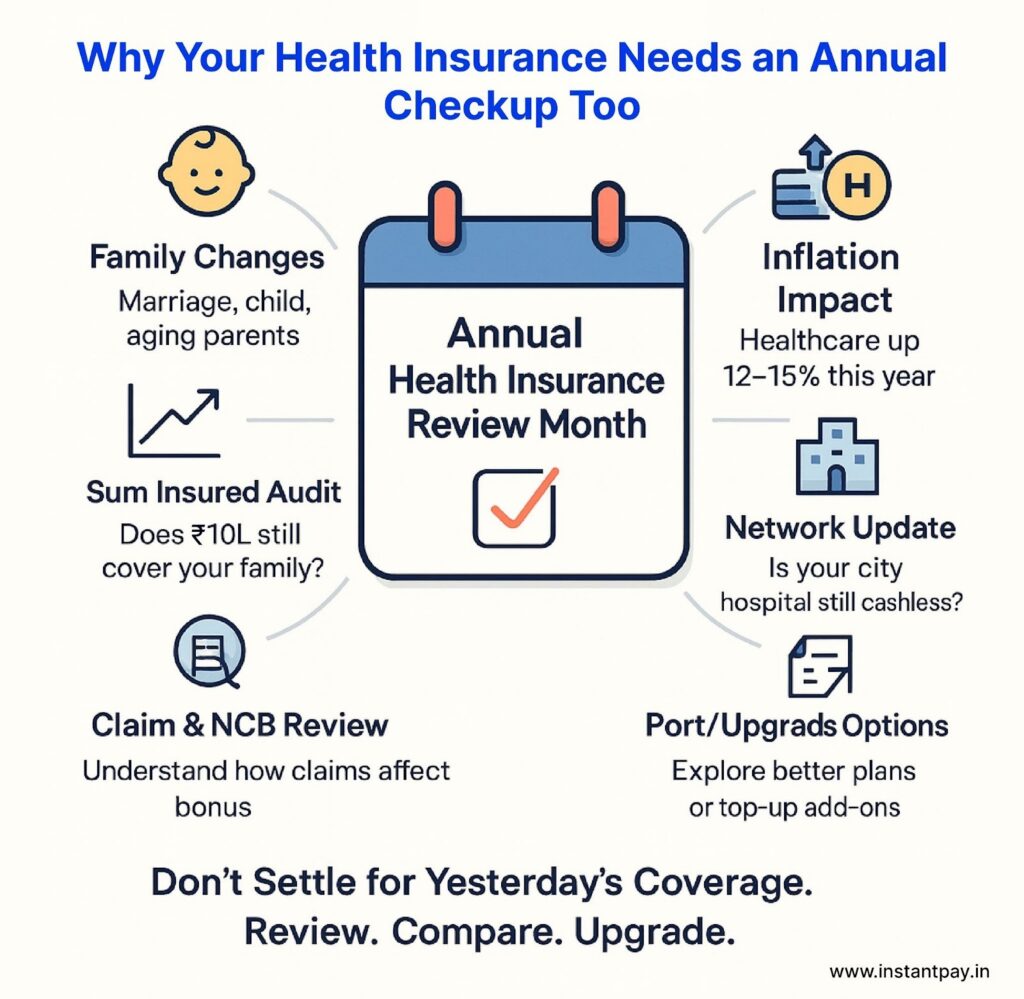
Health insurance isn’t a one-time decision—it’s a living document that needs to evolve with your lifestyle, family structure, income, and even medical inflation. Yet, many policyholders make the mistake of buying and forgetting.
Reviewing and updating your health insurance annually ensures you’re not underinsured, overpaying, or missing out on better options. It’s your opportunity to realign your policy with your present and future needs.
a) Why Annual Reviews Are Non-Negotiable
A lot can change in a year:
- You may have gotten married or had a child
- Your parents may have aged into a high-risk bracket
- You may have developed a chronic condition
- Hospitalization costs might have gone up 12%–15%
Without reviewing, you risk being under-covered or inadequately protected when you need it most.
b) What to Check During Your Annual Review
1. Sum Insured Sufficiency
Ask: Does my coverage match rising healthcare costs and my family size?
- If you’re single, ?5–7 lakh may suffice.
- For families, ?10–15 lakh (or more) is realistic.
- Super top-up plans can help bridge gaps cost-effectively.
2. Sub-Limits and Caps
Has your insurer introduced new caps or conditions?
Revisit policy terms to ensure room rent limits, disease-specific sub-limits, and co-pays haven’t changed.
3. Network Hospital Changes
Has your preferred hospital or city-based network changed?
A new job location or hospital delisting could affect cashless access.
4. Claim History & NCB (No Claim Bonus)
Has your sum insured increased via NCB?
Understand how much bonus is accumulated and how a claim might impact it next year.
c) Consider Policy Porting or Upgrading
Annual review is also the perfect time to ask: “Can I get better value elsewhere?”
- Port to another insurer if your current one has poor service, slow claims, or restrictive clauses.
- Upgrade to a higher plan tier with fewer restrictions or add riders like OPD, maternity, or wellness benefits.
- Add a super top-up plan instead of upgrading the base policy—lower premium, higher coverage.
Portability is allowed annually without losing continuity benefits (like waiting periods)—if done before renewal.
d) Real-Life Example of What Goes Wrong Without a Review
A 35-year-old had a ?5 lakh individual policy for 5 years. He never updated it. When he had a surgery costing ?6.5 lakh, he:
- Exhausted his base cover
- Had no top-up or buffer
- Faced ?1.5 lakh out-of-pocket expense
A simple annual review could have prompted a ?10 lakh upgrade or ?5 lakh super top-up for ?1,000–?1,500/year.
e) What to Discuss with Your Insurer or Advisor
During the review, don’t just look at your document—ask questions:
- Are there newer plans with better features?
- Can I add a parent or spouse this year?
- Should I move to a floater or individual policy?
- What riders are now available or discontinued?
These conversations often uncover newer, better products released by insurers post your original purchase.
f) Set a Reminder & Review With Documentation
- Set a calendar reminder 15–30 days before renewal.
- Review with: policy document, recent claim history, health changes, and premium payments.
- Compare at least 2–3 other plans to know the market offering.
Use policy comparison tools or advisors to help with unbiased suggestions.
Final Thoughts: Turn Passive Coverage into Active Protection
Health insurance isn’t just a backup plan for hospital bills—it’s a living, breathing financial tool that can protect your health, wealth, and peace of mind if you engage with it actively.
Most policyholders make the mistake of being passive users—buying a plan, forgetting about it, and expecting it to just work during emergencies. But true value comes when you use your policy as a year-round asset—leveraging preventive care, customizing with riders, making informed claims, and keeping the coverage current with your life.
Here’s the big shift:
Health insurance shouldn’t be something you use only when you’re sick. It should help you stay healthy, financially stable, and well-prepared at every life stage.
When you:
- Understand the true scope of a comprehensive plan
- Take full advantage of free checkups, wellness rewards, and health tech
- Avoid unnecessary costs by knowing your hospital network and room rent rules
- Customize wisely with riders and family floater logic
- Stay informed, involved, and updated through annual reviews and smart claim practices
—you stop being just a policyholder. You become a healthcare consumer in control.
- Ask questions
- Track benefits
- Use what’s already available
- And review what could work better
Because in today’s fast-evolving healthcare world, insurance isn’t just about emergencies anymore—it’s about empowerment.
FAQs: Making the Most of Your Health Insurance
1. What does “comprehensive” health insurance actually include?
A comprehensive health insurance policy typically includes hospitalization (pre and post), daycare procedures, ambulance cover, AYUSH treatment, and in some cases, preventive check-ups and wellness benefits. However, the exact scope can vary by insurer—always read the fine print.
2. Are preventive health check-ups really free under my policy?
Yes, many comprehensive policies offer free annual check-ups, especially after 1 claim-free year. However, eligibility often depends on the sum insured, age, and claim history. Always verify with your insurer or app dashboard.
3. Why is knowing my network hospitals important?
Network hospitals allow cashless treatment, which eliminates out-of-pocket payments during emergencies. Knowing which hospitals are in-network can save time, money, and reduce claim hassle.
4. How do wellness rewards and health apps benefit me?
Wellness apps from insurers can track your fitness, offer goals, and provide rewards like premium discounts, vouchers, or even increased coverage. These benefits are often underutilized but are great for promoting healthy behavior.
5. What is a family floater plan, and when should I choose it?
A family floater covers all insured members under one sum insured. It’s ideal for young families where medical needs are unpredictable and infrequent. However, for aging parents or high-frequency users, separate individual plans may be more suitable.
6. What are deductibles, sub-limits, and co-payments—and why should I track them?
These are cost-sharing features in your policy. They define how much you pay from your pocket. Tracking them helps avoid claim shocks and ensures you’re not caught off guard during treatment.
7. How should I prepare for a claim to ensure it’s approved?
Maintain clear medical documentation, know your coverage inclusions, use network hospitals when possible, and inform the insurer within the time window. Also, use pre-authorizations for planned procedures.
8. Are riders only meant for critical illness or accidents?
No. Riders like OPD cover, room rent waivers, hospital cash, or maternity add-ons can enhance day-to-day utility—not just emergencies. Choose them based on your health profile and coverage gaps.
9. How do I know if my health insurance covers preventive health check-ups?
Check your policy wording or customer portal/app. Preventive check-ups are typically included once a year after a waiting period or a claim-free year. The type and number of tests covered may also vary.
10. What is a good frequency to review my health insurance policy?
Review your policy annually—ideally 30–45 days before renewal. Life events like marriage, childbirth, income changes, or new diagnoses also warrant a coverage review.
11. Can I switch from an individual policy to a family floater?
Yes, but only at renewal. Evaluate based on family members’ age and health. If one person has frequent claims or chronic illness, individual plans may be better than a shared floater.
12. Do all health insurance plans support app-based tracking and rewards?
Not all, but many modern insurers do. These apps may offer step tracking, sleep scores, or claim submission features. If your insurer doesn’t, consider switching to one that does.
13. Is it possible to add riders after buying a base health insurance policy?
Some riders can be added mid-policy, others only during renewal. Check with your insurer regarding specific riders like OPD, room rent waiver, maternity, etc.