Living longer doesn’t always mean living stress-free, especially when financial responsibilities like dependent spouses, unpaid loans, or medical needs continue after retirement. India’s life insurance penetration has declined to 2.7% in 2024-25 per IRDAI’s latest report, leaving many seniors exposed. For many Indians in their 60s, the question is, can I still get term insurance, and is it worth it now?
In this blog, we simplify everything you need to know about term insurance for senior citizens in India. From eligibility and premiums to return-of-premium plans and no-medical exam options, this guide will help you assess whether buying term life insurance after 60 makes sense for your life stage and financial goals in 2026.
Can Senior Citizens in India Buy Term Insurance?
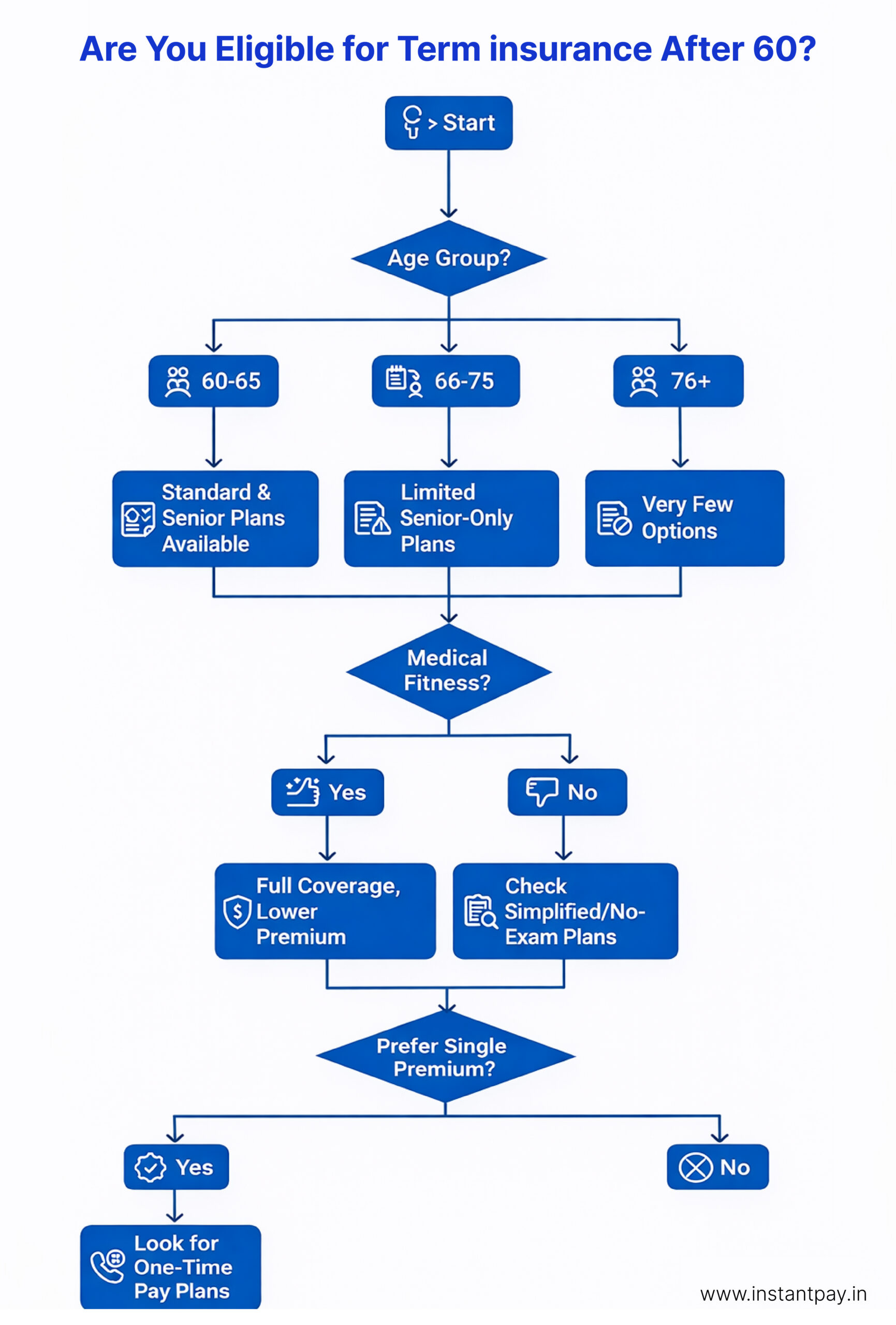
Yes, and the options today are more flexible than ever. Many insurers now offer term insurance for senior citizens with entry age extended well beyond 60, often up to 65 or even 75, depending on the policy. Some plans go further, offering coverage that lasts till age 85 or 99. That means even after retirement, you may still be eligible for financial protection under a structured term plan.
That said, the older you are at the time of application, the fewer the options and the higher the premiums. Most plans require a health declaration or medical screening, and benefits may be capped compared to younger applicants. Still, for those with ongoing financial responsibilities like dependent spouses, late-life loans, or estate planning, it remains a viable option.
Can I get term life insurance after 60 in India?
Yes, you can. Many Indian insurers offer senior citizen term plans with entry allowed up to 75 years. Coverage may extend till 85 or 99, depending on the plan, though premiums are higher and medical checks are often required.
Some insurers now offer single-premium plans tailored for seniors. These allow you to pay once and stay insured for the next 15–25 years, particularly useful if you’ve received a lump-sum retirement benefit.
If you’re still weighing the basics of coverage, structures, and eligibility, it may help to first understand how term life insurance works, especially before comparing senior-focused options
Did You Know?
Some insurers now offer single-premium senior term plans—where you pay once and stay covered for the next 15–25 years. Ideal for retirees with lump-sum funds.
How Term Insurance Works After 60?
Term insurance doesn’t stop working just because you turn 60, but how it works does change. Most senior-focused plans in India still follow the same structure: you pay a premium for a fixed number of years, and your nominee receives the sum assured if you pass away during that term. The difference lies in the coverage limits, medical screening, and policy duration, which become more specific for older applicants.
For example, while standard policies may offer long tenures and high sums assured for younger buyers, senior term insurance in India tends to offer shorter terms, capped benefits, and tighter entry conditions. However, insurers like Tata AIA and ICICI Prudential have created tailored options for those applying after age 60, offering terms that extend up to 85 or even 99 years in some cases.
If you’re nearing retirement and exploring coverage, it’s crucial to understand what features truly matter, what to look for when buying, and what to expect so you don’t miss the fine print when comparing senior options.
Top Term Plans for Senior Citizens (Ages 60–75): Coverage & Limits
Insurer | Entry Age Limit | Max Coverage Age | Term Options | Max Sum Assured |
| Up to 75 | Up to 100 | 5–40 years | Rs.50 lakhs – Rs.2 Cr |

| Up to 65–75 | Up to 85/99 | 10–30 years | Up to ?1.5 Cr |

| Up to 65 | Up to 85 | 5–30 years | Rs.25 lakhs – Rs.1 Cr |

| Up to 65 | Up to 85/99 | 10–40 years | Up to Rs.1 Cr |
Note: These plans typically require a health declaration and may include medical screening based on the applicant’s age and sum assured.
Which term plans can seniors (60+) get in India?
Senior-focused term insurance in India typically allows entry up to age 75, with policy terms from 5 to 40 years and sum assured from Rs. 25 lakhs to Rs. 2 crores. Major insurers—Tata AIA, ICICI Prudential, HDFC Life, and Max Life—offer these plans with varying entry and coverage-age limits.
How Much Does Term Insurance Cost After 60 in India?
Once you turn 60, term insurance premiums start to rise significantly. That’s because risk increases with age, and insurers factor in health, lifestyle, and even policy duration when calculating your costs. But that doesn’t mean coverage is out of reach; it just requires a bit more comparison and clarity.
Here’s what you can expect when planning a policy around age 60 or 65:
- Premiums vary by age, gender, and coverage amount. Women typically pay less than men for the same coverage.
- Health conditions and smoking status directly impact pricing; smokers often pay 40–60% more.
- The higher the sum assured, the more cost-effective it becomes on a per-lakh basis.
- Policy term also matters. A shorter 10–15 year term is more affordable than longer coverage till age 85 or 99.
- Riders like critical illness or return of premium can raise costs but add value for senior applicants.
Estimated Premiums: Rs. 25 – Rs. 50 Lakh Cover
| Age | Sum Assured | Monthly (Men) | Monthly (Women) | Annual (Men) | Annual (Women) |
| 60 | Rs. 25 lakhs | Rs.2,100–Rs.2,400 | Rs. 1,800–Rs. 2,100 | Rs. 24K–Rs. 28K | Rs. 21K–Rs. 25K |
| 60 | Rs 50 lakhs | Rs. 3,900–Rs. 4,500 | Rs. 3,300–Rs. 3,900 | Rs. 46K–Rs. 54K | Rs. 39K–Rs. 47K |
| 65 | Rs. 25 lakhs | Rs. 2,800–Rs. 3,200 | Rs. 2,300–Rs. 2,700 | Rs. 33K–Rs. 38K | Rs. 27K–Rs. 32K |
| 65 | Rs 50 lakhs | Rs. 5,500–Rs. 6,200 | Rs. 4,500–Rs. 5,200 | Rs. 65K–Rs. 74K | Rs. 54K–Rs. 62K |
Do You Need a Medical Test for Term Insurance After 60?
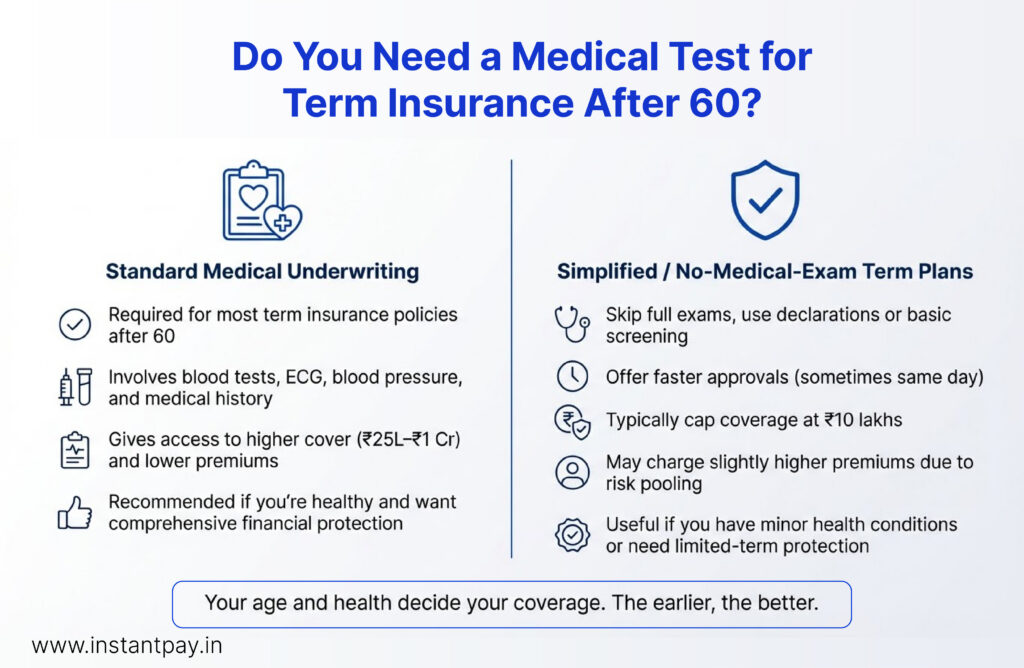
As you grow older, buying term insurance without a medical test becomes more difficult, but not impossible. Most plans for people over 60 require some form of medical screening to assess risk, especially when the coverage is Rs. 25 lakhs or more. However, a few insurers offer simplified term plans for seniors that skip full medical exams, provided the sum assured is modest and the age is within the limit.
Why do insurers ask for medical tests in term insurance for seniors?
Insurers require medical tests for senior citizens to assess health risks and determine premium accuracy.
As age increases, so does the likelihood of pre-existing conditions. Medical underwriting helps insurers evaluate life expectancy, avoid claim disputes, and offer appropriate coverage. It also ensures fair pricing based on your actual health profile.
Here’s how both options compare:
Standard Medical Underwriting
- Required for most term insurance policies after 60
- Involves blood tests, ECG, blood pressure, and medical history
- Gives access to higher cover (Rs. 25L–Rs. 1 Cr) and lower premiums
- Recommended if you’re healthy and want comprehensive financial protection
Simplified / No-Medical-Exam Term Plans
- Skip full exams, use declarations, or basic screening
- Offer faster approvals (sometimes same day)
- Typically, cap coverage at Rs. 10 lakhs
- May charge slightly higher premiums due to risk pooling
- Useful if you have minor health conditions or need limited-term protection
Did You Know?
Simplified term plans for senior citizens often cap coverage at Rs. 10 lakhs and are usually available only up to age 65–70.
Some applicants also consider endowment plans at this stage, especially if they’re looking for maturity benefits or bundled savings.
Should Seniors Consider Return-of-Premium Term Plans & Riders?
If you’re over 60 and hesitant about paying premiums with no return, return-of-premium (ROP) term plans offer a compelling middle ground. Unlike standard policies that pay out only upon the policyholder’s death, ROP plans refund the full premium amount minus taxes if you survive the term. For many seniors, this provides both protection and peace of mind, especially when budgeting for retirement.
However, it’s important to note that ROP plans cost significantly more, sometimes up to 2x higher than traditional term policies. They’re best suited for individuals with disposable income who want financial protection with a guaranteed return.
Can a 65-year-old buy return of premium term insurance?
Yes, many Indian insurers offer return-of-premium term plans to applicants up to age 65 or 70. These plans refund all base premiums at the end of the term but come with higher annual costs than standard term policies.
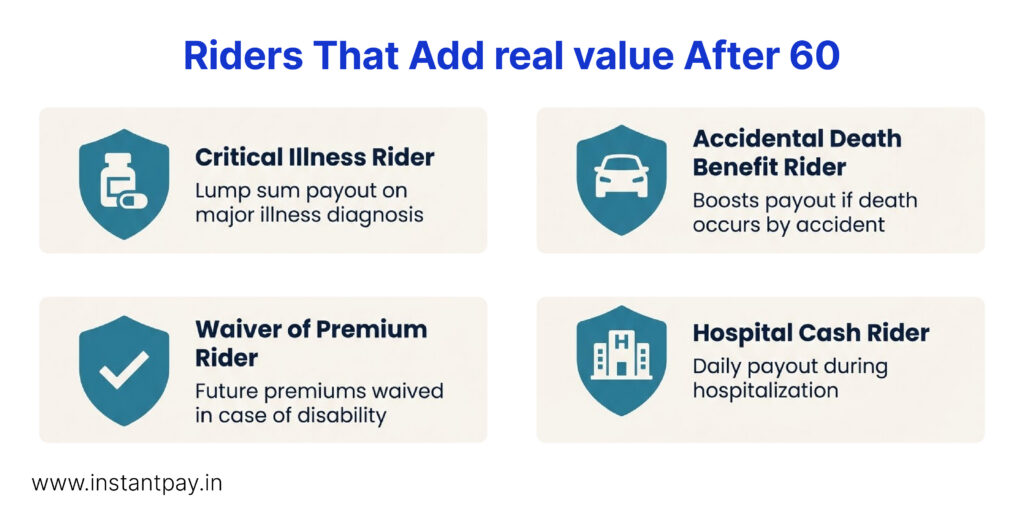
Key Riders That Add Value for Seniors
Riders are optional add-ons that enhance your term plan’s coverage. For senior applicants, these can provide much-needed flexibility and support during unexpected events:
- Critical Illness Rider – Offers a lump sum payout on diagnosis of major illnesses (like cancer, heart attack, stroke)
- Accidental Death Benefit Rider – Increases the total payout if death occurs due to an accident
- Waiver of Premium Rider – Waives all future premiums if you’re permanently disabled or diagnosed with a critical illness
- HospiCare Rider – Pays per day of hospitalization; ideal for managing medical bills in retirement
Some senior-specific plans offer rider bundles but make sure to check exclusions, waiting periods, and claim triggers before opting in.
Why Term Insurance Can Still Be Worth It After 60?
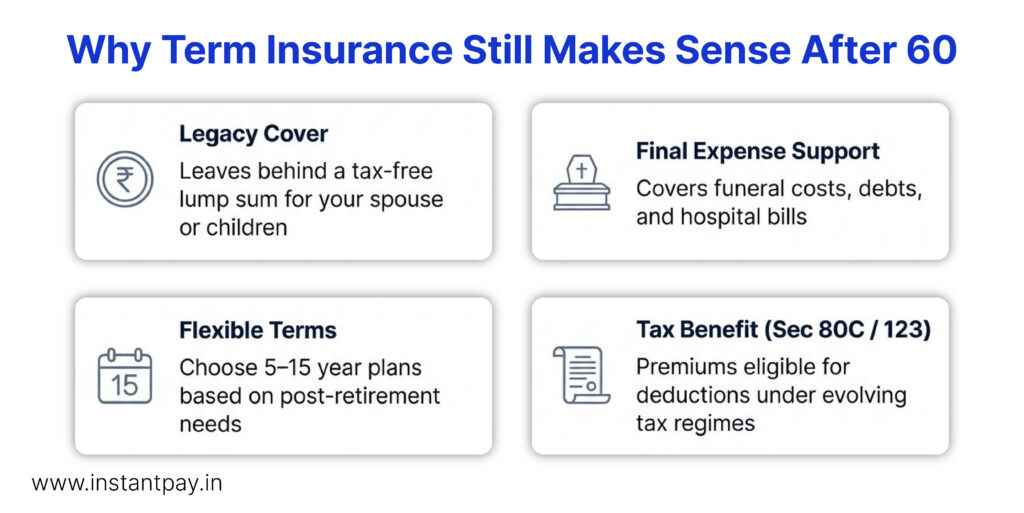
Despite rising age and premiums, many seniors continue to opt for term insurance after 60 to protect their legacy, manage end-of-life expenses, and ensure peace of mind. While coverage durations may be shorter, the purpose shifts—from income replacement to final expense coverage and debt clearance.
Here’s why it still makes sense for many:
- Legacy protection: Offers a lump sum payout to support a spouse, dependent child, or cover liabilities like home loans.
- Final expense planning: Covers funeral costs, unpaid hospital bills, or taxes, reducing financial stress for family members.
- Shorter, purpose-built plans: Terms of 5–15 years align better with post-retirement needs, especially if no long-term income is expected.
- Tax benefits: Premiums are still eligible for deductions under Section 80C, and the structure is expected to transition under Section 123 by 2026.
In some cases, term plans can be enhanced with health-focused riders, especially if you’re concerned about age-related illnesses.
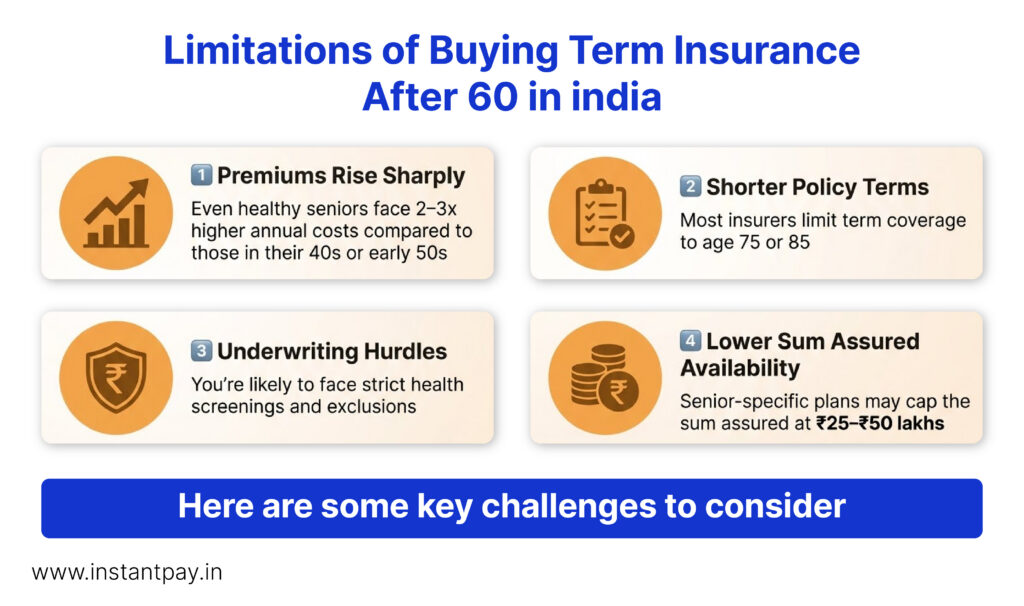
That said, buying term insurance after 60 comes with trade-offs. From steeper premiums to stricter eligibility, it’s not always the ideal solution, especially if you’re managing fixed retirement income or pre-existing conditions.
Here are some key challenges to consider:
- Premiums rise sharply: Even healthy seniors face 2–3x higher annual costs compared to those in their 40s or early 50s.
- Shorter policy terms: Most insurers limit term coverage to age 75 or 85, which may not align with your family’s long-term needs.
- Underwriting hurdles: You’re more likely to undergo strict health screenings and face exclusions or rejections for minor conditions.
- Lower sum assured availability: Some senior-specific plans cap the sum assured at Rs. 25–Rs. 50 lakhs, limiting overall protection.
Tip: Consider return-of-premium plans or hybrid products if you want some capital back and still need coverage for 10–15 years.
How to Choose the Right Term Insurance Plan After 60?
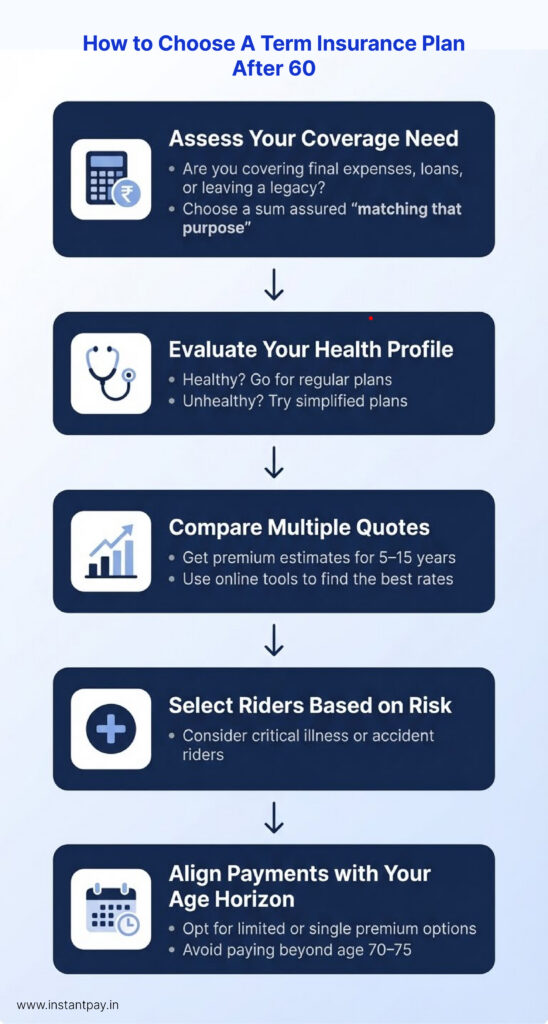
Choosing the right term insurance after 60 isn’t just about comparing premiums—it’s about aligning your coverage with health, financial goals, and policy duration. Since seniors face tighter eligibility, making informed decisions becomes even more important.
Here’s a simple decision flow to help you get started:
Term Plan Selection Checklist for Seniors
- Assess Your Coverage Need
- Are you covering final expenses, an outstanding loan, or leaving behind a legacy?
- Choose a sum assured that realistically fits that purpose (Rs. 25L–Rs. 50L is common for seniors)
- Evaluate Your Health Profile
- If you’re healthy, you may qualify for regular plans with higher coverage at better rates
- If not, look into simplified or return-of-premium plans with limited underwriting
- Compare Multiple Quotes
- Always get premium estimates for 5–15 year terms
- Use online tools and insurer calculators to find the most cost-effective option for your age group
- Select Riders Based on Risk
- Consider adding critical illness, accidental death, or waiver of premium if your medical history or lifestyle warrants it
- Consider adding critical illness, accidental death, or waiver of premium if your medical history or lifestyle warrants it
- Align Payments with Your Age Horizon
- Opt for limited pay or single-premium options if you’re on a fixed income
- Avoid policies where premiums stretch beyond age 70–75
What should seniors keep in mind while buying term insurance after 60?
Seniors should look for term plans with limited premium payment terms, essential riders like critical illness cover, and realistic coverage amounts. Prioritize plans with flexible entry ages, simple claim processes, and strong claim settlement records.
Top Term Plans for Senior Citizens in India
Not all insurers offer the same flexibility when it comes to term insurance for individuals over 60. Some provide extended entry age, return-of-premium options, and even no-medical-exam policies up to a certain sum assured. To help you compare, here’s a quick look at the top life insurance companies offering senior-friendly term plans in India.
Senior Citizen Term Plan Comparison
Insurer | Entry Age Limit | Max Coverage Age | ROP Option | No-Medical Cover | Max Sum Assured* |
| Up to 75 | Up to 100 | Available | Up to Rs.25L | Rs.2 Cr |
|
| Up to 65–75 | Up to 99 | Available | Up to Rs.25L–Rs.30L | Rs.1.5 Cr |
|
| Up to 65 | Up to 85/99 | Select Plans | Up to Rs.20L | Rs.1 Cr |
|
| Up to 65 | Up to 85 | Not Available | Limited (Rs.15–20L) | Rs.1 Cr |

| Up to 60–65 | Up to 80 | Not Available | Limited Options | Rs.50L–Rs.75L |
Real-Life Term Insurance Scenarios After 60
When it comes to buying term insurance after 60, the decision is rarely one-size-fits-all. Your health, financial goals, and timeline play a big role in what kind of plan makes sense for you. Let’s look at two practical scenarios that highlight the differences between standard coverage vs simplified plans and what each means in real terms.
Scenario 1: Rajiv Sharma — 62, Healthy Retiree Planning Ahead
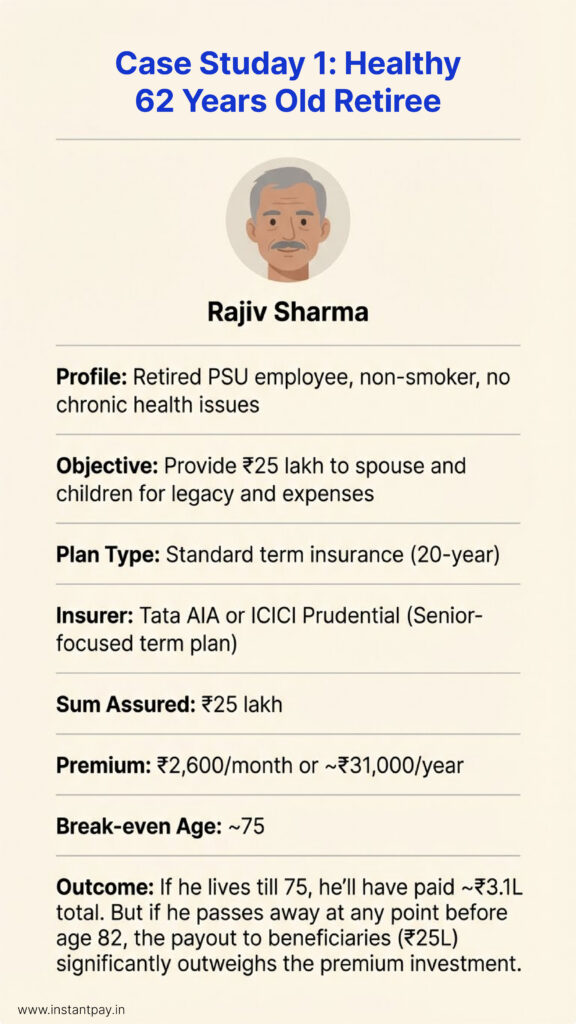
Profile: Rajiv, a recently retired PSU employee, is in good health with no major medical history. He wants to leave a financial cushion for his spouse and avoid burdening his children with final expenses.
Plan Chosen:
- Standard term insurance with full medical underwriting
- Coverage: Rs. 25 lakh
- Term: 20 years
- Monthly Premium: Rs. 2,600 (approx)
- Insurer: Tata AIA / ICICI Pru (based on comparison)
Why This Plan Fits:
His good health and age bracket (60–65) qualify him for better rates
A longer policy term gives peace of mind till age 82
Medical tests help lower premiums over time
Pros
- High sum assured is available
- Premiums are relatively affordable compared to his retirement corpus
- The legacy benefit ensures his family receives Rs. 25 L tax-free in case of his early demise
Cons:
- A medical test is mandatory
- If he outlives the policy, he receives nothing unless he chooses a return-of-premium variant
Why It Matters:
This plan is ideal for financially secure, healthy seniors who want to maximize their term insurance value over a longer horizon while locking in a low premium now.
Scenario 2: Suman Reddy — 65, Self-Employed with Health Conditions
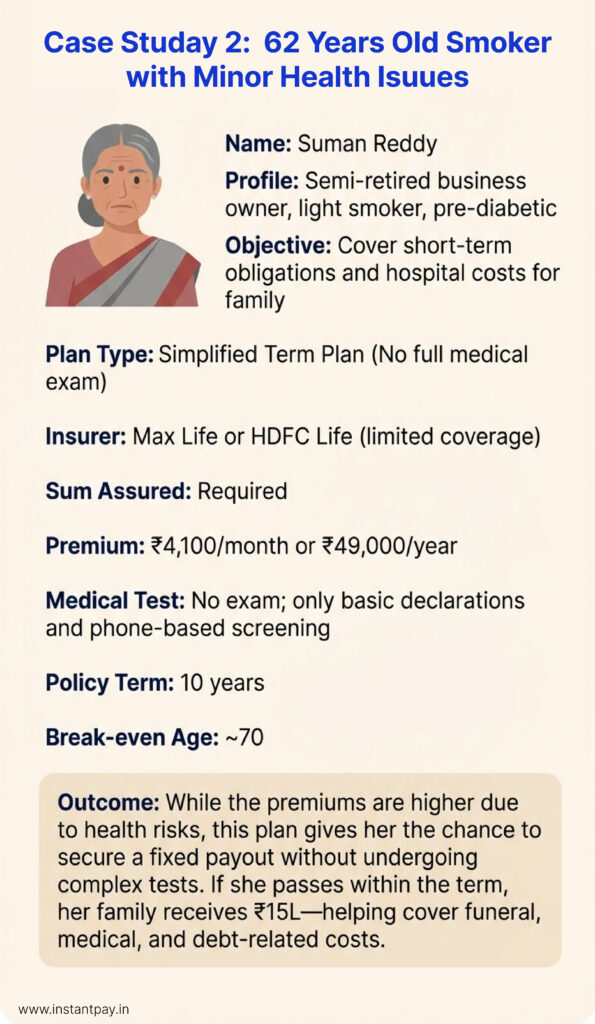
Profile: Suman is a semi-retired entrepreneur managing Type 2 diabetes and a history of smoking. She doesn’t qualify for most full-term plans due to these risks, but still wants short-term coverage to protect her spouse and pay for hospital expenses.
Plan Chosen:
- Simplified or no-medical-exam term plan
- Coverage: Rs. 15 lakh
- Term: 10 years
- Monthly Premium: Rs. 4,100
- Insurer: HDFC Life / Max Life (limited health underwriting plans)
Why This Plan Fits:
Avoids full medical exams, which may result in rejection
Short-term cover helps with financial obligations during the transition to full retirement
Faster approval with limited paperwork
Pros:
- No extensive underwriting needed
- Quick approval process
- Provides basic death benefit coverage during a high-risk window
Cons:
- Limited coverage (usually capped at Rs. 10–15 L)
- Higher premium per lakh of coverage
- Shorter policy term (usually max 10–15 years)
Why It Matters:
For seniors with minor but disqualifying health conditions, simplified issue plans offer a workable compromise, especially if the goal is to cover hospital bills, debts, or funeral costs rather than long-term family support.
What These Scenarios Show
| Factor | Rajiv (Standard Plan) | Suman (Simplified Plan) |
| Eligibility | Full medical exam; good health required | No medical exam; minor health accepted |
| Sum Assured | Rs. 25 lakh | Rs. 15 lakh (max cap) |
| Monthly Premium | Rs. 2,600 approx. | Rs. 4,100 approx. |
| Policy Term | 20 years | 10 years |
| Best For | Legacy planning, long-term cover | Final expenses, short-term financial aid |
| Limitations | Requires good health, long-term view | Higher cost, limited cover, shorter term |
This comparison makes one thing clear: There’s no universal best plan after 60—only the right plan for your specific needs. Whether you’re healthy and planning long-term, or managing health risks and seeking immediate coverage, India’s term insurance market has options. Just be prepared for stricter underwriting and higher premiums as you age.
Key Updates Shaping Senior Term Insurance Going Forward
New Tax Framework (Section 123)
A new section—Section 123—is set to replace the existing 80C for life insurance deductions. This change may influence how much premium you can claim, especially for limited-pay or single-premium policies. Be sure to track tax updates before finalizing your plan.
Senior-Centric Plans on the Rise
Several insurers are rolling out term insurance plans that extend coverage up to age 100, aligning with India’s increasing life expectancy and evolving retirement needs.
AI-Powered Underwriting & Digital Screening
Expect smoother approvals as AI-driven health assessments and telemedicine-based screenings become more common. These advancements can help seniors—especially in smaller towns—get insured faster, without hospital visits.
What are the latest trends in senior term insurance in India?
India is moving to Section 123 for tax deductions on life insurance. New term plans allow coverage till age 100. Insurers also use AI and telemedicine to simplify senior onboarding.
Final Thoughts: Choosing Term Insurance After 60
Yes, you can buy term insurance after 60—but choosing wisely makes all the difference.
At this stage, your focus should shift from income replacement to legacy planning, debt cover, or final expense protection. The right plan depends on your health, coverage horizon, and how much you’re comfortable paying.
For healthy seniors, traditional plans offer long-term coverage at better rates. For those with health conditions or limited goals, simplified or return-of-premium plans provide practical, shorter-term solutions.
One more thing: A new tax regime is set to replace Section 80C with Section 123, changing how life insurance premiums are treated for deductions. Be sure to factor this in when selecting policy duration and payment mode.
FAQs
1. Can a 60-year-old get term insurance?
Yes, many insurers in India offer term insurance up to age 65–75. Options may reduce with age, but coverage is possible with standard or senior-specific plans.
2. What is the best type of life insurance for a 60-year-old?
Standard term plans with a short tenure or return-of-premium (ROP) plans work best, depending on health, goals, and budget.
3. What is the best insurance plan for over 60?
Plans from Tata AIA, ICICI Prudential, and Max Life are senior-friendly—offering flexible terms, optional riders, and simplified approval.
4. What is the maximum age to buy term insurance in India?
Most insurers allow entry up to age 65–75. Some senior-focused plans offer coverage renewals up to age 99 or 100.
5. Is term insurance worth it for senior citizens?
Yes, if used for final expenses, legacy planning, or short-term financial cover. Choose plans based on need, not just age.
6. What are the best term plans for people above 60?
Tata AIA Sampoorna Raksha Supreme, ICICI Pru iProtect Smart, and Max Life Smart Secure Plus are top-rated for 60+.
7. Does term life insurance after 60 require medical tests?
Most plans do, but simplified options are available without full exams. These offer lower coverage and slightly higher premiums.
8. What is the typical premium for a 60-year-old in India?
For a cover of Rs. 25–50 lakh, monthly premiums range from Rs. 2,000–Rs. 4,500 depending on health, term, and insurer.
9. How long does term insurance last for senior citizens?
Terms range from 5 to 30 years, typically ending by age 75–85. Some policies extend up to 99 or 100 years.
10. Are there any tax benefits for term insurance after 60?
Yes. Premiums are currently deductible under Section 80C, transitioning to Section 123 in the upcoming tax regime.
11. What happens if a senior citizen outlives the term plan?
If it’s a standard plan, nothing is paid. With ROP plans, premiums (minus tax) are refunded at the end of term.
12. What’s better after 60: term insurance or whole life plan?
Term insurance is more affordable; whole life plans offer lifetime cover but at higher cost. Choose based on legacy goals.
13. What are the exclusions in senior citizen term insurance plans?
Common exclusions include suicide within 12 months, undisclosed pre-existing illnesses, and deaths from hazardous activities.
14. Can retirees buy term insurance without income proof?
Yes, but options are limited. Some insurers accept pension slips or FD income as proof for coverage eligibility.
15. How much term insurance cover can a 60-year-old get?
Most 60-year-olds can get Rs. 25L–Rs. 1Cr based on health, underwriting, and income documentation.
16. Which riders are useful for seniors buying term insurance?
Critical illness, waiver of premium, accidental death, and hospital cash riders offer valuable extra protection.
17. Is accidental death covered in term insurance after 60?
Yes, if the plan includes an accidental death rider. It enhances the payout beyond the base sum assured.
18. Can I get a refund of premiums if I survive the term?
Only if you’ve chosen a return-of-premium (ROP) plan. These refund your base premiums at the end of term.