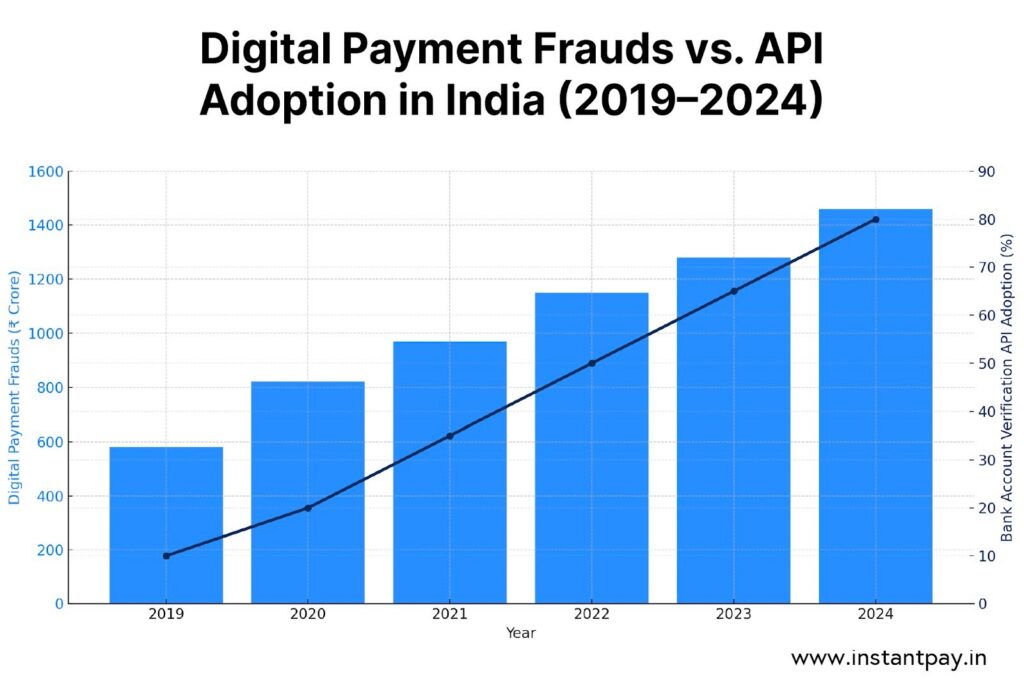
In FY24, India saw Rs.1,457 crore in digital payment frauds. This is a 30% rise from last year, as noted in the RBI Annual Report 2024.
Many frauds included fund transfers to unverified accounts. This shows a significant compliance gap in digital transactions.
As of March 2024, India hit over 13 billion UPI transactions each month. In April alone, more than rs.19.6 lakh crore was transacted, according to NPCI data. Many businesses still rely on manual processes or old penny-drop methods to check beneficiaries. This practice raises the risks of mule accounts, identity theft, and AML violations.
Under the RBI’s KYC Master Direction and the DPDP Act 2023, all financial entities, regulated or not, must:
- Verify identity and bank ownership before releasing funds.
- Keep audit trails of verification activities.
- Handle financial data securely and with consent.
Fintech companies, NBFCs, gig platforms, payment aggregators, and insurers need to grow fast. They must also keep compliance and maintain customer trust.
This is where Bank Account Verification APIs step in — offering a real-time, regulation-friendly way to:
- Confirm if a bank account belongs to the right person
- Prevent unauthorized fund transfers
- Protect businesses from legal exposure
- Build trust in every transaction
Failure to comply can lead to serious penalties. Under DPDP, companies could be fined up to Rs.250 crore for each breach of personal or financial data. This includes unverifiable bank account data used in payouts.
This blog explores the regulatory landscape for bank account verification in India. It shows security best practices and gives a clear plan for safe and compliant use.
What Is a Bank Account Verification API?
A Bank Account Verification API helps a business check if an account number and IFSC code match the right beneficiary. It usually does this by querying bank systems or NPCI databases. The API typically returns:
- Official account holder name
- Match status (Exact / Partial / Mismatch)
- AI-based confidence score
- Fraud flags or anomalies (if enabled)
This verification step is crucial. It makes sure funds go to the right person. This helps cut down on fraud, failed transactions, and compliance issues.
Regulatory Overview: Why Compliance Is Crucial
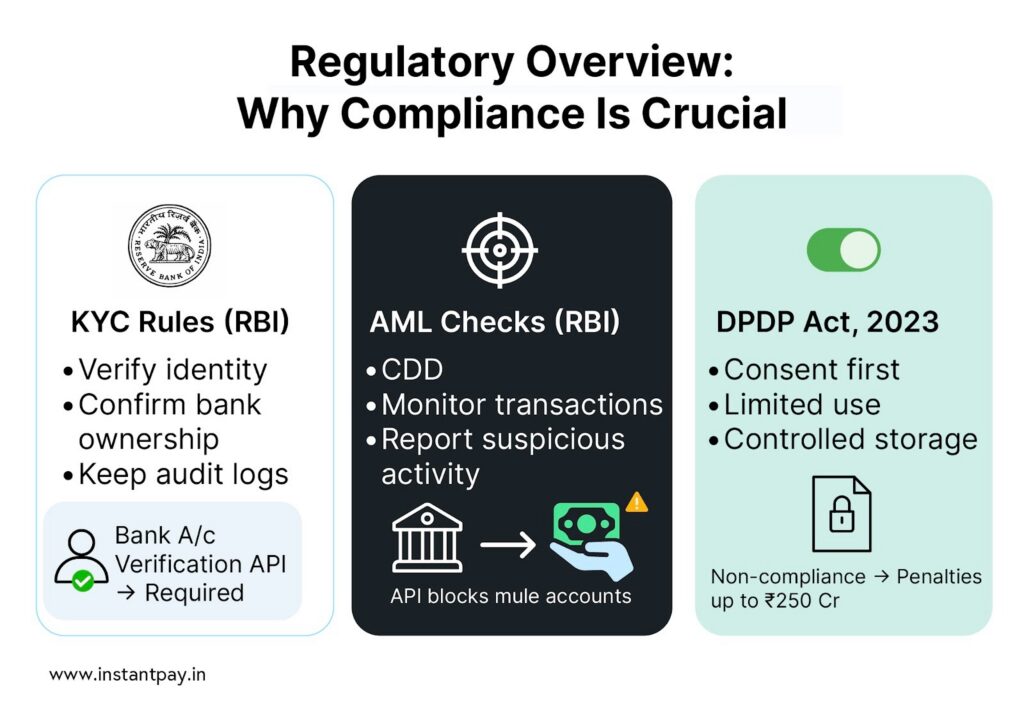
India’s financial rules are managed by bodies like the Reserve Bank of India (RBI), SEBI, and lately, MeitY with the Digital Personal Data Protection (DPDP) Act 2023. These bodies mandate that businesses verify identity, ensure fund traceability, and protect user data.
1. KYC (Know Your Customer) Guidelines
As per the RBI Master Direction – Know Your Customer (KYC) Direction, 2016, regulated entities must:
- Verify the identity of customers
- Establish ownership of bank accounts
- Retain logs and audit trails of verification activities
A bank account verification API is essential in a KYC process. It works with PAN, Aadhaar, and more. This API checks who really owns the recipient’s account. It’s an important step before sending any funds.
2. AML (Anti-Money Laundering) Compliance
RBI also requires financial institutions to perform:
- Customer due diligence (CDD)
- Ongoing transaction monitoring
- Suspicious transaction reporting (STR)
Bank account verification APIs help stop money from going to mule accounts. This tactic is often used in money laundering schemes.
3. Digital Personal Data Protection (DPDP) Act, 2023
DPDP regulates how personal and financial data should be handled. Key mandates include:
- Consent-based data processing
- Purpose limitation
- Data minimization
- Storage and retention control
Using a verification API without consent or proper logging can lead to penalties under DPDP. These penalties can reach up to Rs.250 crore for serious breaches.
Security Considerations for API Implementation
1. Secure Data Transmission (TLS 1.2+)
APIs must be integrated using HTTPS with TLS 1.2 or above to protect against eavesdropping and man-in-the-middle (MITM) attacks.
2. Token-Based Authentication (OAuth 2.0 or JWT)
API keys or tokens should be used for authenticating requests. Rotate tokens periodically and avoid exposing them in client-side code.

3. Input Validation & Rate Limiting
- Validate account numbers and IFSC codes before API calls
- Implement rate limiting and IP whitelisting to avoid abuse
4. Retry & Timeout Handling
Ensure exponential backoff and retry logic for temporary failures or bank downtime.
5. Masking & Encryption of PII
Bank details, names, and account numbers should be:
- Encrypted at rest (AES-256)
- Masked in logs or reports
- Stored with retention controls
Case Study: Compliance and Security – Navigating the Regulatory Landscape of Bank Account Verification APIs
As fintech and digital payment platforms expand, it’s important to stay updated on new regulations. Businesses that do not verify bank account ownership risk serious issues. These include fraud, operational risks, regulatory penalties, and damage to their reputation.
This case study looks at how proactive businesses use Bank Account Verification APIs. They do this to follow RBI’s KYC norms, AML regulations, and the DPDP Act. They also aim to protect sensitive customer data using secure, consent-based systems.
The Challenge: Balancing Growth with Compliance and Data Security
By 2024, India saw over 13 billion UPI transactions each month. Digital payments reached more than Rs.2,300 lakh crore for the fiscal year. With this rapid growth, there was also a concerning rise in fraud. In FY24, Rs.1,457 crore was lost to digital payment fraud (RBI).
Many businesses in various sectors, such as lending, insurance, and gig economy platforms, failed audits because they were non-compliant for not:
- Verify account ownership before disbursements.
- Log consent for sensitive data processing.
- Maintain secure audit trails for verification activities.
- Detect fraudulent or mule accounts in time.
These gaps put businesses at risk of financial losses and penalties under the DPDP Act. Fines can reach Rs.250 crore for each violation.
Real-World Example 1: Strengthening KYC in Digital Lending
Context:
A digital lending platform got flagged for compliance issues in an RBI audit. This happened after it disbursed loans to accounts that weren’t validated for ownership. Several loan frauds traced back to mismatched beneficiary names on the bank accounts.
What They Did:
The platform added a Bank Account Verification API. This checks the account number and IFSC against official records. It then returns:
- Account holder name
- Match status (Exact/Partial/Failed)
- AI-generated confidence score
- Consent timestamp
They created a rule engine that marked mismatches under 80% confidence for manual review.
Outcome:
- Reduced payout fraud rate by 92%
- Improved KYC audit score during next inspection
- Introduced customer-friendly consent flow under DPDP compliance
- Increased approval efficiency without sacrificing compliance
Real-World Example 2: Securing Gig Worker Payouts with Consent & Encryption
Context:
A hyperlocal services platform operating in 50+ cities handled thousands of daily payouts. Regulatory scrutiny grew after concerns about data privacy. This was due to the insecure storage of bank account logs and the lack of user consent.
What They Did:
The team deployed an API-led bank verification system with:
- HTTPS (TLS 1.2+) encryption
- AES-256 data encryption at rest
- Role-based API token access
- Consent capture embedded in the onboarding workflow
- Masked data logging with verification outcome only
Outcome:
- Aligned with DPDP Act mandates within 4 weeks
- Passed third-party penetration testing with no critical vulnerabilities
- Reduced data exposure risk by over 95%
- Strengthened trust with partners by communicating privacy improvements
Key Security Measures Implemented
- OAuth 2.0 Token Authentication
- IP Whitelisting and Rate Limiting
- Exponential Backoff Retry Mechanisms
- Masked Logging for PII
- Consent Layer Built into UI/UX Flow
- Audit Trails with Timestamps and User UUIDs
- Batch Verification with Webhook Status Reports
Lessons Learned
1. Bank verification is integral to KYC, not optional.
Platforms that used to rely only on PAN and Aadhaar now see the need to verify account ownership. This helps close fraud loopholes.
2. Consent is not a UX burden — it builds trust.
Users responded positively to transparent, opt-in consent flows during onboarding, boosting NPS and legal defensibility.
3. Logs, not spreadsheets, win audits.
Timestamped API logs helped businesses succeed in compliance audits and show real-time KYC adherence.
4. APIs reduce costs by preventing violations.
Avoiding a single DPDP violation could save up to Rs.250 crore. So, the low cost of API integration is worth it many times over.
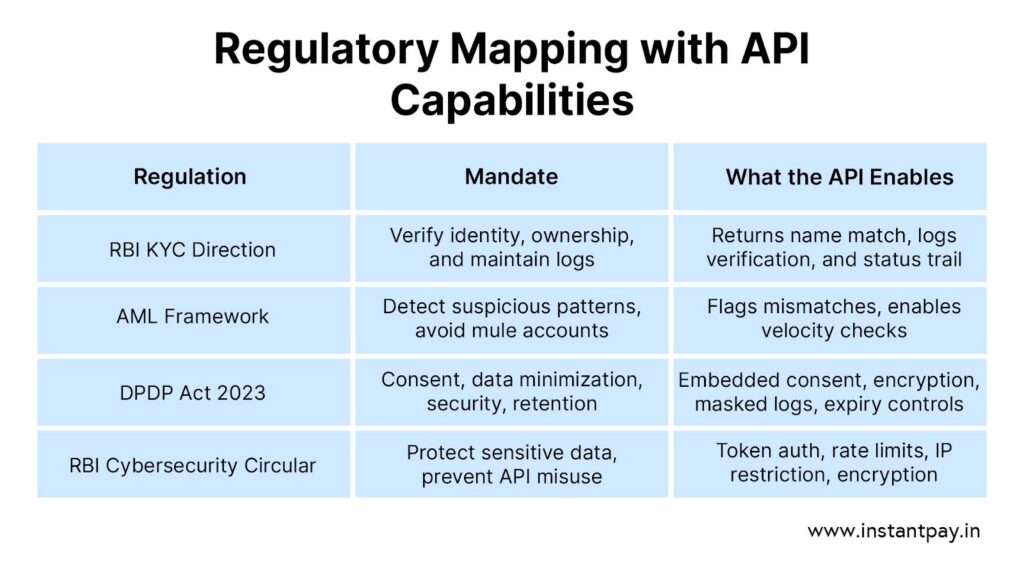
How Bank Account Verification APIs Help Achieve Compliance?
| Compliance Standard | API Utility |
| KYC | Confirms account belongs to customer; complements PAN/Aadhaar verification |
| AML | Blocks transactions to mule or fraudulent accounts |
| DPDP Act | Enforces consent-based, logged, and secure handling of financial data |
| RBI Audit | API logs provide traceability, user consent, and verification outcome trail |
Real-World Risk: What Happens Without Verification?
Let’s say your platform disburses Rs.50 crore in monthly payouts. With a 2% error/fraud rate, that’s Rs.1 crore in:
- Incorrect payouts
- Refund processing delays
- Customer support overhead
- Reputation loss and regulatory risk
Adding real-time verification with proper logging reduces this risk to under 0.2%, resulting in savings of Rs.80–90 lakh monthly.
Implementation Checklist for Compliance & Security
Here’s a 10-point implementation framework to ensure your API usage is both compliant and secure:
Step 1 – Use HTTPS with TLS 1.2+ for all API calls
Step 2 – Authenticate using OAuth2 or signed JWT tokens
Step 3 – Validate IFSC/account formats before calling the API
Step 4 – Obtain explicit user consent and log the timestamp
Step 5 – Limit and monitor API access via IP whitelisting and throttling
Step 6 – Log verification outcome with masked data and UUIDs
Step 7 – Encrypt all sensitive data in transit and at rest
Step 8 – Include API call audit trails in internal reporting
Step 9 – Integrate consent logs with your privacy policy under DPDP
Step 10 – Periodically review vendor compliance and perform penetration testing
Key Considerations When Choosing a Verification API Provider
- Compliance-ready architecture (RBI, DPDP, SEBI)
- Supports consent flow and logging
- Fuzzy name matching with AI scoring for high accuracy
- Fallback options during NPCI/bank downtime
- Batch verification and webhook support
Global and Indian Guidelines to Refer
| Standard/Authority | Relevance |
| RBI Master Direction on KYC | Identity and bank account verification mandate |
| FATF AML Guidelines | Cross-border anti-money laundering protocols |
| India DPDP Act (2023) | Consent, privacy, and personal data protection |
| NPCI Bank Verification Standards | API standards for UPI and account validation integrations |
| ISO/IEC 27001 | Recommended for API provider’s data security management |
Best Practices for Maintaining Customer Trust
In fintech, trust = currency. Here’s how to build it with your verification process:
- Transparency: Let users know why you’re verifying and how their data is protected
- Consent-first UX: Don’t assume; always ask before verifying
- Security Messaging: Highlight use of encryption and compliance on onboarding screens
- Clear Privacy Policy: We store verification data for a specific time. This data helps us confirm your identity and improve our services.
The Future of Compliance: What’s Next?
1. Consent-as-a-Service APIs
APIs that return a verifiable proof-of-consent token will become the norm.
2. Risk-Based KYC
Combined APIs for PAN, Aadhaar, bank account, and mobile ownership — scored in real-time.
3. Live Regulatory Sync
APIs will dynamically adapt to changes in compliance (e.g., auto-updated DPDP consent frameworks).
4. On-Chain Verifications
In Web3 and DeFi, account verification may extend to wallet-banked identities on public ledgers.
Frequently Asked Questions
1. Is consent mandatory for bank account verification in India?
Yes. Under DPDP and RBI norms, explicit consent is required to process bank and personal data.
2. Can I use verification APIs without storing data?
Yes. You can verify in real-time and only log status codes or masked responses to reduce data handling risks.
3. Are these APIs secure for handling financial data?
When implemented with TLS, token-auth, and encryption-at-rest, yes — they meet financial-grade security standards.
4. Do I need to verify bank accounts even after KYC?
Yes. PAN or Aadhaar confirms identity, not ownership of the bank account. Verification APIs bridge that gap.
5. What are the penalties for non-compliance under DPDP?
Fines can go up to Rs.250 crore per violation for significant data breaches or unlawful processing.