By 2025, over 10 trillion in financial transactions globally will be facilitated via API-based platforms, according to a report by PwC and the Open Banking Working Group.
That’s more than the combined GDP of Germany and Japan—flowing not through branches or banking apps, but through invisible, programmable interfaces.
This single statistic captures a profound shift: APIs are not just tools—they are becoming the infrastructure of modern banking. From real-time UPI transfers in India to embedded credit at checkout on Amazon, APIs are quietly transforming how money moves, decisions are made, and products are built.A Quiet Revolution in Financial Services Banking, once defined by branch visits and paper statements, is undergoing a radical transformation. At the heart of this shift lies a
powerful yet invisible force: APIs (Application Programming Interfaces). These digital connectors are redefining how banks operate, collaborate, and serve customers in real time.
According to a 2024 report by McKinsey, over 75% of global banks have either launched or are scaling API strategies to power fintech partnerships, real-time payments, embedded finance, and open banking initiatives. APIs are no longer a technology choice—they are a competitive necessity.
This blog explores how APIs are shaping the future of banking, enabling greater agility, personalization, and innovation while also examining the challenges and regulatory considerations banks must navigate.
What Are Banking APIs?
Banking APIs (Application Programming Interfaces) are standardized, secure software interfaces that enable real-time communication and data exchange between a bank’s internal systems and external third-party applications or platforms. These APIs act as digital bridges, allowing different software systems to interact and perform banking operations without exposing sensitive backend infrastructure.
Key Functions of Banking APIs
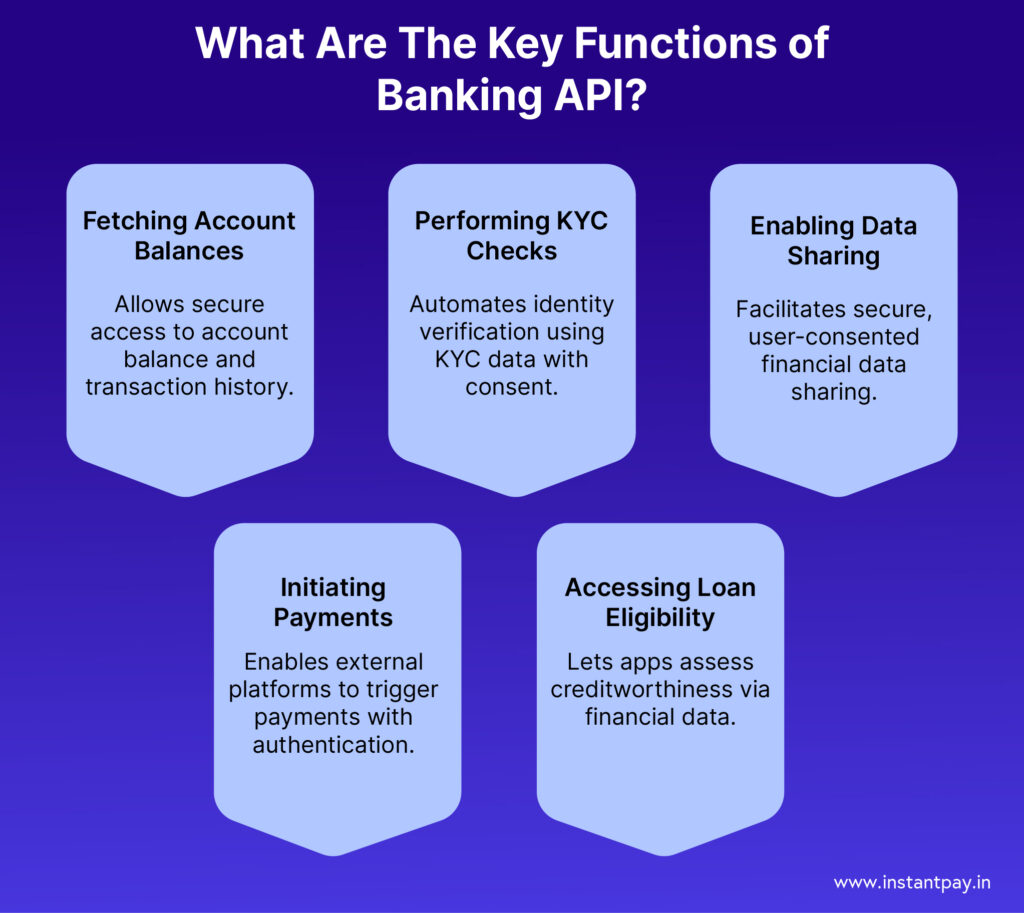
Banking APIs can perform a wide range of functions, including:
1. Fetching Account Balances and Transactions
- What it does: Allows third-party apps (like personal finance managers or fintechs) to securely access a customer’s current account balance and recent transaction history.
- Example: A budgeting app can display your latest bank transactions and balances in real time.
2. Initiating Payments or Fund Transfers
- What it does: Enables external platforms to trigger payments or money transfers directly from a user’s bank account, with proper authentication and consent.
- Example: Paying for an e-commerce order directly from your bank account via a payment gateway that uses banking APIs.
3. Performing KYC (Know Your Customer) Checks
- What it does: Automates the process of verifying a customer’s identity by allowing third-party platforms to access KYC data (with user consent).
- Example: A fintech lending app can verify your identity instantly using your bank’s KYC API, speeding up onboarding.
4. Accessing Loan Eligibility or Credit Scores
- What it does: Lets third-party apps assess a customer’s creditworthiness by accessing relevant financial data, such as credit scores or loan eligibility.
- Example: A loan comparison site can show you pre-approved loan offers based on your real-time credit score retrieved via APIs.
5. Enabling Consent-Based Data Sharing (e.g., Account Aggregators in India)
- What it does: Facilitates secure, user-consented sharing of financial data between banks and regulated third parties, often through frameworks like India’s Account Aggregator (AA) system.
- Example: With your consent, a wealth management app can aggregate your financial data from multiple banks to provide holistic advice.
Why Are Banking APIs Important?
- Expand Service Reach: Banks can offer their services beyond traditional channels (branches, ATMs, their own apps) by integrating with fintechs, e-commerce platforms, neobanks, ERP systems, and more.
- Foster Innovation: APIs enable rapid development of new financial products and services by allowing third parties to build on top of core banking infrastructure.
- Enhance Customer Experience: Customers benefit from seamless, personalized, and real-time financial services across multiple platforms.
- Support Open Banking: Many regulators (like in the EU and India) mandate banks to provide secure API access to foster competition and innovation in the financial sector.
Examples of Banking API Use Cases
- Personal Finance Apps: Aggregate accounts from multiple banks for unified budgeting and expense tracking.
- Payment Gateways: Enable direct payments from bank accounts for online shopping.
- Lending Platforms: Instantly verify income and creditworthiness for faster loan approvals.
- ERP Integrations: Automate reconciliation and cash management for businesses by connecting their accounting software with bank accounts.
Security and Compliance
- Authentication & Authorization: Robust security (OAuth, tokenization) ensures only trusted parties can access APIs.
- Consent Management: APIs are designed to require explicit user consent before sharing data.
- Regulatory Compliance: APIs must comply with data protection laws (like RBI guidelines, DPDP Act in India, PSD2/GDPR in Europe).
Why APIs Matter: The Three Pillars of API-Driven Banking
Banking APIs are transforming the financial industry by enabling banks to be more agile, customer-focused, and competitive. Here’s how the three pillars—Agility, Customer-Centricity, and Competitiveness—make APIs essential for modern banking:
1. Agility: Launch Products Faster
Traditional Challenge: Banks have historically relied on complex, monolithic legacy systems, making it difficult and time-consuming to introduce new products or services.
How APIs Help: APIs modularize banking services, allowing banks to expose specific functionalities (like payments, KYC, or account information) as independent, reusable components. This modularity enables rapid integration with new digital products—such as digital wallets, Buy Now Pay Later (BNPL) solutions, or instant loan disbursement—significantly reducing time-to-market from months to just weeks.
Benefits:
- Faster product launches and updates
- Easier experimentation and innovation
- Quicker response to market trends and regulatory changes
Example: A bank can quickly partner with a fintech company to offer BNPL at checkout by exposing payment and credit APIs, without rebuilding its core systems.
2. Customer-Centricity: Personalize Experiences
Traditional Challenge: Legacy banking often delivers one-size-fits-all services, lacking the flexibility to tailor offerings to individual needs.
How APIs Help: APIs enable banks to securely share customer data (with consent) and collaborate with ecosystem partners—fintechs, e-commerce platforms, wealth managers, and more. This allows for hyper-personalized experiences, such as:
- Real-time investment advice within a banking app
- Personalized BNPL offers at online checkout
- Instant expense tracking and budgeting tools
Benefits:
- Seamless, integrated customer journeys across platforms
- Real-time, context-aware financial services
- Higher customer engagement and loyalty
Example: A customer can view their credit score, receive tailored investment tips, and track spending—all within their favorite finance app, powered by secure API connections.
3. Competitiveness: Survive and Thrive in the Fintech Era
Traditional Challenge: Banks face growing competition from agile fintechs and digital-first neobanks that can rapidly innovate and attract customers.
How APIs Help: By opening up APIs to third-party developers, banks can:
- Create new digital distribution channels (e.g., embedded finance in e-commerce, ride-sharing apps)
- Monetize APIs and consent-based data sharing
- Foster partnerships that extend their reach and relevance in the digital economy
Benefits:
- New revenue streams through API monetization
- Greater ecosystem participation and market presence
- Future-proofing against disruption by fintechs and big tech
Example: A bank can generate revenue by allowing fintechs to access its payment APIs (with customer consent), or by embedding its services into popular business software.
4. Pillars of API-Driven Banking – Summary
| Pillar | What APIs Enable | Key Outcomes |
| Agility | Modular, rapid product development | Faster launches, innovation, adaptability |
| Customer-Centricity | Personalized, integrated experiences | Higher engagement, satisfaction, loyalty |
| Competitiveness | Ecosystem partnerships, API monetization | New revenue, broader reach, digital relevance |
Emerging Trends in API Banking
API banking is rapidly evolving, driven by regulatory changes, technological innovation, and shifting customer expectations. Here’s a detailed look at the most significant trends shaping the future of API-driven financial services:
a) Open Banking & Account Aggregation
Regulatory Drivers: Regulations like PSD2 in Europe and the RBI’s Account Aggregator (AA) framework in India are accelerating open banking adoption. These frameworks require banks to provide secure, standardized APIs that allow customers to share their financial data with third-party providers, always based on explicit consent.
Key Capabilities Enabled by APIs:
- Seamless Data Portability: Customers can move their financial data between platforms, making it easier to switch providers or use multiple services.
- Consent-Based Data Access: Users control who can access their data and for what purpose, enhancing privacy and trust.
- Cross-Platform Financial Planning: Aggregated data enables holistic financial management tools, allowing customers to view accounts, loans, and investments across institutions in one place.
Market Impact: Open banking API call volumes are surging globally, with Europe leading in adoption and transaction volumes. This trend is expanding to include not just banking, but also insurance, pensions, and investments—ushering in the era of “Open Finance”.
b) Real-Time Payments & Instant Settlements
APIs as the Backbone: APIs are fundamental to real-time payment systems like UPI and IMPS in India, Faster Payments in the UK, and SEPA Instant in Europe. They enable instant, secure money movement between accounts, 24/7.
Benefits and Use Cases:
- Instant Payrolls: Employees can receive wages in real time, improving financial wellness.
- On-Demand Lending: APIs allow lenders to instantly disburse approved loans to borrowers’ accounts.
- Just-in-Time Insurance Payments: Premiums can be collected instantly, reducing lapses and improving customer experience.
- Business and Security Implications:
Real-time payments improve operational efficiency, liquidity management, and customer satisfaction. They also require advanced fraud detection and security measures, often powered by AI and tokenization.
c) Embedded Finance – refers to the integration of banking services directly into non-bank platforms—such as e-commerce, ride-hailing, or travel apps—via APIs.
Examples:
- Credit Card Offers at Checkout: Shoppers can apply for and receive instant credit offers while making online purchases.
- Micro-Loans in Food Delivery Apps: Users can access small, short-term loans within their favorite delivery platforms.
- Travel Insurance While Booking Flights: Customers can purchase insurance seamlessly during the booking process.
Impact: Embedded finance expands banks’ reach, creates new revenue streams, and delivers financial services at the point of need, enhancing customer convenience and engagement.
d) AI-Powered Personalization
APIs Unlock Data for AI: With secure access to rich transaction data via APIs, banks and fintechs can deploy machine learning and AI to deliver smarter, more personalized financial services.
Key Applications:
- Smart Nudges: Personalized prompts for saving, investing, or managing expenses based on real-time analysis of customer behavior.
- Risk-Adjusted Lending Decisions: AI models assess creditworthiness using diverse data points, enabling more accurate and inclusive lending.
- Real-Time Fraud Detection: AI continuously monitors transaction patterns to identify and block suspicious activity instantly.
Future Outlook: The synergy between open APIs and AI is driving a new wave of innovation, enabling banks to offer hyper-personalized, secure, and efficient services that adapt to individual customer needs.
Summary Table: Key Trends and Their Impact
| Trend | What APIs Enable | Key Benefits |
| Open Banking & Aggregation | Data portability, consent-based sharing | Empowered customers, holistic planning |
| Real-Time Payments | Instant money movement, 24/7 access | Faster payrolls, lending, and settlements |
| Embedded Finance | Banking in non-bank platforms | Convenience, new revenue, broader reach |
| AI-Powered Personalization | Data-driven, adaptive financial services | Smarter advice, better risk, stronger security |
Challenges in API-Driven Banking
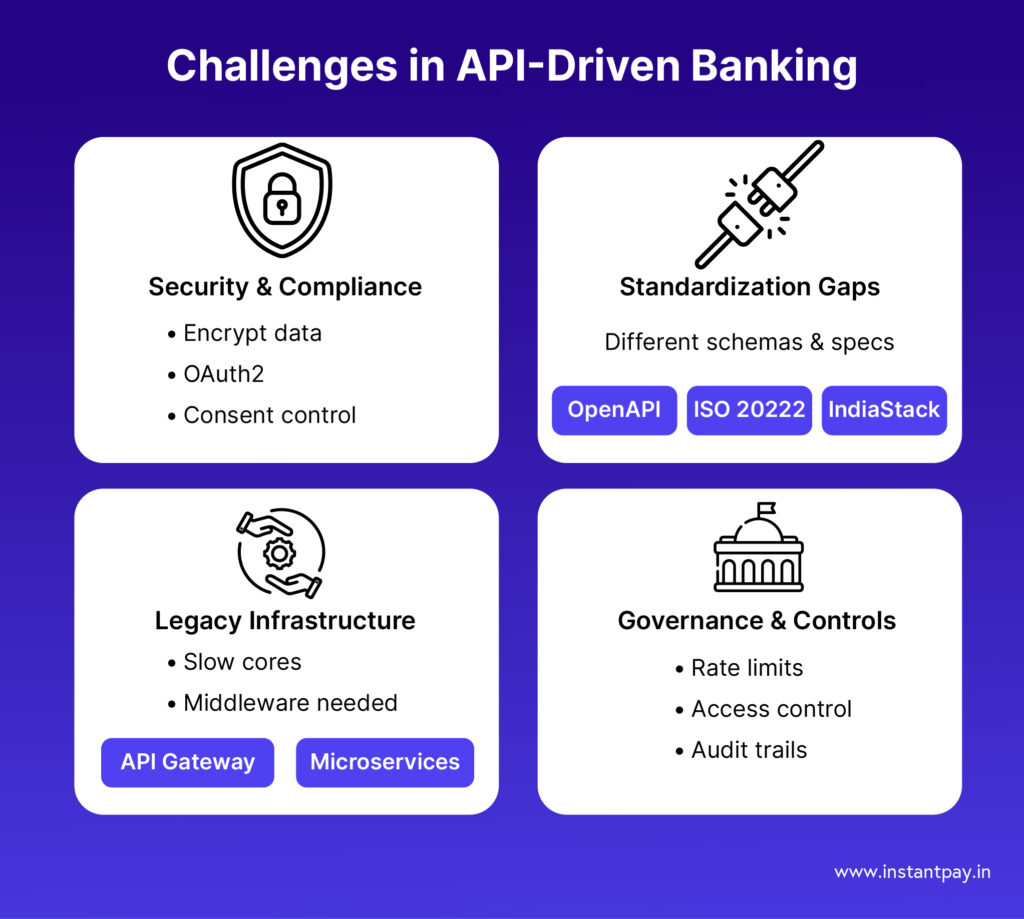
1. Security & Compliance
APIs expose sensitive data. Ensuring encryption, OAuth2.0 protocols, consent management, and compliance with laws like GDPR, DPDP (India), and PCI-DSS is critical.
2. Standardization Gaps
Lack of common standards across APIs makes integration harder. Global initiatives like OpenAPI, ISO 20022, and IndiaStack are working to fix this.
3. Legacy Infrastructure
Traditional banks may struggle to expose real-time APIs due to outdated core banking systems. This calls for API middleware or microservice architecture.
4. Governance and Rate Limiting
Without proper controls, APIs can be abused. Banks must implement:
- Rate limiting
- Access control
- Audit trails
Opportunities for Banks and Fintechs
New Revenue Streams
Banks can monetize APIs by offering premium access to verified fintechs or commercial partners. Examples:
- Usage-based pricing (per API call)
- Tiered SLAs for different partners
Faster Innovation via Ecosystems
APIs allow banks to become platforms—inviting developers, partners, and fintechs to co-create services.
Financial Inclusion
APIs powering Aadhaar-based onboarding, micro-credit, and vernacular UI integrations are bringing underserved users into the financial mainstream.
Case Study: How a Traditional Bank Transformed Through API-Driven Innovation
Background
A large retail and SME-focused bank in South Asia faced increasing pressure from fintech competitors offering seamless digital experiences. While the bank had strong brand equity and a wide branch network, its digital services were siloed, slow to innovate, and unable to scale quickly across channels.
In response, the leadership launched a multi-year API-first transformation strategy to modernize operations, partner with fintechs, and deliver personalized digital products in real time.
The Challenge
The bank’s legacy systems made it difficult to introduce new digital services or integrate with partners. Key roadblocks included:
- Monolithic architecture with minimal external connectivity
- Slow product development cycles (6–9 months on average for new digital features)
- Lack of a unified customer data view
- No developer interface for fintech or B2B integrations
- Rising customer churn due to poor digital UX
The bank needed to pivot quickly to an agile, modular, and ecosystem-ready infrastructure—or risk losing relevance in a rapidly evolving fintech landscape.
The Solution: Building an API-Driven Innovation Layer
Phase 1: API Layer and Middleware Infrastructure
- Deployed an API management platform to securely expose internal banking functions (e.g., account access, KYC, payments, lending workflows)
- Developed 100+ RESTful APIs across core banking, cards, and loan management systems
- Created a centralized API sandbox for fintechs and partners to test integrations
Phase 2: Ecosystem Integration and Embedded Finance
- Launched partnerships with lending startups to offer BNPL and micro-loans at POS via APIs
- Enabled retailers to offer embedded credit scoring and instant EMI conversions
- Integrated with government APIs for Aadhaar-based onboarding, tax payments, and subsidy disbursements
Phase 3: AI + API for Personalization
- Used transaction and behavioral data from APIs to feed ML models for:\n – Real-time credit decisioning
- Personalized offers via push notifications
- Expense categorization and savings nudges in the mobile app
- Personalized offers via push notifications
Phase 4: Regulatory Alignment and Open Banking
- Adopted India’s Account Aggregator (AA) framework, enabling consent-driven data sharing
- Complied with DPDP Act for privacy, encryption, and consent logs via API gateways
- Supported PSD2-style APIs for secure third-party access and SCA (Strong Customer Authentication)
KEY OUTCOMES
After 18 months of API-first execution, the bank achieved measurable business transformation:
| Metric | Before API Strategy | After API Implementation |
| New Digital Features Launch Time | 6–9 months | 4–6 weeks |
| Daily Digital Transactions | ~50,000 | 400,000+ |
| Partner Integrations | 5 (manual onboarding) | 60+ (self-service APIs) |
| Developer NPS (Net Promoter Score) | N/A | 72 |
| Revenue from API Partnerships | 0 | 11% of new retail revenue |
Real-World API Use Cases
- Real-Time Payments
The bank integrated UPI and IMPS APIs across merchant platforms and apps, enabling instant payouts, refunds, and bill payments. - Embedded Insurance
APIs allowed ride-hailing and travel platforms to offer micro-insurance policies directly at checkout, expanding the bank’s insurance penetration by 40%. - SME Lending via APIs
A simplified API workflow for invoice-based lending enabled e-commerce sellers to get working capital within 24 hours, down from the traditional 15–20 day cycle.
The Road Ahead: Platformification of Banking
The future of banking lies in platform models, where banks act not just as service providers but as infrastructure enablers. Just like AWS transformed IT, API banking can make finance programmable, composable, and scalable.
Banks that embrace this future will:
- Scale faster via partnerships
- Launch products at lower cost
- Drive superior customer engagement
Those that resist may find themselves disintermediated by more agile, API-first challengers