In today’s fast-paced digital landscape, security, compliance, and trust are non-negotiable for businesses. The global identity verification market is expected to reach ?14.8?billion in 2025, growing at over 13 percent annually—a clear signal of how crucial ongoing identity checks have become. But what happens when a user’s information changes, or when time or risk makes their old verification no longer valid? That’s where reverification comes into play.
Whether you’ve heard of identity refresh, re-validation steps, or even wondered what this process entails, this guide breaks it all down—from what it is to how it works, and how it can strengthen your business operations.
What Is Reverification?
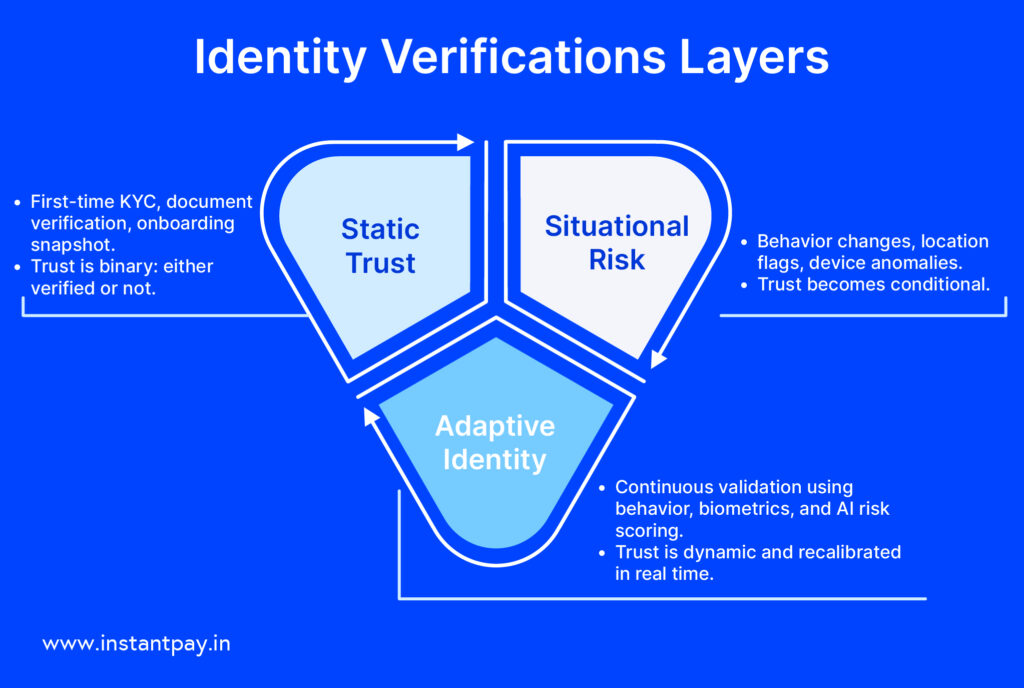
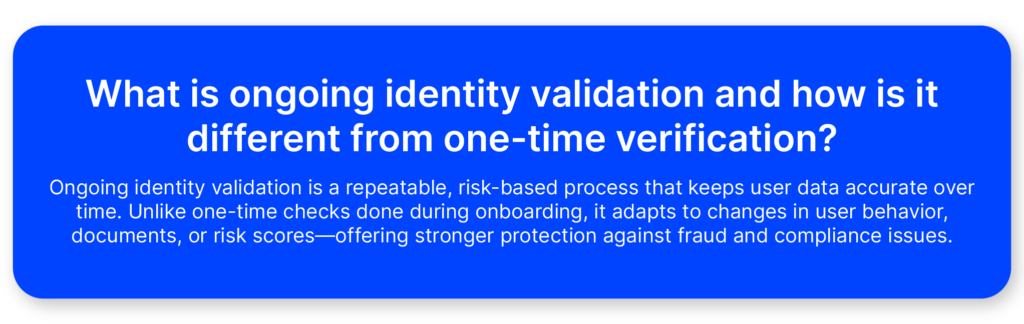
At its core, this is a process that ensures continuity of trust between a business and its customers or users. While initial identity verification is a crucial first step in onboarding, it’s often not enough. Over time, people change—so do their documents, behaviors, and risks. That’s where ongoing identity validation steps in as a dynamic, continuous mechanism.
Unlike one-time identity checks, this process is cyclical or event-triggered, designed to refresh and reconfirm the accuracy, authenticity, and relevancy of user data. It plays a critical role in high-risk industries such as financial services, healthcare, insurance, telecom, and e-commerce, where outdated or inaccurate data could lead to compliance violations, fraud, or reputational damage.
Why Is Reverification a Distinct Process?
This isn’t just a re-run of onboarding—it’s more contextual and adaptive. It considers a user’s relationship history, risk score, and transaction patterns to determine whether and how they need to be re-validated.
It also supports:
- Data lifecycle management – ensuring that data remains current throughout a customer’s journey.
- Continuous identity assurance – extending beyond login to protect ongoing access and transactions.
- Layered security models – where verification is tied to the sensitivity of user actions.
In today’s threat landscape, where synthetic identities and data leaks are on the rise, this acts as an active defense system rather than a passive gatekeeper.
When Is Reverification Needed?
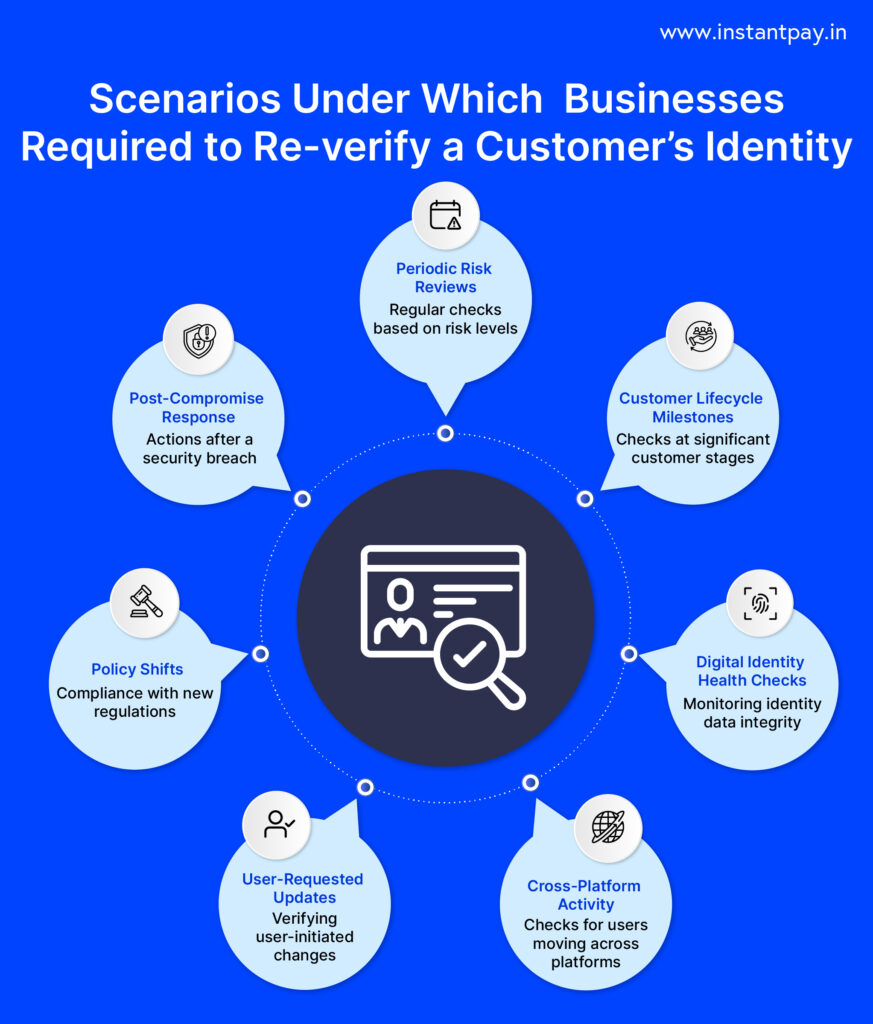
This isn’t a one-size-fits-all routine—it’s a strategic identity check that businesses implement based on changing contexts, behaviors, and regulatory landscapes. Knowing when to initiate this step is key to balancing risk, compliance, and customer experience.
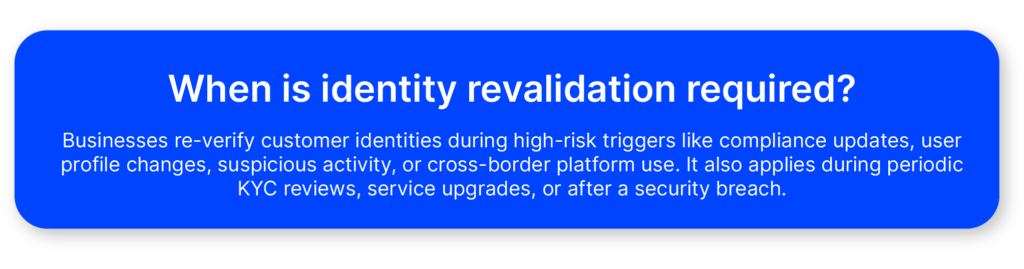
Here are several nuanced scenarios where it becomes essential:
1. Periodic Risk Reviews
Many industries follow a risk-based approach to customer verification, where low-risk users are reviewed less frequently and high-risk profiles are revisited more often. For instance, a fintech app may revalidate users annually if they’re in a high-risk category (e.g., PEPs or users from high-fraud geographies).
2. Customer Lifecycle Milestones
As customers move through different stages—like upgrading services, becoming premium clients, or applying for credit—the level of scrutiny changes. Additional checks may be required:
- Before granting higher credit limits
- Prior to issuing a loan
- When switching from individual to business accounts
3. Digital Identity Health Checks
Identity refresh is also used in systems that score the integrity of identity data over time. If metadata associated with a user (device fingerprint, IP reputation, behavioral patterns) deviates from normal, it can trigger further validation
4. Cross-Platform or Cross-Border Activity
For global platforms, a user moving from one regional interface to another (e.g., from the UK site to the UAE platform) may be prompted for an identity check based on data residency laws, local compliance rules, or internal policy changes.
5. User-Requested Profile Updates
Even seemingly harmless actions—like changing your profile picture or email—can open the door to fraudulent account takeovers. These processes help confirm that such changes are genuinely initiated by the rightful user, not an impersonator.
6. Policy, Legal, or Industry Shifts
If there’s a change in compliance regulations (such as amendments to AML/KYC norms or GDPR updates), businesses may be mandated to reconfirm user details across their database. This is especially relevant in banking, cryptocurrency, and insurance sectors.
7. Post-Compromise Response
In the event of a data breach, phishing attack, or system compromise, companies often initiate wide-scale revalidation campaigns. This helps contain the damage by restoring account accuracy and confirming access legitimacy.
Reverification as a Continuous Practice
The most future-ready organizations don’t just treat this as a reaction—but as part of a continuous identity assurance framework. Smart implementation involves machine learning tools that monitor user behavior and flag anomalies in real-time, triggering contextual reviews only when truly needed.
Reverification vs Reauthentication: Are They the Same?
Although these two terms are often used interchangeably, they serve distinct purposes in identity management and play different roles in business security frameworks. Understanding the difference is critical for designing user journeys that are both secure and frictionless.
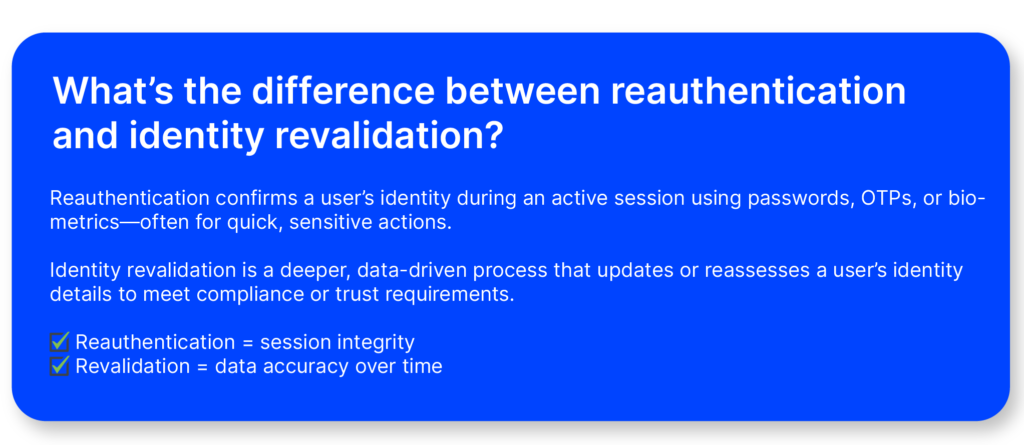
Reauthentication: A Session-Based Identity Check
Reauthentication is typically a short-term security control that confirms a user’s identity within an active session. It usually involves low-friction methods such as:
- Password entry
- One-Time Password (OTP)
- Biometric confirmation (e.g., Face ID, fingerprint)
- Security questions
It’s designed to temporarily reconfirm trust before a user performs a sensitive action, such as:
- Changing account settings
- Making a large payment
- Accessing a high-privilege feature
In short, reauthentication is about session integrity, not data accuracy.
Identity Reassessment: A Data-Driven Refresh
The other process, by contrast, is a deeper and broader identity reassessment. It involves requesting updated documentation, biometric resubmission, or revalidation of personal information—usually when:
- Identity documents expire
- There are signs of fraud or inconsistencies
- Compliance or KYC obligations demand it
- The user relationship evolves or changes risk levels
Whereas reauthentication trusts that the account holder is still the rightful user, this broader validation questions the very foundation of identity and data accuracy.
Key Differences at a Glance
| Criteria | Reauthentication | Reverification |
| Purpose | Confirm identity during an active session | Refresh or reconfirm user identity over time |
| Depth | Shallow – checks login/session credentials | Deep – reviews documents, biometrics, or legal data |
| When Used | Before a high-risk action | After inactivity, policy changes, document expiry, or fraud signals |
| User Effort | Minimal (OTP, biometrics) | Moderate to high (uploading ID, verifying info) |
| Regulatory Impact | Often optional | Often mandatory under KYC/AML laws |
Why This Distinction Matters
Mixing up these two processes can lead to poor security design:
- Over-relying on reauthentication may leave gaps in user identity integrity.
- Overusing periodic identity reviews unnecessarily can cause friction, frustration, and drop-offs.
The best systems employ both—reauthentication for real-time security, and broader verification for lifecycle-level assurance.
How the Reverification Process Works ?
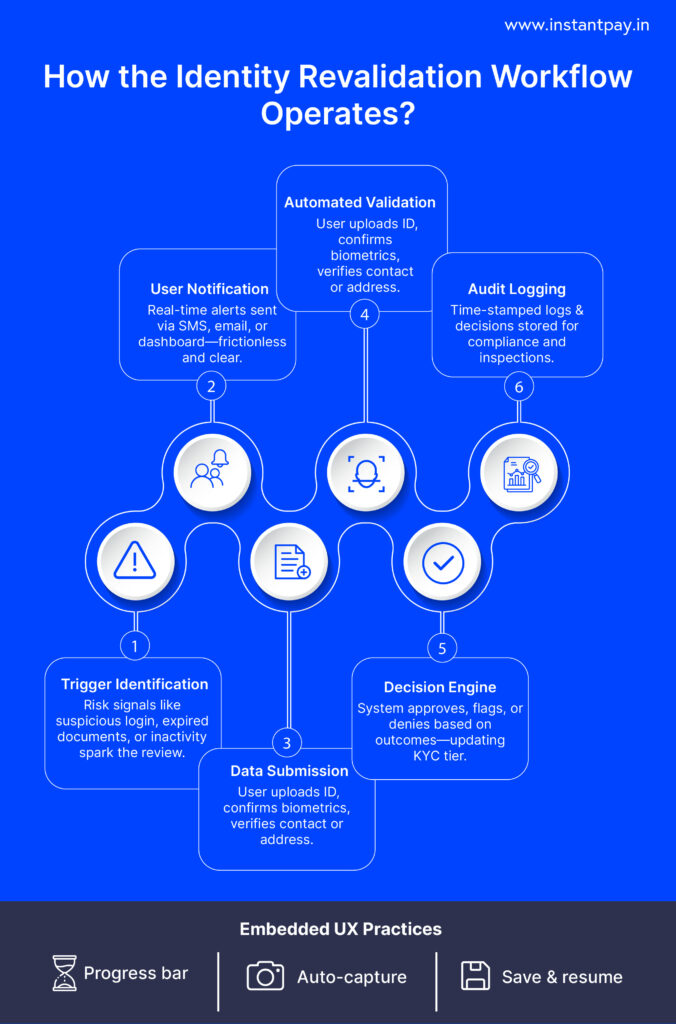
While identity reconfirmation may sound like a single event, it is often a multi-layered, trigger-based workflow that blends automation, risk analysis, and user interaction. The objective To seamlessly confirm identity or data validity without disrupting user experience, unless necessary.
Let’s break down how modern validation processes are structured and executed.
Step 1: Trigger Identification
The process begins when a system detects the need for an identity review. This isn’t random—it’s based on predefined risk signals or compliance triggers, such as:
- Document nearing expiration
- Large or unusual transaction
- Suspicious login patterns
- Regulatory update requiring user recertification
- Inactivity over a certain threshold (e.g., 180 days)
These events automatically flag the user profile and initiate the next steps.
Step 2: User Notification
Once flagged, the system sends a real-time prompt or notification to the user, asking them to begin the process. This could be delivered via:
- In-app message
- Email or SMS
- Push notification
- Secure dashboard login
Best practices involve transparent messaging that explains why this step is needed and what actions are required, reducing friction or confusion.
Step 3: Data Submission or Confirmation
At this stage, the user is guided to submit updated information or confirm existing details. This could involve:
- Re-uploading government-issued ID
- Taking a real-time selfie for biometric comparison
- Verifying contact information via OTP
- Submitting proof-of-address or other supporting documents
Smart systems dynamically adjust the level of scrutiny depending on the risk level and user history.
Step 4: Validation via AI & Rule Engines
Once user inputs are received, the system uses automated validation tools to verify the data. These tools might include:
- Optical Character Recognition (OCR) for document parsing
- Face-matching algorithms for biometric confirmation
- Sanctions or watchlist screening
- Database cross-checks for address or identity proof
Advanced platforms incorporate machine learning models to score the authenticity and consistency of data in real time.
Step 5: Decision & Action
Based on the validation results, the system takes a predefined action:
- Approved – Identity is confirmed, access or transaction proceeds.
- Flagged for Manual Review – If data is inconsistent or risk is high.
- Denied or Limited Access – In case of failure or non-response.
This step may also update the user’s risk profile, compliance status, or KYC tier, ensuring records remain accurate and auditable.
Step 6: Logging & Audit Trail
Every verification event is recorded with:
- Timestamp
- Trigger type
- Data submitted
- System or agent outcome
This audit trail is critical for demonstrating compliance during regulatory inspections and internal audits.
Bonus: Embedded UX Practices
To ensure a smooth user experience, leading platforms integrate:
- Progress indicators to show completion stages
- Save-and-resume features for long forms
- Smart capture tools to assist in ID upload and selfie accuracy
The focus is on keeping users engaged while maintaining the integrity and efficiency of the verification pipeline
How Reverification Helps Your Business
This process isn’t just a security or compliance obligation—it’s a strategic advantage that strengthens every layer of your business. From risk mitigation to customer trust, it plays a critical role in sustaining long-term success, especially in digital-first industries.
Let’s break down the ways this practice adds measurable value to your operations.
1. Enhances Fraud Prevention Capabilities
Fraudsters continuously evolve, exploiting weak links in customer identity systems. By embedding periodic identity validation into your security framework, you:
- Catch impersonators and fake profiles at critical moments
- Prevent account takeovers and data manipulation
- Identify synthetic identities through biometric or document checks
Example: A fintech firm could reduce unauthorized withdrawals by rechecking biometric data during sudden transaction spikes.
2. Ensures Regulatory Compliance with Ease
In highly regulated sectors like finance, insurance, and health tech, KYC and AML laws require ongoing identity confirmation. This approach automates those updates, reducing manual overhead and costly compliance errors.
- Keeps your KYC data valid and audit-ready
- Supports international standards like GDPR, FATF, or RBI guidelines
- Demonstrates due diligence during inspections or legal reviews
Bottom line: It protects your business from regulatory fines, reputation loss, and operational disruption.
3. Builds Customer Trust Through Transparency
When customers see that you regularly validate their information for security and accuracy, it reinforces your credibility and care.
- Increases user confidence in high-risk transactions
- Shows commitment to responsible data handling
- Reduces fear of identity theft or account misuse
Pro tip: Use in-app messages to explain the benefits—it can turn a compliance step into a loyalty driver.
4. Keeps Customer Data Clean and Useful
Old or outdated customer information leads to poor personalization, failed deliveries, and communication issues. A periodic check helps:
- Update contact details, addresses, and preferences
- Identify duplicate or dormant profiles
- Maintain CRM and user database hygiene
Marketing bonus: Cleaner data means sharper targeting and better conversion rates.
5. Improves Operational Efficiency
When automated and rule-based, this system reduces dependency on manual reviews or escalations.
- Scales effortlessly as your customer base grows
- Reduces fraud investigation time
- Minimizes false positives with intelligent risk scoring
It shifts your team’s focus from reactive resolution to proactive security.
6. Supports Dynamic Risk Management
Every user isn’t equally risky—and risks evolve. Adaptive identity control allows you to:
- Avoid overburdening low-risk users
- Closely monitor high-risk or shifting profiles
- Deploy security resources where they matter most
It brings agility to your fraud and compliance programs.
The Strategic Takeaway
This process doesn’t slow you down—it sets you up for sustainable growth. By integrating it smartly, you not only protect your business but also empower your users, meet legal standards, and stay ahead of threats in real time.
It’s no longer about whether you should implement identity reviews—but how well you do it.
Tips to Get the Most Out of Reverification
This process, when done well, can be a powerful tool for risk reduction, compliance, and customer trust. But when implemented poorly, it can lead to user frustration, drop-offs, and inefficiency. The key is to design your validation flow with purpose, precision, and the end-user in mind.
Here’s how to get the most value—while keeping your operations smooth and customers engaged.
1. Implement a Risk-Based Strategy
Not every customer or transaction requires the same level of scrutiny. A risk-based approach helps ensure checks are applied only where necessary.
- Prioritize identity reviews for users with high transaction volumes, international activity, or inconsistent behavior.
- Avoid burdening low-risk users with unnecessary steps.
- Use dynamic workflows that escalate based on risk signals.
Result: Reduced verification fatigue and increased conversion rates.
2. Automate with Smart Triggers and Rules
Manual efforts at scale are unsustainable. Instead, rely on AI-driven automation tools to detect when action is needed and guide users through it.
- Set triggers for events like document expiry, unusual logins, or data mismatches.
- Use workflow engines that auto-initiate tasks based on pre-set criteria.
- Integrate with fraud detection systems for real-time responses.
Bonus: Automation reduces human error and accelerates compliance reviews.
3. Optimize for Mobile and Multi-Device Users
Most users now interact with your brand via smartphones. Your flow should be:
- Mobile-first, with responsive forms and camera access for document uploads or selfies.
- Cross-device compatible, so users can start on one device and finish on another.
- Touch-friendly and guided, using progress bars and tooltips for ease.
Pro tip: Add real-time feedback (“Blurry image—please retake”) to reduce rejection rates.
4. Communicate Clearly and Proactively
One of the top reasons users abandon mid-process is confusion or distrust. Address that head-on by:
- Explaining why this step is required
- Providing a simple checklist of what’s needed
- Reassuring users about data privacy and security
Use plain language, localized content, and tone that fits your brand. Transparency builds trust.
5. Schedule Proactive Campaigns
Don’t always wait for a trigger. For large user bases, it’s smart to run scheduled identity sweeps:
- Annually or bi-annually for high-value customers
- Before policy or regulatory changes
- After major product upgrades or migration
This ensures compliance readiness and avoids last-minute scrambles.
6. Analyze Metrics and Continuously Improve
Track how your identity system performs across metrics like:
- Completion rate
- Time to verify
- Drop-off points
- Approval/rejection ratio
- Customer support tickets
Use these insights to identify bottlenecks, improve UX, and adjust your trigger logic.
Idea: A/B test different flows (e.g., selfie-first vs. document-first) to find the most efficient journey.
Smart Identity Reviews Are a Competitive Advantage
The best systems don’t just satisfy regulators—they enhance user experience, improve data accuracy, and build long-term trust. By approaching it strategically, you can transform a backend obligation into a visible proof of your brand’s reliability and modernity.
Final Thoughts
In an era defined by digital acceleration, identity theft, data breaches, and ever-tightening regulatory frameworks, identity reassessment has evolved from a reactive checkpoint to a proactive pillar of digital trust. It’s no longer just about compliance—it’s about future-proofing your business.
From understanding the difference between revalidating identity and session-based checks, to knowing exactly when to initiate the process, and implementing it with smart automation, risk logic, and user-first design, organizations can unlock real operational and strategic benefits. It empowers businesses to:
- Stay compliant in the face of shifting regulatory demands
- Reduce fraud without compromising on convenience
- Keep customer data clean, current, and useful
- Build transparent relationships grounded in security and care
But perhaps most importantly, this approach sends a powerful message to your customers:
“We care enough to protect what matters most—your identity, your data, and your trust.”
The best systems aren’t just functional—they’re invisible when done right, surfacing only when needed, minimizing friction, and maximizing protection.
As your business scales, the process must scale with it—adapting to user behavior, industry norms, and risk signals in real time. That’s how you turn what was once a compliance obligation into a competitive advantage.

Frequently Asked Questions
1. What is the meaning of reverification?
Reverification means re-validating a person’s identity or credentials after initial verification.
2. Is reverification the same as reauthentication?
No. Reauthentication confirms access within a session (similar to OTP), whereas reverification typically involves document or biometric validation.
3. When should I reverify my customers?
When their documents expire, personal info changes, or they perform high-risk actions.
4. Is reverification required for compliance?
Yes, many regulations like KYC/AML require periodic or event-driven reverification.
5. What documents are typically used during reverification?
Government-issued ID, proof of address, and sometimes biometric data like facial recognition.
6. Can reverification be automated?
Yes, many platforms use automated workflows based on risk triggers.
7. Does reverification affect user experience?
It can if not implemented smoothly. Use clear communication and fast tools to reduce friction.
8. What industries benefit the most from reverification?
Finance, fintech, healthcare, legal, and any industry handling sensitive data.
9. How often should reverification happen?
It depends on your risk profile and regulatory requirements—commonly every 1–3 years or upon specific events.
10. What’s the best way to implement reverification?
Use a layered, trigger-based approach supported by automation and clear UX design.