Introduction
In today’s financial world, where fraudulent activity and money laundering schemes are on the rise, financial institutions and regulated entities are stepping up their game with Enhanced Due Diligence (EDD). Whether you’re a compliance officer, a financial professional, or a curious consumer, understanding how this advanced layer of scrutiny works is essential.
Let’s unpack the EDD’s full form, its significance in banking, how it differs from CDD (Customer Due Diligence), and how it helps mitigate risk.
What is EDD? (Enhanced Due Diligence Meaning)

Enhanced Due Diligence (EDD) refers to a rigorous and proactive approach taken by financial institutions, fintech companies, and other regulated entities to evaluate customers who pose an elevated level of risk. This heightened verification process goes beyond standard checks—it’s tailored to uncover deeper financial behaviors, networks, and client intentions.
Unlike basic onboarding or Customer Due Diligence (CDD), EDD involves tailored scrutiny. It not only confirms identity and address but also digs into the why and how behind a customer’s transactions:
- Why are funds being moved across borders?
- How was the wealth generated?
- Who ultimately controls the assets or business involved?
Who Sets the Rules for EDD and What They Require?
Enhanced Due Diligence is not a practice created in isolation; it’s shaped and mandated by global and national regulatory bodies that define what’s expected when dealing with high-risk customers.
The foundational rules come from:
- FATF (Financial Action Task Force) Recommendations
- EU Anti-Money Laundering Directives (AMLD)
- The Bank Secrecy Act (BSA) in the United States
- Reserve Bank of India (RBI) KYC & AML Guidelines
Each regulatory body defines scenarios where enhanced scrutiny becomes mandatory, such as links to offshore entities, politically exposed persons (PEPs), or opaque ownership chains. They also specify what institutions must do: verify the source of funds, examine beneficial ownership, and monitor ongoing activity with higher scrutiny.
This deeper level of review isn’t just a best practice—it’s a regulatory necessity. The aim is to create a deeper layer of defense against money laundering, terrorist financing, and illicit financial flows across jurisdictions.
Key Characteristics of EDD:
- Tailored Risk Profiles: Institutions often build customized workflows based on a customer’s profile, industry, and transaction patterns.
- Cross-border Data Checks: These advanced checks often include screening international databases—sanctions lists, court records, watchlists, and beneficial ownership registries.
- Behavioral Insight: Behavioral analytics are also used to flag mismatches between declared income and actual financial activity.
Third-Party Intelligence Gathering: Some organizations use external intelligence sources or investigative firms to collect relevant financial or reputational data on
Why It Matters:
Enhanced Due Diligence is not about mistrust; it’s about foresight. In a world of high-speed digital transactions, crypto finance, and complex international structures, risk doesn’t always present itself.
By performing enhanced checks, businesses can:
- Prevent onboarding of shell companies or anonymous entities.
- Detects hidden ties to sanctioned parties or criminal organizations.
- Demonstrate accountability to auditors, regulators, and stakeholders.
In fact, the UNODC estimates global money laundering flows to be 2–5% of global GDP annually, making enhanced screening more vital than ever.
EDD is commonly applied in areas like correspondent banking, wealth management, cross-border remittance, and crypto onboarding, where traditional checks may fall short.
How Enhanced Checks Work in Banking and KYC?
Enhanced Scrutiny in Banking
In banking, enhanced checks aren’t just regulatory formalities—they act as a proactive defense mechanism. Financial institutions are custodians of public trust and are expected to prevent misuse of their platforms for:
- Money laundering
- Tax evasion
- Terrorist financing
- Smurfing or structured deposits
These deeper reviews become essential when banks notice:
- Large or inconsistent transaction flows
- Use of multiple offshore accounts or complex jurisdictions
- Links to high-risk industries such as gambling, arms, or extractive sectors
- Crypto involvement or unexplained third-party transfers
Such cases often require senior-level compliance approval before onboarding or continuing a relationship.
When Standard KYC Isn’t Enough
Know Your Customer (KYC) is the baseline for client onboarding. But when red flags emerge or documentation lacks clarity, institutions apply additional verification measures.
These may include:
- Multi-layer identity checks like biometrics or video KYC
- Verifying Ultimate Beneficial Ownership (UBO), especially in shell entities
- Comparing transaction history with regional or industry norms
- Accessing global databases to screen for political exposure or legal concerns
Here, the aim is not just to tick boxes but to build a transparent, risk-informed profile of the customer.
Banking vs KYC: Different Focus, Same Intent (Table)

Even domestic customers today may be flagged for enhanced review due to evolving real-time surveillance and risk modeling tools.
Why Do Deeper Risk Checks Matter?
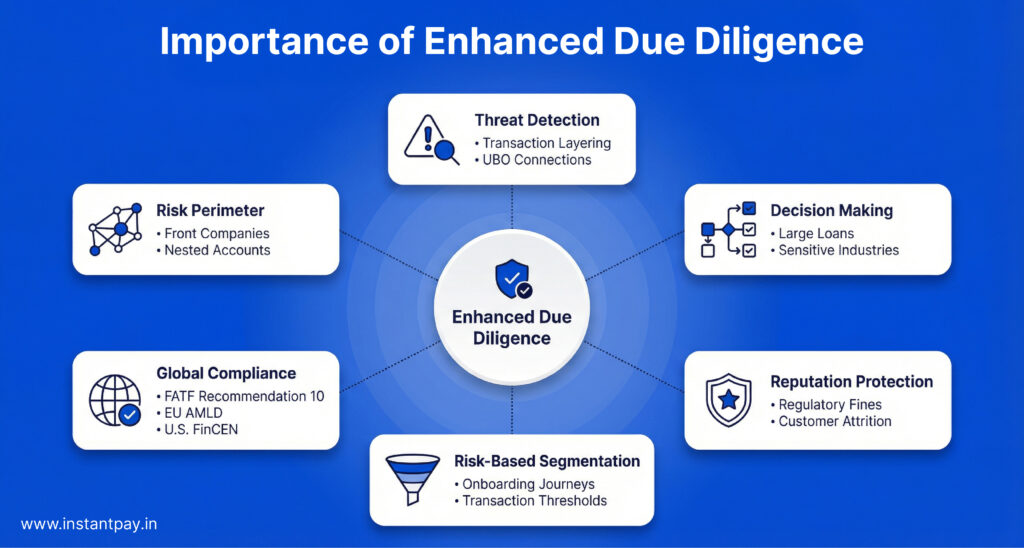
Advanced due diligence is not just a compliance checkbox; it’s a critical defense mechanism in an increasingly complex financial ecosystem. With the rapid globalization of financial services, the rise of digital assets, and the growing sophistication of financial crimes, institutions need more than surface-level verification.
1. Builds a Stronger Risk Perimeter
Basic verification often misses red flags like:
- Front companies or proxy entities
- Nested accounts across jurisdictions
- Inconsistent cash or crypto fund flows
Layered checks uncover subtle behaviors that traditional processes overlook, allowing institutions to detect threats through company search tools and act before a threat escalates.
2. Protects Institutional Integrity and Public Trust
For banks and financial entities, reputation is everything. One association with a money laundering scandal or sanctions breach can result in:
- Regulatory penalties in the millions
- Customer churn
- Long-term reputational damage
By implementing layered checks, institutions show commitment to transparency, accountability, and ethical business, fostering long-term trust among clients, investors, and regulators.
3. Strengthens Global Compliance Posture
Deep risk review ensures alignment with evolving international compliance standards, including:
- FATF Recommendation 10, which mandates enhanced measures for high-risk customers
- EU AML Directives, which now cover virtual assets and decentralized platforms
- U.S. FinCEN Rules, which call for deeper scrutiny of beneficial ownership and risk
With regulators imposing greater liability on non-compliance, layered check becomes a shield against enforcement actions and license suspensions.
4. Supports Accurate Risk-Based Segmentation
Advanced screening allows institutions to move beyond blanket policies and adopt precision-based risk models. This segmentation helps in:
- Tailoring transaction limits
- Customizing onboarding flows
- Deciding on the frequency of monitoring
- Prioritizing internal resources efficiently
It ensures that compliance isn’t just strict—it’s also smart and scalable.
5. Enables Proactive Detection of Emerging Threats
Advanced tools equip organizations to:
- Flag suspicious transaction layering techniques
- Detect politically sensitive connections through UBO networks
- Uncover foreign or anonymous donations in NGOs
- Intervene before transactions escalate to full-blown criminal investigations
With financial crimes constantly evolving, such as through crypto mixers, synthetic identities, or cross-border trade manipulation, it is often the first and only line of proactive defense.
6. Empowers Decision-Making with Context
Standard KYC data tells you who the customer is; precision-based reviews tell you why they’re acting the way they are. This deeper context is crucial for:
- Approving high-value loans or partnerships
- Evaluating the onboarding of politically sensitive clients
- Granting access to investment platforms, remittances, or international accounts
When decisions involve risk, advance screening ensures those decisions are informed, documented, and justifiable.
What Triggers an Advanced Due Diligence Review?
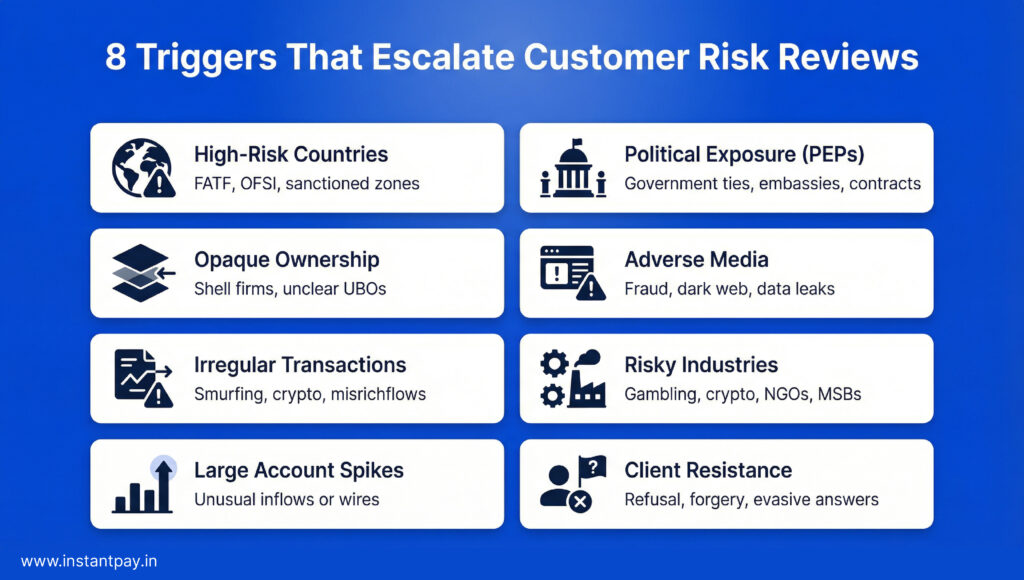
Heightened due diligence isn’t applied randomly—it’s activated through clear, risk-responsive triggers. Banks, fintechs, insurers, and regulated entities use defined checkpoints to decide when a client or transaction should be escalated beyond standard KYC.
These triggers fall into categories like regulatory exposure, unusual behavior, geographic risks, or structural opacity—each flagging potential for financial crime, fraud, or reputational harm.
What triggers enhanced verification in finance?
Trigger points include links to high-risk countries, politically exposed roles, unusual transactions, shell structures, or adverse media. Risk scoring tools help detect these early and apply deeper scrutiny.
1. High-Risk Geographies
Clients residing in or transacting with jurisdictions known for inadequate AML/CFT controls, secrecy laws, or ongoing sanctions are prime candidates. Countries identified by:
- FATF grey or blacklists
- OFSI/UN sanctions
- EU/US embargo zones
automatically increase scrutiny. Even a single transaction routed through such a location may prompt enhanced checks.
2. Politically Exposed Persons (PEPs)
Being a Politically Exposed Person (PEP) doesn’t inherently mean illegal behavior, but it does indicate a higher potential for corruption, bribery, or influence-based transactions. Triggers include:
- Holding (or recently holding) senior political positions
- Immediate family members or close associates of PEPs
- Transactions involving embassies, government contracts, or diplomatic funds
These profiles require ongoing monitoring and periodic reassessment, as political exposure can evolve over time.
3. Complex or Opaque Corporate Structures
EDD is triggered when:
- The Ultimate Beneficial Owner (UBO) cannot be clearly identified
- The company is layered across multiple jurisdictions or shell entities
- There is lack of transparency in directorship, ownership, or source of capital
This is especially important in sectors prone to financial manipulation—like offshore finance, commodities, and high-value real estate.
4. Unusual Transaction Behavior
Certain patterns raise behavioural red flags, such as:
- Structuring (smurfing): breaking large amounts into smaller, frequent transactions
- Rapid movement of funds across borders
- Use of cash-intensive channels despite having digital alternatives
- Transactions that don’t align with a client’s profile or declared income
Modern AML tools use machine learning to detect these inconsistencies in real-time, automatically escalating the customer’s risk profile.
5. Adverse Media or Negative Reputation Signals
Enhanced checks may be triggered even before onboarding if open-source intelligence (OSINT) surfaces:
- News reports of fraud, financial mismanagement, or litigation
- Negative reviews from other institutions or regulatory bodies
- Links to dark web activity or compromised data leaks
Adverse media screening is now part of standard AML workflows, and even unconfirmed associations may prompt an unconfirmed reputational risk review.
6. Industry or Sector Risk
Some industries inherently carry more AML risk and are automatically subject to enhanced scrutiny. These include:
- Casinos, gambling, and betting operations
- Money service businesses (MSBs)
- Precious metals and art dealers
- Private security firms, NGOs receiving foreign funds, and crypto exchanges
Even if customers in these sectors pass basic KYC checks, the sector risk alone can warrant advanced scrutiny.
7. Large or Irregular Account Activity
High-value deposits, unexpected inflows, or new account behavior like:
- Sudden international wire transfers
- Spikes in cryptocurrency wallet transactions
- Unexplained inbound or outbound payments
can raise red flags, especially when occurring in inactive or newly created accounts.
8. Client Resistance or Inconsistency
Sometimes, the customer’s behavior during onboarding or ongoing relationship management can itself act as a trigger:
- Refusing to provide documentation
- Providing inconsistent answers or forged records
- Evading questions about business activity or fund origin
Such signs often result in manual escalation or account review.
A Risk-Responsive Approach
Institutions don’t rely on a single trigger—they build risk-scoring models that weigh multiple factors to determine when a deeper level of scrutiny is necessary. These models combine:
- Regulatory red flags
- Transactional anomalies
- Profile irregularities
- Real-time intelligence feeds
This ensures that enhanced review is applied consistently and objectively, not reactively or arbitrarily.

Some objective parameters that trigger enhanced due diligence include:
- Transaction volumes exceeding thresholds
- Involvement in cash-heavy businesses
- Unusual changes in behavior or sudden wealth
- Use of offshore accounts or shell companies
- Inconsistent identity or documentation
What Is the Difference Between CDD and EDD?
| Factor | CDD (Customer Due Diligence) | EDD (Enhanced Due Diligence) |
| Risk level | Low to medium | High risk |
| Documentation | Basic KYC documents | In-depth documents including source of funds |
| Monitoring | Periodic | Continuous, real-time if needed |
| Trigger | New customer onboarding | PEPs, adverse media, high-risk regions |
| Complexity | Standardized | Case-by-case, tailored approach |
How the Enhanced Due Diligence Process Works?

While the actual workflow may vary across institutions, industries, and countries, the advanced customer verification process always follows a structured, risk-sensitive framework.
The goal is not just to verify, but to build a complete narrative around who the client is, what they do, and whether their financial behavior aligns with declared risk.
How does the Enhanced Due Diligence process work?
It starts with risk flagging and expands into multi-layer identity checks, source of wealth verification, reputational review, ongoing monitoring, and audit documentation. Each step builds a clearer risk profile for high-risk customers.
1. Risk Classification and Trigger Identification
The process typically begins before or during onboarding when a customer is identified as high-risk through a risk scoring model. This model incorporates:
- Geopolitical risk factors
- Nature of business or occupation
- Transaction behavior
- Source and destination of funds
- Known exposure to financial crime typologies (e.g., trade-based money laundering, hawala)
The goal is to flag high-risk profiles early in the customer lifecycle, so deeper scrutiny can begin before onboarding is finalized.
2. Customized Information Requests
Once a trigger is identified, the institution requests additional documentation or declarations tailored to the specific risk. These may include:
- Declaration of Source of Funds/Wealth
- Detailed business model documentation
- Tax filings and audited financial statements
- Organizational charts and UBO disclosures
- Explanation of international transactions or fund flows
Unlike standard KYC, which uses fixed forms, these inquiries are adaptive, often requiring back-and-forth correspondence.
3. Multi-Layered Identity Verification
Deep ID checks involve verifying the individual’s or entity’s identity across multiple authoritative sources:
- Government registries and databases
- Sanctions and watchlists (UN, OFAC, EU)
- Credit bureau or financial history checks
- Video KYC or biometric authentication
- Cross-border ID validation tools
This step helps detect synthetic identities, document forgeries, or identity fraud—common tactics in financial crime.
4. Source of Wealth and Funds Validation
A key part of enhanced verification involves assessing how the customer acquired their wealth and whether their financial activity aligns with that narrative. Validation techniques may include:
- Reviewing inheritance documents, sale deeds, or investment contracts
- Tracing fund flows across intermediary accounts
- Verifying salary slips, business invoices, or royalty agreements
- Comparing customer behavior with peers in similar economic tiers or industries
In some cases, third-party investigators or financial intelligence units (FIUs) are involved to corroborate the financial trail.
5. Beneficial Ownership Mapping (For Businesses or Entities)
For companies or trusts, identifying the Ultimate Beneficial Owner (UBO) is critical. This involves:
- Mapping ownership chains across jurisdictions
- Validating shareholder or trustee identities
- Checking for nominee directors or offshore shell involvement
- Identifying indirect control, voting rights, or familial ties
This prevents criminals from hiding behind legal structures or proxies to launder money or evade sanctions.
6. Adverse Media and Reputational Review
Using AI-powered screening tools, institutions perform extensive negative news checks to surface:
- Criminal charges or investigations
- Allegations of fraud, bribery, or tax evasion
- Regulatory penalties or license suspensions
- Public scandals or litigation involving the customer
7. Transaction Pattern Analysis and Monitoring Setup
Once the client is onboarded, deeper due diligence continues through ongoing transaction monitoring. The system watches for:
- High-risk transaction types (e.g., round-tripping, funnel accounts)
- Behavioral anomalies or sudden account changes
- Changes in business structure or fund sources
- Peer benchmarking analysis
Alerts are escalated via case management systems to compliance officers who decide whether to:
- Request clarification
- File a Suspicious Transaction Report (STR)
- Freeze or close the account
8. Periodic Review and Risk Re-Evaluation
This process isn’t a one-time event—high-risk clients are subject to periodic reviews, driven by internal policy and evolving risk indicators:
- Every 6 months to 1 year (depending on category)
- After large financial events (e.g., mergers, new investors, legal judgments)
- When new sanctions or legal changes affect their risk profile
This ensures that the institution’s understanding of the customer remains accurate and current.
9. Documentation and Audit Trail Creation
Every step—from data collection to decision-making—is documented:
- Interview transcripts or call logs
- Internal notes and risk assessment reports
- Copies of submitted documents and sources
- Decision history and rationale
This is crucial for internal audits and demonstrating compliance to regulators during inspections or inquiries.
Summary: From Data to Intelligence
The EDD process is designed not just to gather data, but to convert it into meaningful insight about who your customers are and what risks they bring. It combines technology, analytics, and human judgment to help organizations:
- Mitigate exposure to financial crimes
- Comply with global AML/KYC mandates
- Operate with confidence in high-risk markets
When executed effectively, EDD transforms compliance from a cost center into a strategic advantage.
Real-Life Examples of EDD in Action
High-risk customer checks aren’t theoretical—they’re applied every day across banking, crypto, real estate, fintech, and NGOs. Institutions go beyond routine compliance to prevent money laundering, terror financing, synthetic fraud, and reputational loss.
Here are detailed, practical examples of how EDD is implemented when high-risk indicators surface:
1. Cross-Border Shell Corporation in Trade Finance
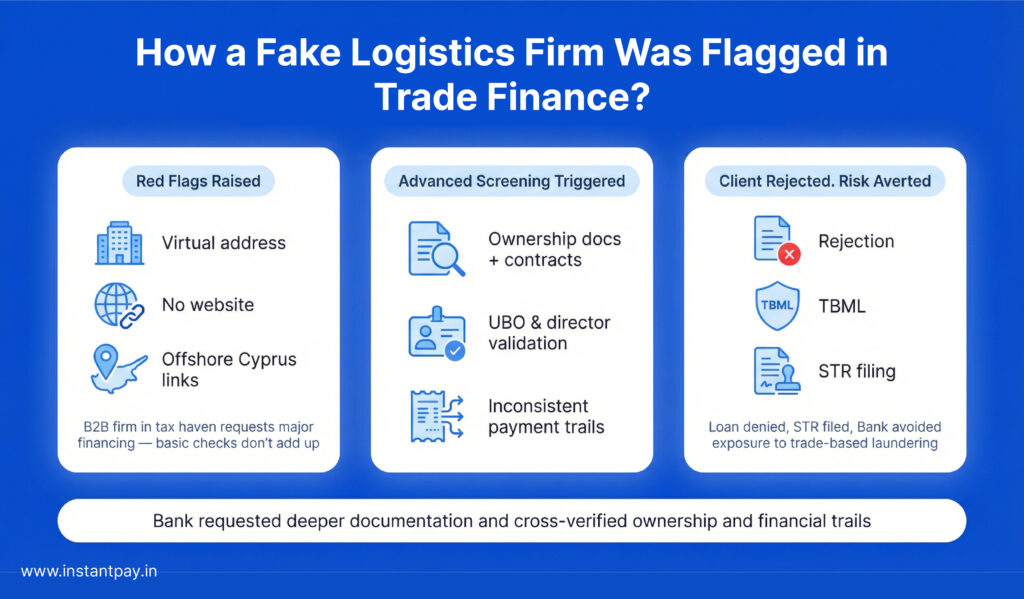
A bank receives a large financing request from a B2B logistics firm registered in a low-tax jurisdiction. Though the company claims to be a supply chain consultant, initial checks show:
- A virtual office address
- No operational website
- Complex ownership links to another entity based in Cyprus
Action Taken:
- Requested detailed documentation on company ownership and business contracts
- Verified identity and control of all directors and UBOs
- Flagged inconsistencies in invoices and payment trails
- Ultimately rejected the client and filed a Suspicious Transaction Report (STR)
Outcome: Prevented potential use of the bank for trade-based money laundering (TBML).
Bank Account Verification for businesses is increasingly used to prevent layering and proxy account misuse in high-value real estate transactions.
2. Crypto Exchange Onboarding a High-Volume User
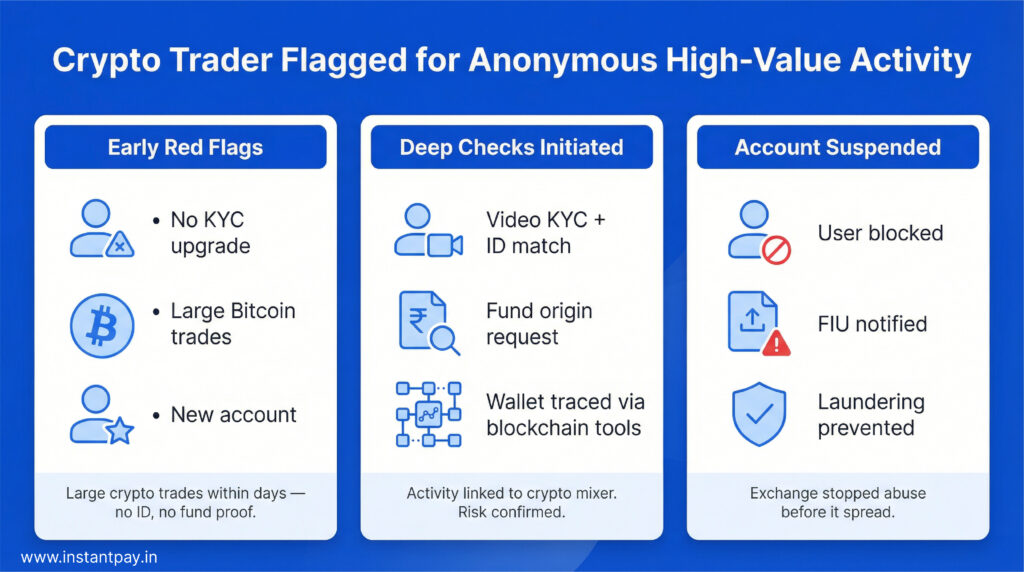
A cryptocurrency exchange notices a newly onboarded user executing high-value Bitcoin trades within days of account activation—without KYC upgrade or fund origin declaration.
Action Taken:
- Triggered enhanced verification: ID, selfie match, and video KYC
- Requested source-of-funds declaration and proof of income
- Conducted wallet address tracing via blockchain analytics tools
- Detected mixing service involvement (obfuscation of origin)
Outcome: The account was suspended; exchange notified the local FIU, preventing misuse for anonymous laundering.
3. Real Estate Investment by Foreign National
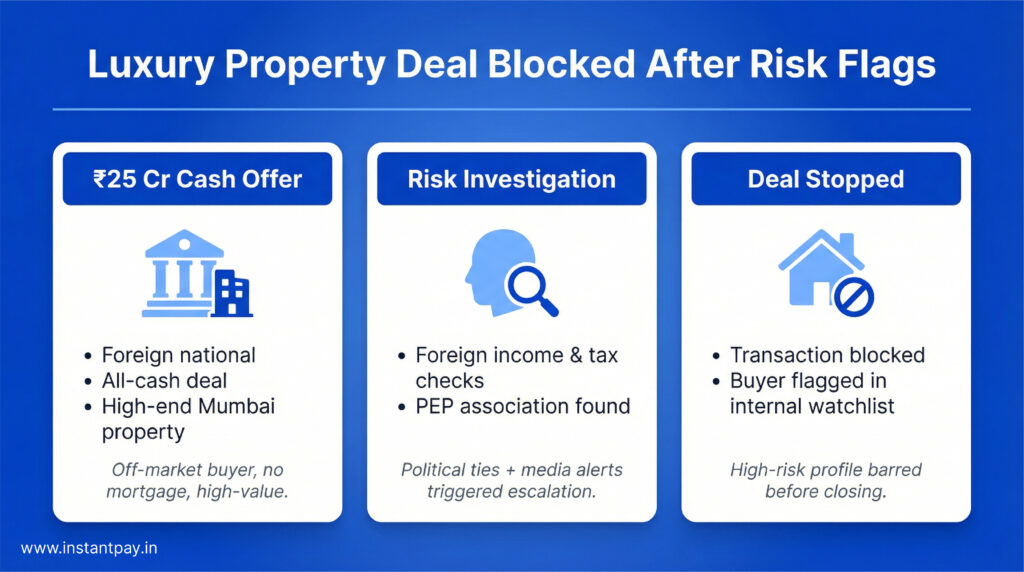
A luxury real estate agency in Mumbai receives interest from a foreign national looking to purchase a Rs.25 crore residential property—fully in cash.
Action Taken:
- Verified legitimacy of declared foreign income
- Asked for foreign tax returns and property registration details in the home country
- Identified client as a politically exposed associate in the Middle East
- Ran global adverse media checks and discovered involvement in procurement corruption
Outcome: Transaction blocked, and buyer flagged in the internal high-risk database.
4. NGO Receiving Large Foreign Donations
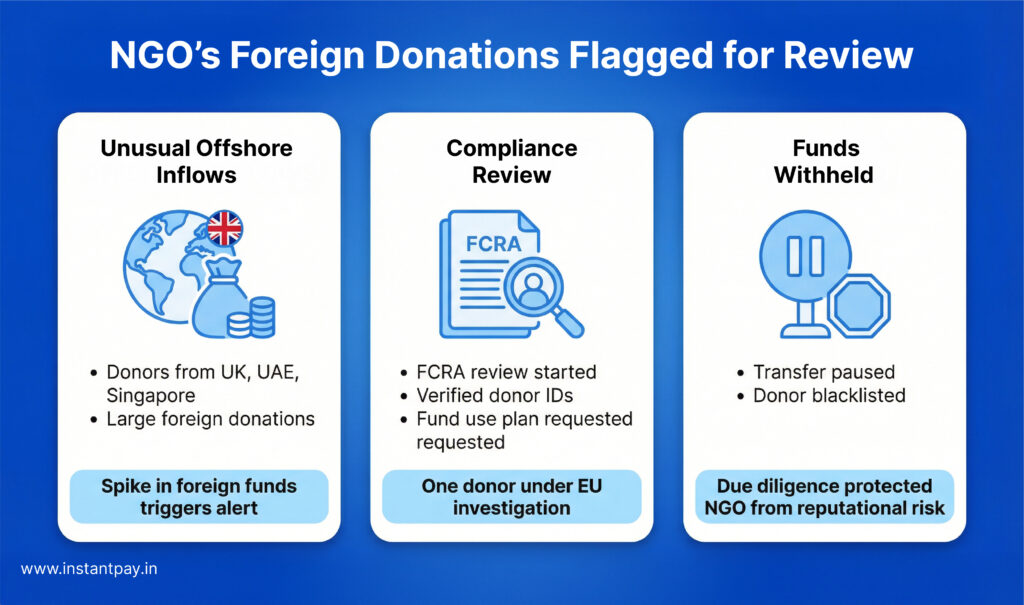
A medium-sized NGO receives multiple donations from offshore entities linked to the UK, Singapore, and the UAE. Donation amounts exceed historical benchmarks.
Action Taken:
- Triggered a compliance review under FCRA (Foreign Contribution Regulation Act)
- Verified identity and corporate nature of overseas donors
- Requested explanation for donor intent and mapped fund utilization plan
- Identified one entity under EU regulatory investigation
Outcome: Funds were held back until due diligence clearance; one donor was blacklisted for future interactions.
5. Private Wealth Account with Irregular Cash Activity
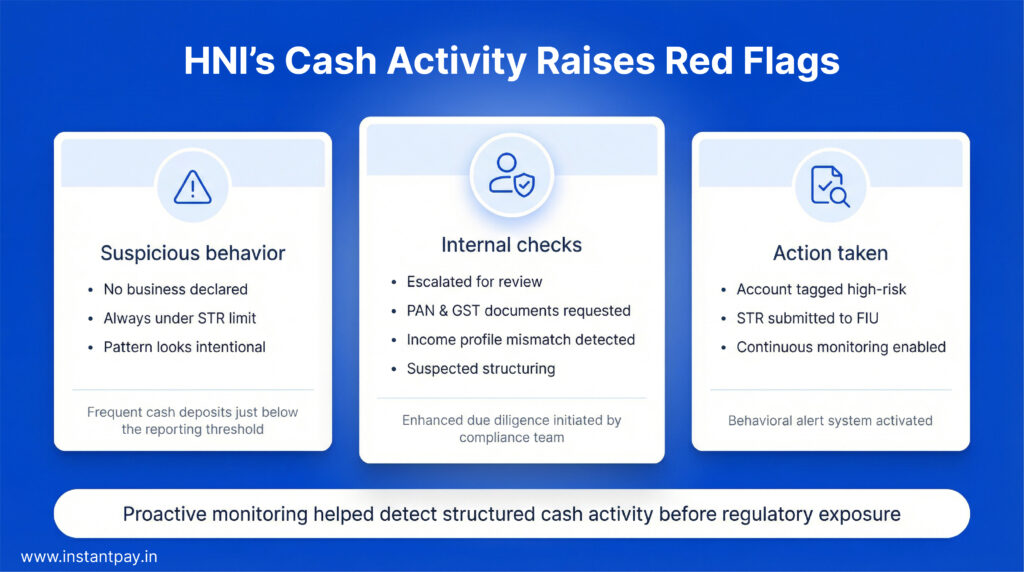
A high-net-worth individual (HNI) banking client frequently deposits Rs.9.5 lakh in cash—just under the Rs.10 lakh threshold for STR filing. Despite high cash deposits, the HNI provided no employment details or UAN records to justify income source.
Action Taken:
- Relationship manager flags the behavior for compliance escalation
- Enhanced profiling reveals no declared business that justifies cash income
- Requested PAN-linked business tax records and GST filings
- Pattern indicates structuring/smurfing to avoid automated detection
Outcome: STR filed with regulators, account flagged internally, and closer monitoring enabled through behavioral alerts.
6. Fintech Lending App Detecting Synthetic Identity

A digital lending startup using e-KYC receives an application from a salaried user with excellent credit history. However, data shows:
- No digital footprint (no social media, low phone activity)
- Aadhar submitted via PDF upload—not live validation, no secondary ID like driving license was verified
- IP address traced to multiple locations within a day
Action Taken:
- Conducted manual review of uploaded documents and initiated live video KYC
- Ran applicant’s name through fraud consortium database
- Found linkage with multiple fraudulent applications across platforms
Outcome: Loan was declined, and identity shared with fraud prevention networks.
Why These Examples Matter
These case studies demonstrate how deeper due diligence empowers organizations to:
- Dig deeper when red flags appear
- Apply contextual judgment, not just automated checks
- Protect themselves from legal, financial, and reputational fallout
Enhanced risk review isn’t about volume—it’s about precision, relevance, and timing. In every case, the institution was able to make smarter decisions by going beyond standard due diligence.
Simplified Due Diligence vs Enhanced Due Diligence (Table)
| Factor | Simplified Due Diligence (SDD) | Enhanced Due Diligence (EDD) |
| Risk Profile | Low | High |
| Application | Government bodies, salary accounts | Crypto, PEPs, cross-border trade |
| Regulatory Scrutiny | Minimal | High |
Final Thoughts
Enhanced Due Diligence (EDD) is far more than a regulatory formality—it’s a strategic risk management tool that empowers institutions to make informed, responsible, and compliant decisions in an increasingly complex financial world.
In an era of fast-moving capital, borderless transactions, and evolving criminal techniques, the limitations of basic Customer Due Diligence (CDD) are clear. This heightened due diligence fills that gap by offering a deeper, data-rich, and context-driven approach to understanding customer intent, financial behavior, and potential risk exposure.
Whether it’s uncovering shell corporations, flagging suspicious crypto activity, vetting foreign donors, or preventing politically exposed clients from slipping through the cracks, this layer of scrutiny plays a critical role in ensuring businesses operate ethically, legally, and securely.
Here’s what advanced due diligence allows institutions to achieve:
- Apply risk-based decision-making instead of one-size-fits-all compliance
- Detect and mitigate exposure to money laundering, fraud, and reputational risks
- Maintain a strong global compliance posture across jurisdictions
- Build long-term trust with regulators, investors, and customers
- Transform compliance from a cost burden into a competitive advantage
In short, deeper risk assessment isn’t just about who your customers are—it’s about why they matter, how they behave, and what they expose you to.
As digital ecosystems expand and real-time risk expectations grow, organizations that treat advanced customer vetting as a core capability—not an afterthought—will be best positioned to thrive in a high-stakes, high-scrutiny landscape.
FAQs: Understanding Enhanced Due Diligence (EDD)
1. What is the full form of EDD in banking?
EDD stands for Enhanced Due Diligence, a deeper verification process used by banks and financial institutions for high-risk customers or transactions.
2. When is Enhanced Due Diligence (EDD) required?
EDD is required when a customer or transaction presents a higher risk, such as dealing with politically exposed persons (PEPs), large cross-border transfers, complex ownership structures, or activity involving high-risk countries.
3. What is the difference between CDD and EDD?
Customer Due Diligence (CDD) is the standard verification process for most customers, while EDD involves more comprehensive checks like source of funds, UBO mapping, and continuous monitoring for high-risk clients.
4. What kind of documents are collected during EDD?
EDD may require:
- Source of funds/wealth declaration
- Tax filings or audited financials
- Proof of address and identity
- Beneficial ownership documents
- Business model explanation or contracts
5. What is the objective of Enhanced Due Diligence?
The primary objective of EDD is to deeply assess the customer’s financial background and risk exposure to prevent money laundering, fraud, terror financing, and to comply with regulatory standards.
6. How does EDD help in risk management?
EDD allows institutions to identify hidden threats, build customized risk profiles, and monitor high-risk accounts more effectively—ensuring safer operations and regulatory compliance.
7. Is EDD only used in banking?
No. EDD is widely used in sectors like:
- Fintech and digital lending
- Cryptocurrency exchanges
- Real estate
- NGOs receiving foreign funds
- Legal and financial advisory services
8. What happens if a customer refuses EDD checks?
If a customer fails to provide the required information for EDD, institutions may deny account opening, suspend existing accounts, or report the case to the relevant financial intelligence unit (FIU).
9. How often is EDD reviewed or updated?
High-risk customers are reviewed periodically—typically every 6 to 12 months—depending on institutional policy and changes in customer activity or risk exposure.
10. What tools or systems are used during EDD?
Institutions use a combination of:
- AML screening software
- Biometric and video KYC tools
- Blockchain analytics (for crypto)
- Adverse media scanning
- Global sanctions and PEP databases